NAME: Lorena Pruna
CARRIER: Lingüística in English
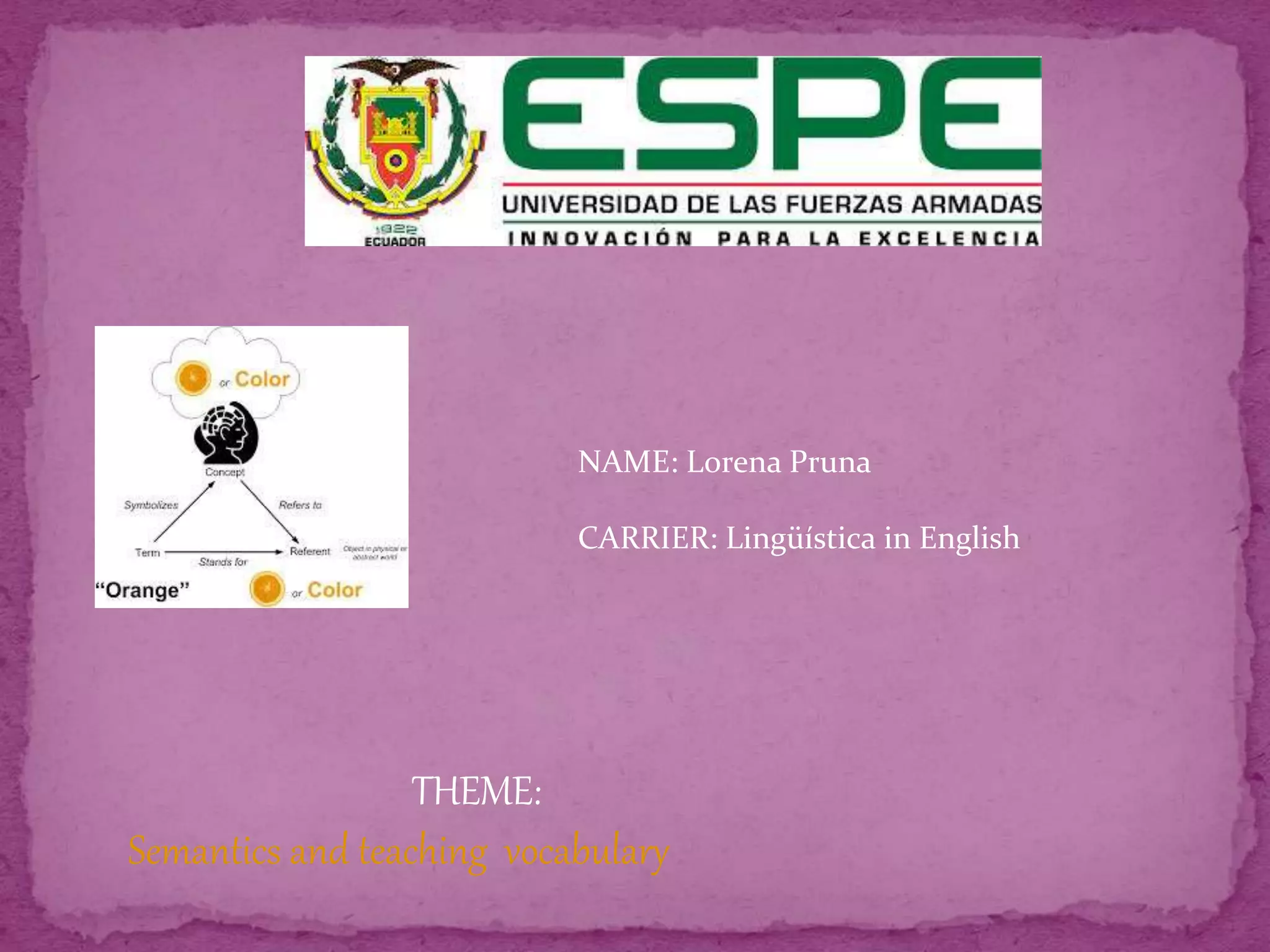
THEME:
Semantics and teaching vocabulary
Vocabulary teaching is an important and difficult part of
language acquisition and teaching, The appearance of
different semantic theories has helped people to know the
words better than ever before and thus are put forward to
the words acquisition and learning.
It can be suggested that semantic mapping can
be used as an efficient methodology for teaching
vocabulary, a technique which is effective for
learners.
INTRODUCTION
A LARGE BODY OF LITERATURE ON VOCABULARY
Lexical knowledge is represented
in the learner's mind, what is
involved in the form-meaning
mapping process, and what
stages a word goes through before
it becomes an integrated part of the
learner's lexicon.
Today that vocabulary acquisition is at
least as important as syntax
acquisition
A MODEL OF ADULT L2 VOCABULARY ACQUISITION
three-stage model of adult vocabulary acquisition
lexical association stage,
adult learners recognize an
orthographic or phonological
form, or both, as a word.
They understand the word's
meaning within an existing
semantic structure.
Stage One Word Association Stage
from a processing perspective, this stage may be called L1
lemma mediation stage. From a representational
perspective, this stage may be called the hybrid-entry stage
because a L2 entry at this stage contains a combination of
L2 form information and L1 meaning and syntax
information.
STAGE TWO L1 LEMMA MEDIATION STAGE
When lexical knowledge specific to a
L2 word is integrated in its entry and L1
information is discarded. As a result, a
L2 word can be used with not only
more automaticity, but also more
idiomaticity, with little influence from its
L1 translation.
Stage Three Full Integration Stage
One of the issues that has
received the most attention is
how the two languages of a
bilingual speaker are connected
to each other and to conceptual
representations.
The linguistic usage of
advanced second-language
learners is influenced by their
mother tongue in a much more
subtle fashion than the
frequency of erroneous usages
clearly traceable to their native
language.
THE SEMANTIC TRANSFER
HYPOTHESIS
According to the semantic transfer
hypothesis, the semantic content
residing in L2 words is transferred
from their LI translations.
It is easier to identify a shared
semantic element in a same-
translation pair than in a
different-translation pair due to
their greater semantic overlap.
STUDY PURPOSES
* it was intended to extend the author's findings (Jiang, 2002)
* provide confirmation for the same-translation effect by using a
design
* to explore the pedagogical implications of the findings.
If semantic transfer is a
steady state of semantic
representation in L2
learners, it has clear
implications for teaching
vocabulary
in a L2.
To investigate the effect of
semantic mapping as an
instructional strategy for
teaching vocabulary.
* Thus, the participants' reaction time in semantic judgment
offers a reliable and objective indication of
the degree of semantic overlap between two words.
* A person's reaction time in making a semantic judgment is
affected by the degree of semantic overlap between two
words.
METHOD
Participants: The participants
in the study included 15
Korean- English bilinguals, 5
females and 10 males, and
15 English native speakers.
Materials: A randomized list of
these 260 English words was
then given to three Korean-
English bilingual speakers who
were asked to provide the first
Korean translation that came to
mind for each English word.
LEXICAL COMPETENCAEN D SEMANTIC AUTONOMY
Lexical competence has hence
become a multidimensional
construct rather than a
monolithic concept.
Autonomy is important because
idiomatic, accurate, and fluent
expression of one's ideas in another
language cannot be achieved until
one has developed a semantic
system.
Thus, semantic autonomy should be
considered in defining and
measuring lexical competence.
LI AS A MEANS OF SEMANTIZATION
Is related to the use of the
L1 as a means of helping
learners understand the
meaning of new words,
or semantization.
A wide range of semantization strategies:
Strategies intralingual: involve the use of
linguistic means of the target language
such as synonyms, definitions, or linguistic
Contexts
Estrategies interlingüística: Utilize
the LI in the form of a bilingual dictionary,
cognates, or L1 translation equivalents,
often associated with word lists.
Estrategies extralingüística: Make use
of pictures, objects, physical contexts, and
other multimedia aids.
OVERCOMING SEMANTIC FOSSILIZATION
L2 learners can benefit tremendously
from a variety of vocabulary instruction
techniques that help draw their attention
to the semantic differences between a L2
word and its LI translation and between
two L2 words.
The issue of how to help learners
overcome the continued L1 semantic
involvement and facilitate the
transition from the second to the third
stage of vocabulary acquisition.
CONCLUSION
* Vocabulary is a complicated process which
requires careful planning by teachers and active participation by
students. Learners need tasks
and strategies to help them organize their mental lexicon
* Vocabulary should be given a high priority in
teaching English as a foreign language since it is the corner stone
of communication.
* Vocabulary should be taught in contexts and integrated with the
other language skills. Teaching vocabulary in isolation or via
wordlists is fruitless.

Semantics.lorena.pruna.tapia.learning activity 2.1

  • 1.
    NAME: Lorena Pruna CARRIER:Lingüística in English THEME: Semantics and teaching vocabulary
  • 2.
    Vocabulary teaching isan important and difficult part of language acquisition and teaching, The appearance of different semantic theories has helped people to know the words better than ever before and thus are put forward to the words acquisition and learning. It can be suggested that semantic mapping can be used as an efficient methodology for teaching vocabulary, a technique which is effective for learners. INTRODUCTION
  • 3.
    A LARGE BODYOF LITERATURE ON VOCABULARY Lexical knowledge is represented in the learner's mind, what is involved in the form-meaning mapping process, and what stages a word goes through before it becomes an integrated part of the learner's lexicon. Today that vocabulary acquisition is at least as important as syntax acquisition
  • 4.
    A MODEL OFADULT L2 VOCABULARY ACQUISITION three-stage model of adult vocabulary acquisition lexical association stage, adult learners recognize an orthographic or phonological form, or both, as a word. They understand the word's meaning within an existing semantic structure. Stage One Word Association Stage
  • 5.
    from a processingperspective, this stage may be called L1 lemma mediation stage. From a representational perspective, this stage may be called the hybrid-entry stage because a L2 entry at this stage contains a combination of L2 form information and L1 meaning and syntax information. STAGE TWO L1 LEMMA MEDIATION STAGE
  • 6.
    When lexical knowledgespecific to a L2 word is integrated in its entry and L1 information is discarded. As a result, a L2 word can be used with not only more automaticity, but also more idiomaticity, with little influence from its L1 translation. Stage Three Full Integration Stage
  • 7.
    One of theissues that has received the most attention is how the two languages of a bilingual speaker are connected to each other and to conceptual representations. The linguistic usage of advanced second-language learners is influenced by their mother tongue in a much more subtle fashion than the frequency of erroneous usages clearly traceable to their native language.
  • 8.
    THE SEMANTIC TRANSFER HYPOTHESIS Accordingto the semantic transfer hypothesis, the semantic content residing in L2 words is transferred from their LI translations. It is easier to identify a shared semantic element in a same- translation pair than in a different-translation pair due to their greater semantic overlap.
  • 9.
    STUDY PURPOSES * itwas intended to extend the author's findings (Jiang, 2002) * provide confirmation for the same-translation effect by using a design * to explore the pedagogical implications of the findings. If semantic transfer is a steady state of semantic representation in L2 learners, it has clear implications for teaching vocabulary in a L2. To investigate the effect of semantic mapping as an instructional strategy for teaching vocabulary.
  • 10.
    * Thus, theparticipants' reaction time in semantic judgment offers a reliable and objective indication of the degree of semantic overlap between two words. * A person's reaction time in making a semantic judgment is affected by the degree of semantic overlap between two words. METHOD
  • 11.
    Participants: The participants inthe study included 15 Korean- English bilinguals, 5 females and 10 males, and 15 English native speakers. Materials: A randomized list of these 260 English words was then given to three Korean- English bilingual speakers who were asked to provide the first Korean translation that came to mind for each English word.
  • 12.
    LEXICAL COMPETENCAEN DSEMANTIC AUTONOMY Lexical competence has hence become a multidimensional construct rather than a monolithic concept. Autonomy is important because idiomatic, accurate, and fluent expression of one's ideas in another language cannot be achieved until one has developed a semantic system. Thus, semantic autonomy should be considered in defining and measuring lexical competence.
  • 13.
    LI AS AMEANS OF SEMANTIZATION Is related to the use of the L1 as a means of helping learners understand the meaning of new words, or semantization. A wide range of semantization strategies: Strategies intralingual: involve the use of linguistic means of the target language such as synonyms, definitions, or linguistic Contexts Estrategies interlingüística: Utilize the LI in the form of a bilingual dictionary, cognates, or L1 translation equivalents, often associated with word lists. Estrategies extralingüística: Make use of pictures, objects, physical contexts, and other multimedia aids.
  • 14.
    OVERCOMING SEMANTIC FOSSILIZATION L2learners can benefit tremendously from a variety of vocabulary instruction techniques that help draw their attention to the semantic differences between a L2 word and its LI translation and between two L2 words. The issue of how to help learners overcome the continued L1 semantic involvement and facilitate the transition from the second to the third stage of vocabulary acquisition.
  • 15.
    CONCLUSION * Vocabulary isa complicated process which requires careful planning by teachers and active participation by students. Learners need tasks and strategies to help them organize their mental lexicon * Vocabulary should be given a high priority in teaching English as a foreign language since it is the corner stone of communication. * Vocabulary should be taught in contexts and integrated with the other language skills. Teaching vocabulary in isolation or via wordlists is fruitless.