








Prepared by
Vaidehi Hariyani
Semester 3
Department of English,MKBU
SECOND LANGUAGE
ACQUISITION (SLA)
The process by which
people learn a Second
language in addition to their
Native language.
Second language plays an
institutional role in the
society.
INTRODUCTION
DIFFERENCE
Acquisition Learning
• Conscious process.
• Grammar, vocabulary
and rules are learnt in
controlled manner.
• It happens in schools,
colleges and so on.
• Activities and methods
are designed. Focus is
on grammar.
• Gradual development .
• It happens naturally.
• It happens through
interaction with the
ones who are native
speakers.
• Focus is on meaningful
communication not on
grammatical forms.
DIFFERENCE
Acquisition Learning
• Not the native
language
• Learned in
addition to Native
language
• Acquired language
• Ones native
language
• Learned in
childhood
• Mother language
LANGUAGE LEARNING
First Language Second Language
• Rules are similar
for L1 and L2
• L1 rules the
L2
CONTRASTIVE ANALYSIS
HYPOTHESIS
CA :- L2 learners will use L1 trends which
sometimes differs and error is generated
• Long (1981), Stephen
Krashen(1980)
• To focus on the process
how l2 can be acquired.
• The way we learn
language consciously is
different to
subconscious
acquisition. Both are
different mental
process.
• Dulay and Burt(1974)
• To determine whether
there is natural
sequence in the order
in which l2 learners
acquire the grammar of
the target language.
• Rejected the
hypotheses that l2
acquisition equals L1
acquisition.
RESEARCH
Product- oriented Process- oriented
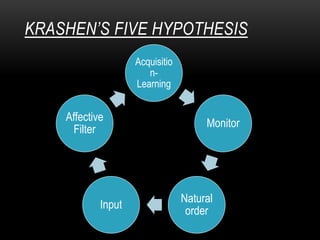
KRASHEN’S FIVE HYPOTHESIS
Acquisitio
n-
Learning
Monitor
Natural
order
Input
Affective
Filter
GENERALIZATIONS
• SLA includes an understanding, in general, of what
language is, what learning is and for classroom context,
what teaching is.
• Knowledge of children’s learning the first language
provides insights to understand SLA.
• There is tremendous variations among learners in
acquiring language.
• The way people view themselves in communiction will
affect the quantity and quality of second language
learning.
CLAIMS
1. Adults can acquire a second language easily…!
2. Practice does not make language perfect.
3. Knowing a language rule does not mean one will be
able to use it in an interaction.
4. One cannot achieve native like command in an hour.
5. Comprehension of text depends on learners ability to
understand language.
6. Learner already has a language available.
7. Atmosphere of the learner.
TRAJECTORY OF ANSWER
• Introduction :- What is SLA?
• Difference:- L1 and L2, Learning and Acquisition.
• Analysis:- Error analysis, contrastive analysis
• Research
• 5 hypothesis – Krashen
• Generalizations and claims
• Summarize
THANK YOU…..

Second Language Acquisition

  • 1.
    Prepared by Vaidehi Hariyani Semester3 Department of English,MKBU SECOND LANGUAGE ACQUISITION (SLA)
  • 2.
    The process bywhich people learn a Second language in addition to their Native language. Second language plays an institutional role in the society. INTRODUCTION
  • 3.
  • 4.
    • Conscious process. •Grammar, vocabulary and rules are learnt in controlled manner. • It happens in schools, colleges and so on. • Activities and methods are designed. Focus is on grammar. • Gradual development . • It happens naturally. • It happens through interaction with the ones who are native speakers. • Focus is on meaningful communication not on grammatical forms. DIFFERENCE Acquisition Learning
  • 5.
    • Not thenative language • Learned in addition to Native language • Acquired language • Ones native language • Learned in childhood • Mother language LANGUAGE LEARNING First Language Second Language
  • 6.
    • Rules aresimilar for L1 and L2 • L1 rules the L2 CONTRASTIVE ANALYSIS HYPOTHESIS CA :- L2 learners will use L1 trends which sometimes differs and error is generated
  • 7.
    • Long (1981),Stephen Krashen(1980) • To focus on the process how l2 can be acquired. • The way we learn language consciously is different to subconscious acquisition. Both are different mental process. • Dulay and Burt(1974) • To determine whether there is natural sequence in the order in which l2 learners acquire the grammar of the target language. • Rejected the hypotheses that l2 acquisition equals L1 acquisition. RESEARCH Product- oriented Process- oriented
  • 8.
  • 9.
    GENERALIZATIONS • SLA includesan understanding, in general, of what language is, what learning is and for classroom context, what teaching is. • Knowledge of children’s learning the first language provides insights to understand SLA. • There is tremendous variations among learners in acquiring language. • The way people view themselves in communiction will affect the quantity and quality of second language learning.
  • 10.
    CLAIMS 1. Adults canacquire a second language easily…! 2. Practice does not make language perfect. 3. Knowing a language rule does not mean one will be able to use it in an interaction. 4. One cannot achieve native like command in an hour. 5. Comprehension of text depends on learners ability to understand language. 6. Learner already has a language available. 7. Atmosphere of the learner.
  • 11.
    TRAJECTORY OF ANSWER •Introduction :- What is SLA? • Difference:- L1 and L2, Learning and Acquisition. • Analysis:- Error analysis, contrastive analysis • Research • 5 hypothesis – Krashen • Generalizations and claims • Summarize
  • 12.