Semantic Role Labeling
Natural Language Processin
g

Emory University


Jinho D. Choi
Predicate Identi
fi
cation
2
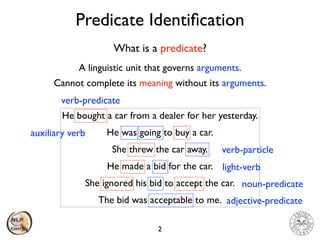
What is a predicate?
A linguistic unit that governs arguments.
Cannot complete its meaning without its arguments.
He bought a car from a dealer for her yesterday
.

He was going to buy a car
.

She threw the car away
.

He made a bid for the car
.

She ignored his bid to accept the car
.

The bid was acceptable to me.
auxiliary verb
verb-particle
light-verb
noun-predicate
adjective-predicate
verb-predicate
Predicate Sense Disambiguation
3
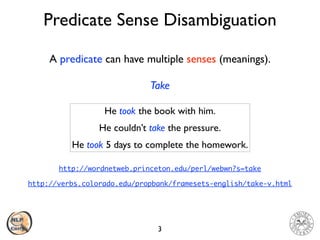
A predicate can have multiple senses (meanings).
Take
He took the book with him
.

He couldn’t take the pressure
.

He took 5 days to complete the homework.
http://verbs.colorado.edu/propbank/framesets-english/take-v.html
http://wordnetweb.princeton.edu/perl/webwn?s=take
Argument Identi
fi
cation
4
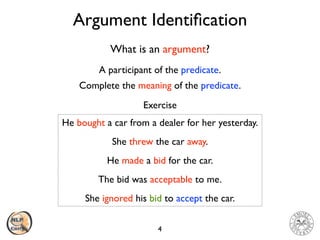
What is an argument?
A participant of the predicate.
Complete the meaning of the predicate.
She threw the car away.
He made a bid for the car.
She ignored his bid to accept the car.
The bid was acceptable to me.
He bought a car from a dealer for her yesterday.
Exercise
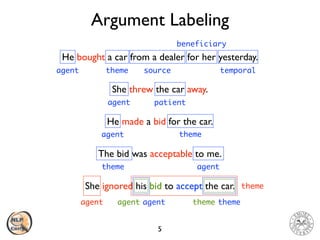
Argument Labeling
5
She threw the car away.
He made a bid for the car.
She ignored his bid to accept the car.
The bid was acceptable to me.
agent theme
He bought a car from a dealer for her yesterday.
agent theme source
beneficiary
temporal
agent patient
theme agent
agent theme theme
agent
agent
theme
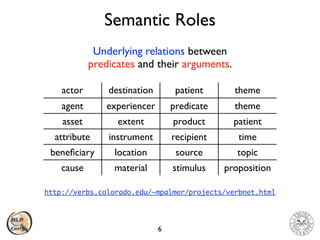
Semantic Roles
6
Underlying relations between


predicates and their arguments.
actor destination patient theme
agent experiencer predicate theme
asset extent product patient
attribute instrument recipient time
bene
fi
ciary location source topic
cause material stimulus proposition
http://verbs.colorado.edu/~mpalmer/projects/verbnet.html
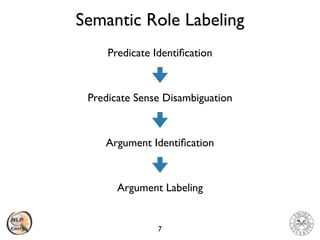
Semantic Role Labeling
7
Predicate Identi
fi
cation
Predicate Sense Disambiguation
Argument Identi
fi
cation
Argument Labeling
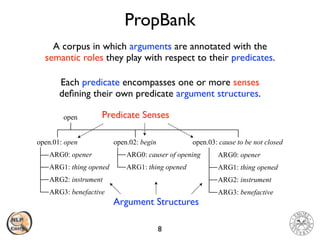
PropBank
8
A corpus in which arguments are annotated with the


semantic roles they play with respect to their predicates.
Each predicate encompasses one or more senses


de
fi
ning their own predicate argument structures.
open
open.01: open open.02: begin open.03: cause to be not closed
ARG0: opener
ARG1: thing opened
ARG2: instrument
ARG3: benefactive
ARG0: causer of opening
ARG1: thing opened
ARG0: opener
ARG1: thing opened
ARG2: instrument
ARG3: benefactive
Predicate Senses
Argument Structures
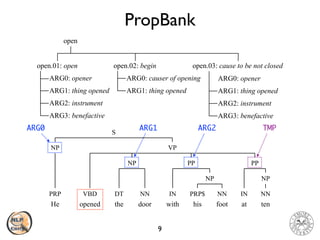
PropBank
9
open
open.01: open open.02: begin open.03: cause to be not closed
ARG0: opener
ARG1: thing opened
ARG2: instrument
ARG3: benefactive
ARG0: causer of opening
ARG1: thing opened
ARG0: opener
ARG1: thing opened
ARG2: instrument
ARG3: benefactive
ARG0 ARG1 ARG2 TMP
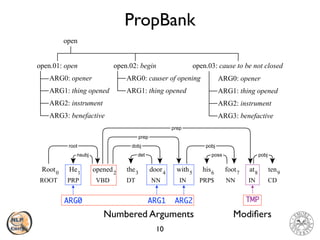
PropBank
10
open
open.01: open open.02: begin open.03: cause to be not closed
ARG0: opener
ARG1: thing opened
ARG2: instrument
ARG3: benefactive
ARG0: causer of opening
ARG1: thing opened
ARG0: opener
ARG1: thing opened
ARG2: instrument
ARG3: benefactive
ARG0 ARG1 ARG2 TMP
Numbered Arguments Modi
fi
ers
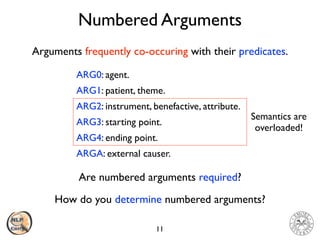
Numbered Arguments
11
Arguments frequently co-occuring with their predicates.
ARG0: agent
.

ARG1: patient, theme
.

ARG2: instrument, benefactive, attribute
.

ARG3: starting point
.

ARG4: ending point
.

ARGA: external causer.
Are numbered arguments required?
How do you determine numbered arguments?
Semantics are


overloaded!
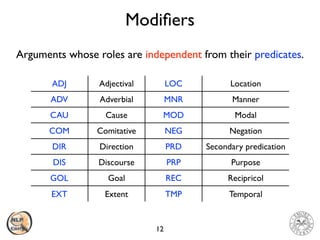
Modi
fi
ers
12
Arguments whose roles are independent from their predicates.
ADJ Adjectival LOC Location
ADV Adverbial MNR Manner
CAU Cause MOD Modal
COM Comitative NEG Negation
DIR Direction PRD Secondary predication
DIS Discourse PRP Purpose
GOL Goal REC Recipricol
EXT Extent TMP Temporal
Argument Candidates
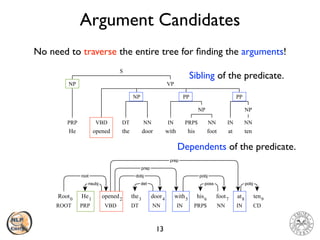
13
No need to traverse the entire tree for
fi
nding the arguments!
Sibling of the predicate.
Dependents of the predicate.
Argument Candidates
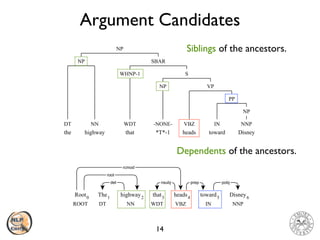
14
Siblings of the ancestors.
Dependents of the ancestors.
Argument Candidates
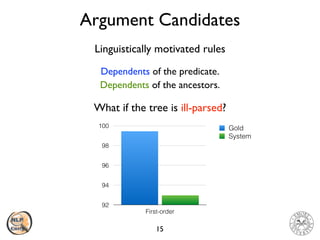
15
Linguistically motivated rules
Dependents of the predicate
.

Dependents of the ancestors.
What if the tree is ill-parsed?
92
94
96
98
100
First-order
Gold
System
Argument Candidates
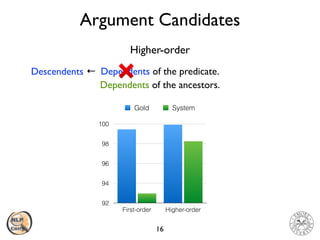
16
Higher-order
Dependents of the predicate
.

Dependents of the ancestors.
Descendents ←
92
94
96
98
100
First-order Higher-order
Gold System
Applications
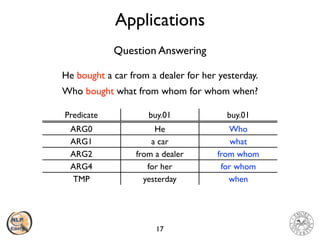
17
Question Answering
He bought a car from a dealer for her yesterday
.

Who bought what from whom for whom when?
ARG0 He Who
ARG1 a car what
ARG2 from a dealer from whom
ARG4 for her for whom
TMP yesterday when
Predicate buy.01 buy.01
Semantic Frames
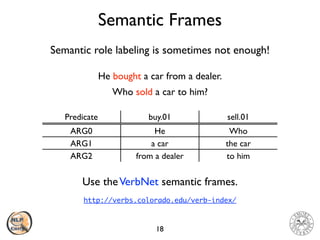
18
Semantic role labeling is sometimes not enough!
He bought a car from a dealer
.

Who sold a car to him?
ARG0 He Who
ARG1 a car the car
ARG2 from a dealer to him
Predicate buy.01 sell.01
Use theVerbNet semantic frames.
http://verbs.colorado.edu/verb-index/
VerbNet
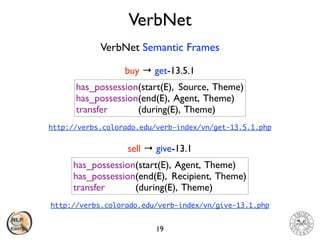
19
VerbNet Semantic Frames
has_possession(start(E), Source, Theme)


has_possession(end(E), Agent, Theme)


transfer (during(E), Theme)
buy → get-13.5.1
sell → give-13.1
has_possession(start(E), Agent, Theme)


has_possession(end(E), Recipient, Theme)


transfer (during(E), Theme)
http://verbs.colorado.edu/verb-index/vn/get-13.5.1.php
http://verbs.colorado.edu/verb-index/vn/give-13.1.php
VerbNet
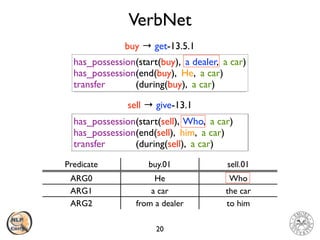
20
ARG0 He Who
ARG1 a car the car
ARG2 from a dealer to him
Predicate buy.01 sell.01
has_possession(start(E), Source, Theme)


has_possession(end(E), Agent, Theme)


transfer (during(E), Theme)
buy → get-13.5.1
sell → give-13.1
has_possession(start(E), Agent, Theme)


has_possession(end(E), Recipient, Theme)


transfer (during(E), Theme)
has_possession(start(buy), a dealer, a car)


has_possession(end(buy), He, a car)


transfer (during(buy), a car)
has_possession(start(sell), Who, a car)


has_possession(end(sell), him, a car)


transfer (during(sell), a car)
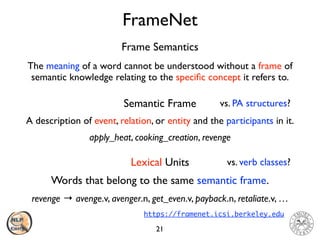
FrameNet
21
Frame Semantics
The meaning of a word cannot be understood without a frame of


semantic knowledge relating to the speci
fi
c concept it refers to.
Semantic Frame
A description of event, relation, or entity and the participants in it.
apply_heat, cooking_creation, revenge
Lexical Units
Words that belong to the same semantic frame.
revenge → avenge.v, avenger.n, get_even.v, payback.n, retaliate.v, …
vs. verb classes?
vs. PA structures?
https://framenet.icsi.berkeley.edu
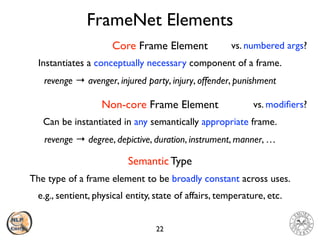
FrameNet Elements
22
Core Frame Element
revenge → avenger, injured party, injury, offender, punishment
Instantiates a conceptually necessary component of a frame.
Non-core Frame Element
Can be instantiated in any semantically appropriate frame.
revenge → degree, depictive, duration, instrument, manner, …
vs. numbered args?
vs. modi
fi
ers?
Semantic Type
The type of a frame element to be broadly constant across uses.
e.g., sentient, physical entity, state of affairs, temperature, etc.
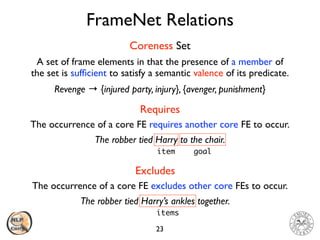
FrameNet Relations
23
Coreness Set
Revenge → {injured party, injury}, {avenger, punishment}
A set of frame elements in that the presence of a member of


the set is suf
fi
cient to satisfy a semantic valence of its predicate.
Requires
The occurrence of a core FE requires another core FE to occur.
The robber tied Harry to the chair.
Excludes
The occurrence of a core FE excludes other core FEs to occur.
The robber tied Harry’s ankles together.
item goal
items
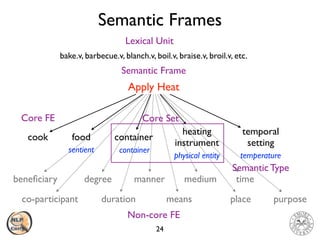
Semantic Frames
24
Apply Heat
cook container
food
heatin
g

instrument
tempora
l

setting
container
sentient
physical entity temperature
bene
fi
ciary
co-participant
degree
duration
manner
means place
medium
purpose
time
Semantic Frame
Core FE
Non-core FE
Semantic Type
Core Set
bake.v, barbecue.v, blanch.v, boil.v, braise.v, broil.v, etc.
Lexical Unit
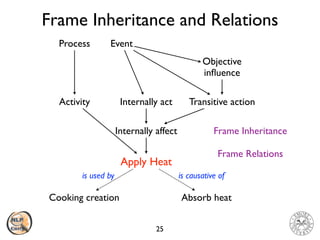
Frame Inheritance and Relations
25
Apply Heat
Activity
Process
Internally affect
Internally act Transitive action
Event
Objective


in
fl
uence
Cooking creation Absorb heat
is used by is causative of
Frame Inheritance
Frame Relations
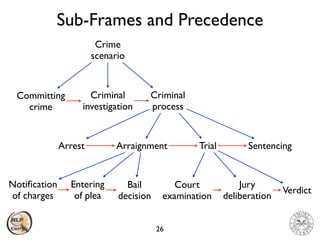
Sub-Frames and Precedence
26
Crime


scenario
Committing


crime
Criminal


investigation
Criminal


process
Arraignment
Arrest Sentencing
Trial
Bail


decision
Entering


of plea
Noti
fi
cation


of charges
Cour
t

examination
Jury


deliberation
Verdict
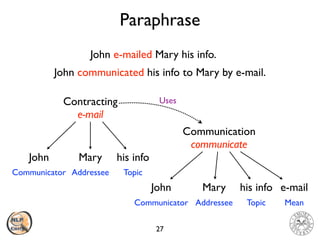
Paraphrase
27
John e-mailed Mary his info.
John communicated his info to Mary by e-mail.
Contractin
g

e-mail
John Mary his info
Communicatio
n

communicate
John his info
Mary e-mail
Communicator Addressee
Uses
Communicator Addressee Topic Mean
Topic
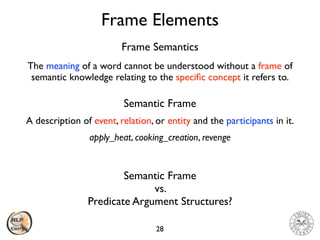
Frame Elements
28
Frame Semantics
The meaning of a word cannot be understood without a frame of


semantic knowledge relating to the speci
fi
c concept it refers to.
Semantic Frame
A description of event, relation, or entity and the participants in it.
apply_heat, cooking_creation, revenge
Semantic Frame


vs.


Predicate Argument Structures?

Semantic Role Labeling

  • 1.
    Semantic Role Labeling NaturalLanguage Processin g Emory University 
 Jinho D. Choi
  • 2.
    Predicate Identi fi cation 2 What isa predicate? A linguistic unit that governs arguments. Cannot complete its meaning without its arguments. He bought a car from a dealer for her yesterday . He was going to buy a car . She threw the car away . He made a bid for the car . She ignored his bid to accept the car . The bid was acceptable to me. auxiliary verb verb-particle light-verb noun-predicate adjective-predicate verb-predicate
  • 3.
    Predicate Sense Disambiguation 3 Apredicate can have multiple senses (meanings). Take He took the book with him . He couldn’t take the pressure . He took 5 days to complete the homework. http://verbs.colorado.edu/propbank/framesets-english/take-v.html http://wordnetweb.princeton.edu/perl/webwn?s=take
  • 4.
    Argument Identi fi cation 4 What isan argument? A participant of the predicate. Complete the meaning of the predicate. She threw the car away. He made a bid for the car. She ignored his bid to accept the car. The bid was acceptable to me. He bought a car from a dealer for her yesterday. Exercise
  • 5.
    Argument Labeling 5 She threwthe car away. He made a bid for the car. She ignored his bid to accept the car. The bid was acceptable to me. agent theme He bought a car from a dealer for her yesterday. agent theme source beneficiary temporal agent patient theme agent agent theme theme agent agent theme
  • 6.
    Semantic Roles 6 Underlying relationsbetween 
 predicates and their arguments. actor destination patient theme agent experiencer predicate theme asset extent product patient attribute instrument recipient time bene fi ciary location source topic cause material stimulus proposition http://verbs.colorado.edu/~mpalmer/projects/verbnet.html
  • 7.
    Semantic Role Labeling 7 PredicateIdenti fi cation Predicate Sense Disambiguation Argument Identi fi cation Argument Labeling
  • 8.
    PropBank 8 A corpus inwhich arguments are annotated with the 
 semantic roles they play with respect to their predicates. Each predicate encompasses one or more senses 
 de fi ning their own predicate argument structures. open open.01: open open.02: begin open.03: cause to be not closed ARG0: opener ARG1: thing opened ARG2: instrument ARG3: benefactive ARG0: causer of opening ARG1: thing opened ARG0: opener ARG1: thing opened ARG2: instrument ARG3: benefactive Predicate Senses Argument Structures
  • 9.
    PropBank 9 open open.01: open open.02:begin open.03: cause to be not closed ARG0: opener ARG1: thing opened ARG2: instrument ARG3: benefactive ARG0: causer of opening ARG1: thing opened ARG0: opener ARG1: thing opened ARG2: instrument ARG3: benefactive ARG0 ARG1 ARG2 TMP
  • 10.
    PropBank 10 open open.01: open open.02:begin open.03: cause to be not closed ARG0: opener ARG1: thing opened ARG2: instrument ARG3: benefactive ARG0: causer of opening ARG1: thing opened ARG0: opener ARG1: thing opened ARG2: instrument ARG3: benefactive ARG0 ARG1 ARG2 TMP Numbered Arguments Modi fi ers
  • 11.
    Numbered Arguments 11 Arguments frequentlyco-occuring with their predicates. ARG0: agent . ARG1: patient, theme . ARG2: instrument, benefactive, attribute . ARG3: starting point . ARG4: ending point . ARGA: external causer. Are numbered arguments required? How do you determine numbered arguments? Semantics are 
 overloaded!
  • 12.
    Modi fi ers 12 Arguments whose rolesare independent from their predicates. ADJ Adjectival LOC Location ADV Adverbial MNR Manner CAU Cause MOD Modal COM Comitative NEG Negation DIR Direction PRD Secondary predication DIS Discourse PRP Purpose GOL Goal REC Recipricol EXT Extent TMP Temporal
  • 13.
    Argument Candidates 13 No needto traverse the entire tree for fi nding the arguments! Sibling of the predicate. Dependents of the predicate.
  • 14.
    Argument Candidates 14 Siblings ofthe ancestors. Dependents of the ancestors.
  • 15.
    Argument Candidates 15 Linguistically motivatedrules Dependents of the predicate . Dependents of the ancestors. What if the tree is ill-parsed? 92 94 96 98 100 First-order Gold System
  • 16.
    Argument Candidates 16 Higher-order Dependents ofthe predicate . Dependents of the ancestors. Descendents ← 92 94 96 98 100 First-order Higher-order Gold System
  • 17.
    Applications 17 Question Answering He boughta car from a dealer for her yesterday . Who bought what from whom for whom when? ARG0 He Who ARG1 a car what ARG2 from a dealer from whom ARG4 for her for whom TMP yesterday when Predicate buy.01 buy.01
  • 18.
    Semantic Frames 18 Semantic rolelabeling is sometimes not enough! He bought a car from a dealer . Who sold a car to him? ARG0 He Who ARG1 a car the car ARG2 from a dealer to him Predicate buy.01 sell.01 Use theVerbNet semantic frames. http://verbs.colorado.edu/verb-index/
  • 19.
    VerbNet 19 VerbNet Semantic Frames has_possession(start(E),Source, Theme) 
 has_possession(end(E), Agent, Theme) 
 transfer (during(E), Theme) buy → get-13.5.1 sell → give-13.1 has_possession(start(E), Agent, Theme) 
 has_possession(end(E), Recipient, Theme) 
 transfer (during(E), Theme) http://verbs.colorado.edu/verb-index/vn/get-13.5.1.php http://verbs.colorado.edu/verb-index/vn/give-13.1.php
  • 20.
    VerbNet 20 ARG0 He Who ARG1a car the car ARG2 from a dealer to him Predicate buy.01 sell.01 has_possession(start(E), Source, Theme) 
 has_possession(end(E), Agent, Theme) 
 transfer (during(E), Theme) buy → get-13.5.1 sell → give-13.1 has_possession(start(E), Agent, Theme) 
 has_possession(end(E), Recipient, Theme) 
 transfer (during(E), Theme) has_possession(start(buy), a dealer, a car) 
 has_possession(end(buy), He, a car) 
 transfer (during(buy), a car) has_possession(start(sell), Who, a car) 
 has_possession(end(sell), him, a car) 
 transfer (during(sell), a car)
  • 21.
    FrameNet 21 Frame Semantics The meaningof a word cannot be understood without a frame of 
 semantic knowledge relating to the speci fi c concept it refers to. Semantic Frame A description of event, relation, or entity and the participants in it. apply_heat, cooking_creation, revenge Lexical Units Words that belong to the same semantic frame. revenge → avenge.v, avenger.n, get_even.v, payback.n, retaliate.v, … vs. verb classes? vs. PA structures? https://framenet.icsi.berkeley.edu
  • 22.
    FrameNet Elements 22 Core FrameElement revenge → avenger, injured party, injury, offender, punishment Instantiates a conceptually necessary component of a frame. Non-core Frame Element Can be instantiated in any semantically appropriate frame. revenge → degree, depictive, duration, instrument, manner, … vs. numbered args? vs. modi fi ers? Semantic Type The type of a frame element to be broadly constant across uses. e.g., sentient, physical entity, state of affairs, temperature, etc.
  • 23.
    FrameNet Relations 23 Coreness Set Revenge→ {injured party, injury}, {avenger, punishment} A set of frame elements in that the presence of a member of 
 the set is suf fi cient to satisfy a semantic valence of its predicate. Requires The occurrence of a core FE requires another core FE to occur. The robber tied Harry to the chair. Excludes The occurrence of a core FE excludes other core FEs to occur. The robber tied Harry’s ankles together. item goal items
  • 24.
    Semantic Frames 24 Apply Heat cookcontainer food heatin g instrument tempora l setting container sentient physical entity temperature bene fi ciary co-participant degree duration manner means place medium purpose time Semantic Frame Core FE Non-core FE Semantic Type Core Set bake.v, barbecue.v, blanch.v, boil.v, braise.v, broil.v, etc. Lexical Unit
  • 25.
    Frame Inheritance andRelations 25 Apply Heat Activity Process Internally affect Internally act Transitive action Event Objective 
 in fl uence Cooking creation Absorb heat is used by is causative of Frame Inheritance Frame Relations
  • 26.
    Sub-Frames and Precedence 26 Crime 
 scenario Committing 
 crime Criminal 
 investigation Criminal 
 process Arraignment ArrestSentencing Trial Bail 
 decision Entering 
 of plea Noti fi cation 
 of charges Cour t examination Jury 
 deliberation Verdict
  • 27.
    Paraphrase 27 John e-mailed Maryhis info. John communicated his info to Mary by e-mail. Contractin g e-mail John Mary his info Communicatio n communicate John his info Mary e-mail Communicator Addressee Uses Communicator Addressee Topic Mean Topic
  • 28.
    Frame Elements 28 Frame Semantics Themeaning of a word cannot be understood without a frame of 
 semantic knowledge relating to the speci fi c concept it refers to. Semantic Frame A description of event, relation, or entity and the participants in it. apply_heat, cooking_creation, revenge Semantic Frame 
 vs. 
 Predicate Argument Structures?