Anaphora Resolution
Spring 2010, UCSC – Adrian Brasoveanu
[Slides based on various sources, collected over a couple of years
and repeatedly modified – the work required to track them down
& list them would take too much time at this point. Please email
me (abrsvn@gmail.com) if you can identify particular sources.]
There are more slides added to Adrian’s presentation.
Reference Phenomena
Five common types of referring expression
Type Example
Indefinite noun phrase I saw a Ford Escort today.
Definite noun phrase I saw a Ford Escort today. The Escort was white.
Pronoun I saw a Ford Escort today. It was white.
Demonstratives I like this better than that.
One-anaphora I saw 6 Ford Escort today. Now I want one.
Three types of referring expression that complicate the reference resolution
Type Example
Inferrables I almost bought a Ford Escort, but a door had a dent.
Discontinuous Sets John and Mary love their Escorts. They often drive them.
Generics I saw 6 Ford Escorts today. They are the coolest cars.
Reference Resolution
 How to develop successful algorithms for reference
resolution? There are two necessary steps.
 First is to filter the set of possible referents by certain
hard-and-fast constraints.
 Second is to set the preference for possible referents.
Constraints (for English)
 Number Agreement:
 To distinguish between singular and plural references.
 *John has a new car. They are red.
 Gender Agreement:
 To distinguish male, female, and non-personal genders.
 John has a new car. It is attractive. [It = the new car]
 Person and Case Agreement:
 To distinguish between three forms of person;
 *You and I have Escorts. They love them.
 To distinguish between subject position, object position, and
genitive position.
Constraints (for English)
 Syntactic Constraints:
 Syntactic relationships between a referring expression and a
possible antecedent noun phrase
 John bought himself a new car. [himself=John]
 John bought him a new car. [him≠John]
 Selectional Restrictions:
 A verb places restrictions on its arguments.
 John parked his Acura in the garage. He had driven it
around for hours. [it=Acura, it≠garage];
 I picked up the book and sat in a chair. It broke.
Syntax can’t be all there is
 John hit Bill. He was severely injured.
 Margaret Thatcher admires Hillary Clinton, and
George W. Bush absolutely worships her.
Preferences in Pronoun Interpretation
 Recency:
 Entities introduced recently are more salient than those
introduced before.
 John has a Legend. Bill has an Escort. Mary likes to drive
it.
 Grammatical Role:
 Entities mentioned in subject position are more salient than
those in object position.
 Bill went to the Acura dealership with John. He bought an
Escort. [he=Bill]
Preferences in Pronoun Interpretation
 Repeated Mention:
 Entities that have been focused on in the prior discourse are
more salient.
John needed a car to get to his new job.
He decided that he wanted something sporty.
Bill went to the Acura dealership with him.
He bought an Integra. [he=John]
Preferences in Pronoun Interpretation
 Parallelism (more generally – discourse structure):
 There are also strong preferences that appear to be induced
by parallelism effects.
 Mary went with Sue to the cinema. Sally went with her
to the mall. [ her = Sue]
 Jim surprised Paul and then Julie shocked him. (him =
Paul)
Preferences in Pronoun Interpretation
 Verb Semantics:
 Certain verbs appear to place a semantically-oriented emphasis
on one of their argument positions.
 John telephoned Bill. He had lost the book in the mall.
[He = John]
 John criticized Bill. He had lost the book in the mall.
[He = Bill]
 David praised Hans because he … [he = Hans]
 David apologized to Hans because he… [he = David]
Preferences in Pronoun Interpretation
 World knowledge in general:
 The city council denied the demonstrators a permit because
they {feared|advocated} violence.
 The city council denied the demonstrators a permit because
they {feared|advocated} violence.
 The city council denied the demonstrators a permit
because they {feared|advocated} violence.
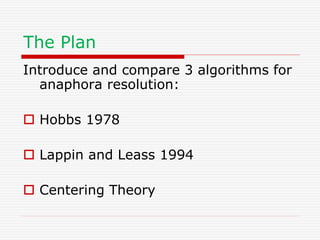
The Plan
Introduce and compare 3 algorithms for
anaphora resolution:
 Hobbs 1978
 Lappin and Leass 1994
 Centering Theory
Hobbs 1978
 Hobbs, Jerry R., 1978, ``Resolving Pronoun
References'', Lingua, Vol. 44, pp. 311-338.
 Also in Readings in Natural Language
Processing, B. Grosz, K. Sparck-Jones, and
B. Webber, editors, pp. 339-352, Morgan
Kaufmann Publishers, Los Altos, California.
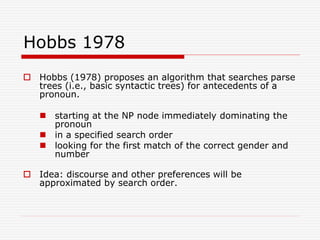
Hobbs 1978
 Hobbs (1978) proposes an algorithm that searches parse
trees (i.e., basic syntactic trees) for antecedents of a
pronoun.
 starting at the NP node immediately dominating the
pronoun
 in a specified search order
 looking for the first match of the correct gender and
number
 Idea: discourse and other preferences will be
approximated by search order.
Hobbs’s point
… the naïve approach is quite good. Computationally
speaking, it will be a long time before a semantically
based algorithm is sophisticated enough to perform as
well, and these results set a very high standard for any
other approach to aim for.
Yet there is every reason to pursue a semantically
based approach. The naïve algorithm does not work.
Any one can think of examples where it fails. In these
cases it not only fails; it gives no indication that it has
failed and offers no help in finding the real antecedent.
(p. 345)
Hobbs 1978
 This simple algorithm has become a baseline:
more complex algorithms should do better than
this.
 Hobbs distance: ith candidate NP considered by
the algorithm is at a Hobbs distance of i.
Hobbs’s “Naïve” Algorithm
1. Begin at the NP immediately dominating the pronoun.
2. Go up tree to first NP or S encountered.
 Call node X, and path to it, p.
 Search left-to-right below X and to left of p, proposing any NP node which
has an NP or S between it and X.
3. If X is highest S node in sentence,
 Search previous trees, in order of recency, left-to-right, breadth-first,
proposing NPs encountered.
4. Otherwise, from X, go up to first NP or S node encountered,
 Call this X, and path to it p.
5. If X is an NP, and p does not pass through an N-bar that X immediately
dominates, propose X.
6. Search below X, to left of p, left-to-right, breadth-first, proposing NP
encountered.
7. If X is an S, search below X to right of p, left-to-right, breadth-first, but not going
through any NP or S, proposing NP encountered.
8. Go to 2.
Another example:
The referent for “he”: we follow the same path, get to the same place, but reject NP4,
then reject NP5. Finally, accept NP6.
Lappin and Leass 1994
 Idea: Maintain a discourse model , in which there are
representations for potential referents. (much like the DRSs we built
throughout the quarter )
 Lappin and Leass 1994 propose a discourse model in which
potential referents have degrees of salience.
 They try to resolve (pronoun) references by finding highly salient
referents compatible with pronoun agreement features.
 In effect, they incorporate:
 recency
 syntax-based preferences
 agreement, but no (other) semantics
Lappin and Leass 1994
 First, we assign a number of salience factors & salience
values to each referring expression.
 The salience values (weights) are arrived by
experimentation on a certain corpus.
Lappin and Leass 1994
Salience Factor Salience Value
Sentence recency 100
Subject emphasis 80
Existential emphasis 70
Accusative emphasis 50
Indirect object emphasis 40
Non-adverbial emphasis 50
Head noun emphasis 80
Lappin and Leass 1994
 Non-adverbial emphasis is to penalize
“demarcated adverbial PPs” (e.g., “In his hand,
…”) by giving points to all other types.
 Head noun emphasis is to penalize embedded
referents.
 Other factors & values:
 Grammatical role parallelism: 35
 Cataphora: -175
Lappin and Leass 1994
 The algorithm employs a simple weighting scheme that integrates the
effects of several preferences:
 For each new entity, a representation for it is added to the discourse
model and salience value computed for it.
 Salience value is computed as the sum of the weights assigned by a
set of salience factors.
 The weight a salience factor assigns to a referent is the highest one the
factor assigns to the referent’s referring expression.
 Salience values are cut in half each time a new sentence is processed.
Lappin and Leass 1994
The steps taken to resolve a pronoun are as follows:
 Collect potential referents (four sentences back);
 Remove potential referents that don’t semantically agree;
 Remove potential referents that don’t syntactically agree;
 Compute salience values for the rest potential referents;
 Select the referent with the highest salience value.
Lappin and Leass 1994
 Salience factors apply per NP, i.e., referring expression.
 However, we want the salience for a potential referent.
 So, all NPs determined to have the same referent are
examined.
 The referent is given the sum of the highest salience factor
associated with any such referring expression.
 Salience factors are considered to have scope over a
sentence
 so references to the same entity over multiple sentences add
up
 while multiple references within the same sentence don’t.
Example (from Jurafsky and Martin)
 John saw a beautiful Acura Integra at
the dealership.
 He showed it to Bob.
 He bought it.
John
Salience Factor Salience Value
Sentence recency 100
Subject emphasis 80
Existential emphasis
Accusative emphasis
Indirect object emphasis
Non-adverbial emphasis 50
Head noun emphasis 80
Integra
Salience Factor Salience Value
Sentence recency 100
Subject emphasis
Existential emphasis
Accusative emphasis 50
Indirect object emphasis
Non-adverbial emphasis 50
Head noun emphasis 80
dealership
Salience Factor Salience Value
Sentence recency 100
Subject emphasis
Existential emphasis
Accusative emphasis
Indirect object emphasis
Non-adverbial emphasis 50
Head noun emphasis 80
He
Salience Factor Salience Value
Sentence recency 100
Subject emphasis 80
Existential emphasis
Accusative emphasis
Indirect object emphasis
Non-adverbial emphasis 50
Head noun emphasis 80
It
Salience Factor Salience Value
Sentence recency 100
Subject emphasis
Existential emphasis
Accusative emphasis 50
Indirect object emphasis
Non-adverbial emphasis 50
Head noun emphasis 80
Bob
Salience Factor Salience Value
Sentence recency 100
Subject emphasis
Existential emphasis
Accusative emphasis
Indirect object emphasis 40
Non-adverbial emphasis 50
Head noun emphasis 80
He
Salience Factor Salience Value
Sentence recency 100
Subject emphasis 80
Existential emphasis
Accusative emphasis
Indirect object emphasis
Non-adverbial emphasis 50
Head noun emphasis 80
It
Salience Factor Salience Value
Sentence recency 100
Subject emphasis
Existential emphasis
Accusative emphasis 50
Indirect object emphasis
Non-adverbial emphasis 50
Head noun emphasis 80
Evaluation of Lappin and Leass 1994
 Weights were arrived at by experimentation on
a corpus of computer training manuals.
 Combined with other filters, algorithm achieve
86% accuracy (74% / 89% inter- / intra-
sentential):
 applied to unseen data of same genre
 Hobbs’ algorithm applied to same data is 82%
accurate (87% / 81% inter / intra).

anaphora resolution.pptx

  • 1.
    Anaphora Resolution Spring 2010,UCSC – Adrian Brasoveanu [Slides based on various sources, collected over a couple of years and repeatedly modified – the work required to track them down & list them would take too much time at this point. Please email me (abrsvn@gmail.com) if you can identify particular sources.] There are more slides added to Adrian’s presentation.
  • 4.
    Reference Phenomena Five commontypes of referring expression Type Example Indefinite noun phrase I saw a Ford Escort today. Definite noun phrase I saw a Ford Escort today. The Escort was white. Pronoun I saw a Ford Escort today. It was white. Demonstratives I like this better than that. One-anaphora I saw 6 Ford Escort today. Now I want one. Three types of referring expression that complicate the reference resolution Type Example Inferrables I almost bought a Ford Escort, but a door had a dent. Discontinuous Sets John and Mary love their Escorts. They often drive them. Generics I saw 6 Ford Escorts today. They are the coolest cars.
  • 5.
    Reference Resolution  Howto develop successful algorithms for reference resolution? There are two necessary steps.  First is to filter the set of possible referents by certain hard-and-fast constraints.  Second is to set the preference for possible referents.
  • 6.
    Constraints (for English) Number Agreement:  To distinguish between singular and plural references.  *John has a new car. They are red.  Gender Agreement:  To distinguish male, female, and non-personal genders.  John has a new car. It is attractive. [It = the new car]  Person and Case Agreement:  To distinguish between three forms of person;  *You and I have Escorts. They love them.  To distinguish between subject position, object position, and genitive position.
  • 7.
    Constraints (for English) Syntactic Constraints:  Syntactic relationships between a referring expression and a possible antecedent noun phrase  John bought himself a new car. [himself=John]  John bought him a new car. [him≠John]  Selectional Restrictions:  A verb places restrictions on its arguments.  John parked his Acura in the garage. He had driven it around for hours. [it=Acura, it≠garage];  I picked up the book and sat in a chair. It broke.
  • 8.
    Syntax can’t beall there is  John hit Bill. He was severely injured.  Margaret Thatcher admires Hillary Clinton, and George W. Bush absolutely worships her.
  • 9.
    Preferences in PronounInterpretation  Recency:  Entities introduced recently are more salient than those introduced before.  John has a Legend. Bill has an Escort. Mary likes to drive it.  Grammatical Role:  Entities mentioned in subject position are more salient than those in object position.  Bill went to the Acura dealership with John. He bought an Escort. [he=Bill]
  • 10.
    Preferences in PronounInterpretation  Repeated Mention:  Entities that have been focused on in the prior discourse are more salient. John needed a car to get to his new job. He decided that he wanted something sporty. Bill went to the Acura dealership with him. He bought an Integra. [he=John]
  • 11.
    Preferences in PronounInterpretation  Parallelism (more generally – discourse structure):  There are also strong preferences that appear to be induced by parallelism effects.  Mary went with Sue to the cinema. Sally went with her to the mall. [ her = Sue]  Jim surprised Paul and then Julie shocked him. (him = Paul)
  • 12.
    Preferences in PronounInterpretation  Verb Semantics:  Certain verbs appear to place a semantically-oriented emphasis on one of their argument positions.  John telephoned Bill. He had lost the book in the mall. [He = John]  John criticized Bill. He had lost the book in the mall. [He = Bill]  David praised Hans because he … [he = Hans]  David apologized to Hans because he… [he = David]
  • 13.
    Preferences in PronounInterpretation  World knowledge in general:  The city council denied the demonstrators a permit because they {feared|advocated} violence.  The city council denied the demonstrators a permit because they {feared|advocated} violence.  The city council denied the demonstrators a permit because they {feared|advocated} violence.
  • 14.
    The Plan Introduce andcompare 3 algorithms for anaphora resolution:  Hobbs 1978  Lappin and Leass 1994  Centering Theory
  • 15.
    Hobbs 1978  Hobbs,Jerry R., 1978, ``Resolving Pronoun References'', Lingua, Vol. 44, pp. 311-338.  Also in Readings in Natural Language Processing, B. Grosz, K. Sparck-Jones, and B. Webber, editors, pp. 339-352, Morgan Kaufmann Publishers, Los Altos, California.
  • 16.
    Hobbs 1978  Hobbs(1978) proposes an algorithm that searches parse trees (i.e., basic syntactic trees) for antecedents of a pronoun.  starting at the NP node immediately dominating the pronoun  in a specified search order  looking for the first match of the correct gender and number  Idea: discourse and other preferences will be approximated by search order.
  • 17.
    Hobbs’s point … thenaïve approach is quite good. Computationally speaking, it will be a long time before a semantically based algorithm is sophisticated enough to perform as well, and these results set a very high standard for any other approach to aim for. Yet there is every reason to pursue a semantically based approach. The naïve algorithm does not work. Any one can think of examples where it fails. In these cases it not only fails; it gives no indication that it has failed and offers no help in finding the real antecedent. (p. 345)
  • 18.
    Hobbs 1978  Thissimple algorithm has become a baseline: more complex algorithms should do better than this.  Hobbs distance: ith candidate NP considered by the algorithm is at a Hobbs distance of i.
  • 19.
    Hobbs’s “Naïve” Algorithm 1.Begin at the NP immediately dominating the pronoun. 2. Go up tree to first NP or S encountered.  Call node X, and path to it, p.  Search left-to-right below X and to left of p, proposing any NP node which has an NP or S between it and X. 3. If X is highest S node in sentence,  Search previous trees, in order of recency, left-to-right, breadth-first, proposing NPs encountered. 4. Otherwise, from X, go up to first NP or S node encountered,  Call this X, and path to it p. 5. If X is an NP, and p does not pass through an N-bar that X immediately dominates, propose X. 6. Search below X, to left of p, left-to-right, breadth-first, proposing NP encountered. 7. If X is an S, search below X to right of p, left-to-right, breadth-first, but not going through any NP or S, proposing NP encountered. 8. Go to 2.
  • 20.
    Another example: The referentfor “he”: we follow the same path, get to the same place, but reject NP4, then reject NP5. Finally, accept NP6.
  • 21.
    Lappin and Leass1994  Idea: Maintain a discourse model , in which there are representations for potential referents. (much like the DRSs we built throughout the quarter )  Lappin and Leass 1994 propose a discourse model in which potential referents have degrees of salience.  They try to resolve (pronoun) references by finding highly salient referents compatible with pronoun agreement features.  In effect, they incorporate:  recency  syntax-based preferences  agreement, but no (other) semantics
  • 22.
    Lappin and Leass1994  First, we assign a number of salience factors & salience values to each referring expression.  The salience values (weights) are arrived by experimentation on a certain corpus.
  • 23.
    Lappin and Leass1994 Salience Factor Salience Value Sentence recency 100 Subject emphasis 80 Existential emphasis 70 Accusative emphasis 50 Indirect object emphasis 40 Non-adverbial emphasis 50 Head noun emphasis 80
  • 24.
    Lappin and Leass1994  Non-adverbial emphasis is to penalize “demarcated adverbial PPs” (e.g., “In his hand, …”) by giving points to all other types.  Head noun emphasis is to penalize embedded referents.  Other factors & values:  Grammatical role parallelism: 35  Cataphora: -175
  • 25.
    Lappin and Leass1994  The algorithm employs a simple weighting scheme that integrates the effects of several preferences:  For each new entity, a representation for it is added to the discourse model and salience value computed for it.  Salience value is computed as the sum of the weights assigned by a set of salience factors.  The weight a salience factor assigns to a referent is the highest one the factor assigns to the referent’s referring expression.  Salience values are cut in half each time a new sentence is processed.
  • 26.
    Lappin and Leass1994 The steps taken to resolve a pronoun are as follows:  Collect potential referents (four sentences back);  Remove potential referents that don’t semantically agree;  Remove potential referents that don’t syntactically agree;  Compute salience values for the rest potential referents;  Select the referent with the highest salience value.
  • 27.
    Lappin and Leass1994  Salience factors apply per NP, i.e., referring expression.  However, we want the salience for a potential referent.  So, all NPs determined to have the same referent are examined.  The referent is given the sum of the highest salience factor associated with any such referring expression.  Salience factors are considered to have scope over a sentence  so references to the same entity over multiple sentences add up  while multiple references within the same sentence don’t.
  • 28.
    Example (from Jurafskyand Martin)  John saw a beautiful Acura Integra at the dealership.  He showed it to Bob.  He bought it.
  • 29.
    John Salience Factor SalienceValue Sentence recency 100 Subject emphasis 80 Existential emphasis Accusative emphasis Indirect object emphasis Non-adverbial emphasis 50 Head noun emphasis 80
  • 30.
    Integra Salience Factor SalienceValue Sentence recency 100 Subject emphasis Existential emphasis Accusative emphasis 50 Indirect object emphasis Non-adverbial emphasis 50 Head noun emphasis 80
  • 31.
    dealership Salience Factor SalienceValue Sentence recency 100 Subject emphasis Existential emphasis Accusative emphasis Indirect object emphasis Non-adverbial emphasis 50 Head noun emphasis 80
  • 32.
    He Salience Factor SalienceValue Sentence recency 100 Subject emphasis 80 Existential emphasis Accusative emphasis Indirect object emphasis Non-adverbial emphasis 50 Head noun emphasis 80
  • 33.
    It Salience Factor SalienceValue Sentence recency 100 Subject emphasis Existential emphasis Accusative emphasis 50 Indirect object emphasis Non-adverbial emphasis 50 Head noun emphasis 80
  • 34.
    Bob Salience Factor SalienceValue Sentence recency 100 Subject emphasis Existential emphasis Accusative emphasis Indirect object emphasis 40 Non-adverbial emphasis 50 Head noun emphasis 80
  • 35.
    He Salience Factor SalienceValue Sentence recency 100 Subject emphasis 80 Existential emphasis Accusative emphasis Indirect object emphasis Non-adverbial emphasis 50 Head noun emphasis 80
  • 36.
    It Salience Factor SalienceValue Sentence recency 100 Subject emphasis Existential emphasis Accusative emphasis 50 Indirect object emphasis Non-adverbial emphasis 50 Head noun emphasis 80
  • 37.
    Evaluation of Lappinand Leass 1994  Weights were arrived at by experimentation on a corpus of computer training manuals.  Combined with other filters, algorithm achieve 86% accuracy (74% / 89% inter- / intra- sentential):  applied to unseen data of same genre  Hobbs’ algorithm applied to same data is 82% accurate (87% / 81% inter / intra).