PLANT BREEDING
Self-incompatibility 2
Dr. K. Vanangamudi
Formerly Dean (Agriculture), AC & RI, Coimbatore,
Dean, Adhiparashakthi Agricultural College, Kalavai,
Professor and Head - Seed Science and Technology,
Tamil Nadu Agricultural University, Coimbatore.
Types of self - incompatibility
1) Single-locus self-incompatibility
o Gametophytic self-incompatibility (GSI)
o Sporophytic self-incompatibility (SSI)
2) 2-locus gametophytic self-incompatibility
3) Heteromorphic self-incompatibility
4) Cryptic self-incompatibility (CSI)
5) Late-acting self-incompatibility (LSI)
2). 2-locus gametophytic self- incompatibility
 Grass subfamily Pooideae, have a gametophytic self- incompatibility that involves two unlinked
loci referred to as S and Z.
 If the alleles expressed at these two loci in the pollen grain both match the corresponding alleles in
the pistil, the pollen grain will be recognized as incompatible.
3). Heteromorphic self-incompatibility
 Genes responsible for self-incompatibility in heterostylous flowers are strongly linked to the genes
responsible for flower polymorphism, so these traits are inherited together.
 Two concepts
o Distyly
o Tristyly
Distyly
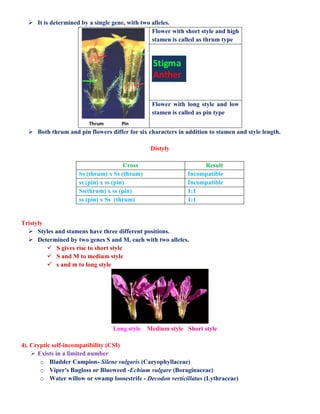
 Here, both stamens and styles are of two types.
 Stamens may be low and high
 Styles short and long.
 It is determined by a single gene, with two alleles.
Flower with short style and high
stamen is called as thrum type
Flower with long style and low
stamen is called as pin type
 Both thrum and pin flowers differ for six characters in addition to stamen and style length.
Distyly
Tristyly
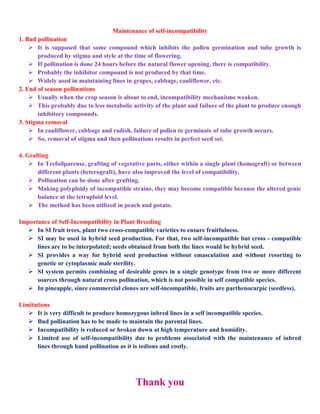
 Styles and stamens have three different positions.
 Determined by two genes S and M, each with two alleles.
 S gives rise to short style
 S and M to medium style
 s and m to long style
Long style Medium style Short style
4). Cryptic self-incompatibility (CSI)
 Exists in a limited number
o Bladder Campion- Silene vulgaris (Caryophyllaceae)
o Viper's Bugloss or Blueweed -Echium vulgare (Boraginaceae)
o Water willow or swamp loosestrife - Decodon verticillatus (Lythraceae)
Cross Result
Ss (thrum) x Ss (thrum) Incompatible
ss (pin) x ss (pin) Incompatible
Ss(thrum) x ss (pin) 1:1
ss (pin) x Ss (thrum) 1:1
Bladder Campion Water willow or swamp loosestrife Viper's Bugloss or Blueweed
 In this mechanism, the simultaneous presence of cross and self pollen on the same stigma, results
in higher seed set from cross pollen than self pollen.
 However in CSI, self - pollination without the presence of competing cross pollen results in
successive fertilization and seed set.
 In some species, pollen tube elongation leads to faster elongation of cross pollen tubes than self
pollen tubes.
 Ratio of crossed to selfed ovules ranges between 3.2 and 11.5, when equal amounts of cross and
self pollen are placed upon the stigma.
5. Late-acting self-incompatibility (LSI)
 Also termed ovarian self-incompatibility (OSI).
 In this mechanism, self pollen germinates and reaches the ovules, but no fruit set.
 Absence of fruit set is due to genetic defects (homozygosity for lethal recessive alleles), which are
the direct result of self-fertilization (inbreeding depression).
 LSI can be
o Pre-zygotic: Deterioration of the embryo sac prior to pollen tube entry, e.g., Narcissus
triandrus
Narcissus triandrus
o Post-zygotic: Malformation of the zygote or embryo, e.g., Asclepias and Spathodea
campanulata)
o
Spathodea campanulata
Maintenance of self-incompatibility
1. Bud pollination
 It is supposed that some compound which inhibits the pollen germination and tube growth is
produced by stigma and style at the time of flowering.
 If pollination is done 24 hours before the natural flower opening, there is compatibility.
 Probably the inhibitor compound is not produced by that time.
 Widely used in maintaining lines in grapes, cabbage, cauliflower, etc.
2. End of season pollinations
 Usually when the crop season is about to end, incompatibility mechanisms weaken.
 This probably due to less metabolic activity of the plant and failure of the plant to produce enough
inhibitory compounds.
3. Stigma removal
 In cauliflower, cabbage and radish, failure of pollen to germinate of tube growth occurs.
 So, removal of stigma and then pollinations results in perfect seed set.
4. Grafting
 In Trefoilparense, grafting of vegetative parts, either within a single plant (homograft) or between
different plants (heterograft), have also improved the level of compatibility.
 Pollination can be done after grafting.
 Making polyploidy of incompatible strains, they may become compatible because the altered genic
balance at the tetraploid level.
 The method has been utilized in peach and potato.
Importance of Self-Incompatibility in Plant Breeding
 In SI fruit trees, plant two cross-compatible varieties to ensure fruitfulness.
 SI may be used in hybrid seed production. For that, two self-incompatible but cross - compatible
lines are to be interpolated; seeds obtained from both the lines would be hybrid seed.
 SI provides a way for hybrid seed production without emasculation and without resorting to
genetic or cytoplasmic male sterility.
 SI system permits combining of desirable genes in a single genotype from two or more different
sources through natural cross pollination, which is not possible in self compatible species.
 In pineapple, since commercial clones are self-incompatible, fruits are parthenocarpic (seedless).
Limitations
 It is very difficult to produce homozygous inbred lines in a self incompatible species.
 Bud pollination has to be made to maintain the parental lines.
 Incompatibility is reduced or broken down at high temperature and humidity.
 Limited use of self-incompatibility due to problems associated with the maintenance of inbred
lines through hand pollination as it is tedious and costly.
Thank you

Self-incompatibility 2.pdf

  • 1.
    PLANT BREEDING Self-incompatibility 2 Dr.K. Vanangamudi Formerly Dean (Agriculture), AC & RI, Coimbatore, Dean, Adhiparashakthi Agricultural College, Kalavai, Professor and Head - Seed Science and Technology, Tamil Nadu Agricultural University, Coimbatore. Types of self - incompatibility 1) Single-locus self-incompatibility o Gametophytic self-incompatibility (GSI) o Sporophytic self-incompatibility (SSI) 2) 2-locus gametophytic self-incompatibility 3) Heteromorphic self-incompatibility 4) Cryptic self-incompatibility (CSI) 5) Late-acting self-incompatibility (LSI) 2). 2-locus gametophytic self- incompatibility  Grass subfamily Pooideae, have a gametophytic self- incompatibility that involves two unlinked loci referred to as S and Z.  If the alleles expressed at these two loci in the pollen grain both match the corresponding alleles in the pistil, the pollen grain will be recognized as incompatible. 3). Heteromorphic self-incompatibility  Genes responsible for self-incompatibility in heterostylous flowers are strongly linked to the genes responsible for flower polymorphism, so these traits are inherited together.  Two concepts o Distyly o Tristyly Distyly  Here, both stamens and styles are of two types.  Stamens may be low and high  Styles short and long.
  • 2.
     It isdetermined by a single gene, with two alleles. Flower with short style and high stamen is called as thrum type Flower with long style and low stamen is called as pin type  Both thrum and pin flowers differ for six characters in addition to stamen and style length. Distyly Tristyly  Styles and stamens have three different positions.  Determined by two genes S and M, each with two alleles.  S gives rise to short style  S and M to medium style  s and m to long style Long style Medium style Short style 4). Cryptic self-incompatibility (CSI)  Exists in a limited number o Bladder Campion- Silene vulgaris (Caryophyllaceae) o Viper's Bugloss or Blueweed -Echium vulgare (Boraginaceae) o Water willow or swamp loosestrife - Decodon verticillatus (Lythraceae) Cross Result Ss (thrum) x Ss (thrum) Incompatible ss (pin) x ss (pin) Incompatible Ss(thrum) x ss (pin) 1:1 ss (pin) x Ss (thrum) 1:1
  • 3.
    Bladder Campion Waterwillow or swamp loosestrife Viper's Bugloss or Blueweed  In this mechanism, the simultaneous presence of cross and self pollen on the same stigma, results in higher seed set from cross pollen than self pollen.  However in CSI, self - pollination without the presence of competing cross pollen results in successive fertilization and seed set.  In some species, pollen tube elongation leads to faster elongation of cross pollen tubes than self pollen tubes.  Ratio of crossed to selfed ovules ranges between 3.2 and 11.5, when equal amounts of cross and self pollen are placed upon the stigma. 5. Late-acting self-incompatibility (LSI)  Also termed ovarian self-incompatibility (OSI).  In this mechanism, self pollen germinates and reaches the ovules, but no fruit set.  Absence of fruit set is due to genetic defects (homozygosity for lethal recessive alleles), which are the direct result of self-fertilization (inbreeding depression).  LSI can be o Pre-zygotic: Deterioration of the embryo sac prior to pollen tube entry, e.g., Narcissus triandrus Narcissus triandrus o Post-zygotic: Malformation of the zygote or embryo, e.g., Asclepias and Spathodea campanulata) o Spathodea campanulata
  • 4.
    Maintenance of self-incompatibility 1.Bud pollination  It is supposed that some compound which inhibits the pollen germination and tube growth is produced by stigma and style at the time of flowering.  If pollination is done 24 hours before the natural flower opening, there is compatibility.  Probably the inhibitor compound is not produced by that time.  Widely used in maintaining lines in grapes, cabbage, cauliflower, etc. 2. End of season pollinations  Usually when the crop season is about to end, incompatibility mechanisms weaken.  This probably due to less metabolic activity of the plant and failure of the plant to produce enough inhibitory compounds. 3. Stigma removal  In cauliflower, cabbage and radish, failure of pollen to germinate of tube growth occurs.  So, removal of stigma and then pollinations results in perfect seed set. 4. Grafting  In Trefoilparense, grafting of vegetative parts, either within a single plant (homograft) or between different plants (heterograft), have also improved the level of compatibility.  Pollination can be done after grafting.  Making polyploidy of incompatible strains, they may become compatible because the altered genic balance at the tetraploid level.  The method has been utilized in peach and potato. Importance of Self-Incompatibility in Plant Breeding  In SI fruit trees, plant two cross-compatible varieties to ensure fruitfulness.  SI may be used in hybrid seed production. For that, two self-incompatible but cross - compatible lines are to be interpolated; seeds obtained from both the lines would be hybrid seed.  SI provides a way for hybrid seed production without emasculation and without resorting to genetic or cytoplasmic male sterility.  SI system permits combining of desirable genes in a single genotype from two or more different sources through natural cross pollination, which is not possible in self compatible species.  In pineapple, since commercial clones are self-incompatible, fruits are parthenocarpic (seedless). Limitations  It is very difficult to produce homozygous inbred lines in a self incompatible species.  Bud pollination has to be made to maintain the parental lines.  Incompatibility is reduced or broken down at high temperature and humidity.  Limited use of self-incompatibility due to problems associated with the maintenance of inbred lines through hand pollination as it is tedious and costly. Thank you