REPRODUCTIVE BIOLOGY
SELF INCOMPATIBILITY IN FLOWERS
BY N.Sannigrahi, Associate Professor,
Department of Botany, Nistarini College,
D.B.Road, Purulia (W.B) India
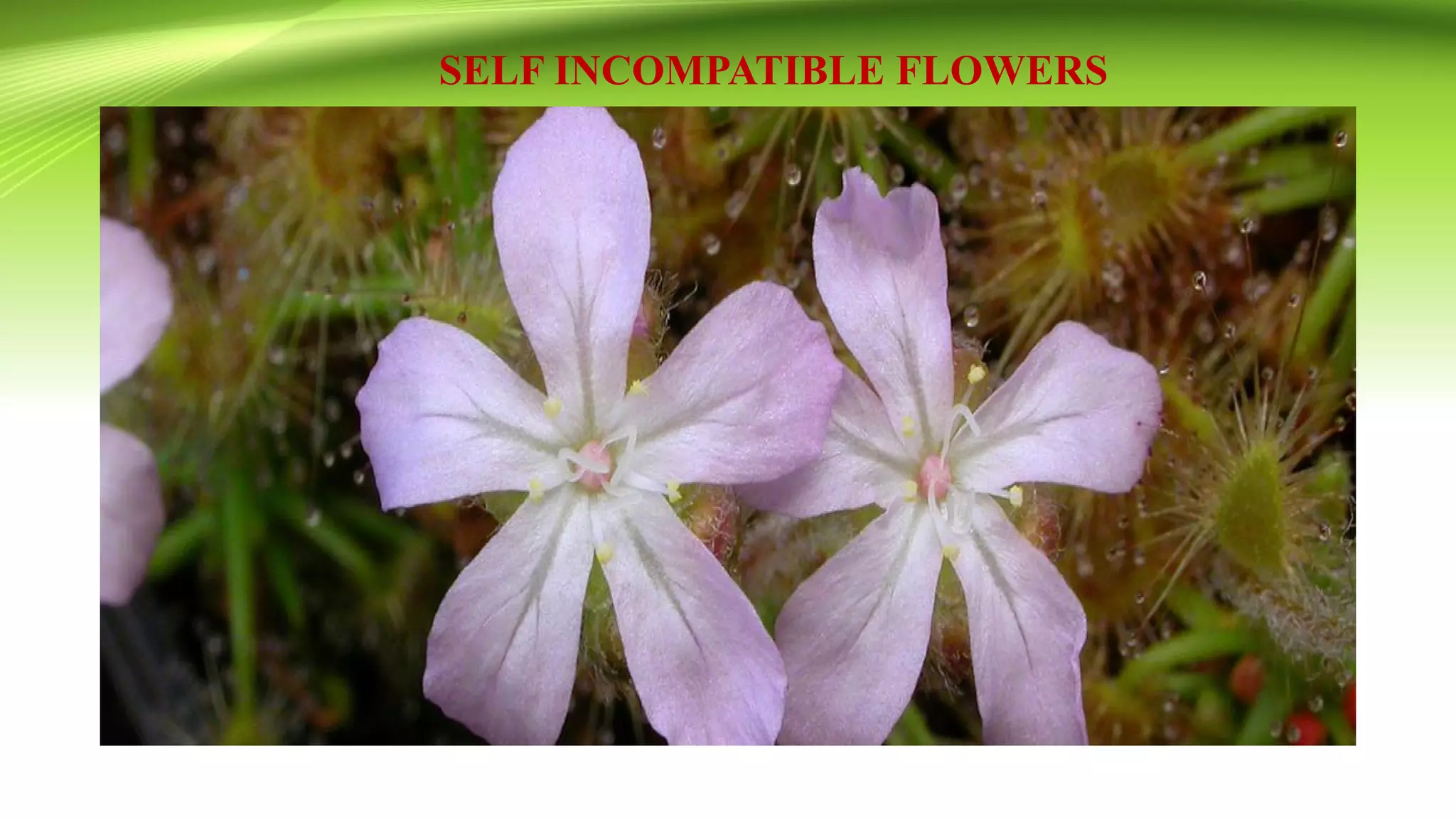
SELF INCOMPATIBLE FLOWERS
SELF INCOMPATIBILITY
• Self Incopatibility or Intra-specific incompatibility is a well designed genetic
mechanisms by which a certain plants recognise and reject their own pollen to
ensure outbreeding.It is defined as “Inability of the plant producing functional
gamerts to set seed upon self pollinsation”(Brewbaker, 1957). Lundqvist(1964)
defined it as “the inability of fertile hermaphrodite seed plant to produce zygotes
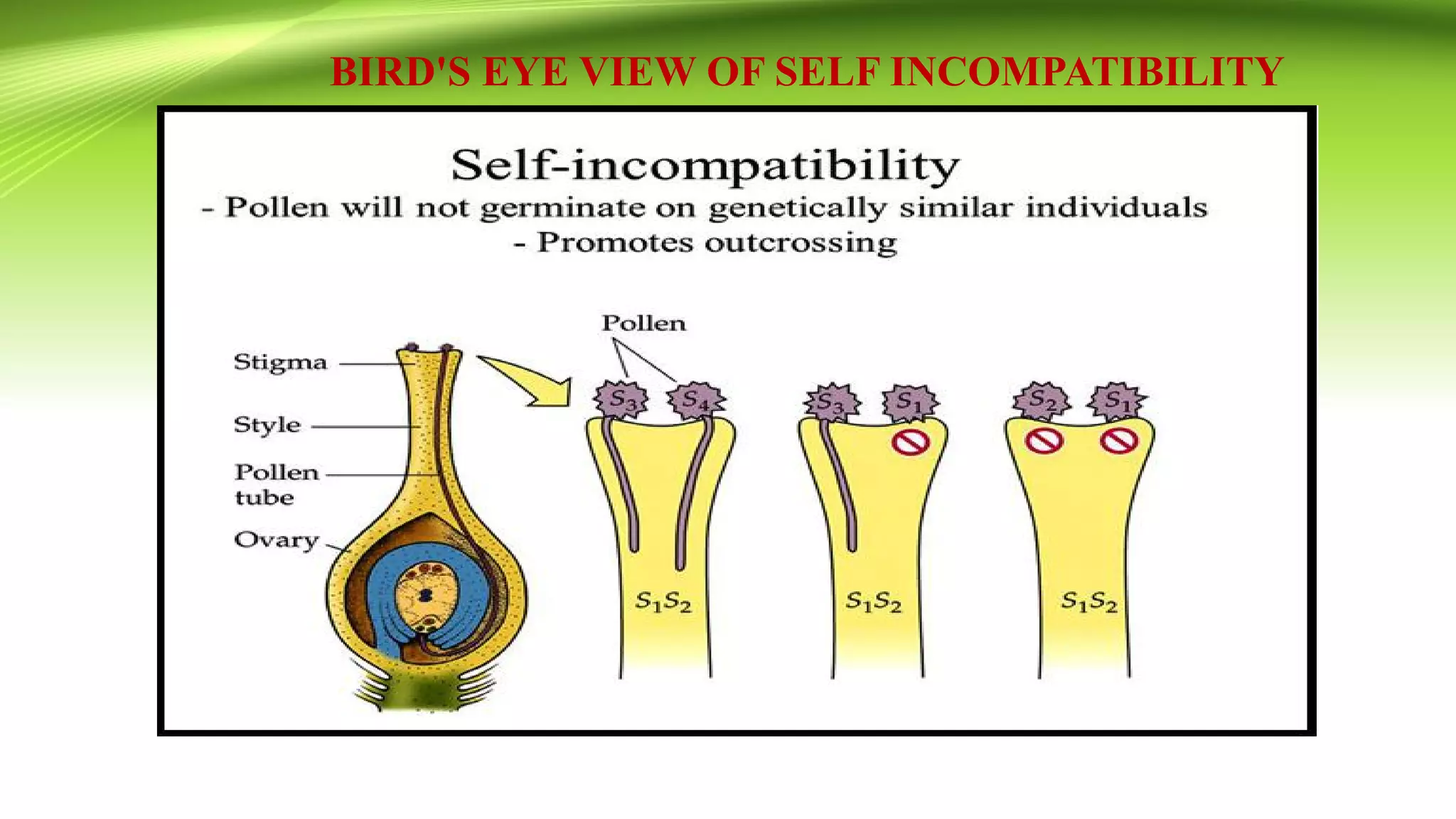
after self pollination”.Its genetic system is based on a single locus, the sterility(S)
locus, with a multiple alleles.Pollen grains germination is blocked along with the
hinderance of pollen tube when the pollen grain or the stigma upon which it lands
have the same allele at the same locus.
• Besides the genetic make up, the intraspecific incompatibility is associated with
different lengths of the stamens and the style in flowers on the same plant.
• This self incompatibility is acquired nearly one or two days before anthesis as
well as open flowers.(Clarke et al. 1990).Nearly 2/3 rd of the families of
angiosperms exhibit self incompatibility.
BIRD'S EYE VIEW OF SELF INCOMPATIBILITY
ALLELES AND MULTIPLE ALLELES
• Allele is a general term denote the alternative forms of a gene or contrasting gene
pair that denote the alternative form of a gene is called allele but multiple alleles
are many alleles of a single gene-multiple allelism.
• Three or more kinds of gene which occuipy the same locus are referred to as
multiple alleles”(Altenburg)
• 1. Situated on the homologous chromosomes
• 2.No crossing over between the members of multiple alleles-CV is intergeneric
recombination.
• 3.Never show complementation with each other.
• Wings of Drosophila, Coat color of Rabbit,Self sterility in plants Blood groups
in man, Rhesus blood group of man, Pleiotropism.
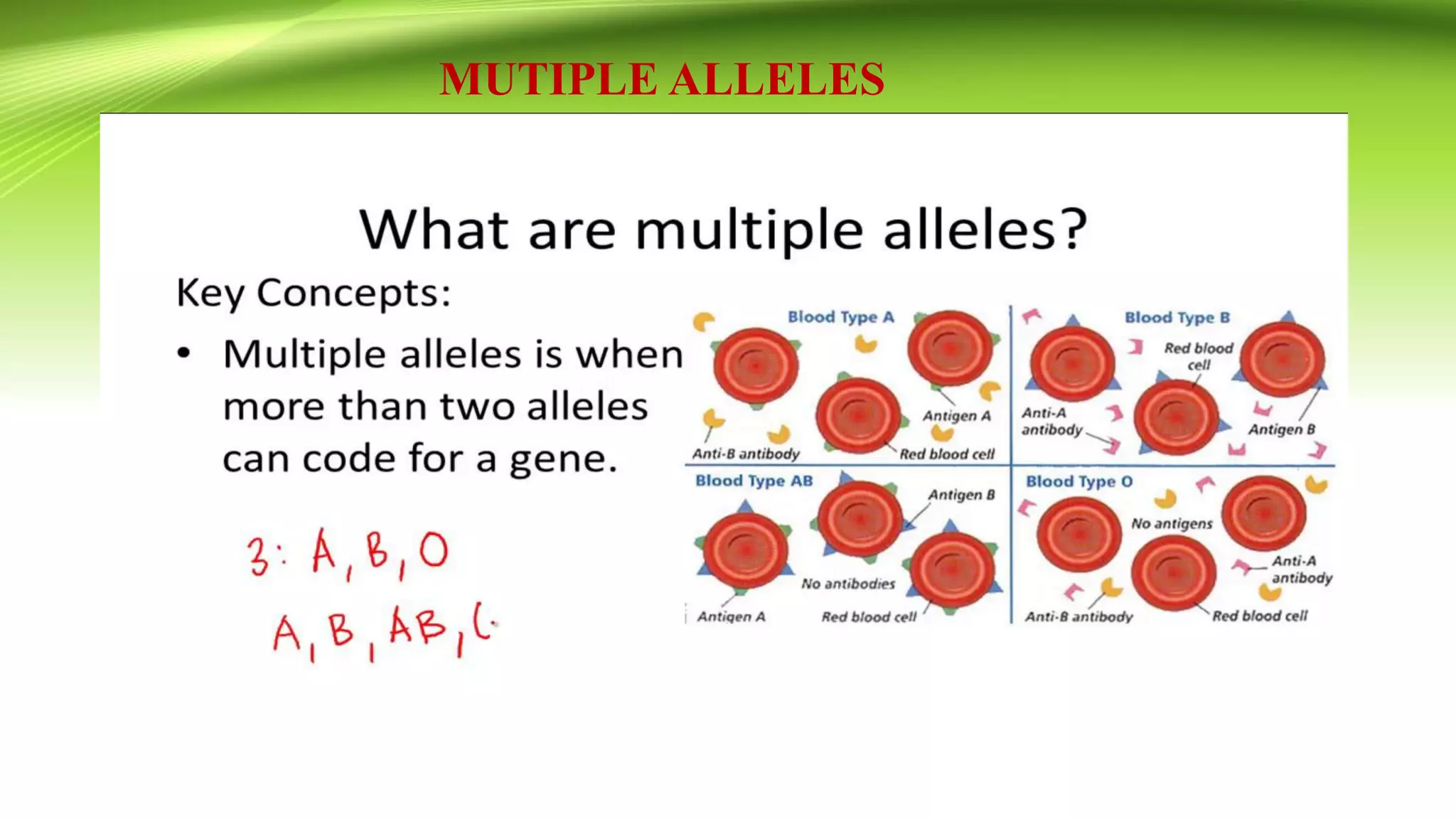
MUTIPLE ALLELES
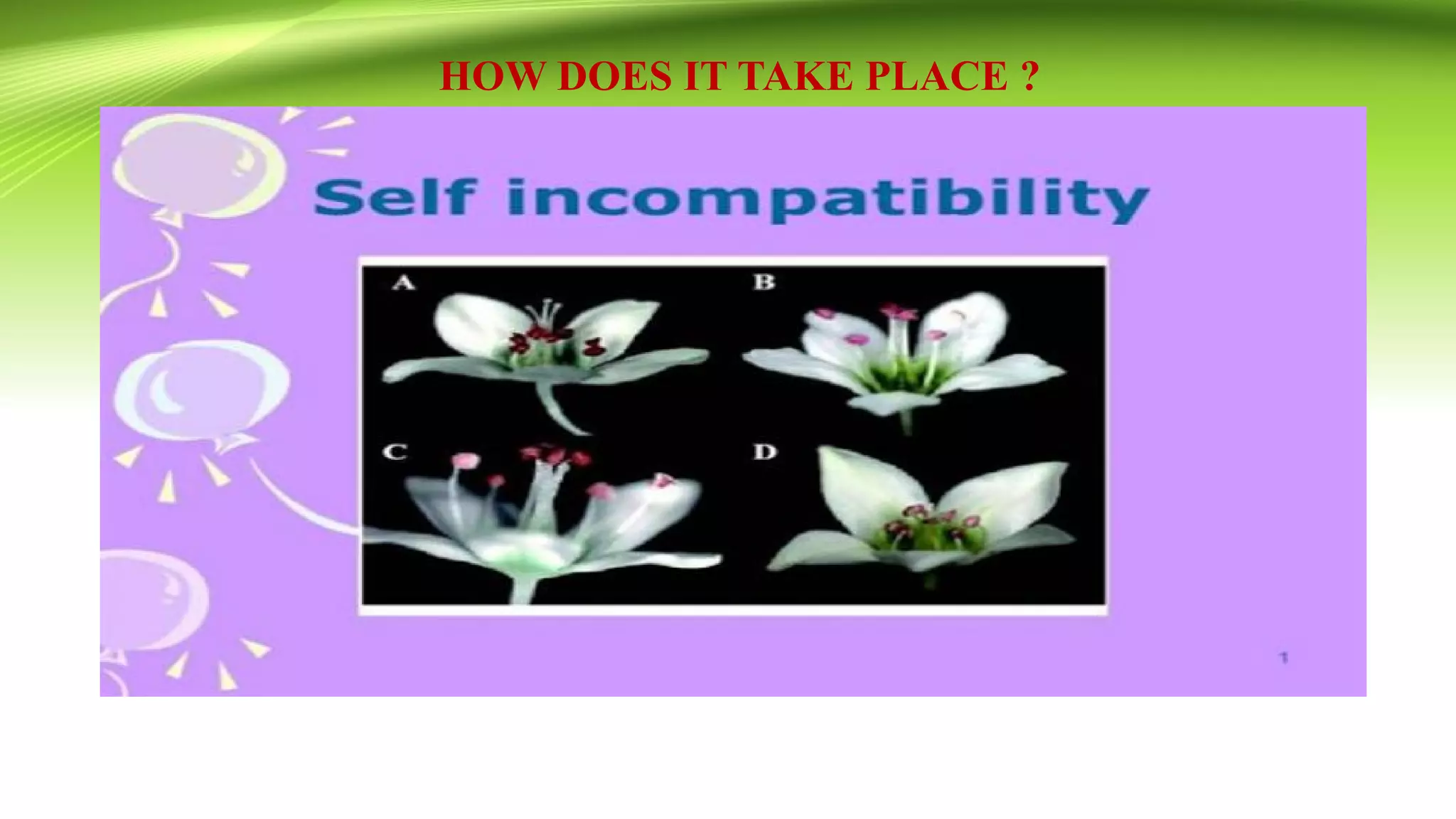
HOW DOES IT TAKE PLACE ?
SELF INCOPATIBILITY-WHERE?
• The significance of the SI in the evolutionary context can not be overstated ,
since it possession leads to obligate outbreeding and the maintenance of
heterozygosity within a species.
• In the crop and ornamental plants, most of the perennial grasses, forge, legumes
and members of Brassicaceae, Asteraceae, Rosaceae and solanaceae have SI
mechanism of varying kinds and degree of efectiveness.
• Prevents selfing and promote outbreeding increases the probablity of new gene
combinations,
• May operate at any stage between pollination and fertlization,
• Reduces Homozygosity
• Prevents autogamy
• About 70 families of angiosperms possess this uniquness
SELF INCOMPATIBILITY
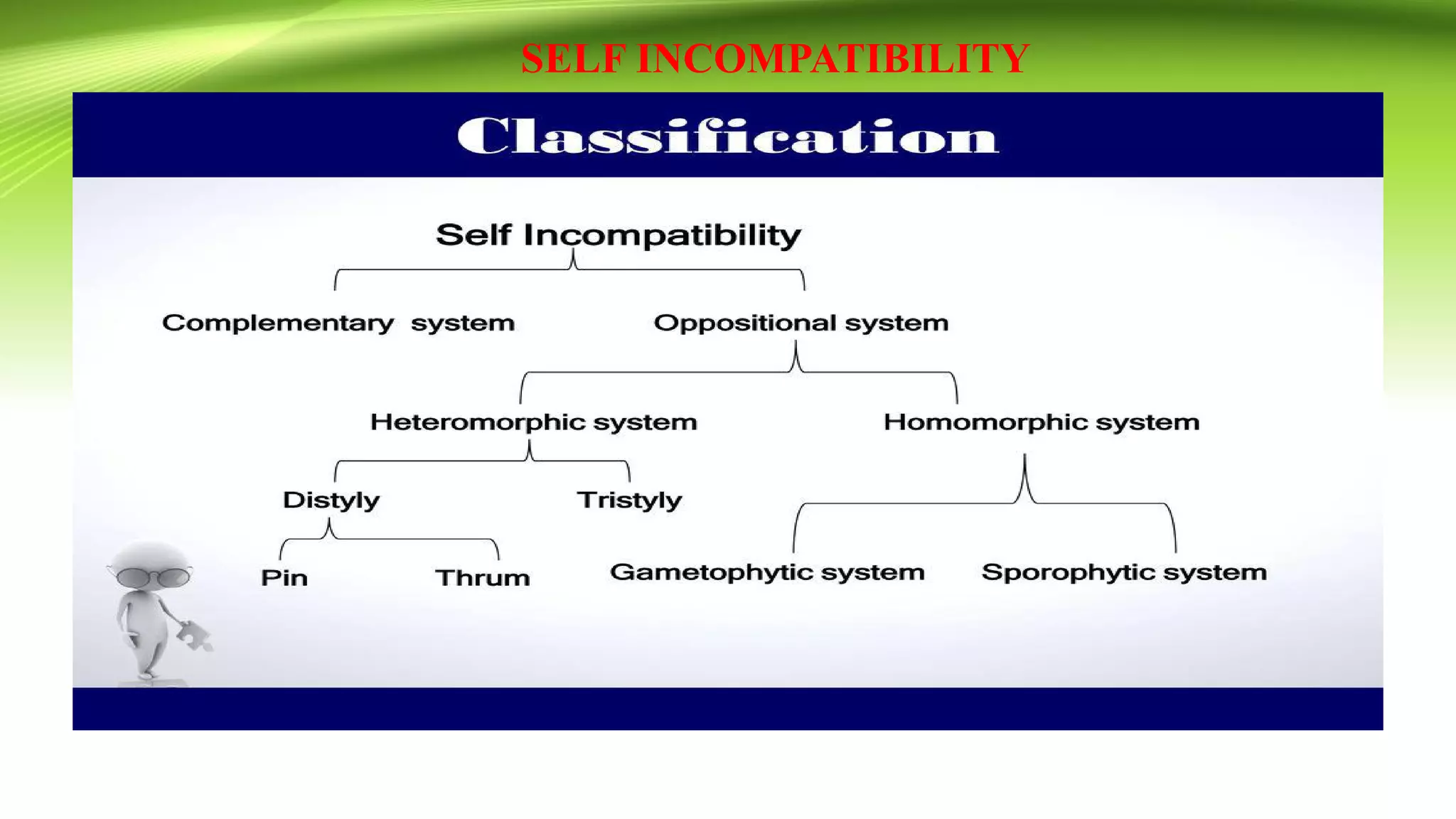
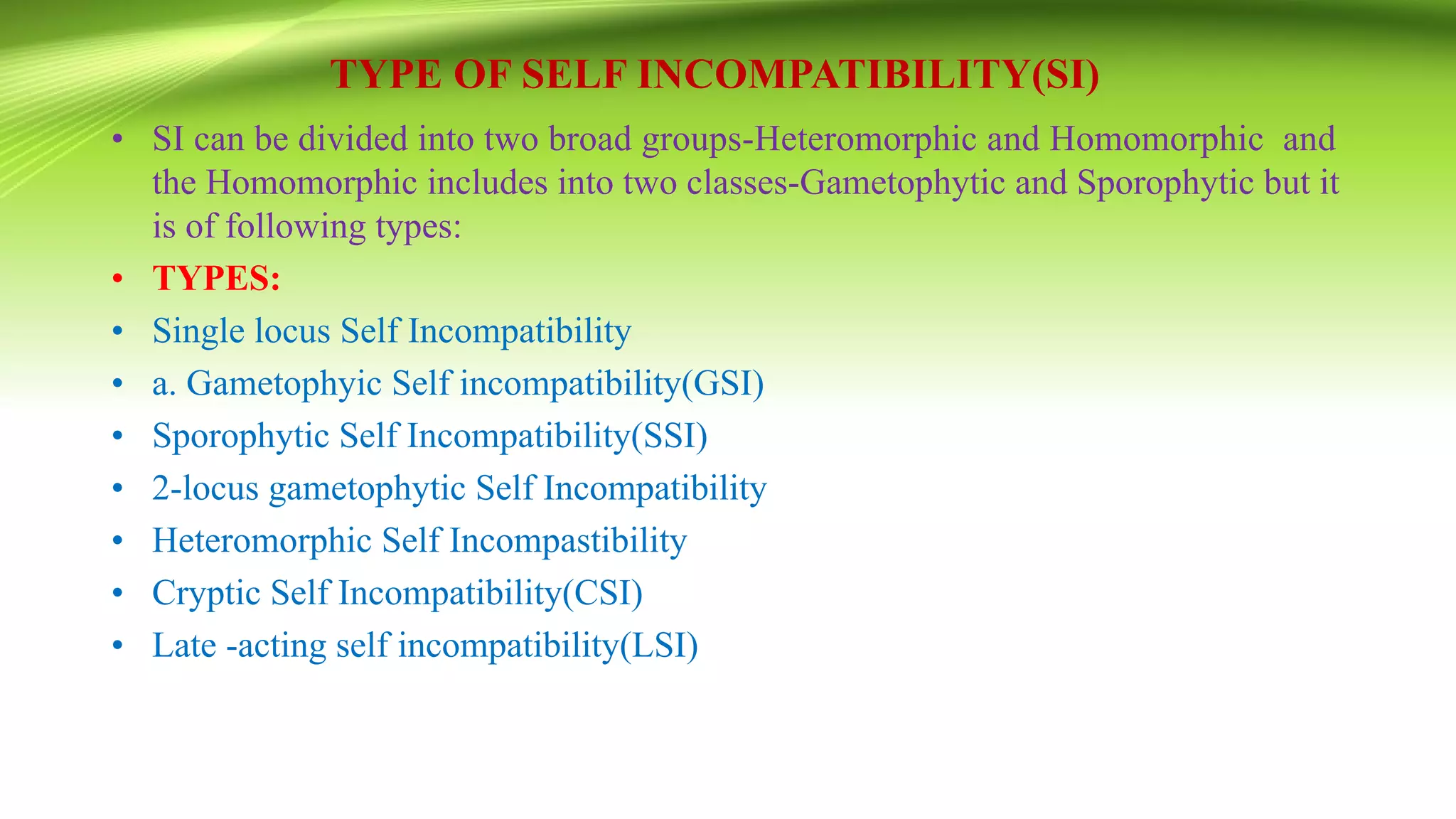
TYPE OF SELF INCOMPATIBILITY(SI)
• SI can be divided into two broad groups-Heteromorphic and Homomorphic and
the Homomorphic includes into two classes-Gametophytic and Sporophytic but it
is of following types:
• TYPES:
• Single locus Self Incompatibility
• a. Gametophyic Self incompatibility(GSI)
• Sporophytic Self Incompatibility(SSI)
• 2-locus gametophytic Self Incompatibility
• Heteromorphic Self Incompastibility
• Cryptic Self Incompatibility(CSI)
• Late -acting self incompatibility(LSI)
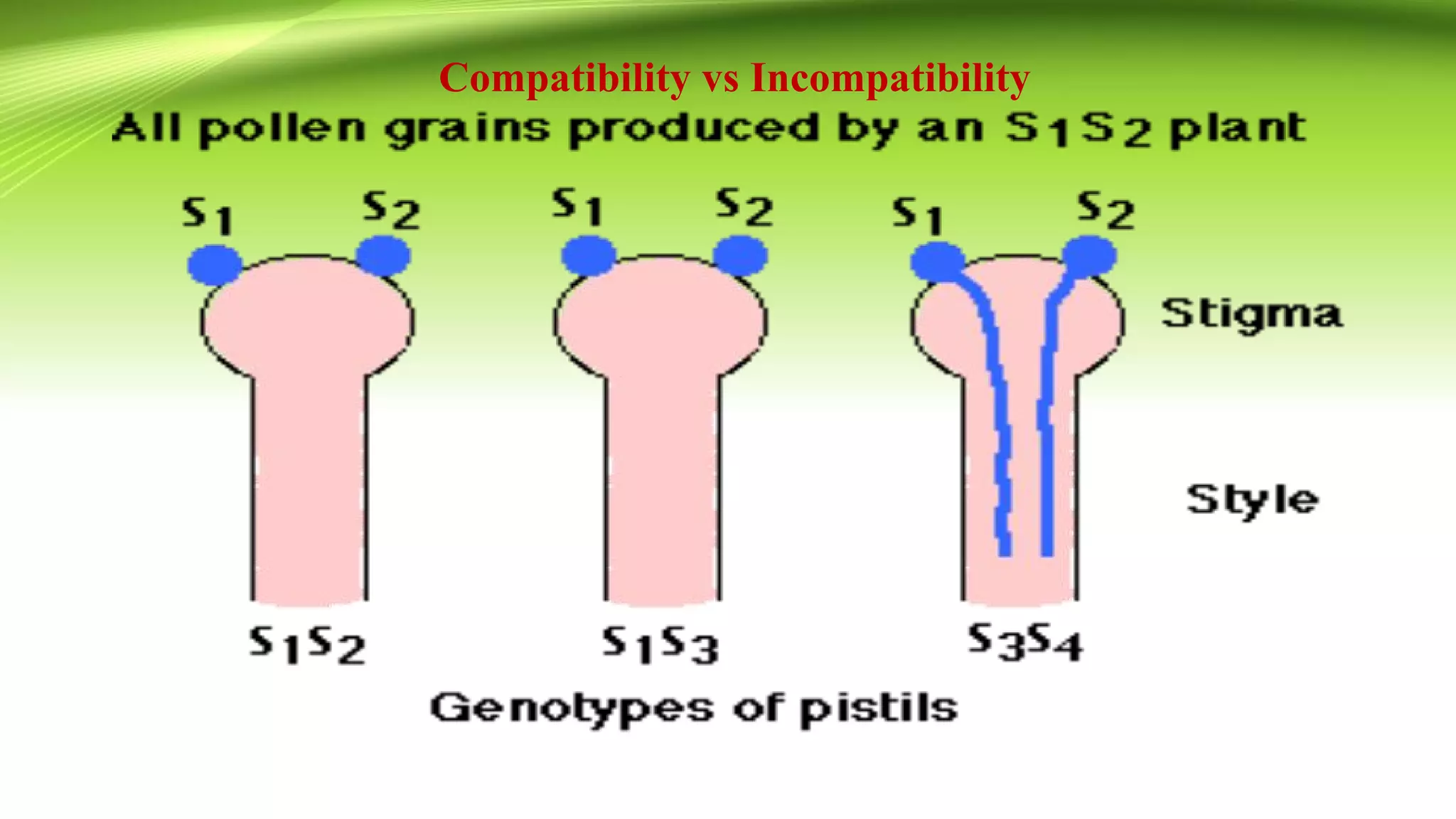
Compatibility vs Incompatibility
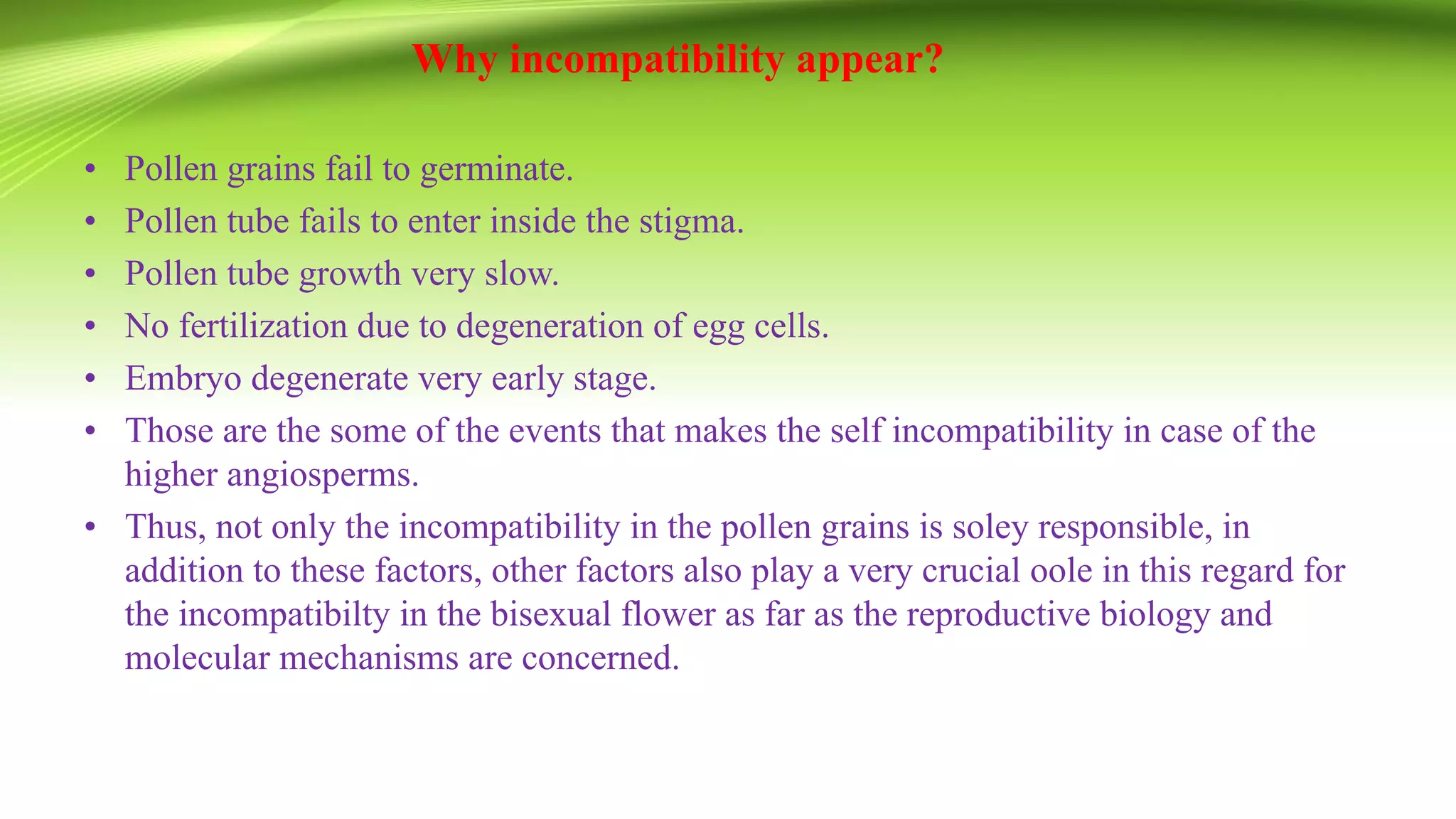
Why incompatibility appear?
• Pollen grains fail to germinate.
• Pollen tube fails to enter inside the stigma.
• Pollen tube growth very slow.
• No fertilization due to degeneration of egg cells.
• Embryo degenerate very early stage.
• Those are the some of the events that makes the self incompatibility in case of the
higher angiosperms.
• Thus, not only the incompatibility in the pollen grains is soley responsible, in
addition to these factors, other factors also play a very crucial oole in this regard for
the incompatibilty in the bisexual flower as far as the reproductive biology and
molecular mechanisms are concerned.
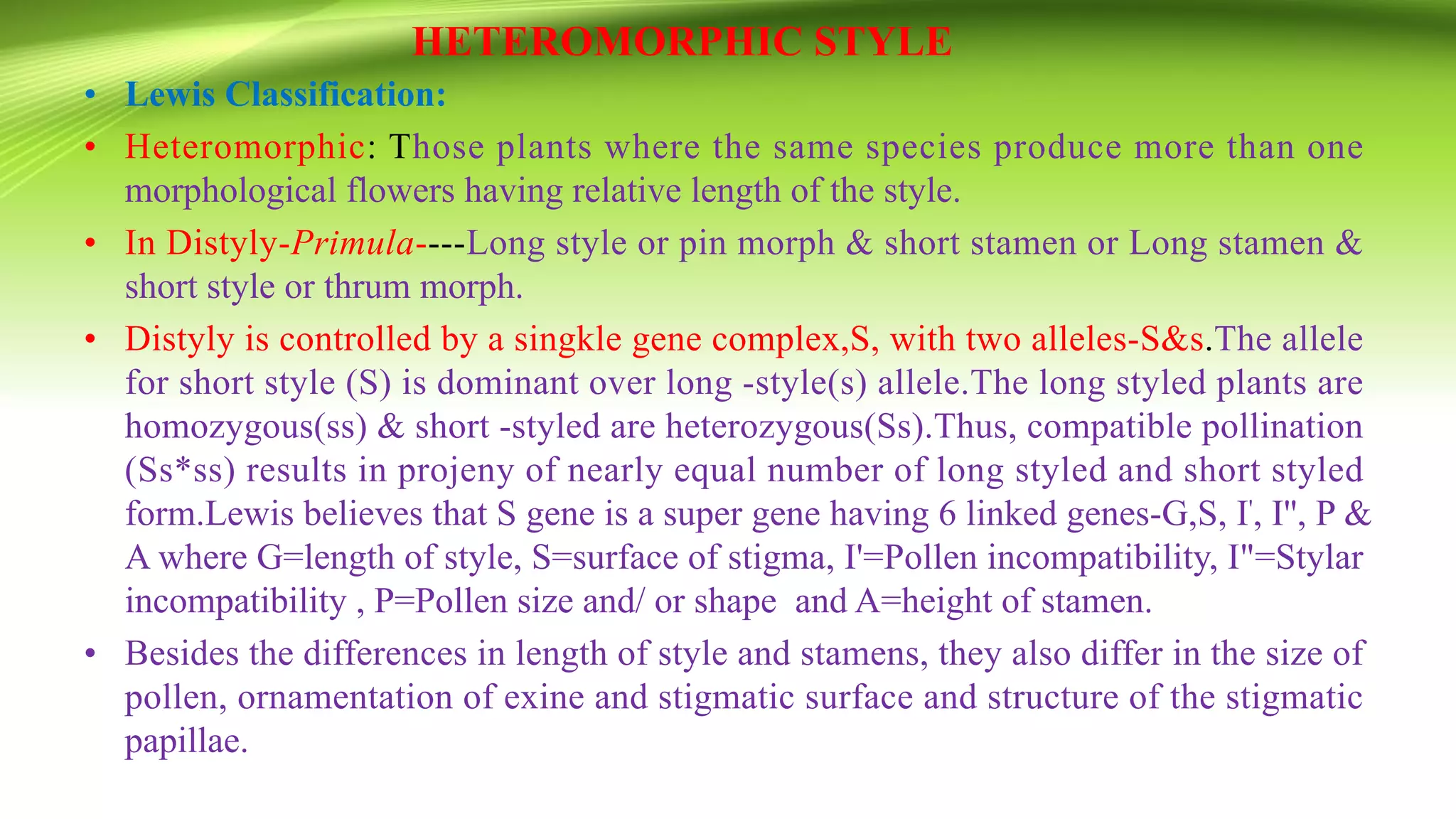
HETEROMORPHIC STYLE
• Lewis Classification:
• Heteromorphic: Those plants where the same species produce more than one
morphological flowers having relative length of the style.
• In Distyly-Primula----Long style or pin morph & short stamen or Long stamen &
short style or thrum morph.
• Distyly is controlled by a singkle gene complex,S, with two alleles-S&s.The allele
for short style (S) is dominant over long -style(s) allele.The long styled plants are
homozygous(ss) & short -styled are heterozygous(Ss).Thus, compatible pollination
(Ss*ss) results in projeny of nearly equal number of long styled and short styled
form.Lewis believes that S gene is a super gene having 6 linked genes-G,S, I', I'', P &
A where G=length of style, S=surface of stigma, I'=Pollen incompatibility, I"=Stylar
incompatibility , P=Pollen size and/ or shape and A=height of stamen.
• Besides the differences in length of style and stamens, they also differ in the size of
pollen, ornamentation of exine and stigmatic surface and structure of the stigmatic
papillae.
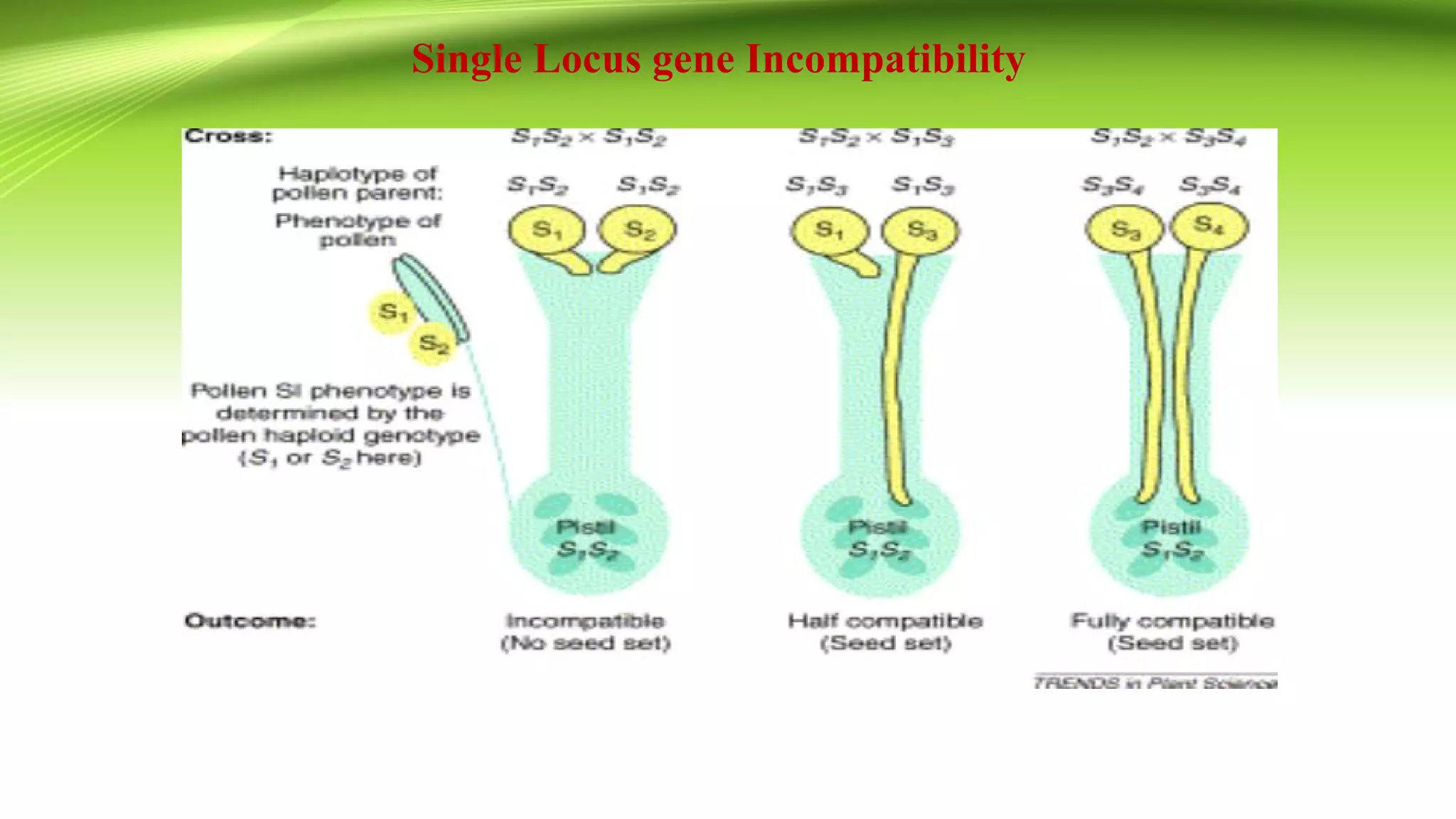
Single Locus gene Incompatibility
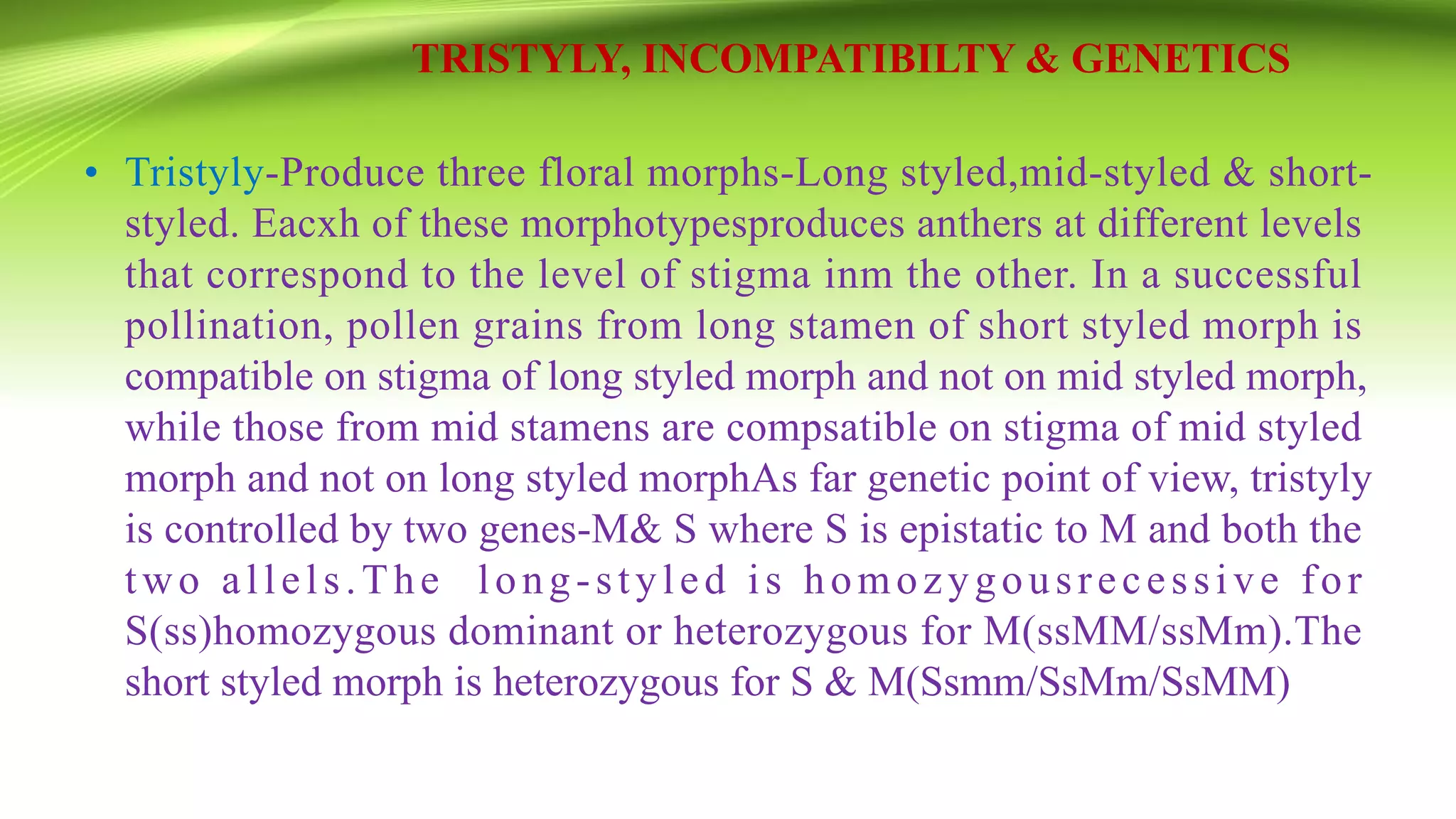
TRISTYLY, INCOMPATIBILTY & GENETICS
• Tristyly-Produce three floral morphs-Long styled,mid-styled & short-
styled. Eacxh of these morphotypesproduces anthers at different levels
that correspond to the level of stigma inm the other. In a successful
pollination, pollen grains from long stamen of short styled morph is
compatible on stigma of long styled morph and not on mid styled morph,
while those from mid stamens are compsatible on stigma of mid styled
morph and not on long styled morphAs far genetic point of view, tristyly
is controlled by two genes-M& S where S is epistatic to M and both the
two allels.The long-styled is homozygousrecessive for
S(ss)homozygous dominant or heterozygous for M(ssMM/ssMm).The
short styled morph is heterozygous for S & M(Ssmm/SsMm/SsMM)
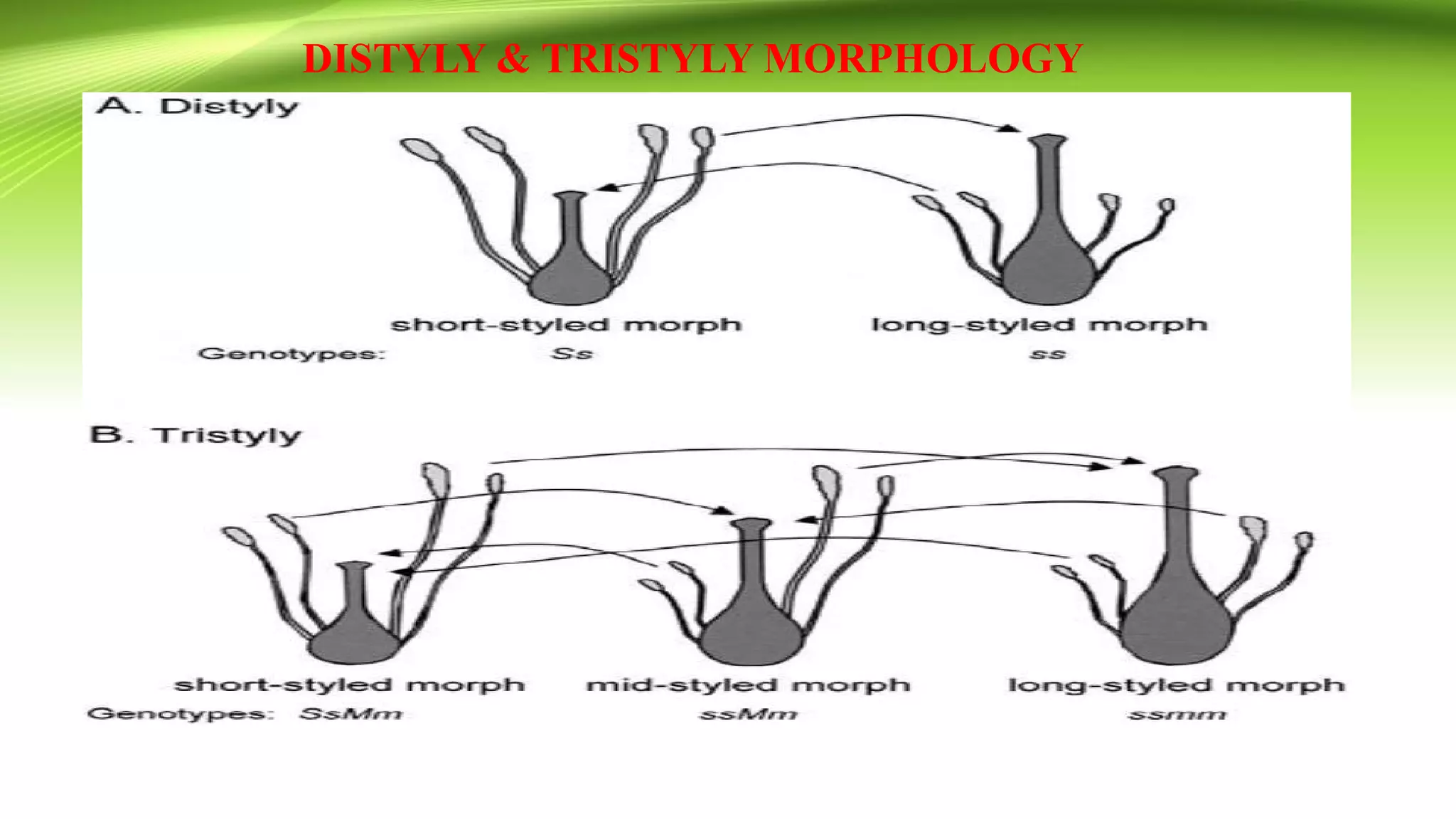
DISTYLY & TRISTYLY MORPHOLOGY
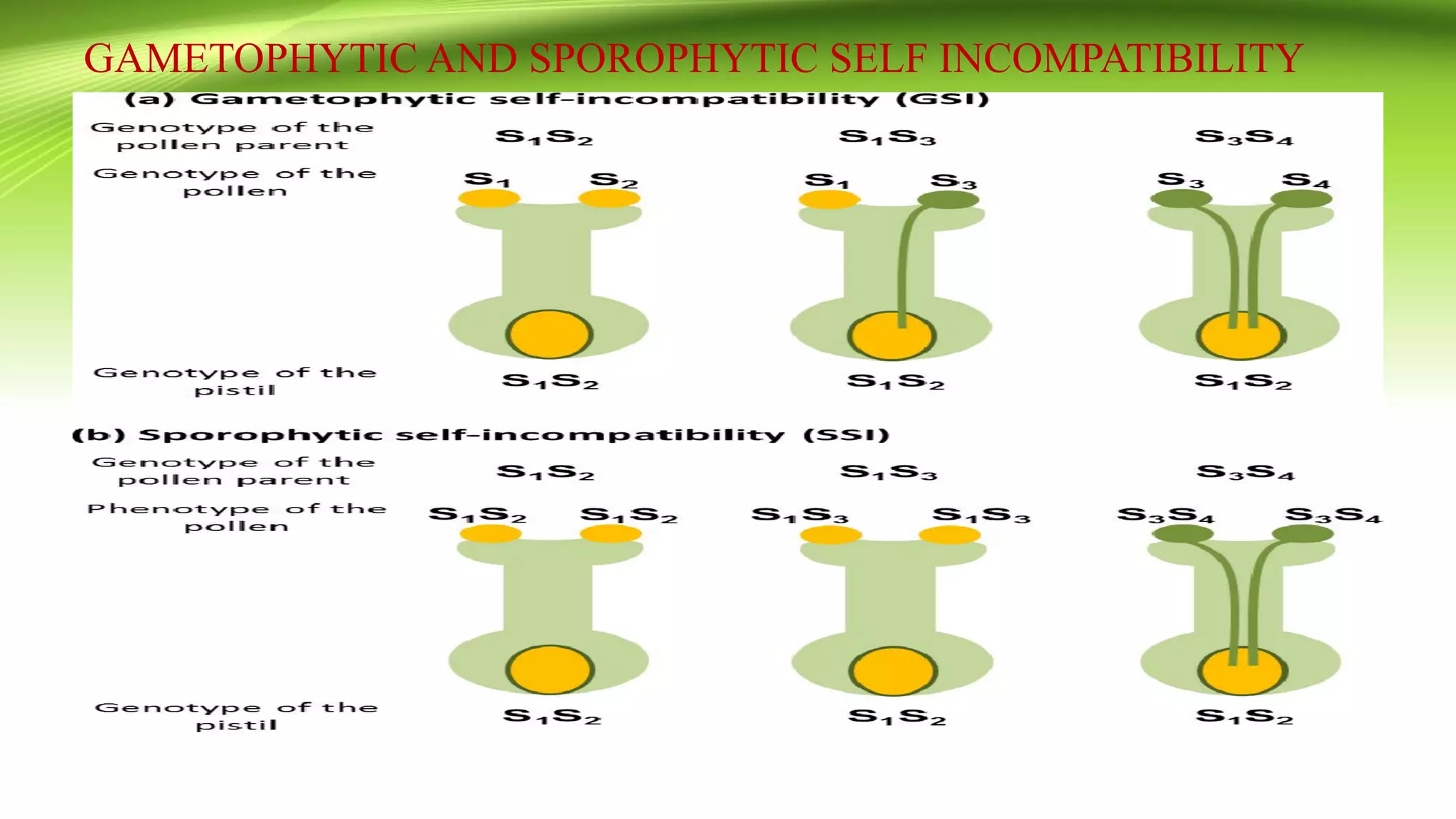
GAMETOPHYTIC & SPOROPHYTIC SELF INCOMPATIBILITY
• Heteromorphic incompatibility , the flowers produced by different plants do not
show morphological variations. Tha physiological barriers act in such a way that
pollens do not germinate on a stigmaof similar genetic constitution or theor growth
so slow that by the time, the pollen tube reaches the embryo sac, the latter withers
out.Almost, all the molecular woirk on self incompatibility has come from
homomorphic systems which have been reported over 250 genera.
• The most common type is sporophytic self-incompatibility, in which the secretions of
the stigmatic tissue or the transmitting tissue prevent the germination or growth of
incompatible pollen.
• Self-incompatibility (SI) prevents the production of "self" seed and inbreeding by
providing a recognition and rejection system for "self," or genetically identical,
pollen. Studies of gametophytic SI (GSI) species at a molecular level have identified
two completely different S-genes and SI mechanisms.
GAMETOPHYTIC AND SPOROPHYTIC SELF INCOMPATIBILITY
SPOROPHYTIC SELF INCOMPATIBILITY-SSI
When not the genotype of the pollen grains but the genotype of the parent plants control
the compatibility , then it is called Sporophytic Self Incompatibility.
Multiple alleles are very common occurence .Let single gene locus is S and its multiple
alleles are S
S1 S2 S3 S4 S5 S6 S7 S 8S9 -------
According to Eest and Mangeledrof(1925), Cabbage has 30 alleles, Oenothera have 37
& Red clover have 200 alleles or more that has impact on the self incompastibility of
the plant in course of reproductive beheaviour.
In the gametophytic self incompatibility, phenotype is determined by the genotype of
the pollen grains, whereas in the sporophytic type, pollen rejection is imposed by the
genotype of the pollen parent plant and not by the pollen genotype.
In the gametophytic type, pollen rejection mechanism operate in the style, leading to the
inhibition of pollen tube growth whereas the stigma is the site for pollen rejection in the
sporophytic type due to failure of its pollen germination.
METHODS TO OVERCOME SELF INCOMPATIBILITY
Many techniques are available to overcome the self incompatibility and it depends on
the different external & internal factors of Pollen viability.Some of the methods are -
1. Bud pollination-Most successful system for SSI & GSI where the pollination is done
before two days of anthesis.
2. Mixed pollination-The stigma is camoflagued from recognising the incompatible
pollen. A mixture of pollen is artificially placed on the stigma with chemically or
irridiatedly treated compatible pollen and live incompatible pollen.It is thought that if
the stigma is pollinated with treated compatible pollen aloing with live incompatible
pollen, the proteins relaeased from the former facade the inhibition reaction at the
surface of the stigma. Self incompatibility is overcome by this method as in
Cosmos(SSI) & Petunia (GSI).
3.Deferred pollination-If pollination is deferred for few days, incopatible pollen pass
through the style to overcome self incompatibility.
METHODS TO OVERCOME-------------
4.Test tube pollination-Here, the stigmatic, stylar and ovary walls are directly removed,
the ovules are directly dusted with pollen grains and the pollinated ovules are cultured
in test tube with media for embryogenesis.e.g Papver somniferum, Nicotiana rustica.
5. Stub pollination- The stigma and the part of the styles are removed and the cut
surface is pollinated with the incompatible pollen grains to make fertilization successful
e.g Nicotiana tabecum
6.Intra-ovarian pollination-Where the zone of the incompatibility lies in the stigma or in
the style, there pollen suspension can be applied directly in the ovary to overcome self
incompatibility,. The ovary is sterilized followed by the acquous pollen suspension
injection by a hypodermal syringe followed by the sealing of the holes by petrolium
jelly.Now the introduce pollen grains germinate and fertlilze successfully. e.g Argemone
mexicana.
7. In vitro pollination-To overcome the pre-zygotic barrier, the exposed ovules are
dusted with pollen grains and then cultured in a suitable nutrient media that supported
both the germination pollen as well as fertilized ovules.eg Papaver somniferum.
8.
CONTINUATION----------------------------------
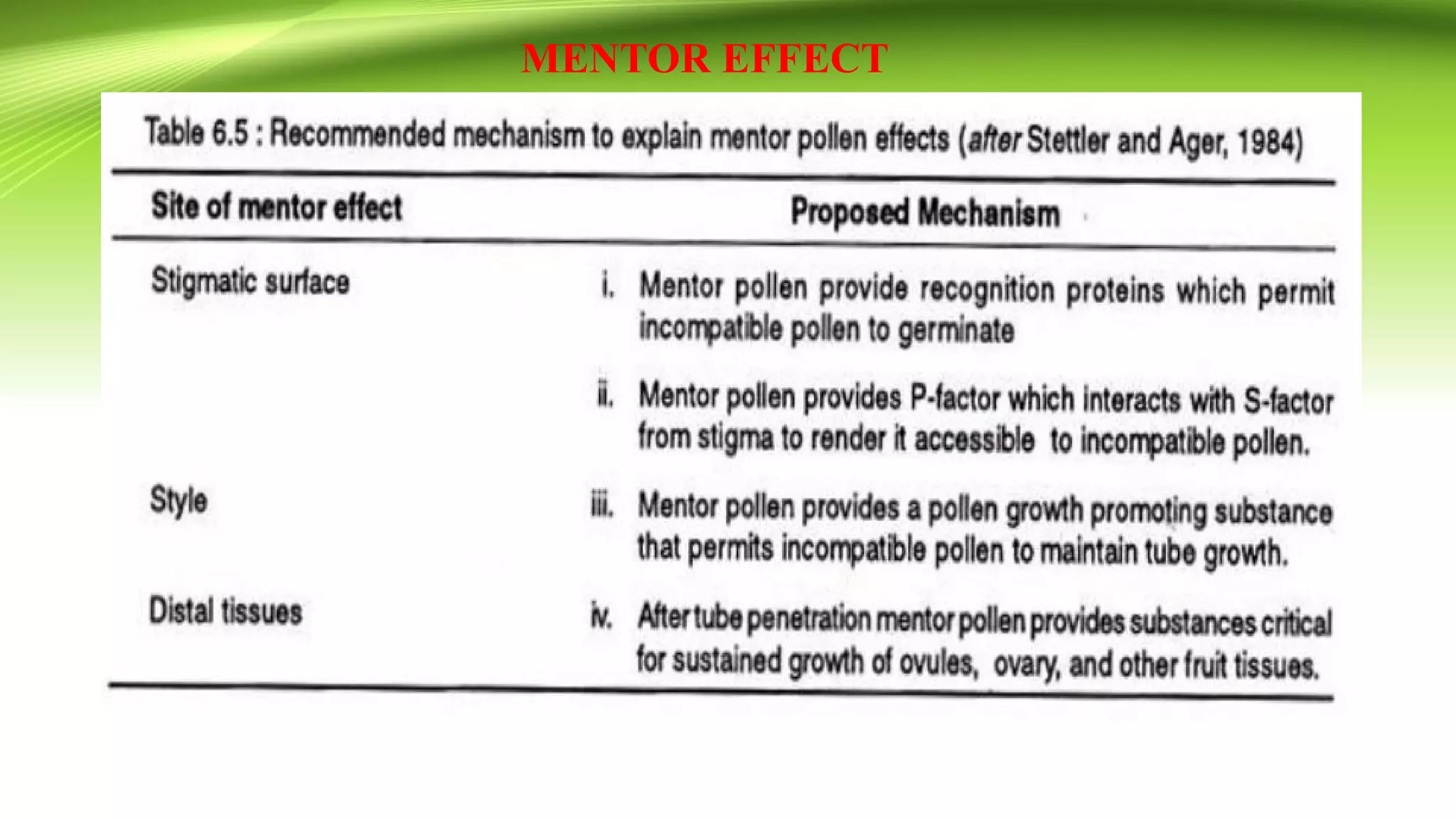
8.Use of mentor pollen-The compatible pollen made ineffective by irradiation or
repeated freezing or chemical like ethanol treatment along with the use of incompatible
pollen to overcome incompatibility. In Cosmos, this process has been widely applied
9.Elevated temperature treatment-Incompatibility is affected with high temperature
treatnment.Hot water treatment of Lilium longiflorum detatched or intact styles at 50C
for 6 minutes before pollination help to overcome incompatibility.Temporary
suspension of incompsatibility reaction was acheived in Oenothera following the style
and the stigma with hot water at 50C for 5 minutes.Further, the stress generated by the
daily variation of the temperature has a positive effect in the strength of self-
incompatibility.
10.Irradiation-X ray irradiation of flower buds at pollen mother cell stage helps to
overcome self incompatibility.The irradiation damages the physiological mechanisms of
self incompatibility in the style, thus allowing the pollen tube to pass through the
style.Induced mutation at the S-locus in Oenothera organensis and porunus avium have
been reported by Lewis & Crowe(1953)
MENTOR EFFECT
METHODS TO OVERCOME SI
• 11.Surgical method-The removal of stigma as SSI can be exercised and the
decapitation of the stigma is done before pollination or deposition of the pollen
grains directly into the stylar tissues through a slit has helped in overcoming the self
incompatibility.
• 12. Application of Chemicals-Different chemicals including the growth hormones
have been effective to overcome SI. Olivomycine, Cyclohexamide-the inhibitors of
RNA & protein synthesis could overcome self incompatibility in Petunia hybrida
when injected into the flower buds just 2-3 days before anthesis.Hexane become
effective to inactivate the incompatibility factors on the stigma.Application of p-
chloromercuribenzens also promoted pollen tube growth in incompatible style of
Oenothera organesis.
• In addition to this , the protoplast fusion is also exercised that involves the fusion of
somatic protoplast as recognised as parasexual hybridization.It includes-Isolation of
protoplasts, fusion of isolated protoplasts and culture of hybrid protoplasts to
generate whole plants.
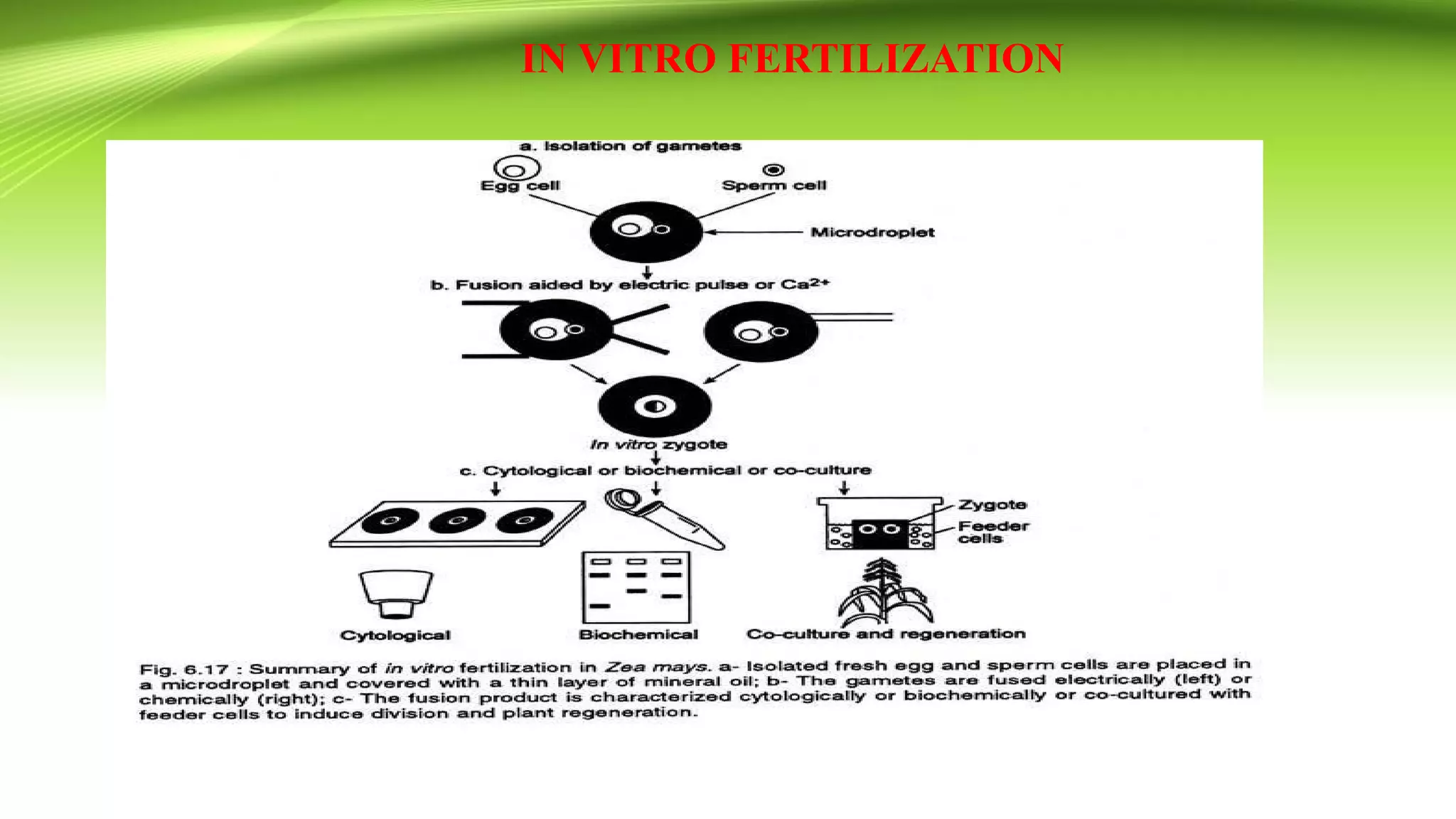
IN VITRO FERTILIZATION
SUMMARY
• Fertilization in flowering plants begins with a pollen grain bearing the male gametes
landing on the female stigma prior to fertilization. Several mechanisms enable the
stigma to discriminate between the different types of pollen that it may receive, of
which the best studied is self-incompatibility. The molecules that regulate self-
incompatibility are well characterized in two plant families, the Solanaceae and
Brassicaceae. This list has recently been extended to include candidates for self-
incompatibility molecules from the Rosaceae, Papaveraceae and Poaceae. The
information provided by the sequences of these molecules gives insight into the
mechanisms and evolution of self-incompatibility in the different families of
flowering plants.But the self incompatibility issue can be addressed to overcome by
the different mechanisms and the deserved genetic traits can be maintained for the
sake of agricultural inputs that have high market value in the retrospect of the quality
and quantity enhancement of crop production.This domain deserves a strog appeal in
the field of Plant breeding Programmes.
HOPE, YOU HAVE ENJOYED THIS JOURNEY.THANK YOU

Self incompatibility in Flowers of Angiosperms

  • 1.
    REPRODUCTIVE BIOLOGY SELF INCOMPATIBILITYIN FLOWERS BY N.Sannigrahi, Associate Professor, Department of Botany, Nistarini College, D.B.Road, Purulia (W.B) India
  • 2.
  • 3.
    SELF INCOMPATIBILITY • SelfIncopatibility or Intra-specific incompatibility is a well designed genetic mechanisms by which a certain plants recognise and reject their own pollen to ensure outbreeding.It is defined as “Inability of the plant producing functional gamerts to set seed upon self pollinsation”(Brewbaker, 1957). Lundqvist(1964) defined it as “the inability of fertile hermaphrodite seed plant to produce zygotes after self pollination”.Its genetic system is based on a single locus, the sterility(S) locus, with a multiple alleles.Pollen grains germination is blocked along with the hinderance of pollen tube when the pollen grain or the stigma upon which it lands have the same allele at the same locus. • Besides the genetic make up, the intraspecific incompatibility is associated with different lengths of the stamens and the style in flowers on the same plant. • This self incompatibility is acquired nearly one or two days before anthesis as well as open flowers.(Clarke et al. 1990).Nearly 2/3 rd of the families of angiosperms exhibit self incompatibility.
  • 4.
    BIRD'S EYE VIEWOF SELF INCOMPATIBILITY
  • 5.
    ALLELES AND MULTIPLEALLELES • Allele is a general term denote the alternative forms of a gene or contrasting gene pair that denote the alternative form of a gene is called allele but multiple alleles are many alleles of a single gene-multiple allelism. • Three or more kinds of gene which occuipy the same locus are referred to as multiple alleles”(Altenburg) • 1. Situated on the homologous chromosomes • 2.No crossing over between the members of multiple alleles-CV is intergeneric recombination. • 3.Never show complementation with each other. • Wings of Drosophila, Coat color of Rabbit,Self sterility in plants Blood groups in man, Rhesus blood group of man, Pleiotropism.
  • 6.
  • 7.
    HOW DOES ITTAKE PLACE ?
  • 8.
    SELF INCOPATIBILITY-WHERE? • Thesignificance of the SI in the evolutionary context can not be overstated , since it possession leads to obligate outbreeding and the maintenance of heterozygosity within a species. • In the crop and ornamental plants, most of the perennial grasses, forge, legumes and members of Brassicaceae, Asteraceae, Rosaceae and solanaceae have SI mechanism of varying kinds and degree of efectiveness. • Prevents selfing and promote outbreeding increases the probablity of new gene combinations, • May operate at any stage between pollination and fertlization, • Reduces Homozygosity • Prevents autogamy • About 70 families of angiosperms possess this uniquness
  • 9.
  • 10.
    TYPE OF SELFINCOMPATIBILITY(SI) • SI can be divided into two broad groups-Heteromorphic and Homomorphic and the Homomorphic includes into two classes-Gametophytic and Sporophytic but it is of following types: • TYPES: • Single locus Self Incompatibility • a. Gametophyic Self incompatibility(GSI) • Sporophytic Self Incompatibility(SSI) • 2-locus gametophytic Self Incompatibility • Heteromorphic Self Incompastibility • Cryptic Self Incompatibility(CSI) • Late -acting self incompatibility(LSI)
  • 11.
  • 12.
    Why incompatibility appear? •Pollen grains fail to germinate. • Pollen tube fails to enter inside the stigma. • Pollen tube growth very slow. • No fertilization due to degeneration of egg cells. • Embryo degenerate very early stage. • Those are the some of the events that makes the self incompatibility in case of the higher angiosperms. • Thus, not only the incompatibility in the pollen grains is soley responsible, in addition to these factors, other factors also play a very crucial oole in this regard for the incompatibilty in the bisexual flower as far as the reproductive biology and molecular mechanisms are concerned.
  • 13.
    HETEROMORPHIC STYLE • LewisClassification: • Heteromorphic: Those plants where the same species produce more than one morphological flowers having relative length of the style. • In Distyly-Primula----Long style or pin morph & short stamen or Long stamen & short style or thrum morph. • Distyly is controlled by a singkle gene complex,S, with two alleles-S&s.The allele for short style (S) is dominant over long -style(s) allele.The long styled plants are homozygous(ss) & short -styled are heterozygous(Ss).Thus, compatible pollination (Ss*ss) results in projeny of nearly equal number of long styled and short styled form.Lewis believes that S gene is a super gene having 6 linked genes-G,S, I', I'', P & A where G=length of style, S=surface of stigma, I'=Pollen incompatibility, I"=Stylar incompatibility , P=Pollen size and/ or shape and A=height of stamen. • Besides the differences in length of style and stamens, they also differ in the size of pollen, ornamentation of exine and stigmatic surface and structure of the stigmatic papillae.
  • 14.
    Single Locus geneIncompatibility
  • 15.
    TRISTYLY, INCOMPATIBILTY &GENETICS • Tristyly-Produce three floral morphs-Long styled,mid-styled & short- styled. Eacxh of these morphotypesproduces anthers at different levels that correspond to the level of stigma inm the other. In a successful pollination, pollen grains from long stamen of short styled morph is compatible on stigma of long styled morph and not on mid styled morph, while those from mid stamens are compsatible on stigma of mid styled morph and not on long styled morphAs far genetic point of view, tristyly is controlled by two genes-M& S where S is epistatic to M and both the two allels.The long-styled is homozygousrecessive for S(ss)homozygous dominant or heterozygous for M(ssMM/ssMm).The short styled morph is heterozygous for S & M(Ssmm/SsMm/SsMM)
  • 16.
  • 17.
    GAMETOPHYTIC & SPOROPHYTICSELF INCOMPATIBILITY • Heteromorphic incompatibility , the flowers produced by different plants do not show morphological variations. Tha physiological barriers act in such a way that pollens do not germinate on a stigmaof similar genetic constitution or theor growth so slow that by the time, the pollen tube reaches the embryo sac, the latter withers out.Almost, all the molecular woirk on self incompatibility has come from homomorphic systems which have been reported over 250 genera. • The most common type is sporophytic self-incompatibility, in which the secretions of the stigmatic tissue or the transmitting tissue prevent the germination or growth of incompatible pollen. • Self-incompatibility (SI) prevents the production of "self" seed and inbreeding by providing a recognition and rejection system for "self," or genetically identical, pollen. Studies of gametophytic SI (GSI) species at a molecular level have identified two completely different S-genes and SI mechanisms.
  • 18.
    GAMETOPHYTIC AND SPOROPHYTICSELF INCOMPATIBILITY
  • 19.
    SPOROPHYTIC SELF INCOMPATIBILITY-SSI Whennot the genotype of the pollen grains but the genotype of the parent plants control the compatibility , then it is called Sporophytic Self Incompatibility. Multiple alleles are very common occurence .Let single gene locus is S and its multiple alleles are S S1 S2 S3 S4 S5 S6 S7 S 8S9 ------- According to Eest and Mangeledrof(1925), Cabbage has 30 alleles, Oenothera have 37 & Red clover have 200 alleles or more that has impact on the self incompastibility of the plant in course of reproductive beheaviour. In the gametophytic self incompatibility, phenotype is determined by the genotype of the pollen grains, whereas in the sporophytic type, pollen rejection is imposed by the genotype of the pollen parent plant and not by the pollen genotype. In the gametophytic type, pollen rejection mechanism operate in the style, leading to the inhibition of pollen tube growth whereas the stigma is the site for pollen rejection in the sporophytic type due to failure of its pollen germination.
  • 20.
    METHODS TO OVERCOMESELF INCOMPATIBILITY Many techniques are available to overcome the self incompatibility and it depends on the different external & internal factors of Pollen viability.Some of the methods are - 1. Bud pollination-Most successful system for SSI & GSI where the pollination is done before two days of anthesis. 2. Mixed pollination-The stigma is camoflagued from recognising the incompatible pollen. A mixture of pollen is artificially placed on the stigma with chemically or irridiatedly treated compatible pollen and live incompatible pollen.It is thought that if the stigma is pollinated with treated compatible pollen aloing with live incompatible pollen, the proteins relaeased from the former facade the inhibition reaction at the surface of the stigma. Self incompatibility is overcome by this method as in Cosmos(SSI) & Petunia (GSI). 3.Deferred pollination-If pollination is deferred for few days, incopatible pollen pass through the style to overcome self incompatibility.
  • 21.
    METHODS TO OVERCOME------------- 4.Testtube pollination-Here, the stigmatic, stylar and ovary walls are directly removed, the ovules are directly dusted with pollen grains and the pollinated ovules are cultured in test tube with media for embryogenesis.e.g Papver somniferum, Nicotiana rustica. 5. Stub pollination- The stigma and the part of the styles are removed and the cut surface is pollinated with the incompatible pollen grains to make fertilization successful e.g Nicotiana tabecum 6.Intra-ovarian pollination-Where the zone of the incompatibility lies in the stigma or in the style, there pollen suspension can be applied directly in the ovary to overcome self incompatibility,. The ovary is sterilized followed by the acquous pollen suspension injection by a hypodermal syringe followed by the sealing of the holes by petrolium jelly.Now the introduce pollen grains germinate and fertlilze successfully. e.g Argemone mexicana. 7. In vitro pollination-To overcome the pre-zygotic barrier, the exposed ovules are dusted with pollen grains and then cultured in a suitable nutrient media that supported both the germination pollen as well as fertilized ovules.eg Papaver somniferum. 8.
  • 22.
    CONTINUATION---------------------------------- 8.Use of mentorpollen-The compatible pollen made ineffective by irradiation or repeated freezing or chemical like ethanol treatment along with the use of incompatible pollen to overcome incompatibility. In Cosmos, this process has been widely applied 9.Elevated temperature treatment-Incompatibility is affected with high temperature treatnment.Hot water treatment of Lilium longiflorum detatched or intact styles at 50C for 6 minutes before pollination help to overcome incompatibility.Temporary suspension of incompsatibility reaction was acheived in Oenothera following the style and the stigma with hot water at 50C for 5 minutes.Further, the stress generated by the daily variation of the temperature has a positive effect in the strength of self- incompatibility. 10.Irradiation-X ray irradiation of flower buds at pollen mother cell stage helps to overcome self incompatibility.The irradiation damages the physiological mechanisms of self incompatibility in the style, thus allowing the pollen tube to pass through the style.Induced mutation at the S-locus in Oenothera organensis and porunus avium have been reported by Lewis & Crowe(1953)
  • 23.
  • 24.
    METHODS TO OVERCOMESI • 11.Surgical method-The removal of stigma as SSI can be exercised and the decapitation of the stigma is done before pollination or deposition of the pollen grains directly into the stylar tissues through a slit has helped in overcoming the self incompatibility. • 12. Application of Chemicals-Different chemicals including the growth hormones have been effective to overcome SI. Olivomycine, Cyclohexamide-the inhibitors of RNA & protein synthesis could overcome self incompatibility in Petunia hybrida when injected into the flower buds just 2-3 days before anthesis.Hexane become effective to inactivate the incompatibility factors on the stigma.Application of p- chloromercuribenzens also promoted pollen tube growth in incompatible style of Oenothera organesis. • In addition to this , the protoplast fusion is also exercised that involves the fusion of somatic protoplast as recognised as parasexual hybridization.It includes-Isolation of protoplasts, fusion of isolated protoplasts and culture of hybrid protoplasts to generate whole plants.
  • 25.
  • 26.
    SUMMARY • Fertilization inflowering plants begins with a pollen grain bearing the male gametes landing on the female stigma prior to fertilization. Several mechanisms enable the stigma to discriminate between the different types of pollen that it may receive, of which the best studied is self-incompatibility. The molecules that regulate self- incompatibility are well characterized in two plant families, the Solanaceae and Brassicaceae. This list has recently been extended to include candidates for self- incompatibility molecules from the Rosaceae, Papaveraceae and Poaceae. The information provided by the sequences of these molecules gives insight into the mechanisms and evolution of self-incompatibility in the different families of flowering plants.But the self incompatibility issue can be addressed to overcome by the different mechanisms and the deserved genetic traits can be maintained for the sake of agricultural inputs that have high market value in the retrospect of the quality and quantity enhancement of crop production.This domain deserves a strog appeal in the field of Plant breeding Programmes.
  • 27.
    HOPE, YOU HAVEENJOYED THIS JOURNEY.THANK YOU