Incompatibility and male sterility and their
utilization in crop improvement
• Self-incompatibility and sterility are the two mechanisms, which encourage
cross- pollination.
• More than 300 species belonging to 20 families of angiosperms show self-
incompatibility.
• In self incompatibility, the flowers produce functional or viable pollen
grainswhich fail to fertilize the same flower or any other flower of the same
plant.
 Self incompatible pollen grain may fail to germinate on the stigmatic surface.
 Some may germinate but fails to penetrate the stigmatic surface.
 Some pollen grains may produce pollen tube, which enters through stigmatic surface, but
its growth will be too slow. By the time the pollen tube enters the ovule the flower will
drop.
 Some time fertilization occurs but embryo degenerates early.
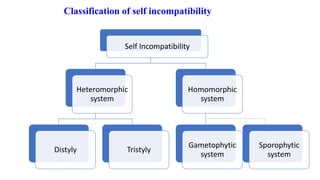
Classification of self incompatibility
Self Incompatibility
Heteromorphic
system
Distyly Tristyly
Homomorphic
system
Gametophytic
system
Sporophytic
system
Heteromorphic system
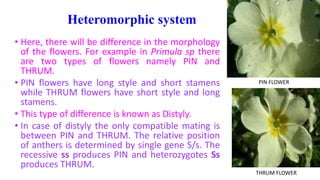
• Here, there will be difference in the morphology
of the flowers. For example in Primula sp there
are two types of flowers namely PIN and
THRUM.
• PIN flowers have long style and short stamens
while THRUM flowers have short style and long
stamens.
• This type of difference is known as Distyly.
• In case of distyly the only compatible mating is
between PIN and THRUM. The relative position
of anthers is determined by single gene S/s. The
recessive ss produces PIN and heterozygotes Ss
produces THRUM.
PIN FLOWER
THRUM FLOWER
•Homozygous dominant SS is lethal and do not exist.
•The incompatibility reaction of pollen is determined by the
genotype of the plant producing them.
•Allele S is dominant over s. This system is also known as
heteromorphic – sporophytic system.
•Pollen grains produced by PIN flowers will be all s in
genotype as well as in incompatibility reaction: Whereas
THRUM flowers will produce two types of gametes S and s
but all of them would be S phenotypically.
•The mating between PIN and THRUM would produce Ss and
ss progeny in equal frequencies. This system is of little
importance in crop plants.
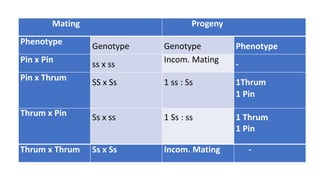
Mating Progeny
Phenotype
Genotype Genotype Phenotype
Pin x Pin
ss x ss
Incom. Mating
-
Pin x Thrum
SS x Ss 1 ss : Ss 1Thrum
1 Pin
Thrum x Pin Ss x ss 1 Ss : ss 1 Thrum
1 Pin
Thrum x Thrum Ss x Ss Incom. Mating -
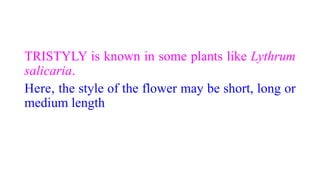
TRISTYLY is known in some plants like Lythrum
salicaria.
Here, the style of the flower may be short, long or
medium length
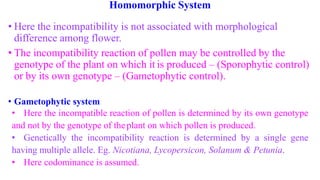
Homomorphic System
• Here the incompatibility is not associated with morphological
difference among flower.
• The incompatibility reaction of pollen may be controlled by the
genotype of the plant on which it is produced – (Sporophytic control)
or by its own genotype – (Gametophytic control).
• Gametophytic system
• Here the incompatible reaction of pollen is determined by its own genotype
and not by the genotype of theplant on which pollen is produced.
• Genetically the incompatibility reaction is determined by a single gene
having multiple allele. Eg. Nicotiana, Lycopersicon, Solanum & Petunia.
• Here codominance is assumed.
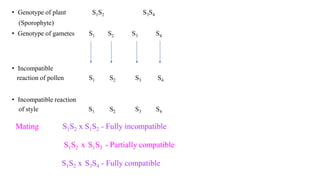
• Genotype of plant S1S2 S3S4
(Sporophyte)
• Genotype of gametes S1 S2 S3 S4
• Incompatible
reaction of pollen S1 S2 S3 S4
• Incompatible reaction
of style S1 S2 S3 S4
Mating S1S2 x S1S2 - Fully incompatible
S1S2 x S1S3 - Partially compatible
S1S2 x S3S4 - Fully compatible
Sporophytic system
• Here also the self incompatibility is governed by a single
gene S with multiple alleles.
• Here dominance is assumed.
• The incompatibility reaction is determined by the genotype
of the plant on which pollen grain is produced and not by
the genotype of the pollen.
• The allele may exhibit dominance, co-dominance or
competition.
characteristics of sporophytic system
1. There are frequent reciprocal differences
2. Incompatibility can occur with female parent
3. A family can consist of three incompatibility
groups
4. Homozygotes are a normal part of the system
5. An incompatibility group may contain two
genotypes.
Mechanism of Self Incompatibility
• This is quite complex and is poorly understood.
• The various phenomena observed in Self incompatibility is grouped into
three categories.
1. Pollen – Stigma interaction
2. Pollen tube – Style interaction
3. Pollen tube – Ovule interaction
Pollen – Stigma interaction
• This occurs just after the pollen grains reach the stigma and generally
prevents pollen from germination.
• Previously it was thought that binucleate condition of pollen in
gametophytic system and trinucleate condition in sporophytic system
was the reason for self incompatibility.
• But later on it was observed that they are not the reason for SI. Under
homomorphic system of incompatibility there are differences in the
stigmatic surface which prevents pollen germination.
• In gametophytic system the stigma surface is plumose having
elongated receptive cells which is commonly known as wet stigma.
• The pollen grain germinates on reaching the stigma and
incompatibility reaction occurs at a later stage.
• In the sporophytic system the stigma is papillate and dry
and covered with hydrated layer of protein known as pellicle.
• This pellicle is involved in incompatibility reaction.
• With in few minutes of reaching the stigmatic surface the
pollen releases an exine exudates which is either protein or
glycerol protein.
• This reacts with pellicle and induces callose formation,
which further prevents the growth of pollen tube.
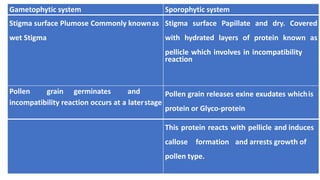
Gametophytic system Sporophytic system
Stigma surface Plumose Commonly knownas
wet Stigma
Stigma surface Papillate and dry. Covered
with hydrated layers of protein known as
pellicle which involves in incompatibility
reaction
Pollen grain germinates and
incompatibility reaction occurs at a laterstage
Pollen grain releases exine exudates whichis
protein or Glyco-protein
This protein reacts with pellicle and induces
callose formation and arrests growth of
pollen type.
Pollen Tube-Style Interaction
•Pollen grains germinate and pollen tube penetrates the
stigmatic surface.
•But in incompatible combinations the growth of
pollen tube is retarded with in the style as in Petunia
& Lilium.
•The protein and poly saccharine synthesis in the
pollen tube stops resulting in bursting up of pollen
tube and leading to death of nuclei.
Pollen Tube-Ovule Interaction
•Pollen tube reaches the ovule and
fertilization occurs but the embryo
degenerates later due to some
biochemical reaction.
Male Sterility
• Male sterility is characterized by nonfunctional pollen grains, while female gametes
function normally. It occurs in nature sporadically.
• Morphological features of male sterility
• May be due to mutation, chromosomal aberrations, cytoplasmic factors or interaction of
cytoplasmic and genetic factors.
• For any of the above reasons the following
morphological changes may occur in male sterile plants:
 Viable pollen grains are not formed. The sterile pollen grains will be transparent andrarely
takes up stain faintly.
 Non-dehiscence of anthers, even though viable pollens are enclosed within. This may bedue
to hard outer layer, which restrict the release of pollen grains.
 Androecium may abort before the pollen grains are formed.
 Androecium may be malformed, thus there is no possibility of pollen grain formation.
Kinds of male sterility, maintenance and uses
• Male sterility may be conditioned due to cytoplasmic or genetic factors or due to
interaction of both. Environment also induces male sterility. Depending on these factors
male sterility can be classified in to
 Cytoplasmic male sterility (CMS)
 Cytoplasmic-genetic male sterility (CGMS)
 Genetic male sterility (GMS) In this the are two categories
are :
 Environment insensitive genic male sterility- commonly referred as Genetic male
sterility.
 Environment sensitive genic male sterility or Environmental induced sterility isagain
sub divided in to
 TGMS (Thermosensitive)
 PGMS (Photo sensitive)
 Photo thermo sensitive
Cytoplasmic Male Sterility (CMS)
• It occurs due to the mutation of mitochondria or some other
cytoplasmic factors outside the nucleus. Nuclear genes are not
involved here.
• There is considerable evidence that gene or genes conditioning
cytoplasmic male sterility. Particularly in maize DNA reside in
mitochondria and may be located in a plasmid like element.
Uses
• Since there are no R lines available, this type of sterility is useful only in
crops where seed is not the end product.
• For example in onion and many ornamental plants the hybrids developed
exhibit maximum hybrid vigour with respect to longer vegetative duration and
larger flower size and larger bulb size.
• Cytoplasmic male sterility has successfully been exploited in maize for
producing double cross hybrids.
Genetic Male Sterility (Gms)
• Genetic male sterility is normally governed by nuclear recessive genes ms ms. Exception
to this is safflower where male sterility is governed by dominant gene Ms Ms. This type of
male sterility is used in Redgram and Castor for production of hybrids.
• Maintenance
• In genetic male sterility, the sterile line will be maintained from heterozygous condition.
• When this heterozygous line is grown in the field it will segregate in the ratio of 1 Fertile
: 1sterile.
• The pollen from the Fertile line will pollinate the sterile line and as a result seed set will be
there in the sterile line.
• These seeds are to be harvested and used for hybrid seed production.
•For hybrid seed production, the seeds collected from
sterile plants will be grown using double the seed
rate since it will segregate in the ratio of 1 fertile : 1
sterile line.
•At the time of flowering, the fertile line will be
identified by yellow plumpy anthers and removed
from the field.
•Only the sterile line will remain in field. These will
be pollinated by the R line and the R1 obtained will
be hybrid redgram.
Difficulties in use of Gms
1. Maintenance of GMS requires skilled labour to identify fertile
and sterile line. Labelling is time consuming and costly.
2. In hybrid seed production plot identification of fertile line and
removing them is costly.
3. Use of double the seed rate of GMS line is costly
4. In crops like castor high temperature leads to break down of
male sterility.
Transgenic Genetic Male Sterility
• A gene introduced into the genome of an organism by
recombinant DNA technology or genetic engineering is called
transgene.
• Many transgenes have been shown to produce genetic male
sterility, which is dominant to fertility.
• Consequently, it is essential to develop effective fertility
restoration system if these are to be utilized for hybrid seed
production.
• An effective restoration system is available in at least one case
called Barnase or Barstar system.
• Transgenic plants expressing both Barstar and Barnase are fully
male fertile.
• The Barnase gene has been tagged with bar gene, which specifies
resistance to the herbicide phosphinothricin.
• This male sterile line is maintained by crossing with a male fertile
line. The progeny so obtained contain 1 male sterile : 1 male fertile
plants; the latter are easily eliminated at seedling stage by a
phosphinothricin spray.
• The male sterile plants are crossed with the Barstar line to obtain
male fertile hybrid progeny.
• This system of male sterility is yet to be commercially used.
Cytoplasmic Genetic Male Sterility
• This is a case of cytoplasmic male sterility where dominant
nuclear gene restorers fertility.
• This system is utilized for the production of hybrids in bajra,
jowar, maize, rice, wheat and many other crops.
Limitations of CGMS lines
1. Fertility restoration is a problem. E.g. Rice.
2. Seed set will be low in crops like rice where special techniques are
to be adopted to increase seed set.
3. Break down of male sterility at higher temperature
4. In crops like wheat having a polyploidy series it is difficult to
develop effective R line.
5. Undesirable effect of cytoplasm. Eg. Texas cytoplasm in maize
became susceptible to Helminthosporium. In bajra Tift 23 A
cytoplasm became susceptible to downy mildew.
6. Modifier genes may reduce effectiveness of cytoplasmic male
sterility.

Self incompatability & Male sterility.pptx

  • 1.
    Incompatibility and malesterility and their utilization in crop improvement • Self-incompatibility and sterility are the two mechanisms, which encourage cross- pollination. • More than 300 species belonging to 20 families of angiosperms show self- incompatibility. • In self incompatibility, the flowers produce functional or viable pollen grainswhich fail to fertilize the same flower or any other flower of the same plant.  Self incompatible pollen grain may fail to germinate on the stigmatic surface.  Some may germinate but fails to penetrate the stigmatic surface.  Some pollen grains may produce pollen tube, which enters through stigmatic surface, but its growth will be too slow. By the time the pollen tube enters the ovule the flower will drop.  Some time fertilization occurs but embryo degenerates early.
  • 2.
    Classification of selfincompatibility Self Incompatibility Heteromorphic system Distyly Tristyly Homomorphic system Gametophytic system Sporophytic system
  • 3.
    Heteromorphic system • Here,there will be difference in the morphology of the flowers. For example in Primula sp there are two types of flowers namely PIN and THRUM. • PIN flowers have long style and short stamens while THRUM flowers have short style and long stamens. • This type of difference is known as Distyly. • In case of distyly the only compatible mating is between PIN and THRUM. The relative position of anthers is determined by single gene S/s. The recessive ss produces PIN and heterozygotes Ss produces THRUM. PIN FLOWER THRUM FLOWER
  • 4.
    •Homozygous dominant SSis lethal and do not exist. •The incompatibility reaction of pollen is determined by the genotype of the plant producing them. •Allele S is dominant over s. This system is also known as heteromorphic – sporophytic system. •Pollen grains produced by PIN flowers will be all s in genotype as well as in incompatibility reaction: Whereas THRUM flowers will produce two types of gametes S and s but all of them would be S phenotypically. •The mating between PIN and THRUM would produce Ss and ss progeny in equal frequencies. This system is of little importance in crop plants.
  • 5.
    Mating Progeny Phenotype Genotype GenotypePhenotype Pin x Pin ss x ss Incom. Mating - Pin x Thrum SS x Ss 1 ss : Ss 1Thrum 1 Pin Thrum x Pin Ss x ss 1 Ss : ss 1 Thrum 1 Pin Thrum x Thrum Ss x Ss Incom. Mating -
  • 6.
    TRISTYLY is knownin some plants like Lythrum salicaria. Here, the style of the flower may be short, long or medium length
  • 7.
    Homomorphic System • Herethe incompatibility is not associated with morphological difference among flower. • The incompatibility reaction of pollen may be controlled by the genotype of the plant on which it is produced – (Sporophytic control) or by its own genotype – (Gametophytic control). • Gametophytic system • Here the incompatible reaction of pollen is determined by its own genotype and not by the genotype of theplant on which pollen is produced. • Genetically the incompatibility reaction is determined by a single gene having multiple allele. Eg. Nicotiana, Lycopersicon, Solanum & Petunia. • Here codominance is assumed.
  • 8.
    • Genotype ofplant S1S2 S3S4 (Sporophyte) • Genotype of gametes S1 S2 S3 S4 • Incompatible reaction of pollen S1 S2 S3 S4 • Incompatible reaction of style S1 S2 S3 S4 Mating S1S2 x S1S2 - Fully incompatible S1S2 x S1S3 - Partially compatible S1S2 x S3S4 - Fully compatible
  • 9.
    Sporophytic system • Herealso the self incompatibility is governed by a single gene S with multiple alleles. • Here dominance is assumed. • The incompatibility reaction is determined by the genotype of the plant on which pollen grain is produced and not by the genotype of the pollen. • The allele may exhibit dominance, co-dominance or competition.
  • 10.
    characteristics of sporophyticsystem 1. There are frequent reciprocal differences 2. Incompatibility can occur with female parent 3. A family can consist of three incompatibility groups 4. Homozygotes are a normal part of the system 5. An incompatibility group may contain two genotypes.
  • 11.
    Mechanism of SelfIncompatibility • This is quite complex and is poorly understood. • The various phenomena observed in Self incompatibility is grouped into three categories. 1. Pollen – Stigma interaction 2. Pollen tube – Style interaction 3. Pollen tube – Ovule interaction
  • 12.
    Pollen – Stigmainteraction • This occurs just after the pollen grains reach the stigma and generally prevents pollen from germination. • Previously it was thought that binucleate condition of pollen in gametophytic system and trinucleate condition in sporophytic system was the reason for self incompatibility. • But later on it was observed that they are not the reason for SI. Under homomorphic system of incompatibility there are differences in the stigmatic surface which prevents pollen germination. • In gametophytic system the stigma surface is plumose having elongated receptive cells which is commonly known as wet stigma. • The pollen grain germinates on reaching the stigma and incompatibility reaction occurs at a later stage.
  • 13.
    • In thesporophytic system the stigma is papillate and dry and covered with hydrated layer of protein known as pellicle. • This pellicle is involved in incompatibility reaction. • With in few minutes of reaching the stigmatic surface the pollen releases an exine exudates which is either protein or glycerol protein. • This reacts with pellicle and induces callose formation, which further prevents the growth of pollen tube.
  • 14.
    Gametophytic system Sporophyticsystem Stigma surface Plumose Commonly knownas wet Stigma Stigma surface Papillate and dry. Covered with hydrated layers of protein known as pellicle which involves in incompatibility reaction Pollen grain germinates and incompatibility reaction occurs at a laterstage Pollen grain releases exine exudates whichis protein or Glyco-protein This protein reacts with pellicle and induces callose formation and arrests growth of pollen type.
  • 15.
    Pollen Tube-Style Interaction •Pollengrains germinate and pollen tube penetrates the stigmatic surface. •But in incompatible combinations the growth of pollen tube is retarded with in the style as in Petunia & Lilium. •The protein and poly saccharine synthesis in the pollen tube stops resulting in bursting up of pollen tube and leading to death of nuclei.
  • 16.
    Pollen Tube-Ovule Interaction •Pollentube reaches the ovule and fertilization occurs but the embryo degenerates later due to some biochemical reaction.
  • 17.
    Male Sterility • Malesterility is characterized by nonfunctional pollen grains, while female gametes function normally. It occurs in nature sporadically. • Morphological features of male sterility • May be due to mutation, chromosomal aberrations, cytoplasmic factors or interaction of cytoplasmic and genetic factors. • For any of the above reasons the following morphological changes may occur in male sterile plants:  Viable pollen grains are not formed. The sterile pollen grains will be transparent andrarely takes up stain faintly.  Non-dehiscence of anthers, even though viable pollens are enclosed within. This may bedue to hard outer layer, which restrict the release of pollen grains.  Androecium may abort before the pollen grains are formed.  Androecium may be malformed, thus there is no possibility of pollen grain formation.
  • 18.
    Kinds of malesterility, maintenance and uses • Male sterility may be conditioned due to cytoplasmic or genetic factors or due to interaction of both. Environment also induces male sterility. Depending on these factors male sterility can be classified in to  Cytoplasmic male sterility (CMS)  Cytoplasmic-genetic male sterility (CGMS)  Genetic male sterility (GMS) In this the are two categories are :  Environment insensitive genic male sterility- commonly referred as Genetic male sterility.  Environment sensitive genic male sterility or Environmental induced sterility isagain sub divided in to  TGMS (Thermosensitive)  PGMS (Photo sensitive)  Photo thermo sensitive
  • 19.
    Cytoplasmic Male Sterility(CMS) • It occurs due to the mutation of mitochondria or some other cytoplasmic factors outside the nucleus. Nuclear genes are not involved here. • There is considerable evidence that gene or genes conditioning cytoplasmic male sterility. Particularly in maize DNA reside in mitochondria and may be located in a plasmid like element.
  • 20.
    Uses • Since thereare no R lines available, this type of sterility is useful only in crops where seed is not the end product. • For example in onion and many ornamental plants the hybrids developed exhibit maximum hybrid vigour with respect to longer vegetative duration and larger flower size and larger bulb size. • Cytoplasmic male sterility has successfully been exploited in maize for producing double cross hybrids.
  • 21.
    Genetic Male Sterility(Gms) • Genetic male sterility is normally governed by nuclear recessive genes ms ms. Exception to this is safflower where male sterility is governed by dominant gene Ms Ms. This type of male sterility is used in Redgram and Castor for production of hybrids. • Maintenance • In genetic male sterility, the sterile line will be maintained from heterozygous condition. • When this heterozygous line is grown in the field it will segregate in the ratio of 1 Fertile : 1sterile. • The pollen from the Fertile line will pollinate the sterile line and as a result seed set will be there in the sterile line. • These seeds are to be harvested and used for hybrid seed production.
  • 22.
    •For hybrid seedproduction, the seeds collected from sterile plants will be grown using double the seed rate since it will segregate in the ratio of 1 fertile : 1 sterile line. •At the time of flowering, the fertile line will be identified by yellow plumpy anthers and removed from the field. •Only the sterile line will remain in field. These will be pollinated by the R line and the R1 obtained will be hybrid redgram.
  • 23.
    Difficulties in useof Gms 1. Maintenance of GMS requires skilled labour to identify fertile and sterile line. Labelling is time consuming and costly. 2. In hybrid seed production plot identification of fertile line and removing them is costly. 3. Use of double the seed rate of GMS line is costly 4. In crops like castor high temperature leads to break down of male sterility.
  • 24.
    Transgenic Genetic MaleSterility • A gene introduced into the genome of an organism by recombinant DNA technology or genetic engineering is called transgene. • Many transgenes have been shown to produce genetic male sterility, which is dominant to fertility. • Consequently, it is essential to develop effective fertility restoration system if these are to be utilized for hybrid seed production. • An effective restoration system is available in at least one case called Barnase or Barstar system.
  • 25.
    • Transgenic plantsexpressing both Barstar and Barnase are fully male fertile. • The Barnase gene has been tagged with bar gene, which specifies resistance to the herbicide phosphinothricin. • This male sterile line is maintained by crossing with a male fertile line. The progeny so obtained contain 1 male sterile : 1 male fertile plants; the latter are easily eliminated at seedling stage by a phosphinothricin spray. • The male sterile plants are crossed with the Barstar line to obtain male fertile hybrid progeny. • This system of male sterility is yet to be commercially used.
  • 26.
    Cytoplasmic Genetic MaleSterility • This is a case of cytoplasmic male sterility where dominant nuclear gene restorers fertility. • This system is utilized for the production of hybrids in bajra, jowar, maize, rice, wheat and many other crops.
  • 27.
    Limitations of CGMSlines 1. Fertility restoration is a problem. E.g. Rice. 2. Seed set will be low in crops like rice where special techniques are to be adopted to increase seed set. 3. Break down of male sterility at higher temperature 4. In crops like wheat having a polyploidy series it is difficult to develop effective R line. 5. Undesirable effect of cytoplasm. Eg. Texas cytoplasm in maize became susceptible to Helminthosporium. In bajra Tift 23 A cytoplasm became susceptible to downy mildew. 6. Modifier genes may reduce effectiveness of cytoplasmic male sterility.