PERSONAL
DEVELOPMENT
Lesson 1:Knowing
Oneself Strengths
and Limitations
As an individual, we commonly see
other people’s manner of doing things,
belief, and lifestyle. Most of the time,
we give comments and/or judgment on
how they behave and react in certain
scenarios
Self-development is a process of discovering oneself
by realizing one's potentials and capabilities that are
shaped over time either by studying in a formal
school or through environmental factors.
On the other hand, examining yourself, most
specifically how you react on things, your belief,
traits, and values is one of the most complicated
things to do in the world. You must understand,
though, that it is not that simple. In fact, it follows a
process.
Know Thyself is an old maxim or aphorism which in time has
been used in varied literature and consequently gained
different meanings. One of its meanings is recorded in the
Greek encyclopedia of knowledge called “The Suda”.
Thomas Hobbes also discussed his own views about the maxim
from which he used the phrase “read thyself” in his famous
work The Leviathan. He stressed that an individual could learn
more by studying others and that he/she can do this by
engaging himself/herself to reading books. However, Hobbes
emphasized that a person learns more by studying oneself.
Self-concept is ones abstract and
general idea about him/herself
particularly toward his/her unique
personality and his/her own perception
about his/her set of values, point of
views and behavior.
This theory began as Rene Descartes, the
Father of Modern Philosophy, proposed his
theory that a person’s existence depends on
his/her perception. Rene Descartes stated that
mind is the seat of consciousness.
Three aspects of Self-Concept
• Self-concept is learned.
This explains that no individual is born with self-
concept. This means that self-concept can only be
acquired as soon as the person learns how to
mingle with others and so this indicates that self-
concept is influenced by the person’s environment
and can be a product of the person’s socialization
• Self-concept is organized. This stresses out that
one’s perception towards themself is firm. This
means that a person may hear other people’s
point of view regarding themself but will keep
on believing that what they thinks of theirself is
always the right one.
• Self-concept is dynamic. As an
individual grows older, they continues to
encounter problems or challenges that
may reveal their self-concept in that
particular time or situation.
Aside from the philosophers above, Sigmund
Freud who is a well-known psychologist,
neurologist and the creator of
Psychoanalysis Theory and the father of
psychoanalysis, proposed that there are
three components of personality.
•
Three Components of Personality
1. The Id. Freud explained that
man's personality is driven by
pleasure principle. This means that
the nature of Id is to satisfy man's
desire without thinking much of the
situation.
•
Three Components of Personality
2. The Ego. This operates according to
reality which makes it possible for the Id
to work in a more proper and
satisfactory ways. In other words, it is the
job of the ego to provide a man some
guidelines on how to behave accordingly
while he fulfilled his pleasure.
•
Three Components of Personality
3. The Superego. Freud believed that this
aspect of man begins to manifest as a
child turns 5. This is the last component of
personality which holds our moral
judgments or concept of right and wrong
that are believed to be acquired from
the family and the environment.
Lesson 2:Knowing Oneself Characteristics,
Habits, and Experiences
• Adolescence is the period when a young individual develops
from a child into an adult. There are a lot of changes that
happen to an adolescent like you and some of those are: how
you look, how you take your role in the community, how other
people expect you in making decisions on your own, and how
you perceive yourself.
• Many people believe that we are the product of our own
experiences. Those experiences shape our unique qualities and
habits that define who we as a person and differ from others.
• Self is the foundation of all human behavior. It is our sense of
identity and of who we are as an individual
Some of the factors that may affect a
person’s
• Self-Esteem
- Self-esteem is your evaluation of your own worth. It may be positive
or negative. Positive self-esteem is the valuation that is pleasing and
acceptable according to your standard and that of others, while
negative self-esteem is the opposite which is feeling distraught or
down and unaccepted by others.
- According to Tafarodi & Swann (1995), there are many factors to
identify the level of self-esteem of an individual and some of the
major factors are:
- own appearance
- how satisfied you are in a relationship; and
- how you view your performance.
• Self-Efficacy is not considered as a trait.
- Maddux and Kleiman (2000) define and explain the five (5) different ways that influenced
self-efficacy beliefs from the ideas of Albert Badura, a professor and a psychologist.
(a) Performance Experiences - if you are good at achieving your specific goal, then you
probably think that you will achieve it again. When the opposite happens, if you fail, you
will often think that you will fail again.
(b) Vicarious Performances - if others achieved their goal or specific task, then you will come
to believe that you will also achieve your goal. (c)
(c) Verbal Persuasion - it is when people tell you whether they believe or not on what you
can do or cannot do. The effect of your self-efficacy will depend on how that person
matters to you.
(d) Imaginal Performances - When you imagine yourself doing well, then it will happen.
(e) The Affective States & Physical Sensations - if your mood or emotion (e.g. shame) and
physical state (e.g. shaking) come together, it will affect your self-efficacy. If negative
mood connects with negative physical sensation, the result will be negative. And if it is
positive, most likely the result will be positive.
• Self and Identity
- According to William James, a psychologist, “the self is what happens when I reflect
upon ME". Taylor (1989) described the self as a Reflective Period. How we see
ourselves is geared toward improving ourselves depending on a lot of factors.
- Dan McAdam, a psychologist, reiterated that even there are many ways on how we
reflect to improve ourselves, it brings us back to these three (3) categories:
1. Self as Social Actor o We are portraying different roles and behaving for every
type/set of people in front of us since we all care about what people think about
us. It is practically for social acceptance.
2. Self as Motivated Agent o People act based on their purpose. They do things
based on their own dreams, desires, and planned goals for the future. This, though,
is not easily identifiable since it is self-conceptualized, unless it was shared with us.
3. Self as Autobiographical Author o He/she as the creator of his/her own entire life
story. It is about how oneself is developed from his/her past, up to the present, and
what he/she will become in the future.
• Judgment and Decision Making
- As an individual, you are expected to act and decide on your own. Most
people tend to decide based on the intuitions and available information that
could be a hindrance in making a wise decision.
Six Steps on How to Make a Rational Decision:
1. Define the Problem (select your most desired course);
2. Identify the criteria necessary to judge the multiple options (list things to be
considered like location, facilities, prestige, etc.);
3. Weight the criteria (rank the criteria based on its importance to you);
4. Generate alternatives (the schools that accepted you);
5. Rate each alternative on each criterion (rate each school on the criteria you
have identified); and
6. Compute the optimal decision
Lesson 3
Developing the
Whole Person
• Developing oneself holistically may be the goal of everyone.
However, there are times that we lack awareness of our doings
and actions that leads to misunderstanding with others
especially our parents. This can also potentially lead to self-
harm. To start picking the pieces of ourselves and subsequently
develop our individuality completely to be like an “ideal”
person is not easy.
Developmental Aspect
• Physical Aspect (Physical)
• Cognitive Aspect (Mental)
• Psychosocial Aspect (Emotional & Social)
• Spiritual Aspect
• Our personality is a product of genetic response that
we inherit from our parents and from the influence of
our environment.
• This environment shaped by the people around us,
culture, and practices that we are being raised in
continuously creates social interactions and
relationships.
Personality development that influence
personal judgement
• Thoughts
• Feelings
• Emotion
• Behavior
• When you reach adolescence, you experience drastic changes
in your physical appearance, cognitive abilities, social
relationship, and emotional behavior.
• According to Erik Erikson, adolescence stage of Psychosocial
development, also known as “identity vs. role confusion” is the
stage wherein teens need to develop the sense of self and
personal identity.
• Teenagers also experience adolescence cognitive empathy,
known as “theory of mind” which is described as having high
regards toward the perspective of others and feeling concern
for others.
• Teenagers are very careful in understanding the emotions of
their friends as they start to create deep trust with them.
Sometimes, this leads to misunderstanding with their family,
abuse of prohibited drugs, pre-marital sex, cigarette smoking
and alcohol intake. Based on research, teenagers are commonly
high risk-takers and impulsive due to incomplete development
of frontal lobe during adolescence.
• The frontal lobe is responsible for judgement, impulse control,
and planning.
• You cannot escape life challenges so you should know how your
thoughts, feelings, and actions in managing personal agency
should be handled.
• Thoughts are impression activated by a stimulus in your mind
that is evident from the environment that you are in. This conscious
thought occupies emotions that give life to thoughts and it
expressed through feelings. Sometimes when you are too
emotional, you could not think properly because your emotions
occupy your thoughts, this means there is lesser space to analyze
the situation because feelings occupy it. Behaviors are bodily
reaction made based on our feelings that result to actions.
• Teenagers experience enjoyment and daunting times but it is very
important to stay focused so that they will lead you to the route
of your goal.
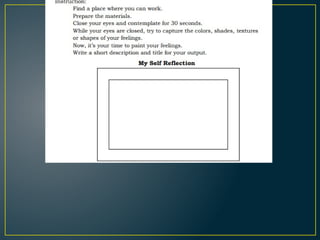
Sharing one’s thoughts and feelings is
important, but it should be expressed with
focus and gentleness. Painting is an outlet
for the expression of your thoughts, feelings,
and emotion. It is an opportunity to see and
hear your feelings and emotions through a
tangible and authentic output.
Lesson 4:
Developmental
Task and
Challenges of
Adolescence
• Adolescence is the period of development that begins at
puberty and ends at emerging adulthood. During puberty
stage, there are changes that occur in the body of a child.
• Mostly resulted to your being self-consciousness and being
overly emotional. These adjustments are part of developmental
changes during adolescence stage -- the time when a child
transitions in terms of physiology and cognition to fulfil a new
role as an emerging adult.
Here is the list of the most common
challenges that adolescents experience:
• Biological Challenges
- Adolescence begins with the first well-defined
maturation event called puberty. Included in the
biological challenges are the changes that occur due to
the release of the sexual hormones that affect emotions.
Mood changes can increase which can have an impact
on relationships both at home with parents and siblings
and peers at school.
• Cognitive Challenges
- Piaget, in his Theory of Social Development, believed that
adolescence is the time when young people develop cognitively
from takes time to develop confidence using these newly acquired
skills, and they may make mistakes in judgment.
- Adolescents are egocentric. They can become self-conscious
thinking they are being watched by others, and at other times they
behave as if they were on a center stage and perform for a non-
existent audience.
• Psychological Challenges
- A new person is emerging, thus, rules will change, and more
responsibilities will be placed on him/her, so a certain standard
of behavior is now required to be maintained.
- As adolescents continue their journey of self-discovery, they
continually adjust to new experiences, even biologically and
socially. This can be both stressful and anxiety-provoking.
• Health Issues of adolescence:
 Eating Disorders An eating disorder describe illness that are
characterized by irregular eating habits and severe distress or
concern about body weight or shape.
Types of Eating Disorders:
1. Anorexia Nervosa – they may take extreme measures to avoid
eating and to control the quantity and quality of the foods they
eat. They may become abnormally thin and still talk about feeling
fat. They typically continue to strict diet even at very unhealthy
weights because they have a distorted image of their body.
2. Bulimia Nervosa - they typically ‘binge and purge’ by engaging
in uncontrollable episodes of overeating (bingeing) usually
followed by compensatory behavior such as: purging through
vomiting, use of laxatives, enemas, fasting, or excessive exercise.
• Mental Health Disorder
 Anxiety Disorders - are a group of mental disorders
characterized by significant feelings of anxiety and fear. These
feelings may cause physical symptoms, such as a fast heart rate
and shakiness.
 Mood Disorders - the development of emotional or behavioral
symptoms in response to identifiable stressors that occur within 3
months of the onset of the stressors. Here, low mood, tearfulness,
or feelings of hopelessness are predominant.
 Major Depressive Disorder (MDD) - a period of at least 2
weeks during which there is either depressed mood or the loss of
interest or pleasure in nearly all activities. In children and
adolescents, the mood may be irritable rather than sad.
 Bipolar Disorder: A period of abnormally and persistently
elevated, expansive, or irritable mood and abnormally and
persistency increased activity or energy, lasting at least 4
consecutive days and present most of the day, nearly every day,
or that requires hospitalization.
 Attention Deficit Hyperactivity Disorder Definitions of the
symptom complex known as attention-deficit/hyperactivity
disorder (ADHD) differ, but severe problems with concentration or
attention and/or hyperactivity are estimated to affect
adolescents. Six times as many boys as girls are affected.
 School phobia, also called school refusal, is defined as a
persistent and irrational fear of going to school. It must be
distinguished from a mere dislike of school that is related to issues
such as a new teacher, a difficult examination, the class bully, lack
of confidence, or having to undress for a gym class.
 Learning disabilities encompasses disorders that affect the way
individuals with normal or above normal intelligence receive,
store, organize, retrieve, and use information. Problems included
dyslexia and other specific learning problems involving reading,
spelling, writing, reasoning, and mathematics.
• Social Issues
 Sexual Abuse - is a sexual behavior, or a sexual act forced
upon a woman, man, or child without their consent. Sexual abuse
in childhood may result in problems of depression and low self-
esteem, as well as in sexual difficulties, either avoidance of sexual
contact or, on the other hand, promiscuity or prostitution.
 Substance Abuse - many communities are plagued with
problems of substance abuse among youth. Some children start
smoking or chewing tobacco at an early age, aided by easy
access to tobacco products. Many of our youth, with limited
supervision or few positive alternatives, drink too much beer and
liquor. Other youth, influenced by their peers, use other illegal
drugs. Our youth suffer from substance abuse in familiar ways:
diminished health, compromised school performance, and reduced
opportunities for development.
 Influence of Mass Media - adolescents spend a significant
amount of time in viewing and interacting with electronic devices
in the form of TV, radio, cellphone, and computers. Mass media
activate and reinforce attitude and contribute significantly in the
formation of new attitudes and will continue to affect children's
cognitive and social development.
 Impact of Social Media Social – it is a constant part of our
lives: we are bombarded by alerts from Facebook, Twitter,
Snapchat, and Instagram from the time we wake up to the time we
go to sleep. This constant noise is associated with negative mental
health outcomes in younger generations who have grown up with
the chatter.
Developmental Tasks
• In the eight stages of Psychosocial Developmental Theory of Erik
Erikson, Identity vs. Role Confusion (this stage is the age between 12 to
18 years old) explains that adolescents would try to explore and figure
out their own identity and try to fit in with social interactions at the same
time. According to Erikson, an adolescent9s main task is developing a
sense of self.
• Establishing social responsibility, moreover, develops personal and
moral values to guide you on how to react to social issues. Entering
adulthood is undeniably a big challenge. At this stage of your life, your
family, your school, and your community contribute to prepare you in
this life-changing task. You should, in turn, need to be emotionally
prepared since you would need to choose people whom you think would
help you fulfill these tasks in order for you to reach you goals in life.
Lesson 5:
Significant
People in Life
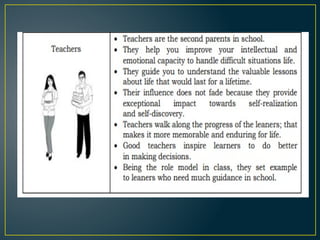
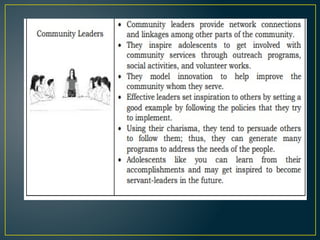
• People normally look up to influential personalities
who have shown greatness in terms of leadership,
intelligence, creativity, talents, and charisma. They
usually listen to their strong belief system that brings so
much inspiration and positive energy to other’s life.
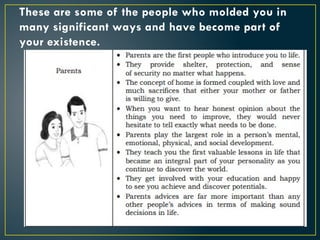
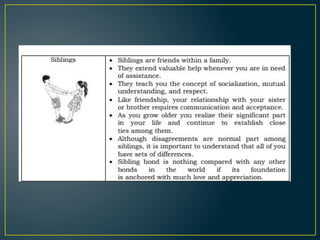
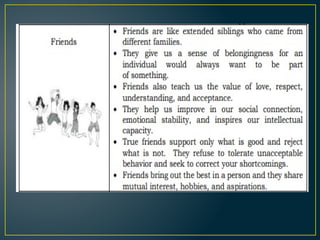
These are some of the people who molded you in
many significant ways and have become part of
your existence.
Lesson 5: Self-Development -
Identify ways that help one
become capable and responsible
adolescent prepared for adult life
Responsibility
Responsibility is any moral, legal or mental obligation or duty that
is directly or indirectly entrusted to you by the people around
from which you are held accountable for whatever consequences
or circumstance that may arrive in the future.
Why Be Capable and Responsible
Adolescent
• Aside from the fact that being responsible helps us become
successful in many aspects of life, we are being taught and
trained to develop a great sense of responsibility so that we
will be capable of facing the consequences of our own actions.
As they say nobody can clean our own mess but ourselves alone.
• Becoming responsible person performing his/her own sets of
duties and accountabilities is not as simple as one two three but
as soon as it manifests in one’s personality it has a greater
impact to the community. Individuals who are being emulated
by the whole community eventually serve as the key for the
good transformation of the society.
Common responsibilities of adolescents
1. Show respect to elders. Adolescents are the model for the
younger generation. Their way of doing things, manner of
dressing up, means of talking to elders are essential for the
younger ones as they look for someone who will serve as their
role model.
2. Take care of the younger ones. Helping your parents to take
care of your younger siblings is like hitting two birds with one
stone. Giving a hand to your parents as you take their part in
babysitting kids in the family is a means of showing respect to
them and a training ground for you to become a loving and
caring parents in the future.
3. Study well. Studying hard is not your obligation to your family rather it is
your personal responsibility. Accepting this obligation and overcoming the
challenges of it will give you a guarantee of living a bright future
4. Avoid engaging to bad vices. Along with performing your other personal
duties you must also distance yourself from bad vices and practices. First these
activities will surely mislead you from the principles of your parents and
teachings of your school. Second, engaging to bad vices will consequently
draw you away from your dreamed success and instead you might catch
yourself struggling from depression, self-blaming, tiring stage of self-pity and
helpless phase of regrets. In the end, you will live an unwanted life.
5. Establish a good identify. Identity is what people seek as they try to take
their role in their community. Living with good identify will help you see all
your potentials and love yourself more. A lot of people will start to like
working with you and this would mean learning more.
6. Earn the trust of the people around. Gaining the trust of the people
that surrounds you is the fulfilling result of creating your own identify.
Being reliable becomes your dominant identity and out of this you obtain
trust from the people around.
7. Distinguish good company from bad influence. Living a happy life is
everybody’s dream. For you to achieve this kind of life as adolescent it is
vital for you to learn to distinguish good company from the bad ones. It is
your level of willpower that helps you concretized your success; however,
your choice of company might hinder your strong will to become
successful. Learn to choose your company well.
8. Know yourself better. Knowing yourself is being able to identify your
strongest characteristic traits and personality. Obtaining a comprehensive
understanding of your abilities and capabilities is of great advantage for
you to become genuinely responsible and later be a fulfilled individual.
How to become capable and responsible
person in preparation for adult life
• Know your priority
Putting the most important things at the top of your priority is the
best strategy for you to have a good sense of direction. Having this
enables you to identify your goal and keep your concentration on it.
• Have focus
Prioritizing things out leads you to set your eyes to the most
important things. This will maximize your strong determination to
accomplish your goals. This will give you a clear mind and a clear
objective as well. Having focused on one thing delivers you from
being efficient in your task/s applying effective strategies.
• Be decisive
Being responsible is equal to being decisive. Decision making is one of the life skills
that teeners must have. People must learn that being decisive means being assertive
arriving with the best decision you could come up with by carefully weighing things
and considering the logic implied in the situation. Therefore, before you become
decisive you must be assertive first.
• Work diligently
For you to claim that you are such a responsible person you must have several
outputs to let people see how responsible person are you. Working with your job is
different from working diligently with your duties. Taking time to do your work need
not to be imposed to you rather you should have the initiative to do each. Diligently
working entails joyful atmosphere and graceful aura.
• Don’t count at all
A real hard-working person does not count their duties instead they works with the
goal of finishing all the tasks. This is quite a simple way of becoming responsible but
of equal weight on some other guiding principles on how to become responsible.
• Stay humble
Having not to count what you have successfully accomplished will help you keep
your feet on the ground. A responsible person need not to boast every now and
then. Acknowledging your imperfections and apologizing for it is a clear
manifestation that understanding the virtue of sense of responsibility is little by
little being accepted by your system and sets of principles.
• Love your duty
Your passion towards the fulfilment of your duties can serve as the fuel that will
make you capable of fulfilling even the most impossible task and challenging
duty. It is your love towards your work that will drive you to the road of
becoming capable and responsible individual.
• Dedicate time
Loving your duty is not complete without dedicating your time. Being responsible
individual also requires you to dedicate enough amount of time. Spending time
doing your work is an important matter. It is when you dedicate your time that
all your effort will be materialized. Your goal to succeed will also be realized.
Stress and Mental Health
• “You can’t change how people treat you or what they say about
you. All you can do is change how you react to it” - Mahatma
Gandhi
• Each of us has our own battle. We encounter different
challenges in life, and it is up to us on how to deal with each
challenge. Nowadays, most adolescents like you deal with
different issues with friends, family, academics, relationships,
and even pressure that could lead to stress and worst -
depression. There are several ways on how to deal and cope
with stress
Stress - a condition characterized by symptoms
of physical or emotional tension. An individual
may feel when he/she is struggling to accept
changes with physical, mental, and emotional
responses. It may give tension which will lead into
various responses such as anger, frustration, and
nervousness. Stress can be positive or negative.
Classification of Stress
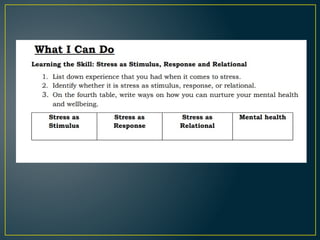
• Stress as Stimulus
- they characterize that causes certain reactions. Stimulus-based
definitions of stress are problematic, however, because they fail to
recognize that people differ in how they view and react to
challenging life events and situations.
Ex: a high-stress job, overcrowding, and long commutes to work
• Stress as Response
- Other researchers have conceptualized stress in ways that
emphasize the physiological responses that occur when faced
with demanding or threatening situations. Selye’s definition of
stress is response-based in that it conceptualizes stress chiefly in
terms of the body’s physiological reaction to any demand that is
placed on it. Many of the physiological reactions that occur when
faced with demanding situations (e.g., accelerated heart rate)
can also occur in response to things that most people would not
consider to be truly stressful, such as receiving unexpected good
news: an unexpected academic award.
Ex: increased arousal, accelerated heart rate
• Stress as Relational
- When a person is experiencing stress takes a step back to look
at the situation that is causing the stress and reflect on it.
Mental Health
• it is a condition of being sound mentally and emotionally that is
characterized by the absence of mental illness and by
adequate adjustment especially as reflected in feeling
comfortable about oneself. It is also a positive feeling about
others, and the ability to meet the demands of daily life.
Having a good mental health is also a state of the overall
wellbeing of a person associated with, can set and aim your
goals, enjoying your life to the fullest, can have and maintain a
good relationship with other people especially your classmates
and colleagues and lastly, you are able to manage and recover
from loneliness and stress.
• A good mental health does not necessarily mean being happy or
successful all the time. Most people feel depressed, lonely, or anxious
now and then, but those with good mental health can take these feelings
in stride and overcome them. When such feelings or moods persist and
interfere with a person’s ability to function normally, though, it may be a
sign of a more serious mental health problem and time to seek help.
• Wellbeing is the holistic view of our self and our health. As an
adolescent, several factors that could influence your wellbeing such as
pressure due to exams, assignments and projects, family issues, financial
status, relationships among other people, and mobile addiction. It is your
task to cope with stress and manage your mental health.
• Having a good mental health means that you are stable enough to face
challenges brought by the different daily circumstances. Whatever life
may bring to you, you can 8bounce back9 and get to action again.
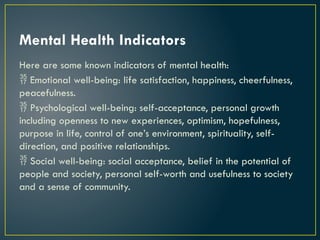
Mental Health Indicators
Here are some known indicators of mental health:
 Emotional well-being: life satisfaction, happiness, cheerfulness,
peacefulness.
 Psychological well-being: self-acceptance, personal growth
including openness to new experiences, optimism, hopefulness,
purpose in life, control of one’s environment, spirituality, self-
direction, and positive relationships.
 Social well-being: social acceptance, belief in the potential of
people and society, personal self-worth and usefulness to society
and a sense of community.
Identify Causes
and Effects of
Stress in One’s
Life
• Experiencing stresses in life may lead you to struggle and may
direct you to unwanted emotions such as anger, frustration, and
nervousness. These may result into tensions which in return affect
your physical, mental, and emotional responses.
Stress is a simple reaction to an input that disturbs our physical
and mental balance. It is ever present in everyone9s life in various
situations and activities. Therefore, you are not exempted from
experiencing stress.
These are the commonly cited causes of
stress of the students:
 peers
 examinations
 making portfolios
 returning to study
 poor time management
 bullying
 overcrowding
 noise
 meeting the deadlines
 difficulty in organizing work
 various tasks from each subject
 leaving assignments to the last minute
 adjusting to life as senior high school students
 parents or problems at home
 balancing between family and school
 difficulties with personal relationships (e.g. infatuation, crushes)
The Good Stress and The Bad Stress
There are two types of stress, the “eustress”, which is term for
positive stress or good stress, and “dystress” which refers to
negative stress or bad stress as cited by Dr. Lazarus, building on
Dr. Selye’s work.
In everyday life, we always use the term "stress" to describe
negative situations. This directs many people to believe that all
stress is bad for people, which is not true. Eustress, or positive
stress, can motivate someone to regain enthusiasm in their
endeavor, it can give excitement to revitalize performance.
Causes of Good Stress:
Good stress is the type of stress you feel when you are excited. Your hormones
surges high and your pulse quickens. You feel that you are far from stress.
 being promoted in the job
 having your first date
 becomes number one in your class or competitions
 receiving good commendations from family, friends, and relatives
 acquiring and possessing new gadgets
 during holiday seasons
 passing in your examinations
 meeting your old closest friends
 starting a new business
 additional allowance
 having outdoor activities together with your classmates
 jamming/bonding
Causes of Bad Stress:
It happens when you feel stressors that burden you and put you in a seemingly hopeless situation which
hinders your problem-solving capability.
 death of family members
 losing a job
 failed to submit task on time
 hospitalization
 illness/sickness
 sleep problem
 abused / neglected
 bankruptcy/lack of finances
 separation of parents
 conflict with peers
 physical appearance
 being bullied
 sexual abuse
 traumatic experience
 dropping out of school
 lack of gadgets/ poor gadgets
 left behind from trend
 emotional problems
 unhappy home/broken family
 receive reprimand from authority
According to George Essel and Patrick Owusu (2017) in their
research on “causes of students’ stress, its effects on their academic
success, and stress management by students”, there are different
factors that causes stress among students. Here are the causes of
stress that can affect many aspects of life.
• Environmental factors of stress occur when an event or stimulus
requires us to change in some way that makes a change in living
environment a stressful experience. Apart from moving from
home to school, commuting going to school, bumping into new
faces on campus, disorders from roommates, etc. is tensed
experience.
• Academic factors of stress are the responsibilities related to
work in school. While in school students will certainly compound
to a heavy academic load which is bound to result in stress.
There are some factors that happen in the academic curriculum
that causes so much stress to students.
• Physical factors of stress deal with the health issues which are
the concern of everyone because bad health causes a lot of
damage to the life of a person. Stress can lead to physical
symptoms including headaches, upset stomach, elevated blood
pressure, chest pain, and problems sleeping.
• Emotional Factors of stress involves emotional problems
(depression, anxiety, anger, grief, guilt, low self-esteem)
Traumatic event, such as a natural disaster, theft, rape, or
violence against you or a loved one. It may lead into chronic
disease if not properly handled.
Effects of Stress
Most young people go through situations that cause stress. Most of
the time, these stressors pile up, affecting behavior once stress hits
the individual. Too much stress can affect your mood, behavior,
action, performance, and even your relationships.
Some good effects of positive stress:
1. motivate individual to pursue his goal
2. create positive effect in every human endeavor
3. boost someone’s morale
4. benefit good health / create good immune system
5. increases performance
6. become more responsible
7. handle things lightly
8. enhance memory
9. drive to surpass previous achievement
10. improve decisions
11. help someone to grow more with pleasant attitude
12. has a positive views for the future
Some of the bad effects of negative stress:
1. Depression
2. Aggressive behavior
3. Suicidal tendency
4. Involvement in fighting
5. Involvement in gambling
6. Taking alcohol and drugs
7. Early marriage
8. Peer pressure
9. Develop fatigue
10. Irritability
11.Withdrawing from people
12. Changes in sleeping and eating habit
What are some signs that a teen or adolescent is suffering from stress?
• Increased complaints of headache, stomachache, muscle pain
• Crying most of the time.
• Withdrawing from people and activities.
• Increased anger or irritability
• Feelings of hopeless.
• Chronic anxiety and nervousness.
• Changes in sleeping and eating habits
• Lack concentration
• Experimentation with drugs or alcohol.
• Hangouts with friends
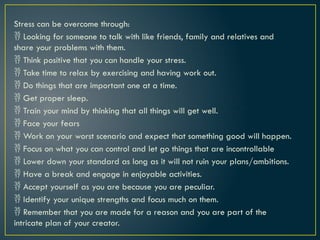
Stress can be overcome through:
 Looking for someone to talk with like friends, family and relatives and
share your problems with them.
 Think positive that you can handle your stress.
 Take time to relax by exercising and having work out.
 Do things that are important one at a time.
 Get proper sleep.
 Train your mind by thinking that all things will get well.
 Face your fears
 Work on your worst scenario and expect that something good will happen.
 Focus on what you can control and let go things that are incontrollable
 Lower down your standard as long as it will not ruin your plans/ambitions.
 Have a break and engage in enjoyable activities.
 Accept yourself as you are because you are peculiar.
 Identify your unique strengths and focus much on them.
 Remember that you are made for a reason and you are part of the
intricate plan of your creator.
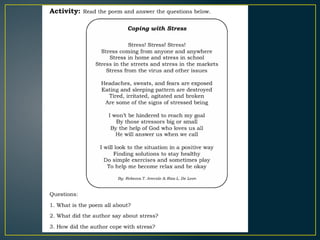
Coping with
Stress
Coping refers to mental and behavioral efforts that we use to
deal with problems relating to stress, including its presumed cause
and the unpleasant feelings and emotions it produces.
- In coping with stress, we are using all aspects of our self to deal
with both the causes of stress and their impacts on our emotions
that can make us feel uneasy or uncomfortable.
Approaches in Coping with Stress
1. Avoidance Approach
In this approach, people tend to run away from the stress by
denying the presence of stress and by distancing from the causes
of stress or stressor. People will tend to avoid the place, people,
situation, feeling, etc., that would remind them of the stressful
moment in their lives.
- Some people practice avoidance by directing their action or
resorting to bad/negative habits like smoking, drinking alcoholic
beverages, or even taking illegal drugs, which they think is helpful,
but is worsening the situation and causing more stress.
2. Acceptance-Action Approach
Acknowledging and accepting the reality of stress and its effects
would lead you to take action to feel better or to resolve stress
and have a healthy life. Dealing with stress leads to finding better
solutions.
Ways on how to Cope with Stress to
Maintain a Healthy Well-Being:
1. Physically:
A. Simple exercise
B. Eat Nutritious Food and Healthy foods
C. Drink a Lot of water
D. Take a Bath Daily
E. Proper Hygiene
F. Take a Nap
G. Sleep at least 8 hours
H. Find, Look or Imagine
I. Do sports
2. Emotionally/Socially:
A. Listen to Music
B. Do your favorite hobbies
C. Watch funny videos /movies
D. Play
E. Make a journal/blog
F. Release your emotions
G. Have a positive talk to yourself
H. Learn to forgive
I. Accept mistakes and learn from it
J. Support group
K. Talk to professionals like doctors or counselors if needed
3. Mentally and Spiritually:
A. Read books/Novels/Comics
B. Think Positive
C. Manage your Time-Plan ahead
D. Pray to God
E. Be thankful
F. Learn to say No
G. Know your Value
4. Things to be avoided when you are stressed:
A. Tobacco/cigarette
B. Alcoholic beverage
C. Illegal drugs
D. Too much coffee and soft drinks
E. Negative thoughts
Coping/managing stress is important because it will help you to
keep moving amid the daily challenges you are facing. It will help
you live a healthy mind and healthy being.
How to minimize Stressful situations?
1. Manage your time wisely
2. Work with others
3. Be Positive
4. Trust God

PERSONAL DEVELOPMENT POWER POINT PRESENTATION

  • 1.
  • 3.
  • 4.
    As an individual,we commonly see other people’s manner of doing things, belief, and lifestyle. Most of the time, we give comments and/or judgment on how they behave and react in certain scenarios
  • 5.
    Self-development is aprocess of discovering oneself by realizing one's potentials and capabilities that are shaped over time either by studying in a formal school or through environmental factors. On the other hand, examining yourself, most specifically how you react on things, your belief, traits, and values is one of the most complicated things to do in the world. You must understand, though, that it is not that simple. In fact, it follows a process.
  • 6.
    Know Thyself isan old maxim or aphorism which in time has been used in varied literature and consequently gained different meanings. One of its meanings is recorded in the Greek encyclopedia of knowledge called “The Suda”. Thomas Hobbes also discussed his own views about the maxim from which he used the phrase “read thyself” in his famous work The Leviathan. He stressed that an individual could learn more by studying others and that he/she can do this by engaging himself/herself to reading books. However, Hobbes emphasized that a person learns more by studying oneself.
  • 7.
    Self-concept is onesabstract and general idea about him/herself particularly toward his/her unique personality and his/her own perception about his/her set of values, point of views and behavior.
  • 8.
    This theory beganas Rene Descartes, the Father of Modern Philosophy, proposed his theory that a person’s existence depends on his/her perception. Rene Descartes stated that mind is the seat of consciousness.
  • 9.
    Three aspects ofSelf-Concept • Self-concept is learned. This explains that no individual is born with self- concept. This means that self-concept can only be acquired as soon as the person learns how to mingle with others and so this indicates that self- concept is influenced by the person’s environment and can be a product of the person’s socialization
  • 10.
    • Self-concept isorganized. This stresses out that one’s perception towards themself is firm. This means that a person may hear other people’s point of view regarding themself but will keep on believing that what they thinks of theirself is always the right one.
  • 11.
    • Self-concept isdynamic. As an individual grows older, they continues to encounter problems or challenges that may reveal their self-concept in that particular time or situation.
  • 12.
    Aside from thephilosophers above, Sigmund Freud who is a well-known psychologist, neurologist and the creator of Psychoanalysis Theory and the father of psychoanalysis, proposed that there are three components of personality.
  • 13.
    • Three Components ofPersonality 1. The Id. Freud explained that man's personality is driven by pleasure principle. This means that the nature of Id is to satisfy man's desire without thinking much of the situation.
  • 14.
    • Three Components ofPersonality 2. The Ego. This operates according to reality which makes it possible for the Id to work in a more proper and satisfactory ways. In other words, it is the job of the ego to provide a man some guidelines on how to behave accordingly while he fulfilled his pleasure.
  • 15.
    • Three Components ofPersonality 3. The Superego. Freud believed that this aspect of man begins to manifest as a child turns 5. This is the last component of personality which holds our moral judgments or concept of right and wrong that are believed to be acquired from the family and the environment.
  • 17.
    Lesson 2:Knowing OneselfCharacteristics, Habits, and Experiences • Adolescence is the period when a young individual develops from a child into an adult. There are a lot of changes that happen to an adolescent like you and some of those are: how you look, how you take your role in the community, how other people expect you in making decisions on your own, and how you perceive yourself. • Many people believe that we are the product of our own experiences. Those experiences shape our unique qualities and habits that define who we as a person and differ from others. • Self is the foundation of all human behavior. It is our sense of identity and of who we are as an individual
  • 18.
    Some of thefactors that may affect a person’s • Self-Esteem - Self-esteem is your evaluation of your own worth. It may be positive or negative. Positive self-esteem is the valuation that is pleasing and acceptable according to your standard and that of others, while negative self-esteem is the opposite which is feeling distraught or down and unaccepted by others. - According to Tafarodi & Swann (1995), there are many factors to identify the level of self-esteem of an individual and some of the major factors are: - own appearance - how satisfied you are in a relationship; and - how you view your performance.
  • 19.
    • Self-Efficacy isnot considered as a trait. - Maddux and Kleiman (2000) define and explain the five (5) different ways that influenced self-efficacy beliefs from the ideas of Albert Badura, a professor and a psychologist. (a) Performance Experiences - if you are good at achieving your specific goal, then you probably think that you will achieve it again. When the opposite happens, if you fail, you will often think that you will fail again. (b) Vicarious Performances - if others achieved their goal or specific task, then you will come to believe that you will also achieve your goal. (c) (c) Verbal Persuasion - it is when people tell you whether they believe or not on what you can do or cannot do. The effect of your self-efficacy will depend on how that person matters to you. (d) Imaginal Performances - When you imagine yourself doing well, then it will happen. (e) The Affective States & Physical Sensations - if your mood or emotion (e.g. shame) and physical state (e.g. shaking) come together, it will affect your self-efficacy. If negative mood connects with negative physical sensation, the result will be negative. And if it is positive, most likely the result will be positive.
  • 20.
    • Self andIdentity - According to William James, a psychologist, “the self is what happens when I reflect upon ME". Taylor (1989) described the self as a Reflective Period. How we see ourselves is geared toward improving ourselves depending on a lot of factors. - Dan McAdam, a psychologist, reiterated that even there are many ways on how we reflect to improve ourselves, it brings us back to these three (3) categories: 1. Self as Social Actor o We are portraying different roles and behaving for every type/set of people in front of us since we all care about what people think about us. It is practically for social acceptance. 2. Self as Motivated Agent o People act based on their purpose. They do things based on their own dreams, desires, and planned goals for the future. This, though, is not easily identifiable since it is self-conceptualized, unless it was shared with us. 3. Self as Autobiographical Author o He/she as the creator of his/her own entire life story. It is about how oneself is developed from his/her past, up to the present, and what he/she will become in the future.
  • 21.
    • Judgment andDecision Making - As an individual, you are expected to act and decide on your own. Most people tend to decide based on the intuitions and available information that could be a hindrance in making a wise decision. Six Steps on How to Make a Rational Decision: 1. Define the Problem (select your most desired course); 2. Identify the criteria necessary to judge the multiple options (list things to be considered like location, facilities, prestige, etc.); 3. Weight the criteria (rank the criteria based on its importance to you); 4. Generate alternatives (the schools that accepted you); 5. Rate each alternative on each criterion (rate each school on the criteria you have identified); and 6. Compute the optimal decision
  • 22.
  • 23.
    • Developing oneselfholistically may be the goal of everyone. However, there are times that we lack awareness of our doings and actions that leads to misunderstanding with others especially our parents. This can also potentially lead to self- harm. To start picking the pieces of ourselves and subsequently develop our individuality completely to be like an “ideal” person is not easy.
  • 24.
    Developmental Aspect • PhysicalAspect (Physical) • Cognitive Aspect (Mental) • Psychosocial Aspect (Emotional & Social) • Spiritual Aspect
  • 25.
    • Our personalityis a product of genetic response that we inherit from our parents and from the influence of our environment. • This environment shaped by the people around us, culture, and practices that we are being raised in continuously creates social interactions and relationships.
  • 26.
    Personality development thatinfluence personal judgement • Thoughts • Feelings • Emotion • Behavior
  • 27.
    • When youreach adolescence, you experience drastic changes in your physical appearance, cognitive abilities, social relationship, and emotional behavior. • According to Erik Erikson, adolescence stage of Psychosocial development, also known as “identity vs. role confusion” is the stage wherein teens need to develop the sense of self and personal identity. • Teenagers also experience adolescence cognitive empathy, known as “theory of mind” which is described as having high regards toward the perspective of others and feeling concern for others.
  • 28.
    • Teenagers arevery careful in understanding the emotions of their friends as they start to create deep trust with them. Sometimes, this leads to misunderstanding with their family, abuse of prohibited drugs, pre-marital sex, cigarette smoking and alcohol intake. Based on research, teenagers are commonly high risk-takers and impulsive due to incomplete development of frontal lobe during adolescence. • The frontal lobe is responsible for judgement, impulse control, and planning.
  • 29.
    • You cannotescape life challenges so you should know how your thoughts, feelings, and actions in managing personal agency should be handled. • Thoughts are impression activated by a stimulus in your mind that is evident from the environment that you are in. This conscious thought occupies emotions that give life to thoughts and it expressed through feelings. Sometimes when you are too emotional, you could not think properly because your emotions occupy your thoughts, this means there is lesser space to analyze the situation because feelings occupy it. Behaviors are bodily reaction made based on our feelings that result to actions. • Teenagers experience enjoyment and daunting times but it is very important to stay focused so that they will lead you to the route of your goal.
  • 30.
    Sharing one’s thoughtsand feelings is important, but it should be expressed with focus and gentleness. Painting is an outlet for the expression of your thoughts, feelings, and emotion. It is an opportunity to see and hear your feelings and emotions through a tangible and authentic output.
  • 32.
  • 33.
    • Adolescence isthe period of development that begins at puberty and ends at emerging adulthood. During puberty stage, there are changes that occur in the body of a child. • Mostly resulted to your being self-consciousness and being overly emotional. These adjustments are part of developmental changes during adolescence stage -- the time when a child transitions in terms of physiology and cognition to fulfil a new role as an emerging adult.
  • 34.
    Here is thelist of the most common challenges that adolescents experience: • Biological Challenges - Adolescence begins with the first well-defined maturation event called puberty. Included in the biological challenges are the changes that occur due to the release of the sexual hormones that affect emotions. Mood changes can increase which can have an impact on relationships both at home with parents and siblings and peers at school.
  • 35.
    • Cognitive Challenges -Piaget, in his Theory of Social Development, believed that adolescence is the time when young people develop cognitively from takes time to develop confidence using these newly acquired skills, and they may make mistakes in judgment. - Adolescents are egocentric. They can become self-conscious thinking they are being watched by others, and at other times they behave as if they were on a center stage and perform for a non- existent audience.
  • 36.
    • Psychological Challenges -A new person is emerging, thus, rules will change, and more responsibilities will be placed on him/her, so a certain standard of behavior is now required to be maintained. - As adolescents continue their journey of self-discovery, they continually adjust to new experiences, even biologically and socially. This can be both stressful and anxiety-provoking.
  • 37.
    • Health Issuesof adolescence:  Eating Disorders An eating disorder describe illness that are characterized by irregular eating habits and severe distress or concern about body weight or shape. Types of Eating Disorders: 1. Anorexia Nervosa – they may take extreme measures to avoid eating and to control the quantity and quality of the foods they eat. They may become abnormally thin and still talk about feeling fat. They typically continue to strict diet even at very unhealthy weights because they have a distorted image of their body. 2. Bulimia Nervosa - they typically ‘binge and purge’ by engaging in uncontrollable episodes of overeating (bingeing) usually followed by compensatory behavior such as: purging through vomiting, use of laxatives, enemas, fasting, or excessive exercise.
  • 38.
    • Mental HealthDisorder  Anxiety Disorders - are a group of mental disorders characterized by significant feelings of anxiety and fear. These feelings may cause physical symptoms, such as a fast heart rate and shakiness.  Mood Disorders - the development of emotional or behavioral symptoms in response to identifiable stressors that occur within 3 months of the onset of the stressors. Here, low mood, tearfulness, or feelings of hopelessness are predominant.  Major Depressive Disorder (MDD) - a period of at least 2 weeks during which there is either depressed mood or the loss of interest or pleasure in nearly all activities. In children and adolescents, the mood may be irritable rather than sad.
  • 39.
     Bipolar Disorder:A period of abnormally and persistently elevated, expansive, or irritable mood and abnormally and persistency increased activity or energy, lasting at least 4 consecutive days and present most of the day, nearly every day, or that requires hospitalization.  Attention Deficit Hyperactivity Disorder Definitions of the symptom complex known as attention-deficit/hyperactivity disorder (ADHD) differ, but severe problems with concentration or attention and/or hyperactivity are estimated to affect adolescents. Six times as many boys as girls are affected.
  • 40.
     School phobia,also called school refusal, is defined as a persistent and irrational fear of going to school. It must be distinguished from a mere dislike of school that is related to issues such as a new teacher, a difficult examination, the class bully, lack of confidence, or having to undress for a gym class.  Learning disabilities encompasses disorders that affect the way individuals with normal or above normal intelligence receive, store, organize, retrieve, and use information. Problems included dyslexia and other specific learning problems involving reading, spelling, writing, reasoning, and mathematics.
  • 41.
    • Social Issues Sexual Abuse - is a sexual behavior, or a sexual act forced upon a woman, man, or child without their consent. Sexual abuse in childhood may result in problems of depression and low self- esteem, as well as in sexual difficulties, either avoidance of sexual contact or, on the other hand, promiscuity or prostitution.  Substance Abuse - many communities are plagued with problems of substance abuse among youth. Some children start smoking or chewing tobacco at an early age, aided by easy access to tobacco products. Many of our youth, with limited supervision or few positive alternatives, drink too much beer and liquor. Other youth, influenced by their peers, use other illegal drugs. Our youth suffer from substance abuse in familiar ways: diminished health, compromised school performance, and reduced opportunities for development.
  • 42.
     Influence ofMass Media - adolescents spend a significant amount of time in viewing and interacting with electronic devices in the form of TV, radio, cellphone, and computers. Mass media activate and reinforce attitude and contribute significantly in the formation of new attitudes and will continue to affect children's cognitive and social development.  Impact of Social Media Social – it is a constant part of our lives: we are bombarded by alerts from Facebook, Twitter, Snapchat, and Instagram from the time we wake up to the time we go to sleep. This constant noise is associated with negative mental health outcomes in younger generations who have grown up with the chatter.
  • 43.
    Developmental Tasks • Inthe eight stages of Psychosocial Developmental Theory of Erik Erikson, Identity vs. Role Confusion (this stage is the age between 12 to 18 years old) explains that adolescents would try to explore and figure out their own identity and try to fit in with social interactions at the same time. According to Erikson, an adolescent9s main task is developing a sense of self. • Establishing social responsibility, moreover, develops personal and moral values to guide you on how to react to social issues. Entering adulthood is undeniably a big challenge. At this stage of your life, your family, your school, and your community contribute to prepare you in this life-changing task. You should, in turn, need to be emotionally prepared since you would need to choose people whom you think would help you fulfill these tasks in order for you to reach you goals in life.
  • 45.
  • 46.
    • People normallylook up to influential personalities who have shown greatness in terms of leadership, intelligence, creativity, talents, and charisma. They usually listen to their strong belief system that brings so much inspiration and positive energy to other’s life.
  • 47.
    These are someof the people who molded you in many significant ways and have become part of your existence.
  • 52.
    Lesson 5: Self-Development- Identify ways that help one become capable and responsible adolescent prepared for adult life
  • 53.
    Responsibility Responsibility is anymoral, legal or mental obligation or duty that is directly or indirectly entrusted to you by the people around from which you are held accountable for whatever consequences or circumstance that may arrive in the future.
  • 54.
    Why Be Capableand Responsible Adolescent • Aside from the fact that being responsible helps us become successful in many aspects of life, we are being taught and trained to develop a great sense of responsibility so that we will be capable of facing the consequences of our own actions. As they say nobody can clean our own mess but ourselves alone. • Becoming responsible person performing his/her own sets of duties and accountabilities is not as simple as one two three but as soon as it manifests in one’s personality it has a greater impact to the community. Individuals who are being emulated by the whole community eventually serve as the key for the good transformation of the society.
  • 55.
    Common responsibilities ofadolescents 1. Show respect to elders. Adolescents are the model for the younger generation. Their way of doing things, manner of dressing up, means of talking to elders are essential for the younger ones as they look for someone who will serve as their role model. 2. Take care of the younger ones. Helping your parents to take care of your younger siblings is like hitting two birds with one stone. Giving a hand to your parents as you take their part in babysitting kids in the family is a means of showing respect to them and a training ground for you to become a loving and caring parents in the future.
  • 56.
    3. Study well.Studying hard is not your obligation to your family rather it is your personal responsibility. Accepting this obligation and overcoming the challenges of it will give you a guarantee of living a bright future 4. Avoid engaging to bad vices. Along with performing your other personal duties you must also distance yourself from bad vices and practices. First these activities will surely mislead you from the principles of your parents and teachings of your school. Second, engaging to bad vices will consequently draw you away from your dreamed success and instead you might catch yourself struggling from depression, self-blaming, tiring stage of self-pity and helpless phase of regrets. In the end, you will live an unwanted life. 5. Establish a good identify. Identity is what people seek as they try to take their role in their community. Living with good identify will help you see all your potentials and love yourself more. A lot of people will start to like working with you and this would mean learning more.
  • 57.
    6. Earn thetrust of the people around. Gaining the trust of the people that surrounds you is the fulfilling result of creating your own identify. Being reliable becomes your dominant identity and out of this you obtain trust from the people around. 7. Distinguish good company from bad influence. Living a happy life is everybody’s dream. For you to achieve this kind of life as adolescent it is vital for you to learn to distinguish good company from the bad ones. It is your level of willpower that helps you concretized your success; however, your choice of company might hinder your strong will to become successful. Learn to choose your company well. 8. Know yourself better. Knowing yourself is being able to identify your strongest characteristic traits and personality. Obtaining a comprehensive understanding of your abilities and capabilities is of great advantage for you to become genuinely responsible and later be a fulfilled individual.
  • 58.
    How to becomecapable and responsible person in preparation for adult life • Know your priority Putting the most important things at the top of your priority is the best strategy for you to have a good sense of direction. Having this enables you to identify your goal and keep your concentration on it. • Have focus Prioritizing things out leads you to set your eyes to the most important things. This will maximize your strong determination to accomplish your goals. This will give you a clear mind and a clear objective as well. Having focused on one thing delivers you from being efficient in your task/s applying effective strategies.
  • 59.
    • Be decisive Beingresponsible is equal to being decisive. Decision making is one of the life skills that teeners must have. People must learn that being decisive means being assertive arriving with the best decision you could come up with by carefully weighing things and considering the logic implied in the situation. Therefore, before you become decisive you must be assertive first. • Work diligently For you to claim that you are such a responsible person you must have several outputs to let people see how responsible person are you. Working with your job is different from working diligently with your duties. Taking time to do your work need not to be imposed to you rather you should have the initiative to do each. Diligently working entails joyful atmosphere and graceful aura. • Don’t count at all A real hard-working person does not count their duties instead they works with the goal of finishing all the tasks. This is quite a simple way of becoming responsible but of equal weight on some other guiding principles on how to become responsible.
  • 60.
    • Stay humble Havingnot to count what you have successfully accomplished will help you keep your feet on the ground. A responsible person need not to boast every now and then. Acknowledging your imperfections and apologizing for it is a clear manifestation that understanding the virtue of sense of responsibility is little by little being accepted by your system and sets of principles. • Love your duty Your passion towards the fulfilment of your duties can serve as the fuel that will make you capable of fulfilling even the most impossible task and challenging duty. It is your love towards your work that will drive you to the road of becoming capable and responsible individual. • Dedicate time Loving your duty is not complete without dedicating your time. Being responsible individual also requires you to dedicate enough amount of time. Spending time doing your work is an important matter. It is when you dedicate your time that all your effort will be materialized. Your goal to succeed will also be realized.
  • 62.
  • 63.
    • “You can’tchange how people treat you or what they say about you. All you can do is change how you react to it” - Mahatma Gandhi • Each of us has our own battle. We encounter different challenges in life, and it is up to us on how to deal with each challenge. Nowadays, most adolescents like you deal with different issues with friends, family, academics, relationships, and even pressure that could lead to stress and worst - depression. There are several ways on how to deal and cope with stress
  • 64.
    Stress - acondition characterized by symptoms of physical or emotional tension. An individual may feel when he/she is struggling to accept changes with physical, mental, and emotional responses. It may give tension which will lead into various responses such as anger, frustration, and nervousness. Stress can be positive or negative.
  • 65.
    Classification of Stress •Stress as Stimulus - they characterize that causes certain reactions. Stimulus-based definitions of stress are problematic, however, because they fail to recognize that people differ in how they view and react to challenging life events and situations. Ex: a high-stress job, overcrowding, and long commutes to work
  • 66.
    • Stress asResponse - Other researchers have conceptualized stress in ways that emphasize the physiological responses that occur when faced with demanding or threatening situations. Selye’s definition of stress is response-based in that it conceptualizes stress chiefly in terms of the body’s physiological reaction to any demand that is placed on it. Many of the physiological reactions that occur when faced with demanding situations (e.g., accelerated heart rate) can also occur in response to things that most people would not consider to be truly stressful, such as receiving unexpected good news: an unexpected academic award. Ex: increased arousal, accelerated heart rate
  • 67.
    • Stress asRelational - When a person is experiencing stress takes a step back to look at the situation that is causing the stress and reflect on it.
  • 68.
    Mental Health • itis a condition of being sound mentally and emotionally that is characterized by the absence of mental illness and by adequate adjustment especially as reflected in feeling comfortable about oneself. It is also a positive feeling about others, and the ability to meet the demands of daily life. Having a good mental health is also a state of the overall wellbeing of a person associated with, can set and aim your goals, enjoying your life to the fullest, can have and maintain a good relationship with other people especially your classmates and colleagues and lastly, you are able to manage and recover from loneliness and stress.
  • 69.
    • A goodmental health does not necessarily mean being happy or successful all the time. Most people feel depressed, lonely, or anxious now and then, but those with good mental health can take these feelings in stride and overcome them. When such feelings or moods persist and interfere with a person’s ability to function normally, though, it may be a sign of a more serious mental health problem and time to seek help. • Wellbeing is the holistic view of our self and our health. As an adolescent, several factors that could influence your wellbeing such as pressure due to exams, assignments and projects, family issues, financial status, relationships among other people, and mobile addiction. It is your task to cope with stress and manage your mental health. • Having a good mental health means that you are stable enough to face challenges brought by the different daily circumstances. Whatever life may bring to you, you can 8bounce back9 and get to action again.
  • 70.
    Mental Health Indicators Hereare some known indicators of mental health:  Emotional well-being: life satisfaction, happiness, cheerfulness, peacefulness.  Psychological well-being: self-acceptance, personal growth including openness to new experiences, optimism, hopefulness, purpose in life, control of one’s environment, spirituality, self- direction, and positive relationships.  Social well-being: social acceptance, belief in the potential of people and society, personal self-worth and usefulness to society and a sense of community.
  • 73.
    Identify Causes and Effectsof Stress in One’s Life
  • 74.
    • Experiencing stressesin life may lead you to struggle and may direct you to unwanted emotions such as anger, frustration, and nervousness. These may result into tensions which in return affect your physical, mental, and emotional responses.
  • 75.
    Stress is asimple reaction to an input that disturbs our physical and mental balance. It is ever present in everyone9s life in various situations and activities. Therefore, you are not exempted from experiencing stress.
  • 76.
    These are thecommonly cited causes of stress of the students:  peers  examinations  making portfolios  returning to study  poor time management  bullying  overcrowding  noise  meeting the deadlines  difficulty in organizing work  various tasks from each subject  leaving assignments to the last minute  adjusting to life as senior high school students  parents or problems at home  balancing between family and school  difficulties with personal relationships (e.g. infatuation, crushes)
  • 77.
    The Good Stressand The Bad Stress There are two types of stress, the “eustress”, which is term for positive stress or good stress, and “dystress” which refers to negative stress or bad stress as cited by Dr. Lazarus, building on Dr. Selye’s work. In everyday life, we always use the term "stress" to describe negative situations. This directs many people to believe that all stress is bad for people, which is not true. Eustress, or positive stress, can motivate someone to regain enthusiasm in their endeavor, it can give excitement to revitalize performance.
  • 78.
    Causes of GoodStress: Good stress is the type of stress you feel when you are excited. Your hormones surges high and your pulse quickens. You feel that you are far from stress.  being promoted in the job  having your first date  becomes number one in your class or competitions  receiving good commendations from family, friends, and relatives  acquiring and possessing new gadgets  during holiday seasons  passing in your examinations  meeting your old closest friends  starting a new business  additional allowance  having outdoor activities together with your classmates  jamming/bonding
  • 79.
    Causes of BadStress: It happens when you feel stressors that burden you and put you in a seemingly hopeless situation which hinders your problem-solving capability.  death of family members  losing a job  failed to submit task on time  hospitalization  illness/sickness  sleep problem  abused / neglected  bankruptcy/lack of finances  separation of parents  conflict with peers  physical appearance  being bullied  sexual abuse  traumatic experience  dropping out of school  lack of gadgets/ poor gadgets  left behind from trend  emotional problems  unhappy home/broken family  receive reprimand from authority
  • 80.
    According to GeorgeEssel and Patrick Owusu (2017) in their research on “causes of students’ stress, its effects on their academic success, and stress management by students”, there are different factors that causes stress among students. Here are the causes of stress that can affect many aspects of life. • Environmental factors of stress occur when an event or stimulus requires us to change in some way that makes a change in living environment a stressful experience. Apart from moving from home to school, commuting going to school, bumping into new faces on campus, disorders from roommates, etc. is tensed experience.
  • 81.
    • Academic factorsof stress are the responsibilities related to work in school. While in school students will certainly compound to a heavy academic load which is bound to result in stress. There are some factors that happen in the academic curriculum that causes so much stress to students. • Physical factors of stress deal with the health issues which are the concern of everyone because bad health causes a lot of damage to the life of a person. Stress can lead to physical symptoms including headaches, upset stomach, elevated blood pressure, chest pain, and problems sleeping. • Emotional Factors of stress involves emotional problems (depression, anxiety, anger, grief, guilt, low self-esteem) Traumatic event, such as a natural disaster, theft, rape, or violence against you or a loved one. It may lead into chronic disease if not properly handled.
  • 82.
    Effects of Stress Mostyoung people go through situations that cause stress. Most of the time, these stressors pile up, affecting behavior once stress hits the individual. Too much stress can affect your mood, behavior, action, performance, and even your relationships.
  • 83.
    Some good effectsof positive stress: 1. motivate individual to pursue his goal 2. create positive effect in every human endeavor 3. boost someone’s morale 4. benefit good health / create good immune system 5. increases performance 6. become more responsible 7. handle things lightly 8. enhance memory 9. drive to surpass previous achievement 10. improve decisions 11. help someone to grow more with pleasant attitude 12. has a positive views for the future
  • 84.
    Some of thebad effects of negative stress: 1. Depression 2. Aggressive behavior 3. Suicidal tendency 4. Involvement in fighting 5. Involvement in gambling 6. Taking alcohol and drugs 7. Early marriage 8. Peer pressure 9. Develop fatigue 10. Irritability 11.Withdrawing from people 12. Changes in sleeping and eating habit
  • 85.
    What are somesigns that a teen or adolescent is suffering from stress? • Increased complaints of headache, stomachache, muscle pain • Crying most of the time. • Withdrawing from people and activities. • Increased anger or irritability • Feelings of hopeless. • Chronic anxiety and nervousness. • Changes in sleeping and eating habits • Lack concentration • Experimentation with drugs or alcohol. • Hangouts with friends
  • 86.
    Stress can beovercome through:  Looking for someone to talk with like friends, family and relatives and share your problems with them.  Think positive that you can handle your stress.  Take time to relax by exercising and having work out.  Do things that are important one at a time.  Get proper sleep.  Train your mind by thinking that all things will get well.  Face your fears  Work on your worst scenario and expect that something good will happen.  Focus on what you can control and let go things that are incontrollable  Lower down your standard as long as it will not ruin your plans/ambitions.  Have a break and engage in enjoyable activities.  Accept yourself as you are because you are peculiar.  Identify your unique strengths and focus much on them.  Remember that you are made for a reason and you are part of the intricate plan of your creator.
  • 87.
  • 88.
    Coping refers tomental and behavioral efforts that we use to deal with problems relating to stress, including its presumed cause and the unpleasant feelings and emotions it produces. - In coping with stress, we are using all aspects of our self to deal with both the causes of stress and their impacts on our emotions that can make us feel uneasy or uncomfortable.
  • 89.
    Approaches in Copingwith Stress 1. Avoidance Approach In this approach, people tend to run away from the stress by denying the presence of stress and by distancing from the causes of stress or stressor. People will tend to avoid the place, people, situation, feeling, etc., that would remind them of the stressful moment in their lives. - Some people practice avoidance by directing their action or resorting to bad/negative habits like smoking, drinking alcoholic beverages, or even taking illegal drugs, which they think is helpful, but is worsening the situation and causing more stress.
  • 90.
    2. Acceptance-Action Approach Acknowledgingand accepting the reality of stress and its effects would lead you to take action to feel better or to resolve stress and have a healthy life. Dealing with stress leads to finding better solutions.
  • 91.
    Ways on howto Cope with Stress to Maintain a Healthy Well-Being: 1. Physically: A. Simple exercise B. Eat Nutritious Food and Healthy foods C. Drink a Lot of water D. Take a Bath Daily E. Proper Hygiene F. Take a Nap G. Sleep at least 8 hours H. Find, Look or Imagine I. Do sports
  • 92.
    2. Emotionally/Socially: A. Listento Music B. Do your favorite hobbies C. Watch funny videos /movies D. Play E. Make a journal/blog F. Release your emotions G. Have a positive talk to yourself H. Learn to forgive I. Accept mistakes and learn from it J. Support group K. Talk to professionals like doctors or counselors if needed
  • 93.
    3. Mentally andSpiritually: A. Read books/Novels/Comics B. Think Positive C. Manage your Time-Plan ahead D. Pray to God E. Be thankful F. Learn to say No G. Know your Value
  • 94.
    4. Things tobe avoided when you are stressed: A. Tobacco/cigarette B. Alcoholic beverage C. Illegal drugs D. Too much coffee and soft drinks E. Negative thoughts
  • 95.
    Coping/managing stress isimportant because it will help you to keep moving amid the daily challenges you are facing. It will help you live a healthy mind and healthy being. How to minimize Stressful situations? 1. Manage your time wisely 2. Work with others 3. Be Positive 4. Trust God