AfL Self & Peer Assessment
Effective marking & feedback

      To provide strategies which promote and develop
                               self and peer assessment
            To identify opportunities to introduce these
                       strategies when planning lessons
Dinosaur doodles …

   Draw a picture of a
    dinosaur.
       Think about the features
        which a dinosaur may
        have.
       Be as creative as you
        like.
       Your time starts now …
Self Assess your Dinosaur

   Using the marking criteria give yourself a
    mark out of 10
   Convert this to a percentage
   How have you done? How could you have
    improved?
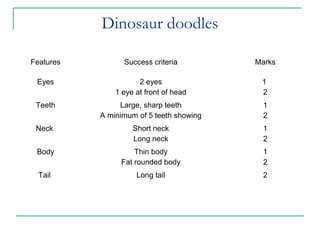
Dinosaur doodles

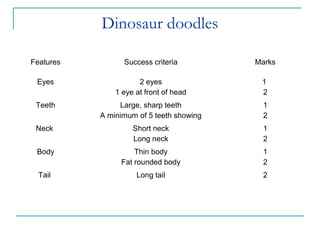
Features         Success criteria         Marks

 Eyes                 2 eyes               1
               1 eye at front of head      2
 Teeth          Large, sharp teeth         1
           A minimum of 5 teeth showing    2
 Neck               Short neck             1
                    Long neck              2
 Body               Thin body              1
                Fat rounded body           2
  Tail               Long tail             2
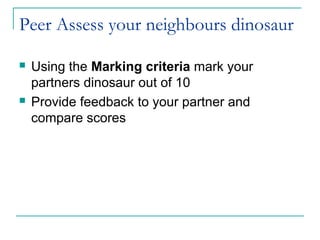
Peer Assess your neighbours dinosaur

   Using the Marking criteria mark your
    partners dinosaur out of 10
   Provide feedback to your partner and
    compare scores
Dinosaur doodles

Features         Success criteria         Marks

 Eyes                 2 eyes               1
               1 eye at front of head      2
 Teeth          Large, sharp teeth         1
           A minimum of 5 teeth showing    2
 Neck               Short neck             1
                    Long neck              2
 Body               Thin body              1
                Fat rounded body           2
  Tail               Long tail             2
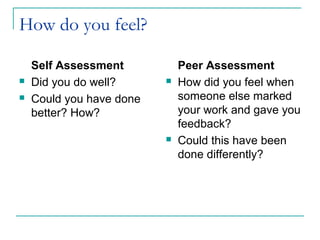
How do you feel?

    Self Assessment           Peer Assessment
   Did you do well?         How did you feel when
   Could you have done       someone else marked
    better? How?              your work and gave you
                              feedback?
                             Could this have been
                              done differently?
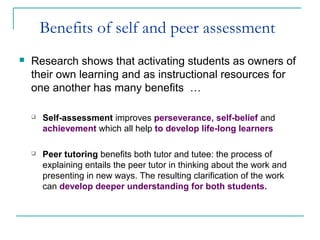
Benefits of self and peer assessment
   Research shows that activating students as owners of
    their own learning and as instructional resources for
    one another has many benefits …

       Self-assessment improves perseverance, self-belief and
        achievement which all help to develop life-long learners

       Peer tutoring benefits both tutor and tutee: the process of
        explaining entails the peer tutor in thinking about the work and
        presenting in new ways. The resulting clarification of the work
        can develop deeper understanding for both students.
Reflecting on self and peer assessment
Read the suggested strategies for supporting the development of self
and peer assessment in class.

   What could the benefits be of using these strategies in your
    practice?

   How and when would this type of strategy be most useful for
    use in a lesson?

   Consider how effectively each strategy could be used to support
    a variety of students to become more effective …
     Self assessors
     Peer assessors
Reflecting on self and peer assessment
    Consider how strategies could be developed and
     adapted to allow learners to become more reflective
     practitioners in your own classroom.

    Highlight some of the strategies you like

    Highlight some of the strategies you will try following
     this Inset Session
Dinosaur


Team Challenge!
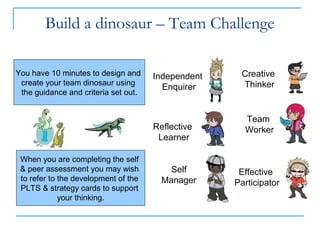
Build a dinosaur – Team Challenge

You have 10 minutes to design and     Independent    Creative
 create your team dinosaur using                     Thinker
                                        Enquirer
 the guidance and criteria set out.


                                                      Team
                                      Reflective      Worker
                                       Learner

 When you are completing the self
 & peer assessment you may wish           Self       Effective
 to refer to the development of the     Manager     Participator
 PLTS & strategy cards to support
             your thinking.
How do you feel?

    Group (Self)              Peer Assessment
    Assessment               How did you feel when
   Did you do well?          someone else marked
   Could you have done       your work and gave you
    better? How?              feedback?
                             Could this have been
                              done differently?
Implications for using self and peer assessment
   To develop peer and self assessment teachers need
    to …
       Train pupils over time to assess their work and the work of
        others
       Plan for peer and self assessment opportunities in their
        lessons
       Systematically explain the learning objectives, outcomes
        and contributing success criteria behind each task
       Guide pupils to identify their next steps
       Frequently and consistently encourage pupils’ self-
        reflection on their own learning
       Plan opportunities and time to allow pupils to do it!
Summary from ‘Working inside the black box’
       (Black, Harrison, Lee, William – 2002)
   The criteria for evaluating and learning achievement must be
    transparent to pupils to enable them to have a clear overview.

   Pupils should be taught the habits and skills of collaboration in peer
    assessment.

   Pupils should be encouraged to keep in mind the aims of their work
    and to assess their own progress to meet these aims as they
    proceed.

   Peer & self assessment make unique contributions to the
    development of pupils’ learning – they secure aims that cannot be
    achieved in any other way.
Advantages for the teacher
   Pupils use each other to discuss, prepare and
    assess their work. They become independent
    learners
   Free time for the teacher to observe pupil learning
   Relaxing – the children do the work, we manage/
    overview
   Quicker assessment, immediate feedback
   Pupils learn assessment criteria in an interesting
    way, so they remember it and use it automatically.
    This makes us more effective

Self and Peer Assessment

  • 1.
    AfL Self &Peer Assessment Effective marking & feedback  To provide strategies which promote and develop self and peer assessment  To identify opportunities to introduce these strategies when planning lessons
  • 2.
    Dinosaur doodles …  Draw a picture of a dinosaur.  Think about the features which a dinosaur may have.  Be as creative as you like.  Your time starts now …
  • 3.
    Self Assess yourDinosaur  Using the marking criteria give yourself a mark out of 10  Convert this to a percentage  How have you done? How could you have improved?
  • 4.
    Dinosaur doodles Features Success criteria Marks Eyes 2 eyes 1 1 eye at front of head 2 Teeth Large, sharp teeth 1 A minimum of 5 teeth showing 2 Neck Short neck 1 Long neck 2 Body Thin body 1 Fat rounded body 2 Tail Long tail 2
  • 5.
    Peer Assess yourneighbours dinosaur  Using the Marking criteria mark your partners dinosaur out of 10  Provide feedback to your partner and compare scores
  • 6.
    Dinosaur doodles Features Success criteria Marks Eyes 2 eyes 1 1 eye at front of head 2 Teeth Large, sharp teeth 1 A minimum of 5 teeth showing 2 Neck Short neck 1 Long neck 2 Body Thin body 1 Fat rounded body 2 Tail Long tail 2
  • 7.
    How do youfeel? Self Assessment Peer Assessment  Did you do well?  How did you feel when  Could you have done someone else marked better? How? your work and gave you feedback?  Could this have been done differently?
  • 8.
    Benefits of selfand peer assessment  Research shows that activating students as owners of their own learning and as instructional resources for one another has many benefits …  Self-assessment improves perseverance, self-belief and achievement which all help to develop life-long learners  Peer tutoring benefits both tutor and tutee: the process of explaining entails the peer tutor in thinking about the work and presenting in new ways. The resulting clarification of the work can develop deeper understanding for both students.
  • 9.
    Reflecting on selfand peer assessment Read the suggested strategies for supporting the development of self and peer assessment in class.  What could the benefits be of using these strategies in your practice?  How and when would this type of strategy be most useful for use in a lesson?  Consider how effectively each strategy could be used to support a variety of students to become more effective …  Self assessors  Peer assessors
  • 10.
    Reflecting on selfand peer assessment  Consider how strategies could be developed and adapted to allow learners to become more reflective practitioners in your own classroom.  Highlight some of the strategies you like  Highlight some of the strategies you will try following this Inset Session
  • 11.
  • 12.
    Build a dinosaur– Team Challenge You have 10 minutes to design and Independent Creative create your team dinosaur using Thinker Enquirer the guidance and criteria set out. Team Reflective Worker Learner When you are completing the self & peer assessment you may wish Self Effective to refer to the development of the Manager Participator PLTS & strategy cards to support your thinking.
  • 13.
    How do youfeel? Group (Self) Peer Assessment Assessment  How did you feel when  Did you do well? someone else marked  Could you have done your work and gave you better? How? feedback?  Could this have been done differently?
  • 14.
    Implications for usingself and peer assessment  To develop peer and self assessment teachers need to …  Train pupils over time to assess their work and the work of others  Plan for peer and self assessment opportunities in their lessons  Systematically explain the learning objectives, outcomes and contributing success criteria behind each task  Guide pupils to identify their next steps  Frequently and consistently encourage pupils’ self- reflection on their own learning  Plan opportunities and time to allow pupils to do it!
  • 15.
    Summary from ‘Workinginside the black box’ (Black, Harrison, Lee, William – 2002)  The criteria for evaluating and learning achievement must be transparent to pupils to enable them to have a clear overview.  Pupils should be taught the habits and skills of collaboration in peer assessment.  Pupils should be encouraged to keep in mind the aims of their work and to assess their own progress to meet these aims as they proceed.  Peer & self assessment make unique contributions to the development of pupils’ learning – they secure aims that cannot be achieved in any other way.
  • 16.
    Advantages for theteacher  Pupils use each other to discuss, prepare and assess their work. They become independent learners  Free time for the teacher to observe pupil learning  Relaxing – the children do the work, we manage/ overview  Quicker assessment, immediate feedback  Pupils learn assessment criteria in an interesting way, so they remember it and use it automatically. This makes us more effective

Editor's Notes

  • #2 The aim of this session is to review our understanding of AfL and the importance of using self and peer assessment within learning and teaching Strategies which will be touched upon in this session may be familiar to many of you, but the hope is that revisiting such ideas may provide you with the opportunity to reflect up on your own practice and of practice within your own department. The hope is that discussion within this session may prompt you to review the most effective ways of providing pupils with opportunities for peer and self assessment within your own practice.
  • #3 Ask colleagues to complete task in time it takes music to play. NB – click on Dinosaur doodles title for hyperlink to film
  • #5 Lead a discussion around need to share clear success criteria with students. Whilst this may seem obvious, this is still not seen as common practice in many lessons observed. Discuss the need to share clearly focused success criteria with students in order for them to see their individual steps to success. Hopefully these success criteria will lead to discussions about interpretations etc which you may wish to follow up on.
  • #7 Lead a discussion around need to share clear success criteria with students. Whilst this may seem obvious, this is still not seen as common practice in many lessons observed. Discuss the need to share clearly focused success criteria with students in order for them to see their individual steps to success. Hopefully these success criteria will lead to discussions about interpretations etc which you may wish to follow up on.
  • #8 Lead a discussion around need to share clear success criteria with students. Whilst this may seem obvious, this is still not seen as common practice in many lessons observed. Discuss the need to share clearly focused success criteria with students in order for them to see their individual steps to success. Hopefully these success criteria will lead to discussions about interpretations etc which you may wish to follow up on. Peer Assessment discuss the need for honest and open dialogue but also the need to be given clear guidelines and boundaries that all assessors work to.
  • #9 Watch the DVD clip of Dylan William discussing self and peer assessment – Clip 6
  • #10 Trainees discuss the questions above with regards to the strategies shared (see separate sheet as well as the clip just seen).
  • #12 See additional resources for this activity.
  • #14 Lead a discussion around need to share clear success criteria with students. Whilst this may seem obvious, this is still not seen as common practice in many lessons observed. Discuss the need to share clearly focused success criteria with students in order for them to see their individual steps to success. Hopefully these success criteria will lead to discussions about interpretations etc which you may wish to follow up on. Peer Assessment discuss the need for honest and open dialogue but also the need to be given clear guidelines and boundaries that all assessors work to.
  • #15 It is worth discussing how such issues can be/have been overcome in school. How can existing good practice already evident in school be shared?
  • #16 The final slide summarises the key findings from research on self and peer assessment.