This document discusses different types of reading disabilities including dyslexia, hyperlexia, and alexia. Dyslexia is a learning disability affecting decoding, comprehension, and fluency. Hyperlexia is a superability in reading beyond one's age and IQ. Alexia is acquired dyslexia from brain damage. Decoding difficulties are at the root of most reading disabilities. Signs include issues with sounding out words and reading fluency. Comprehension and retention problems also impact reading ability. The document provides information to design remedial reading programs tailored for specific disabilities.
In this document
Powered by AI
Introduces reading disabilities focusing on Dyslexia, Hyperlexia, and Alexia. Discusses comprehension, definitions, statistics, and brain functions affecting reading.
Explains decoding and its fundamental role in reading development. Highlights the prevalence of reading difficulties related to decoding problems and their neurodevelopmental nature.
Discusses comprehension difficulties stemming from decoding issues. Lists signs of challenges in understanding text and connecting ideas.
Examines retention difficulties in children related to reading comprehension and decoding. Lists signs indicating retention issues.
Guidelines for designing remedial reading programs targeting students with Dyslexia, Hyperlexia, comprehension, or retention issues. Presentation details and evaluation criteria included.
What is ReadingDisability?
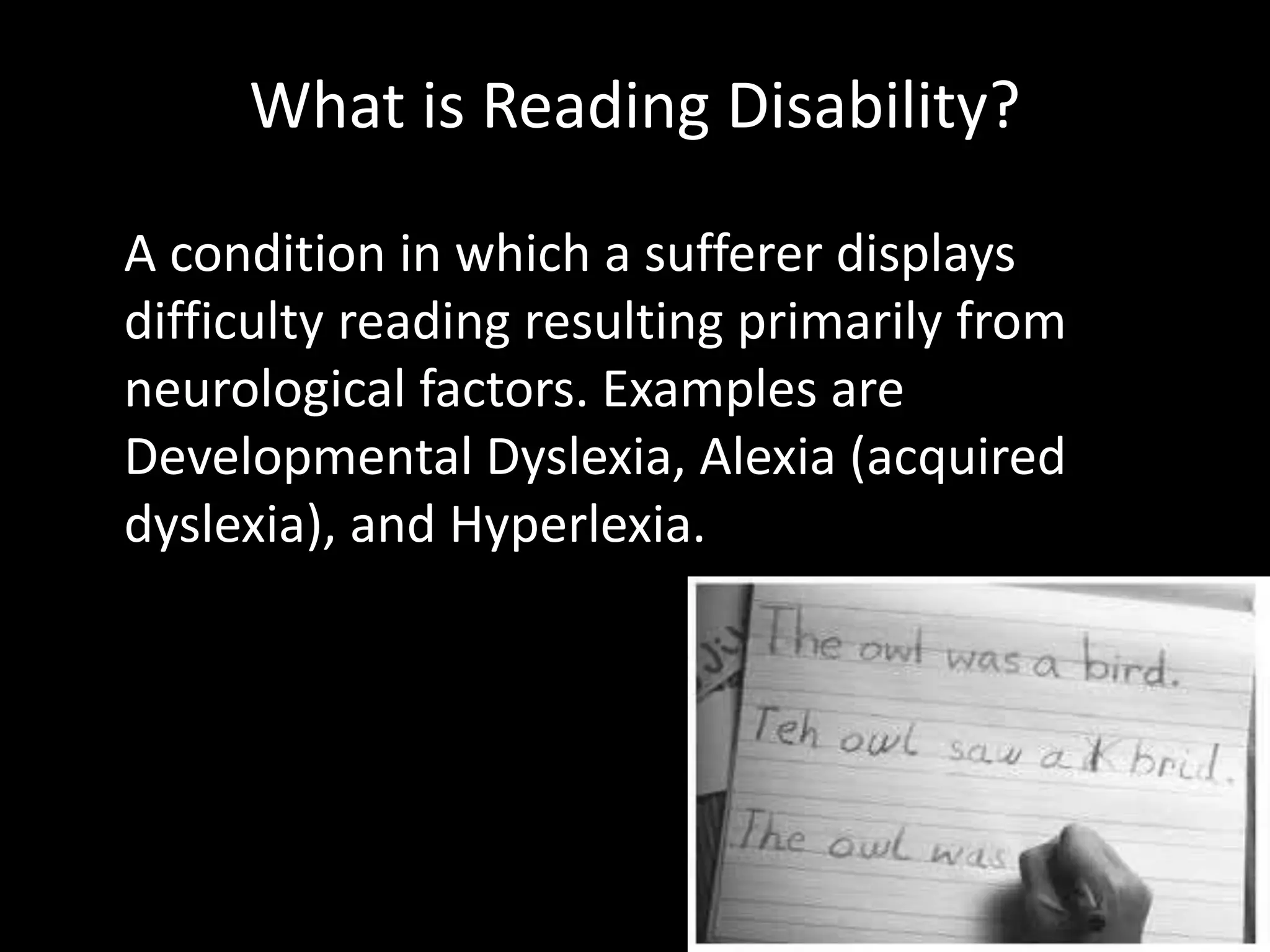
A condition in which a sufferer displays
difficulty reading resulting primarily from
neurological factors. Examples are
Developmental Dyslexia, Alexia (acquired
dyslexia), and Hyperlexia.
3.
DYSLEXIA
• a learningdisability that manifests itself as a
difficulty with reading decoding, reading
comprehension and/or reading fluency
• affects between 5-17% of the population
• has been proposed to have three cognitive
subtypes: auditory, visual and attentional
• NOT related to I.Q., since reading and cognition
develop independently
• NOT characterized by letter or word reversal but by a
simple inability to decode, or break down, words into
phonemes
4.
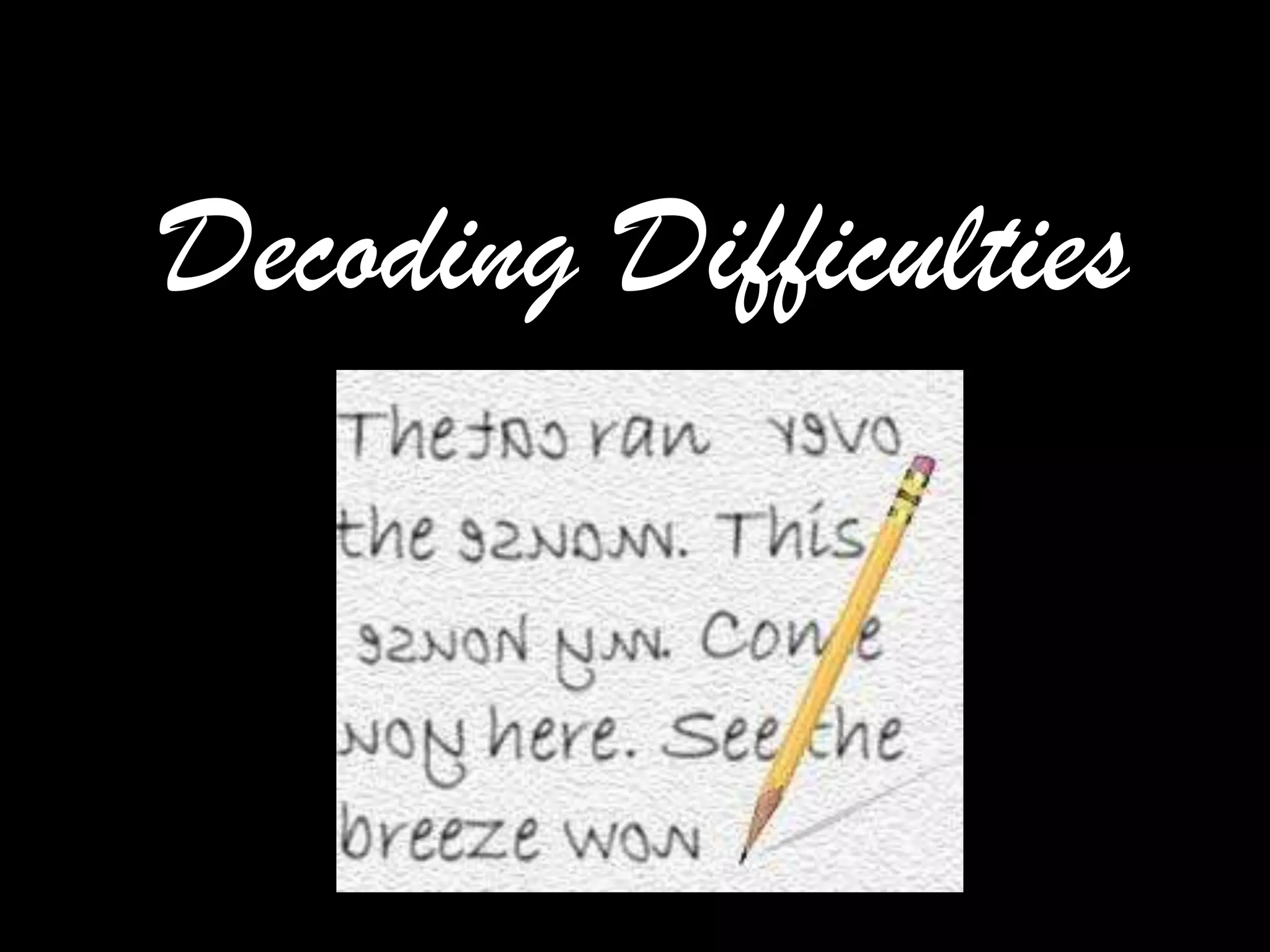
Signs of adecoding problem, or dyslexia, include:
• consistent difficulty sounding out words and
recognizing words out of context
• confusion between letters and the sounds
they represent
• slow reading rate when reading aloud (reading
word-by-word)
• reading without expression
• ignoring punctuation while reading
5.
HYPERLEXIA
• a superabilityin which word recognition ability goes
far above expected levels of skill
• characterized by having average or above average
IQs and word-reading ability well above what would
be expected given their ages and IQs
• some hyperlexics have trouble understanding speech
• most or perhaps all children with hyperlexia lie on the
autism spectrum
• between 5-10% of autistic children have been
estimated to be hyperlexic
6.
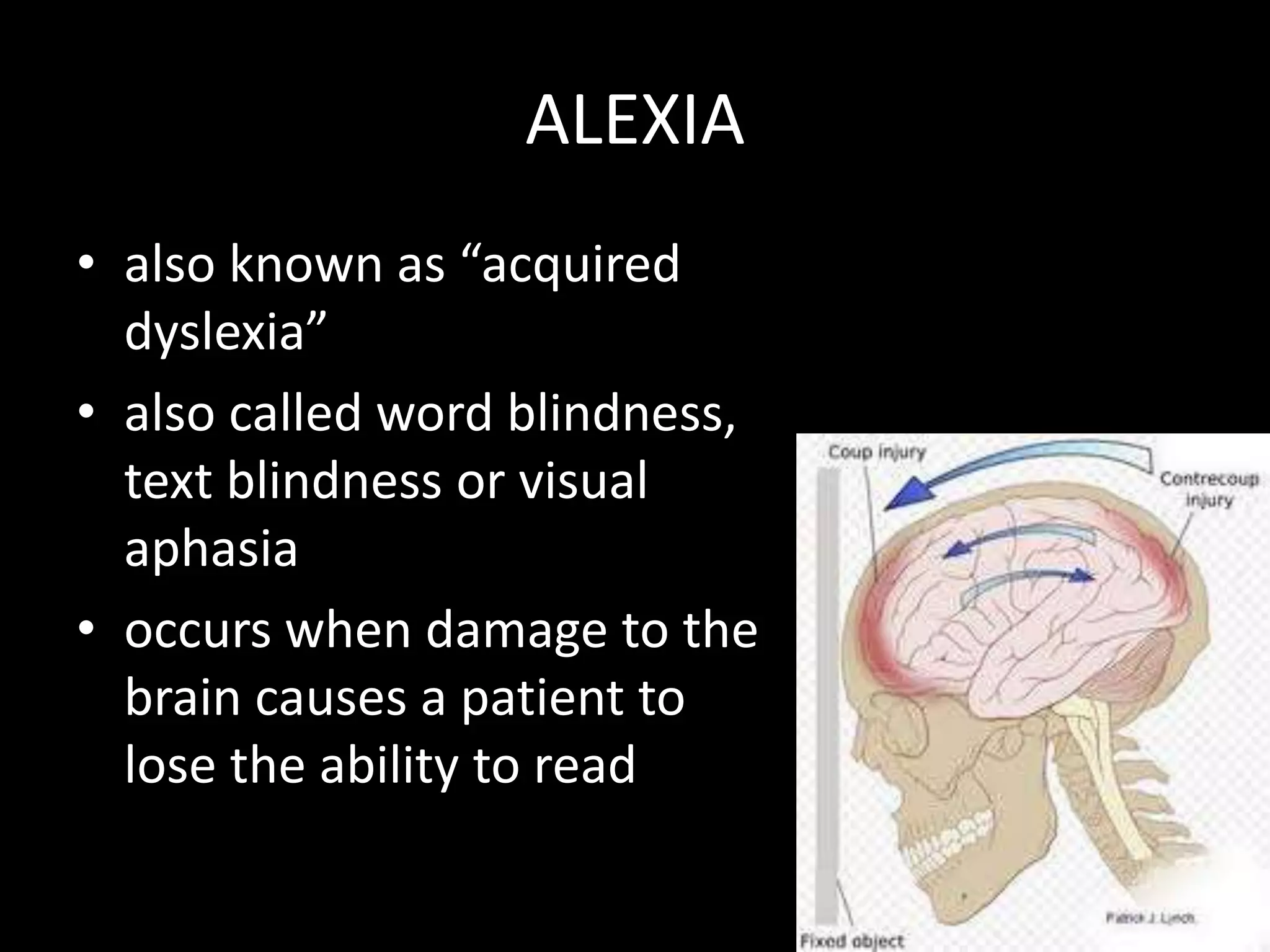
ALEXIA
• also knownas “acquired
dyslexia”
• also called word blindness,
text blindness or visual
aphasia
• occurs when damage to the
brain causes a patient to
lose the ability to read
DECODING…
creates thefoundation
on which all other
reading skills are built
comes naturally,
quickly becoming an
automatic process
9.
Decoding Problems
• Forpeople who struggle to decode words, the
process requires such extreme concentration
that they often miss much of the meaning in
what they read.
• Indeed, according to many experts, decoding
problems are at the root of most reading
disabilities.
10.
Medical & EducationalFacts
Roughly 85% of children diagnosed with learning
difficulties have a primary problem with reading and
related language skills.
Most reading disabilities are neurodevelopmental in
nature.
Neurodevelopmental problems don't go away, but they can
be managed.
Most children with reading disabilities can become
proficient readers and can learn strategies for success in
school.
When a child's reading disability is identified early, that
child is more likely to learn strategies that will raise his or
her reading to grade level.
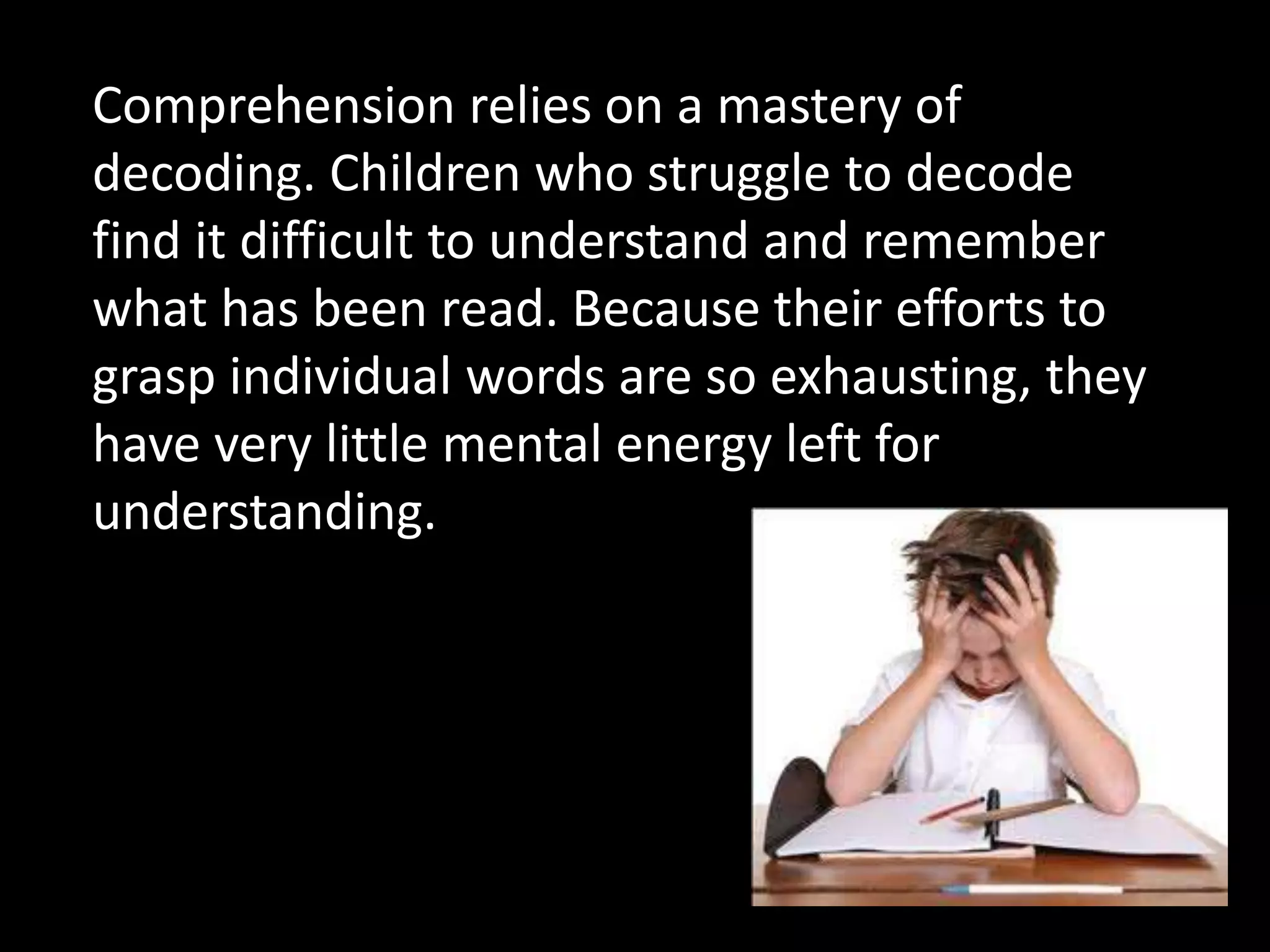
Comprehension relies ona mastery of
decoding. Children who struggle to decode
find it difficult to understand and remember
what has been read. Because their efforts to
grasp individual words are so exhausting, they
have very little mental energy left for
understanding.
13.
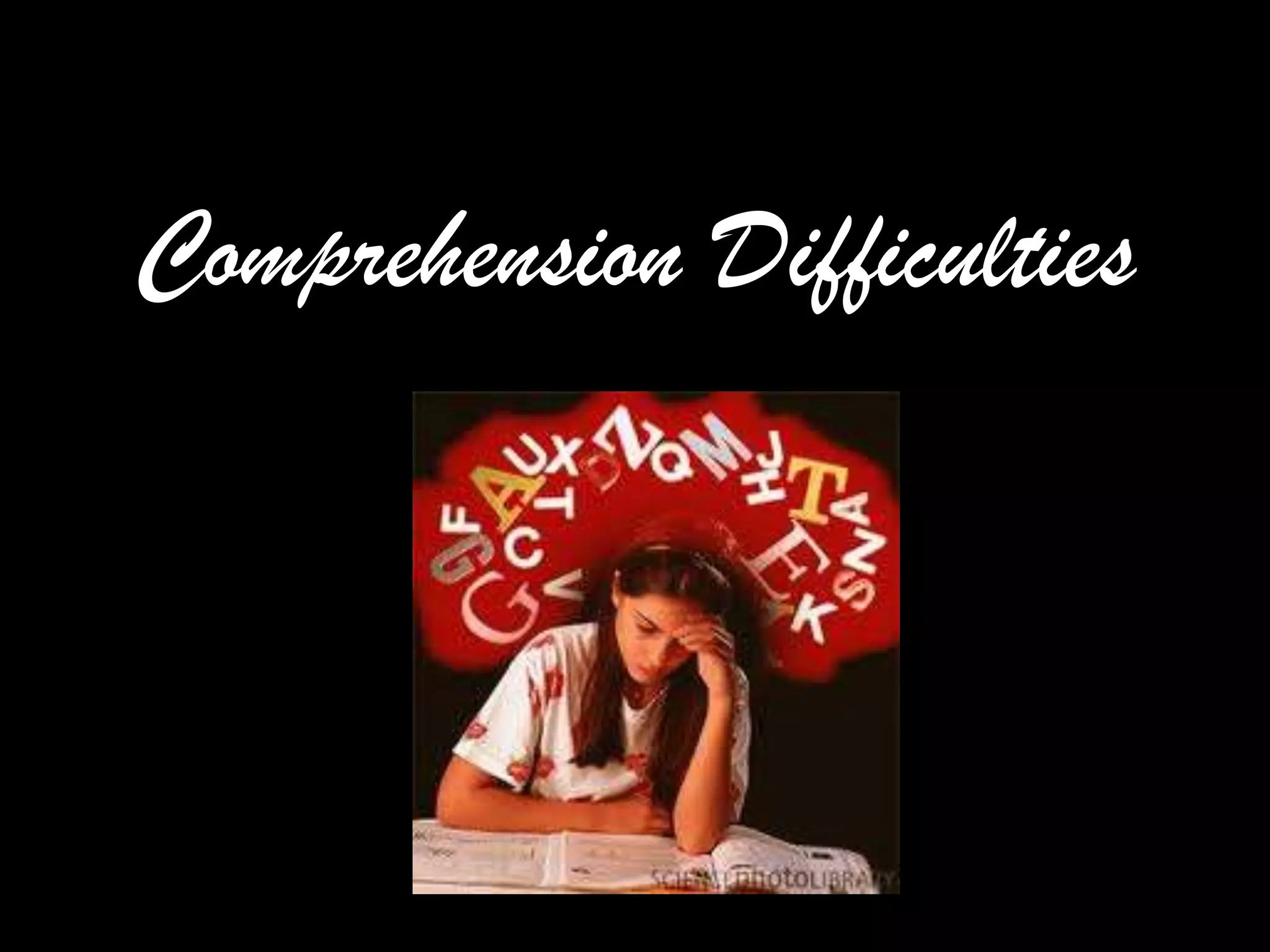
Signs of aproblem with comprehension include:
• confusion about the meaning of words and
sentences
• inability to connect ideas in a passage
• omission of, or glossing over, detail
• difficulty distinguishing significant information
from minor details
• lack of concentration during reading
Children are commonlyasked to read passages
and to answer questions, verbally or in writing,
based on what they've read. This requires the
ability to retain, which relies heavily on a
child's decoding proficiency and ability to
comprehend what is read. As students progress
through grade levels, they are expected to
retain more and more of what they read —
from third grade on, reading to learn is central
to classroom work and, by high school, it is an
essential task.
16.
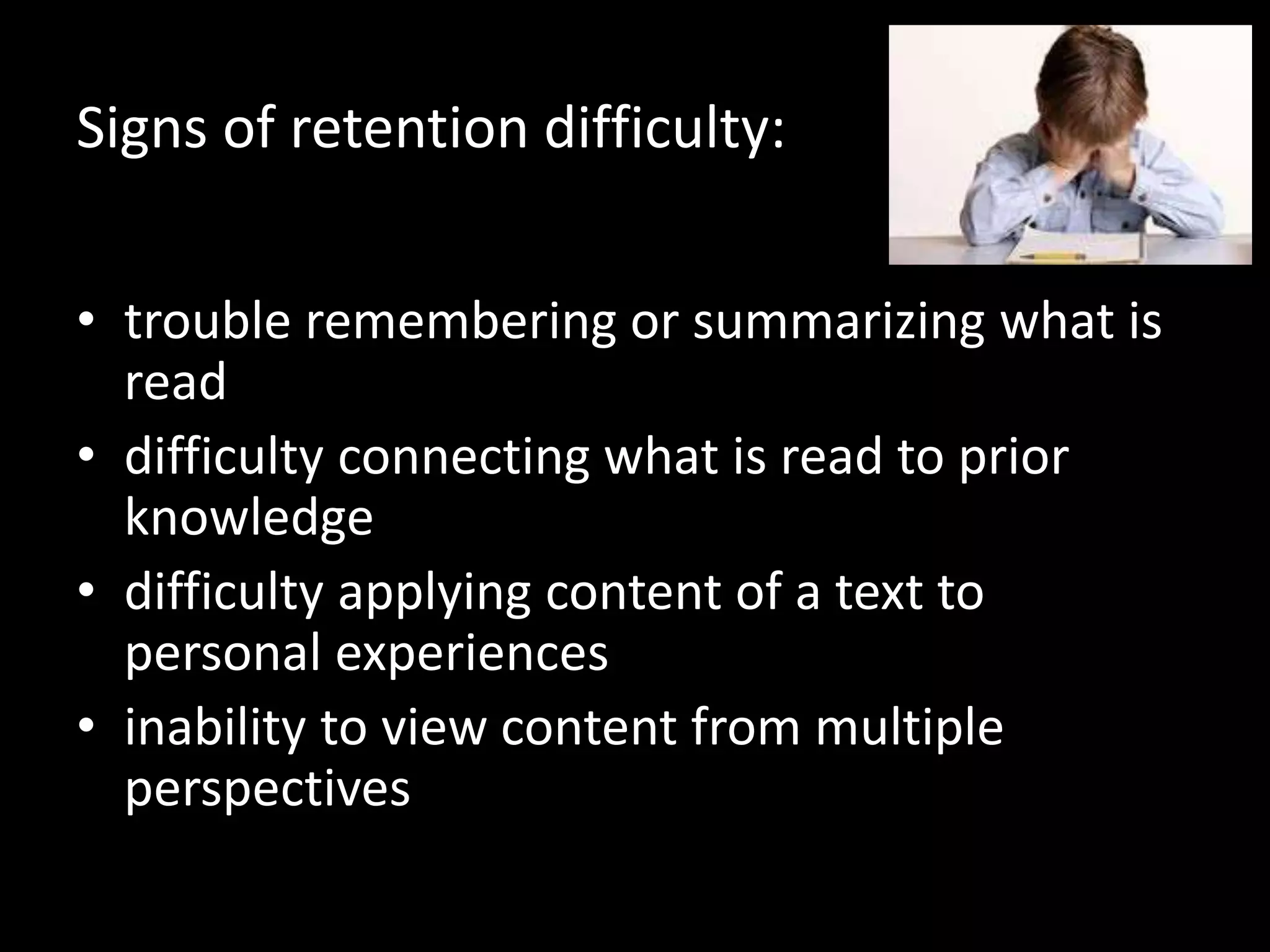
Signs of retentiondifficulty:
• trouble remembering or summarizing what is
read
• difficulty connecting what is read to prior
knowledge
• difficulty applying content of a text to
personal experiences
• inability to view content from multiple
perspectives
17.
Dyad Assignment (1whole yellow paper)
• With a partner, design a remedial reading
program for any one of the following types of
students with reading disability:
Type A: Students with Dyslexia
Type B: Students with Hyperlexia
Type C: Students with Comprehension Problem
Type D: Students with Retention Problem
18.
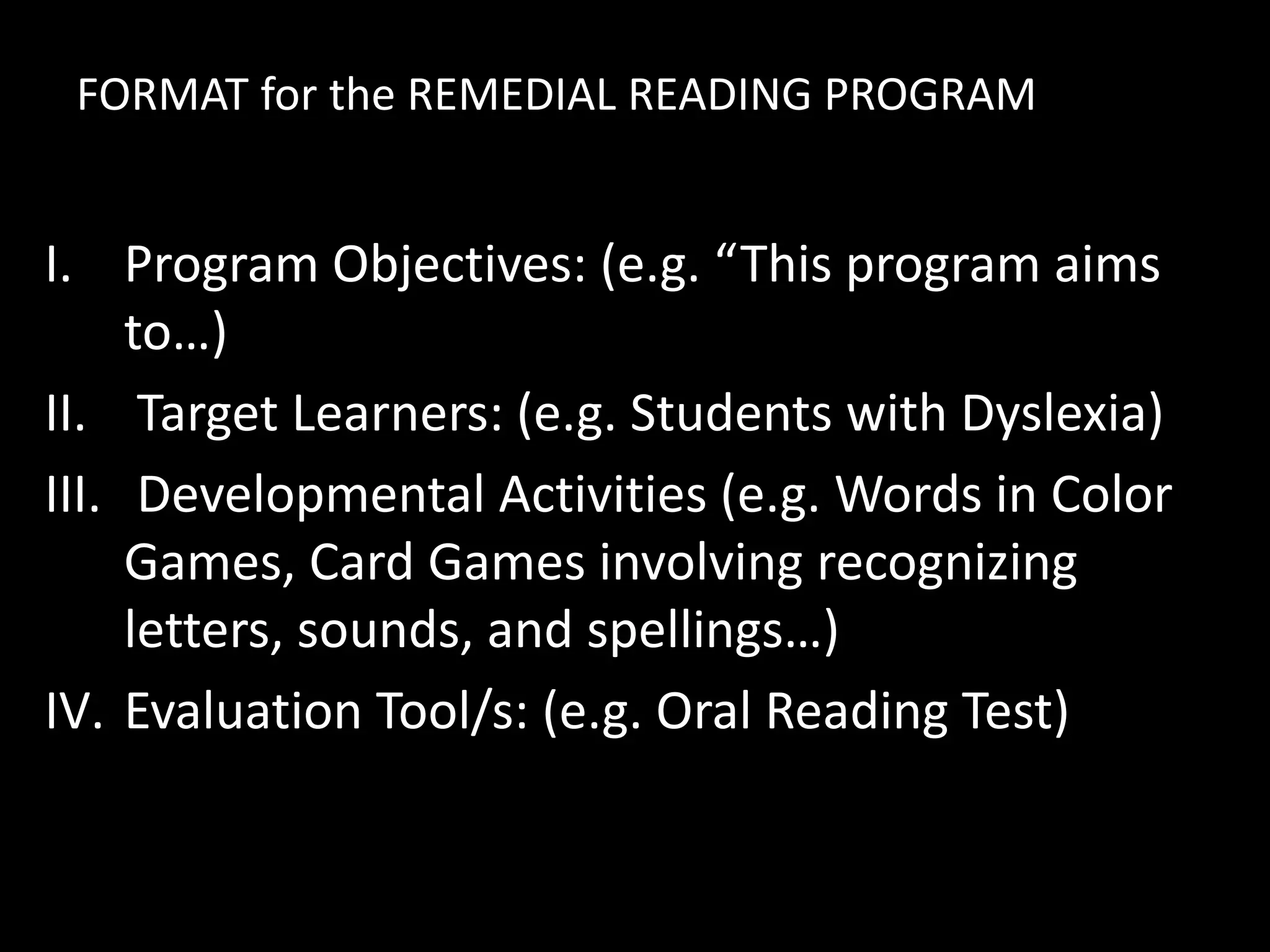
FORMAT for theREMEDIAL READING PROGRAM
I. Program Objectives: (e.g. “This program aims
to…)
II. Target Learners: (e.g. Students with Dyslexia)
III. Developmental Activities (e.g. Words in Color
Games, Card Games involving recognizing
letters, sounds, and spellings…)
IV. Evaluation Tool/s: (e.g. Oral Reading Test)
19.
• Present yourproposed Remedial Reading
Program in PowerPoint format, to be
presented for critiquing and evaluation next
meeting.
• First 5 groups to volunteer will get bonus
points for their oral participation