Amy De Martin – S0120260
Assessment Concept
   Does peer and self-assessment
contribute to ensuring student success?


        Dimension 4 - Investigation
Research Information – Concept
     and Scenario – Year 7 Robotics
                  Class
   Concept: evaluation of the use of peer and self-assessment to
    ensure student success.

   Scenario: observe students utilising peer and self-assessment
    techniques. Record observations. Written documentation only.
    Permission from all parents for image or written documentation of
    student work could not be obtained, images/video of robots allowed.

   Students were required to build and program a sumo robot. The
    challenge is for the robot to be able to push another robot out of the
    sumo circle. Requirements: 1. for the build to have a shield
    somewhere on the body that is a minimum of 15cm, a light sensor
    must be attached and functioning and that there are no hammers,
    claws or other add-ons that could damage another robot. Pushing is
    the only way to win. 2. the programming must be able to keep the
    robot in the sumo circle. The circle is white with a black boarder
    therefore the use of the light sensor is vital to ensure the robot is not
    disqualified by leaving the circle.
Research Information – observed (known)– Year 7
                    Robotics Class
   In forming groups, due to previous robotics experience, students ensured that their
    group included people with skills in building, programming and ideas. This links to
    the self assessment of prior learning/experience and what types of people and skills
    are needed to complete tasks successfully.

   In building, programming and test runs, students were witnessed having meetings,
    sharing knowledge, discussing what was asked of them in the task and how the
    successful group/s interpreted the criteria. Ideas and suggestions were exchanged
    and modifications made. Due to self and peer assessment of the task work being
    completed, groups whether highly capable or struggling with robotics, were able to
    successfully complete the building and programming specifications given, then
    complete the assessment set by competing in the sumo challenge.

   Competing against other class groups before defining their robots as finished was
    suggested and asked for by the students. When asked why they think this is a good
    idea and why they want to do this; their reply was that it would allow them to test out
    their program and robot against another group, ensuring no further modifications are
    needed. This questioning and reasoning process shows that there is an
    understanding of the value and use of peer and self-assessment in task work.
Research Information – observed (known)– Year 7 Robotics
Class
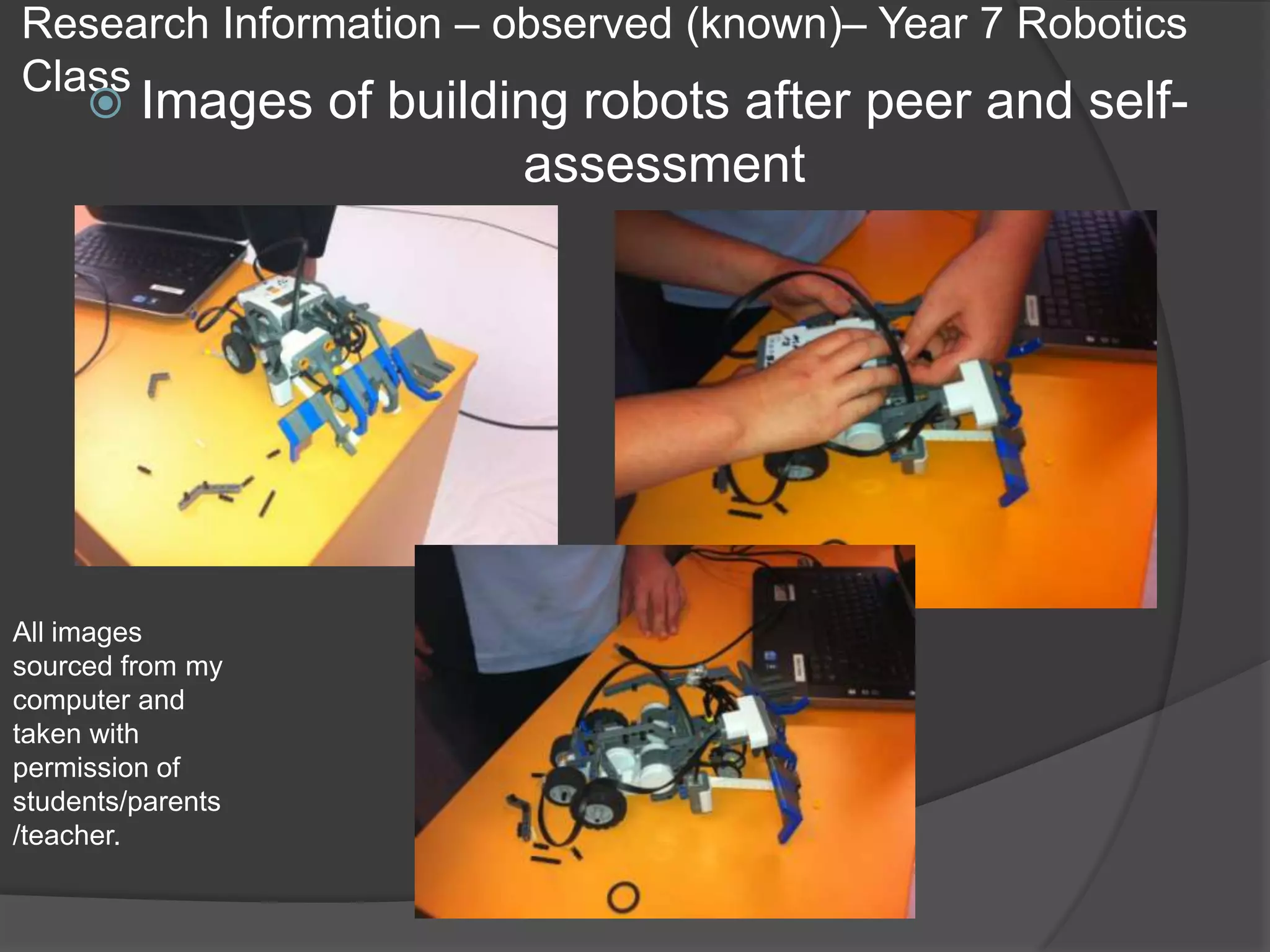
    Images of building robots after peer and self-
                        assessment


All images
sourced from my
computer and
taken with
permission of
students/parents
/teacher.
Research Information – observed (known)– Year 7 Robotics
Class
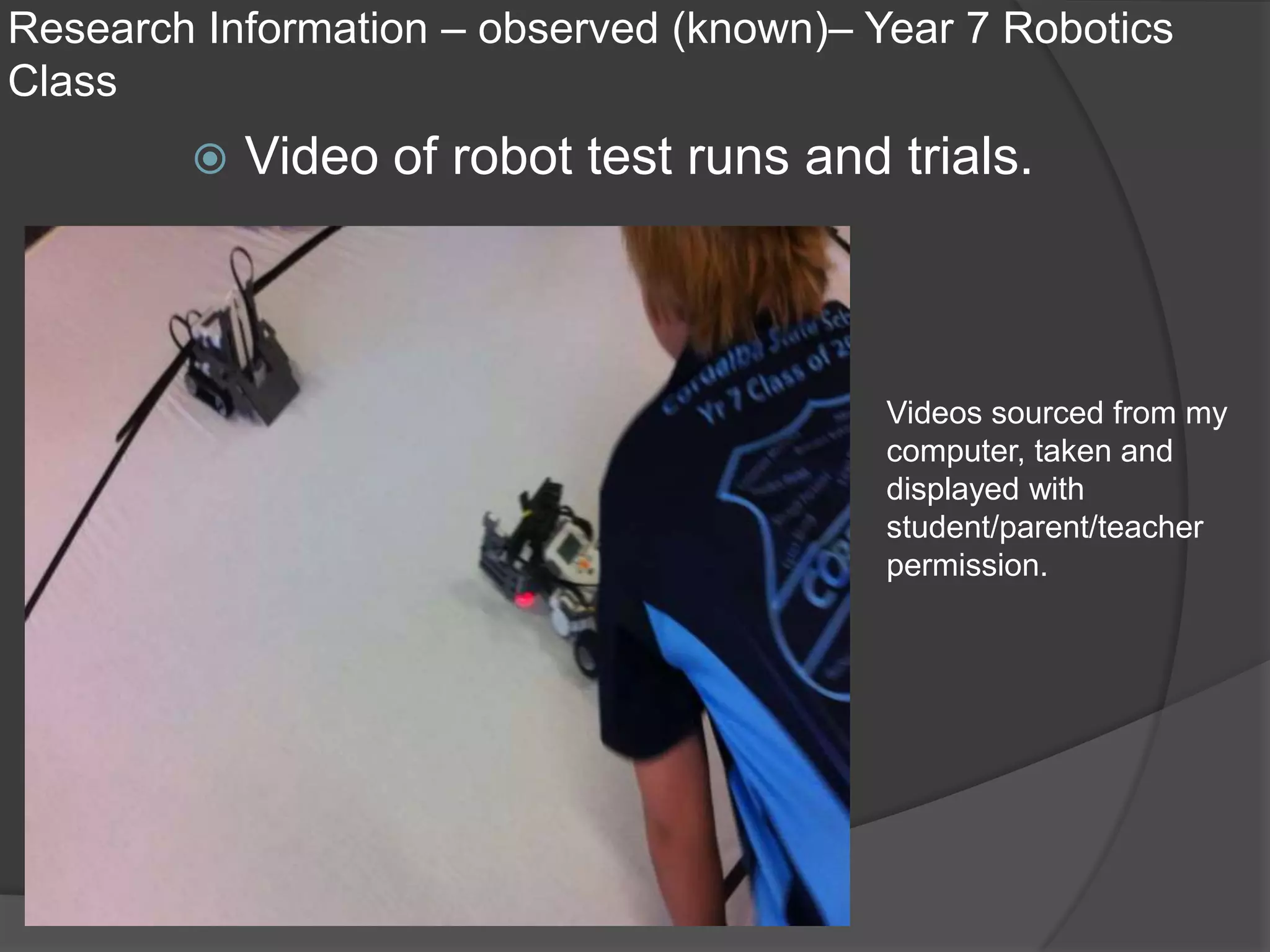
           Video of robot test runs and trials.


                                          Videos sourced from my
                                          computer, taken and
                                          displayed with
                                          student/parent/teacher
                                          permission.
Research information – observed
     (misconceptions) – Year 7 Robotics
                   Class
    Students in the robotics class were observed to have the following misconceptions
     regarding peer and self-assessment:

1.    Peer and self-assessment was something none of them had ever done. That it is
      something completely different to learning strategies previously engaged in such
      as feedback, task discussion and question/answer time.

2.    When asked about strategies such as idea discussion and questioning of other
      students for task insight and whether this was something they had done before;
      the students assumed that talking to other students to exchange ideas, broaden
      thinking and check correct understanding of the task were all strategies that
      either were not allowed (within assessment tasks) or are not peer/self-
      assessment.

3.    Peer and self-assessment was initially thought of as something done in an
      assessment and not processes or strategies that can be incorporated into their
      learning for class or assessment tasks to ensure student success.
Resolution - Does peer and self-assessment contribute to
 ensuring student success? Regarding research conducted with
                     Year 7 Robotics class.
From observations and questioning completed in this class, peer and self-assessment
does indeed contribute to ensuring student success. If the students did not continually
assess their own and others‟ work and then discuss the successful robots, no groups
would have then modified their work, leading to most of the groups not being able to
successfully complete the assessment by having a working robot for the sumo
challenge.
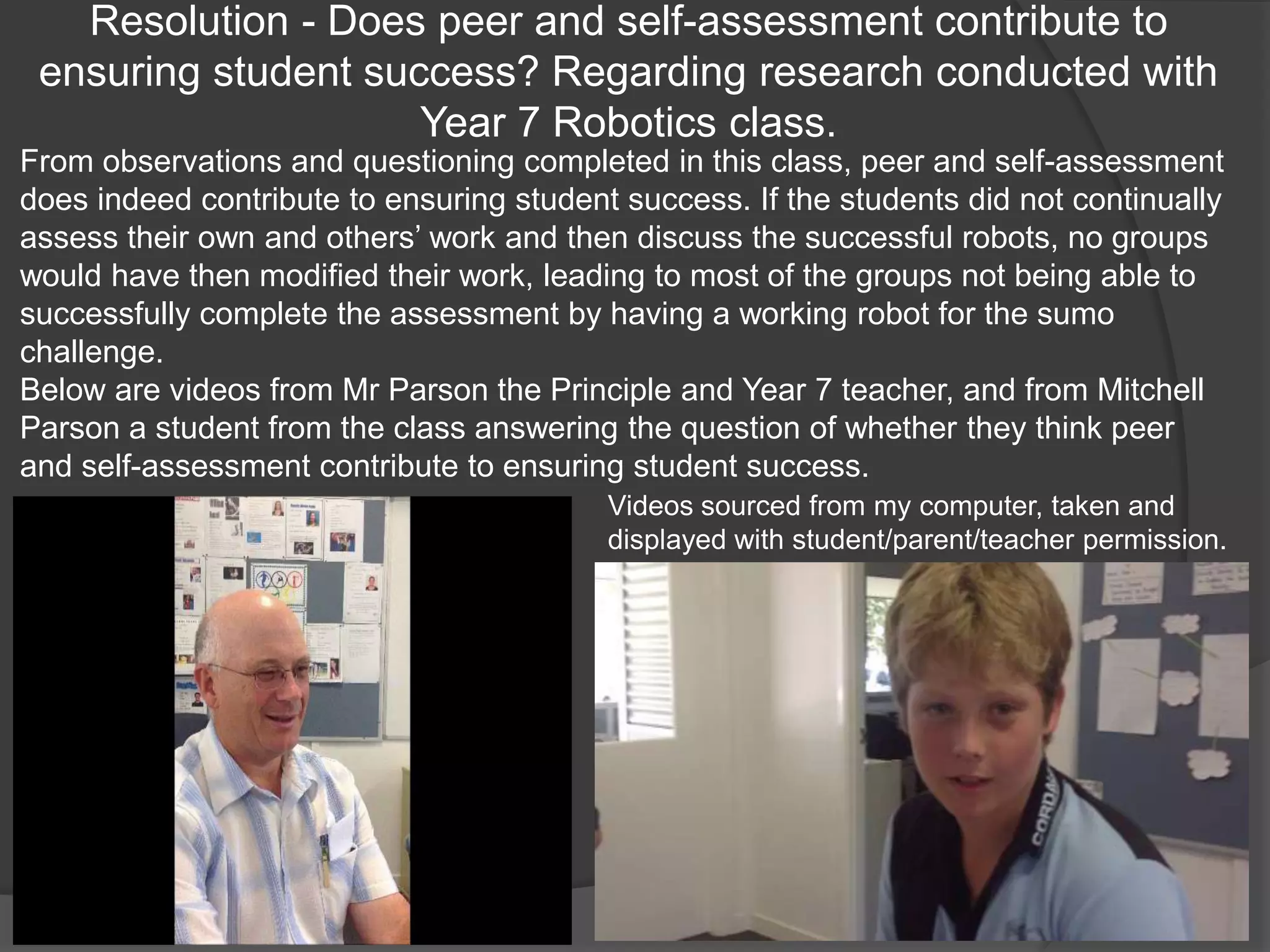
Below are videos from Mr Parson the Principle and Year 7 teacher, and from Mitchell
Parson a student from the class answering the question of whether they think peer
and self-assessment contribute to ensuring student success.
                                          Videos sourced from my computer, taken and
                                          displayed with student/parent/teacher permission.
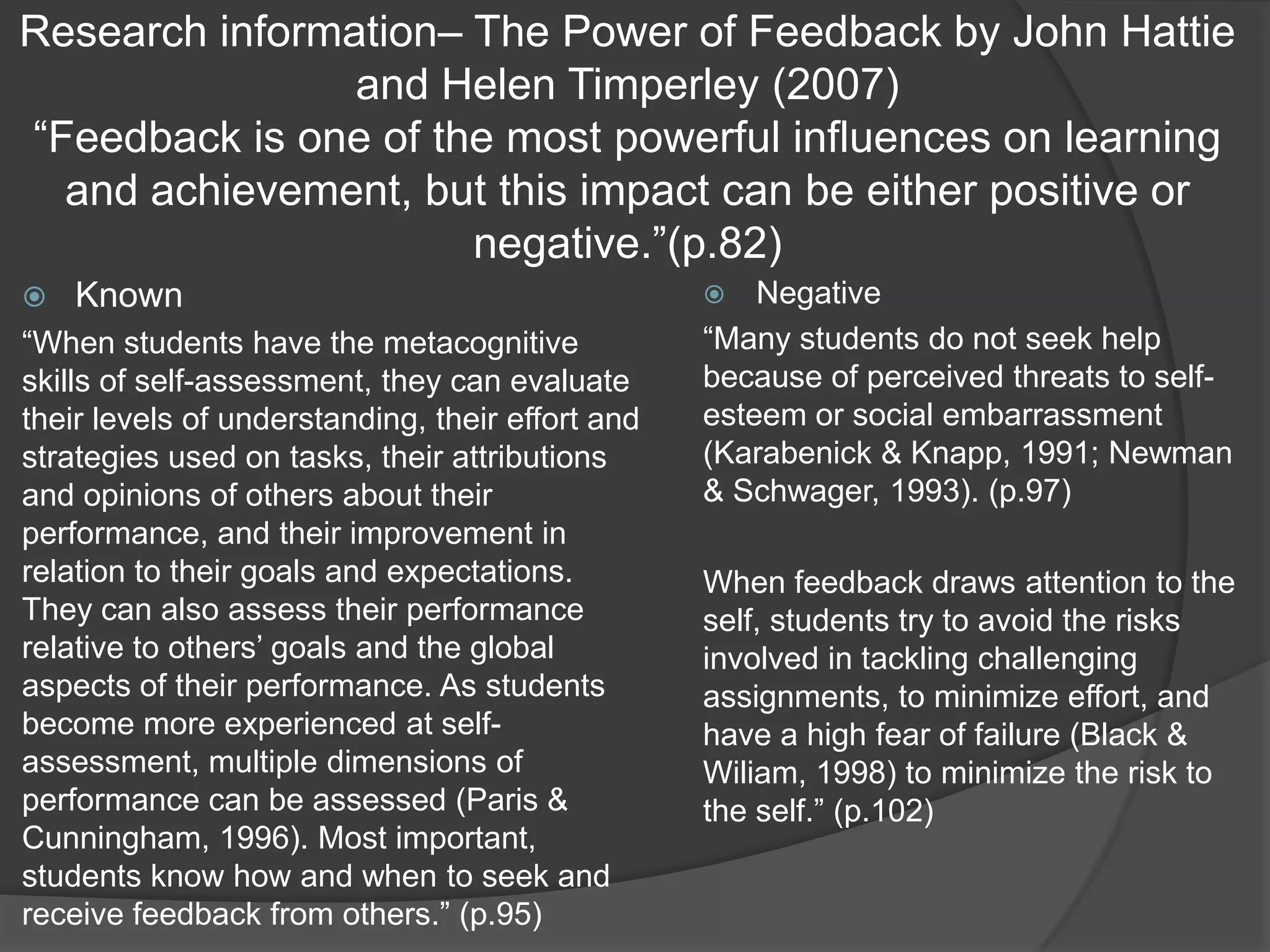
Research information– The Power of Feedback by John Hattie
                and Helen Timperley (2007)
“Feedback is one of the most powerful influences on learning
  and achievement, but this impact can be either positive or
                      negative.”(p.82)
   Known                                            Negative
“When students have the metacognitive             “Many students do not seek help
skills of self-assessment, they can evaluate      because of perceived threats to self-
their levels of understanding, their effort and   esteem or social embarrassment
strategies used on tasks, their attributions      (Karabenick & Knapp, 1991; Newman
and opinions of others about their                & Schwager, 1993). (p.97)
performance, and their improvement in
relation to their goals and expectations.         When feedback draws attention to the
They can also assess their performance            self, students try to avoid the risks
relative to others‟ goals and the global          involved in tackling challenging
aspects of their performance. As students         assignments, to minimize effort, and
become more experienced at self-                  have a high fear of failure (Black &
assessment, multiple dimensions of                Wiliam, 1998) to minimize the risk to
performance can be assessed (Paris &              the self.” (p.102)
Cunningham, 1996). Most important,
students know how and when to seek and
receive feedback from others.” (p.95)
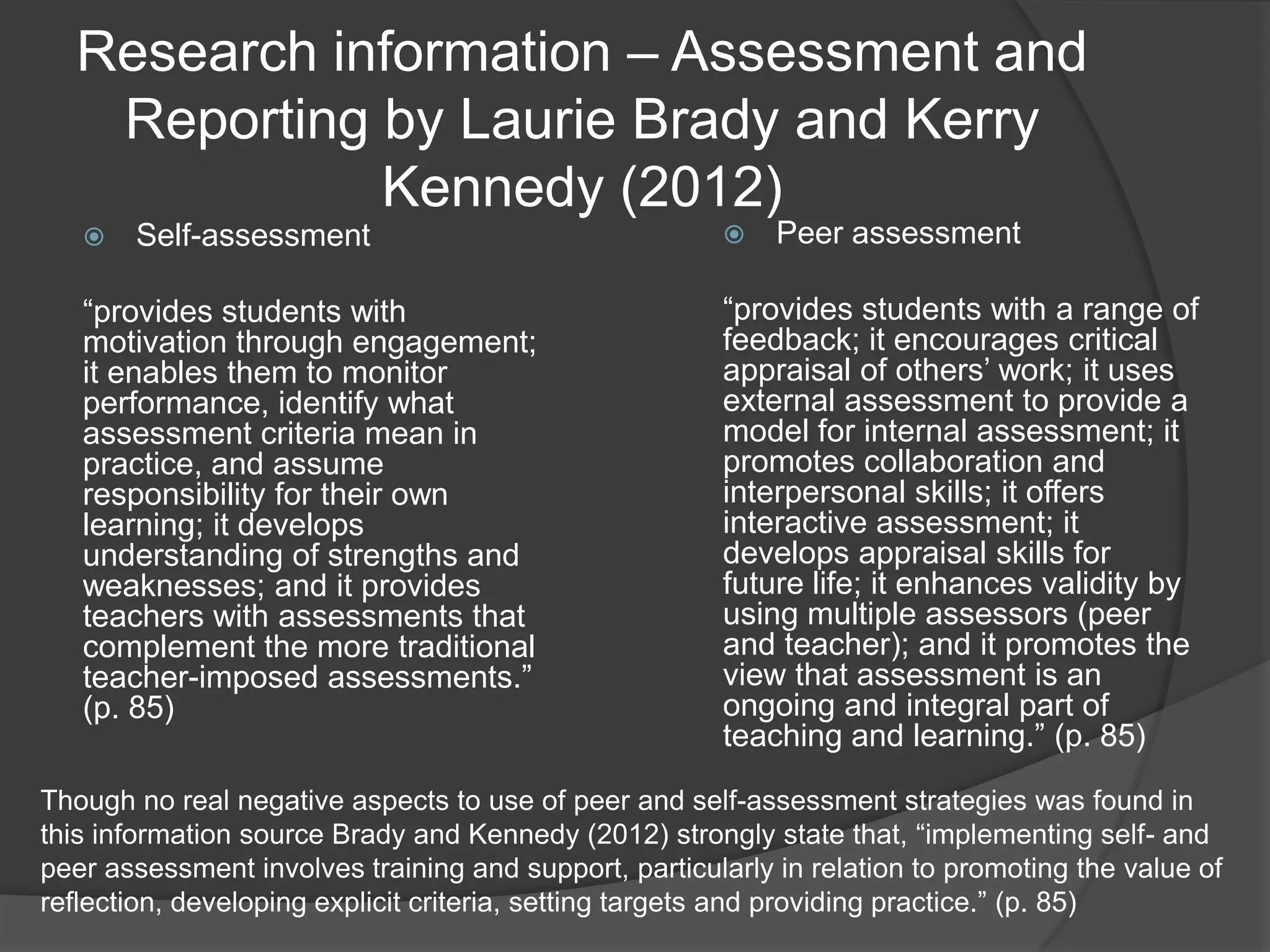
Research information – Assessment and
   Reporting by Laurie Brady and Kerry
             Kennedy (2012)
      Self-assessment                                     Peer assessment

   “provides students with                              “provides students with a range of
   motivation through engagement;                       feedback; it encourages critical
   it enables them to monitor                           appraisal of others‟ work; it uses
   performance, identify what                           external assessment to provide a
   assessment criteria mean in                          model for internal assessment; it
   practice, and assume                                 promotes collaboration and
   responsibility for their own                         interpersonal skills; it offers
   learning; it develops                                interactive assessment; it
   understanding of strengths and                       develops appraisal skills for
   weaknesses; and it provides                          future life; it enhances validity by
   teachers with assessments that                       using multiple assessors (peer
   complement the more traditional                      and teacher); and it promotes the
   teacher-imposed assessments.”                        view that assessment is an
   (p. 85)                                              ongoing and integral part of
                                                        teaching and learning.” (p. 85)

Though no real negative aspects to use of peer and self-assessment strategies was found in
this information source Brady and Kennedy (2012) strongly state that, “implementing self- and
peer assessment involves training and support, particularly in relation to promoting the value of
reflection, developing explicit criteria, setting targets and providing practice.” (p. 85)
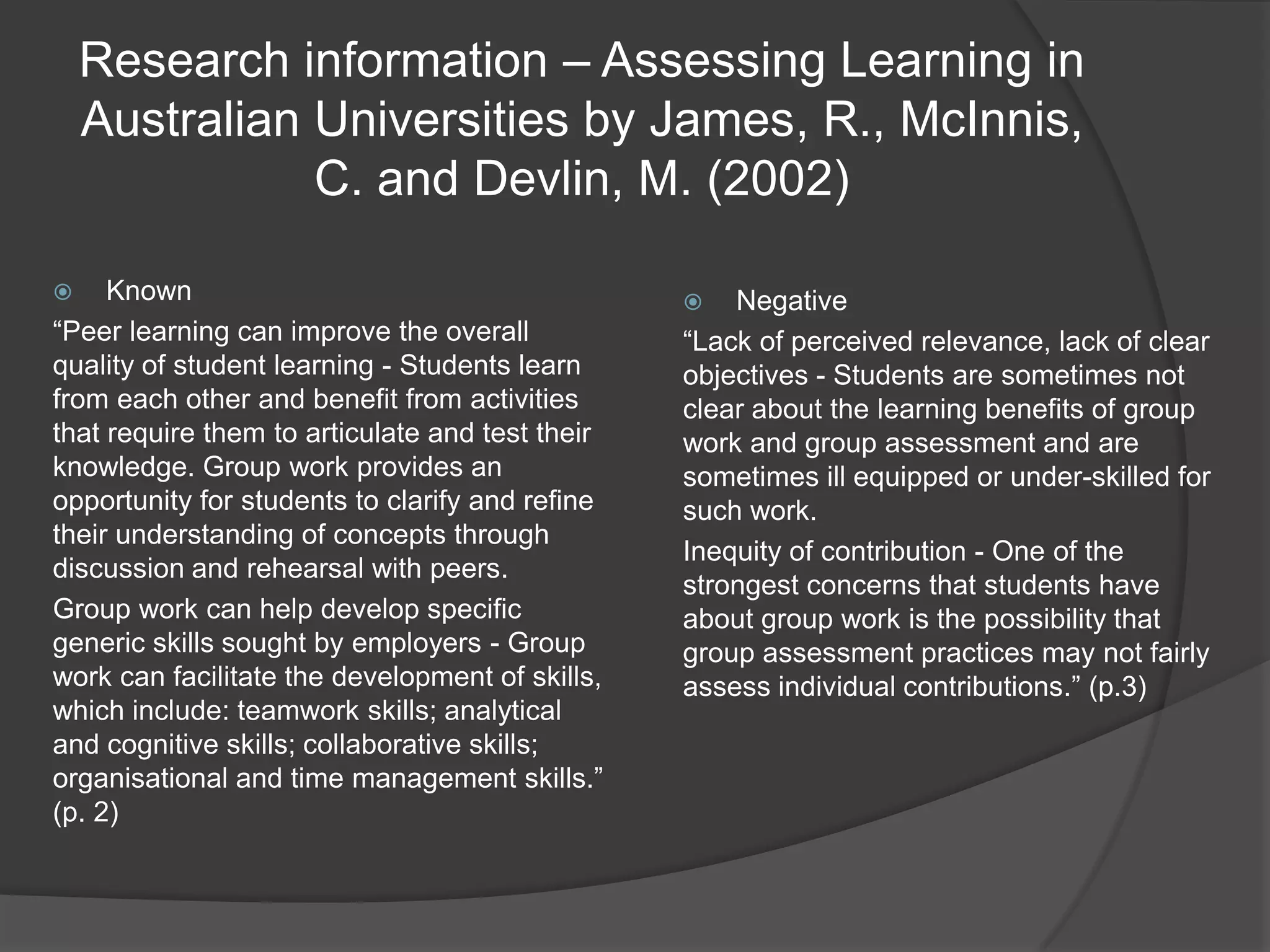
Research information – Assessing Learning in
    Australian Universities by James, R., McInnis,
               C. and Devlin, M. (2002)

    Known                                          Negative
“Peer learning can improve the overall           “Lack of perceived relevance, lack of clear
quality of student learning - Students learn     objectives - Students are sometimes not
from each other and benefit from activities      clear about the learning benefits of group
that require them to articulate and test their   work and group assessment and are
knowledge. Group work provides an                sometimes ill equipped or under-skilled for
opportunity for students to clarify and refine   such work.
their understanding of concepts through
                                                 Inequity of contribution - One of the
discussion and rehearsal with peers.
                                                 strongest concerns that students have
Group work can help develop specific             about group work is the possibility that
generic skills sought by employers - Group       group assessment practices may not fairly
work can facilitate the development of skills,   assess individual contributions.” (p.3)
which include: teamwork skills; analytical
and cognitive skills; collaborative skills;
organisational and time management skills.”
(p. 2)
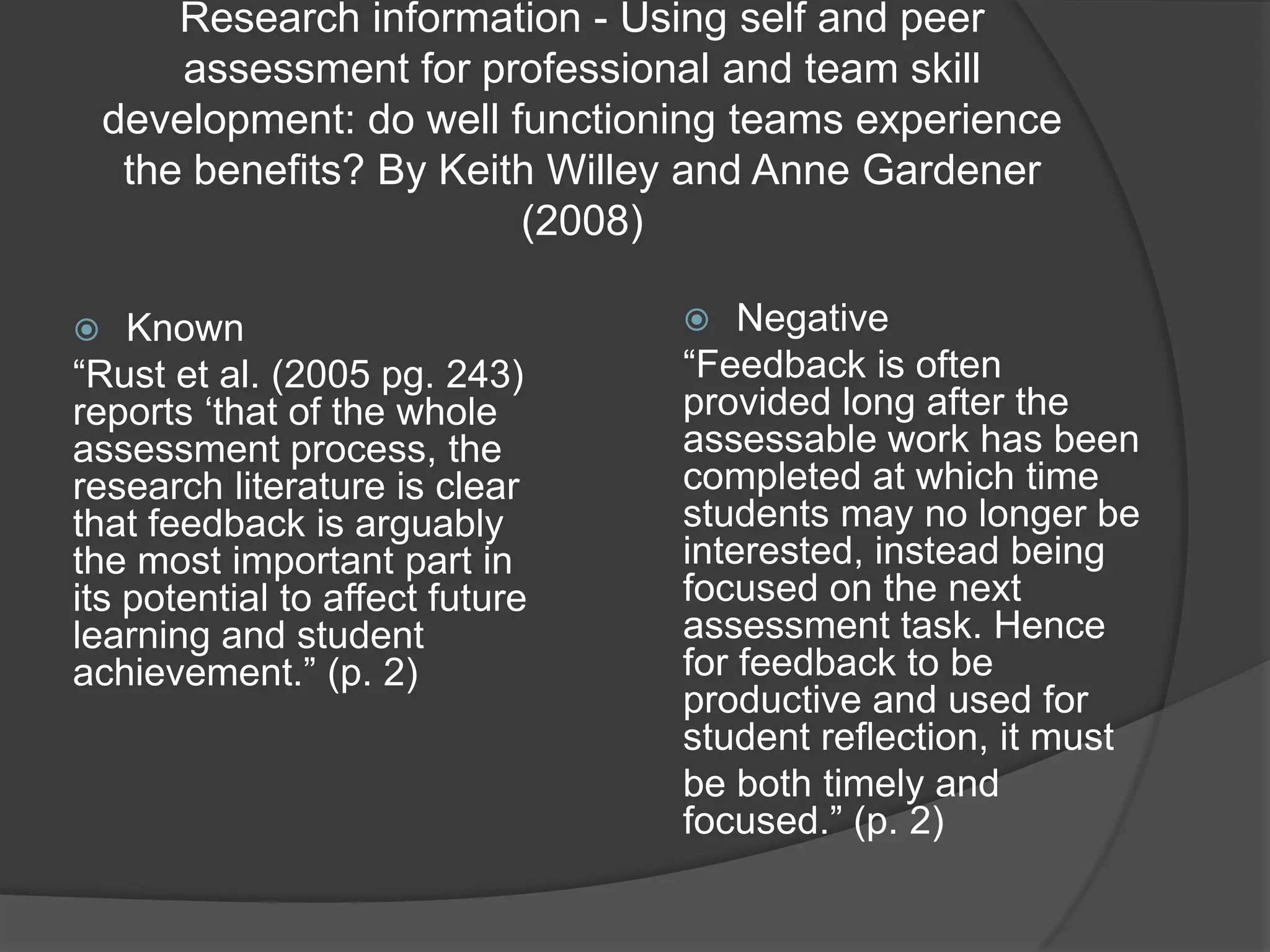
Research information - Using self and peer
        assessment for professional and team skill
    development: do well functioning teams experience
     the benefits? By Keith Willey and Anne Gardener
                          (2008)

   Known                           Negative
“Rust et al. (2005 pg. 243)      “Feedback is often
reports „that of the whole       provided long after the
assessment process, the          assessable work has been
research literature is clear     completed at which time
that feedback is arguably        students may no longer be
the most important part in       interested, instead being
its potential to affect future   focused on the next
learning and student             assessment task. Hence
achievement.” (p. 2)             for feedback to be
                                 productive and used for
                                 student reflection, it must
                                 be both timely and
                                 focused.” (p. 2)
Resolution - Does peer and self-assessment
   contribute to ensuring student success?
Regarding research information collected from
               reliable sources.
   From the aforementioned research information
    collected it can be stated that peer and self-assessment
    does contribute to ensuring student success.

   However, it is vitally important that to be effective
    students and teachers alike must understand what peer
    and self-assessment is and the strategies that can be
    employed for their use and how to use the strategies
    effectively. If students are not informed of how to
    engage in peer and self-assessment nor its benefits
    then it can be said that peer and self-assessment will
    not contribute to ensuring student success.
Resolution – answer to the concept
 question Does peer and self-assessment
 contribute to ensuring student success?
In conclusion, assessing the research information investigated from both
the investigation into the Year 7 Robotic Class and the other reliable
sources; it can be concluded that yes, peer and self-assessment contribute
to ensuring student success, providing effective teaching and learning
strategies are implemented for their use.

Peer and self-assessment are vital to student learning in class tasks and
assessment work. The Queensland Studies Authority (2009) has stated that
“Australian education ministers have made the following commitment to
assessment of student achievement: assessment as learning - enabling
students to reflect on and monitor their own progress to inform their future
learning goals.” (p. 4) This is because as explained by the National
Academy of Science (2000) “Strong learners can explain strategies they
used to solve a problem and why, while less competent students monitor
their own thinking sporadically and ineffectively.” (Cited in ACT Education
and Training (n.d))
References

Assessment 1 ess

  • 1.
    Amy De Martin– S0120260
  • 2.
    Assessment Concept  Does peer and self-assessment contribute to ensuring student success?  Dimension 4 - Investigation
  • 3.
    Research Information –Concept and Scenario – Year 7 Robotics Class  Concept: evaluation of the use of peer and self-assessment to ensure student success.  Scenario: observe students utilising peer and self-assessment techniques. Record observations. Written documentation only. Permission from all parents for image or written documentation of student work could not be obtained, images/video of robots allowed.  Students were required to build and program a sumo robot. The challenge is for the robot to be able to push another robot out of the sumo circle. Requirements: 1. for the build to have a shield somewhere on the body that is a minimum of 15cm, a light sensor must be attached and functioning and that there are no hammers, claws or other add-ons that could damage another robot. Pushing is the only way to win. 2. the programming must be able to keep the robot in the sumo circle. The circle is white with a black boarder therefore the use of the light sensor is vital to ensure the robot is not disqualified by leaving the circle.
  • 4.
    Research Information –observed (known)– Year 7 Robotics Class  In forming groups, due to previous robotics experience, students ensured that their group included people with skills in building, programming and ideas. This links to the self assessment of prior learning/experience and what types of people and skills are needed to complete tasks successfully.  In building, programming and test runs, students were witnessed having meetings, sharing knowledge, discussing what was asked of them in the task and how the successful group/s interpreted the criteria. Ideas and suggestions were exchanged and modifications made. Due to self and peer assessment of the task work being completed, groups whether highly capable or struggling with robotics, were able to successfully complete the building and programming specifications given, then complete the assessment set by competing in the sumo challenge.  Competing against other class groups before defining their robots as finished was suggested and asked for by the students. When asked why they think this is a good idea and why they want to do this; their reply was that it would allow them to test out their program and robot against another group, ensuring no further modifications are needed. This questioning and reasoning process shows that there is an understanding of the value and use of peer and self-assessment in task work.
  • 5.
    Research Information –observed (known)– Year 7 Robotics Class  Images of building robots after peer and self- assessment All images sourced from my computer and taken with permission of students/parents /teacher.
  • 6.
    Research Information –observed (known)– Year 7 Robotics Class  Video of robot test runs and trials. Videos sourced from my computer, taken and displayed with student/parent/teacher permission.
  • 7.
    Research information –observed (misconceptions) – Year 7 Robotics Class  Students in the robotics class were observed to have the following misconceptions regarding peer and self-assessment: 1. Peer and self-assessment was something none of them had ever done. That it is something completely different to learning strategies previously engaged in such as feedback, task discussion and question/answer time. 2. When asked about strategies such as idea discussion and questioning of other students for task insight and whether this was something they had done before; the students assumed that talking to other students to exchange ideas, broaden thinking and check correct understanding of the task were all strategies that either were not allowed (within assessment tasks) or are not peer/self- assessment. 3. Peer and self-assessment was initially thought of as something done in an assessment and not processes or strategies that can be incorporated into their learning for class or assessment tasks to ensure student success.
  • 8.
    Resolution - Doespeer and self-assessment contribute to ensuring student success? Regarding research conducted with Year 7 Robotics class. From observations and questioning completed in this class, peer and self-assessment does indeed contribute to ensuring student success. If the students did not continually assess their own and others‟ work and then discuss the successful robots, no groups would have then modified their work, leading to most of the groups not being able to successfully complete the assessment by having a working robot for the sumo challenge. Below are videos from Mr Parson the Principle and Year 7 teacher, and from Mitchell Parson a student from the class answering the question of whether they think peer and self-assessment contribute to ensuring student success. Videos sourced from my computer, taken and displayed with student/parent/teacher permission.
  • 9.
    Research information– ThePower of Feedback by John Hattie and Helen Timperley (2007) “Feedback is one of the most powerful influences on learning and achievement, but this impact can be either positive or negative.”(p.82)  Known  Negative “When students have the metacognitive “Many students do not seek help skills of self-assessment, they can evaluate because of perceived threats to self- their levels of understanding, their effort and esteem or social embarrassment strategies used on tasks, their attributions (Karabenick & Knapp, 1991; Newman and opinions of others about their & Schwager, 1993). (p.97) performance, and their improvement in relation to their goals and expectations. When feedback draws attention to the They can also assess their performance self, students try to avoid the risks relative to others‟ goals and the global involved in tackling challenging aspects of their performance. As students assignments, to minimize effort, and become more experienced at self- have a high fear of failure (Black & assessment, multiple dimensions of Wiliam, 1998) to minimize the risk to performance can be assessed (Paris & the self.” (p.102) Cunningham, 1996). Most important, students know how and when to seek and receive feedback from others.” (p.95)
  • 10.
    Research information –Assessment and Reporting by Laurie Brady and Kerry Kennedy (2012)  Self-assessment  Peer assessment “provides students with “provides students with a range of motivation through engagement; feedback; it encourages critical it enables them to monitor appraisal of others‟ work; it uses performance, identify what external assessment to provide a assessment criteria mean in model for internal assessment; it practice, and assume promotes collaboration and responsibility for their own interpersonal skills; it offers learning; it develops interactive assessment; it understanding of strengths and develops appraisal skills for weaknesses; and it provides future life; it enhances validity by teachers with assessments that using multiple assessors (peer complement the more traditional and teacher); and it promotes the teacher-imposed assessments.” view that assessment is an (p. 85) ongoing and integral part of teaching and learning.” (p. 85) Though no real negative aspects to use of peer and self-assessment strategies was found in this information source Brady and Kennedy (2012) strongly state that, “implementing self- and peer assessment involves training and support, particularly in relation to promoting the value of reflection, developing explicit criteria, setting targets and providing practice.” (p. 85)
  • 11.
    Research information –Assessing Learning in Australian Universities by James, R., McInnis, C. and Devlin, M. (2002)  Known  Negative “Peer learning can improve the overall “Lack of perceived relevance, lack of clear quality of student learning - Students learn objectives - Students are sometimes not from each other and benefit from activities clear about the learning benefits of group that require them to articulate and test their work and group assessment and are knowledge. Group work provides an sometimes ill equipped or under-skilled for opportunity for students to clarify and refine such work. their understanding of concepts through Inequity of contribution - One of the discussion and rehearsal with peers. strongest concerns that students have Group work can help develop specific about group work is the possibility that generic skills sought by employers - Group group assessment practices may not fairly work can facilitate the development of skills, assess individual contributions.” (p.3) which include: teamwork skills; analytical and cognitive skills; collaborative skills; organisational and time management skills.” (p. 2)
  • 12.
    Research information -Using self and peer assessment for professional and team skill development: do well functioning teams experience the benefits? By Keith Willey and Anne Gardener (2008)  Known  Negative “Rust et al. (2005 pg. 243) “Feedback is often reports „that of the whole provided long after the assessment process, the assessable work has been research literature is clear completed at which time that feedback is arguably students may no longer be the most important part in interested, instead being its potential to affect future focused on the next learning and student assessment task. Hence achievement.” (p. 2) for feedback to be productive and used for student reflection, it must be both timely and focused.” (p. 2)
  • 13.
    Resolution - Doespeer and self-assessment contribute to ensuring student success? Regarding research information collected from reliable sources.  From the aforementioned research information collected it can be stated that peer and self-assessment does contribute to ensuring student success.  However, it is vitally important that to be effective students and teachers alike must understand what peer and self-assessment is and the strategies that can be employed for their use and how to use the strategies effectively. If students are not informed of how to engage in peer and self-assessment nor its benefits then it can be said that peer and self-assessment will not contribute to ensuring student success.
  • 14.
    Resolution – answerto the concept question Does peer and self-assessment contribute to ensuring student success? In conclusion, assessing the research information investigated from both the investigation into the Year 7 Robotic Class and the other reliable sources; it can be concluded that yes, peer and self-assessment contribute to ensuring student success, providing effective teaching and learning strategies are implemented for their use. Peer and self-assessment are vital to student learning in class tasks and assessment work. The Queensland Studies Authority (2009) has stated that “Australian education ministers have made the following commitment to assessment of student achievement: assessment as learning - enabling students to reflect on and monitor their own progress to inform their future learning goals.” (p. 4) This is because as explained by the National Academy of Science (2000) “Strong learners can explain strategies they used to solve a problem and why, while less competent students monitor their own thinking sporadically and ineffectively.” (Cited in ACT Education and Training (n.d))
  • 15.