THERMAL MODELING OF ELECTRON BEAM
     ADDITIVE MANUFACTURING PROCESS –
         POWDER SINTERING EFFECTS

                           Ninggang (George) Shen
                               Dr. Kevin Chou

                                   6/6/2012


The University of Alabama-Mechanical Engineering    1
Outline of the contents

1. Introduction & research objectives

2. Heat transfer and heat source modeling

3. Material properties & state changes

4. FE mode configuration

5. Model validation

6. Simulation results

7. Conclusions

8. Future work

The University of Alabama-Mechanical Engineering   2
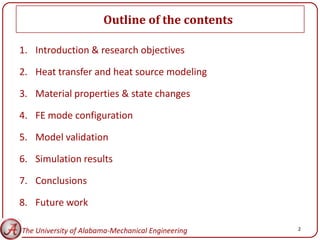
1. Introduction and research objectives


The University of Alabama-Mechanical Engineering   3
1. Introduction and research objectives


                                                   Fig. 1 Melt ball formation [2]


                                                    Fig. 2 Delamination [2]         4
The University of Alabama-Mechanical Engineering
1. Introduction and research objectives


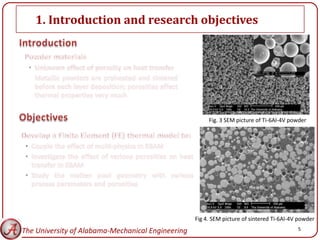
                                                        Fig. 3 SEM picture of Ti-6Al-4V powder


                                                   Fig 4. SEM picture of sintered Ti-6Al-4V powder
The University of Alabama-Mechanical Engineering                                           5
2. Heat transfer and heat source modeling

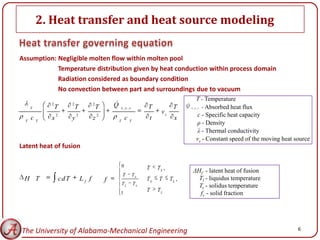
Assumption: Negligible molten flow within molten pool
            Temperature distribution given by heat conduction within process domain
            Radiation considered as boundary condition
            No convection between part and surroundings due to vacuum
                                                                                                               T - Temperature
              2              2              2           
                                                        Q                                           Q
      T           T              T              T           x, y,z               T            T          x , y , z - Absorbed heat flux

                  2              2              2
                                                                                        vs                       c - Specific heat capacity
      c       x              y              z                       c             t            x
  T       T                                                 T           T
                                                                                                                 ρ - Density
                                                                                                                 λ - Thermal conductivity
                                                                                                               vs - Constant speed of the moving heat source
Latent heat of fusion

                                                                0                T    TS ,               ΔHf - latent heat of fusion
                                                                T           TS
 H T                  cd T           Lf f           f                            TS    T     TL ,          Tl - liquidus temperature
                                                                TL          TS                             Ts - solidus temperature
                                                                                 T    TL
                                                            1                                               fs - solid fraction


The University of Alabama-Mechanical Engineering                                                                                                      6
2. Heat transfer and heat source modeling


• The cross sectional geometry of keyhole is usually idealized as a cone
• The intensity distribution is considered as a conical source:
    Horizontal – Gaussian distribution
    Vertical – Decaying with increasing of penetration depth


                          Fig. 5 Actual keyhole example and idealization [3]

The University of Alabama-Mechanical Engineering                               7
2. Heat transfer and heat source modeling

Heat source equation used in our study [4]:
                                                    2                 2
                         8 UIb         8   x   xs            y   ys
                                                                                           2       z
S x, y, z          f z      2
                                 exp                    2                   with   f z         1
                            E                           E
                                                                                           h       h


                                                            Max. density = 306 W/mm2
       U       6 0 kV
       Ib      2mA

  If       E
                   2mm
               1
       h       2mm
       z       0


                                                        Fig. 6 Horizontal intensity distribution @ z = 0
The University of Alabama-Mechanical Engineering                                                           8
3. Material properties & state changes


                Fig. 7 Temperature dependent material properties of Ti-6Al-4V [5]

The University of Alabama-Mechanical Engineering                                    9
3. Material properties & state changes

Emissivity [6]:                                                                        Thermal Conductivity [7]:
      AH   H
                  1    AH       S
                                                                               2       k    kr   kc
                                                                       1
                                            S
                                                    2     3 .0 8 2
                       2
               0.908                                                                        16
 AH              2                  H                                      2           kc        l T
                                                                                                       3   kr   k b u lk x
      1.908            2    1                                      1
                                                1       3 .0 8 2                   1         3
                                        S


     εS – Emissivity of solid material
      εH – Emissivity of the hole among adjacent powder particles
        f – Fraction of total cavity surface
     AH – The area fraction of the surface that is occupied by the radiation emitting holes
       d – Mean pore diameter
      D – Particle size
       φ – Fractional porosity of the bed
        l – Mean photon free path between scattering events, the particle diameter in this study
       σ – Stefan-Boltzmann constant,
       T – Temperature
x = b/R – Ratio of neck radius to particle radius
       Λ – Normalized contact conductivity for the three packing structures.


 The University of Alabama-Mechanical Engineering                                                                            10
3. Material properties & state changes


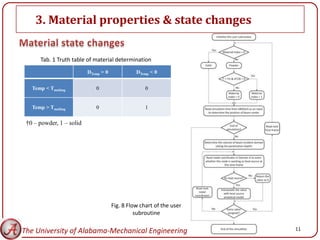
      Tab. 1 Truth table of material determination
                          DTemp > 0             DTemp < 0


   Temp < Tmelting           0                      0


   Temp > Tmelting           0                      1

 †0 – powder, 1 – solid


                                      Fig. 8 Flow chart of the user
                                                subroutine

The University of Alabama-Mechanical Engineering                      11
4. FE model configuration

                                                       Tab. 2 Parameters in the simulation
                                              Parameters                                       Values
                                              Solidus temperature, TS ( C)                   1605 [8]
                                              Liquidus temperature, TL ( C)                  1665 [8]
                                              Latent heat of fusion, Lf (kJ/Kg)               440 [8]
                                              Electron beam diameter, Φ (mm)         0.2, 0.4, 0.7, 1.0
                                              Absorption efficiency, η                         0.9 [2]
                                              Scan speed, v (mm/sec)                          400 [2]
                                              Acceleration voltage, U (kV)                      60 [2]
                                              Beam current, Ib (mA)                         0.002 [2]
                                              Powder layer thickness, t-layer (mm)             0.1 [2]
                                              Porosity, φ                             0, 0.3, 0.45,0.6
                                              Beam penetration depth, dP (mm)                   0.1[2]
        Fig. 9 New FE model configuration
                                              Preheat temperature, Tpreheat ( C)              760 [2]


The University of Alabama-Mechanical Engineering                                               12
5. Model validation


                                                       Fig. 10 Model geometry, ICs and BCs [9]


                   Fig. 11 Simulation results comparison with Wang et al [9]:
        a) Temperature contour; b) Temperature distribution along beam center scan pass
The University of Alabama-Mechanical Engineering                                                 13
6. Simulation results


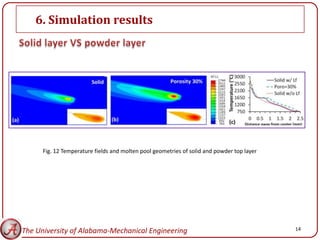
      Fig. 12 Temperature fields and molten pool geometries of solid and powder top layer


The University of Alabama-Mechanical Engineering                                            14
6. Simulation results


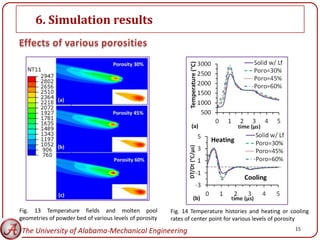
Fig. 13 Temperature fields and molten pool               Fig. 14 Temperature histories and heating or cooling
geometries of powder bed of various levels of porosity   rates of center point for various levels of porosity

The University of Alabama-Mechanical Engineering                                                       15
6. Simulation results


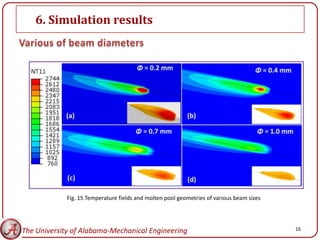
             Fig. 15 Temperature fields and molten pool geometries of various beam sizes


The University of Alabama-Mechanical Engineering                                           16
6. Simulation results


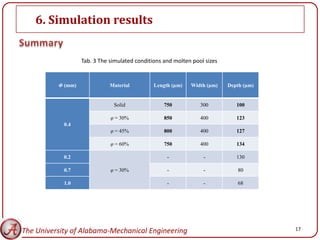
                   Tab. 3 The simulated conditions and molten pool sizes


          Φ (mm)              Material         Length (µm)   Width (µm)    Depth (µm)


                               Solid               750           300          100

                              φ = 30%              850           400          123
            0.4
                              φ = 45%              800           400          127

                              φ = 60%              750           400          134

            0.2                                     -             -           130

            0.7               φ = 30%               -             -           80

            1.0                                     -             -           68


The University of Alabama-Mechanical Engineering                                        17
7. Conclusions

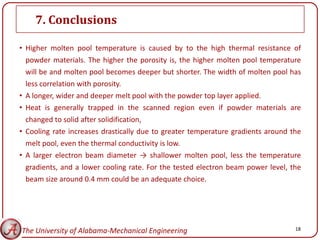
• Higher molten pool temperature is caused by to the high thermal resistance of
  powder materials. The higher the porosity is, the higher molten pool temperature
  will be and molten pool becomes deeper but shorter. The width of molten pool has
  less correlation with porosity.
• A longer, wider and deeper melt pool with the powder top layer applied.
• Heat is generally trapped in the scanned region even if powder materials are
  changed to solid after solidification,
• Cooling rate increases drastically due to greater temperature gradients around the
  melt pool, even the thermal conductivity is low.
• A larger electron beam diameter → shallower molten pool, less the temperature
  gradients, and a lower cooling rate. For the tested electron beam power level, the
  beam size around 0.4 mm could be an adequate choice.


The University of Alabama-Mechanical Engineering                                  18
8. Future work


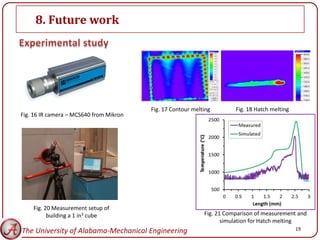
                                         Fig. 17 Contour melting        Fig. 18 Hatch melting
Fig. 16 IR camera – MCS640 from Mikron


    Fig. 20 Measurement setup of
          building a 1 in3 cube                              Fig. 21 Comparison of measurement and
                                                                    simulation for Hatch melting
The University of Alabama-Mechanical Engineering                                                19
8. Future work


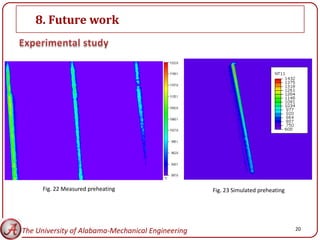
      Fig. 22 Measured preheating                  Fig. 23 Simulated preheating


The University of Alabama-Mechanical Engineering                                  20
8. Future work


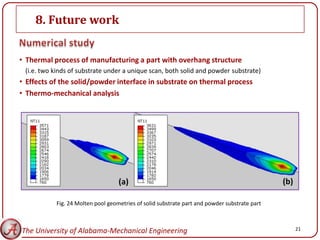
• Thermal process of manufacturing a part with overhang structure
 (i.e. two kinds of substrate under a unique scan, both solid and powder substrate)
• Effects of the solid/powder interface in substrate on thermal process
• Thermo-mechanical analysis


           Fig. 24 Molten pool geometries of solid substrate part and powder substrate part


The University of Alabama-Mechanical Engineering                                              21
Acknowledgement

Sponsor: NASA, No. NNX11AM11A
Collaborator: Marshall Space Flight Center (Huntsville, AL),
              Advanced Manufacturing Team.


 The University of Alabama-Mechanical Engineering         22
Q&A


                       Thank you!

                     Any Question?


The University of Alabama-Mechanical Engineering   23
Reference
[1] Available from: http://www.arcam.com/.
[2] Zaeh, M. F., and Lutzmann, S., 2010, "Modelling and simulation of electron beam melting," Production
    Engeering. Research and Development, 4, pp. 15-23.
[3] Lampa, C., Kaplan, A. F. H., Powell, J., and Magnusson, C., 1997, "An analytical thermodynamic model of laser
    welding," Journal of Physics D: Applied Physics, 30(9), p. 1293.
[4] Rouquette, S., Guo, J., and Le Masson, P., 2007, "Estimation of the parameters of a Gaussian heat source by
    the Levenberg-Marquardt method: Application to the electron beam welding," International Journal of
    Thermal Sciences, 46(2), pp. 128-138.
[5] Yang, J., Sun, S., Brandt, M., and Yan, W., 2010, "Experimental investigation and 3D finite element prediction
    of the heat affected zone during laser assisted machining of Ti6Al4V alloy," Journal of Materials Processing
    Technology, 210(15), pp. 2215-2222.
[6] Sih, S. S., and Barlow, J. W., 2004, "The prediction of the emissivity and thermal conductivity of powder beds,"
    Particulate Science and Technology, 22, pp. 291-304.
[7] Kolossov, S., Boillat, E., Glardon, R., Fischer, P., and Locher, M., 2004, "3D FE simulation for temperature
    evolution in the selective laser sintering process," International Journal of Machine Tools and Manufacture,
    44(2-3), pp. 117-123.
[8] Boyer, R., Welsch, G., and Collings, E. W., 1998, "Materials Properties Handbook: Titanium Alloys," ASM
    InternationalMaterials Park, OH, USA, pp. 483-636.
[9] Wang, L., Felicelli, S., Gooroochurn, Y., Wang, P. T., and Horstemeyer, M. F., 2008, "Optimization of the LENS
    process for steady molten pool size," Materials Science & Engineering A (Structural Materials: Properties,
    Microstructure and Processing), 474, pp. 148-156.
[10] Hofmeister, W., Wert, M., Smugeresky, J., Philliber, J. A., Griffith, M., and Ensz, M. T., 1999, "Invesitigation of
    solidification in the Laser Engineered Net Shaping (LENS) process," JOM, 51(7).

  The University of Alabama-Mechanical Engineering                                                                  24
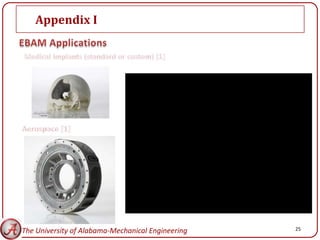
Appendix I


The University of Alabama-Mechanical Engineering   25
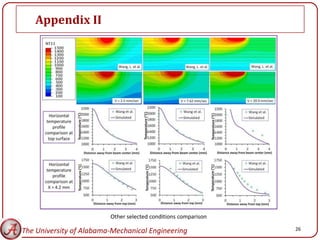
Appendix II


                         Other selected conditions comparison

The University of Alabama-Mechanical Engineering                26

Thermal Modeling of Electron Beam Additive Manufacturing Process–Powder Sintering Effects

  • 1.
    THERMAL MODELING OFELECTRON BEAM ADDITIVE MANUFACTURING PROCESS – POWDER SINTERING EFFECTS Ninggang (George) Shen Dr. Kevin Chou 6/6/2012 The University of Alabama-Mechanical Engineering 1
  • 2.
    Outline of thecontents 1. Introduction & research objectives 2. Heat transfer and heat source modeling 3. Material properties & state changes 4. FE mode configuration 5. Model validation 6. Simulation results 7. Conclusions 8. Future work The University of Alabama-Mechanical Engineering 2
  • 3.
    1. Introduction andresearch objectives The University of Alabama-Mechanical Engineering 3
  • 4.
    1. Introduction andresearch objectives Fig. 1 Melt ball formation [2] Fig. 2 Delamination [2] 4 The University of Alabama-Mechanical Engineering
  • 5.
    1. Introduction andresearch objectives Fig. 3 SEM picture of Ti-6Al-4V powder Fig 4. SEM picture of sintered Ti-6Al-4V powder The University of Alabama-Mechanical Engineering 5
  • 6.
    2. Heat transferand heat source modeling Assumption: Negligible molten flow within molten pool Temperature distribution given by heat conduction within process domain Radiation considered as boundary condition No convection between part and surroundings due to vacuum T - Temperature 2 2 2  Q Q T T T T x, y,z T T x , y , z - Absorbed heat flux 2 2 2 vs c - Specific heat capacity c x y z c t x T T T T ρ - Density λ - Thermal conductivity vs - Constant speed of the moving heat source Latent heat of fusion 0 T TS , ΔHf - latent heat of fusion T TS H T cd T Lf f f TS T TL , Tl - liquidus temperature TL TS Ts - solidus temperature T TL 1 fs - solid fraction The University of Alabama-Mechanical Engineering 6
  • 7.
    2. Heat transferand heat source modeling • The cross sectional geometry of keyhole is usually idealized as a cone • The intensity distribution is considered as a conical source:  Horizontal – Gaussian distribution  Vertical – Decaying with increasing of penetration depth Fig. 5 Actual keyhole example and idealization [3] The University of Alabama-Mechanical Engineering 7
  • 8.
    2. Heat transferand heat source modeling Heat source equation used in our study [4]: 2 2 8 UIb 8 x xs y ys 2 z S x, y, z f z 2 exp 2 with f z 1 E E h h Max. density = 306 W/mm2 U 6 0 kV Ib 2mA If E 2mm 1 h 2mm z 0 Fig. 6 Horizontal intensity distribution @ z = 0 The University of Alabama-Mechanical Engineering 8
  • 9.
    3. Material properties& state changes Fig. 7 Temperature dependent material properties of Ti-6Al-4V [5] The University of Alabama-Mechanical Engineering 9
  • 10.
    3. Material properties& state changes Emissivity [6]: Thermal Conductivity [7]: AH H 1 AH S 2 k kr kc 1 S 2 3 .0 8 2 2 0.908 16 AH 2 H 2 kc l T 3 kr k b u lk x 1.908 2 1 1 1 3 .0 8 2 1 3 S εS – Emissivity of solid material εH – Emissivity of the hole among adjacent powder particles f – Fraction of total cavity surface AH – The area fraction of the surface that is occupied by the radiation emitting holes d – Mean pore diameter D – Particle size φ – Fractional porosity of the bed l – Mean photon free path between scattering events, the particle diameter in this study σ – Stefan-Boltzmann constant, T – Temperature x = b/R – Ratio of neck radius to particle radius Λ – Normalized contact conductivity for the three packing structures. The University of Alabama-Mechanical Engineering 10
  • 11.
    3. Material properties& state changes Tab. 1 Truth table of material determination DTemp > 0 DTemp < 0 Temp < Tmelting 0 0 Temp > Tmelting 0 1 †0 – powder, 1 – solid Fig. 8 Flow chart of the user subroutine The University of Alabama-Mechanical Engineering 11
  • 12.
    4. FE modelconfiguration Tab. 2 Parameters in the simulation Parameters Values Solidus temperature, TS ( C) 1605 [8] Liquidus temperature, TL ( C) 1665 [8] Latent heat of fusion, Lf (kJ/Kg) 440 [8] Electron beam diameter, Φ (mm) 0.2, 0.4, 0.7, 1.0 Absorption efficiency, η 0.9 [2] Scan speed, v (mm/sec) 400 [2] Acceleration voltage, U (kV) 60 [2] Beam current, Ib (mA) 0.002 [2] Powder layer thickness, t-layer (mm) 0.1 [2] Porosity, φ 0, 0.3, 0.45,0.6 Beam penetration depth, dP (mm) 0.1[2] Fig. 9 New FE model configuration Preheat temperature, Tpreheat ( C) 760 [2] The University of Alabama-Mechanical Engineering 12
  • 13.
    5. Model validation Fig. 10 Model geometry, ICs and BCs [9] Fig. 11 Simulation results comparison with Wang et al [9]: a) Temperature contour; b) Temperature distribution along beam center scan pass The University of Alabama-Mechanical Engineering 13
  • 14.
    6. Simulation results Fig. 12 Temperature fields and molten pool geometries of solid and powder top layer The University of Alabama-Mechanical Engineering 14
  • 15.
    6. Simulation results Fig.13 Temperature fields and molten pool Fig. 14 Temperature histories and heating or cooling geometries of powder bed of various levels of porosity rates of center point for various levels of porosity The University of Alabama-Mechanical Engineering 15
  • 16.
    6. Simulation results Fig. 15 Temperature fields and molten pool geometries of various beam sizes The University of Alabama-Mechanical Engineering 16
  • 17.
    6. Simulation results Tab. 3 The simulated conditions and molten pool sizes Φ (mm) Material Length (µm) Width (µm) Depth (µm) Solid 750 300 100 φ = 30% 850 400 123 0.4 φ = 45% 800 400 127 φ = 60% 750 400 134 0.2 - - 130 0.7 φ = 30% - - 80 1.0 - - 68 The University of Alabama-Mechanical Engineering 17
  • 18.
    7. Conclusions • Highermolten pool temperature is caused by to the high thermal resistance of powder materials. The higher the porosity is, the higher molten pool temperature will be and molten pool becomes deeper but shorter. The width of molten pool has less correlation with porosity. • A longer, wider and deeper melt pool with the powder top layer applied. • Heat is generally trapped in the scanned region even if powder materials are changed to solid after solidification, • Cooling rate increases drastically due to greater temperature gradients around the melt pool, even the thermal conductivity is low. • A larger electron beam diameter → shallower molten pool, less the temperature gradients, and a lower cooling rate. For the tested electron beam power level, the beam size around 0.4 mm could be an adequate choice. The University of Alabama-Mechanical Engineering 18
  • 19.
    8. Future work Fig. 17 Contour melting Fig. 18 Hatch melting Fig. 16 IR camera – MCS640 from Mikron Fig. 20 Measurement setup of building a 1 in3 cube Fig. 21 Comparison of measurement and simulation for Hatch melting The University of Alabama-Mechanical Engineering 19
  • 20.
    8. Future work Fig. 22 Measured preheating Fig. 23 Simulated preheating The University of Alabama-Mechanical Engineering 20
  • 21.
    8. Future work •Thermal process of manufacturing a part with overhang structure (i.e. two kinds of substrate under a unique scan, both solid and powder substrate) • Effects of the solid/powder interface in substrate on thermal process • Thermo-mechanical analysis Fig. 24 Molten pool geometries of solid substrate part and powder substrate part The University of Alabama-Mechanical Engineering 21
  • 22.
    Acknowledgement Sponsor: NASA, No.NNX11AM11A Collaborator: Marshall Space Flight Center (Huntsville, AL), Advanced Manufacturing Team. The University of Alabama-Mechanical Engineering 22
  • 23.
    Q&A Thank you! Any Question? The University of Alabama-Mechanical Engineering 23
  • 24.
    Reference [1] Available from:http://www.arcam.com/. [2] Zaeh, M. F., and Lutzmann, S., 2010, "Modelling and simulation of electron beam melting," Production Engeering. Research and Development, 4, pp. 15-23. [3] Lampa, C., Kaplan, A. F. H., Powell, J., and Magnusson, C., 1997, "An analytical thermodynamic model of laser welding," Journal of Physics D: Applied Physics, 30(9), p. 1293. [4] Rouquette, S., Guo, J., and Le Masson, P., 2007, "Estimation of the parameters of a Gaussian heat source by the Levenberg-Marquardt method: Application to the electron beam welding," International Journal of Thermal Sciences, 46(2), pp. 128-138. [5] Yang, J., Sun, S., Brandt, M., and Yan, W., 2010, "Experimental investigation and 3D finite element prediction of the heat affected zone during laser assisted machining of Ti6Al4V alloy," Journal of Materials Processing Technology, 210(15), pp. 2215-2222. [6] Sih, S. S., and Barlow, J. W., 2004, "The prediction of the emissivity and thermal conductivity of powder beds," Particulate Science and Technology, 22, pp. 291-304. [7] Kolossov, S., Boillat, E., Glardon, R., Fischer, P., and Locher, M., 2004, "3D FE simulation for temperature evolution in the selective laser sintering process," International Journal of Machine Tools and Manufacture, 44(2-3), pp. 117-123. [8] Boyer, R., Welsch, G., and Collings, E. W., 1998, "Materials Properties Handbook: Titanium Alloys," ASM InternationalMaterials Park, OH, USA, pp. 483-636. [9] Wang, L., Felicelli, S., Gooroochurn, Y., Wang, P. T., and Horstemeyer, M. F., 2008, "Optimization of the LENS process for steady molten pool size," Materials Science & Engineering A (Structural Materials: Properties, Microstructure and Processing), 474, pp. 148-156. [10] Hofmeister, W., Wert, M., Smugeresky, J., Philliber, J. A., Griffith, M., and Ensz, M. T., 1999, "Invesitigation of solidification in the Laser Engineered Net Shaping (LENS) process," JOM, 51(7). The University of Alabama-Mechanical Engineering 24
  • 25.
    Appendix I The Universityof Alabama-Mechanical Engineering 25
  • 26.
    Appendix II Other selected conditions comparison The University of Alabama-Mechanical Engineering 26