Selection and UseSelection and Use
of Teachingof Teaching
StrategiesStrategies
-Deah Grace R. Galas
Guiding Principles in the selectionGuiding Principles in the selection
and use of teaching strategiesand use of teaching strategies
1.Learning is an active process
What I hear, I forget
What I see, I remember
What I do , I understand
2. The more senses that are involved in
learning, the more and the better the
learning.
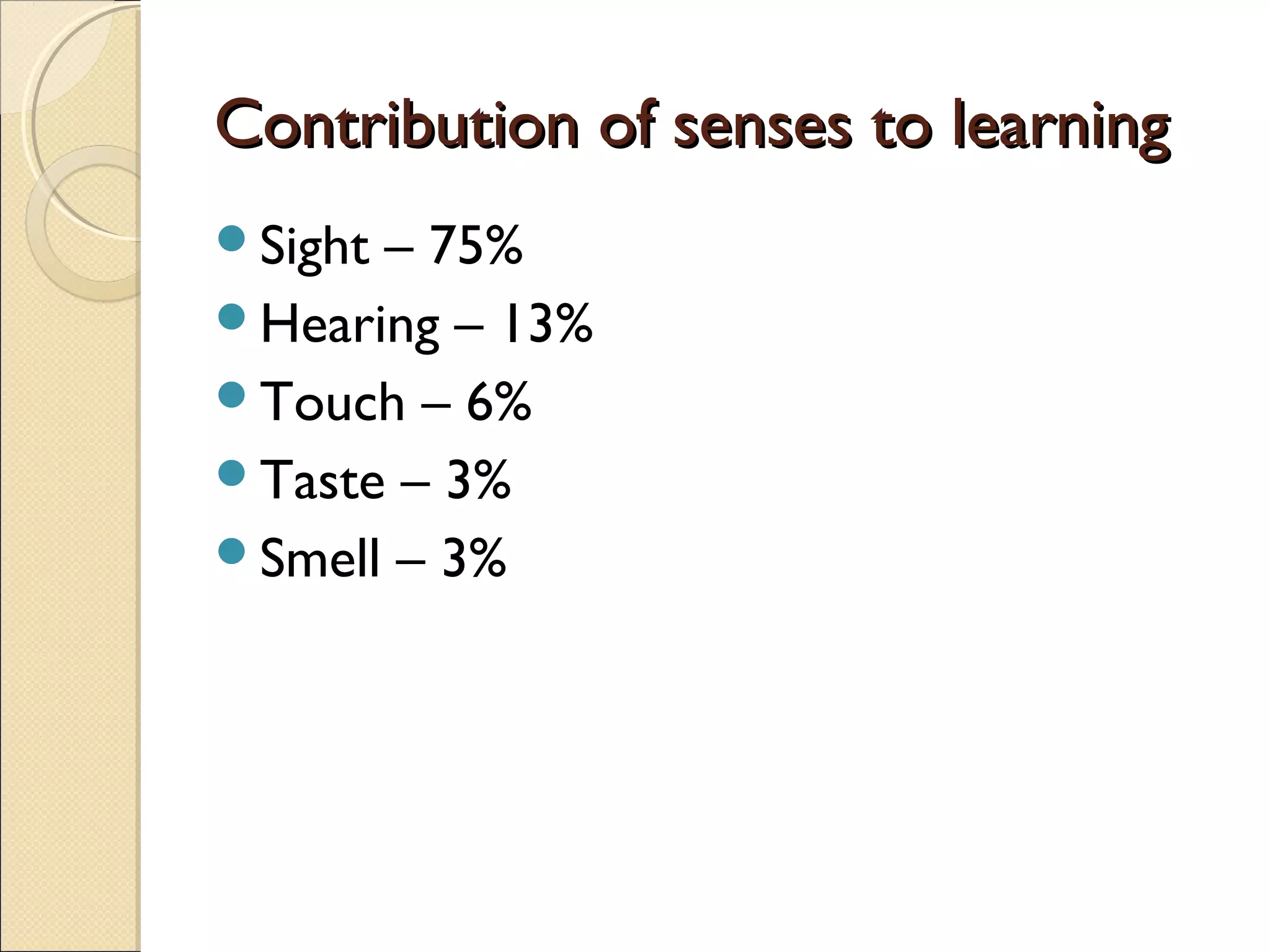
Contribution of senses to learningContribution of senses to learning
Sight – 75%
Hearing – 13%
Touch – 6%
Taste – 3%
Smell – 3%
3. Emotion has the power to increase retention
and learning.
4. Learning is meaningful when it is connected
to student’s everyday life.
5. Good teaching goes beyond recall of
information.
6. An integrated teaching approach is far more
effective than teaching isolated bits of
information
An Integrated approach incorporatesAn Integrated approach incorporates
successful, research-based and brain-basedsuccessful, research-based and brain-based
instructional strategiesinstructional strategies
1. Without rehearsal or constant attention,
information remains in working memory
for only about 15 to 20 seconds. This
implies the need for memory aids.
2. Learning is a process of building neural
networks. This network is formed
through concrete experience,
representational or symbolic learning, and
abstract learning-the 3 levels of learning.
3. Our brains have difficulty
comprehending very large numbers
because we have nothing in our
experience to “hook” them to.
4. The eyes contain nearly 70 percent of
the body’s sensory receptors and send
millions of signals every second along the
optic nerves to the visual processing of
the brain. The capacity of the long-term
memory for pictures seems almost
unlimited.
5. There is little doubt that when
information is embedded in music or
rhyme, its recall is easier than when it is
in prose.
Based-Based StrategiesBased-Based Strategies
1. Involving students in real-life or
authentic problem solving.
2. Using projects to increase meaning and
motivation.
3. Simulations and role plays as meaning
makers.
4. Classroom strategies using visual
processing.
5. Songs, jingles, and raps
6. Mnemonic strategies
7.Writing strategies
8.Active review
9.Hands-on-activities
10.There is no such thing as best teaching
method. The best method is the one that
works, the one that yields result.
FACTORS TO CONSIDER IN THEFACTORS TO CONSIDER IN THE
CHOICE OF A TEACHING METHODCHOICE OF A TEACHING METHOD
1. The instructional objective
2. The nature of the subject matter
3. The learner
4. The teacher
5. School policies
“THE END”

Selection and Use of Teaching Strategies

  • 1.
    Selection and UseSelectionand Use of Teachingof Teaching StrategiesStrategies -Deah Grace R. Galas
  • 2.
    Guiding Principles inthe selectionGuiding Principles in the selection and use of teaching strategiesand use of teaching strategies 1.Learning is an active process What I hear, I forget What I see, I remember What I do , I understand 2. The more senses that are involved in learning, the more and the better the learning.
  • 3.
    Contribution of sensesto learningContribution of senses to learning Sight – 75% Hearing – 13% Touch – 6% Taste – 3% Smell – 3%
  • 4.
    3. Emotion hasthe power to increase retention and learning. 4. Learning is meaningful when it is connected to student’s everyday life. 5. Good teaching goes beyond recall of information. 6. An integrated teaching approach is far more effective than teaching isolated bits of information
  • 5.
    An Integrated approachincorporatesAn Integrated approach incorporates successful, research-based and brain-basedsuccessful, research-based and brain-based instructional strategiesinstructional strategies 1. Without rehearsal or constant attention, information remains in working memory for only about 15 to 20 seconds. This implies the need for memory aids. 2. Learning is a process of building neural networks. This network is formed through concrete experience, representational or symbolic learning, and abstract learning-the 3 levels of learning.
  • 6.
    3. Our brainshave difficulty comprehending very large numbers because we have nothing in our experience to “hook” them to. 4. The eyes contain nearly 70 percent of the body’s sensory receptors and send millions of signals every second along the optic nerves to the visual processing of the brain. The capacity of the long-term memory for pictures seems almost unlimited.
  • 7.
    5. There islittle doubt that when information is embedded in music or rhyme, its recall is easier than when it is in prose.
  • 8.
    Based-Based StrategiesBased-Based Strategies 1.Involving students in real-life or authentic problem solving. 2. Using projects to increase meaning and motivation. 3. Simulations and role plays as meaning makers. 4. Classroom strategies using visual processing. 5. Songs, jingles, and raps
  • 9.
    6. Mnemonic strategies 7.Writingstrategies 8.Active review 9.Hands-on-activities 10.There is no such thing as best teaching method. The best method is the one that works, the one that yields result.
  • 10.
    FACTORS TO CONSIDERIN THEFACTORS TO CONSIDER IN THE CHOICE OF A TEACHING METHODCHOICE OF A TEACHING METHOD 1. The instructional objective 2. The nature of the subject matter 3. The learner 4. The teacher 5. School policies
  • 11.