Selection
Created by Syed Shaz Gilani
Introduction
What is Selection?
Why is it important to get
right?
Selection
• The process of assessing candidates
and appointing a post holder
• Applicants short listed –
most suitable candidates selected
• Selection process –
varies according to organisation:
Importance of Selection to
be right
• Making a bad selection decision is costly in
terms of the cost of the recruitment and
selection process itself, salary, management time
and resources
• If you select someone unsuitable you might
need to spend time managing their
performance and it might affect other
employees.
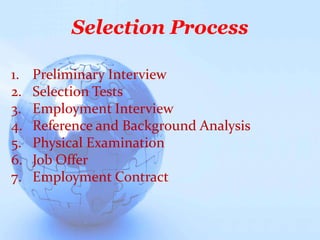
Selection Process
1. Preliminary Interview
2. Selection Tests
3. Employment Interview
4. Reference and Background Analysis
5. Physical Examination
6. Job Offer
7. Employment Contract
Preliminary Interview
• In preliminary interview the applicant is
given the job details enabling him to decide
whether the job will suit him or not
• In preliminary interview, interviewer ask
general questions
Selection Test
Selection Test
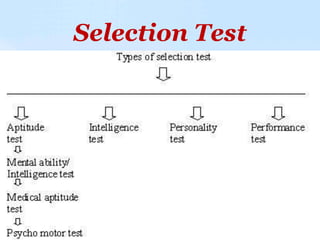
Aptitude Test:
Aptitude tests are test which assess the potential and ability of a
candidate
• Mental Ability/Mental intelligence test:
This test is used to measure the over all intelligence and intellectual
ability of the candidate to deal with problems. It judges the decision
making abilities
• Mechanical aptitude test:
This test deals with the ability of the candidate to do mechanical work.
It is used to judge and measure the specialized knowledge and problem
solving ability.
• Psycho motor test :
This test judges the motor skills the hand and eye co-ordination and
Selection Test
Intelligence Test:
This test measures the numerical skills and
reasoning abilities of the candidates. Such abilities
become important in decision making. The test
consists of logical reasoning ability, data
interpretation, comprehension skills and basic
language skills
Selection Test
Personality Test:
In this test the emotional ability or the emotional
quotient is tested. This test judges the ability to
work in a group, inter personal skills, ability to
understand and handle conflicts and judge
motivation levels. This test is becoming very
popular now days
Selection Test
Performance Test:
This test judges and evaluates the acquired
knowledge and experience of the knowledge and
experience of the individual and his speed and
accuracy in performing a job. It is used to test
performance of typist, data entry operators etc
Employment Interview
• Behavioral questions reveal the most about how a
candidate would fit into the company culture
• Problem-solving questions ask the candidate to
solve problems
• Create an agenda for the candidate's visit
• Consider taking the candidate off campus for
lunch or drinks once the formal questioning is done
to see how they transition from formal office
settings to social situations
Reference & Background
Analysis
• Factual information about Candidate
• Encourages applicants to be honest
• Discourages applicants who hide
something
Physical Examination
• It includes medical examination, or clinical
examination (more popularly known as a
check-up or medical) is the process by which
a medical professional investigates the body
of a patient for signs of disease. It generally
follows the taking of the medical history
Job Offer
• A job offer is an invitation for a potential
employee, whether he or she has applied for
a job, or not, to become an employee in your
organization. The job offer contains the
details of your employment offer
Employment Contract
• An employment contract is a written legal
document that lays out binding terms and
conditions of employment between an employee
and an employer.
Employment contract generally covers:
an overview of
 job responsibilities
 reporting relationships
 salary
 benefits
 paid holidays
 paid vacation
 paid sick leave
 paid time off (PTO)
Selection Process

Selection Process

  • 1.
  • 2.
    Introduction What is Selection? Whyis it important to get right?
  • 3.
    Selection • The processof assessing candidates and appointing a post holder • Applicants short listed – most suitable candidates selected • Selection process – varies according to organisation:
  • 4.
    Importance of Selectionto be right • Making a bad selection decision is costly in terms of the cost of the recruitment and selection process itself, salary, management time and resources • If you select someone unsuitable you might need to spend time managing their performance and it might affect other employees.
  • 5.
    Selection Process 1. PreliminaryInterview 2. Selection Tests 3. Employment Interview 4. Reference and Background Analysis 5. Physical Examination 6. Job Offer 7. Employment Contract
  • 6.
    Preliminary Interview • Inpreliminary interview the applicant is given the job details enabling him to decide whether the job will suit him or not • In preliminary interview, interviewer ask general questions
  • 7.
  • 8.
    Selection Test Aptitude Test: Aptitudetests are test which assess the potential and ability of a candidate • Mental Ability/Mental intelligence test: This test is used to measure the over all intelligence and intellectual ability of the candidate to deal with problems. It judges the decision making abilities • Mechanical aptitude test: This test deals with the ability of the candidate to do mechanical work. It is used to judge and measure the specialized knowledge and problem solving ability. • Psycho motor test : This test judges the motor skills the hand and eye co-ordination and
  • 9.
    Selection Test Intelligence Test: Thistest measures the numerical skills and reasoning abilities of the candidates. Such abilities become important in decision making. The test consists of logical reasoning ability, data interpretation, comprehension skills and basic language skills
  • 10.
    Selection Test Personality Test: Inthis test the emotional ability or the emotional quotient is tested. This test judges the ability to work in a group, inter personal skills, ability to understand and handle conflicts and judge motivation levels. This test is becoming very popular now days
  • 11.
    Selection Test Performance Test: Thistest judges and evaluates the acquired knowledge and experience of the knowledge and experience of the individual and his speed and accuracy in performing a job. It is used to test performance of typist, data entry operators etc
  • 12.
    Employment Interview • Behavioralquestions reveal the most about how a candidate would fit into the company culture • Problem-solving questions ask the candidate to solve problems • Create an agenda for the candidate's visit • Consider taking the candidate off campus for lunch or drinks once the formal questioning is done to see how they transition from formal office settings to social situations
  • 13.
    Reference & Background Analysis •Factual information about Candidate • Encourages applicants to be honest • Discourages applicants who hide something
  • 14.
    Physical Examination • Itincludes medical examination, or clinical examination (more popularly known as a check-up or medical) is the process by which a medical professional investigates the body of a patient for signs of disease. It generally follows the taking of the medical history
  • 15.
    Job Offer • Ajob offer is an invitation for a potential employee, whether he or she has applied for a job, or not, to become an employee in your organization. The job offer contains the details of your employment offer
  • 16.
    Employment Contract • Anemployment contract is a written legal document that lays out binding terms and conditions of employment between an employee and an employer. Employment contract generally covers: an overview of  job responsibilities  reporting relationships  salary  benefits  paid holidays  paid vacation  paid sick leave  paid time off (PTO)