Testing and Selecting Employees
• A predictive exercise
• Managerial decision makers seeking to
predict which job applicants will be
successful if hired
Why is selection important?
• First - your own performance depends
in part on your subordinates.
Employees with the right skills and
attributes will do a better job for you
and the company
Why is selection important?
• Second - it’s costly to
recruit and hire employees
• Third - the legal
implications of incompetent
selection – negligent hiring
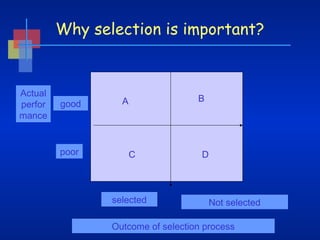
Why selection is important?

Actual
perfor
mance

good

poor

B

A

C

selected

D

Not selected

Outcome of selection process
Reliability
Consistency of scores obtained by the
same person when retested with the
identical tests or with an equivalent
form of a test.
Validity
• Tests must be valid, or measure what
they are supposed to measure
• A test should be job related performance on a test should be a
valid predictor of subsequent
performance on the job
Demonstrating a test’s validity
• Criterion validity
• Demonstrating criterion validity
-those who do well on the test also do
well on the job, and those who do
poorly on the test do poorly on the
job
Criterion related validity
• Predictive validity
• Concurrent validity
Demonstrating a test’s validity
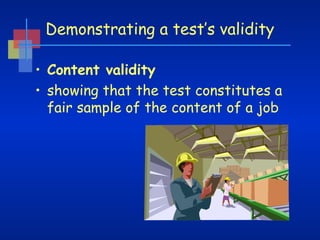
• Content validity
• showing that the test constitutes a
fair sample of the content of a job
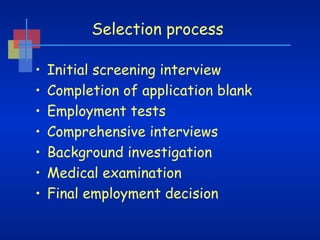
Selection process
•
•
•
•
•
•
•

Initial screening interview
Completion of application blank
Employment tests
Comprehensive interviews
Background investigation
Medical examination
Final employment decision
Initial screening
• To eliminate a large number of
candidates who are obviously not
suitable
Application Blank
• Ranges from very short to a six page
comprehensive personal profile
wide scope to give false data
Weighted application blank
• Studying the relationship between
biographical data requested on the
form and success on the job
• Weights have been assigned to such
factors as qualification etc.
employment tests
• Employers use tests to measure a
wide range of candidate attributes,
including cognitive (mental) abilities,
motor and physical abilities,
personality and interests, and
achievement
Ethical and Legal Questions in
Testing
1) You must be able to prove that your
tests were related to success or
failure on the job
(2) You must prove that your tests
don’t unfairly discriminate against
either minority or non-minority
subgroups
• Intelligence tests, such as IQ tests,
are tests of general intellectual
abilities including memory, vocabulary,
verbal fluency, and numeric ability

www.wonderlic.com
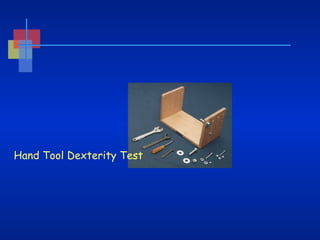
• Tests of Motor and Physical
Abilities -  measure finger
dexterity, strength, manual
dexterity, and reaction time
Hand Tool Dexterity Test
• Personality and interests inventories
are used as predictors of motivation
and interpersonal skills
• Personality tests measure basic
aspects of an applicant’s personality,
such as introversion, stability, and
motivation
• Personality tests—particularly the
projective type—are the most
difficult to evaluate and use
• studies confirm that personality
tests can help companies hire more
effective workers
Personality tests
• Emphasize the “big five” personality
dimensions as they apply to personnel
testing: extroversion, emotional
stability, agreeableness,
conscientiousness, and openness to
experience
• Conscientiousness shows a consistent
relationship with all job performance
criteria for all the occupations.
• Extroversion is a valid predictor of
performance for managers and sales
employees
to
experience
and
• Openness
extroversion
predicted
training
proficiency for all occupations
• Interest inventories compare one’s
interests with those of people in
various occupations
• Achievement Tests are a measure of
what a person has learned
Work samples &simulations
• Work sampling technique measures
how a employee actually performs
some of the basic job tasks
Video based tests
• Video based situational tests
• Presenting candidates with several scenarios
followed by multiple choice questions
The MJTE approach
• The miniature job training &
evaluation approach
Management Assessment Centers
• Management candidates take tests
and make decisions in simulated
situations.
• Lasts two or three days and involves
10 to 12 management candidates
performing realistic management
tasks
• Can be expensive to operate
Management Assessment Centers
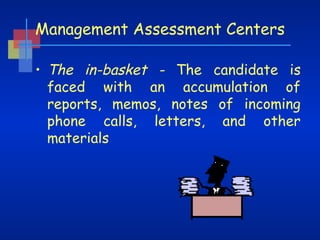
• The in-basket - The candidate is
faced with an accumulation of
reports, memos, notes of incoming
phone calls, letters, and other
materials
Management Assessment Centers
• The leaderless group discussion. A
leaderless group is given a discussion
question and told to arrive at a group
decision.
• The raters then evaluate each group
member’s interpersonal skills,
acceptance by the group, leadership
ability, and individual influence
Management Assessment Centers
• Individual presentations. A
participant’s communication skills and
persuasiveness are evaluated by
having the person make an oral
presentation on an assigned topic
Selection Interview
• Selection procedure designed
to
predict
future
job
performance on the basis of
applicants’ oral responses to
oral inquiries
Selection Interview
• Non-structured Interviewer asks
questions as they
come to mind,
• no set format to
follow

• Structured questions are
specified in
advance and the
responses may be
rated for
appropriateness of
content
Structured interviews
• Structured interviews are generally
more valid
also
help
inexperienced
• can
interviewers to ask questions and
conduct useful interviews.
• structured interviews don’t always
leave the flexibility to pursue points
of interest as they develop
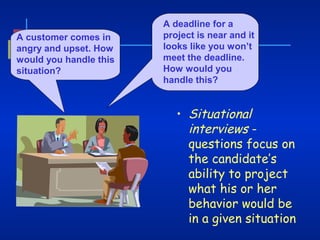
A customer comes in
angry and upset. How
would you handle this
situation?

A deadline for a
project is near and it
looks like you won’t
meet the deadline.
How would you
handle this?

• Situational
interviews questions focus on
the candidate’s
ability to project
what his or her
behavior would be
in a given situation
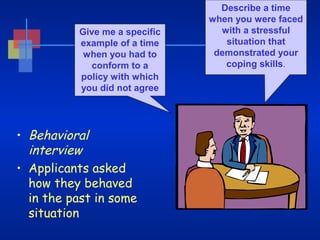
Give me a specific
example of a time
when you had to
conform to a
policy with which
you did not agree

• Behavioral
interview
• Applicants asked
how they behaved
in the past in some
situation

Describe a time
when you were faced
with a stressful
situation that
demonstrated your
coping skills.
• Sequential interview - several
persons interview the applicant in
sequence before a selection decision
is made
• Panel interview - candidate is
interviewed simultaneously by a group
(or panel) of interviewers
Common Interviewing Mistakes
•
•
•
•
•

Snap Judgments  
Negative Emphasis
Pressure to Hire  
Candidate Order (Contrast) Error  
Influence of Nonverbal Behavior  
Common Interviewing Mistakes
• An interviewer should remember to
keep an open mind and consciously
work against being preoccupied with
negative feedback.
Common Interviewing Mistakes
Not Knowing the Job 
•  Interviewers who don’t know
precisely what the job entails and
what sort of candidate is best suited
for it usually make decisions based on
incorrect stereotypes about what
makes a good applicant
Guidelines for Conducting an
Interview
• Plan the Interview   - start the interview
with a clear picture of the traits of an
ideal candidate.
• Structure the interview - assures greater
consistency, but helps to make sure that
you are asking questions that provide real
insight into how the person will perform on
the job
Increase the standardization of
the interview
• Base questions on actual job duties
• Use job knowledge, situational, or
behaviorally oriented questions and
objective criteria to evaluate the
interviewee’s responses
• Train interviewers
• Use the same questions with all candidates
• Use rating scales to rate answers
• Use multiple interviewers or panel
interviews
• Take brief notes during the interview
Guidelines for Conducting an
Interview
• Establish
Rapport  
• Be aware of the
applicant’s status
• Make it clear
you’re going to
conduct
reference checks

• Close the
Interview  
• Try to end all
interviews on a
positive note
• Review your
interview notes
• Don’t ask questions that can be
answered “yes” or “no
• Don’t put words in the applicant’s
mouth or telegraph the desired
answer
• Don’t interrogate the applicant as if
the person is a criminal, and don’t be
patronizing, sarcastic, or inattentive.
• Don’t monopolize the interview by
rambling
• Do ask open-ended questions
• Do listen to the candidate to
encourage him or her to express
thoughts fully
• Do draw out the applicant’s opinions
and feelings by repeating the person’s
last comment as a question
• Do ask for examples
Background Investigations and
Reference Checks
• Why?
• verify the accuracy of factual information
provided by the applicant
• uncover damaging background information
such as criminal records and suspended
drivers’ licenses.
• Always get at least two forms of
identification and always require applicants
to fill at a job application
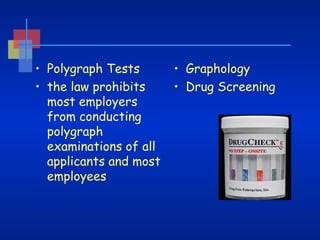
• Polygraph Tests  
• the law prohibits
most employers
from conducting
polygraph
examinations of all
applicants and most
employees

• Graphology
• Drug Screening
• Discrete selection process
• Comprehensive selection process
• How to treat rejected candidates –
the role of proper communication

Selection process 50 SDS

  • 1.
  • 3.
    • A predictiveexercise • Managerial decision makers seeking to predict which job applicants will be successful if hired
  • 4.
    Why is selectionimportant? • First - your own performance depends in part on your subordinates. Employees with the right skills and attributes will do a better job for you and the company
  • 5.
    Why is selectionimportant? • Second - it’s costly to recruit and hire employees • Third - the legal implications of incompetent selection – negligent hiring
  • 6.
    Why selection isimportant? Actual perfor mance good poor B A C selected D Not selected Outcome of selection process
  • 7.
    Reliability Consistency of scoresobtained by the same person when retested with the identical tests or with an equivalent form of a test.
  • 8.
    Validity • Tests mustbe valid, or measure what they are supposed to measure • A test should be job related performance on a test should be a valid predictor of subsequent performance on the job
  • 9.
    Demonstrating a test’svalidity • Criterion validity • Demonstrating criterion validity -those who do well on the test also do well on the job, and those who do poorly on the test do poorly on the job
  • 10.
    Criterion related validity •Predictive validity • Concurrent validity
  • 11.
    Demonstrating a test’svalidity • Content validity • showing that the test constitutes a fair sample of the content of a job
  • 12.
    Selection process • • • • • • • Initial screeninginterview Completion of application blank Employment tests Comprehensive interviews Background investigation Medical examination Final employment decision
  • 13.
    Initial screening • Toeliminate a large number of candidates who are obviously not suitable
  • 14.
    Application Blank • Rangesfrom very short to a six page comprehensive personal profile wide scope to give false data
  • 15.
    Weighted application blank •Studying the relationship between biographical data requested on the form and success on the job • Weights have been assigned to such factors as qualification etc.
  • 16.
    employment tests • Employersuse tests to measure a wide range of candidate attributes, including cognitive (mental) abilities, motor and physical abilities, personality and interests, and achievement
  • 17.
    Ethical and LegalQuestions in Testing 1) You must be able to prove that your tests were related to success or failure on the job (2) You must prove that your tests don’t unfairly discriminate against either minority or non-minority subgroups
  • 18.
    • Intelligence tests,such as IQ tests, are tests of general intellectual abilities including memory, vocabulary, verbal fluency, and numeric ability www.wonderlic.com
  • 19.
    • Tests ofMotor and Physical Abilities -  measure finger dexterity, strength, manual dexterity, and reaction time
  • 20.
  • 21.
    • Personality andinterests inventories are used as predictors of motivation and interpersonal skills • Personality tests measure basic aspects of an applicant’s personality, such as introversion, stability, and motivation
  • 22.
    • Personality tests—particularlythe projective type—are the most difficult to evaluate and use • studies confirm that personality tests can help companies hire more effective workers
  • 23.
    Personality tests • Emphasizethe “big five” personality dimensions as they apply to personnel testing: extroversion, emotional stability, agreeableness, conscientiousness, and openness to experience
  • 24.
    • Conscientiousness showsa consistent relationship with all job performance criteria for all the occupations. • Extroversion is a valid predictor of performance for managers and sales employees to experience and • Openness extroversion predicted training proficiency for all occupations
  • 25.
    • Interest inventoriescompare one’s interests with those of people in various occupations • Achievement Tests are a measure of what a person has learned
  • 26.
    Work samples &simulations •Work sampling technique measures how a employee actually performs some of the basic job tasks
  • 27.
    Video based tests •Video based situational tests • Presenting candidates with several scenarios followed by multiple choice questions
  • 28.
    The MJTE approach •The miniature job training & evaluation approach
  • 29.
    Management Assessment Centers •Management candidates take tests and make decisions in simulated situations. • Lasts two or three days and involves 10 to 12 management candidates performing realistic management tasks • Can be expensive to operate
  • 30.
    Management Assessment Centers •The in-basket - The candidate is faced with an accumulation of reports, memos, notes of incoming phone calls, letters, and other materials
  • 31.
    Management Assessment Centers •The leaderless group discussion. A leaderless group is given a discussion question and told to arrive at a group decision. • The raters then evaluate each group member’s interpersonal skills, acceptance by the group, leadership ability, and individual influence
  • 32.
    Management Assessment Centers •Individual presentations. A participant’s communication skills and persuasiveness are evaluated by having the person make an oral presentation on an assigned topic
  • 33.
    Selection Interview • Selectionprocedure designed to predict future job performance on the basis of applicants’ oral responses to oral inquiries
  • 34.
    Selection Interview • Non-structuredInterviewer asks questions as they come to mind, • no set format to follow • Structured questions are specified in advance and the responses may be rated for appropriateness of content
  • 35.
    Structured interviews • Structuredinterviews are generally more valid also help inexperienced • can interviewers to ask questions and conduct useful interviews. • structured interviews don’t always leave the flexibility to pursue points of interest as they develop
  • 36.
    A customer comesin angry and upset. How would you handle this situation? A deadline for a project is near and it looks like you won’t meet the deadline. How would you handle this? • Situational interviews questions focus on the candidate’s ability to project what his or her behavior would be in a given situation
  • 37.
    Give me aspecific example of a time when you had to conform to a policy with which you did not agree • Behavioral interview • Applicants asked how they behaved in the past in some situation Describe a time when you were faced with a stressful situation that demonstrated your coping skills.
  • 38.
    • Sequential interview- several persons interview the applicant in sequence before a selection decision is made • Panel interview - candidate is interviewed simultaneously by a group (or panel) of interviewers
  • 39.
    Common Interviewing Mistakes • • • • • SnapJudgments   Negative Emphasis Pressure to Hire   Candidate Order (Contrast) Error   Influence of Nonverbal Behavior  
  • 40.
    Common Interviewing Mistakes •An interviewer should remember to keep an open mind and consciously work against being preoccupied with negative feedback.
  • 41.
    Common Interviewing Mistakes NotKnowing the Job  •  Interviewers who don’t know precisely what the job entails and what sort of candidate is best suited for it usually make decisions based on incorrect stereotypes about what makes a good applicant
  • 42.
    Guidelines for Conductingan Interview • Plan the Interview   - start the interview with a clear picture of the traits of an ideal candidate. • Structure the interview - assures greater consistency, but helps to make sure that you are asking questions that provide real insight into how the person will perform on the job
  • 43.
    Increase the standardizationof the interview • Base questions on actual job duties • Use job knowledge, situational, or behaviorally oriented questions and objective criteria to evaluate the interviewee’s responses • Train interviewers • Use the same questions with all candidates • Use rating scales to rate answers • Use multiple interviewers or panel interviews • Take brief notes during the interview
  • 44.
    Guidelines for Conductingan Interview • Establish Rapport   • Be aware of the applicant’s status • Make it clear you’re going to conduct reference checks • Close the Interview   • Try to end all interviews on a positive note • Review your interview notes
  • 45.
    • Don’t askquestions that can be answered “yes” or “no • Don’t put words in the applicant’s mouth or telegraph the desired answer • Don’t interrogate the applicant as if the person is a criminal, and don’t be patronizing, sarcastic, or inattentive. • Don’t monopolize the interview by rambling
  • 46.
    • Do askopen-ended questions • Do listen to the candidate to encourage him or her to express thoughts fully • Do draw out the applicant’s opinions and feelings by repeating the person’s last comment as a question • Do ask for examples
  • 47.
    Background Investigations and ReferenceChecks • Why? • verify the accuracy of factual information provided by the applicant • uncover damaging background information such as criminal records and suspended drivers’ licenses. • Always get at least two forms of identification and always require applicants to fill at a job application
  • 48.
    • Polygraph Tests   •the law prohibits most employers from conducting polygraph examinations of all applicants and most employees • Graphology • Drug Screening
  • 49.
    • Discrete selectionprocess • Comprehensive selection process
  • 50.
    • How totreat rejected candidates – the role of proper communication