A Presentation by Atul Chanodkar
Job Analysis
Recruitment
& Selection
Job Analysis
A job analysis is a systematic exploration of the activities within a job. It is a technical
procedure used to define a job’s duties, responsibilities, and accountabilities. This analysis
“involves the identification and description of what is happening on the job accurately and
precisely identifying the required tasks, the knowledge, and the skills necessary for
performing them, and the conditions under which they must be performed.
Job analysis is the procedure through which you determine the duties of the positions and
the characteristics of the people to hire for them.
Job analysis produces information for writing job descriptions (a list of what the job
entails) and job (or person ) specifications (what kind of people to hire for the job).
Job analysis is the process of collecting, analyzing and setting out information about the
content of jobs in order to provide the basis for a job description and data for recruitment,
training, job evaluation and performance management. Job analysis concentrates on what
job holders are expected to do.
Job Analysis
The supervisor or human resources specialist normally collects one or more of the following types of
information via the job analysis:
Work activities. First, he or she collects information about the job s actual work activities, such as cleaning,
selling, teaching, or painting. This list may also include how, why, and when the worker performs each activity.
Human behaviors. Information about human behaviors the job requires, like sensing, communicating, lifting
weights, or walking long distances.
Machines, tools, equipment, and work aids. Information regarding tools used, materials processed,
knowledge dealt with or applied (such as finance or law), and services rendered (such as counseling or
repairing).
Performance standards. Information about the job s performance standards (in terms of quantity or quality
levels for each job duty, for instance).
Job context. Information about such matters as physical working conditions, work schedule, incentives, and,
for instance, the number of people with whom the employee would normally interact.
Human requirements. Information such as knowledge or skills (education, training, work experience) and
required personal attributes (aptitudes, personality, interests).
Job Analysis
The output from analysis of a job is used to develop a job description and its job specifications. Together, these
two documents summarize job analysis information in a readable format and provide the basis for defensible
job related actions. They also identify individual jobs for employees by providing documentation from
management.
Job Descriptions
In most cases, the job description and job specifications are combined into one document that contains several
sections. A job description identifies the tasks, duties, and responsibilities of a job. It describes what is done,
why it is done, where it is done, and, briefly, how it is done. The HR On-the-Job shows suggestions for writing
job descriptions.
Job Specifications
While the job description describes activities to be done, the job specifications list the knowledge, skills, and
abilities (KSAs) an individual needs to perform a job satisfactorily. KSAs include education, experience, work
skill requirements, personal abilities, and mental and physical requirements. Accurate job specifications
identify what KSAs a person needs to do the job, not necessarily the current employee’s qualifications.
Methods of Job Analysis
Observation Method
Using the observation method, a job analyst watches employees directly or reviews films of
workers on the job. Although the observation method provides firsthand information,
workers rarely function most efficiently when they are being watched, and thus distortions
in the job analysis can occur. This method also requires that the entire range of activities be
observable, which is possible with some jobs, but impossible for many others—for example,
most managerial jobs.
Individual Interview Method
The individual interview method assembles a team of job incumbents for extensive
individual interviews. The results of these interviews are combined into a single job
analysis. This method is effective for assessing what a job entails. Involving employees in the
job analysis is essential.
Methods of Job Analysis
Group Interview Method
The group interview method is similar to the individual interview method except that job
incumbents are interviewed simultaneously. Accuracy is increased in assessing jobs, but
group dynamics may hinder its effectiveness.
Structured Questionnaire Method
The structured questionnaire method gives workers a specifically designed questionnaire
on which they check or rate items they perform in their job from a long list of possible task
items. This technique is excellent for gathering information about jobs. However, exceptions
to a job may be overlooked, and opportunity may be lacking to ask follow-up questions or to
clarify the information received.
Technical Conference Method
The technical conference method uses supervisors with extensive knowledge of the job,
frequently called subject matter experts. Here, specific job characteristics are obtained from
the experts. Although a good data-gathering method, it often overlooks the incumbent
workers’ perceptions about what they do on their job.
Methods of Job Analysis
Diary Method
The diary method requires job incumbents to record their daily activities. This is the most
time consuming of the job analysis methods and may extend over long periods of time—all
adding to its cost.
These six methods are not mutually exclusive; nor is one method universally superior. Even
obtaining job information from incumbents can create a problem, especially if these
individuals describe what they think they should be doing rather than what they actually
do. The best results, then, are usually achieved with some combination of methods - with
information provided by individual employees, their immediate supervisors, a professional
analyst, or an unobtrusive source such as filmed observations.
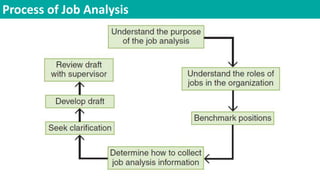
Process of Job Analysis
Purpose of Job Analysis
No matter what method you use to gather data, the information amassed and written down
from the conceptual, analytical job analysis process generates three tangible outcomes: job
descriptions, job specifications, and job evaluation. Let’s look at them more closely.
Job Descriptions
A job description is a written statement of what the jobholder does, how it is done, under what
conditions, and why. It should accurately portray job content, environment, and conditions of
employment. Although there is no standard format for job descriptions, a common format for a
job description includes:
■ Job title usually describes the job and hints at the nature and duties of the job.
■ Job identification includes the department location of the job, who the person reports to, a
job identification code, and the date the description was last revised.
■ Job duties lists the job duties in order of importance. This section is particularly important
because it helps the organization with ADA compliance.
■ Job specifications that explain the personal qualifications necessary to perform the duties
listed above including specific skills, education, certification, and physical abilities.
Purpose of Job Analysis
Job Specifications
The job specification states the minimum acceptable qualifications that the incumbent must possess
to perform the job successfully. Based on information acquired through job analysis, the job
specification identifies pertinent knowledge, skills, education, experience, certification, and abilities.
Individuals possessing the personal characteristics identified in the job specification should perform
the job more effectively than those lacking these personal characteristics. The job specification,
therefore, is an important tool for keeping the selector’s attention on the list of necessary
qualifications and assisting in determining whether candidates are essentially qualified.
Job Evaluations
In addition to providing data for job descriptions and specifications, job analysis also provides
valuable information for making job comparisons. If an organization is to have an equitable
compensation program, jobs that have similar demands in terms of skills, knowledge, and abilities
should be placed in common compensation groups. Job evaluation contributes by specifying the
relative value of each job in the organization, which makes it an important part of compensation
administration. In the meantime, keep in mind that job evaluation relies on data generated from job
analysis.
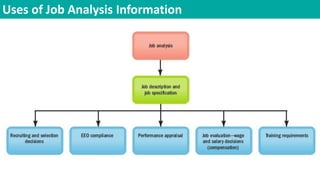
Uses of Job Analysis Information
Writing Job Descriptions (JDs)
The most important product of job analysis is the job description. A job description is a
written statement of what the worker actually does, how he or she does it, and what the job
s working conditions are. You use this information to write a job specification; this lists the
knowledge, abilities, and skills required to perform the job satisfactorily.
There is no standard format for writing a job description. However,most descriptions
contain sections that cover:
1. Job identification
2. Job summary
3. Responsibilities and duties
4. Authority of incumbent
5. Standards of performance
6. Working conditions
7. Job specification
Writing Job Specifications
The job specification takes the job description and answers the question, What huma traits
and experience are required to do this job effectively? It shows what kind of person to
recruit and for what qualities you should test that person. It may be a section of the job
description, or a separate document.
Recruitment and Selection
Recruitment is the process of finding and engaging the people the organization needs.
Selection is that part of the recruitment process concerned with deciding which applicants
or candidates should be appointed to jobs.
Four Stages of Recruitment and Selection
 Defining requirements – preparing role profiles and person specifications; deciding
terms and conditions of employment.
 Planning recruitment campaigns.
 Attracting candidates – reviewing and evaluating alternative sources of applicants,
inside and outside the company: advertising, e-recruiting, agencies and consultants.
 Selecting candidates – sifting applications, interviewing, testing, assessing candidates,
assessment centers, offering employment, obtaining references; preparing contracts of
employment.
Recruitment and Selection
The overall aim of the recruitment and selection process should be to obtain at minimum
cost the number and quality of employees required to satisfy the human resource needs of
the company.
Employee recruiting means finding and/or attracting applicants for the employer s open
positions.
Recruitment and Selection
The overall aim of the recruitment and selection process should be to obtain at minimum
cost the number and quality of employees required to satisfy the human resource needs of
the company.
Employee recruiting means finding and/or attracting applicants for the employer s open
positions.
Recruitment is the process of locating and encouraging potential applicants to apply for
existing or anticipated job openings.
Recruitment aims at
 Attracting a large number of qualified applicants who are ready to take up the jobs if it
is offered.
 Offering enough information for unqualified persons to self-select themselves out.
Sources of Recruitment
Internal Sources of Recruitment
1. Employee referrals and Recommendations
2. Internal Job Postings
3. Rehiring
4. Succession Planning
External Sources of Recruitment
1. Advertisements
2. Employment Agencies
3. Campus Placements
4. Job Fairs
5. Online/ Web-based Recruitments
6. Walk-ins
Selection
The aim of selection is to assess the suitability of candidates by predicting the extent to
which they will be able to carry out a role successfully. It involves deciding on the degree to
which the characteristics of applicants in terms of their competencies, experience, qualify
cations, education and training match the person specification. It also involves using this
assessment to make a choice between candidates.
Selection is the process of choosing individuals with the correct qualifications needed to fill
jobs in an organization. Without these qualified employees, an organization is far less likely
to succeed.
Methods of Selection
Following methods are used for selection
1. Individual Interviews (Structured and Unstructured)
2. Interviews through panels
3. Assessment Center(s)
Process of Selection
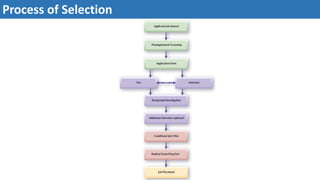
Most organizations take a series of consistent steps to process and select applicants for jobs.
Company size, job characteristics, the number of people needed, the use of electronic
technology, and other factors cause variations on the basic process. Selection can take place
in a day or over a much longer period of time, and certain phases of the process may be
omitted or the order changed, depending on the employer. If the applicant is processed in
one day, the employer usually checks references after selection.
Process of Selection
The selection process follows a standard process:
 Initial screening interview
 Completion of the application form
 Pre-employment tests
 Comprehensive interview
 Conditional job offer
 Background investigation
 Medical or physical examination
 Permanent job offer
Each step represents a decision point requiring affirmative feedback in order for the
process to continue. Each step in the process seeks to expand the organization’s knowledge
about the applicant’s background, abilities, and motivation, and it increases the
information that decision makers use to make their predictions and final choice.
A Presentation by Atul Chanodkar
Job Analysis
Recruitment
& Selection

Job Analysis and Recruitment and Selection

  • 1.
    A Presentation byAtul Chanodkar Job Analysis Recruitment & Selection
  • 2.
    Job Analysis A jobanalysis is a systematic exploration of the activities within a job. It is a technical procedure used to define a job’s duties, responsibilities, and accountabilities. This analysis “involves the identification and description of what is happening on the job accurately and precisely identifying the required tasks, the knowledge, and the skills necessary for performing them, and the conditions under which they must be performed. Job analysis is the procedure through which you determine the duties of the positions and the characteristics of the people to hire for them. Job analysis produces information for writing job descriptions (a list of what the job entails) and job (or person ) specifications (what kind of people to hire for the job). Job analysis is the process of collecting, analyzing and setting out information about the content of jobs in order to provide the basis for a job description and data for recruitment, training, job evaluation and performance management. Job analysis concentrates on what job holders are expected to do.
  • 3.
    Job Analysis The supervisoror human resources specialist normally collects one or more of the following types of information via the job analysis: Work activities. First, he or she collects information about the job s actual work activities, such as cleaning, selling, teaching, or painting. This list may also include how, why, and when the worker performs each activity. Human behaviors. Information about human behaviors the job requires, like sensing, communicating, lifting weights, or walking long distances. Machines, tools, equipment, and work aids. Information regarding tools used, materials processed, knowledge dealt with or applied (such as finance or law), and services rendered (such as counseling or repairing). Performance standards. Information about the job s performance standards (in terms of quantity or quality levels for each job duty, for instance). Job context. Information about such matters as physical working conditions, work schedule, incentives, and, for instance, the number of people with whom the employee would normally interact. Human requirements. Information such as knowledge or skills (education, training, work experience) and required personal attributes (aptitudes, personality, interests).
  • 4.
    Job Analysis The outputfrom analysis of a job is used to develop a job description and its job specifications. Together, these two documents summarize job analysis information in a readable format and provide the basis for defensible job related actions. They also identify individual jobs for employees by providing documentation from management. Job Descriptions In most cases, the job description and job specifications are combined into one document that contains several sections. A job description identifies the tasks, duties, and responsibilities of a job. It describes what is done, why it is done, where it is done, and, briefly, how it is done. The HR On-the-Job shows suggestions for writing job descriptions. Job Specifications While the job description describes activities to be done, the job specifications list the knowledge, skills, and abilities (KSAs) an individual needs to perform a job satisfactorily. KSAs include education, experience, work skill requirements, personal abilities, and mental and physical requirements. Accurate job specifications identify what KSAs a person needs to do the job, not necessarily the current employee’s qualifications.
  • 5.
    Methods of JobAnalysis Observation Method Using the observation method, a job analyst watches employees directly or reviews films of workers on the job. Although the observation method provides firsthand information, workers rarely function most efficiently when they are being watched, and thus distortions in the job analysis can occur. This method also requires that the entire range of activities be observable, which is possible with some jobs, but impossible for many others—for example, most managerial jobs. Individual Interview Method The individual interview method assembles a team of job incumbents for extensive individual interviews. The results of these interviews are combined into a single job analysis. This method is effective for assessing what a job entails. Involving employees in the job analysis is essential.
  • 6.
    Methods of JobAnalysis Group Interview Method The group interview method is similar to the individual interview method except that job incumbents are interviewed simultaneously. Accuracy is increased in assessing jobs, but group dynamics may hinder its effectiveness. Structured Questionnaire Method The structured questionnaire method gives workers a specifically designed questionnaire on which they check or rate items they perform in their job from a long list of possible task items. This technique is excellent for gathering information about jobs. However, exceptions to a job may be overlooked, and opportunity may be lacking to ask follow-up questions or to clarify the information received. Technical Conference Method The technical conference method uses supervisors with extensive knowledge of the job, frequently called subject matter experts. Here, specific job characteristics are obtained from the experts. Although a good data-gathering method, it often overlooks the incumbent workers’ perceptions about what they do on their job.
  • 7.
    Methods of JobAnalysis Diary Method The diary method requires job incumbents to record their daily activities. This is the most time consuming of the job analysis methods and may extend over long periods of time—all adding to its cost. These six methods are not mutually exclusive; nor is one method universally superior. Even obtaining job information from incumbents can create a problem, especially if these individuals describe what they think they should be doing rather than what they actually do. The best results, then, are usually achieved with some combination of methods - with information provided by individual employees, their immediate supervisors, a professional analyst, or an unobtrusive source such as filmed observations.
  • 8.
  • 9.
    Purpose of JobAnalysis No matter what method you use to gather data, the information amassed and written down from the conceptual, analytical job analysis process generates three tangible outcomes: job descriptions, job specifications, and job evaluation. Let’s look at them more closely. Job Descriptions A job description is a written statement of what the jobholder does, how it is done, under what conditions, and why. It should accurately portray job content, environment, and conditions of employment. Although there is no standard format for job descriptions, a common format for a job description includes: ■ Job title usually describes the job and hints at the nature and duties of the job. ■ Job identification includes the department location of the job, who the person reports to, a job identification code, and the date the description was last revised. ■ Job duties lists the job duties in order of importance. This section is particularly important because it helps the organization with ADA compliance. ■ Job specifications that explain the personal qualifications necessary to perform the duties listed above including specific skills, education, certification, and physical abilities.
  • 10.
    Purpose of JobAnalysis Job Specifications The job specification states the minimum acceptable qualifications that the incumbent must possess to perform the job successfully. Based on information acquired through job analysis, the job specification identifies pertinent knowledge, skills, education, experience, certification, and abilities. Individuals possessing the personal characteristics identified in the job specification should perform the job more effectively than those lacking these personal characteristics. The job specification, therefore, is an important tool for keeping the selector’s attention on the list of necessary qualifications and assisting in determining whether candidates are essentially qualified. Job Evaluations In addition to providing data for job descriptions and specifications, job analysis also provides valuable information for making job comparisons. If an organization is to have an equitable compensation program, jobs that have similar demands in terms of skills, knowledge, and abilities should be placed in common compensation groups. Job evaluation contributes by specifying the relative value of each job in the organization, which makes it an important part of compensation administration. In the meantime, keep in mind that job evaluation relies on data generated from job analysis.
  • 11.
    Uses of JobAnalysis Information
  • 12.
    Writing Job Descriptions(JDs) The most important product of job analysis is the job description. A job description is a written statement of what the worker actually does, how he or she does it, and what the job s working conditions are. You use this information to write a job specification; this lists the knowledge, abilities, and skills required to perform the job satisfactorily. There is no standard format for writing a job description. However,most descriptions contain sections that cover: 1. Job identification 2. Job summary 3. Responsibilities and duties 4. Authority of incumbent 5. Standards of performance 6. Working conditions 7. Job specification
  • 13.
    Writing Job Specifications Thejob specification takes the job description and answers the question, What huma traits and experience are required to do this job effectively? It shows what kind of person to recruit and for what qualities you should test that person. It may be a section of the job description, or a separate document.
  • 14.
    Recruitment and Selection Recruitmentis the process of finding and engaging the people the organization needs. Selection is that part of the recruitment process concerned with deciding which applicants or candidates should be appointed to jobs. Four Stages of Recruitment and Selection  Defining requirements – preparing role profiles and person specifications; deciding terms and conditions of employment.  Planning recruitment campaigns.  Attracting candidates – reviewing and evaluating alternative sources of applicants, inside and outside the company: advertising, e-recruiting, agencies and consultants.  Selecting candidates – sifting applications, interviewing, testing, assessing candidates, assessment centers, offering employment, obtaining references; preparing contracts of employment.
  • 15.
    Recruitment and Selection Theoverall aim of the recruitment and selection process should be to obtain at minimum cost the number and quality of employees required to satisfy the human resource needs of the company. Employee recruiting means finding and/or attracting applicants for the employer s open positions.
  • 16.
    Recruitment and Selection Theoverall aim of the recruitment and selection process should be to obtain at minimum cost the number and quality of employees required to satisfy the human resource needs of the company. Employee recruiting means finding and/or attracting applicants for the employer s open positions. Recruitment is the process of locating and encouraging potential applicants to apply for existing or anticipated job openings. Recruitment aims at  Attracting a large number of qualified applicants who are ready to take up the jobs if it is offered.  Offering enough information for unqualified persons to self-select themselves out.
  • 17.
    Sources of Recruitment InternalSources of Recruitment 1. Employee referrals and Recommendations 2. Internal Job Postings 3. Rehiring 4. Succession Planning External Sources of Recruitment 1. Advertisements 2. Employment Agencies 3. Campus Placements 4. Job Fairs 5. Online/ Web-based Recruitments 6. Walk-ins
  • 18.
    Selection The aim ofselection is to assess the suitability of candidates by predicting the extent to which they will be able to carry out a role successfully. It involves deciding on the degree to which the characteristics of applicants in terms of their competencies, experience, qualify cations, education and training match the person specification. It also involves using this assessment to make a choice between candidates. Selection is the process of choosing individuals with the correct qualifications needed to fill jobs in an organization. Without these qualified employees, an organization is far less likely to succeed.
  • 19.
    Methods of Selection Followingmethods are used for selection 1. Individual Interviews (Structured and Unstructured) 2. Interviews through panels 3. Assessment Center(s)
  • 20.
    Process of Selection Mostorganizations take a series of consistent steps to process and select applicants for jobs. Company size, job characteristics, the number of people needed, the use of electronic technology, and other factors cause variations on the basic process. Selection can take place in a day or over a much longer period of time, and certain phases of the process may be omitted or the order changed, depending on the employer. If the applicant is processed in one day, the employer usually checks references after selection.
  • 21.
  • 22.
    Process of Selection Theselection process follows a standard process:  Initial screening interview  Completion of the application form  Pre-employment tests  Comprehensive interview  Conditional job offer  Background investigation  Medical or physical examination  Permanent job offer Each step represents a decision point requiring affirmative feedback in order for the process to continue. Each step in the process seeks to expand the organization’s knowledge about the applicant’s background, abilities, and motivation, and it increases the information that decision makers use to make their predictions and final choice.
  • 23.
    A Presentation byAtul Chanodkar Job Analysis Recruitment & Selection