Selection
•It is the process of choosing individuals who have
relevant qualifications to fill jobs in an
organization.
•It involves predicting which candidates will make
the most appropriate contribution to an
organization.
•It is the process of;- gathering information about
applicants and
-using that information to choose the most
appropriate applicant.
Cont’d
• Managers can use a number of selection devices
to reduce accept and reject errors.
The best-known devices include;-
-analysis of application form,
-written and performance - simulation tests,
-interviews,
-background investigations, and
-in some cases, a physical examination.
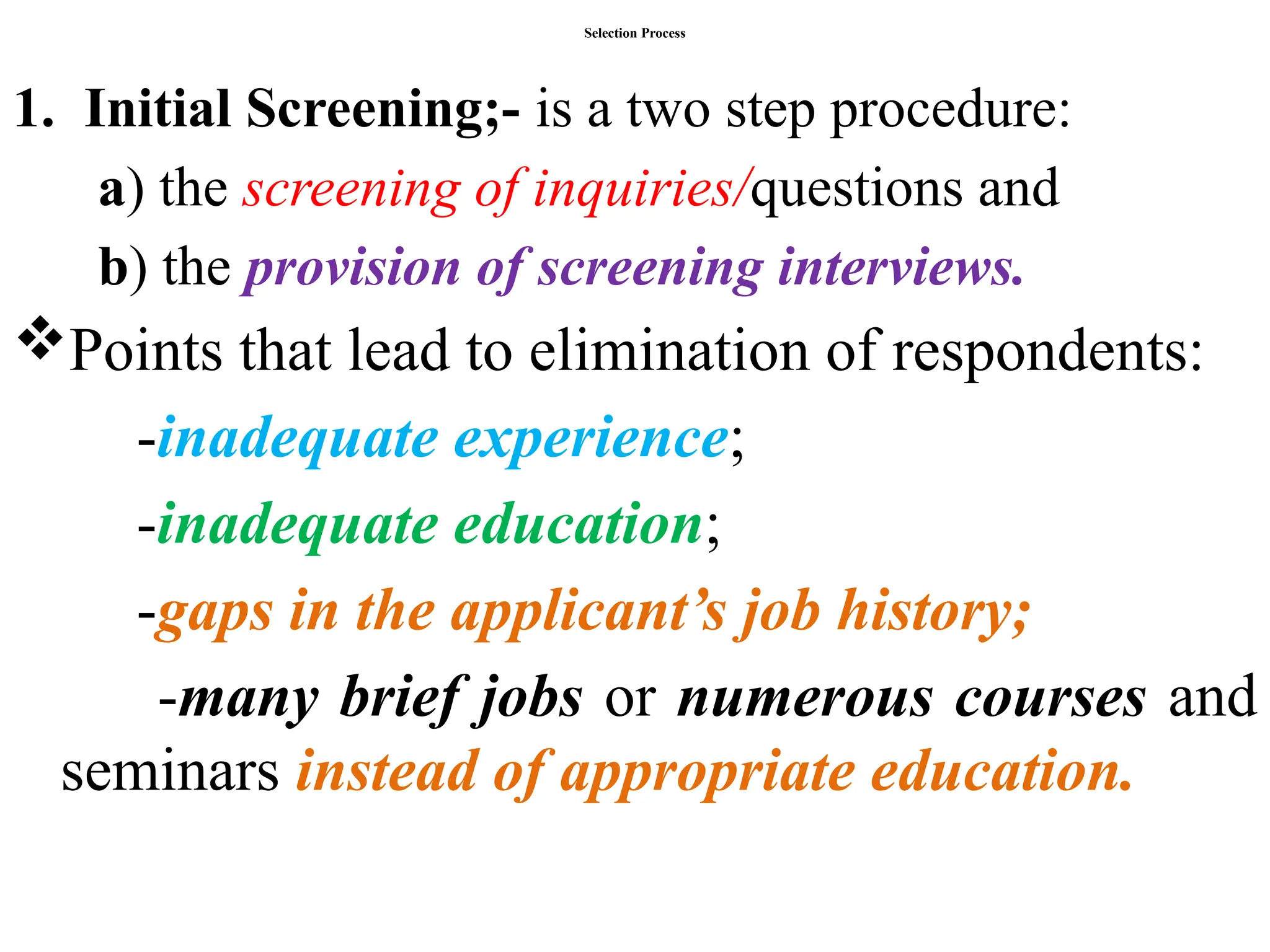
Selection Process
1. Initial Screening;- is a two step procedure:
a) the screening of inquiries/questions and
b) the provision of screening interviews.
Points that lead to elimination of respondents:
-inadequate experience;
-inadequate education;
-gaps in the applicant’s job history;
-many brief jobs or numerous courses and
seminars instead of appropriate education.
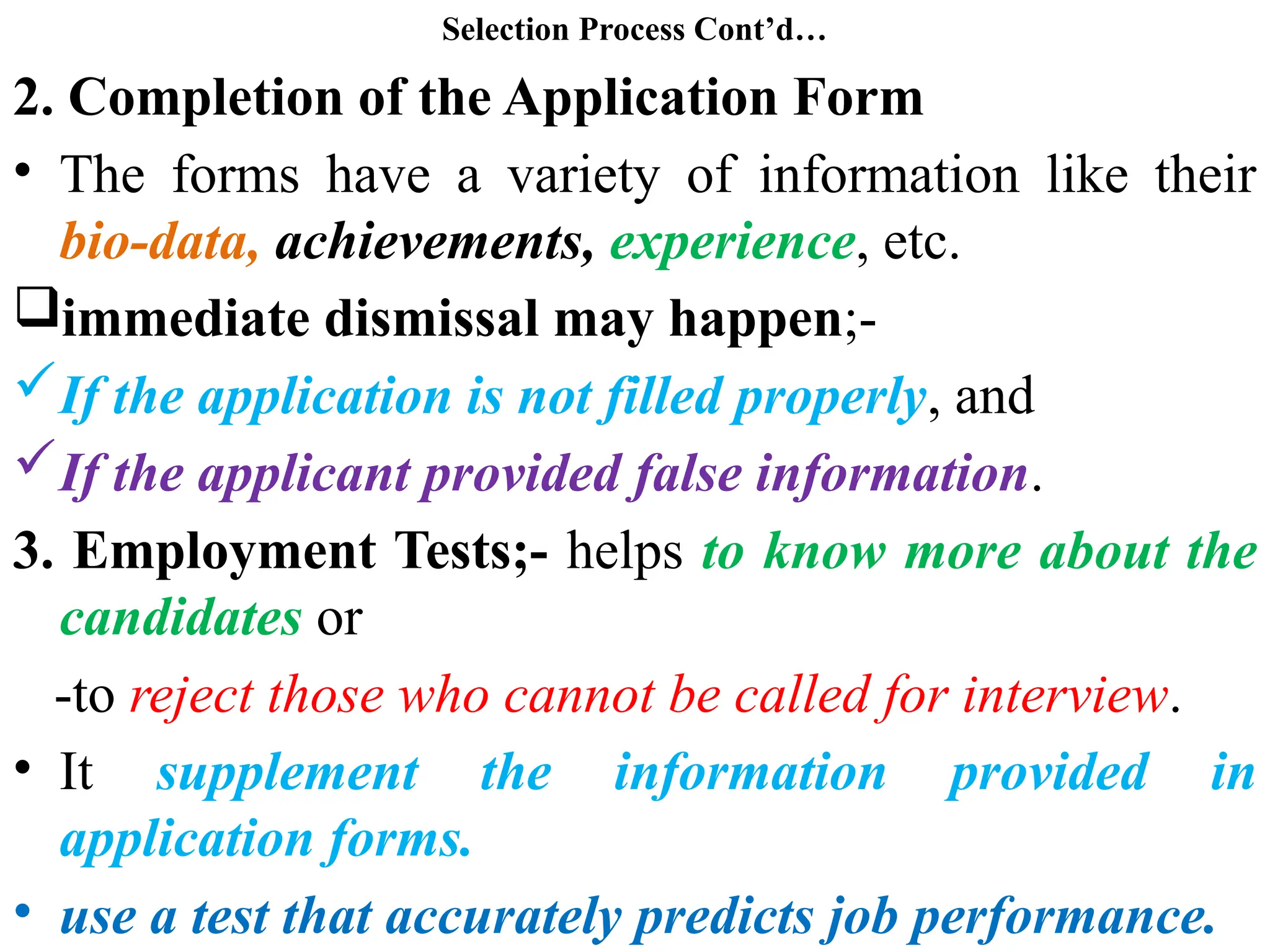
Selection Process Cont’d…
2. Completion of the Application Form
• The forms have a variety of information like their
bio-data, achievements, experience, etc.
immediate dismissal may happen;-
If the application is not filled properly, and
If the applicant provided false information.
3. Employment Tests;- helps to know more about the
candidates or
-to reject those who cannot be called for interview.
• It supplement the information provided in
application forms.
• use a test that accurately predicts job performance.
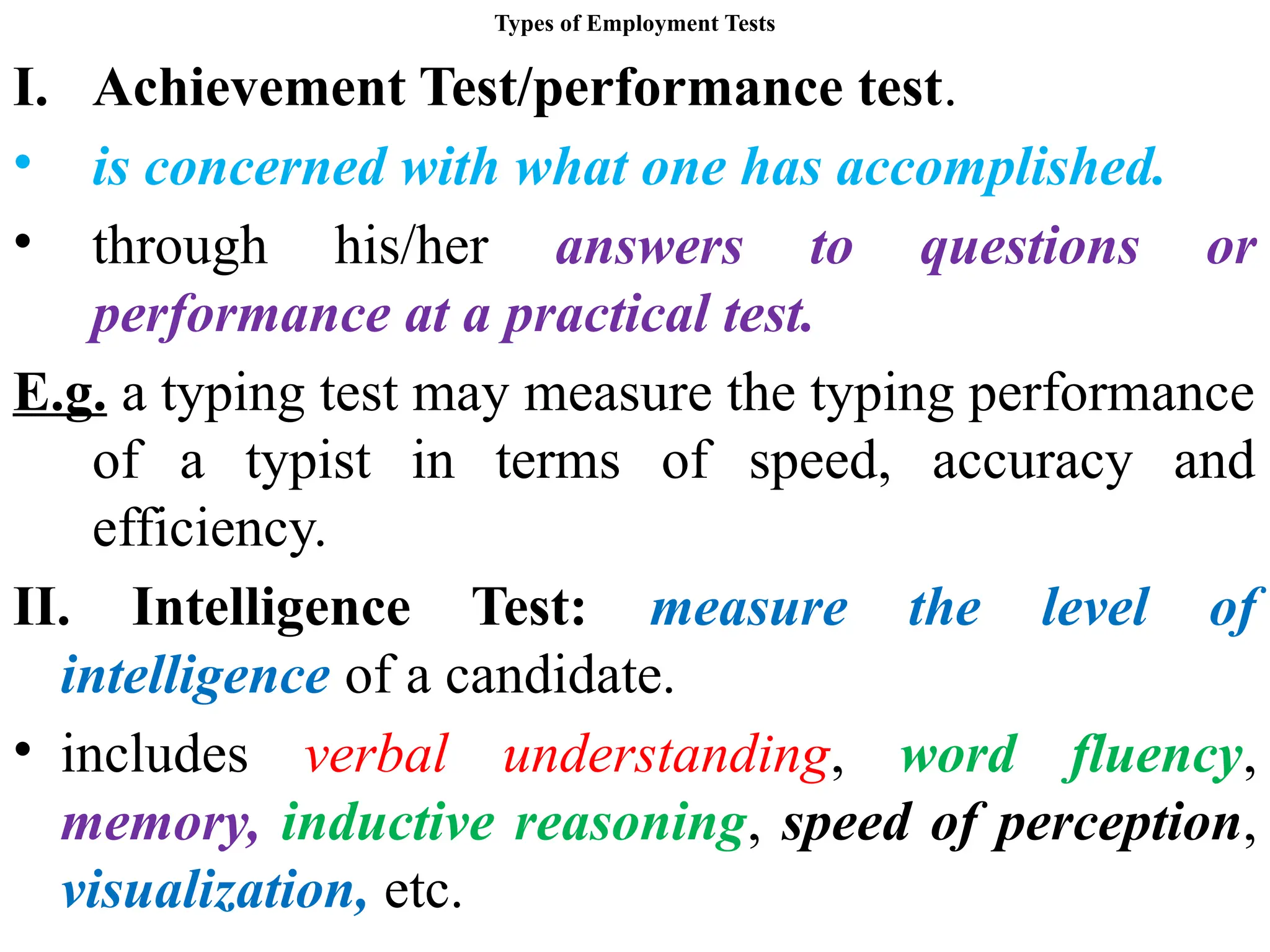
Types of Employment Tests
I. Achievement Test/performance test.
• is concerned with what one has accomplished.
• through his/her answers to questions or
performance at a practical test.
E.g. a typing test may measure the typing performance
of a typist in terms of speed, accuracy and
efficiency.
II. Intelligence Test: measure the level of
intelligence of a candidate.
• includes verbal understanding, word fluency,
memory, inductive reasoning, speed of perception,
visualization, etc.
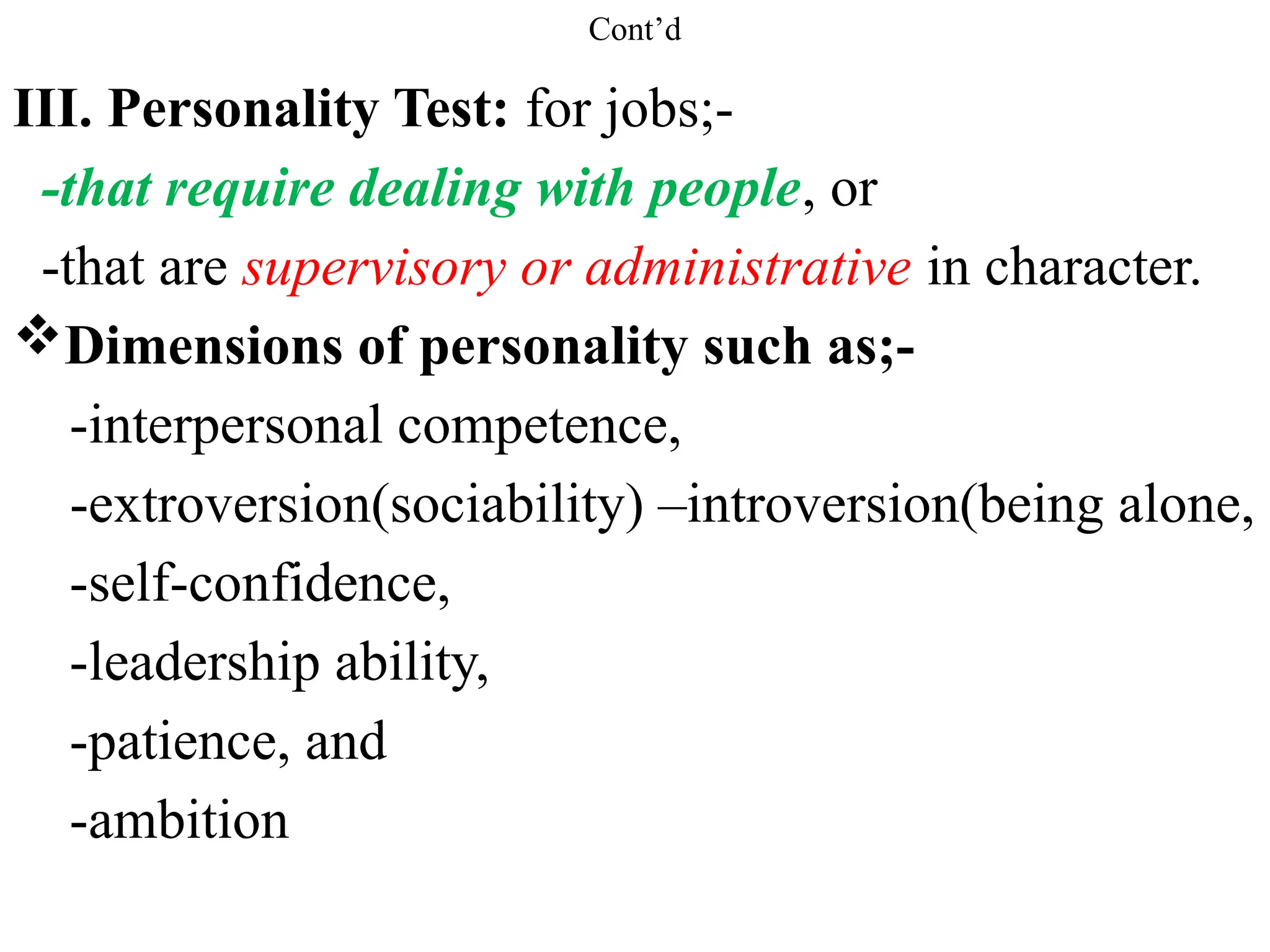
Cont’d
III. Personality Test: for jobs;-
-that require dealing with people, or
-that are supervisory or administrative in character.
Dimensions of personality such as;-
-interpersonal competence,
-extroversion(sociability) –introversion(being alone,
-self-confidence,
-leadership ability,
-patience, and
-ambition
Cont’d
IV. Aptitude Test: used for measuring development
of proficiency(skill) on specific jobs.
• It measures potential characteristics to do
something.
• It is more valid when the applicants have no
experience or very little experience.
V. Interest Test: is designed to discover a person's
area of interest, and
-to identify the kind of jobs that will satisfy him/her.
Therefore, a combination of tests that are related
with the nature of the job should be given.
Selection Process Cont’d…
4. The Comprehensive Interview- is used;-
• to find out overall suitability of candidates for jobs.
• For direct contact between candidates and the
employer
• to give relevant information about an organization
to candidates.
• to assess job related knowledge, skills and abilities.
• to probe areas that cannot be addressed by
application form or tests, E.g.
-assessing one’s motivation,
-ability to work under pressure and
-ability to “fit in” with an organization.
Selection Process Cont’d…
5. Background Investigation
The usual referees may be;- previous employers,
-persons associated with educational institutions,or
-persons who are aware of the candidates' ability.
verifying the educational accomplishments,
verifying an individual’s legal status to work in the
country and so on.
6. Conditional Job offer
• Before medical, physical or substance abuse test,
the job will be offered on conditional basis.
Selection Process Cont’d…
7. Physical/Medical Examination
• to ascertain the physical standards and fitness of
prospective employees.
• can be used to screen out individuals who are
unable to physically comply with the requirements
of a job.
• Some organizations only have general check up.
8. Job Offer
• Those individuals who perform successfully in the
preceding steps are now considered to be eligible to
receive the employment offer.
Selection Process Cont’d…
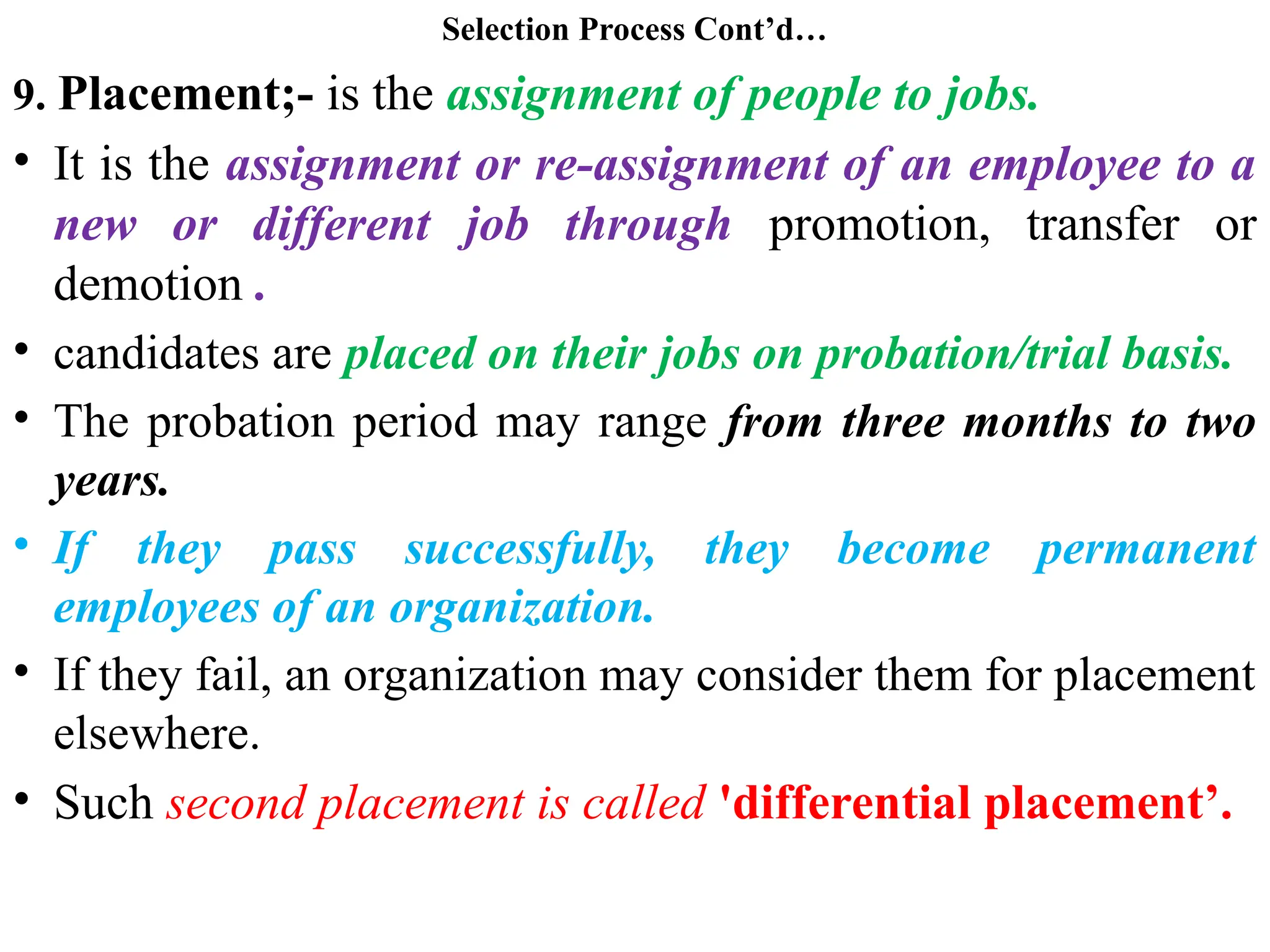
9. Placement;- is the assignment of people to jobs.
• It is the assignment or re-assignment of an employee to a
new or different job through promotion, transfer or
demotion .
• candidates are placed on their jobs on probation/trial basis.
• The probation period may range from three months to two
years.
• If they pass successfully, they become permanent
employees of an organization.
• If they fail, an organization may consider them for placement
elsewhere.
• Such second placement is called 'differential placement’.
Orientation
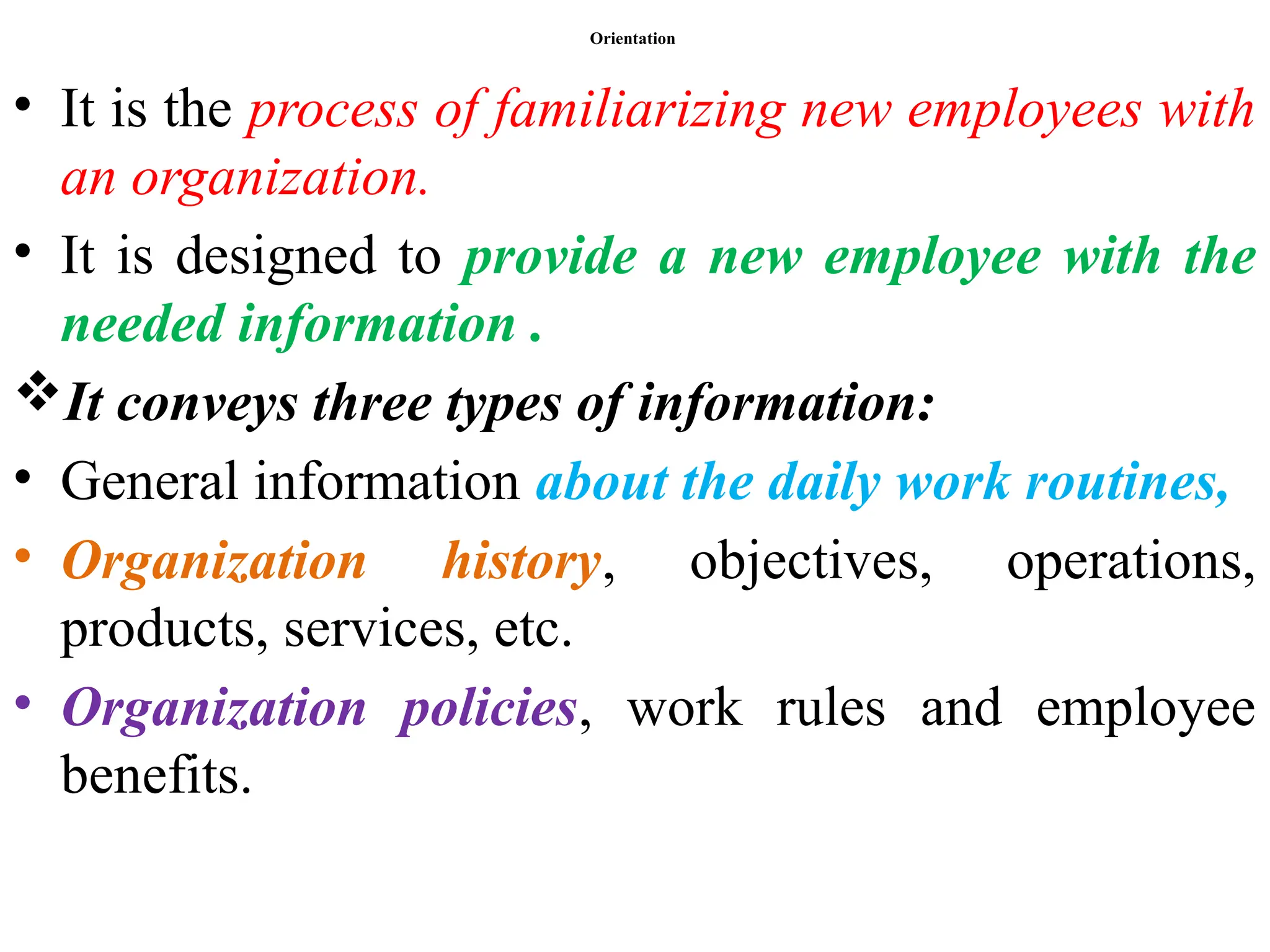
• It is the process of familiarizing new employees with
an organization.
• It is designed to provide a new employee with the
needed information .
It conveys three types of information:
• General information about the daily work routines,
• Organization history, objectives, operations,
products, services, etc.
• Organization policies, work rules and employee
benefits.
Purposes of Orientation
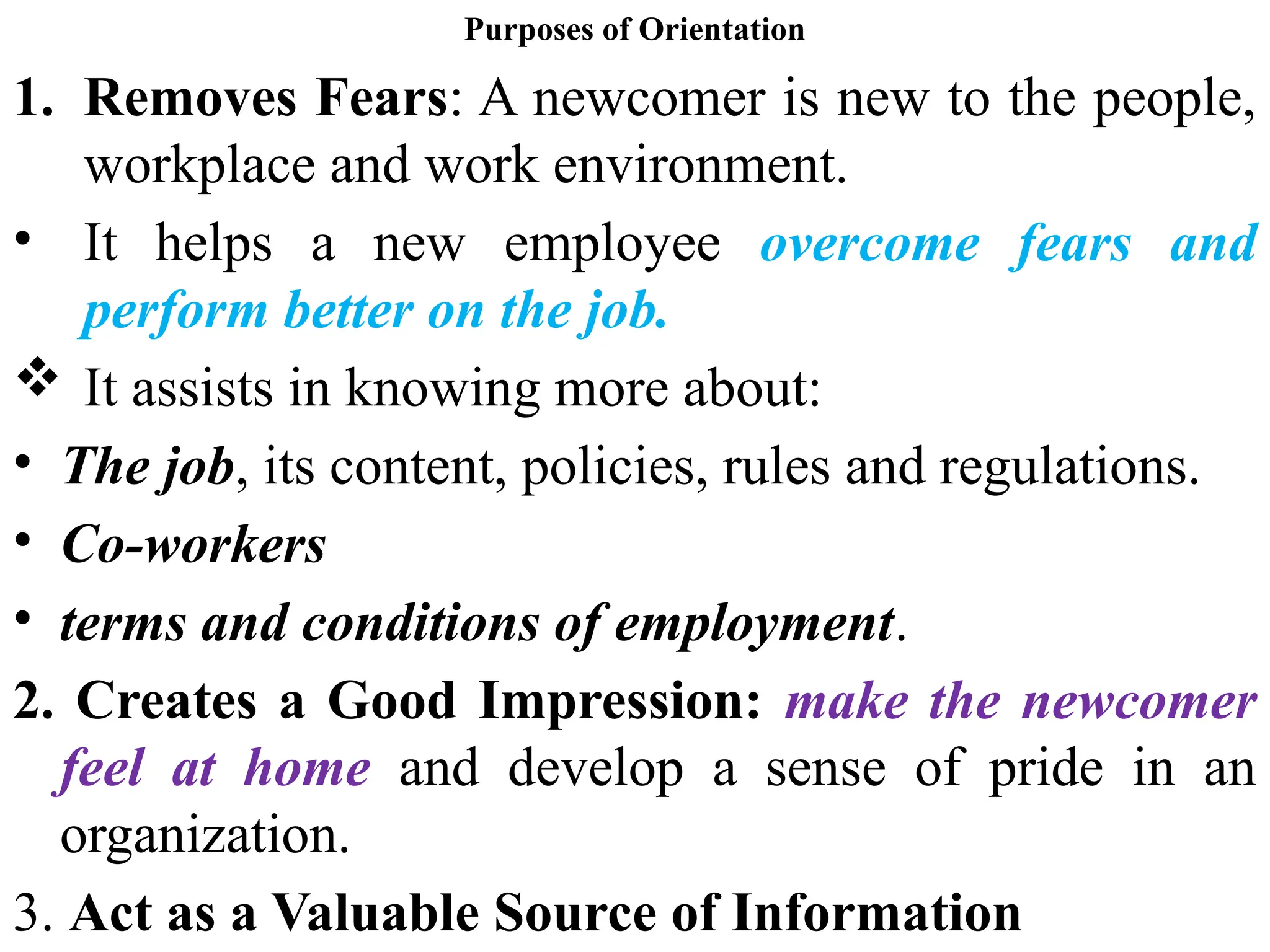
1. Removes Fears: A newcomer is new to the people,
workplace and work environment.
• It helps a new employee overcome fears and
perform better on the job.
 It assists in knowing more about:
• The job, its content, policies, rules and regulations.
• Co-workers
• terms and conditions of employment.
2. Creates a Good Impression: make the newcomer
feel at home and develop a sense of pride in an
organization.
3. Act as a Valuable Source of Information
Steps in Induction Program
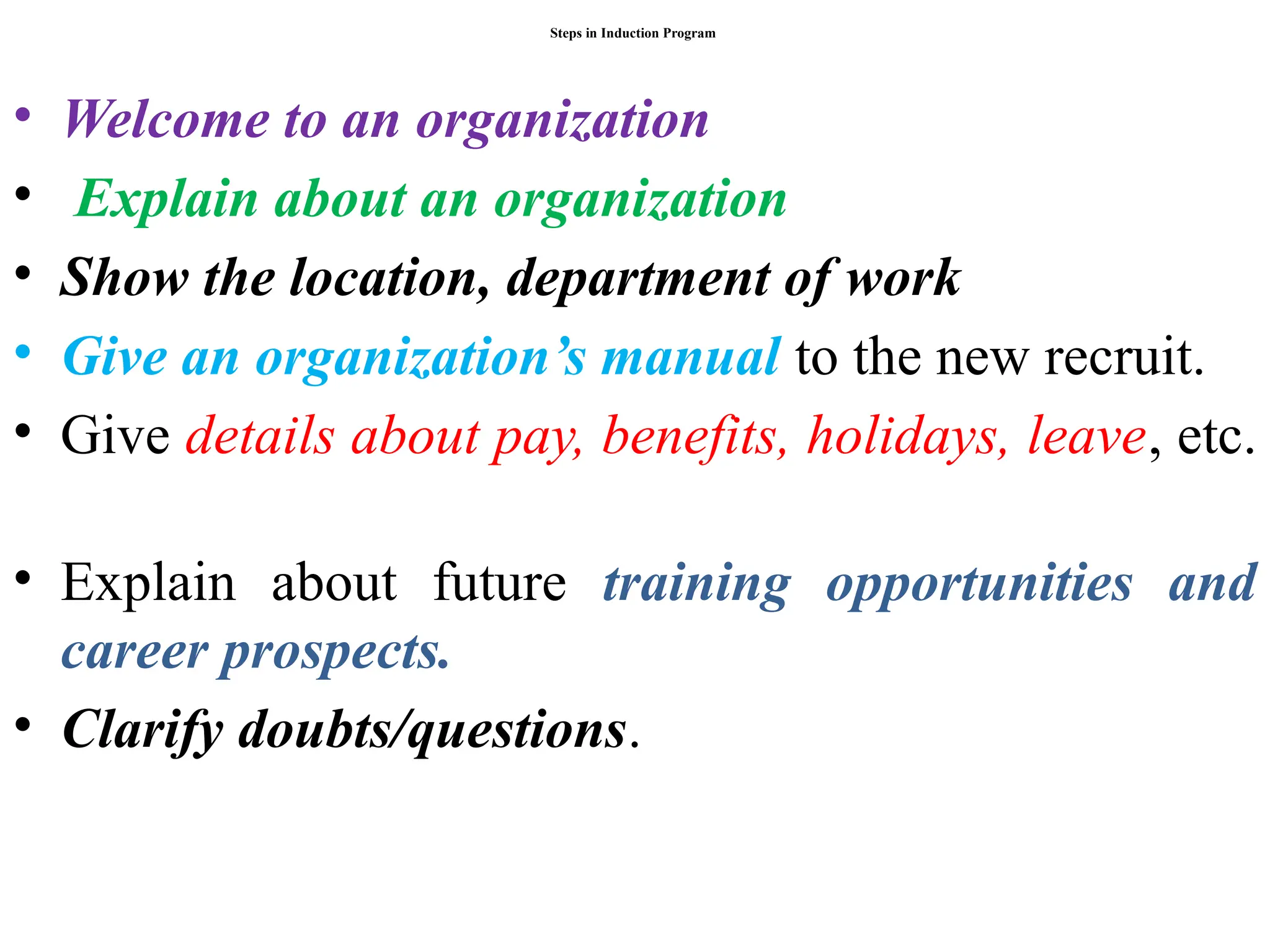
• Welcome to an organization
• Explain about an organization
• Show the location, department of work
• Give an organization’s manual to the new recruit.
• Give details about pay, benefits, holidays, leave, etc.
• Explain about future training opportunities and
career prospects.
• Clarify doubts/questions.
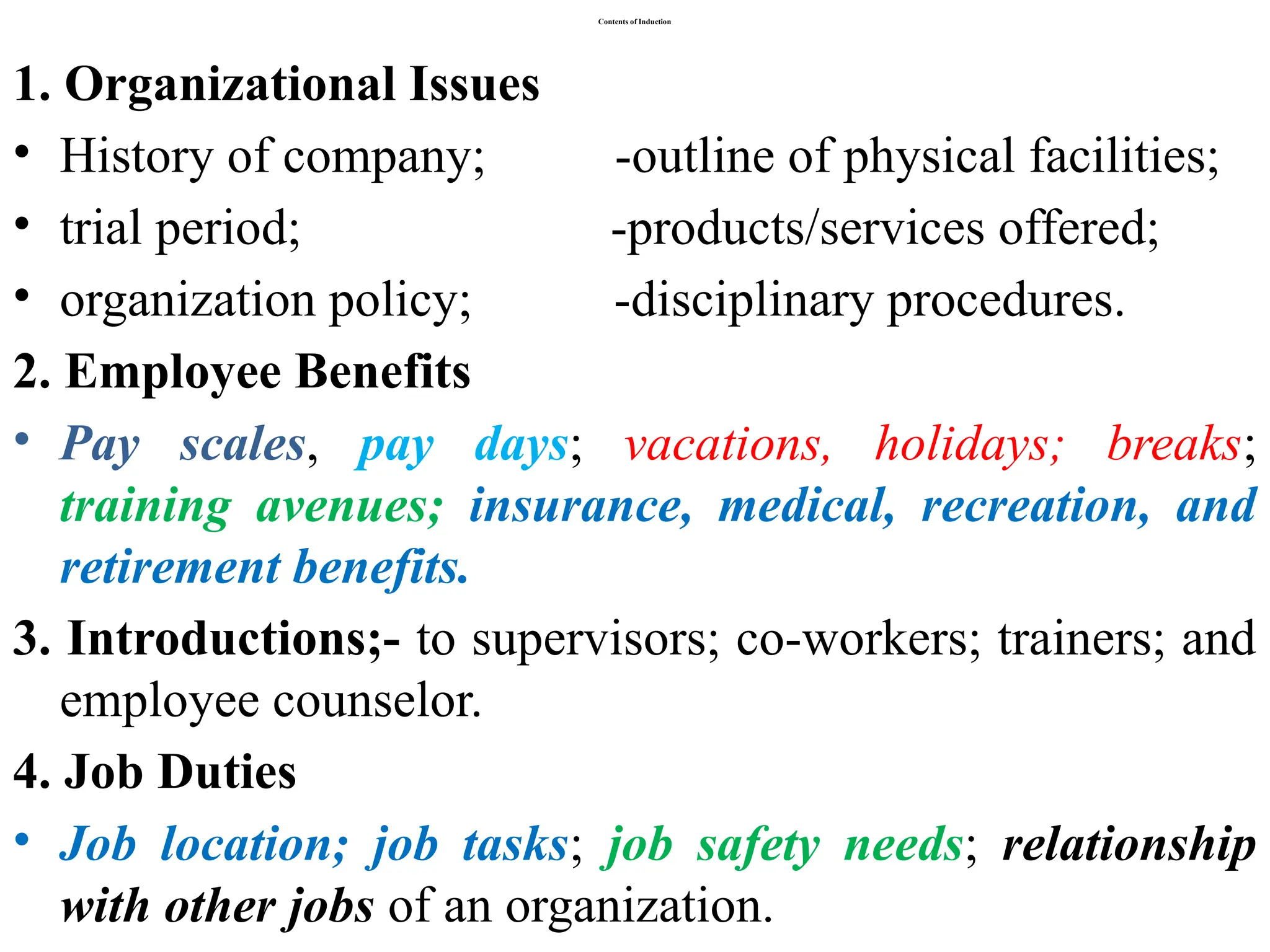
Contents of Induction
1. Organizational Issues
• History of company; -outline of physical facilities;
• trial period; -products/services offered;
• organization policy; -disciplinary procedures.
2. Employee Benefits
• Pay scales, pay days; vacations, holidays; breaks;
training avenues; insurance, medical, recreation, and
retirement benefits.
3. Introductions;- to supervisors; co-workers; trainers; and
employee counselor.
4. Job Duties
• Job location; job tasks; job safety needs; relationship
with other jobs of an organization.
Quiz
1. What is the difference between recruitment and
selection?
2. What are the major importance of orientation?
3. Which method of job finding do you prefer? Do
you want to apply for job through employment
agencies or by yourself? Why?
Ch 3selection.pptx chapter three part three hrm

  • 1.
    Selection •It is theprocess of choosing individuals who have relevant qualifications to fill jobs in an organization. •It involves predicting which candidates will make the most appropriate contribution to an organization. •It is the process of;- gathering information about applicants and -using that information to choose the most appropriate applicant.
  • 2.
    Cont’d • Managers canuse a number of selection devices to reduce accept and reject errors. The best-known devices include;- -analysis of application form, -written and performance - simulation tests, -interviews, -background investigations, and -in some cases, a physical examination.
  • 3.
    Selection Process 1. InitialScreening;- is a two step procedure: a) the screening of inquiries/questions and b) the provision of screening interviews. Points that lead to elimination of respondents: -inadequate experience; -inadequate education; -gaps in the applicant’s job history; -many brief jobs or numerous courses and seminars instead of appropriate education.
  • 4.
    Selection Process Cont’d… 2.Completion of the Application Form • The forms have a variety of information like their bio-data, achievements, experience, etc. immediate dismissal may happen;- If the application is not filled properly, and If the applicant provided false information. 3. Employment Tests;- helps to know more about the candidates or -to reject those who cannot be called for interview. • It supplement the information provided in application forms. • use a test that accurately predicts job performance.
  • 5.
    Types of EmploymentTests I. Achievement Test/performance test. • is concerned with what one has accomplished. • through his/her answers to questions or performance at a practical test. E.g. a typing test may measure the typing performance of a typist in terms of speed, accuracy and efficiency. II. Intelligence Test: measure the level of intelligence of a candidate. • includes verbal understanding, word fluency, memory, inductive reasoning, speed of perception, visualization, etc.
  • 6.
    Cont’d III. Personality Test:for jobs;- -that require dealing with people, or -that are supervisory or administrative in character. Dimensions of personality such as;- -interpersonal competence, -extroversion(sociability) –introversion(being alone, -self-confidence, -leadership ability, -patience, and -ambition
  • 7.
    Cont’d IV. Aptitude Test:used for measuring development of proficiency(skill) on specific jobs. • It measures potential characteristics to do something. • It is more valid when the applicants have no experience or very little experience. V. Interest Test: is designed to discover a person's area of interest, and -to identify the kind of jobs that will satisfy him/her. Therefore, a combination of tests that are related with the nature of the job should be given.
  • 8.
    Selection Process Cont’d… 4.The Comprehensive Interview- is used;- • to find out overall suitability of candidates for jobs. • For direct contact between candidates and the employer • to give relevant information about an organization to candidates. • to assess job related knowledge, skills and abilities. • to probe areas that cannot be addressed by application form or tests, E.g. -assessing one’s motivation, -ability to work under pressure and -ability to “fit in” with an organization.
  • 9.
    Selection Process Cont’d… 5.Background Investigation The usual referees may be;- previous employers, -persons associated with educational institutions,or -persons who are aware of the candidates' ability. verifying the educational accomplishments, verifying an individual’s legal status to work in the country and so on. 6. Conditional Job offer • Before medical, physical or substance abuse test, the job will be offered on conditional basis.
  • 10.
    Selection Process Cont’d… 7.Physical/Medical Examination • to ascertain the physical standards and fitness of prospective employees. • can be used to screen out individuals who are unable to physically comply with the requirements of a job. • Some organizations only have general check up. 8. Job Offer • Those individuals who perform successfully in the preceding steps are now considered to be eligible to receive the employment offer.
  • 11.
    Selection Process Cont’d… 9.Placement;- is the assignment of people to jobs. • It is the assignment or re-assignment of an employee to a new or different job through promotion, transfer or demotion . • candidates are placed on their jobs on probation/trial basis. • The probation period may range from three months to two years. • If they pass successfully, they become permanent employees of an organization. • If they fail, an organization may consider them for placement elsewhere. • Such second placement is called 'differential placement’.
  • 12.
    Orientation • It isthe process of familiarizing new employees with an organization. • It is designed to provide a new employee with the needed information . It conveys three types of information: • General information about the daily work routines, • Organization history, objectives, operations, products, services, etc. • Organization policies, work rules and employee benefits.
  • 13.
    Purposes of Orientation 1.Removes Fears: A newcomer is new to the people, workplace and work environment. • It helps a new employee overcome fears and perform better on the job.  It assists in knowing more about: • The job, its content, policies, rules and regulations. • Co-workers • terms and conditions of employment. 2. Creates a Good Impression: make the newcomer feel at home and develop a sense of pride in an organization. 3. Act as a Valuable Source of Information
  • 14.
    Steps in InductionProgram • Welcome to an organization • Explain about an organization • Show the location, department of work • Give an organization’s manual to the new recruit. • Give details about pay, benefits, holidays, leave, etc. • Explain about future training opportunities and career prospects. • Clarify doubts/questions.
  • 15.
    Contents of Induction 1.Organizational Issues • History of company; -outline of physical facilities; • trial period; -products/services offered; • organization policy; -disciplinary procedures. 2. Employee Benefits • Pay scales, pay days; vacations, holidays; breaks; training avenues; insurance, medical, recreation, and retirement benefits. 3. Introductions;- to supervisors; co-workers; trainers; and employee counselor. 4. Job Duties • Job location; job tasks; job safety needs; relationship with other jobs of an organization.
  • 16.
    Quiz 1. What isthe difference between recruitment and selection? 2. What are the major importance of orientation? 3. Which method of job finding do you prefer? Do you want to apply for job through employment agencies or by yourself? Why?