GATHERING AND
ORGANIZING INFORMATION
ORGANIZING
INFORMATION
Note-taking
Outlining
Summarizing
Categorizing/ Classifying
 Is a recording of important items of
information for future use.
 Best notes are as brief as possible
without missing any vital points
 learn to take notes as you read and
study
When you read assignment, gather
information in the library, prepare a book
report, or study magazine articles for a
talk or composition, collect the facts in
notes.
Aid when taking down notes.
A. Normal Organization Pattern
 Most materials are organized in the
following way: the main idea stated first,
followed by supporting details B.
B. Other Pattern of Organization
 the main idea may not come first all the
time
 Details are presented first.
 Follows a concluding statement, general
statement or a summary statement.
General Guides for Note-
taking
 First, read carefully all headings to
understand the purpose of the writing
and its organization.
 If the material is not difficult, take the
notes as you read. These notes
should consist mainly of Key words,
that is important words that will remind
you of the ideas that you want to
remember.
 If the material is difficult, read a section
through; then take a notes as you re-
read it.
 Distinguish between important and minor
ideas. If you are reading a selection for a
specific purpose, distinguish between the
idea that fit your purpose and those do
not.
 Make use of the topic sentences to find
and understand the main ideas for your
notes.
Outlining
 Some students try to prepare a
written report by first reading all the
references and then writing the report
from memory
 By writing out the report on each
reference as they read it;
 Learning to take notes efficiently is a
useful skill in the preparation of
reports both orall and written
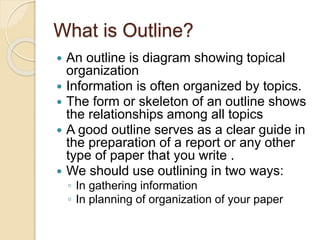
What is Outline?
 An outline is diagram showing topical
organization
 Information is often organized by topics.
 The form or skeleton of an outline shows
the relationships among all topics
 A good outline serves as a clear guide in
the preparation of a report or any other
type of paper that you write .
 We should use outlining in two ways:
◦ In gathering information
◦ In planning of organization of your paper
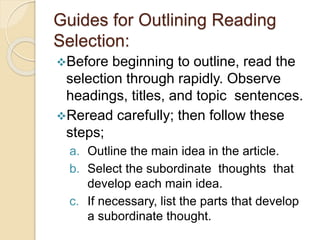
Guides for Outlining Reading
Selection:
Before beginning to outline, read the
selection through rapidly. Observe
headings, titles, and topic sentences.
Reread carefully; then follow these
steps;
a. Outline the main idea in the article.
b. Select the subordinate thoughts that
develop each main idea.
c. If necessary, list the parts that develop
a subordinate thought.
 Cross out ideas that are unnecessary
or unimportant for your purpose.
Use a sentence outline for material
that you may have difficulty in
remembering.
Study your outline and see that each
part serves a purpose.
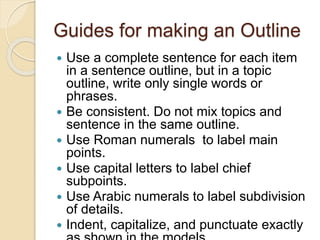
Guides for making an Outline
 Use a complete sentence for each item
in a sentence outline, but in a topic
outline, write only single words or
phrases.
 Be consistent. Do not mix topics and
sentence in the same outline.
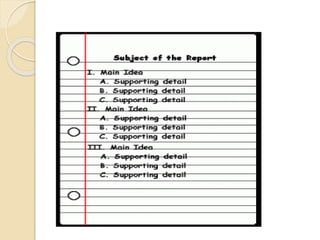
 Use Roman numerals to label main
points.
 Use capital letters to label chief
subpoints.
 Use Arabic numerals to label subdivision
of details.
 Indent, capitalize, and punctuate exactly
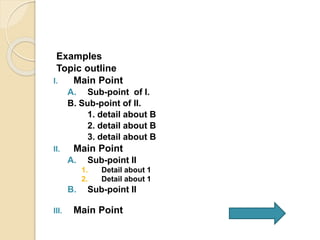
Examples
Topic outline
I. Main Point
A. Sub-point of I.
B. Sub-point of II.
1. detail about B
2. detail about B
3. detail about B
II. Main Point
A. Sub-point II
1. Detail about 1
2. Detail about 1
B. Sub-point II
III. Main Point
Summarizing
 a summary is a brief, accurate, restatement
of a speakers or writers words; it extracts the
meats from all details and ideas contained in
the material. It requires clear thinking and
high reading ability. One must be able to
understand the ideas that he reads and then
be able to judge their relative importance.
 Practice in summarizing will improve your
thinking, speaking and writing, skill in
summarizing will help you to be more efficient
in studying preparing reports, taking notes,
and writing test.
Guides for making a
Summary
 As you read or listen, select what you think are
important ideas.
 Restate accurately each main idea.
 Omit ideas that are not important.
 Be brief, combine two or more related ideas into
one sentence. Often you can do so by reducing
sentences to words, phrases, or clauses.
 Study your summary to make sure that all
necessary ideas have been included and all
unnecessary ones omitted.
 The summary may approximately be one third
of the original.
 Classification-is a strategy for organizing
information into groups and categories.
 A good reader is one who is able to group
objects, concepts, people, places and the
like according to given criterion and to
assign categories for each group.
 It is very important for us college student
to hone our skills in
classifying/categorizing because it will
facilitate our comprehension of textual
materials as well as recording of the basic
information.
◦ For example
 Books may be categorized according to subject, size
or author.

Gathering and organizing information developental reading

  • 1.
  • 2.
  • 3.
     Is arecording of important items of information for future use.  Best notes are as brief as possible without missing any vital points  learn to take notes as you read and study When you read assignment, gather information in the library, prepare a book report, or study magazine articles for a talk or composition, collect the facts in notes.
  • 4.
    Aid when takingdown notes. A. Normal Organization Pattern  Most materials are organized in the following way: the main idea stated first, followed by supporting details B. B. Other Pattern of Organization  the main idea may not come first all the time  Details are presented first.  Follows a concluding statement, general statement or a summary statement.
  • 5.
    General Guides forNote- taking  First, read carefully all headings to understand the purpose of the writing and its organization.  If the material is not difficult, take the notes as you read. These notes should consist mainly of Key words, that is important words that will remind you of the ideas that you want to remember.
  • 6.
     If thematerial is difficult, read a section through; then take a notes as you re- read it.  Distinguish between important and minor ideas. If you are reading a selection for a specific purpose, distinguish between the idea that fit your purpose and those do not.  Make use of the topic sentences to find and understand the main ideas for your notes.
  • 7.
    Outlining  Some studentstry to prepare a written report by first reading all the references and then writing the report from memory  By writing out the report on each reference as they read it;  Learning to take notes efficiently is a useful skill in the preparation of reports both orall and written
  • 8.
    What is Outline? An outline is diagram showing topical organization  Information is often organized by topics.  The form or skeleton of an outline shows the relationships among all topics  A good outline serves as a clear guide in the preparation of a report or any other type of paper that you write .  We should use outlining in two ways: ◦ In gathering information ◦ In planning of organization of your paper
  • 10.
    Guides for OutliningReading Selection: Before beginning to outline, read the selection through rapidly. Observe headings, titles, and topic sentences. Reread carefully; then follow these steps; a. Outline the main idea in the article. b. Select the subordinate thoughts that develop each main idea. c. If necessary, list the parts that develop a subordinate thought.
  • 11.
     Cross outideas that are unnecessary or unimportant for your purpose. Use a sentence outline for material that you may have difficulty in remembering. Study your outline and see that each part serves a purpose.
  • 12.
    Guides for makingan Outline  Use a complete sentence for each item in a sentence outline, but in a topic outline, write only single words or phrases.  Be consistent. Do not mix topics and sentence in the same outline.  Use Roman numerals to label main points.  Use capital letters to label chief subpoints.  Use Arabic numerals to label subdivision of details.  Indent, capitalize, and punctuate exactly
  • 13.
    Examples Topic outline I. MainPoint A. Sub-point of I. B. Sub-point of II. 1. detail about B 2. detail about B 3. detail about B II. Main Point A. Sub-point II 1. Detail about 1 2. Detail about 1 B. Sub-point II III. Main Point
  • 14.
    Summarizing  a summaryis a brief, accurate, restatement of a speakers or writers words; it extracts the meats from all details and ideas contained in the material. It requires clear thinking and high reading ability. One must be able to understand the ideas that he reads and then be able to judge their relative importance.  Practice in summarizing will improve your thinking, speaking and writing, skill in summarizing will help you to be more efficient in studying preparing reports, taking notes, and writing test.
  • 15.
    Guides for makinga Summary  As you read or listen, select what you think are important ideas.  Restate accurately each main idea.  Omit ideas that are not important.  Be brief, combine two or more related ideas into one sentence. Often you can do so by reducing sentences to words, phrases, or clauses.  Study your summary to make sure that all necessary ideas have been included and all unnecessary ones omitted.  The summary may approximately be one third of the original.
  • 16.
     Classification-is astrategy for organizing information into groups and categories.  A good reader is one who is able to group objects, concepts, people, places and the like according to given criterion and to assign categories for each group.  It is very important for us college student to hone our skills in classifying/categorizing because it will facilitate our comprehension of textual materials as well as recording of the basic information. ◦ For example  Books may be categorized according to subject, size or author.