Principles, Elements,
Techniques, and Devices
of Creative Nonfiction
Prepared by: Marrianne S. Ledesma, LPT
Plot or Plot Structure
How to Begin:
 Catchy and clever titles have an advantage.
Examples:
“The Wild Man of Green Swamp” by Maxine Hong Kingston
“ The Courage of Turtles” by Edward Hoagland
 Titles should give the reader a quick idea of what to expect, without giving
away the whole story (Hidalgo, 56-57)
The First Paragraph
Ways of Writing your First Paragraph for CNF
 Passage of Vivid Description
 Quotation
 List
 Dialogue
 Little Scene
 Anecdote
 Question
 Striking Statement
 Reference to a current event which serves as the context of the action
How to End?
It is expected that the ending of a creative nonfiction piece is the logical
conclusion of the flow of your narrative or the development of your ideas. You
must constantly bear in mind that the reader should be left with a sense of
completion. However, satisfying the ending does not mean that you need to
answer or resolve the issues that you raised in the essay you may even wish to
end by suggesting new problems or asking other questions. ( Hidalgo, 109)
Character or Characterization
Ways Of Revealing Your Characters In A Creative Nonfiction Piece
 Direct Description
 Action and Reaction
 Other Character’s Opinion
 Dialogue
 Monologue
 Focusing on a Character’s Distinct or Idiosyncratic Behavior
Point of View
“ a good piece of creative nonfiction has a personal voice, a clearly defined point
of view, which will reveal itself in the tone, and be presented through scene,
summary and description, as it is in fiction. All its strategies are designed to
reach out to the readers and draw them in –again, as in fiction- without losing
tract of the facts. ( Hidalgo 6)
What does it suppose to mean?
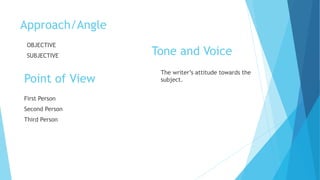
Approach/Angle
First Person
Second Person
Third Person
Point of View
OBJECTIVE
SUBJECTIVE
The writer’s attitude towards the
subject.
Tone and Voice
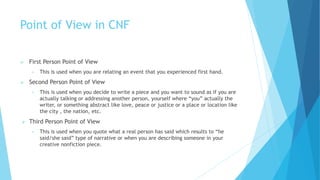
Point of View in CNF
 First Person Point of View
• This is used when you are relating an event that you experienced first hand.
 Second Person Point of View
• This is used when you decide to write a piece and you want to sound as if you are
actually talking or addressing another person, yourself where “you” actually the
writer, or something abstract like love, peace or justice or a place or location like
the city , the nation, etc.
 Third Person Point of View
• This is used when you quote what a real person has said which results to “he
said/she said” type of narrative or when you are describing someone in your
creative nonfiction piece.
Let’s Read a CNF Example!
The Death of the Moth
Virginia Woolf
(Aguila et. Al 48-50)
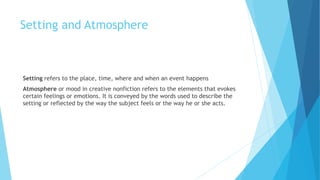
Setting and Atmosphere
Setting refers to the place, time, where and when an event happens
Atmosphere or mood in creative nonfiction refers to the elements that evokes
certain feelings or emotions. It is conveyed by the words used to describe the
setting or reflected by the way the subject feels or the way he or she acts.
According to Cristina Pantoja-Hidalgo:
“The most successful pieces of creative nonfiction are rich in details. Bare facts
are never enough. They need to be fleshed out; they need to be humanized. But
besides giving information, details serve other purposes. Details should be
accurate and informative first. And then must be suggestive or evocative. The
right details arouse emotions, evoke memories, help to produce the right
response in your reader. Details are extremely important in evoking a sense of
time and place. It must evoke a period as well as location. Descriptive details
are of particular importance for travel writing , the point of which , to begin
with , to literally transport the reader to the place to which the traveler has
been”
Let’s Read a CNF Example!
Baguio
(from Sojourns)
Cristina Pantoja-Hidalgo
(Aguila, Ph.D 55-57)
Literary Concerns: Structure, Symbols or
Symbolisms, Irony, Figures of Speech
Principles, elements, techniques, and devices

Principles, elements, techniques, and devices

  • 1.
    Principles, Elements, Techniques, andDevices of Creative Nonfiction Prepared by: Marrianne S. Ledesma, LPT
  • 2.
    Plot or PlotStructure How to Begin:  Catchy and clever titles have an advantage. Examples: “The Wild Man of Green Swamp” by Maxine Hong Kingston “ The Courage of Turtles” by Edward Hoagland  Titles should give the reader a quick idea of what to expect, without giving away the whole story (Hidalgo, 56-57)
  • 3.
    The First Paragraph Waysof Writing your First Paragraph for CNF  Passage of Vivid Description  Quotation  List  Dialogue  Little Scene  Anecdote  Question  Striking Statement  Reference to a current event which serves as the context of the action
  • 4.
    How to End? Itis expected that the ending of a creative nonfiction piece is the logical conclusion of the flow of your narrative or the development of your ideas. You must constantly bear in mind that the reader should be left with a sense of completion. However, satisfying the ending does not mean that you need to answer or resolve the issues that you raised in the essay you may even wish to end by suggesting new problems or asking other questions. ( Hidalgo, 109)
  • 5.
    Character or Characterization WaysOf Revealing Your Characters In A Creative Nonfiction Piece  Direct Description  Action and Reaction  Other Character’s Opinion  Dialogue  Monologue  Focusing on a Character’s Distinct or Idiosyncratic Behavior
  • 6.
    Point of View “a good piece of creative nonfiction has a personal voice, a clearly defined point of view, which will reveal itself in the tone, and be presented through scene, summary and description, as it is in fiction. All its strategies are designed to reach out to the readers and draw them in –again, as in fiction- without losing tract of the facts. ( Hidalgo 6) What does it suppose to mean?
  • 7.
    Approach/Angle First Person Second Person ThirdPerson Point of View OBJECTIVE SUBJECTIVE The writer’s attitude towards the subject. Tone and Voice
  • 8.
    Point of Viewin CNF  First Person Point of View • This is used when you are relating an event that you experienced first hand.  Second Person Point of View • This is used when you decide to write a piece and you want to sound as if you are actually talking or addressing another person, yourself where “you” actually the writer, or something abstract like love, peace or justice or a place or location like the city , the nation, etc.  Third Person Point of View • This is used when you quote what a real person has said which results to “he said/she said” type of narrative or when you are describing someone in your creative nonfiction piece.
  • 9.
    Let’s Read aCNF Example! The Death of the Moth Virginia Woolf (Aguila et. Al 48-50)
  • 10.
    Setting and Atmosphere Settingrefers to the place, time, where and when an event happens Atmosphere or mood in creative nonfiction refers to the elements that evokes certain feelings or emotions. It is conveyed by the words used to describe the setting or reflected by the way the subject feels or the way he or she acts.
  • 11.
    According to CristinaPantoja-Hidalgo: “The most successful pieces of creative nonfiction are rich in details. Bare facts are never enough. They need to be fleshed out; they need to be humanized. But besides giving information, details serve other purposes. Details should be accurate and informative first. And then must be suggestive or evocative. The right details arouse emotions, evoke memories, help to produce the right response in your reader. Details are extremely important in evoking a sense of time and place. It must evoke a period as well as location. Descriptive details are of particular importance for travel writing , the point of which , to begin with , to literally transport the reader to the place to which the traveler has been”
  • 12.
    Let’s Read aCNF Example! Baguio (from Sojourns) Cristina Pantoja-Hidalgo (Aguila, Ph.D 55-57)
  • 13.
    Literary Concerns: Structure,Symbols or Symbolisms, Irony, Figures of Speech