 The annelids also known as the ringed
worms or segmented worms, are a large phylum, with
over
22,000 extant species including ragworms, earthworms,
and leeches.
 The species exist in and have adapted to various
ecologies – some in marine environments as distinct
as tidal zones and hydrothermal vents, others in fresh
water, and yet others in moist terrestrial environments.
 The Annelids are bilaterally
symmetrical, triploblastic, coelomate, invertebrate orga
nisms.
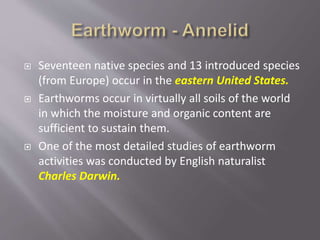
 Seventeen native species and 13 introduced species
(from Europe) occur in the eastern United States.
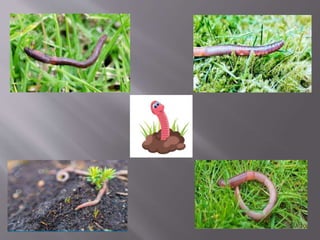
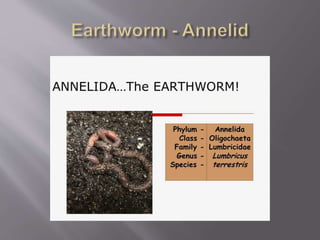
 Earthworms occur in virtually all soils of the world
in which the moisture and organic content are
sufficient to sustain them.
 One of the most detailed studies of earthworm
activities was conducted by English naturalist
Charles Darwin.
 The brain of most annelids (phylum Annelida;
segmented worms, including the leeches and
terrestrial earthworms) is relatively simple in
structure.
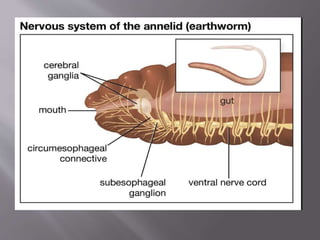
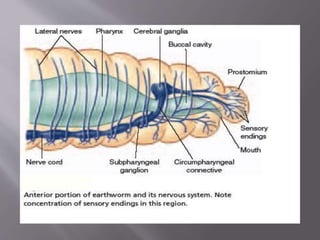
 The earthworm brain is a bilobed mass lying above
the pharynx in the third body segment.
 In some the brain of annelids can be divided into
A forebrain
A midbrain
A hindbrain
 A single pair of circumesophageal or
circumpharyngeal connectives leave the brain,
surround the anterior gut, and connect with the
ventral nerve cord.
 In most annelids (segmented worms) such as the
earthworm, two cerebral ganglia (bundles of nerve
cells) form a primitive bilobed brain, from which
sensory and motor nerve fibres lead to other areas
of the body
 Sensory nerves leave the brain and run forward into
the prostomium (extreme anterior end) and first
segment. The brain of the active, predatory
polychaetes (a class of marine worms) is more
complicated.
 The most primitive annelids have a pair of
ventral nerve cords joined by transverse
connectives; the most advanced forms have the
cords fused to form a single cord.
 A ganglionic swelling of the cord is found in each
body segment, with the most anterior ganglion,
the subpharyngeal ganglion, being the most
prominent.
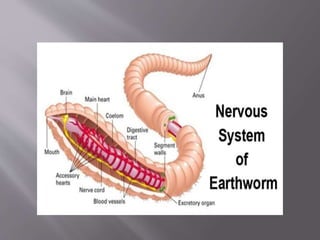
 Earthworm has a well-developed nervous
system.
 The nervous system is metamerically
segmented.
 The nervous system is divisible into central,
peripheral and autonomic nervous system
(sympathetic nervous system).
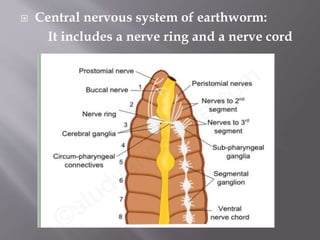
 Central nervous system of earthworm:
It includes a nerve ring and a nerve cord
Nerve ring of earthworm :
 Nerve ring is an oblique ring around the
pharynx in 3rd and 4th segments.
 Its mid-dorsal part comprises of a pair of
small and fused supra-pharyngeal ganglia, also
called cerebral ganglia or brain.
Nerve cord in Earthworm :
 Nerve cord is surrounded by epineurium (a
common sheath of connective tissue).
 Outside epineurium, there is a layer of
longitudinal muscle fibers.
 This is finally surrounded by a layer of visceral
peritoneum.
 Nerve cells are mainly present in ventral and
lateral sides of the nerve cord.
 Nerve fibers are mainly present in dorsal and
middle portion of nerve cord.
Peripheral nervous system (PNS) of
earthworm:
 All nerves arise from CNS and supply to various
parts of body.
 All the nerves present in earthworm are of mixed
type as they contain both afferent and efferent
nerve fibres and adjustors (association neurons).
 From the cerebral ganglia/brain, 8-10 pairs of
nerves arise.
Autonomic nervous system (ANS) of
earthworm:
 ANS of Pheretima posthuma possess sympathetic
nervous system only with extensive nerve plexus
that are connected to the nerves from circum-
pharyngeal connectives.
Nervous activities in Earthworm:
 All earthworm operations are regulated by the
nervous system, but not necessarily by the brain.
 They have both sensory and motor neurons, like
larger animals.Sensory fibers start in the epidermis
from sensory cells or receptor organs and end in
fine branches in the ventral nerve cord.
Segmented nervous system in annelids.pptx

Segmented nervous system in annelids.pptx

  • 2.
     The annelidsalso known as the ringed worms or segmented worms, are a large phylum, with over 22,000 extant species including ragworms, earthworms, and leeches.  The species exist in and have adapted to various ecologies – some in marine environments as distinct as tidal zones and hydrothermal vents, others in fresh water, and yet others in moist terrestrial environments.  The Annelids are bilaterally symmetrical, triploblastic, coelomate, invertebrate orga nisms.
  • 5.
     Seventeen nativespecies and 13 introduced species (from Europe) occur in the eastern United States.  Earthworms occur in virtually all soils of the world in which the moisture and organic content are sufficient to sustain them.  One of the most detailed studies of earthworm activities was conducted by English naturalist Charles Darwin.
  • 7.
     The brainof most annelids (phylum Annelida; segmented worms, including the leeches and terrestrial earthworms) is relatively simple in structure.  The earthworm brain is a bilobed mass lying above the pharynx in the third body segment.
  • 8.
     In somethe brain of annelids can be divided into A forebrain A midbrain A hindbrain  A single pair of circumesophageal or circumpharyngeal connectives leave the brain, surround the anterior gut, and connect with the ventral nerve cord.
  • 9.
     In mostannelids (segmented worms) such as the earthworm, two cerebral ganglia (bundles of nerve cells) form a primitive bilobed brain, from which sensory and motor nerve fibres lead to other areas of the body  Sensory nerves leave the brain and run forward into the prostomium (extreme anterior end) and first segment. The brain of the active, predatory polychaetes (a class of marine worms) is more complicated.
  • 10.
     The mostprimitive annelids have a pair of ventral nerve cords joined by transverse connectives; the most advanced forms have the cords fused to form a single cord.  A ganglionic swelling of the cord is found in each body segment, with the most anterior ganglion, the subpharyngeal ganglion, being the most prominent.
  • 12.
     Earthworm hasa well-developed nervous system.  The nervous system is metamerically segmented.  The nervous system is divisible into central, peripheral and autonomic nervous system (sympathetic nervous system).
  • 14.
     Central nervoussystem of earthworm: It includes a nerve ring and a nerve cord
  • 15.
    Nerve ring ofearthworm :  Nerve ring is an oblique ring around the pharynx in 3rd and 4th segments.  Its mid-dorsal part comprises of a pair of small and fused supra-pharyngeal ganglia, also called cerebral ganglia or brain.
  • 16.
    Nerve cord inEarthworm :  Nerve cord is surrounded by epineurium (a common sheath of connective tissue).  Outside epineurium, there is a layer of longitudinal muscle fibers.  This is finally surrounded by a layer of visceral peritoneum.  Nerve cells are mainly present in ventral and lateral sides of the nerve cord.  Nerve fibers are mainly present in dorsal and middle portion of nerve cord.
  • 17.
    Peripheral nervous system(PNS) of earthworm:  All nerves arise from CNS and supply to various parts of body.  All the nerves present in earthworm are of mixed type as they contain both afferent and efferent nerve fibres and adjustors (association neurons).  From the cerebral ganglia/brain, 8-10 pairs of nerves arise.
  • 18.
    Autonomic nervous system(ANS) of earthworm:  ANS of Pheretima posthuma possess sympathetic nervous system only with extensive nerve plexus that are connected to the nerves from circum- pharyngeal connectives.
  • 19.
    Nervous activities inEarthworm:  All earthworm operations are regulated by the nervous system, but not necessarily by the brain.  They have both sensory and motor neurons, like larger animals.Sensory fibers start in the epidermis from sensory cells or receptor organs and end in fine branches in the ventral nerve cord.