













MARKET
SEGMENTATION-
By- shehzaad shaikh
Roll-07
Class- t.y.b.m.s
Contents
• What is Market Segmentation?
• Why segmentation?
• What are the requirements of Segmentation?
• Benefits & Limitations of Segmentation
• Segmenting Consumer Markets
- Geographic Segmentation
- Demographic Segmentation
- Psychographic Segmentation
- Behavioural Segmentation
Target Marketing-
•Market segmentation
•whereby a product is developed and
marketed for a very well-defined, specific
segment of the consumer population.
• Target marketing is particularly effective
for small companies with limited
resources because it enables the
company to achieve a strong market
position in the specific market
Requirements of Market
Segments
In addition to having different needs, for segments to be
practical they should be evaluated against the following
criteria:
• Identifiable: the differentiating attributes of the
segments must be measurable so that they can be
identified.
• Accessible: the segments must be reachable through
communication and distribution channels.
• Measurable: This is important especially for demographic and
geographic variables. For an organization with direct sales
(without intermediaries), the own customer database could
deliver valuable information on buying behavior (frequency,
volume, product groups, mode of payment etc).
• Substantial: the segments should be sufficiently large to
justify the resources required to target them.
• Unique needs: to justify separate offerings, the segments
must respond differently to the different marketing mixes.
• Durable: the segments should be relatively stable to minimize
the cost of frequent changes.
Defining Marketing Segmentation
‘Market Segmentation’
Market Segmentation is the sub-dividing of
customers into homogenous sub-set of customers
where any sub-set may conceivably selected as
market target to be reached with distinct Marketing
Mix – Philip Kotler
• Segmentation aims to match groups of purchasers
with the same set of needs and buyer behaviour. Such
a group is known as a 'segment'.
Market segmentation involves the subdividing of a
market into distinct subgroups of customers, where
any subgroup can be selected as a target market to
be met with a distinct marketing mix. - AAA
Benefits and LimitationsBenefits:
The Organisation gets to know its customers better.
Provides guidelines for resource allocation.
It helps focus the strategy of the organisation.
Limitations:
Targeting multiple segments increases marketing costs.
Segmentation can lead to proliferation of products.
Narrowly segmenting a market can hamper the
development of broad-brand equity.
Why Segmentation?
• To develop marketing activities
• Generate greater customer satisfaction
• Create savings
• Allocation of marketing budget
• Adjustment of product to the market need
• To estimate the level of sales in the market
• To overcome competition effectively
• To develop effective marketing programmes
• To contribute towards achieving company goals
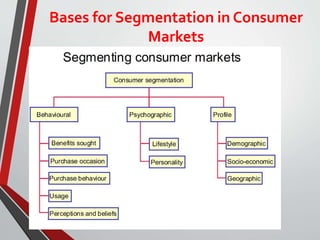
Bases for Segmentation in Consumer
Markets
Geographic Segmentation
The following are some examples of geographic variables
often used in segmentation.
• Region: by continent, country, state, or even
neighbourhood.
• Size of metropolitan area: segmented according to size of
population.
• Population density: often classified as urban, suburban, or
rural.
• Climate: according to weather patterns common to
certain geographic regions.
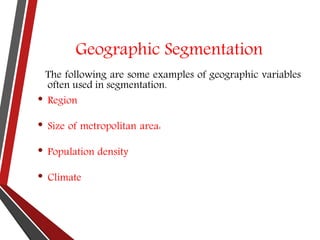
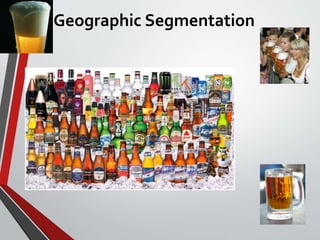
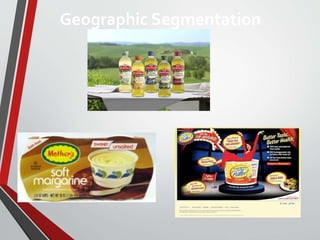
Geographic Segmentation
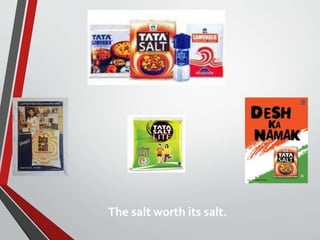
The salt worth its salt.
Gender
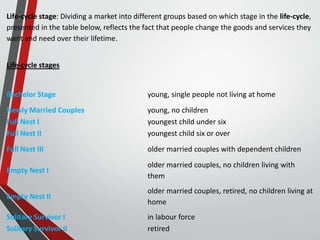
Life-cycle stage: Dividing a market into different groups based on which stage in the life-cycle,
presented in the table below, reflects the fact that people change the goods and services they
want and need over their lifetime.
Life-cycle stages
Bachelor Stage young, single people not living at home
Newly Married Couples young, no children
Full Nest I youngest child under six
Full Nest II youngest child six or over
Full Nest III older married couples with dependent children
Empty Nest I
older married couples, no children living with
them
Empty Nest II
older married couples, retired, no children living at
home
Solitary Survivor I in labour force
Solitary Survivor II retired
Psychographic Segmentation
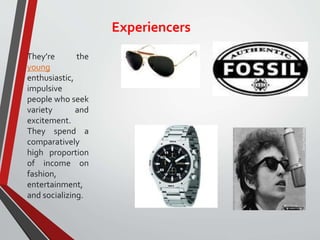
Experiencers
They’re the
young
enthusiastic,
impulsive
people who seek
variety and
excitement.
They spend a
comparatively
high proportion
of income on
fashion,
entertainment,
and socializing.
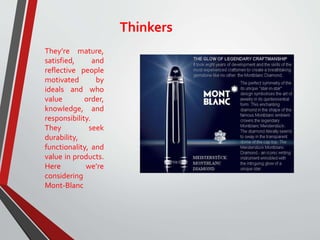
Thinkers
They’re mature,
satisfied, and
reflective people
motivated by
ideals and who
value order,
knowledge, and
responsibility.
They seek
durability,
functionality, and
value in products.
Here we’re
considering
Mont-Blanc
Behavioral Segmentation
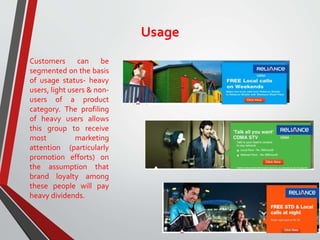
Usage
Customers can be
segmented on the basis
of usage status- heavy
users, light users & non-
users of a product
category. The profiling
of heavy users allows
this group to receive
most marketing
attention (particularly
promotion efforts) on
the assumption that
brand loyalty among
these people will pay
heavy dividends.
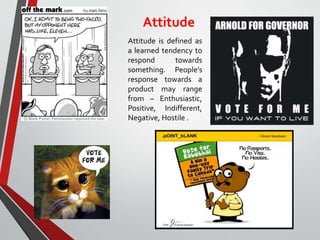
Attitude
Attitude is defined as
a learned tendency to
respond towards
something. People’s
response towards a
product may range
from – Enthusiastic,
Positive, Indifferent,
Negative, Hostile .
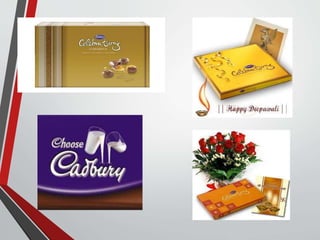
Occasions
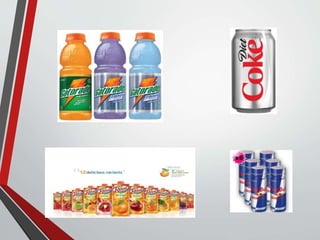
Brand Loyalty
Benefit Sought
Market segmentation (tybms)

Market segmentation (tybms)

  • 1.
  • 2.
    Contents • What isMarket Segmentation? • Why segmentation? • What are the requirements of Segmentation? • Benefits & Limitations of Segmentation • Segmenting Consumer Markets - Geographic Segmentation - Demographic Segmentation - Psychographic Segmentation - Behavioural Segmentation
  • 4.
    Target Marketing- •Market segmentation •wherebya product is developed and marketed for a very well-defined, specific segment of the consumer population. • Target marketing is particularly effective for small companies with limited resources because it enables the company to achieve a strong market position in the specific market
  • 5.
    Requirements of Market Segments Inaddition to having different needs, for segments to be practical they should be evaluated against the following criteria: • Identifiable: the differentiating attributes of the segments must be measurable so that they can be identified.
  • 6.
    • Accessible: thesegments must be reachable through communication and distribution channels. • Measurable: This is important especially for demographic and geographic variables. For an organization with direct sales (without intermediaries), the own customer database could deliver valuable information on buying behavior (frequency, volume, product groups, mode of payment etc).
  • 7.
    • Substantial: thesegments should be sufficiently large to justify the resources required to target them. • Unique needs: to justify separate offerings, the segments must respond differently to the different marketing mixes. • Durable: the segments should be relatively stable to minimize the cost of frequent changes.
  • 8.
  • 9.
    ‘Market Segmentation’ Market Segmentationis the sub-dividing of customers into homogenous sub-set of customers where any sub-set may conceivably selected as market target to be reached with distinct Marketing Mix – Philip Kotler
  • 10.
    • Segmentation aimsto match groups of purchasers with the same set of needs and buyer behaviour. Such a group is known as a 'segment'.
  • 11.
    Market segmentation involvesthe subdividing of a market into distinct subgroups of customers, where any subgroup can be selected as a target market to be met with a distinct marketing mix. - AAA
  • 12.
    Benefits and LimitationsBenefits: TheOrganisation gets to know its customers better. Provides guidelines for resource allocation. It helps focus the strategy of the organisation. Limitations: Targeting multiple segments increases marketing costs. Segmentation can lead to proliferation of products. Narrowly segmenting a market can hamper the development of broad-brand equity.
  • 13.
    Why Segmentation? • Todevelop marketing activities • Generate greater customer satisfaction • Create savings • Allocation of marketing budget • Adjustment of product to the market need • To estimate the level of sales in the market • To overcome competition effectively • To develop effective marketing programmes • To contribute towards achieving company goals
  • 14.
    Bases for Segmentationin Consumer Markets
  • 15.
    Geographic Segmentation The followingare some examples of geographic variables often used in segmentation. • Region: by continent, country, state, or even neighbourhood. • Size of metropolitan area: segmented according to size of population. • Population density: often classified as urban, suburban, or rural. • Climate: according to weather patterns common to certain geographic regions.
  • 16.
  • 17.
  • 18.
  • 19.
    The salt worthits salt.
  • 22.
  • 23.
    Life-cycle stage: Dividinga market into different groups based on which stage in the life-cycle, presented in the table below, reflects the fact that people change the goods and services they want and need over their lifetime. Life-cycle stages Bachelor Stage young, single people not living at home Newly Married Couples young, no children Full Nest I youngest child under six Full Nest II youngest child six or over Full Nest III older married couples with dependent children Empty Nest I older married couples, no children living with them Empty Nest II older married couples, retired, no children living at home Solitary Survivor I in labour force Solitary Survivor II retired
  • 24.
  • 25.
    Experiencers They’re the young enthusiastic, impulsive people whoseek variety and excitement. They spend a comparatively high proportion of income on fashion, entertainment, and socializing.
  • 26.
    Thinkers They’re mature, satisfied, and reflectivepeople motivated by ideals and who value order, knowledge, and responsibility. They seek durability, functionality, and value in products. Here we’re considering Mont-Blanc
  • 28.
  • 29.
    Usage Customers can be segmentedon the basis of usage status- heavy users, light users & non- users of a product category. The profiling of heavy users allows this group to receive most marketing attention (particularly promotion efforts) on the assumption that brand loyalty among these people will pay heavy dividends.
  • 30.
    Attitude Attitude is definedas a learned tendency to respond towards something. People’s response towards a product may range from – Enthusiastic, Positive, Indifferent, Negative, Hostile .
  • 31.
  • 33.
  • 35.