PRESENTED BY-
MANISH KUMAR
MBA(FIN.)-16104002
SEGMENTATION, TARGETING, AND
POSITIONING
LEARNING GOALS
 Learn the three steps of target marketing, market
segmentation, market targeting and market
positioning
 Understand the major bases for segmenting
consumer and business marketing strategy
 Know how companies identify attractive market
segments and choose market targeting strategy
 Realize how companies position their products for
maximum competitive advantage in the marketplace
STEPS IN MARKET SEGMENTATION,
TARGETING AND POSITIONING
Market Segmentation
• Identify bases for segmenting the market
• Develop segment profiles
Market Targeting
• Develop measure of each segment
• Select target segments
Market Positioning
• Develop positioning for target segments
• Choose the strategy for the positioning
Goal 1: Learn the three steps of target marketing
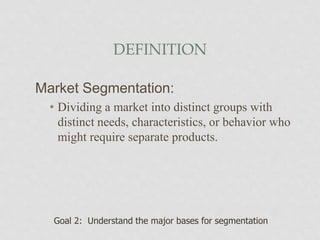
DEFINITION
Market Segmentation:
• Dividing a market into distinct groups with
distinct needs, characteristics, or behavior who
might require separate products.
Goal 2: Understand the major bases for segmentation
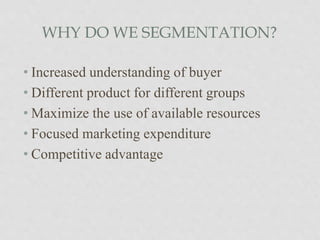
WHY DO WE SEGMENTATION?
• Increased understanding of buyer
• Different product for different groups
• Maximize the use of available resources
• Focused marketing expenditure
• Competitive advantage
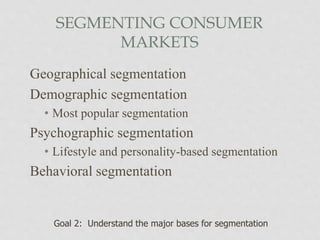
SEGMENTING CONSUMER
MARKETS
Geographical segmentation
Demographic segmentation
• Most popular segmentation
Psychographic segmentation
• Lifestyle and personality-based segmentation
Behavioral segmentation
Goal 2: Understand the major bases for segmentation
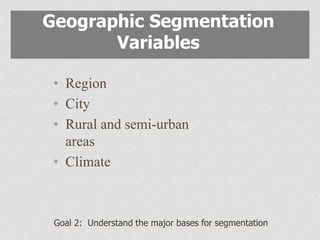
• Region
• City
• Rural and semi-urban
areas
• Climate
Geographic Segmentation
Variables
Goal 2: Understand the major bases for segmentation
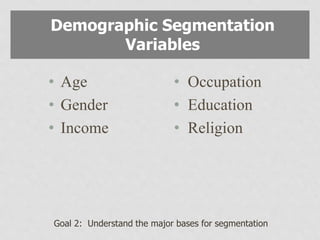
Demographic Segmentation
Variables
• Age
• Gender
• Income
• Occupation
• Education
• Religion
Goal 2: Understand the major bases for segmentation
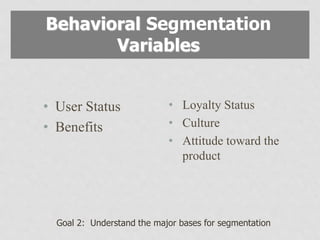
• User Status
• Benefits
• Loyalty Status
• Culture
• Attitude toward the
product
Behavioral Segmentation
Variables
Goal 2: Understand the major bases for segmentation
• Personality
• Life style
Goal 2: Understand the major bases for segmentation
Psychographic segmentation
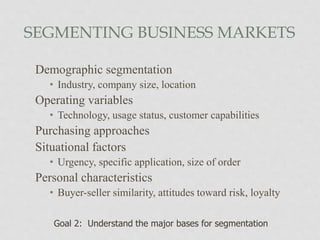
SEGMENTING BUSINESS MARKETS
Demographic segmentation
• Industry, company size, location
Operating variables
• Technology, usage status, customer capabilities
Purchasing approaches
Situational factors
• Urgency, specific application, size of order
Personal characteristics
• Buyer-seller similarity, attitudes toward risk, loyalty
Goal 2: Understand the major bases for segmentation
REQUIREMENTS FOR EFFECTIVE
SEGMENTATION
Measurable
• Size, purchasing power, and profile of segment
Accessible
• Can be reached and served
Substantial
• Large and profitable enough to serve
Differentiable
• Respond differently
Actionable
• Effective programs can be developed
Goal 2: Understand the major bases for segmentation
MARKET TARGETING
Target Market
• Consists of a set of buyers who share common
needs or characteristics that the company
decides to serve.
Goal 3: Know how companies identify and target attractive segments
MARKET TARGETING
Evaluating Market Segments
• Segment size and growth
• Segment structural attractiveness
• Level of competition
• Substitute products
• Power of buyers
• Powerful suppliers
• Company objectives and resources
Goal 3: Know how companies identify and target attractive segments
MARKET TARGETING
Selecting Target Market Segments
• Undifferentiated (mass) marketing
• Differentiated (multiple segment) marketing
• Concentrated (segment) marketing
• Micromarketing (local or individual)
Goal 3: Know how companies identify and target attractive segments
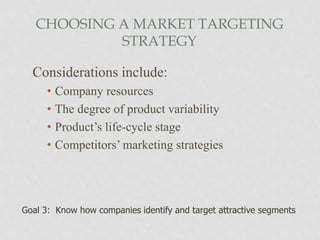
CHOOSING A MARKET TARGETING
STRATEGY
Considerations include:
• Company resources
• The degree of product variability
• Product’s life-cycle stage
• Competitors’ marketing strategies
Goal 3: Know how companies identify and target attractive segments
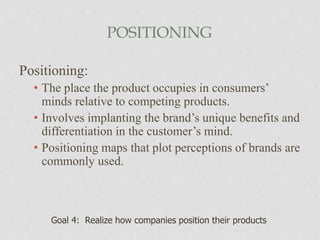
POSITIONING
Positioning:
• The place the product occupies in consumers’
minds relative to competing products.
• Involves implanting the brand’s unique benefits and
differentiation in the customer’s mind.
• Positioning maps that plot perceptions of brands are
commonly used.
Goal 4: Realize how companies position their products
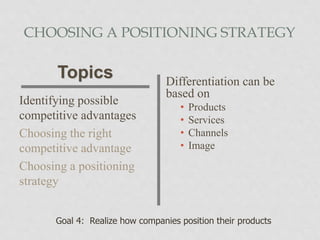
CHOOSING A POSITIONING STRATEGY
Identifying possible
competitive advantages
Choosing the right
competitive advantage
Choosing a positioning
strategy
Differentiation can be
based on
• Products
• Services
• Channels
• Image
Topics
Goal 4: Realize how companies position their products
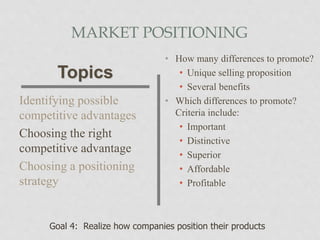
MARKET POSITIONING
Identifying possible
competitive advantages
Choosing the right
competitive advantage
Choosing a positioning
strategy
• How many differences to promote?
• Unique selling proposition
• Several benefits
• Which differences to promote?
Criteria include:
• Important
• Distinctive
• Superior
• Affordable
• Profitable
Topics
Goal 4: Realize how companies position their products
MARKET POSITIONING
Identifying possible
competitive advantages
Choosing the right
competitive advantage
Choosing a positioning
strategy
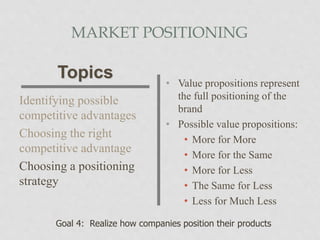
• Value propositions represent
the full positioning of the
brand
• Possible value propositions:
• More for More
• More for the Same
• More for Less
• The Same for Less
• Less for Much Less
Topics
Goal 4: Realize how companies position their products
THANK YOU

Segmentation, Targeting, and Positioning

  • 1.
  • 2.
    LEARNING GOALS  Learnthe three steps of target marketing, market segmentation, market targeting and market positioning  Understand the major bases for segmenting consumer and business marketing strategy  Know how companies identify attractive market segments and choose market targeting strategy  Realize how companies position their products for maximum competitive advantage in the marketplace
  • 3.
    STEPS IN MARKETSEGMENTATION, TARGETING AND POSITIONING Market Segmentation • Identify bases for segmenting the market • Develop segment profiles Market Targeting • Develop measure of each segment • Select target segments Market Positioning • Develop positioning for target segments • Choose the strategy for the positioning Goal 1: Learn the three steps of target marketing
  • 4.
    DEFINITION Market Segmentation: • Dividinga market into distinct groups with distinct needs, characteristics, or behavior who might require separate products. Goal 2: Understand the major bases for segmentation
  • 5.
    WHY DO WESEGMENTATION? • Increased understanding of buyer • Different product for different groups • Maximize the use of available resources • Focused marketing expenditure • Competitive advantage
  • 6.
    SEGMENTING CONSUMER MARKETS Geographical segmentation Demographicsegmentation • Most popular segmentation Psychographic segmentation • Lifestyle and personality-based segmentation Behavioral segmentation Goal 2: Understand the major bases for segmentation
  • 7.
    • Region • City •Rural and semi-urban areas • Climate Geographic Segmentation Variables Goal 2: Understand the major bases for segmentation
  • 8.
    Demographic Segmentation Variables • Age •Gender • Income • Occupation • Education • Religion Goal 2: Understand the major bases for segmentation
  • 9.
    • User Status •Benefits • Loyalty Status • Culture • Attitude toward the product Behavioral Segmentation Variables Goal 2: Understand the major bases for segmentation
  • 10.
    • Personality • Lifestyle Goal 2: Understand the major bases for segmentation Psychographic segmentation
  • 11.
    SEGMENTING BUSINESS MARKETS Demographicsegmentation • Industry, company size, location Operating variables • Technology, usage status, customer capabilities Purchasing approaches Situational factors • Urgency, specific application, size of order Personal characteristics • Buyer-seller similarity, attitudes toward risk, loyalty Goal 2: Understand the major bases for segmentation
  • 12.
    REQUIREMENTS FOR EFFECTIVE SEGMENTATION Measurable •Size, purchasing power, and profile of segment Accessible • Can be reached and served Substantial • Large and profitable enough to serve Differentiable • Respond differently Actionable • Effective programs can be developed Goal 2: Understand the major bases for segmentation
  • 13.
    MARKET TARGETING Target Market •Consists of a set of buyers who share common needs or characteristics that the company decides to serve. Goal 3: Know how companies identify and target attractive segments
  • 14.
    MARKET TARGETING Evaluating MarketSegments • Segment size and growth • Segment structural attractiveness • Level of competition • Substitute products • Power of buyers • Powerful suppliers • Company objectives and resources Goal 3: Know how companies identify and target attractive segments
  • 15.
    MARKET TARGETING Selecting TargetMarket Segments • Undifferentiated (mass) marketing • Differentiated (multiple segment) marketing • Concentrated (segment) marketing • Micromarketing (local or individual) Goal 3: Know how companies identify and target attractive segments
  • 16.
    CHOOSING A MARKETTARGETING STRATEGY Considerations include: • Company resources • The degree of product variability • Product’s life-cycle stage • Competitors’ marketing strategies Goal 3: Know how companies identify and target attractive segments
  • 17.
    POSITIONING Positioning: • The placethe product occupies in consumers’ minds relative to competing products. • Involves implanting the brand’s unique benefits and differentiation in the customer’s mind. • Positioning maps that plot perceptions of brands are commonly used. Goal 4: Realize how companies position their products
  • 18.
    CHOOSING A POSITIONINGSTRATEGY Identifying possible competitive advantages Choosing the right competitive advantage Choosing a positioning strategy Differentiation can be based on • Products • Services • Channels • Image Topics Goal 4: Realize how companies position their products
  • 19.
    MARKET POSITIONING Identifying possible competitiveadvantages Choosing the right competitive advantage Choosing a positioning strategy • How many differences to promote? • Unique selling proposition • Several benefits • Which differences to promote? Criteria include: • Important • Distinctive • Superior • Affordable • Profitable Topics Goal 4: Realize how companies position their products
  • 20.
    MARKET POSITIONING Identifying possible competitiveadvantages Choosing the right competitive advantage Choosing a positioning strategy • Value propositions represent the full positioning of the brand • Possible value propositions: • More for More • More for the Same • More for Less • The Same for Less • Less for Much Less Topics Goal 4: Realize how companies position their products
  • 21.