Principles of Marketing
Module 3: Segmentation and Targeting
Segmentation and Targeting
• Segmentation is the process of
dividing potential customers into
groups to better understand them
• Targeting is determining which
segments are most likely to become
customers and directing marketing
efforts to best satisfy them
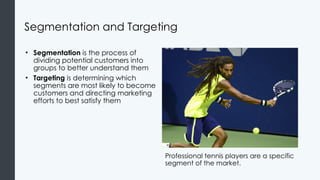
Professional tennis players are a specific
segment of the market.
Five Criteria for a Market
1. There must be a true need and/or want for the product, service, or idea; this
need may be recognized, unrecognized, or latent
2. The person/organization must have the ability to pay for the product via
means acceptable to the marketer
3. The person/organization must be willing to buy the product
4. The person/organization must have the authority to buy the product
5. The total number of people/organizations meeting the previous criteria must
be large enough to be profitable for the marketer
Objectives of Segmentation
• To improve an organization’s understanding of who their prospective
customers are and how to serve them
• To reduce risk in deciding where, when, how, and to whom a product,
service, or brand will be marketed
• To increase marketing efficiency by directing effort toward designated
segment(s) in ways that are consistent with that segment’s characteristics
Practice Question
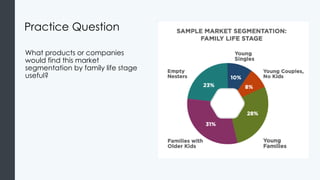
What products or companies
would find this market
segmentation by family life stage
useful?
Choosing a Target Market
The target market should include only
those segments of a market that are
both:
• Profitable to serve
• Likely to be receptive to the
products a company provides
Common Market Segmentation Approaches
Type of Approach Segmentation Criteria
Geographic
Nations, states, regions, cities, neighborhoods, zip codes,
etc.
Demographic
Age, gender, family size, income, occupation, education,
religion, ethnicity, and nationality
Psychographic Lifestyle, personality, attitudes, and social class
Behavioral User status, purchase occasion, loyalty, readiness to buy
Decision maker Decision-making role (purchaser, influencer, etc.)
Common Business Segmentation Approaches
• Organization size: by revenue, number of employees, geographic reach, etc.
• Geography
• Industry
• User status: usage frequency, volume used, loyalty, longevity, products
already in use, readiness to buy, etc.
• Benefits sought
• End use
• Purchasing approaches
Combining Bases for Segmentation
• Geo-cluster approach demographic +
geographic data
• Geographic + behavioral data
• Can point companies toward locations
where customers are clustered
• Demographic + lifestyle or behavioral
segments
Sample Market Segment Profiles
Ideal Market Segment
1. Can be measured
2. Is profitable
3. Is stable
4. Is reachable
5. Is internally homogeneous
6. Is externally heterogeneous
7. Is responsive
8. Is cost-effective
9. Helps determine the marketing mix
Questions to Consider in Selecting a Target
Segment
• Whose needs can you best satisfy?
• Who will be the most profitable customers?
• Can you reach and serve each target segment effectively?
• Are the segments large and profitable enough to support your business?
• Do you have the resources available to effectively reach and serve
each target segment?
Targeting Strategy
Concentration
Only one marketing mix is developed
• Advantage: focus
• Disadvantage if demand in segment declines,
company will suffer
Multi-segment
Marketing mix for each segment
• Advantage: may reach more customers
• Disadvantage: Costs of multiple campaigns and
distribution channels
Targeting Strategies
Strategy Target Market Example
Mass marketing Everybody everywhere Target
Differentiated
marketing
Large groups within the total
market
Costco, Sam’s Club
Niche marketing
High penetration within smaller,
specialized segments
Trader Joe’s, Whole
Foods
Micromarketing
Individual customers or
localized microsegments
Groupon
The Marketing Mix
Shaping Marketing Mix for Target Markets
Marketing
Element
Targeting Criteria
Product What would make the ideal product for your target segment?
What special features or capabilities are critical for this segment?
What unique problems does your product help them solve?
Promotion What are the best ways to get your target segment’s attention?
What do you want this segment to remember about your product?
Place /
Distribution
Where does this segment look or shop for your product?
What is the best way to get your product to your target customers?
Price What price(s) are your target customers willing to pay?
How much is too expensive? How much is too cheap?
Quick Review
• What is the purpose of segmentation and targeting in marketing?
• What are some common segmentation approaches?
• How do businesses select an appropriate segmentation approach and
decide which customer segments to target for marketing activities?
• How does targeting influence each element of the marketing mix?

PrinciplesofMarketing_03_SegmentationandTargeting.pptx

  • 1.
    Principles of Marketing Module3: Segmentation and Targeting
  • 2.
    Segmentation and Targeting •Segmentation is the process of dividing potential customers into groups to better understand them • Targeting is determining which segments are most likely to become customers and directing marketing efforts to best satisfy them Professional tennis players are a specific segment of the market.
  • 3.
    Five Criteria fora Market 1. There must be a true need and/or want for the product, service, or idea; this need may be recognized, unrecognized, or latent 2. The person/organization must have the ability to pay for the product via means acceptable to the marketer 3. The person/organization must be willing to buy the product 4. The person/organization must have the authority to buy the product 5. The total number of people/organizations meeting the previous criteria must be large enough to be profitable for the marketer
  • 4.
    Objectives of Segmentation •To improve an organization’s understanding of who their prospective customers are and how to serve them • To reduce risk in deciding where, when, how, and to whom a product, service, or brand will be marketed • To increase marketing efficiency by directing effort toward designated segment(s) in ways that are consistent with that segment’s characteristics
  • 5.
    Practice Question What productsor companies would find this market segmentation by family life stage useful?
  • 6.
    Choosing a TargetMarket The target market should include only those segments of a market that are both: • Profitable to serve • Likely to be receptive to the products a company provides
  • 7.
    Common Market SegmentationApproaches Type of Approach Segmentation Criteria Geographic Nations, states, regions, cities, neighborhoods, zip codes, etc. Demographic Age, gender, family size, income, occupation, education, religion, ethnicity, and nationality Psychographic Lifestyle, personality, attitudes, and social class Behavioral User status, purchase occasion, loyalty, readiness to buy Decision maker Decision-making role (purchaser, influencer, etc.)
  • 8.
    Common Business SegmentationApproaches • Organization size: by revenue, number of employees, geographic reach, etc. • Geography • Industry • User status: usage frequency, volume used, loyalty, longevity, products already in use, readiness to buy, etc. • Benefits sought • End use • Purchasing approaches
  • 9.
    Combining Bases forSegmentation • Geo-cluster approach demographic + geographic data • Geographic + behavioral data • Can point companies toward locations where customers are clustered • Demographic + lifestyle or behavioral segments
  • 10.
  • 11.
    Ideal Market Segment 1.Can be measured 2. Is profitable 3. Is stable 4. Is reachable 5. Is internally homogeneous 6. Is externally heterogeneous 7. Is responsive 8. Is cost-effective 9. Helps determine the marketing mix
  • 12.
    Questions to Considerin Selecting a Target Segment • Whose needs can you best satisfy? • Who will be the most profitable customers? • Can you reach and serve each target segment effectively? • Are the segments large and profitable enough to support your business? • Do you have the resources available to effectively reach and serve each target segment?
  • 13.
    Targeting Strategy Concentration Only onemarketing mix is developed • Advantage: focus • Disadvantage if demand in segment declines, company will suffer Multi-segment Marketing mix for each segment • Advantage: may reach more customers • Disadvantage: Costs of multiple campaigns and distribution channels
  • 14.
    Targeting Strategies Strategy TargetMarket Example Mass marketing Everybody everywhere Target Differentiated marketing Large groups within the total market Costco, Sam’s Club Niche marketing High penetration within smaller, specialized segments Trader Joe’s, Whole Foods Micromarketing Individual customers or localized microsegments Groupon
  • 15.
  • 16.
    Shaping Marketing Mixfor Target Markets Marketing Element Targeting Criteria Product What would make the ideal product for your target segment? What special features or capabilities are critical for this segment? What unique problems does your product help them solve? Promotion What are the best ways to get your target segment’s attention? What do you want this segment to remember about your product? Place / Distribution Where does this segment look or shop for your product? What is the best way to get your product to your target customers? Price What price(s) are your target customers willing to pay? How much is too expensive? How much is too cheap?
  • 17.
    Quick Review • Whatis the purpose of segmentation and targeting in marketing? • What are some common segmentation approaches? • How do businesses select an appropriate segmentation approach and decide which customer segments to target for marketing activities? • How does targeting influence each element of the marketing mix?

Editor's Notes

  • #1 All text in these slides is taken from https://courses.lumenlearning.com/wmopen-principlesofmarketing/, where it is published under one or more open licenses. All images in these slides are attributed in the notes of the slide on which they appear and licensed as indicated. Cover Image: "Shopping freak." Provided by: freestocks.org. Located at: https://unsplash.com/photos/_3Q3tsJ01nc. Content Type: CC Licensed Content, Shared Previously. License: CC0: No Rights Reserved.
  • #2 2014 US Open (Tennis) - Tournament - Dustin Brown. Authored by: Steven Pisano. Located at: https://www.flickr.com/photos/stevenpisano/15140591721/. License: CC BY: Attribution
  • #5 Answers may vary. McDonald’s is an example in the module. Companies that sell foods, clothes, toys, etc. Hot restaurants might want to capture the young couples and empty nesters. Sample Market Segmentation (Chart). Authored by: Lumen Learning. License: CC BY: Attribution
  • #6 Windsurfing at Gislu00f6vshammar. Authored by: Matthias Weinberger. Located at: https://www.flickr.com/photos/infomastern/10271441954/. License: CC BY-SA: Attribution-ShareAlike
  • #9 Sophie shopping. Authored by: David Veksler. Located at: https://www.flickr.com/photos/heroiclife/15316262230/. License: CC BY-SA: Attribution-ShareAlike
  • #15 Defining the Marketing Mix. Provided by: Lumen Learning. License: CC BY-SA: Attribution-ShareAlike