Segmentation, Targeting,
   and Positioning
      Building the Right
 Relationships with the Right
          Customers
          Chapter 7
Learning Goals
1. Learn the three steps of target marketing,
   market segmentation, target marketing,
   and market positioning
2. Understand the major bases for
   segmenting consumer and business
   marketing strategy
3. Know how companies identify attractive
   market segments and choose target
   marketing strategy
4. Realize how companies position their
   products for maximum competitive
   advantage in the marketplace
                                      7-2
Case Study
           Procter & Gamble

• Sells multiple brands       • Has also identified
  within the same product       different niches within
  category for a variety of     certain segments
  products                    • Product modifications
                                are useful: Tide offers
• Brands feature a              seven different product
  different mix of benefits     formulations to serve
  and appeal to different       different niches’ needs
  segments


                                               7-3
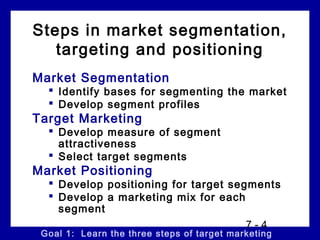
Steps in market segmentation,
   targeting and positioning
Market Segmentation
   Identify bases for segmenting the market
   Develop segment profiles
Target Marketing
   Develop measure of segment
    attractiveness
   Select target segments
Market Positioning
   Develop positioning for target segments
   Develop a marketing mix for each
    segment
                                            7-4
 Goal 1: Learn the three steps of target marketing
Definition
Market Segmentation:
  Dividing a market into distinct
   groups with distinct needs,
   characteristics, or behavior who
   might require separate products or
   marketing mixes.


                                               7-5
  Goal 2: Understand the major bases for segmentation
Segmenting Consumer
       Markets
Geographical segmentation
Demographic segmentation
   Most popular segmentation
Psychographic segmentation
   Lifestyle, social class, and
    personality-based segmentation
Behavioral segmentation

                                               7-6
  Goal 2: Understand the major bases for segmentation
Geographic Segmentation
       Variables
• World region                • Neighborhood
  or country                  • City or
• U.S. region                   metro size
• State                       • Density
• City                        • Climate


                                                7-7
   Goal 2: Understand the major bases for segmentation
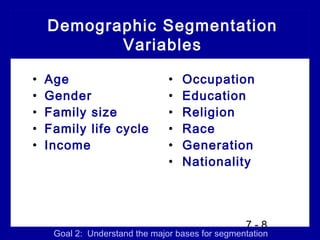
Demographic Segmentation
           Variables

•   Age                         •   Occupation
•   Gender                      •   Education
•   Family size                 •   Religion
•   Family life cycle           •   Race
•   Income                      •   Generation
                                •   Nationality


                                                  7-8
     Goal 2: Understand the major bases for segmentation
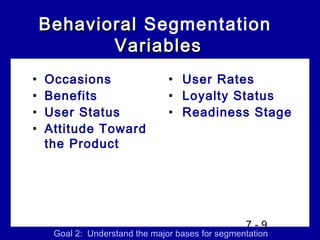
Behavioral Segmentation
           Variables
•   Occasions                   • User Rates
•   Benefits                    • Loyalty Status
•   User Status                 • Readiness Stage
•   Attitude Toward
    the Product


                                                  7-9
     Goal 2: Understand the major bases for segmentation
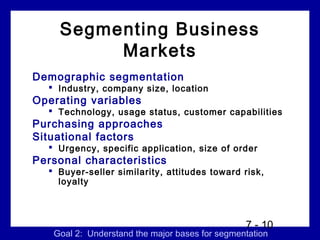
Segmenting Business
         Markets
Demographic segmentation
   Industry, company size, location
Operating variables
   Technology, usage status, customer capabilities
Purchasing approaches
Situational factors
   Urgency, specific application, size of order
Personal characteristics
   Buyer-seller similarity, attitudes toward risk,
    loyalty


                                                7 - 10
   Goal 2: Understand the major bases for segmentation
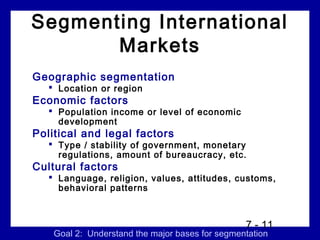
Segmenting International
       Markets
Geographic segmentation
    Location or region
Economic factors
    Population income or level of economic
     development
Political and legal factors
    Type / stability of government, monetary
     regulations, amount of bureaucracy, etc.
Cultural factors
    Language, religion, values, attitudes, customs,
     behavioral patterns


                                                 7 - 11
    Goal 2: Understand the major bases for segmentation
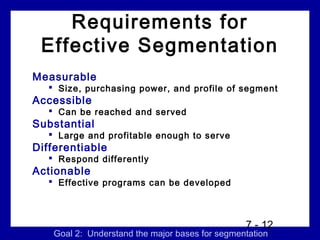
Requirements for
 Effective Segmentation
Measurable
    Size, purchasing power, and profile of segment
Accessible
    Can be reached and served
Substantial
    Large and profitable enough to serve
Differentiable
    Respond differently
Actionable
    Effective programs can be developed


                                                 7 - 12
    Goal 2: Understand the major bases for segmentation
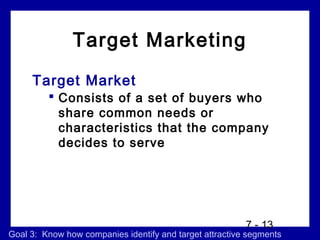
Target Marketing
     Target Market
          Consists of a set of buyers who
           share common needs or
           characteristics that the company
           decides to serve


                                                         7 - 13
Goal 3: Know how companies identify and target attractive segments
Target Marketing
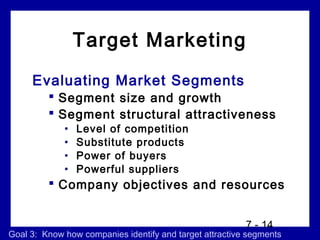
     Evaluating Market Segments
          Segment size and growth
          Segment structural attractiveness
             •   Level of competition
             •   Substitute products
             •   Power of buyers
             •   Powerful suppliers
          Company objectives and resources


                                                         7 - 14
Goal 3: Know how companies identify and target attractive segments
Target Marketing
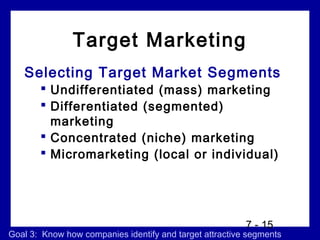
   Selecting Target Market Segments
        Undifferentiated (mass) marketing
        Differentiated (segmented)
         marketing
        Concentrated (niche) marketing
        Micromarketing (local or individual)


                                                         7 - 15
Goal 3: Know how companies identify and target attractive segments
Choosing a Target
             Marketing Strategy
     Considerations include:
            Company resources
            The degree of product variability
            Product’s life-cycle stage
            Market variability
            Competitors’ marketing strategies


                                                         7 - 16
Goal 3: Know how companies identify and target attractive segments
Target Marketing
     Socially Responsible Targeting
          Some segments, especially
           children, are at special risk
          Many potential abuses on the
           Internet, including fraud Internet
           shoppers
          Controversy occurs when the
           methods used are questionable

                                                         7 - 17
Goal 3: Know how companies identify and target attractive segments
Positioning
Positioning:
   The place the product occupies in
    consumers’ minds relative to competing
    products.
   Typically defined by consumers on the
    basis of important attributes.
   Involves implanting the brand’s unique
    benefits and differentiation in the
    customer’s mind.
   Positioning maps that plot perceptions of
    brands are commonly used.

                                                 7 - 18
  Goal 4: Realize how companies position their products
Choosing a Positioning
         Strategy
      Topics                     Differentiation can be based
                                 on
Identifying possible                    Products
                                        Services
competitive advantages                  Channels
Choosing the right                      People
                                        Image
competitive advantage
Choosing a positioning
strategy


                                                    7 - 19
     Goal 4: Realize how companies position their products
Market Segmentation
        Topics                   • How many differences to
                                    promote?
                                      Unique selling
Identifying possible                   proposition
competitive advantages                Several benefits
Choosing the right               • Which differences to
competitive advantage               promote? Criteria include:
Choosing a positioning                Important
                                      Distinctive
strategy
                                      Superior
                                      Communicable
                                      Preemptive
                                      Affordable
                                      Profitable
                                                      7 - 20
      Goal 4: Realize how companies position their products
Market Segmentation
      Topics                     •   Value propositions
                                     represent the full
Identifying possible                 positioning of the brand
competitive advantages           •   Possible value
Choosing the right                   propositions:
competitive advantage                  More for More
                                       More for the Same
Choosing a positioning
                                       More for Less
strategy
                                       The Same for Less
                                       Less for Much Less


                                                    7 - 21
     Goal 4: Realize how companies position their products
Developing a
   Positioning Statement
Positioning statements summarize
the company or brand positioning
   EXAMPLE: To (target segment and
    need) our (brand) is (concept) that
    (point-of-difference)


                                                 7 - 22
  Goal 4: Realize how companies position their products
Communicating the
       Positioning
Companies must be certain to
DELIVER their value propositions.
Positions must be monitored and
adapted over time.


                                                 7 - 23
  Goal 4: Realize how companies position their products

Segmentation, positioning, targeting

  • 1.
    Segmentation, Targeting, and Positioning Building the Right Relationships with the Right Customers Chapter 7
  • 2.
    Learning Goals 1. Learnthe three steps of target marketing, market segmentation, target marketing, and market positioning 2. Understand the major bases for segmenting consumer and business marketing strategy 3. Know how companies identify attractive market segments and choose target marketing strategy 4. Realize how companies position their products for maximum competitive advantage in the marketplace 7-2
  • 3.
    Case Study Procter & Gamble • Sells multiple brands • Has also identified within the same product different niches within category for a variety of certain segments products • Product modifications are useful: Tide offers • Brands feature a seven different product different mix of benefits formulations to serve and appeal to different different niches’ needs segments 7-3
  • 4.
    Steps in marketsegmentation, targeting and positioning Market Segmentation  Identify bases for segmenting the market  Develop segment profiles Target Marketing  Develop measure of segment attractiveness  Select target segments Market Positioning  Develop positioning for target segments  Develop a marketing mix for each segment 7-4 Goal 1: Learn the three steps of target marketing
  • 5.
    Definition Market Segmentation: Dividing a market into distinct groups with distinct needs, characteristics, or behavior who might require separate products or marketing mixes. 7-5 Goal 2: Understand the major bases for segmentation
  • 6.
    Segmenting Consumer Markets Geographical segmentation Demographic segmentation  Most popular segmentation Psychographic segmentation  Lifestyle, social class, and personality-based segmentation Behavioral segmentation 7-6 Goal 2: Understand the major bases for segmentation
  • 7.
    Geographic Segmentation Variables • World region • Neighborhood or country • City or • U.S. region metro size • State • Density • City • Climate 7-7 Goal 2: Understand the major bases for segmentation
  • 8.
    Demographic Segmentation Variables • Age • Occupation • Gender • Education • Family size • Religion • Family life cycle • Race • Income • Generation • Nationality 7-8 Goal 2: Understand the major bases for segmentation
  • 9.
    Behavioral Segmentation Variables • Occasions • User Rates • Benefits • Loyalty Status • User Status • Readiness Stage • Attitude Toward the Product 7-9 Goal 2: Understand the major bases for segmentation
  • 10.
    Segmenting Business Markets Demographic segmentation  Industry, company size, location Operating variables  Technology, usage status, customer capabilities Purchasing approaches Situational factors  Urgency, specific application, size of order Personal characteristics  Buyer-seller similarity, attitudes toward risk, loyalty 7 - 10 Goal 2: Understand the major bases for segmentation
  • 11.
    Segmenting International Markets Geographic segmentation  Location or region Economic factors  Population income or level of economic development Political and legal factors  Type / stability of government, monetary regulations, amount of bureaucracy, etc. Cultural factors  Language, religion, values, attitudes, customs, behavioral patterns 7 - 11 Goal 2: Understand the major bases for segmentation
  • 12.
    Requirements for EffectiveSegmentation Measurable  Size, purchasing power, and profile of segment Accessible  Can be reached and served Substantial  Large and profitable enough to serve Differentiable  Respond differently Actionable  Effective programs can be developed 7 - 12 Goal 2: Understand the major bases for segmentation
  • 13.
    Target Marketing Target Market  Consists of a set of buyers who share common needs or characteristics that the company decides to serve 7 - 13 Goal 3: Know how companies identify and target attractive segments
  • 14.
    Target Marketing Evaluating Market Segments  Segment size and growth  Segment structural attractiveness • Level of competition • Substitute products • Power of buyers • Powerful suppliers  Company objectives and resources 7 - 14 Goal 3: Know how companies identify and target attractive segments
  • 15.
    Target Marketing Selecting Target Market Segments  Undifferentiated (mass) marketing  Differentiated (segmented) marketing  Concentrated (niche) marketing  Micromarketing (local or individual) 7 - 15 Goal 3: Know how companies identify and target attractive segments
  • 16.
    Choosing a Target Marketing Strategy Considerations include:  Company resources  The degree of product variability  Product’s life-cycle stage  Market variability  Competitors’ marketing strategies 7 - 16 Goal 3: Know how companies identify and target attractive segments
  • 17.
    Target Marketing Socially Responsible Targeting  Some segments, especially children, are at special risk  Many potential abuses on the Internet, including fraud Internet shoppers  Controversy occurs when the methods used are questionable 7 - 17 Goal 3: Know how companies identify and target attractive segments
  • 18.
    Positioning Positioning: The place the product occupies in consumers’ minds relative to competing products.  Typically defined by consumers on the basis of important attributes.  Involves implanting the brand’s unique benefits and differentiation in the customer’s mind.  Positioning maps that plot perceptions of brands are commonly used. 7 - 18 Goal 4: Realize how companies position their products
  • 19.
    Choosing a Positioning Strategy Topics Differentiation can be based on Identifying possible  Products  Services competitive advantages  Channels Choosing the right  People  Image competitive advantage Choosing a positioning strategy 7 - 19 Goal 4: Realize how companies position their products
  • 20.
    Market Segmentation Topics • How many differences to promote?  Unique selling Identifying possible proposition competitive advantages  Several benefits Choosing the right • Which differences to competitive advantage promote? Criteria include: Choosing a positioning  Important  Distinctive strategy  Superior  Communicable  Preemptive  Affordable  Profitable 7 - 20 Goal 4: Realize how companies position their products
  • 21.
    Market Segmentation Topics • Value propositions represent the full Identifying possible positioning of the brand competitive advantages • Possible value Choosing the right propositions: competitive advantage  More for More  More for the Same Choosing a positioning  More for Less strategy  The Same for Less  Less for Much Less 7 - 21 Goal 4: Realize how companies position their products
  • 22.
    Developing a Positioning Statement Positioning statements summarize the company or brand positioning  EXAMPLE: To (target segment and need) our (brand) is (concept) that (point-of-difference) 7 - 22 Goal 4: Realize how companies position their products
  • 23.
    Communicating the Positioning Companies must be certain to DELIVER their value propositions. Positions must be monitored and adapted over time. 7 - 23 Goal 4: Realize how companies position their products