WELCOME
A SUMMER TRAINING IN
DELHI METRO RAIL CORPORATION LTD
ON
CAPITAL BUDGETING
.MASTER OF BUSINESS ADMINISTRATION
(MBA)
PRESENTED BY :
Manish
MBA FINANCE
TABLE OF CONTENTS
• About the industry
• Delhi Metro
• Vision & Mission
• Organisation Structure
• SWOT analysis
• Capital budgeting
• Data interpretation & analysis
• Queries
ABOUT THE INDUSTRY
• Start – 1890
• Country – London
• Longest Metro – Shanghai Metro (588 KM)
• Largest Metro – Shanghai (364 Stations)
• India’s Oldest Metro – Kolkata Metro (1984)
ABOUT DMRC
Particulars Detail
Registration Date 3rd May , 1995
Name of the Company Delhi Metro Rail Corporation Ltd.
Act Companies Act , 1956
Whether listed or not No
Status Joint Venture Company
Chairman Shri Rajiv Gauba
M.D. Shri Mangu Singh
First M.D. Dr. E. Sreedharan
Finance Director Shri K.K. Saberwal
E.D. Finance Shri Anand Kumar Garg
Email www.delhimetrorail.com
INTRODUCTION
• For implementation and subsequent operation of
Delhi MRTS , a company under the name “DELHI
METRO RAIL CORPORATION” was registered
on 03-05—1995 under the Companies Act, 1956
with equal participation of GNCTD and GOI to
implement the dream of construction and operation of
a world class MRTS.
HISTORY
• The concept of a mass rapid transit for New Delhi first
emerged from traffic and travel characteristics study
which was carried out in the city in 1969. over the next
several years, many official committees by a variety of
government departments were commissioned to examine
issues related to technology, route alignment, and
government jurisdiction. In 1984, the Delhi Development
Authority(DDA) and the Urban Arts Commission came
up with a proposal for developing a multi-modal transport
system, which would consist of constructing three
underground mass rapid transit corridors as well
augmenting the city’s existing suburban railway and
road transport networks.
INTRODUCTION TO DMRC
• The Delhi Metro is a metro system serving Delhi and its
satellite cities of Faridabad, Guru gram , Noida and Ghaziabad
in NCR in India. DMRC Ltd. , a state-owned company with
equal equity participation from Government of India and
Government of Delhi , built and operates the Delhi Metro.
o 12th longest metro system
o 16th largest in ridership
o Five-color coded lines and one Faster Airport Express line
o Total length – 218 KM
o 164 stations (including 6 on Airport Express Line)
o Power supplied – 25 KV
o 3,000 trips per day
o 2.76 million passengers per day
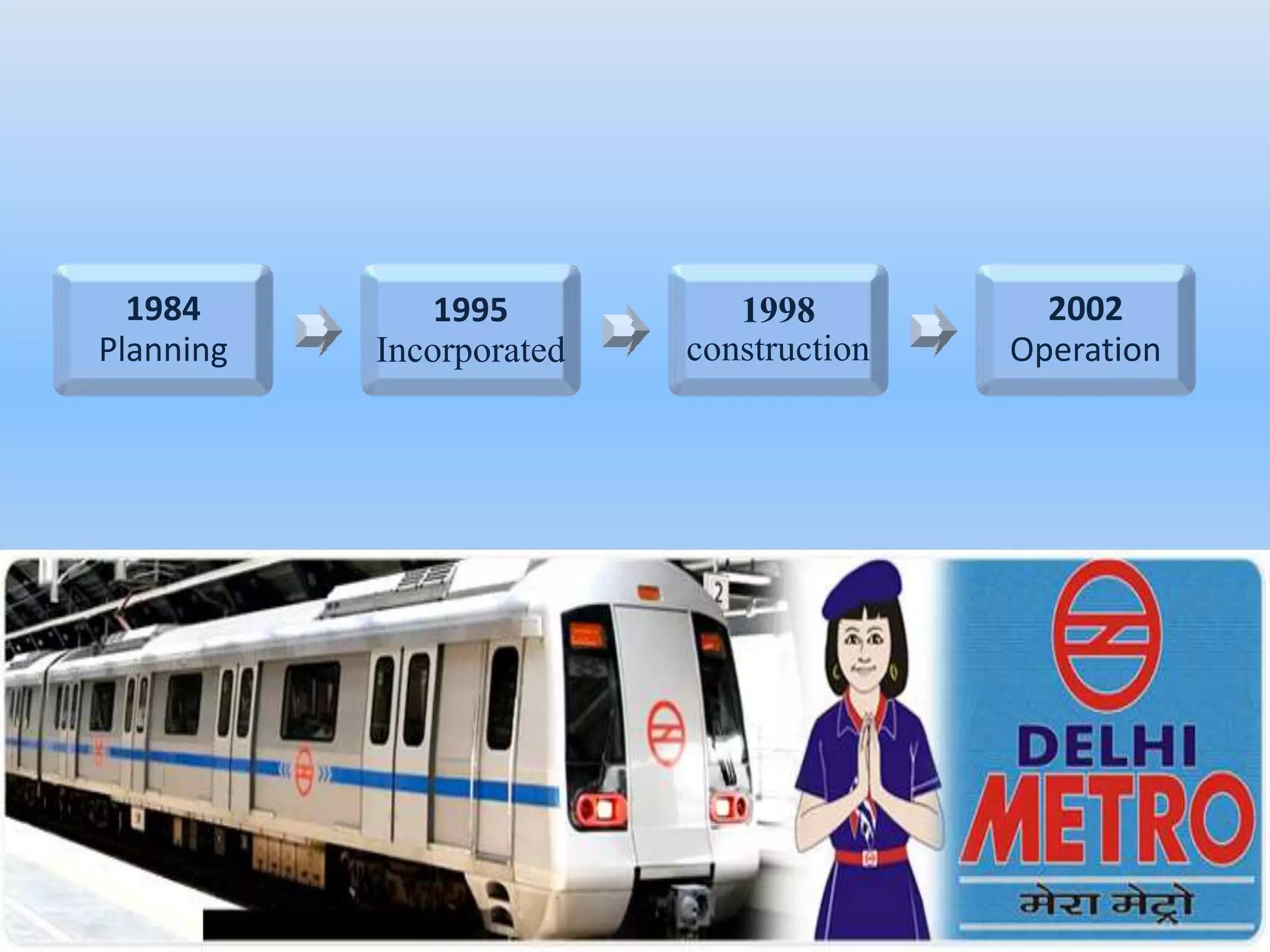
1984
Planning
1995
Incorporated
1998
construction
2002
Operation
VISION & MISSION
 VISION :- Customer’s delight.
 MISSION :-
• To cover the whole of Delhi & adjoining areas
• To serve customers including ‘differently abled’
• The image of being Number One in the transportation Sector in India and
to be among the Top 3 Metro Rail systems in Asia, with regard to :
• Safety
• Reliability
• Punctuality
• Quality and
• Responsiveness to customers
 To make Delhi-Metro self-sustainable
WHAT IS MRTS ?
An urban passenger transportation system using surface,
elevated or underground railway systems or some combination
of these; capable of moving large number of passengers in a
single train.
FUNDING AND CAPITALISATION
• DMRC is owned equally by the Delhi Government
and the Government of India. Share %
JICA Loan
GNCTD Equity
GOOI Equity
Land and Central
Tax
PD by DMRC
Grant
48.57%
10.04%
10.04%
13.39%
7.34%
10.62%
ORGANIZATION STRUCTURE OF
DMRC
BOARD OF DIRECTOR
CHAIRMAN
MANAGING DIRECTOR
DIRECTORS
HOD's
DEPUTY HOD's
MANAGER
ASSISTANT MANAGER
NON - EXECUTIVE
SOP’s of DIFFERENT
AUTHORITIES IN FINANCIAL
MATTERS
In case of Project Matters
In case of O&M Matters
PROJECT MATTERS
S. No. Item Director (F) HOD(F) D.HOD(F) A.M./Mana
ger
1 Opening current
bank account
Full powers Nil Nil Nil
2 Authorization to
operate bank
account
Full powers Nil Nil Nil
3 Authorization of
payment in each
case
Full powers Full powers Full powers Upto Rs. 2 lakhs
4 Vetting of
financial
proposals/
indent/
purchase orders
Full powers Full powers Full powers Upto Rs. 2 lakhs
O&M MATTERS
S.
No.
Item Director (F) FA & CAO Dy. FA
&CAO
SAO &
AAO
1 Opening
current bank
account
Full powers Nil Nil Nil
2 Authorization
to operate bank
account
Full powers Nil Nil Nil
3 Authorization
of payment in
each case
Full powers Full powers Full powers Upto Rs. 2
lakhs
4 Vetting of
financial
proposals/
indent/
purchase orders
Full powers Full powers Full powers Upto Rs. 2
lakhs
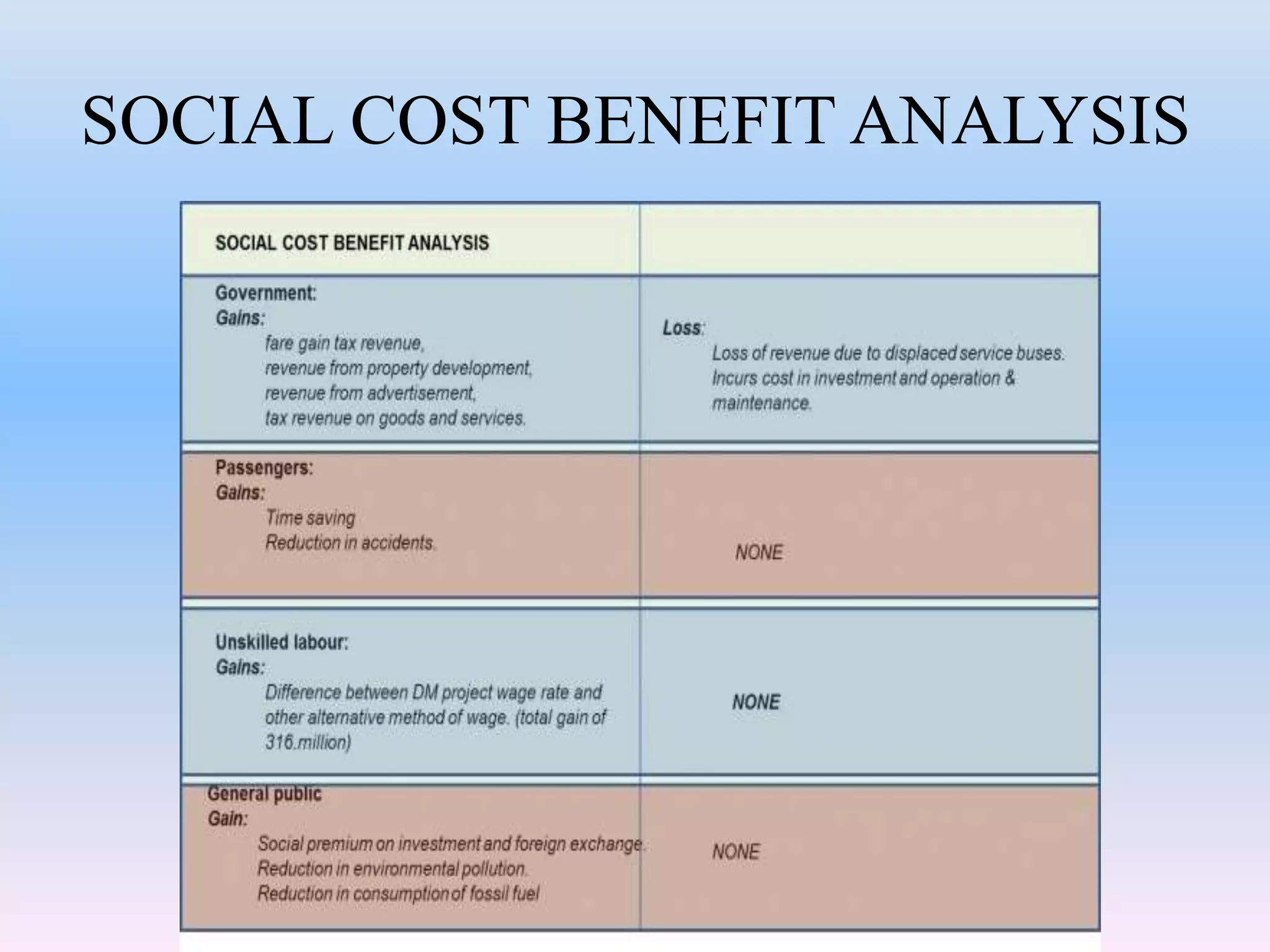
SOCIAL COST BENEFIT ANALYSIS
SWOT ANALYSIS
 STRENGTHS :-
• Certified by the UN to get carbon credits for reducing greenhouse gas emissions.
• Entry and exit doors
• Monopoly
• Reducing traffic and pollution
• Carries approx 2.7 million passengers daily
• Connectivity of 200 KM approx
 WEAKNESSES :-
• Too much cost
• Difficulties while acquiring land.
 OPPORTUNITIES :-
• Increasing demand for public transport.
• No close substitute.
 THREATS :-
• Less infrastructure
• Threat of security
MY LEARNING
Tenders of DMRC
Open Tender
Limited Tender
Single Tender
Contract payment/Milestone bills
VAT- vary (UP VAT – 4%, Haryana VAT – 4%, Delhi
VAT – 5%)
DVAT Re-imbursement – it is exclusive from
contract payment and refundable by Delhi Govt.
CAPITAL BUDGETING
A capital budgeting decision may be defined as the firm’s decision
to invest its current funds most efficiently in the long-term assets in
anticipation of an expected flow of benefits over a series of years.
The long-term assets are those that affect the firm’s operations
beyond the one-year period. The firm’s investment decisions should
generally include expansion, acquisition, modernization and
replacement of the long-term assets. Sale of a division or
business(divestment) is also as an investment decision. Decisions
like the change in the methods of sales distribution, or an
advertisement campaign or a research and a development
programme have long-term implications for the firm’s expenditures
and benefits, and therefore, they should also be evaluated as
investment decisions. It is important to note that investment in the
long-term assets invariably requires large funds to be tied up in the
current assets such as inventories and receivables. As such,
investment in fixed and current assets is one single activity.
INVESTMENT DECISION RULE
The investment decision rules may be referred to as capital budgeting
techniques, or investment criteria. A sound appraisal technique should be
used to measure the economic worth of an investment project. The
essential property of a sound technique is that it should maximize the
shareholders wealth. The following other characteristics should also be
possessed by a sound investment evaluation criterion.
• It should consider all cash flows to determine the true profitability of the
project.
• It should provide for an objective and unambiguous way of separating
good projects from bad projects.
• It should help ranking of projects according to their true profitability.
• It should recognize the fact that bigger cash flows are preferable to
smaller ones and early cash flows are preferable to later ones.
• It should help to choose among mutually exclusive projects that project
which maximizes the shareholders wealth.
• It should be a criterion which is applicable to any conceivable investment
project, independent of others.
EVALUATION CRITERIA
A number of investment criteria (or capital budgeting techniques) are
in use in practice. They may be grouped in the following two
categories:
 Discounted Cash Flow(DCF) Criteria
• Net Present Value(NPV)
• Internal Rate Of Return(IRR)
• Profitability Index
 Non-Discounted Cash Flow Technique
• Payback (PB)
• Discounted Payback
• Accounting Rate Of Return (ARR)
 NPV
The NPV method is the classic economic method of evaluating the
investment proposals .It is a DCF technique that explicitly recognizes the
time value of money. It correctly postulates that cash flow arising at
different time periods differ in value and are comparable only when their
equivalents-present values-are found.
 IRR
The internal rate of return (IRR) method is another discounted cash flow
technique, which takes account of the magnitude and timing of cash flows.
Other terms used to describe the IRR method are yield on an investment,
marginal efficiency of capital, rate of return over cost, time-adjusted rate of
internal return and so on. The concept of internal rate of return is quite
simple to understand in the case of a one-period project.
 PROFITABILITY INDEX
Yet another time-adjusted method of evaluating the investment proposals is
the benefit – cost (B/C) ratio or profitability index (PI). Profitability Index
is the ratio of the present value of cash inflows, as the required rate of
return, to the initial cash outflow of the investment.
 PAYBACK PERIOD METHOD
The payback is one of the most popular and widely recognized traditional
methods of evaluating investment proposals. Payback is the number of
years required to recover the original cash outlay invested in a project. If
the project generates constant annual cash inflows, the payback period can
be computed by dividing cash outlay by the annual cash inflow.
 ACCOUNTING RATE OF RETURN
The accounting rate of return is also known as the return on investment
(ROI), uses accounting information, as revealed by financial statements, to
measure the profitability of an investment. The accounting rate of return is
the ratio of the average after tax profit divided by the average investment.
The average investment would be equal to half of the original investment if
it were depreciated constantly. Alternatively, it can be found out by
dividing the total of the investment’s book value after depreciation by the
life of the project.
DATA COLLECTION
• Primary Sources
Data are collected through personal discussion with
Finance- Executive.
Data are collected through personal discussion with
Finance-Assistant Manager.
• Secondary Sources
Data are collected from the company’s website.
Detailed Project Report Phase-IV of DMRC.
TOOLS USED IN THE ANALYSIS
• NPV
• IRR
DATA ANALYSIS AND
INTERPRETATION
 NPV :-
The NPV method is the classic economic method of
evaluating the investment proposals. It is a DCF
technique that explicitly recognizes the time value of
money. It correctly postulates that cash flow arising at
different time periods differ in value and are comparable
only when their equivalents-present values-are found.
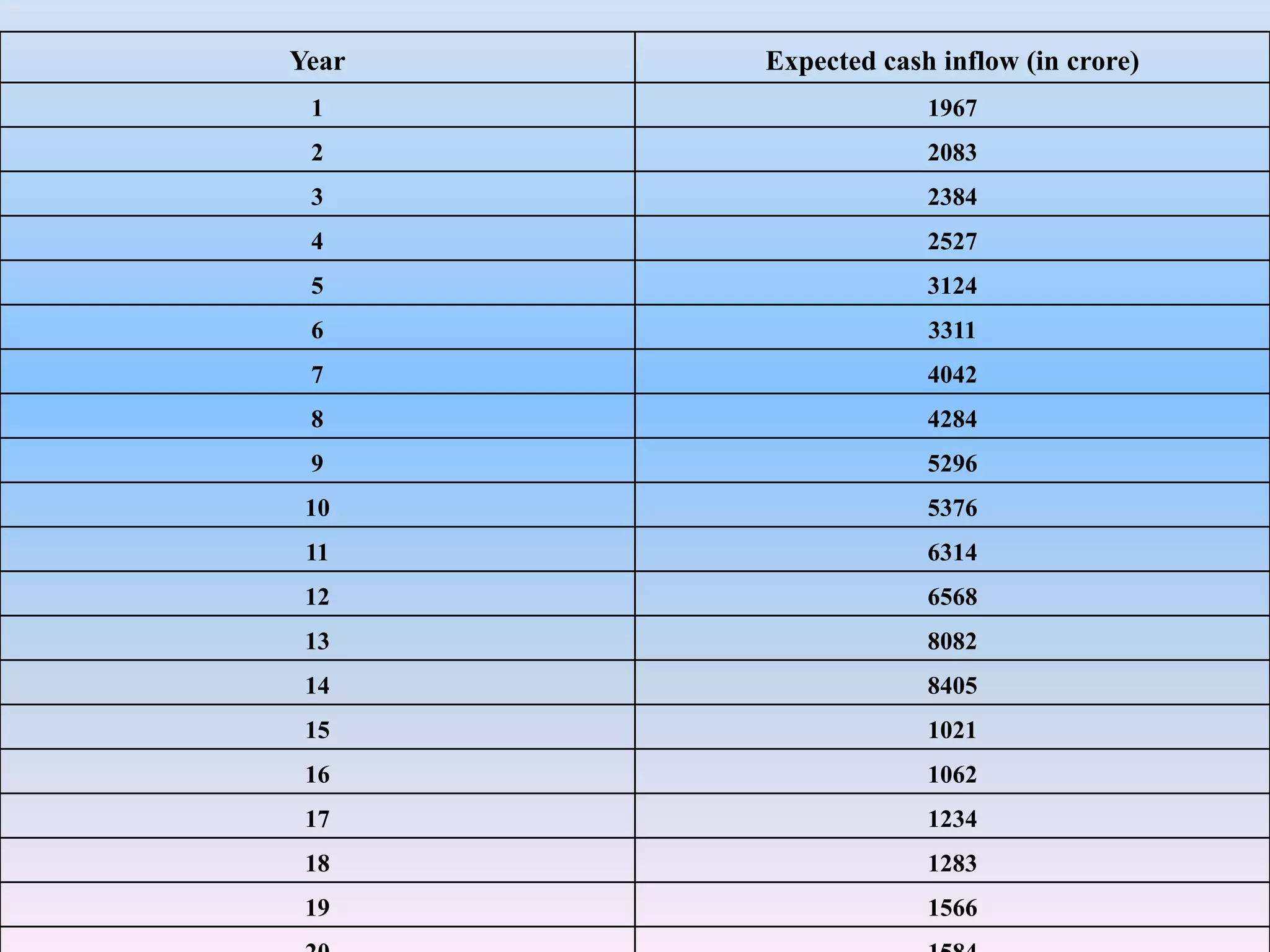
 The cash outflow of the DMRC Phase-IV project is
rupees 41,600 crore. The project is expected to generate
the following net cash flow for the next 20 years :
Year Expected cash inflow (in crore)
1 1967
2 2083
3 2384
4 2527
5 3124
6 3311
7 4042
8 4284
9 5296
10 5376
11 6314
12 6568
13 8082
14 8405
15 1021
16 1062
17 1234
18 1283
19 1566
Calculation of NPV :
NPV =
-
Year Cash inflow (in
crore)
PVFit PV
1 1967 0.952 1872.58
2 2083 0.907 1889.28
3 2384 0.864 2059.77
4 2527 0.823 2079.72
5 3124 0.784 2449.22
6 3311 0.746 2470
7 4042 0.711 2873.86
8 4284 0.677 2900.27
9 5296 0.645 3415.92
10 5376 0.614 3300.86
11 6314 0.585 3693.7
12 6568 0.557 3658.37
13 8082 0.530 4283.46
14 8405 0.505 4244.52
15 1021 0.481 491.1
16 1062 0.458 486.39
17 1234 0.436 538.02
18 1283 0.416 533.73
19 1566 0.396 620.13
20 1584 0.377 597.16
Total 44458.06
NPV = PV – Initial Investment
= 44458 – 41600
= 2858 (Rupees in crore)
ANALYSIS & INTERPRETATION
The calculation above is based on the assumption that
the firm chooses to receive the cash benefit resulting
from the investment in the year it is made. The NPV of
the project is positive or greater than 0, the project
would be accepted.
IRR
The internal rate of return (IRR) method is another discounted cash
flow technique, which takes account of the magnitude and timing of
cash flows. It is that discount rate which makes NPV zero. Other terms
used to describe the IRR method are yield on an investment, marginal
efficiency of capital, rate of return over cost, time-adjusted rate of
internal return and so on. The concept of internal rate of return is quite
simple to understand in the case of a one-period project
ACCEPTANCE RULE
•Accept the project if IRR is greater than opportunity cost of
capital,
IRR > k
•Reject the project if IRR is less than opportunity cost of capital,
IRR < k
•May accept the project when IRR is equal to opportunity cost of
capital,
IRR = k
Now we calculate the IRR of the same project mentioned in
the previous cash flows of the project.
If the cost of capital is 5%, then calculate the IRR of the
project.
We can calculate the IRR of the project by the Trial & Error
method.
PV of the project when the Cost Of Capital is 5% =
44458(Rupees in crore.
Let us assume that Cost of Capital is 6%, then PV of the
project will be:
Year Cash inflow (in crore) PVFit PV
1 1967 0.943 1854.88
2 2083 0.890 1853.87
3 2384 0.840 2002.56
4 2527 0.792 2001.38
5 3124 0.747 2333.62
6 3311 0.705 2334.25
7 4042 0.665 2687.93
8 4284 0.627 2686.06
9 5296 0.592 2870.43
10 5376 0.558 2999.80
11 6314 0.527 3327.47
12 6568 0.497 3264.29
13 8082 0.469 3790.45
14 8405 0.442 3716.33
15 1021 0.417 425.75
16 1062 0.394 418.43
17 1234 0.371 457.81
18 1283 0.350 449.05
19 1566 0.331 518.35
IRR = LR + (HR - LR) ( ) = 5+ (6-5)
= 5.71
The IRR of the project is 5.71%.
ANALYSIS & INTERPRETATION
The above calculation is based on the assumption and is
calculated by the Trial & Error method. By this method,
the IRR of the project is 5.71% or greater than the cost
of capital. So, the project may be accepted by the
company.
Capital budgeting

Capital budgeting

  • 1.
  • 2.
    A SUMMER TRAININGIN DELHI METRO RAIL CORPORATION LTD ON CAPITAL BUDGETING .MASTER OF BUSINESS ADMINISTRATION (MBA) PRESENTED BY : Manish MBA FINANCE
  • 3.
    TABLE OF CONTENTS •About the industry • Delhi Metro • Vision & Mission • Organisation Structure • SWOT analysis • Capital budgeting • Data interpretation & analysis • Queries
  • 4.
    ABOUT THE INDUSTRY •Start – 1890 • Country – London • Longest Metro – Shanghai Metro (588 KM) • Largest Metro – Shanghai (364 Stations) • India’s Oldest Metro – Kolkata Metro (1984)
  • 6.
    ABOUT DMRC Particulars Detail RegistrationDate 3rd May , 1995 Name of the Company Delhi Metro Rail Corporation Ltd. Act Companies Act , 1956 Whether listed or not No Status Joint Venture Company Chairman Shri Rajiv Gauba M.D. Shri Mangu Singh First M.D. Dr. E. Sreedharan Finance Director Shri K.K. Saberwal E.D. Finance Shri Anand Kumar Garg Email www.delhimetrorail.com
  • 7.
    INTRODUCTION • For implementationand subsequent operation of Delhi MRTS , a company under the name “DELHI METRO RAIL CORPORATION” was registered on 03-05—1995 under the Companies Act, 1956 with equal participation of GNCTD and GOI to implement the dream of construction and operation of a world class MRTS.
  • 8.
    HISTORY • The conceptof a mass rapid transit for New Delhi first emerged from traffic and travel characteristics study which was carried out in the city in 1969. over the next several years, many official committees by a variety of government departments were commissioned to examine issues related to technology, route alignment, and government jurisdiction. In 1984, the Delhi Development Authority(DDA) and the Urban Arts Commission came up with a proposal for developing a multi-modal transport system, which would consist of constructing three underground mass rapid transit corridors as well augmenting the city’s existing suburban railway and road transport networks.
  • 9.
    INTRODUCTION TO DMRC •The Delhi Metro is a metro system serving Delhi and its satellite cities of Faridabad, Guru gram , Noida and Ghaziabad in NCR in India. DMRC Ltd. , a state-owned company with equal equity participation from Government of India and Government of Delhi , built and operates the Delhi Metro. o 12th longest metro system o 16th largest in ridership o Five-color coded lines and one Faster Airport Express line o Total length – 218 KM o 164 stations (including 6 on Airport Express Line) o Power supplied – 25 KV o 3,000 trips per day o 2.76 million passengers per day
  • 10.
  • 11.
    VISION & MISSION VISION :- Customer’s delight.  MISSION :- • To cover the whole of Delhi & adjoining areas • To serve customers including ‘differently abled’ • The image of being Number One in the transportation Sector in India and to be among the Top 3 Metro Rail systems in Asia, with regard to : • Safety • Reliability • Punctuality • Quality and • Responsiveness to customers  To make Delhi-Metro self-sustainable
  • 12.
    WHAT IS MRTS? An urban passenger transportation system using surface, elevated or underground railway systems or some combination of these; capable of moving large number of passengers in a single train.
  • 14.
    FUNDING AND CAPITALISATION •DMRC is owned equally by the Delhi Government and the Government of India. Share % JICA Loan GNCTD Equity GOOI Equity Land and Central Tax PD by DMRC Grant 48.57% 10.04% 10.04% 13.39% 7.34% 10.62%
  • 15.
    ORGANIZATION STRUCTURE OF DMRC BOARDOF DIRECTOR CHAIRMAN MANAGING DIRECTOR DIRECTORS HOD's DEPUTY HOD's MANAGER ASSISTANT MANAGER NON - EXECUTIVE
  • 16.
    SOP’s of DIFFERENT AUTHORITIESIN FINANCIAL MATTERS In case of Project Matters In case of O&M Matters
  • 17.
    PROJECT MATTERS S. No.Item Director (F) HOD(F) D.HOD(F) A.M./Mana ger 1 Opening current bank account Full powers Nil Nil Nil 2 Authorization to operate bank account Full powers Nil Nil Nil 3 Authorization of payment in each case Full powers Full powers Full powers Upto Rs. 2 lakhs 4 Vetting of financial proposals/ indent/ purchase orders Full powers Full powers Full powers Upto Rs. 2 lakhs
  • 18.
    O&M MATTERS S. No. Item Director(F) FA & CAO Dy. FA &CAO SAO & AAO 1 Opening current bank account Full powers Nil Nil Nil 2 Authorization to operate bank account Full powers Nil Nil Nil 3 Authorization of payment in each case Full powers Full powers Full powers Upto Rs. 2 lakhs 4 Vetting of financial proposals/ indent/ purchase orders Full powers Full powers Full powers Upto Rs. 2 lakhs
  • 19.
  • 20.
    SWOT ANALYSIS  STRENGTHS:- • Certified by the UN to get carbon credits for reducing greenhouse gas emissions. • Entry and exit doors • Monopoly • Reducing traffic and pollution • Carries approx 2.7 million passengers daily • Connectivity of 200 KM approx  WEAKNESSES :- • Too much cost • Difficulties while acquiring land.  OPPORTUNITIES :- • Increasing demand for public transport. • No close substitute.  THREATS :- • Less infrastructure • Threat of security
  • 21.
    MY LEARNING Tenders ofDMRC Open Tender Limited Tender Single Tender Contract payment/Milestone bills VAT- vary (UP VAT – 4%, Haryana VAT – 4%, Delhi VAT – 5%) DVAT Re-imbursement – it is exclusive from contract payment and refundable by Delhi Govt.
  • 22.
    CAPITAL BUDGETING A capitalbudgeting decision may be defined as the firm’s decision to invest its current funds most efficiently in the long-term assets in anticipation of an expected flow of benefits over a series of years. The long-term assets are those that affect the firm’s operations beyond the one-year period. The firm’s investment decisions should generally include expansion, acquisition, modernization and replacement of the long-term assets. Sale of a division or business(divestment) is also as an investment decision. Decisions like the change in the methods of sales distribution, or an advertisement campaign or a research and a development programme have long-term implications for the firm’s expenditures and benefits, and therefore, they should also be evaluated as investment decisions. It is important to note that investment in the long-term assets invariably requires large funds to be tied up in the current assets such as inventories and receivables. As such, investment in fixed and current assets is one single activity.
  • 23.
    INVESTMENT DECISION RULE Theinvestment decision rules may be referred to as capital budgeting techniques, or investment criteria. A sound appraisal technique should be used to measure the economic worth of an investment project. The essential property of a sound technique is that it should maximize the shareholders wealth. The following other characteristics should also be possessed by a sound investment evaluation criterion. • It should consider all cash flows to determine the true profitability of the project. • It should provide for an objective and unambiguous way of separating good projects from bad projects. • It should help ranking of projects according to their true profitability. • It should recognize the fact that bigger cash flows are preferable to smaller ones and early cash flows are preferable to later ones. • It should help to choose among mutually exclusive projects that project which maximizes the shareholders wealth. • It should be a criterion which is applicable to any conceivable investment project, independent of others.
  • 24.
    EVALUATION CRITERIA A numberof investment criteria (or capital budgeting techniques) are in use in practice. They may be grouped in the following two categories:  Discounted Cash Flow(DCF) Criteria • Net Present Value(NPV) • Internal Rate Of Return(IRR) • Profitability Index  Non-Discounted Cash Flow Technique • Payback (PB) • Discounted Payback • Accounting Rate Of Return (ARR)
  • 25.
     NPV The NPVmethod is the classic economic method of evaluating the investment proposals .It is a DCF technique that explicitly recognizes the time value of money. It correctly postulates that cash flow arising at different time periods differ in value and are comparable only when their equivalents-present values-are found.  IRR The internal rate of return (IRR) method is another discounted cash flow technique, which takes account of the magnitude and timing of cash flows. Other terms used to describe the IRR method are yield on an investment, marginal efficiency of capital, rate of return over cost, time-adjusted rate of internal return and so on. The concept of internal rate of return is quite simple to understand in the case of a one-period project.  PROFITABILITY INDEX Yet another time-adjusted method of evaluating the investment proposals is the benefit – cost (B/C) ratio or profitability index (PI). Profitability Index is the ratio of the present value of cash inflows, as the required rate of return, to the initial cash outflow of the investment.
  • 26.
     PAYBACK PERIODMETHOD The payback is one of the most popular and widely recognized traditional methods of evaluating investment proposals. Payback is the number of years required to recover the original cash outlay invested in a project. If the project generates constant annual cash inflows, the payback period can be computed by dividing cash outlay by the annual cash inflow.  ACCOUNTING RATE OF RETURN The accounting rate of return is also known as the return on investment (ROI), uses accounting information, as revealed by financial statements, to measure the profitability of an investment. The accounting rate of return is the ratio of the average after tax profit divided by the average investment. The average investment would be equal to half of the original investment if it were depreciated constantly. Alternatively, it can be found out by dividing the total of the investment’s book value after depreciation by the life of the project.
  • 27.
    DATA COLLECTION • PrimarySources Data are collected through personal discussion with Finance- Executive. Data are collected through personal discussion with Finance-Assistant Manager. • Secondary Sources Data are collected from the company’s website. Detailed Project Report Phase-IV of DMRC. TOOLS USED IN THE ANALYSIS • NPV • IRR
  • 28.
    DATA ANALYSIS AND INTERPRETATION NPV :- The NPV method is the classic economic method of evaluating the investment proposals. It is a DCF technique that explicitly recognizes the time value of money. It correctly postulates that cash flow arising at different time periods differ in value and are comparable only when their equivalents-present values-are found.  The cash outflow of the DMRC Phase-IV project is rupees 41,600 crore. The project is expected to generate the following net cash flow for the next 20 years :
  • 29.
    Year Expected cashinflow (in crore) 1 1967 2 2083 3 2384 4 2527 5 3124 6 3311 7 4042 8 4284 9 5296 10 5376 11 6314 12 6568 13 8082 14 8405 15 1021 16 1062 17 1234 18 1283 19 1566
  • 30.
    Calculation of NPV: NPV = - Year Cash inflow (in crore) PVFit PV 1 1967 0.952 1872.58 2 2083 0.907 1889.28 3 2384 0.864 2059.77 4 2527 0.823 2079.72 5 3124 0.784 2449.22 6 3311 0.746 2470 7 4042 0.711 2873.86 8 4284 0.677 2900.27 9 5296 0.645 3415.92 10 5376 0.614 3300.86 11 6314 0.585 3693.7 12 6568 0.557 3658.37 13 8082 0.530 4283.46 14 8405 0.505 4244.52 15 1021 0.481 491.1 16 1062 0.458 486.39 17 1234 0.436 538.02 18 1283 0.416 533.73 19 1566 0.396 620.13 20 1584 0.377 597.16 Total 44458.06
  • 31.
    NPV = PV– Initial Investment = 44458 – 41600 = 2858 (Rupees in crore) ANALYSIS & INTERPRETATION The calculation above is based on the assumption that the firm chooses to receive the cash benefit resulting from the investment in the year it is made. The NPV of the project is positive or greater than 0, the project would be accepted.
  • 32.
    IRR The internal rateof return (IRR) method is another discounted cash flow technique, which takes account of the magnitude and timing of cash flows. It is that discount rate which makes NPV zero. Other terms used to describe the IRR method are yield on an investment, marginal efficiency of capital, rate of return over cost, time-adjusted rate of internal return and so on. The concept of internal rate of return is quite simple to understand in the case of a one-period project ACCEPTANCE RULE •Accept the project if IRR is greater than opportunity cost of capital, IRR > k •Reject the project if IRR is less than opportunity cost of capital, IRR < k •May accept the project when IRR is equal to opportunity cost of capital, IRR = k
  • 33.
    Now we calculatethe IRR of the same project mentioned in the previous cash flows of the project. If the cost of capital is 5%, then calculate the IRR of the project. We can calculate the IRR of the project by the Trial & Error method. PV of the project when the Cost Of Capital is 5% = 44458(Rupees in crore. Let us assume that Cost of Capital is 6%, then PV of the project will be:
  • 34.
    Year Cash inflow(in crore) PVFit PV 1 1967 0.943 1854.88 2 2083 0.890 1853.87 3 2384 0.840 2002.56 4 2527 0.792 2001.38 5 3124 0.747 2333.62 6 3311 0.705 2334.25 7 4042 0.665 2687.93 8 4284 0.627 2686.06 9 5296 0.592 2870.43 10 5376 0.558 2999.80 11 6314 0.527 3327.47 12 6568 0.497 3264.29 13 8082 0.469 3790.45 14 8405 0.442 3716.33 15 1021 0.417 425.75 16 1062 0.394 418.43 17 1234 0.371 457.81 18 1283 0.350 449.05 19 1566 0.331 518.35
  • 35.
    IRR = LR+ (HR - LR) ( ) = 5+ (6-5) = 5.71 The IRR of the project is 5.71%. ANALYSIS & INTERPRETATION The above calculation is based on the assumption and is calculated by the Trial & Error method. By this method, the IRR of the project is 5.71% or greater than the cost of capital. So, the project may be accepted by the company.