WELCOME
Options & Options Strategy
Presented By:
Manish Pannu
1610401
Equity options today are hailed as one of the most
successful financial products to be introduced in modern
times. Options have proven to be superior and prudent
investment tools offering you, the investor, flexibility,
diversification and control in protecting your portfolio or
in generating additional investment income
Options are financial instruments that can be used
effectively under almost every market condition and for
almost every investment goal. Among a few of the many
ways, options can help you:
Protect your investments against a decline in market prices
Increase your income on current or new investments
Buy an equity at a lower price
Benefit from an equity price’s rise or fall without owning the
equity or selling it outright
Benefits of Trading Options:
Orderly, Efficient and Liquid Markets
Standardized option contracts allow for orderly, efficient
and liquid option markets.
Flexibility
Options are an extremely
versatile investment tool.
Because of their unique
risk/reward structure, options
can be used in many
combinations with other option
contracts and/or other financial
instruments to seek profits or
protection.
Leverage
An equity option allows investors to fix the price for a
specific period of time at which an investor can purchase or
sell 100 shares of an equity for a premium (price), which is
only a percentage of what one would pay to own the equity
outright. This allows option investors to leverage their
investment power while increasing their potential reward
from an equity’s price movements.
Limited Risk for Buyer
Unlike other investments where the risks may have no
boundaries, options trading offers a defined risk to buyers. An
option buyer absolutely cannot lose more than the price of
the option, the premium. Because the right to buy or sell the
underlying security at a specific price expires on a given date,
the option will expire worthless if the conditions for profitable
exercise or sale of the option contract are not met by the
expiration date. An uncovered option seller (sometimes
referred to as the uncovered writer of an option), on the other
hand, may face unlimited risk.
Options Strategies
Covered Call
Aside from purchasing a naked call
option, you can also engage in a basic
covered call or buy-write strategy. In
this strategy, you would purchase the
assets outright, and simultaneously
write (or sell) a call option on those
same assets. Your volume of assets
owned should be equivalent to the
number of assets underlying the call
option. Investors will often use this
position when they have a short-term
position and a neutral opinion on the
assets, and are looking to generate
additional profits (through receipt of
the call premium), or protect against a
potential decline in the underlying
asset's value. (For more insight, read
Covered Call Strategies For A Falling
Market.
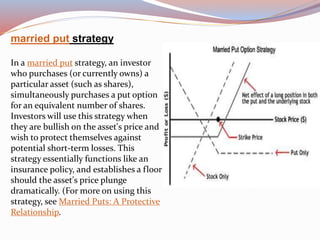
married put strategy
In a married put strategy, an investor
who purchases (or currently owns) a
particular asset (such as shares),
simultaneously purchases a put option
for an equivalent number of shares.
Investors will use this strategy when
they are bullish on the asset's price and
wish to protect themselves against
potential short-term losses. This
strategy essentially functions like an
insurance policy, and establishes a floor
should the asset's price plunge
dramatically. (For more on using this
strategy, see Married Puts: A Protective
Relationship.
Bull Call Spread
In a bull call spread strategy, an
investor will simultaneously buy call
options at a specific strike price and
sell the same number of calls at a
higher strike price. Both call options
will have the same expiration month
and underlying asset. This type of
vertical spread strategy is often used
when an investor is bullish and
expects a moderate rise in the price of
the underlying asset. (To learn more,
read Vertical Bull and Bear Credit
Spreads.)
Bear Put Spread
The bear put spread strategy is another
form of vertical spread like the bull call
spread. In this strategy, the investor will
simultaneously purchase put options at
a specific strike price and sell the same
number of puts at a lower strike price.
Both options would be for the same
underlying asset and have the same
expiration date. This method is used
when the trader is bearish and expects
the underlying asset's price to decline. It
offers both limited gains and limited
losses. (For more on this strategy, read
Bear Put Spreads: A Roaring Alternative
To Short Selling.)
Protective Collar
A protective collar strategy is
performed by purchasing an out-of-
the-money put option and writing an
out-of-the-money call option at the
same time, for the same underlying
asset (such as shares). This strategy
is often used by investors after a long
position in a stock has experienced
substantial gains. In this way, investors
can lock in profits without selling their
shares. (For more on these types of
strategies, see Don't Forget Your
Protective Collar and How a Protective
Collar Works.)
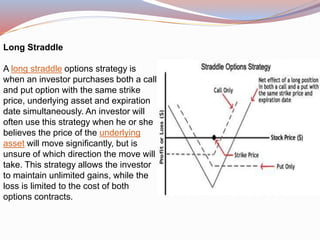
Long Straddle
A long straddle options strategy is
when an investor purchases both a call
and put option with the same strike
price, underlying asset and expiration
date simultaneously. An investor will
often use this strategy when he or she
believes the price of the underlying
asset will move significantly, but is
unsure of which direction the move will
take. This strategy allows the investor
to maintain unlimited gains, while the
loss is limited to the cost of both
options contracts.
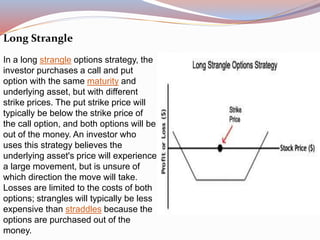
Long Strangle
In a long strangle options strategy, the
investor purchases a call and put
option with the same maturity and
underlying asset, but with different
strike prices. The put strike price will
typically be below the strike price of
the call option, and both options will be
out of the money. An investor who
uses this strategy believes the
underlying asset's price will experience
a large movement, but is unsure of
which direction the move will take.
Losses are limited to the costs of both
options; strangles will typically be less
expensive than straddles because the
options are purchased out of the
money.
Butterfly Spread
All the strategies up to this point have
required a combination of two different
positions or contracts. In a butterfly
spread options strategy, an investor
will combine both a bull spread
strategy and a bear spread strategy,
and use three different strike prices.
For example, one type of butterfly
spread involves purchasing one call
(put) option at the lowest (highest)
strike price, while selling two call (put)
options at a higher (lower) strike price,
and then one last call (put) option at an
even higher (lower) strike price.
Iron Condor
An even more interesting strategy is
the iron condor. In this strategy, the
investor simultaneously holds a long
and short position in two different
strangle strategies. The iron condor is
a fairly complex strategy that definitely
requires time to learn, and practice to
master.
Iron Butterfly
The final options strategy we will
demonstrate here is the iron butterfly.
In this strategy, an investor will
combine either a long or short straddle
with the simultaneous purchase or sale
of a strangle. Although similar to a
butterfly spread, this strategy differs
because it uses both calls and puts, as
opposed to one or the other. Profit and
loss are both limited within a specific
range, depending on the strike prices
of the options used. Investors will often
use out-of-the-money options in an
effort to cut costs while limiting risk
THANK YOU

derivative ppt

  • 1.
  • 2.
    Options & OptionsStrategy Presented By: Manish Pannu 1610401
  • 3.
    Equity options todayare hailed as one of the most successful financial products to be introduced in modern times. Options have proven to be superior and prudent investment tools offering you, the investor, flexibility, diversification and control in protecting your portfolio or in generating additional investment income
  • 4.
    Options are financialinstruments that can be used effectively under almost every market condition and for almost every investment goal. Among a few of the many ways, options can help you: Protect your investments against a decline in market prices Increase your income on current or new investments Buy an equity at a lower price Benefit from an equity price’s rise or fall without owning the equity or selling it outright
  • 5.
    Benefits of TradingOptions: Orderly, Efficient and Liquid Markets Standardized option contracts allow for orderly, efficient and liquid option markets.
  • 6.
    Flexibility Options are anextremely versatile investment tool. Because of their unique risk/reward structure, options can be used in many combinations with other option contracts and/or other financial instruments to seek profits or protection.
  • 7.
    Leverage An equity optionallows investors to fix the price for a specific period of time at which an investor can purchase or sell 100 shares of an equity for a premium (price), which is only a percentage of what one would pay to own the equity outright. This allows option investors to leverage their investment power while increasing their potential reward from an equity’s price movements.
  • 8.
    Limited Risk forBuyer Unlike other investments where the risks may have no boundaries, options trading offers a defined risk to buyers. An option buyer absolutely cannot lose more than the price of the option, the premium. Because the right to buy or sell the underlying security at a specific price expires on a given date, the option will expire worthless if the conditions for profitable exercise or sale of the option contract are not met by the expiration date. An uncovered option seller (sometimes referred to as the uncovered writer of an option), on the other hand, may face unlimited risk.
  • 9.
  • 10.
    Covered Call Aside frompurchasing a naked call option, you can also engage in a basic covered call or buy-write strategy. In this strategy, you would purchase the assets outright, and simultaneously write (or sell) a call option on those same assets. Your volume of assets owned should be equivalent to the number of assets underlying the call option. Investors will often use this position when they have a short-term position and a neutral opinion on the assets, and are looking to generate additional profits (through receipt of the call premium), or protect against a potential decline in the underlying asset's value. (For more insight, read Covered Call Strategies For A Falling Market.
  • 11.
    married put strategy Ina married put strategy, an investor who purchases (or currently owns) a particular asset (such as shares), simultaneously purchases a put option for an equivalent number of shares. Investors will use this strategy when they are bullish on the asset's price and wish to protect themselves against potential short-term losses. This strategy essentially functions like an insurance policy, and establishes a floor should the asset's price plunge dramatically. (For more on using this strategy, see Married Puts: A Protective Relationship.
  • 12.
    Bull Call Spread Ina bull call spread strategy, an investor will simultaneously buy call options at a specific strike price and sell the same number of calls at a higher strike price. Both call options will have the same expiration month and underlying asset. This type of vertical spread strategy is often used when an investor is bullish and expects a moderate rise in the price of the underlying asset. (To learn more, read Vertical Bull and Bear Credit Spreads.)
  • 13.
    Bear Put Spread Thebear put spread strategy is another form of vertical spread like the bull call spread. In this strategy, the investor will simultaneously purchase put options at a specific strike price and sell the same number of puts at a lower strike price. Both options would be for the same underlying asset and have the same expiration date. This method is used when the trader is bearish and expects the underlying asset's price to decline. It offers both limited gains and limited losses. (For more on this strategy, read Bear Put Spreads: A Roaring Alternative To Short Selling.)
  • 14.
    Protective Collar A protectivecollar strategy is performed by purchasing an out-of- the-money put option and writing an out-of-the-money call option at the same time, for the same underlying asset (such as shares). This strategy is often used by investors after a long position in a stock has experienced substantial gains. In this way, investors can lock in profits without selling their shares. (For more on these types of strategies, see Don't Forget Your Protective Collar and How a Protective Collar Works.)
  • 15.
    Long Straddle A longstraddle options strategy is when an investor purchases both a call and put option with the same strike price, underlying asset and expiration date simultaneously. An investor will often use this strategy when he or she believes the price of the underlying asset will move significantly, but is unsure of which direction the move will take. This strategy allows the investor to maintain unlimited gains, while the loss is limited to the cost of both options contracts.
  • 16.
    Long Strangle In along strangle options strategy, the investor purchases a call and put option with the same maturity and underlying asset, but with different strike prices. The put strike price will typically be below the strike price of the call option, and both options will be out of the money. An investor who uses this strategy believes the underlying asset's price will experience a large movement, but is unsure of which direction the move will take. Losses are limited to the costs of both options; strangles will typically be less expensive than straddles because the options are purchased out of the money.
  • 17.
    Butterfly Spread All thestrategies up to this point have required a combination of two different positions or contracts. In a butterfly spread options strategy, an investor will combine both a bull spread strategy and a bear spread strategy, and use three different strike prices. For example, one type of butterfly spread involves purchasing one call (put) option at the lowest (highest) strike price, while selling two call (put) options at a higher (lower) strike price, and then one last call (put) option at an even higher (lower) strike price.
  • 18.
    Iron Condor An evenmore interesting strategy is the iron condor. In this strategy, the investor simultaneously holds a long and short position in two different strangle strategies. The iron condor is a fairly complex strategy that definitely requires time to learn, and practice to master.
  • 19.
    Iron Butterfly The finaloptions strategy we will demonstrate here is the iron butterfly. In this strategy, an investor will combine either a long or short straddle with the simultaneous purchase or sale of a strangle. Although similar to a butterfly spread, this strategy differs because it uses both calls and puts, as opposed to one or the other. Profit and loss are both limited within a specific range, depending on the strike prices of the options used. Investors will often use out-of-the-money options in an effort to cut costs while limiting risk
  • 20.