Seminar
Topic- Seed Vigour and its Testing
Name
Jay Singh
Id.No. A-11184/19
M.Sc.(Ag.) Seed science and technology
Course Instructor
Dr. S.C. Vimal
Associate professor
Seed Technology Section ( GPB)
Acharya Narendra Deva University of Agriculture and Technology Narendra
Nagar Kumarganj Ayodhya (U.P.)-224229
OUTLINE
Seed vigor definitions
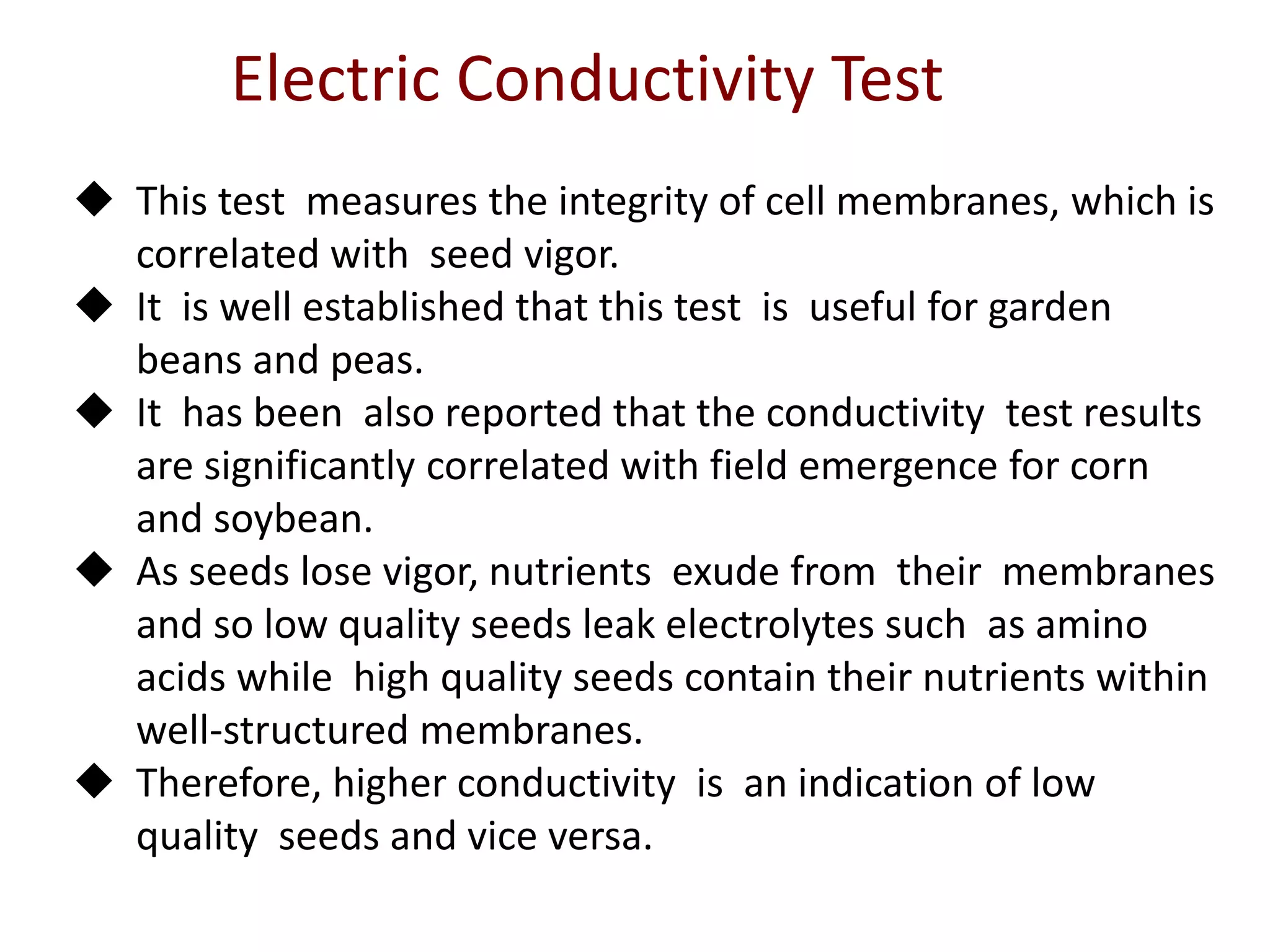
Initial development of
soybean seedlings of the
same age from a lower (A)
and higher (B) vigor
seedlots, showing clear
difference in performance.
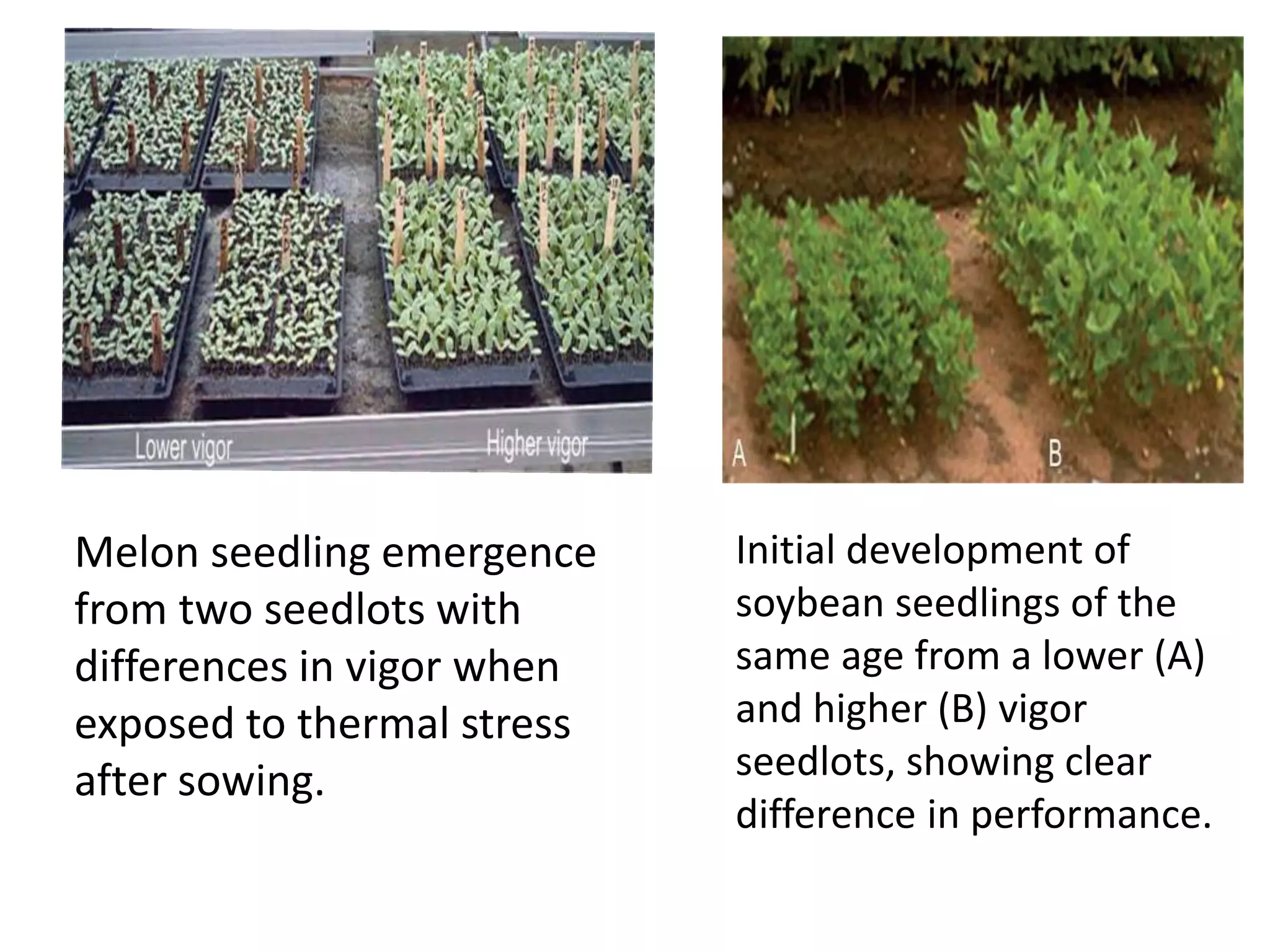
Melon seedling emergence
from two seedlots with
differences in vigor when
exposed to thermal stress
after sowing.
 • 1876: Friedrich Nobbe:‘Triebcraft’, driving force
 • 1950: ISTA President WJ Franck - ISTA
Biochemical and Seedling Vigour Committee
 • Many years discussion and debate!
 • 2001: ISTA Ordinary Meeting accepted Seed Vigour
Testing as Chapter 15 in the ISTA Rule
 The first seed testing station was established in Thrandt,
Germany, in 1869 by Prof. Friedrich Nobbe
 Nobbe’s classic work on seed testing ‘Handbuch der
Samenkunde’ (Hand book on Seed Testing) was published
in 1876
 In United States, the first seed testing laboratory was set in
1876
 In India first seed testing lab was opened in 1961
History of Vigour and seed testing
TYPE OF SEED VIGOR TESTING
Seedling Growth and Evaluation test
First count of germination test
Speed of germination
Uniform seedling emergence
Evaluation Seedling of length
Evaluation of seedling dry
weight
Rate of primary root
emergence
Vigour test by Germination
Speed of Germination
One hundred seeds each in four replications are planted in
recommended substratum for germination. The substratum is
kept in a germinator maintained at recommended
temperature for the crop in reference Crable S.l).
Number ofseedlings emerging daily are counted fromday of
planting the seeds in the medium till the time germination is
complete.
Thereafter a germination index (G.I.) is computed by using
the following formula: G.I. = n/d
Seed lot A - No. of seedlings= 0,0,0,40,30, 12,7, counted
Day of counting = 1,2,3,4,5,6,7
Seed lot B - No. of seedlings =0,0,0,0,30,42,21counted
G.I. of Seed lot A = 0/1+ 0/2+0/3+40/4+30/5+12/6+7/7
= 10+6+2+1
= 19
Example
G.I. of Seed lot B = 0/1 +0/2+ 0/3+0/4+30/5+ 42/6+21/7
= 6+7+ 3
= 16
In this example seed lot A has greater G.I.(19) than seed lot
B(16), so seed lot A is more vigorous than seed lot B.
 This test measures the integrity of cell membranes, which is
correlated with seed vigor.
 It is well established that this test is useful for garden
beans and peas.
 It has been also reported that the conductivity test results
are significantly correlated with field emergence for corn
and soybean.
 As seeds lose vigor, nutrients exude from their membranes
and so low quality seeds leak electrolytes such as amino
acids while high quality seeds contain their nutrients within
well-structured membranes.
 Therefore, higher conductivity is an indication of low
quality seeds and vice versa.
Electric Conductivity Test
Apparatus:
Conductivity meter, beaker, 0.1% mercuric chloride, distilled
water, seed sample, wash bottle, tissue paper.
Procedure:
• Use 4 replicates of 50 seeds and weigh each replicate to
two decimal
places (0.01 g).
• Fill four containers of the same size with 250 ml of
deionized water,
cover to prevent contamination and maintain at 20 ± 2 °C for
24 h.
• Put the seeds to soak in the containers and re-cover to
avoid pollution
and evaporation. Place in a germinator at 20 ± 2 °C for 24 h.
• Use two other containers containing only de-ionized water as
control for
each test run.
• At the end of the incubation period, stir the seeds and
measure the elec-trical specific conductivity – either between
seeds or after the seeds
have been removed from the water.
• Measure the conductivity of the control containers and
subtract the
mean value from the readings for the seed samples. Between
readings,
rinse the dip cell in deionized water.
Conductivity is expressed in μS cm-1 g-1 and is calculated as
follows:
Conductivity = Conductivity reading - Mean value of the
An illustration of the electrical
conductivity test (Elias et al.,
2012).
The tetrazolium test has been used for many years to
obtain a rapid general
estimation of seed viability, particularly in species with
dormancy when the
germination test would last too long.
To determine seed lot vigour, the procedure is as for the
viability test, but classification is more precise:
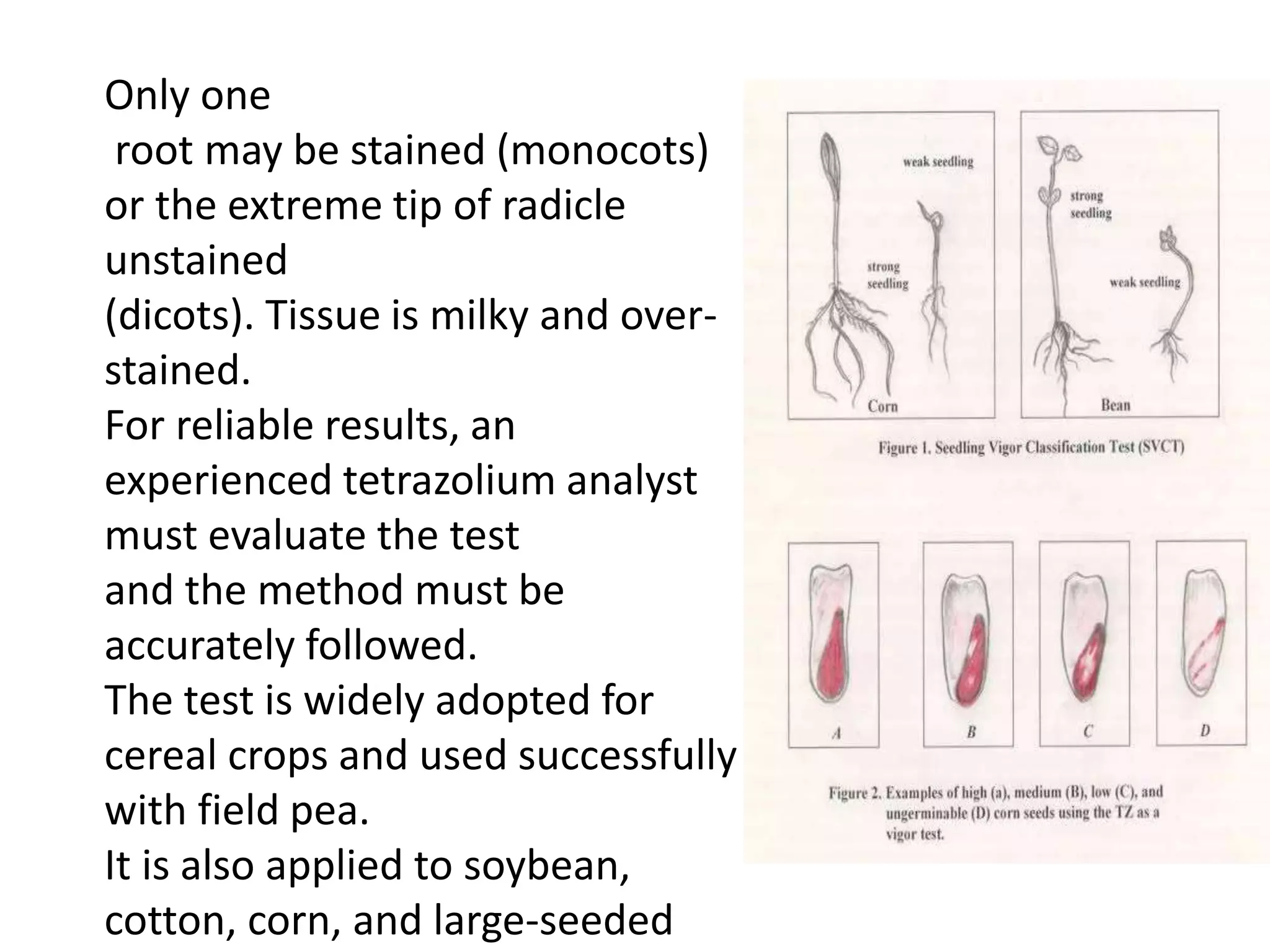
• High vigour - staining uniform and even, tissue firm and
bright.
• Medium vigour - embryo completely stained or
embryonic axis stained in dicots. Extremities may be
unstained, while some areas may be more or less
stained.
• Low vigour - large areas of non-essential structures
Tetrazolium test
Only one
root may be stained (monocots)
or the extreme tip of radicle
unstained
(dicots). Tissue is milky and over-
stained.
For reliable results, an
experienced tetrazolium analyst
must evaluate the test
and the method must be
accurately followed.
The test is widely adopted for
cereal crops and used successfully
with field pea.
It is also applied to soybean,
cotton, corn, and large-seeded
The accelerated ageing test was developed initially to
determine storage
potential. It is now used to predict the seedling field
emergence potential
of seed lots and is widely adopted for soybean (Glycine max).
The ageing
process is accelerated by subjecting the seeds to high
temperature (40–45°C) and high relative humidity (around
95%) in the ageing chamber for 72
hours. Seeds are then subjected to a germination test.
During the test, the seeds absorb moisture from the humid
environment;
the increased seed moisture content, combined with the high
tempera-
ture, causes rapid seed ageing. Seed lots that show high
Accelerated ageing test
Apparatus:
Accelerated ageing chamber, equipment for germination test,
plastic accelerated ageing boxes with wire mesh, distilled
water.
Procedure:
• Use two boxes with 42 g of seed (100 seeds) in each.
• Place seeds on a dry wire mesh (screen) tray in a plastic
accelerated
ageing box containing 40 ml of distilled water. Take care not to
splash
water on the screen.
• Close the containers and place in the ageing chamber at 41 ±
0.3 °C for
72 hours. Stable temperature is important to ensure the
validity of the
results of repeated tests.Remove the seeds from the
containers and conduct a standard germination test using four
Cold Test
Objective
Asses the extent of seed lot deterioration or physical damage
occur in storage.
Distinguish important differences in physiological potential
among seed lots of commercial value.
Rate and uniformity of seed germination and seedling growth.
Ability of seed to emerge under unfavourable environment.
Performance after storage, perticulerly retention of the ability
to germinate.
 Rapid germination.
 Uniform germination

 Tolerance of stressful environmental conditions

 Less susceptible to soil pathogens

 Longer potential storage life
Characteristics of Vigorous Seed
 Genetics (Gene effect)
 Environment during maturation

 Seed maturity

 Harvesting methods

 Storage conditions and duration

 Germination conditions

Factors Influencing Vigour
Conclusion
• Seed vigour testing is important for seed quality
assesment
• This is require to predict seed rate of a crop.
• Vigour is not included in lebel, but essential to test
• This is the fact that there is no universily accepted
and perfect method of testing seed vigour of a
perticular crop.
• Further research is needed for specify best method of
vigour testing.
References
• Seed labs lnc. 20/20 cold test
• Gupta P.C., Seed vigour testing.
• Seed tool kit 2019 CA7202EN/1/12.19
• AOSA., Seed Vigor Testing Handbook
• ISTA.,Handbook of vigour Test Methods
Vigour and Its testing.pptx

Vigour and Its testing.pptx

  • 2.
    Seminar Topic- Seed Vigourand its Testing Name Jay Singh Id.No. A-11184/19 M.Sc.(Ag.) Seed science and technology Course Instructor Dr. S.C. Vimal Associate professor Seed Technology Section ( GPB) Acharya Narendra Deva University of Agriculture and Technology Narendra Nagar Kumarganj Ayodhya (U.P.)-224229
  • 3.
  • 4.
  • 5.
    Initial development of soybeanseedlings of the same age from a lower (A) and higher (B) vigor seedlots, showing clear difference in performance. Melon seedling emergence from two seedlots with differences in vigor when exposed to thermal stress after sowing.
  • 6.
     • 1876:Friedrich Nobbe:‘Triebcraft’, driving force  • 1950: ISTA President WJ Franck - ISTA Biochemical and Seedling Vigour Committee  • Many years discussion and debate!  • 2001: ISTA Ordinary Meeting accepted Seed Vigour Testing as Chapter 15 in the ISTA Rule  The first seed testing station was established in Thrandt, Germany, in 1869 by Prof. Friedrich Nobbe  Nobbe’s classic work on seed testing ‘Handbuch der Samenkunde’ (Hand book on Seed Testing) was published in 1876  In United States, the first seed testing laboratory was set in 1876  In India first seed testing lab was opened in 1961 History of Vigour and seed testing
  • 7.
    TYPE OF SEEDVIGOR TESTING
  • 9.
    Seedling Growth andEvaluation test First count of germination test Speed of germination Uniform seedling emergence Evaluation Seedling of length Evaluation of seedling dry weight Rate of primary root emergence
  • 10.
    Vigour test byGermination
  • 11.
    Speed of Germination Onehundred seeds each in four replications are planted in recommended substratum for germination. The substratum is kept in a germinator maintained at recommended temperature for the crop in reference Crable S.l). Number ofseedlings emerging daily are counted fromday of planting the seeds in the medium till the time germination is complete. Thereafter a germination index (G.I.) is computed by using the following formula: G.I. = n/d
  • 12.
    Seed lot A- No. of seedlings= 0,0,0,40,30, 12,7, counted Day of counting = 1,2,3,4,5,6,7 Seed lot B - No. of seedlings =0,0,0,0,30,42,21counted G.I. of Seed lot A = 0/1+ 0/2+0/3+40/4+30/5+12/6+7/7 = 10+6+2+1 = 19 Example G.I. of Seed lot B = 0/1 +0/2+ 0/3+0/4+30/5+ 42/6+21/7 = 6+7+ 3 = 16 In this example seed lot A has greater G.I.(19) than seed lot B(16), so seed lot A is more vigorous than seed lot B.
  • 13.
     This testmeasures the integrity of cell membranes, which is correlated with seed vigor.  It is well established that this test is useful for garden beans and peas.  It has been also reported that the conductivity test results are significantly correlated with field emergence for corn and soybean.  As seeds lose vigor, nutrients exude from their membranes and so low quality seeds leak electrolytes such as amino acids while high quality seeds contain their nutrients within well-structured membranes.  Therefore, higher conductivity is an indication of low quality seeds and vice versa. Electric Conductivity Test
  • 14.
    Apparatus: Conductivity meter, beaker,0.1% mercuric chloride, distilled water, seed sample, wash bottle, tissue paper. Procedure: • Use 4 replicates of 50 seeds and weigh each replicate to two decimal places (0.01 g). • Fill four containers of the same size with 250 ml of deionized water, cover to prevent contamination and maintain at 20 ± 2 °C for 24 h. • Put the seeds to soak in the containers and re-cover to avoid pollution and evaporation. Place in a germinator at 20 ± 2 °C for 24 h.
  • 15.
    • Use twoother containers containing only de-ionized water as control for each test run. • At the end of the incubation period, stir the seeds and measure the elec-trical specific conductivity – either between seeds or after the seeds have been removed from the water. • Measure the conductivity of the control containers and subtract the mean value from the readings for the seed samples. Between readings, rinse the dip cell in deionized water. Conductivity is expressed in μS cm-1 g-1 and is calculated as follows: Conductivity = Conductivity reading - Mean value of the
  • 16.
    An illustration ofthe electrical conductivity test (Elias et al., 2012).
  • 17.
    The tetrazolium testhas been used for many years to obtain a rapid general estimation of seed viability, particularly in species with dormancy when the germination test would last too long. To determine seed lot vigour, the procedure is as for the viability test, but classification is more precise: • High vigour - staining uniform and even, tissue firm and bright. • Medium vigour - embryo completely stained or embryonic axis stained in dicots. Extremities may be unstained, while some areas may be more or less stained. • Low vigour - large areas of non-essential structures Tetrazolium test
  • 18.
    Only one root maybe stained (monocots) or the extreme tip of radicle unstained (dicots). Tissue is milky and over- stained. For reliable results, an experienced tetrazolium analyst must evaluate the test and the method must be accurately followed. The test is widely adopted for cereal crops and used successfully with field pea. It is also applied to soybean, cotton, corn, and large-seeded
  • 19.
    The accelerated ageingtest was developed initially to determine storage potential. It is now used to predict the seedling field emergence potential of seed lots and is widely adopted for soybean (Glycine max). The ageing process is accelerated by subjecting the seeds to high temperature (40–45°C) and high relative humidity (around 95%) in the ageing chamber for 72 hours. Seeds are then subjected to a germination test. During the test, the seeds absorb moisture from the humid environment; the increased seed moisture content, combined with the high tempera- ture, causes rapid seed ageing. Seed lots that show high Accelerated ageing test
  • 20.
    Apparatus: Accelerated ageing chamber,equipment for germination test, plastic accelerated ageing boxes with wire mesh, distilled water. Procedure: • Use two boxes with 42 g of seed (100 seeds) in each. • Place seeds on a dry wire mesh (screen) tray in a plastic accelerated ageing box containing 40 ml of distilled water. Take care not to splash water on the screen. • Close the containers and place in the ageing chamber at 41 ± 0.3 °C for 72 hours. Stable temperature is important to ensure the validity of the results of repeated tests.Remove the seeds from the containers and conduct a standard germination test using four
  • 22.
  • 23.
    Objective Asses the extentof seed lot deterioration or physical damage occur in storage. Distinguish important differences in physiological potential among seed lots of commercial value. Rate and uniformity of seed germination and seedling growth. Ability of seed to emerge under unfavourable environment. Performance after storage, perticulerly retention of the ability to germinate.
  • 24.
     Rapid germination. Uniform germination   Tolerance of stressful environmental conditions   Less susceptible to soil pathogens   Longer potential storage life Characteristics of Vigorous Seed
  • 25.
     Genetics (Geneeffect)  Environment during maturation   Seed maturity   Harvesting methods   Storage conditions and duration   Germination conditions  Factors Influencing Vigour
  • 26.
    Conclusion • Seed vigourtesting is important for seed quality assesment • This is require to predict seed rate of a crop. • Vigour is not included in lebel, but essential to test • This is the fact that there is no universily accepted and perfect method of testing seed vigour of a perticular crop. • Further research is needed for specify best method of vigour testing.
  • 27.
    References • Seed labslnc. 20/20 cold test • Gupta P.C., Seed vigour testing. • Seed tool kit 2019 CA7202EN/1/12.19 • AOSA., Seed Vigor Testing Handbook • ISTA.,Handbook of vigour Test Methods