
Freshness tests for quality assessment

Naresh Kumar Metha
PHT-PA1-04
Sensory analysis
• It has been stated frequently that no single instrumental method
is generally reliable for assessment of freshness and spoilage in
seafood.
• To be useful in quality control, responses of instrumental
methods should be causally related to sensory changes in seafood
or they should at least correlate with sensory analyses.
• Sensory methods relying on trained assessors i.e. objective
sensory methods are required for use in quality control for
evaluation of freshness and for determination of remaining shelf
life of seafoods
EU scheme for freshness
(Council Regulation No 103/76 of January 1976; Council Regulation No. 2406/96 of November 1996)

• The freshness grading of fishes in particular EU schemes usually
carried out by trained personnel
• Whole and gutted fish are assessed for appearance, odour of skin,
outer slime, eyes, gills and belly cavity.
• Fish are then placed in the grades Extra (E), A, B or Unfit (C) on
the basis of schemes for different groups of species.
• It has been indicated by scientists that the EU sensory schemes
have disadvantages because information on remaining shelf life
cannot be obtained directly from the freshness grades, and
because the schemes are too complicated
Quality Index Method (QIM)
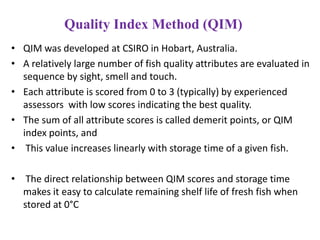
• QIM was developed at CSIRO in Hobart, Australia.
• A relatively large number of fish quality attributes are evaluated in
sequence by sight, smell and touch.
• Each attribute is scored from 0 to 3 (typically) by experienced
assessors with low scores indicating the best quality.
• The sum of all attribute scores is called demerit points, or QIM
index points, and
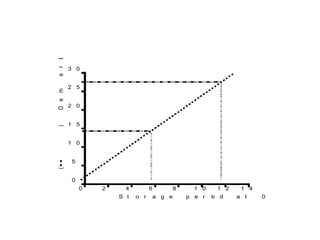
• This value increases linearly with storage time of a given fish.
• The direct relationship between QIM scores and storage time
makes it easy to calculate remaining shelf life of fresh fish when
stored at 0°C
Quality Index Method (QIM)
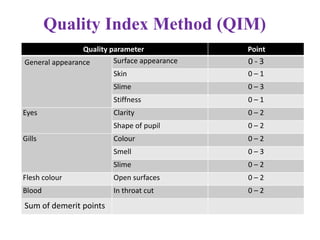
Quality parameter
Surface appearance
General appearance

Point

0-3

Skin

0–1

Slime

0–3

Stiffness

0–1

Clarity

0–2

Shape of pupil

0–2

Colour

0–2

Smell

0–3

Slime

0–2

Flesh colour

Open surfaces

0–2

Blood

In throat cut

0–2

Eyes
Gills

Sum of demerit points
Q
o r
it
e r
D e m
)

3 0

2 5

2 0

1 5

1 0

(

5

0
0

2

4
S t

6
o r

8

a g e

1 0
p e r

1 2
o
i d

1 4
a t

0 °

C

(

D a
• In chemical methods of quality assessment, Various
product of spoilage in fish muscle are quantitively
determined and correlated with sensory characteristics

• Reasons of spoilage are autolytic enzymes
,putrefactive micro-organism or lipid oxidation

• During spoilage compounds gradually accumulate in
the flesh and their determination provides a measure
of the progress of spoilage
Quality indices classification
• Volatile bases- Ammonia, TVBN, TMAO & TMA

• Nucleotides-degradation product of ATP such as
IMP, Hypoxanthine and K-value

• Lipid Oxidation Product- Peroxides, Hydro
peroxides and Aldehydes
Total volatile base N
• The most common index of quality used universally for deciding the state
of freshness of fish. Total volatile bases refers to TMA and Ammonia
• A level of 35-40 mg TVB-N/100g of muscle is the limit of acceptability
• Critical limits of 25, 30 and 35 mg-TVB-N/100g were established for
different groups of fish species.
• In processed, lightly or semi preserved, seafood levels of TVB-N at
sensory product rejection are more variable.
• For example, 30-40 mg-TVB-N/100g has been found at sensory rejection
of sliced vacuum packed cold-smoked salmon but lower levels of 10-20
mg-TVB-N/100g were determined in modified atmosphere packed,
cooked and brined shrimps.
• However, in sugar salted herring as much as 75 mg-N TVB-N/100g was
determined in products of acceptable sensory quality.
• These variable levels of TVB-N at time of sensory rejection support the
view that off-flavours in spoiling seafood cannot be caused by TVB-N
alone.
TMA
• It is used as a more specific index of bacterial
spoilage
• Development of TMA in seafood depends primarily
on the content of the substrate trimethylamine-oxide
(TMAO) in the fish raw material

• Its level increase with time of storage at ambient
temperature
• 10-15 mg/100 g of muscle is taken as limit of
acceptability
Indole
• Indole production is an indication of spoilage in
shrimp
• USFDA limit less than 25 microgam/100g
Hypoxanthine (Hx)
• The end product of nucleotide degradation

• Therefore, its presence clearly indicates spoilage
• Hx converted into uric acid by enzyme xanthine
oxidase and measures at 290 nm.

• Fish with more than 2.5 micromoles/g is
regarded as spoiled
K-Value
•

Defined as the ratio of the sum of inosine and Hx to total
concentration of the other nucleotides. It is expressed as
percentage
• The K-value was suggested by Japanese researchers in 1959 as an
objective index of fish freshness. In Japan, a K-value of 20% is used
as a critical limit for fish to be consumed raw
• Adenosine triphosphate (ATP) is degraded into adenosine
diphosphate (ADP), adenosine monophosphate (AMP), inosine
monophosphate (IMP), inosine (Ino) and hypoxanthine (Hx) during
processing and storage of fresh and lightly preserved seafood.
•

IMP is formed by autolytic enzymes whereas spoilage bacteria
contribute to Ino and Hx formation.

• Rejection usually above 50-60 %
Instrumental analysis
The Intellectron Fishtester, the Torrymeter and the RT-Freshtester represent instruments
with increasing degrees of sophistication.

Readings from all instruments reflect di-electrical properties of fish and they decrease
with storage time, almost following a straight line
Based on these rapid and non-destructive measurements, the RT-Freshtester allows
automatic grading of 60-70 fish per minute.
These instruments need calibration depending on the season and fish handling
procedures
The high cost of the instruments limits their practical use in the seafood sector for
freshness evaluation.
Thank you

Fresh ness test for fishery products

  • 1.
    Freshness tests forquality assessment Naresh Kumar Metha PHT-PA1-04
  • 2.
    Sensory analysis • Ithas been stated frequently that no single instrumental method is generally reliable for assessment of freshness and spoilage in seafood. • To be useful in quality control, responses of instrumental methods should be causally related to sensory changes in seafood or they should at least correlate with sensory analyses. • Sensory methods relying on trained assessors i.e. objective sensory methods are required for use in quality control for evaluation of freshness and for determination of remaining shelf life of seafoods
  • 3.
    EU scheme forfreshness (Council Regulation No 103/76 of January 1976; Council Regulation No. 2406/96 of November 1996) • The freshness grading of fishes in particular EU schemes usually carried out by trained personnel • Whole and gutted fish are assessed for appearance, odour of skin, outer slime, eyes, gills and belly cavity. • Fish are then placed in the grades Extra (E), A, B or Unfit (C) on the basis of schemes for different groups of species. • It has been indicated by scientists that the EU sensory schemes have disadvantages because information on remaining shelf life cannot be obtained directly from the freshness grades, and because the schemes are too complicated
  • 4.
    Quality Index Method(QIM) • QIM was developed at CSIRO in Hobart, Australia. • A relatively large number of fish quality attributes are evaluated in sequence by sight, smell and touch. • Each attribute is scored from 0 to 3 (typically) by experienced assessors with low scores indicating the best quality. • The sum of all attribute scores is called demerit points, or QIM index points, and • This value increases linearly with storage time of a given fish. • The direct relationship between QIM scores and storage time makes it easy to calculate remaining shelf life of fresh fish when stored at 0°C
  • 5.
    Quality Index Method(QIM) Quality parameter Surface appearance General appearance Point 0-3 Skin 0–1 Slime 0–3 Stiffness 0–1 Clarity 0–2 Shape of pupil 0–2 Colour 0–2 Smell 0–3 Slime 0–2 Flesh colour Open surfaces 0–2 Blood In throat cut 0–2 Eyes Gills Sum of demerit points
  • 6.
    Q o r it e r De m ) 3 0 2 5 2 0 1 5 1 0 ( 5 0 0 2 4 S t 6 o r 8 a g e 1 0 p e r 1 2 o i d 1 4 a t 0 ° C ( D a
  • 7.
    • In chemicalmethods of quality assessment, Various product of spoilage in fish muscle are quantitively determined and correlated with sensory characteristics • Reasons of spoilage are autolytic enzymes ,putrefactive micro-organism or lipid oxidation • During spoilage compounds gradually accumulate in the flesh and their determination provides a measure of the progress of spoilage
  • 8.
    Quality indices classification •Volatile bases- Ammonia, TVBN, TMAO & TMA • Nucleotides-degradation product of ATP such as IMP, Hypoxanthine and K-value • Lipid Oxidation Product- Peroxides, Hydro peroxides and Aldehydes
  • 9.
    Total volatile baseN • The most common index of quality used universally for deciding the state of freshness of fish. Total volatile bases refers to TMA and Ammonia • A level of 35-40 mg TVB-N/100g of muscle is the limit of acceptability • Critical limits of 25, 30 and 35 mg-TVB-N/100g were established for different groups of fish species. • In processed, lightly or semi preserved, seafood levels of TVB-N at sensory product rejection are more variable. • For example, 30-40 mg-TVB-N/100g has been found at sensory rejection of sliced vacuum packed cold-smoked salmon but lower levels of 10-20 mg-TVB-N/100g were determined in modified atmosphere packed, cooked and brined shrimps. • However, in sugar salted herring as much as 75 mg-N TVB-N/100g was determined in products of acceptable sensory quality. • These variable levels of TVB-N at time of sensory rejection support the view that off-flavours in spoiling seafood cannot be caused by TVB-N alone.
  • 10.
    TMA • It isused as a more specific index of bacterial spoilage • Development of TMA in seafood depends primarily on the content of the substrate trimethylamine-oxide (TMAO) in the fish raw material • Its level increase with time of storage at ambient temperature • 10-15 mg/100 g of muscle is taken as limit of acceptability
  • 11.
    Indole • Indole productionis an indication of spoilage in shrimp • USFDA limit less than 25 microgam/100g
  • 12.
    Hypoxanthine (Hx) • Theend product of nucleotide degradation • Therefore, its presence clearly indicates spoilage • Hx converted into uric acid by enzyme xanthine oxidase and measures at 290 nm. • Fish with more than 2.5 micromoles/g is regarded as spoiled
  • 13.
    K-Value • Defined as theratio of the sum of inosine and Hx to total concentration of the other nucleotides. It is expressed as percentage • The K-value was suggested by Japanese researchers in 1959 as an objective index of fish freshness. In Japan, a K-value of 20% is used as a critical limit for fish to be consumed raw • Adenosine triphosphate (ATP) is degraded into adenosine diphosphate (ADP), adenosine monophosphate (AMP), inosine monophosphate (IMP), inosine (Ino) and hypoxanthine (Hx) during processing and storage of fresh and lightly preserved seafood. • IMP is formed by autolytic enzymes whereas spoilage bacteria contribute to Ino and Hx formation. • Rejection usually above 50-60 %
  • 14.
    Instrumental analysis The IntellectronFishtester, the Torrymeter and the RT-Freshtester represent instruments with increasing degrees of sophistication. Readings from all instruments reflect di-electrical properties of fish and they decrease with storage time, almost following a straight line Based on these rapid and non-destructive measurements, the RT-Freshtester allows automatic grading of 60-70 fish per minute. These instruments need calibration depending on the season and fish handling procedures The high cost of the instruments limits their practical use in the seafood sector for freshness evaluation.
  • 15.