Fundamentals of Sedimentology and
Stratigraphy
Key tools for Exploration and Development
Dr. Islam H. Ali
Sedimentology Department Manager
Belayim Petroleum Company (Petrobel)/E ni’s J V.
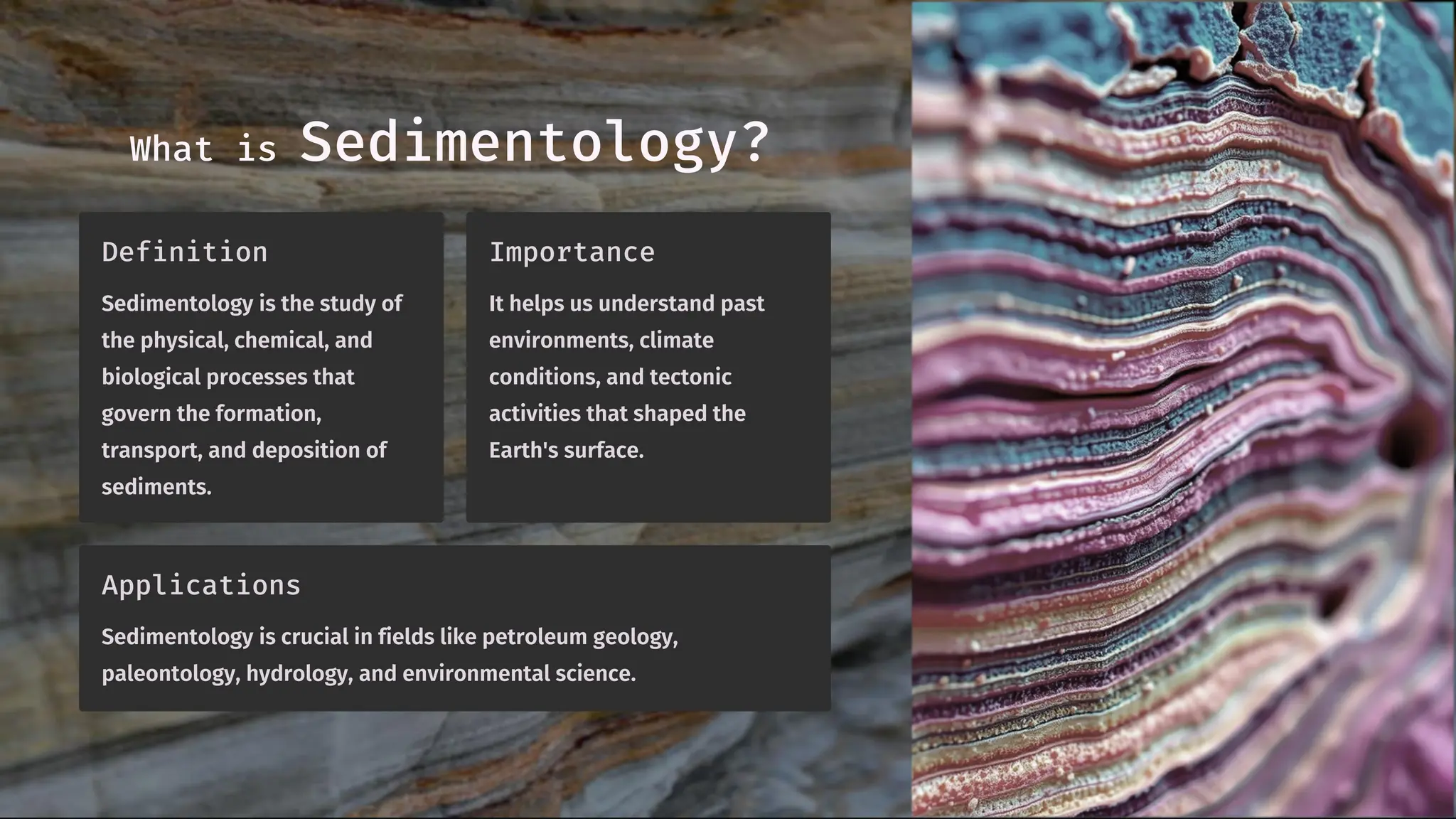
What is Sedimentology?
Definition
Sedimentology is the study of
the physical, chemical, and
biological processes that
govern the formation,
transport, and deposition of
sediments.
Importance
It helps us understand past
environments, climate
conditions, and tectonic
activities that shaped the
Earth's surface.
Applications
Sedimentology is crucial in fields like petroleum geology,
paleontology, hydrology, and environmental science.
Sedimentology is the science that deals with the description,
classification, and origin of sedimentary rock.
It is the study of sediments and sedimentation.
Sedimentology = the study of the processes of formation, transport and deposition of material
which accumulates as sediment in continental and marine environments and eventually forms
sedimentary rocks
Stratigraphy the study of rocks to determine the order and timing
of events in Earth history
Sedimentology & Stratigraphy
Sedimentary Geology » Sedimentology + Stratigraphy
Applications of Sedimentology and
Stratigraphy
Petroleum Exploration
Identifying hydrocarbon-bearing
reservoir rocks and traps through
sedimentary facies analysis.
Paleoenvironmental
Reconstruction
Interpreting ancient depositional
environments and climate conditions
from sedimentary evidence.
Geohazard Assessment
Studying sedimentary structures to
assess risks of landslides, floods, and
other natural hazards.
1- Description of sediments
2- Origin of sediments
3- Understanding the depositional condition resulting in
the formation of a given sedimentary rock
4- Evolution of the sedimentary basin and the sequence
5- Information and understanding of the past depositional
and environmental conditions
The aim of Sedimentology
1- Picture rocky outcrops on the slopes of a valley in the mountains.
When it rains, cracks in the rock fill with water.
Sedimentation Process
After Alexis Holt
Sedimentation Process..
In cold weather, this water freezes into ice, which expands as it
forms, creating new cracks in the rock.
After Alexis Holt
Sedimentation Process..
After several cycles of freezing and thawing, fragments of rock become
loose and fall from the outcrop, sliding downhill until they reach the
river at the valley floor.
After Alexis Holt
Sedimentation Process..
Once in the river, these rock fragments slide, roll, and bounce
downstream, propelled by the water's flow.
After Alexis Holt
Sedimentation Process..
As they travel, the fragments break down into smaller grains of sand
and mud particles.
After Alexis Holt
Sedimentation Process..
When the river empties into the sea, the rock fragments settle on the
seabed as the water flow slows.
After Alexis Holt
Sedimentation Process..
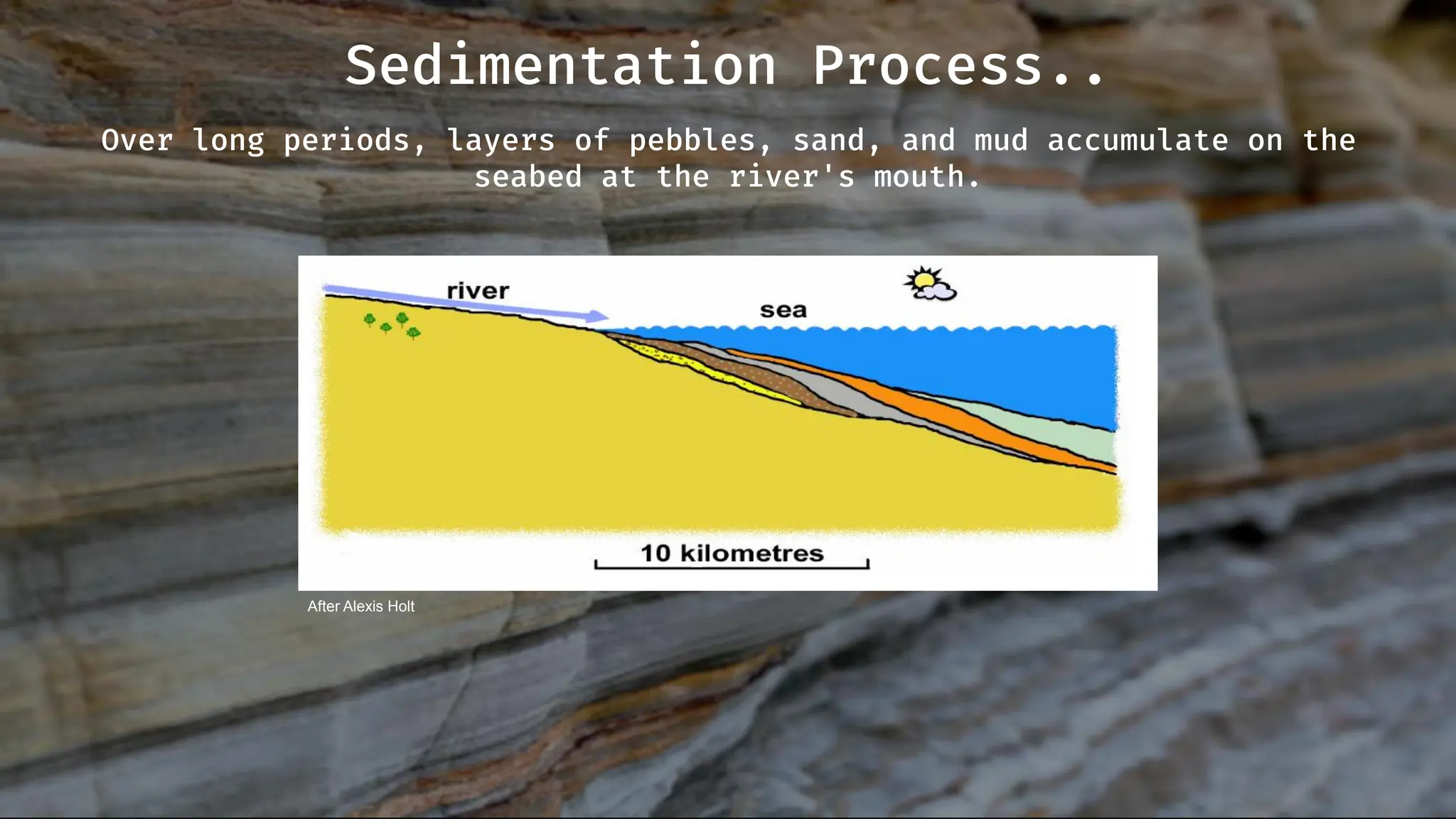
Over long periods, layers of pebbles, sand, and mud accumulate on the
seabed at the river's mouth.
After Alexis Holt
Sedimentation Process..
Water circulates through the small spaces between the rock particles
in these layers, gradually depositing minerals that cement the
particles together. Ultimately, sediments like sand and mud transform
into sedimentary rocks known as sandstone and mudstone.
After Alexis Holt
Sedimentation Process..
Over millions of years, layers of various sedimentary rocks stack on
top of one another, forming rock formations that can reach hundreds of
meters in thickness. These formations often remain undisturbed for
hundreds of millions of years.
After Alexis Holt
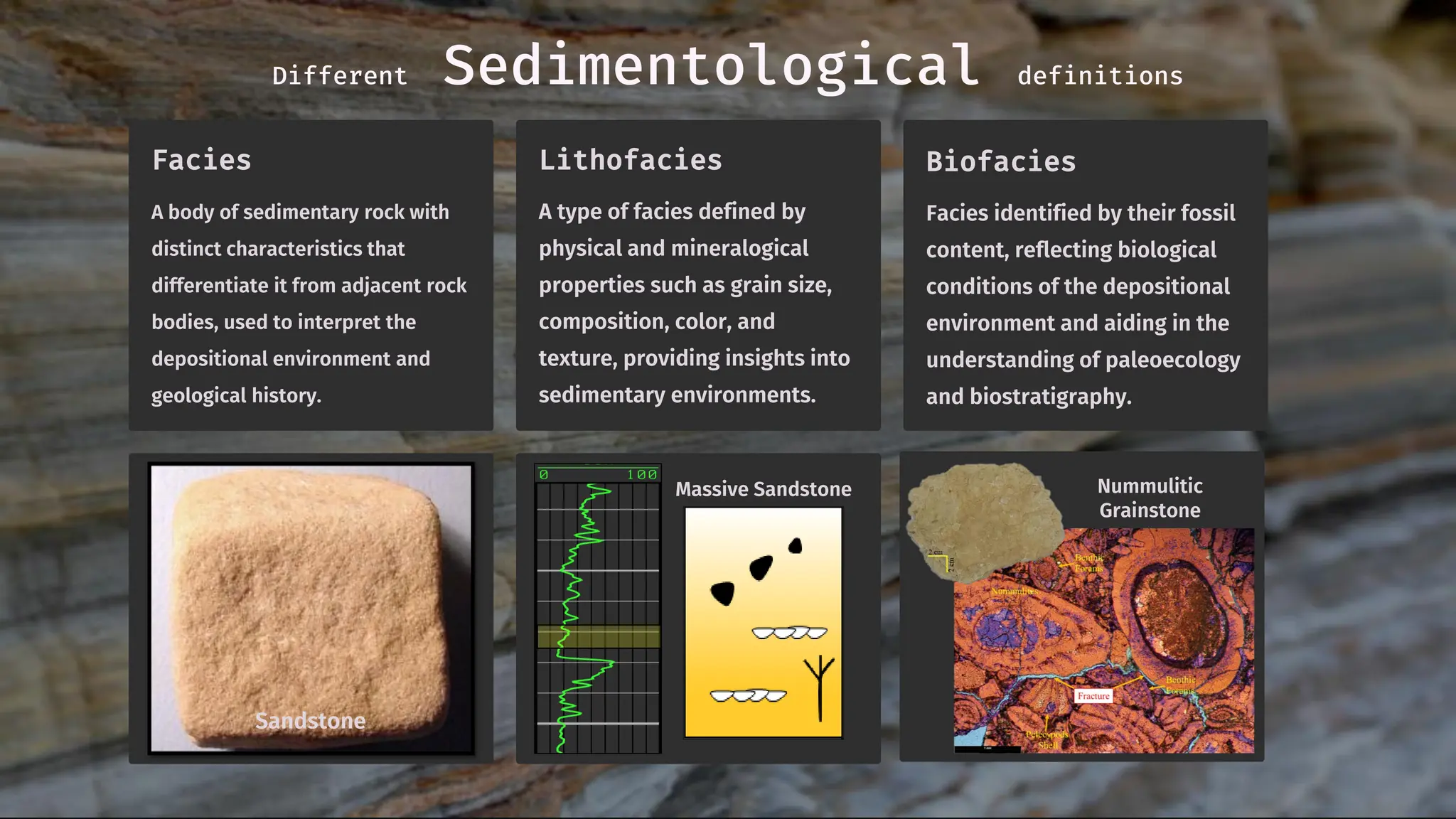
Facies
A body of sedimentary rock with
distinct characteristics that
differentiate it from adjacent rock
bodies, used to interpret the
depositional environment and
geological history.
Lithofacies
A type of facies defined by
physical and mineralogical
properties such as grain size,
composition, color, and
texture, providing insights into
sedimentary environments.
Biofacies
Facies identified by their fossil
content, reflecting biological
conditions of the depositional
environment and aiding in the
understanding of paleoecology
and biostratigraphy.
Massive Sandstone
Sandstone
Nummulitic
Grainstone
Different Sedimentological definitions
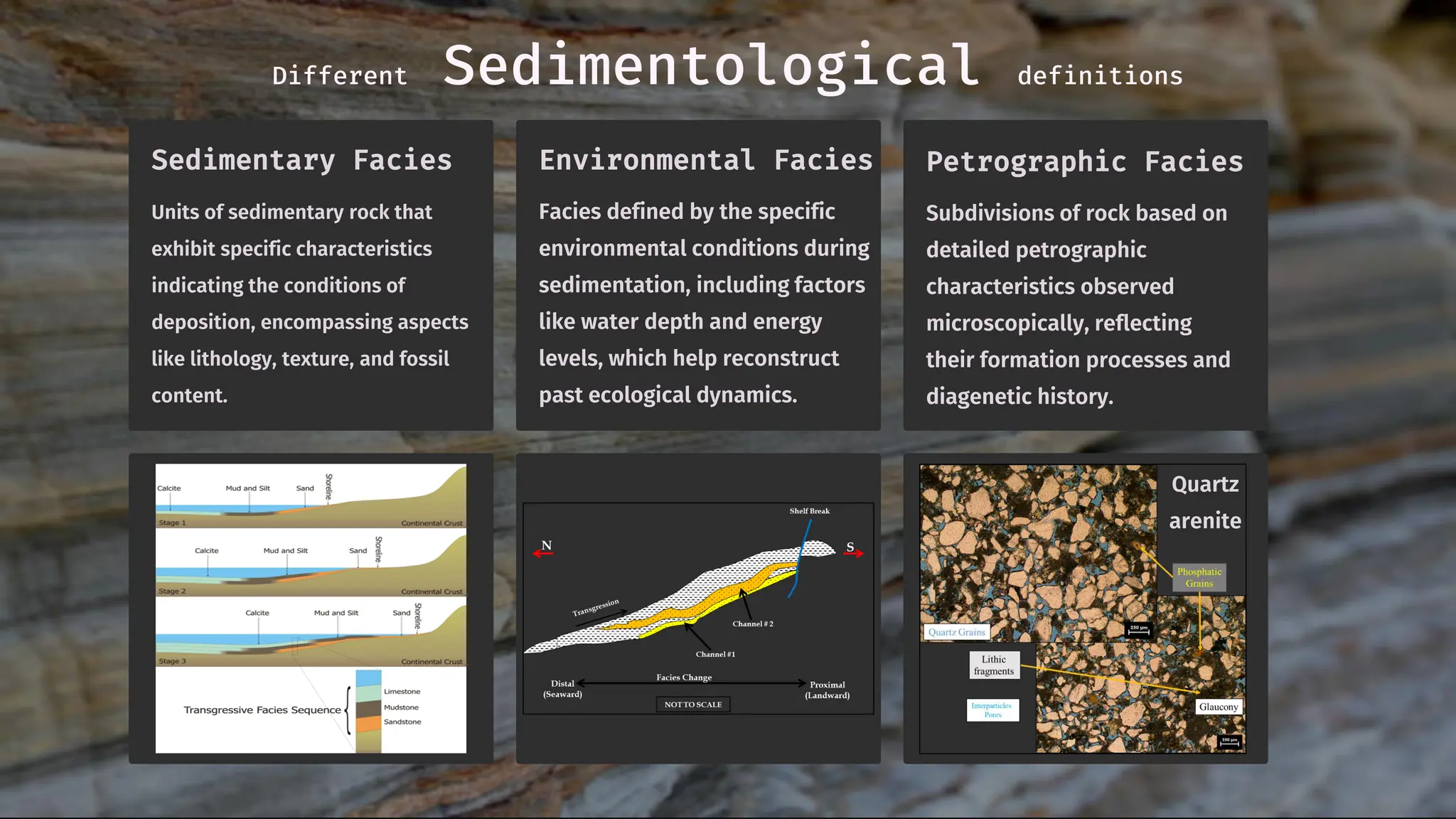
Sedimentary Facies
Units of sedimentary rock that
exhibit specific characteristics
indicating the conditions of
deposition, encompassing aspects
like lithology, texture, and fossil
content.
Environmental Facies
Facies defined by the specific
environmental conditions during
sedimentation, including factors
like water depth and energy
levels, which help reconstruct
past ecological dynamics.
Petrographic Facies
Subdivisions of rock based on
detailed petrographic
characteristics observed
microscopically, reflecting
their formation processes and
diagenetic history.
Quartz
arenite
Types of Sedimentary Rocks
Detrital
(Mechanical)
Organic Chemical
Crystalline Texture
Clastic Texture
Formed by the breakdown of
pre-existing rocks and
minerals by the process of
weathering and erosion
Materials which form within the
environment of transport and
deposition
Minerals which grow
crystals in deposition
environment
Different Sedimentological definitions
Texture
refers to the physical
characteristics of a rock or
sediment, including the
size, shape, and
arrangement of its grains
or particles
Grain Size: The diameter of individual particles in a rock
or sediment, which can range from clay (very fine) to
boulders (very coarse). Common classifications include:
Clay: < 0.002 mm
Silt: 0.002 mm to 0.063 mm
Sand: 0.063 mm to 2 mm
Granule: 2 mm to 4 mm
Pebble: 4 mm to 64 mm
Cobble: 64 mm to 256 mm
Boulder: > 256 mm
Sorting: The uniformity of grain sizes in a sedimentary
deposit. Well-sorted sediments contain grains of
similar size, while poorly sorted sediments have a mix
of sizes. Sorting can indicate the energy of the
environment (e.g., high-energy environments tend to
produce well-sorted materials).
Shape: The form of the grains, which can be angular, rounded,
or irregular. This provides clues about the history of the
sediment, such as transport distance and energy conditions.
Arrangement: The spatial distribution of grains,
which includes aspects like layering or
stratification and the presence of features such
as cross-bedding or ripple marks.
Fabrics: The three-
dimensional
arrangement of
grains and how
they interact with
one another, which
can influence the
rock’s permeability
and porosity.
The Fundamental Processes of Sedimentation
1
Erosion
The wearing away of rocks and minerals by physical, chemical, and
biological agents.
2
Transport
The movement of sediments by water, wind, ice, or gravity to new locations.
3
Deposition
The settling and accumulation of sediments in different environments,
such as rivers, lakes, or oceans.
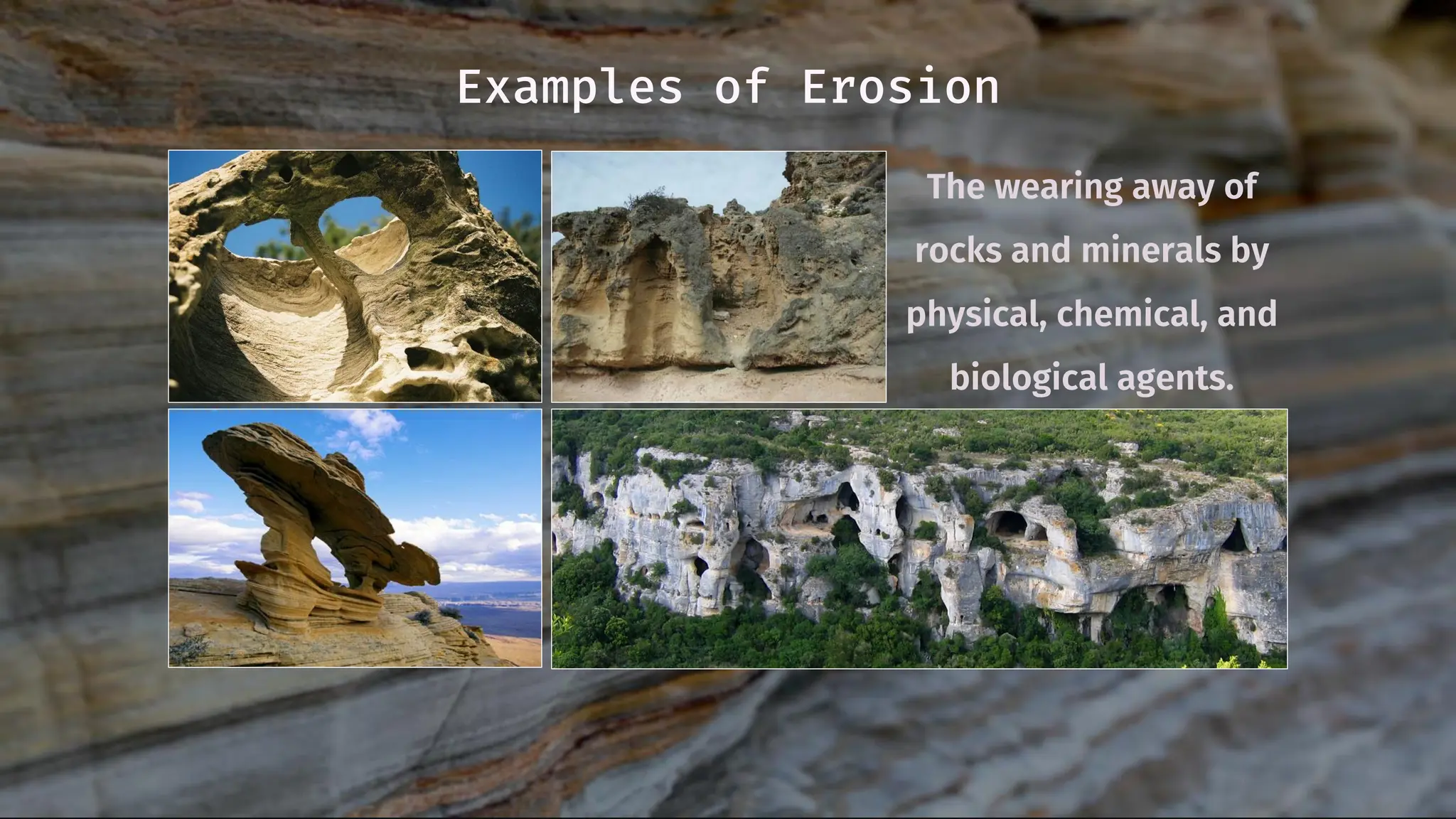
Examples of Erosion
The wearing away of
rocks and minerals by
physical, chemical, and
biological agents.
What do Sedimentary Rocks Record?
Magma
Igneous Rocks
Sedimentary Rocks
Metamorphic Rocks
Sediment
Crystallization Melting
Metamorphism
Lithification
Weathering
Erosion
Transport
Deposition
What do Sedimentary Rocks Record?
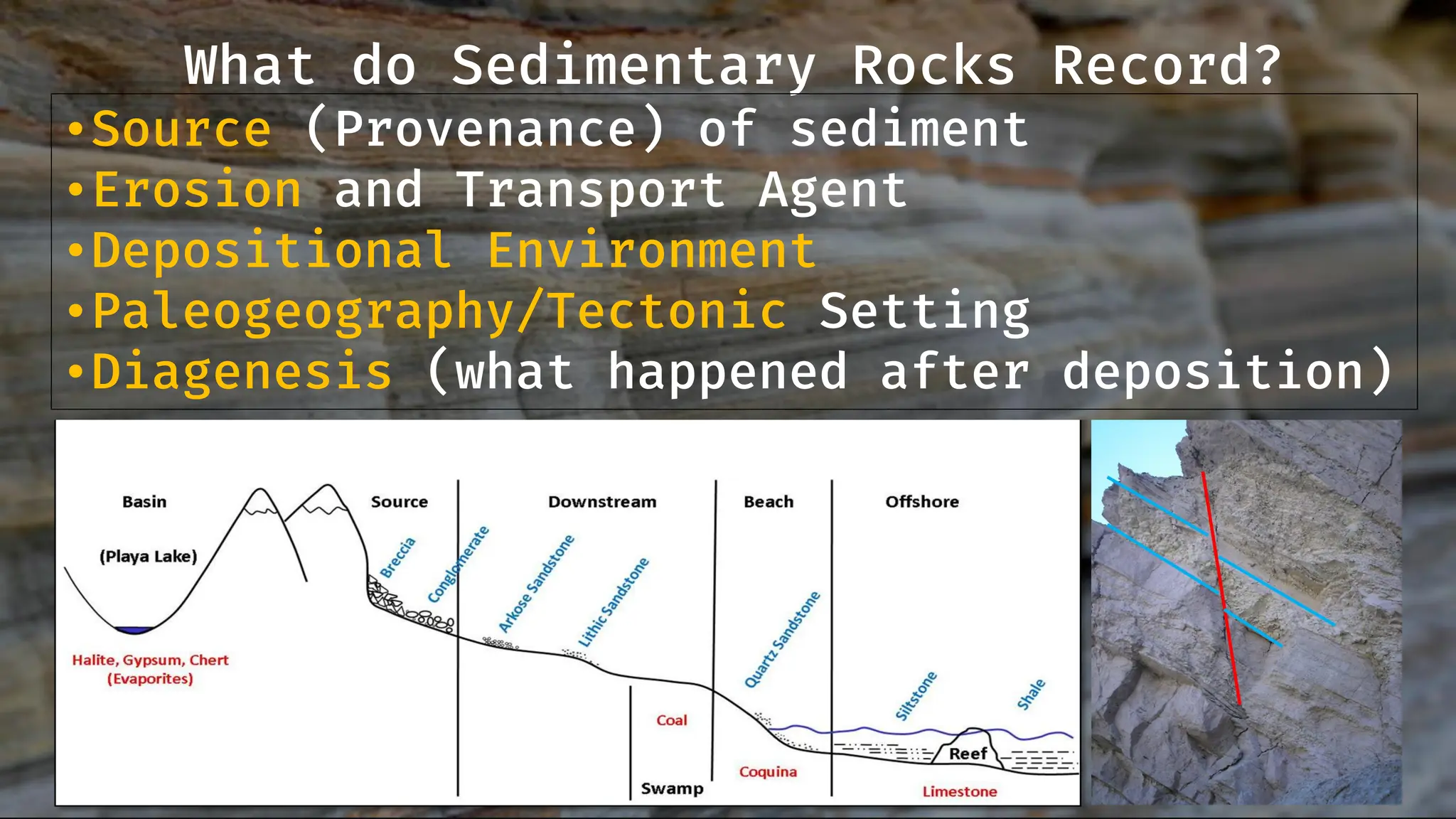
•Source (Provenance) of sediment
•Erosion and Transport Agent
•Depositional Environment
•Paleogeography/Tectonic Setting
•Diagenesis (what happened after deposition)
Petrography
Microscopic examination of rock thin
sections.
X-Ray Diffraction
Mineral composition and clay content
analysis.
Core Analysis
Physical properties and fluid flow
characteristics.
Seismic Facies
Large-scale depositional patterns and
geometries.
Sedimentological
Analysis
Techniques
Petrography
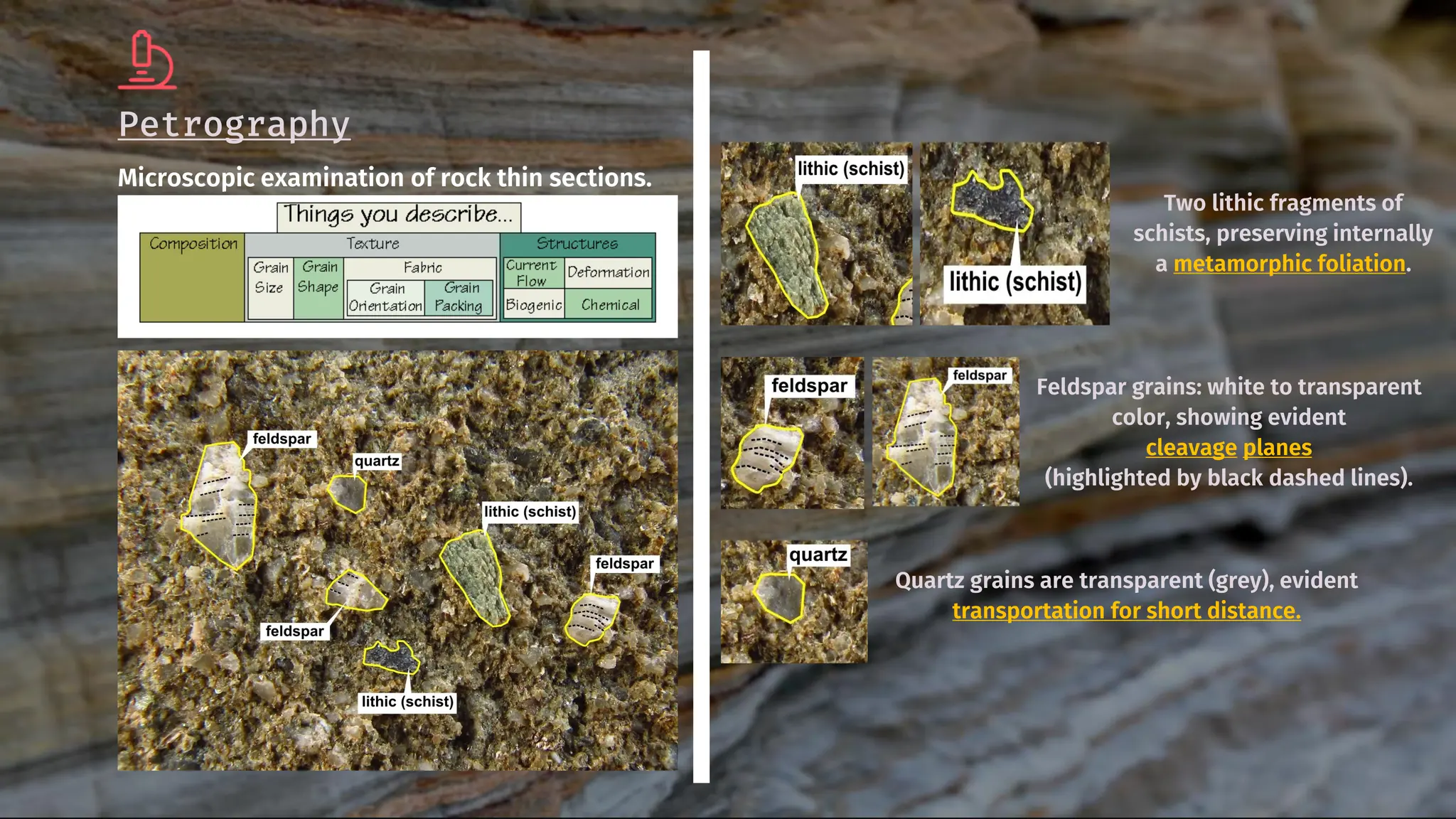
Microscopic examination of rock thin sections.
Feldspar grains: white to transparent
color, showing evident
cleavage planes
(highlighted by black dashed lines).
Quartz grains are transparent (grey), evident
transportation for short distance.
Two lithic fragments of
schists, preserving internally
a metamorphic foliation.
X-Ray Diffraction
Mineral composition and clay content analysis.
A Case study
A significant observation associated with the elevated gamma-ray (GR) readings is the considerable amount of clay,
particularly Kaolinite.
A curve generated by the author illustrates the increasing levels of Kaolinite and hematite, indicating that a more
exposed environment contributes to the formation of more porous intervals.
Core Analysis
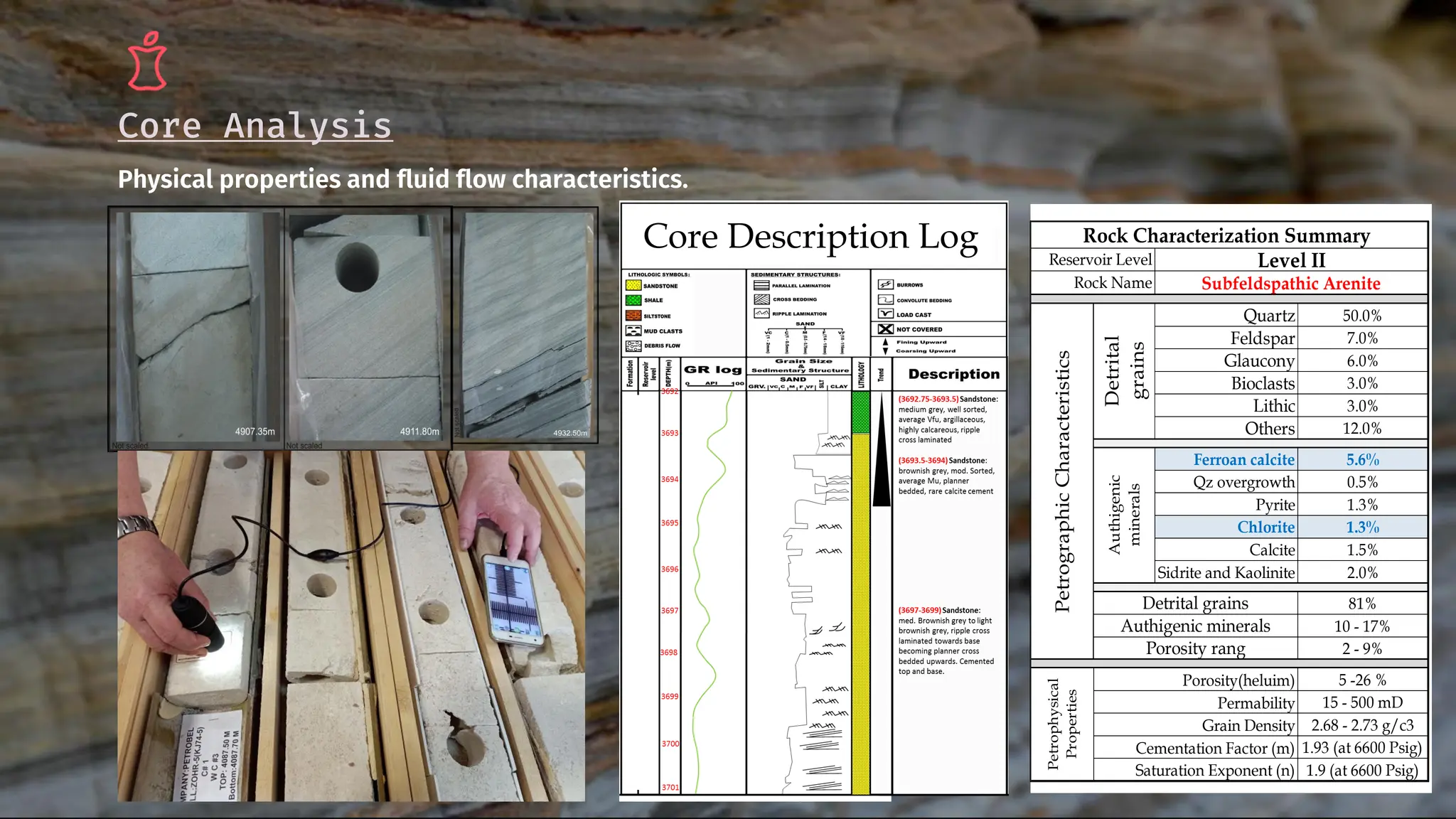
Physical properties and fluid flow characteristics.
Quartz 50.0%
Feldspar 7.0%
Glaucony 6.0%
Bioclasts 3.0%
Lithic 3.0%
Others 12.0%
Ferroan calcite 5.6%
Qz overgrowth 0.5%
Pyrite 1.3%
Chlorite 1.3%
Calcite 1.5%
Sidrite and Kaolinite 2.0%
81%
10 - 17%
2 - 9%
5 -26 %
15 - 500 mD
2.68 - 2.73 g/c3
1.93 (at 6600 Psig)
1.9 (at 6600 Psig)
Petrophysical
Properties
Porosity(heluim)
Permability
Grain Density
Cementation Factor (m)
Saturation Exponent (n)
Petrographic
Characteristics
Detrital
grains
Authigenic
minerals
Detrital grains
Authigenic minerals
Porosity rang
Rock Characterization Summary
Reservoir Level Level II
Rock Name Subfeldspathic Arenite
Core Description Log
Seismic Facies
Large-scale depositional patterns and geometries.
Sedimentary Structures: Clues to
Depositional Environments
Cross-bedding
Indicates the direction of ancient
water or wind currents.
Ripple Marks
Suggest the energy levels and flow
regimes of the depositional
environment.
Mudcracks
Provide evidence of periodic drying
and wetting of the sediment surface.
Sedimentary Structures
Bedding and laminations (Stratification)
refers to the layering of sedimentary rocks into distinct
horizontal layers or beds. Each bed represents a single
episode of deposition. Beds can vary in thickness and
composition and often provide a chronological record of
changing environmental conditions.
are distinctive features found within sedimentary rocks that provide valuable information about the
conditions under which the sediments were deposited, the processes that shaped them, and
sometimes even the direction of the ancient currents. These structures offer insights into the past
environments, such as river systems, coastal areas, deserts, and deep-sea settings.
Graded-Bedding
occurs when sediments within a bed change in size
from bottom to top. This structure is often found in
turbidity currents (underwater avalanches of
sediment) and debris flows. The larger particles
settle out first, forming the bottom of the bed, while
finer particles settle on top.
Sedimentary Structures..
are distinctive features found within sedimentary rocks that provide valuable information about the
conditions under which the sediments were deposited, the processes that shaped them, and
sometimes even the direction of the ancient currents. These structures offer insights into the past
environments, such as river systems, coastal areas, deserts, and deep-sea settings.
Fossils
While not strictly structures, fossils preserved
within sedimentary rocks provide crucial
insights into past life forms and ecosystems.
Fossils can be found in various positions, such
as in life position (preserved as they lived),
transported, or disarticulated.
Introduction to
Stratigraphy
1 Definition
Stratigraphy is the study of
the order, age, and
distribution of sedimentary
and volcanic rock layers.
2 Principles
Key principles include
superposition, original
horizontality, and lateral
continuity.
3 Applications
Stratigraphy is crucial for understanding geological history and
correlating rock units across regions.
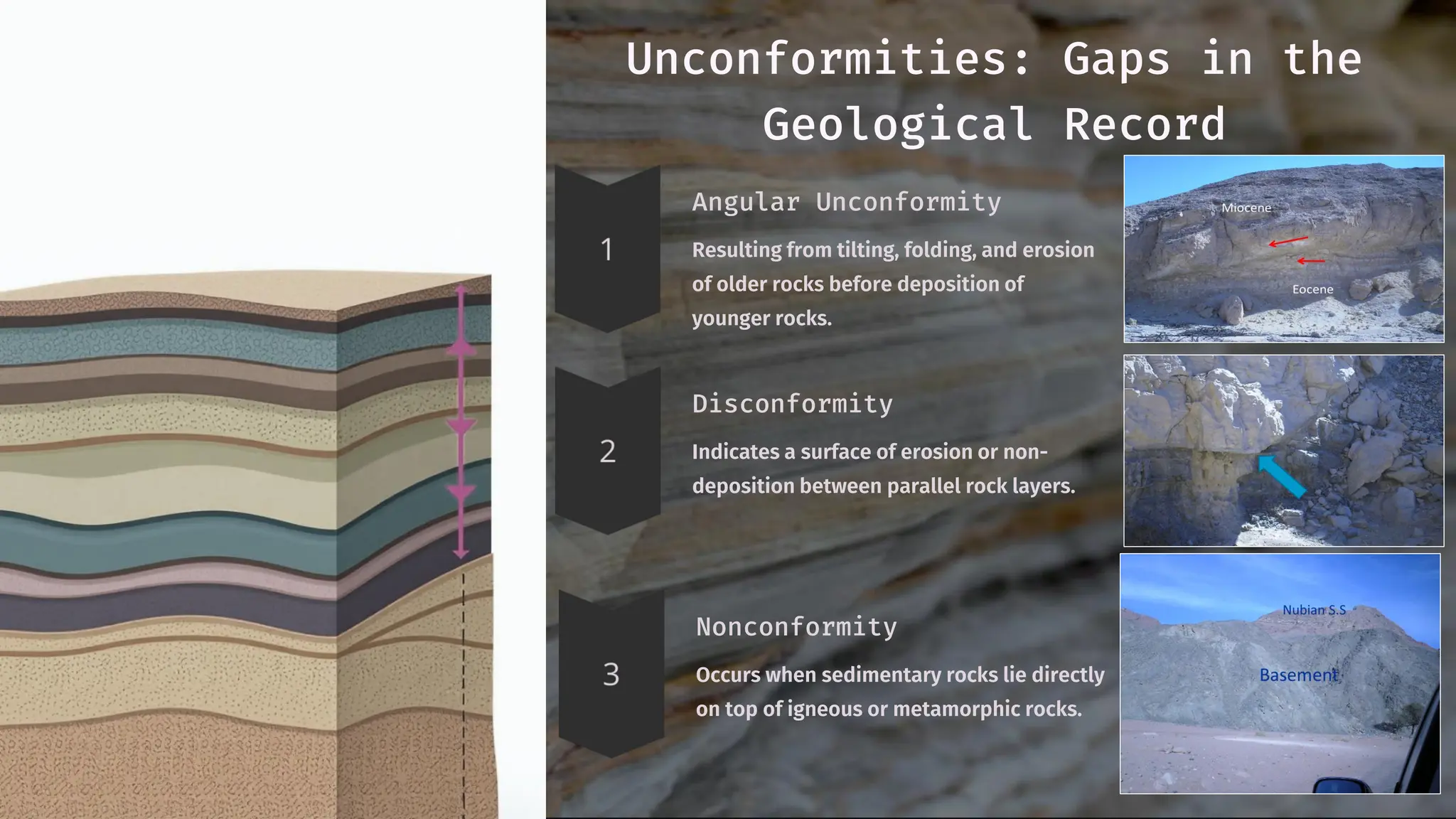
Unconformities: Gaps in the
Geological Record
Angular Unconformity
Resulting from tilting, folding, and erosion
of older rocks before deposition of
younger rocks.
Nonconformity
Occurs when sedimentary rocks lie directly
on top of igneous or metamorphic rocks.
Disconformity
Indicates a surface of erosion or non-
deposition between parallel rock layers.
Principles of
Stratigraphic Correlation
Lithologic
Matching rock types and sedimentary structures between locations.
Biostratigraphic
Using the distribution and succession of fossils to match rock units.
Geophysical
Applying techniques like magnetostratigraphy and chemostratigraphy.
Fundamentals of Sedimentology and Stratigraphy

Fundamentals of Sedimentology and Stratigraphy

  • 1.
    Fundamentals of Sedimentologyand Stratigraphy Key tools for Exploration and Development Dr. Islam H. Ali Sedimentology Department Manager Belayim Petroleum Company (Petrobel)/E ni’s J V.
  • 2.
    What is Sedimentology? Definition Sedimentologyis the study of the physical, chemical, and biological processes that govern the formation, transport, and deposition of sediments. Importance It helps us understand past environments, climate conditions, and tectonic activities that shaped the Earth's surface. Applications Sedimentology is crucial in fields like petroleum geology, paleontology, hydrology, and environmental science.
  • 3.
    Sedimentology is thescience that deals with the description, classification, and origin of sedimentary rock. It is the study of sediments and sedimentation. Sedimentology = the study of the processes of formation, transport and deposition of material which accumulates as sediment in continental and marine environments and eventually forms sedimentary rocks Stratigraphy the study of rocks to determine the order and timing of events in Earth history Sedimentology & Stratigraphy Sedimentary Geology » Sedimentology + Stratigraphy
  • 4.
    Applications of Sedimentologyand Stratigraphy Petroleum Exploration Identifying hydrocarbon-bearing reservoir rocks and traps through sedimentary facies analysis. Paleoenvironmental Reconstruction Interpreting ancient depositional environments and climate conditions from sedimentary evidence. Geohazard Assessment Studying sedimentary structures to assess risks of landslides, floods, and other natural hazards.
  • 5.
    1- Description ofsediments 2- Origin of sediments 3- Understanding the depositional condition resulting in the formation of a given sedimentary rock 4- Evolution of the sedimentary basin and the sequence 5- Information and understanding of the past depositional and environmental conditions The aim of Sedimentology
  • 6.
    1- Picture rockyoutcrops on the slopes of a valley in the mountains. When it rains, cracks in the rock fill with water. Sedimentation Process After Alexis Holt
  • 7.
    Sedimentation Process.. In coldweather, this water freezes into ice, which expands as it forms, creating new cracks in the rock. After Alexis Holt
  • 8.
    Sedimentation Process.. After severalcycles of freezing and thawing, fragments of rock become loose and fall from the outcrop, sliding downhill until they reach the river at the valley floor. After Alexis Holt
  • 9.
    Sedimentation Process.. Once inthe river, these rock fragments slide, roll, and bounce downstream, propelled by the water's flow. After Alexis Holt
  • 10.
    Sedimentation Process.. As theytravel, the fragments break down into smaller grains of sand and mud particles. After Alexis Holt
  • 11.
    Sedimentation Process.. When theriver empties into the sea, the rock fragments settle on the seabed as the water flow slows. After Alexis Holt
  • 12.
    Sedimentation Process.. Over longperiods, layers of pebbles, sand, and mud accumulate on the seabed at the river's mouth. After Alexis Holt
  • 13.
    Sedimentation Process.. Water circulatesthrough the small spaces between the rock particles in these layers, gradually depositing minerals that cement the particles together. Ultimately, sediments like sand and mud transform into sedimentary rocks known as sandstone and mudstone. After Alexis Holt
  • 14.
    Sedimentation Process.. Over millionsof years, layers of various sedimentary rocks stack on top of one another, forming rock formations that can reach hundreds of meters in thickness. These formations often remain undisturbed for hundreds of millions of years. After Alexis Holt
  • 15.
    Facies A body ofsedimentary rock with distinct characteristics that differentiate it from adjacent rock bodies, used to interpret the depositional environment and geological history. Lithofacies A type of facies defined by physical and mineralogical properties such as grain size, composition, color, and texture, providing insights into sedimentary environments. Biofacies Facies identified by their fossil content, reflecting biological conditions of the depositional environment and aiding in the understanding of paleoecology and biostratigraphy. Massive Sandstone Sandstone Nummulitic Grainstone Different Sedimentological definitions
  • 16.
    Different Sedimentological definitions SedimentaryFacies Units of sedimentary rock that exhibit specific characteristics indicating the conditions of deposition, encompassing aspects like lithology, texture, and fossil content. Environmental Facies Facies defined by the specific environmental conditions during sedimentation, including factors like water depth and energy levels, which help reconstruct past ecological dynamics. Petrographic Facies Subdivisions of rock based on detailed petrographic characteristics observed microscopically, reflecting their formation processes and diagenetic history. Quartz arenite
  • 17.
    Types of SedimentaryRocks Detrital (Mechanical) Organic Chemical Crystalline Texture Clastic Texture Formed by the breakdown of pre-existing rocks and minerals by the process of weathering and erosion Materials which form within the environment of transport and deposition Minerals which grow crystals in deposition environment
  • 18.
    Different Sedimentological definitions Texture refersto the physical characteristics of a rock or sediment, including the size, shape, and arrangement of its grains or particles Grain Size: The diameter of individual particles in a rock or sediment, which can range from clay (very fine) to boulders (very coarse). Common classifications include: Clay: < 0.002 mm Silt: 0.002 mm to 0.063 mm Sand: 0.063 mm to 2 mm Granule: 2 mm to 4 mm Pebble: 4 mm to 64 mm Cobble: 64 mm to 256 mm Boulder: > 256 mm Sorting: The uniformity of grain sizes in a sedimentary deposit. Well-sorted sediments contain grains of similar size, while poorly sorted sediments have a mix of sizes. Sorting can indicate the energy of the environment (e.g., high-energy environments tend to produce well-sorted materials). Shape: The form of the grains, which can be angular, rounded, or irregular. This provides clues about the history of the sediment, such as transport distance and energy conditions. Arrangement: The spatial distribution of grains, which includes aspects like layering or stratification and the presence of features such as cross-bedding or ripple marks. Fabrics: The three- dimensional arrangement of grains and how they interact with one another, which can influence the rock’s permeability and porosity.
  • 19.
    The Fundamental Processesof Sedimentation 1 Erosion The wearing away of rocks and minerals by physical, chemical, and biological agents. 2 Transport The movement of sediments by water, wind, ice, or gravity to new locations. 3 Deposition The settling and accumulation of sediments in different environments, such as rivers, lakes, or oceans.
  • 20.
    Examples of Erosion Thewearing away of rocks and minerals by physical, chemical, and biological agents.
  • 21.
    What do SedimentaryRocks Record? Magma Igneous Rocks Sedimentary Rocks Metamorphic Rocks Sediment Crystallization Melting Metamorphism Lithification Weathering Erosion Transport Deposition
  • 22.
    What do SedimentaryRocks Record? •Source (Provenance) of sediment •Erosion and Transport Agent •Depositional Environment •Paleogeography/Tectonic Setting •Diagenesis (what happened after deposition)
  • 23.
    Petrography Microscopic examination ofrock thin sections. X-Ray Diffraction Mineral composition and clay content analysis. Core Analysis Physical properties and fluid flow characteristics. Seismic Facies Large-scale depositional patterns and geometries. Sedimentological Analysis Techniques
  • 24.
    Petrography Microscopic examination ofrock thin sections. Feldspar grains: white to transparent color, showing evident cleavage planes (highlighted by black dashed lines). Quartz grains are transparent (grey), evident transportation for short distance. Two lithic fragments of schists, preserving internally a metamorphic foliation.
  • 25.
    X-Ray Diffraction Mineral compositionand clay content analysis. A Case study A significant observation associated with the elevated gamma-ray (GR) readings is the considerable amount of clay, particularly Kaolinite. A curve generated by the author illustrates the increasing levels of Kaolinite and hematite, indicating that a more exposed environment contributes to the formation of more porous intervals.
  • 26.
    Core Analysis Physical propertiesand fluid flow characteristics. Quartz 50.0% Feldspar 7.0% Glaucony 6.0% Bioclasts 3.0% Lithic 3.0% Others 12.0% Ferroan calcite 5.6% Qz overgrowth 0.5% Pyrite 1.3% Chlorite 1.3% Calcite 1.5% Sidrite and Kaolinite 2.0% 81% 10 - 17% 2 - 9% 5 -26 % 15 - 500 mD 2.68 - 2.73 g/c3 1.93 (at 6600 Psig) 1.9 (at 6600 Psig) Petrophysical Properties Porosity(heluim) Permability Grain Density Cementation Factor (m) Saturation Exponent (n) Petrographic Characteristics Detrital grains Authigenic minerals Detrital grains Authigenic minerals Porosity rang Rock Characterization Summary Reservoir Level Level II Rock Name Subfeldspathic Arenite Core Description Log
  • 27.
  • 28.
    Sedimentary Structures: Cluesto Depositional Environments Cross-bedding Indicates the direction of ancient water or wind currents. Ripple Marks Suggest the energy levels and flow regimes of the depositional environment. Mudcracks Provide evidence of periodic drying and wetting of the sediment surface.
  • 29.
    Sedimentary Structures Bedding andlaminations (Stratification) refers to the layering of sedimentary rocks into distinct horizontal layers or beds. Each bed represents a single episode of deposition. Beds can vary in thickness and composition and often provide a chronological record of changing environmental conditions. are distinctive features found within sedimentary rocks that provide valuable information about the conditions under which the sediments were deposited, the processes that shaped them, and sometimes even the direction of the ancient currents. These structures offer insights into the past environments, such as river systems, coastal areas, deserts, and deep-sea settings. Graded-Bedding occurs when sediments within a bed change in size from bottom to top. This structure is often found in turbidity currents (underwater avalanches of sediment) and debris flows. The larger particles settle out first, forming the bottom of the bed, while finer particles settle on top.
  • 30.
    Sedimentary Structures.. are distinctivefeatures found within sedimentary rocks that provide valuable information about the conditions under which the sediments were deposited, the processes that shaped them, and sometimes even the direction of the ancient currents. These structures offer insights into the past environments, such as river systems, coastal areas, deserts, and deep-sea settings. Fossils While not strictly structures, fossils preserved within sedimentary rocks provide crucial insights into past life forms and ecosystems. Fossils can be found in various positions, such as in life position (preserved as they lived), transported, or disarticulated.
  • 31.
    Introduction to Stratigraphy 1 Definition Stratigraphyis the study of the order, age, and distribution of sedimentary and volcanic rock layers. 2 Principles Key principles include superposition, original horizontality, and lateral continuity. 3 Applications Stratigraphy is crucial for understanding geological history and correlating rock units across regions.
  • 32.
    Unconformities: Gaps inthe Geological Record Angular Unconformity Resulting from tilting, folding, and erosion of older rocks before deposition of younger rocks. Nonconformity Occurs when sedimentary rocks lie directly on top of igneous or metamorphic rocks. Disconformity Indicates a surface of erosion or non- deposition between parallel rock layers.
  • 33.
    Principles of Stratigraphic Correlation Lithologic Matchingrock types and sedimentary structures between locations. Biostratigraphic Using the distribution and succession of fossils to match rock units. Geophysical Applying techniques like magnetostratigraphy and chemostratigraphy.