UPLOAD TO SLIDE SHARE ALL4
OPEN ALL OF THESE-3 AM
• aaaaaaaaaaROCKEXAM aaaaaFELSIC PAGE 58
• Answers to tell class on Monday j5 ese 11 new
• And
• Characteristics of sedimentary rocks
• And
• Agends foe first payday open this Sunday and
monday
NEXT H.W-metamorphic rock
• PAGE 106-EX 1
Page 109 –ex 2
Page 110-ex 3 and 4
Page 111-ex 5
Page 113-ex 6
Page 114-ex 7
Page 119-ex 8
Page 120-ex 9
NEXT H.W-metamorphic rock
• Page 122-ex 10
• Page 123-ex 11
• Page 124-ex 11-cont.
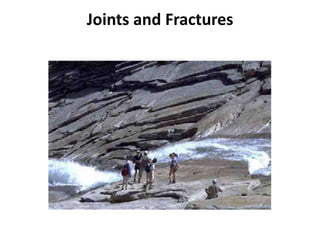
• Page 125-ex metamorphic study sheet
• Page 126-ex metamorphic study sheet
• Page 127 -152-read ahead is best
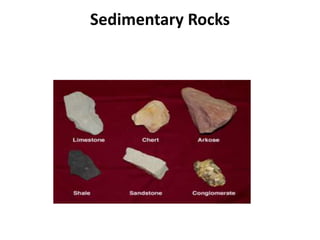
Sedimentary Rocks
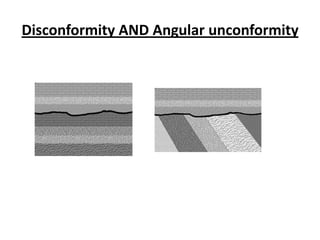
Granite is Phaneritic and
• Composed of (page 72)
• Granite is a hard, coarse-grained rock making
up most of the earth. It consists chiefly of
three minerals: quartz, alkali feldspar (which
contain alumina and silica) and plagioclase
feldspar (which contain sodium and calcium).
It also contains small amounts of minerals
such as hornblende and biotite mica.
What ions
• Composed of (page 72)
• 1. Feldspars AlSi3Os (M : H, Li, Ag) synthesized
by low-temperature ion exchange
• only feldspars with essentially disordered Al-Si
distributions
2. plagioclase feldspar (which contain sodium
and calcium).
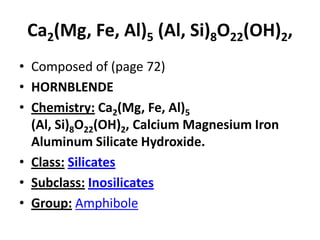
Ca2(Mg, Fe, Al)5 (Al, Si)8O22(OH)2,
• Composed of (page 72)
• HORNBLENDE
• Chemistry: Ca2(Mg, Fe, Al)5
(Al, Si)8O22(OH)2, Calcium Magnesium Iron
Aluminum Silicate Hydroxide.
• Class: Silicates
• Subclass: Inosilicates
• Group: Amphibole
compaction of the sediments.
• Sedimentary rocks are formed due to the
aggradations and compaction of the
sediments.
• The word sedimentary has been derived from
the Latin word which means settling down..
Stratified or layered rocks
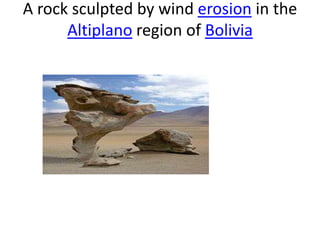
• The sedimentary rocks are also Called as
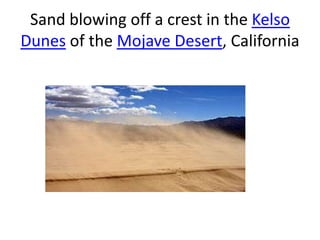
Stratified or layered rocks and hence Consists
of different types of layers and strata of
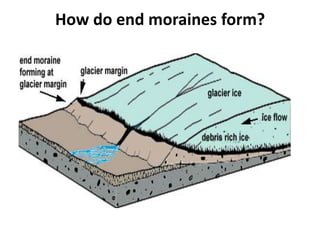
various sediments. Some sedimentary rocks
do not consist of layers, ex: loess.
Characteristics of Sedimentary rocks
• Sedimentary rocks are formed of sediments
derived from older rocks, Plants and animal
remains thus these rocks contains fossils of
animals and plants
Characteristics of Sedimentary rocks
• The sedimentary rocks are widespread about
75 % of the globe consists of sedimentary
rocks and the remaining 25% by igneous and
metamorphic rocks. Nevertheless the
sedimentary constitute only 5 % of the
composition of earth’s crust
Characteristics of Sedimentary rocks
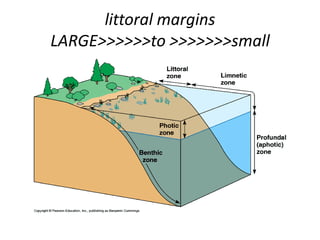
• The deposition of sediments takes place in a
certain sequence. The size of the Sediments
decreases from the littoral margins to the
centre of the water bodies.
littoral margins
LARGE>>>>>>to >>>>>>>small
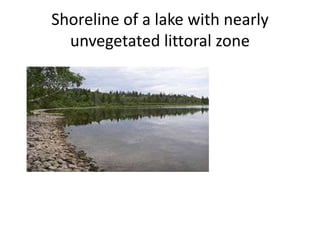
Shoreline of a lake with nearly
unvegetated littoral zone
Characteristics of Sedimentary rocks
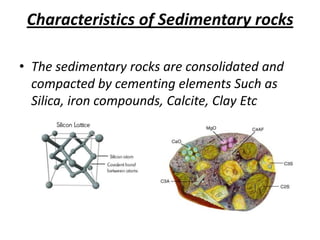
• The sedimentary rocks are consolidated and
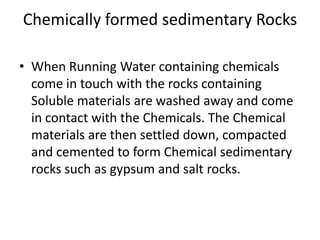
compacted by cementing elements Such as
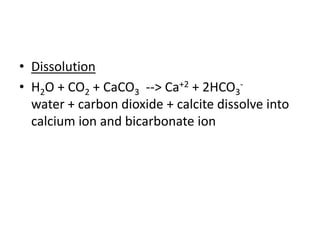
Silica, iron compounds, Calcite, Clay Etc
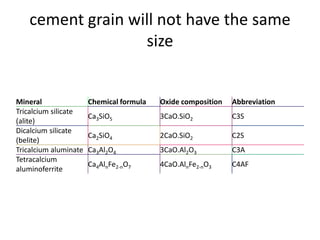
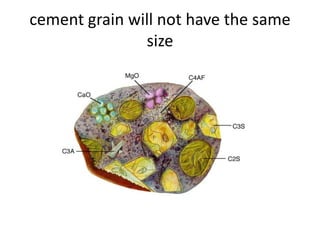
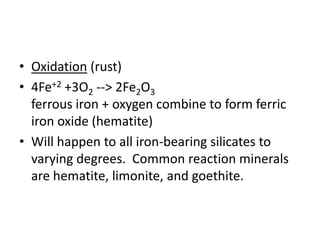
cement grain will not have the same
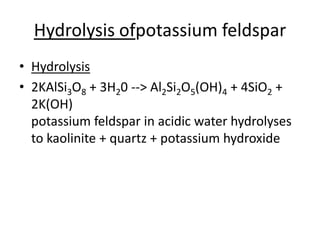
size
Mineral Chemical formula Oxide composition Abbreviation
Tricalcium silicate
(alite)
Ca3SiO5 3CaO.SiO2 C3S
Dicalcium silicate
(belite)
Ca2SiO4 2CaO.SiO2 C2S
Tricalcium aluminate Ca3Al2O4 3CaO.Al2O3 C3A
Tetracalcium
aluminoferrite
Ca4AlnFe2-nO7 4CaO.AlnFe2-nO3 C4AF
cement grain will not have the same
size
calcium aluminoferrite
• The calcium aluminoferrite (C4AF) forms a
continuous phase around the other mineral
crystallites, as the iron containing species act
as a fluxing agent in the rotary kiln during
cement production and are the last to solidify
around the others. Figure 1 shows a typical
cement grain.
Characteristics of Sedimentary rocks
• of cementing materials and the rocks are
Seldom found in their original manner because
of the lateral compressive and tensile forces
Characteristics of Sedimentary rocks
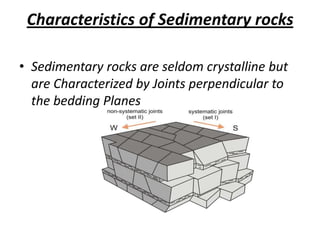
• Sedimentary rocks are seldom crystalline but
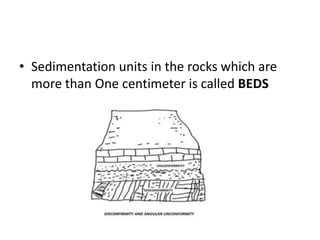
are Characterized by Joints perpendicular to
the bedding Planes
Joints and Fractures
Characteristics of Sedimentary rocks
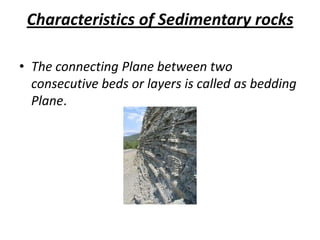
• The connecting Plane between two
consecutive beds or layers is called as bedding
Plane.
Types of formation in Sedimentary
rocks
• When two beds are uniform along the
bedding Plane then this type of formation is
called conformity.
• Non-conformity (where sedimentary rocks
succeed igneous & metamorphic rocks)
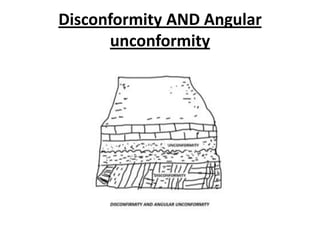
• Angular unconformity (where horizontal
sedimentary beds are deposited over the
previously folded strata)
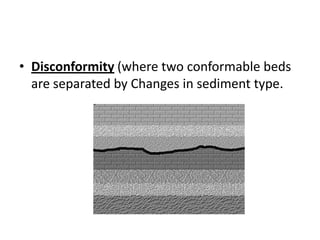
• Disconformity (where two conformable beds are
separated by Changes in sediment type.
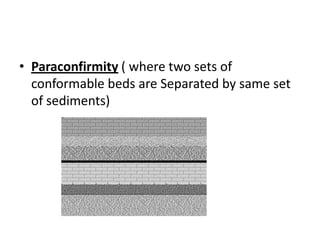
• Paraconfirmity ( where two sets of conformable
beds are Separated by same set of sediments)
two beds
• conformity.
• When two beds are uniform along the
bedding Plane then this type of formation is
called conformity.
• When two beds are not uniform then the
structure is called as Unconformity
Types of formation in Sedimentary
rocks
• Unconformity
• When two beds are not uniform then the
structure is called as Unconformity.
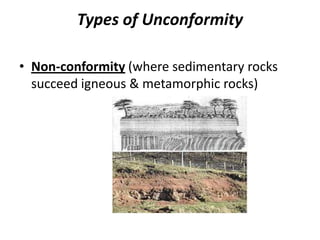
Types of Unconformity
• Non-conformity (where sedimentary rocks
succeed igneous & metamorphic rocks)
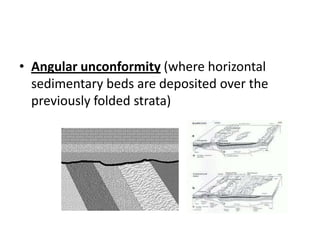
• Angular unconformity (where horizontal
sedimentary beds are deposited over the
previously folded strata)
• Disconformity (where two conformable beds
are separated by Changes in sediment type.
• Paraconfirmity ( where two sets of
conformable beds are Separated by same set
of sediments)
• A paraconformity is a type of unconformity in
which strata are parallel; there is little
apparent erosion and the unconformity
surface resembles a simple bedding plane. It is
also called nondepositional unconformity or
pseudoconformity.
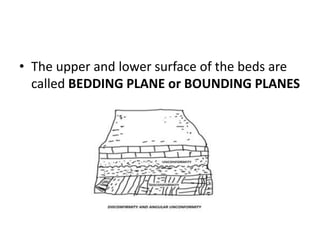
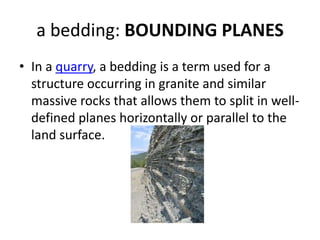
Disconformity AND Angular
unconformity
Disconformity AND Angular unconformity
• Sedimentation units in the rocks which are
more than One centimeter is called BEDS
• The upper and lower surface of the beds are
called BEDDING PLANE or BOUNDING PLANES
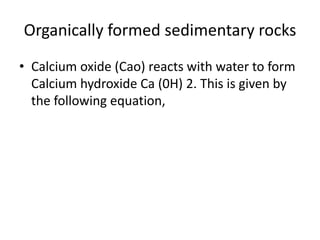
a bedding: BOUNDING PLANES
• In a quarry, a bedding is a term used for a
structure occurring in granite and similar
massive rocks that allows them to split in well-
defined planes horizontally or parallel to the
land surface.
• Sometimes the lower surface of the bed is
called SOLE. There are further sedimentary
units within a bed. The units having more than
one centimeter is called layer or Strata Where
as the units below one centimeter are Called
laminae
strata and Layer > 1 cm
laminae < 1 cm
• 1 cm<
• more than one centimeter is called layer
or Strata
Where as the units below one centimeter are
Called laminae < 1 cm
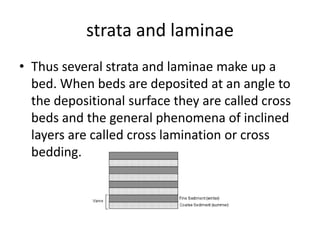
strata and laminae
• Thus several strata and laminae make up a
bed. When beds are deposited at an angle to
the depositional surface they are called cross
beds and the general phenomena of inclined
layers are called cross lamination or cross
bedding.
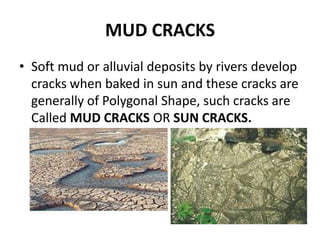
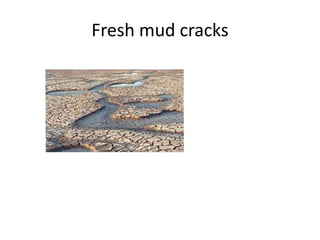
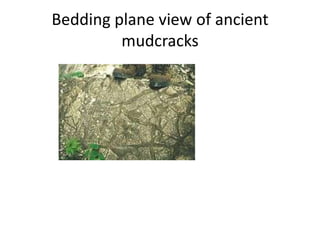
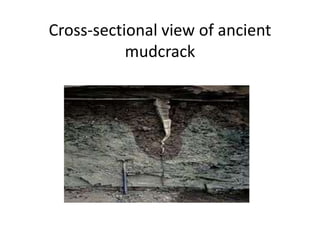
MUD CRACKS
• Soft mud or alluvial deposits by rivers develop
cracks when baked in sun and these cracks are
generally of Polygonal Shape, such cracks are
Called MUD CRACKS OR SUN CRACKS.
Fresh mud cracks
Bedding plane view of ancient
mudcracks
Cross-sectional view of ancient
mudcrack
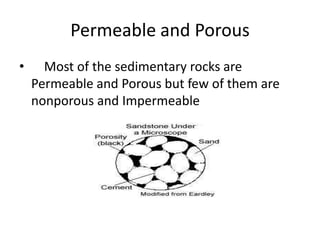
Permeable and Porous
• Most of the sedimentary rocks are
Permeable and Porous but few of them are
nonporous and Impermeable
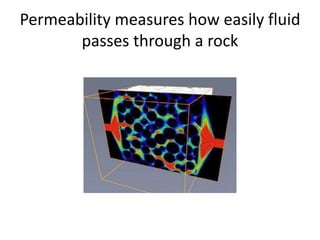
Permeability measures how easily fluid
passes through a rock
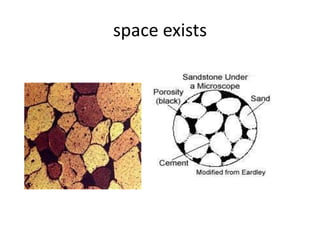
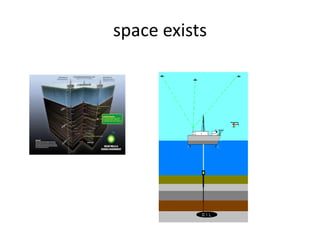
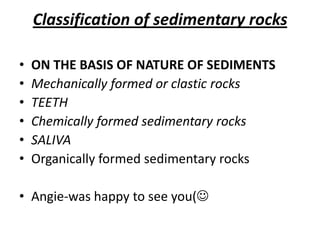
space exists
a decent oil well,
• This means 92 percent is solid rock and 8
percent is open space containing oil, gas, or
water. Eight percent is about the minimum
porosity that is required to make a decent oil
well,
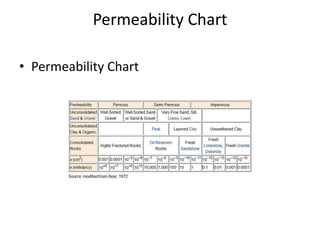
Permeability Chart
• Permeability Chart
space exists
Classification of sedimentary rocks
• ON THE BASIS OF NATURE OF SEDIMENTS
• Mechanically formed or clastic rocks
• TEETH
• Chemically formed sedimentary rocks
• SALIVA
• Organically formed sedimentary rocks
• Angie-was happy to see you(
Classification of sedimentary rocks
– ON THE BASIS OF NATURE OF SEDIMENTS
– Mechanically formed or clastic rocks
• Sandstones
• Conglomerates
• Clay rock
• Shale
• Loess
Classification of sedimentary rocks
– ON THE BASIS OF NATURE OF SEDIMENTS
– Chemically formed sedimentary rocks
• Gypsum
• Salt rock
Classification of sedimentary rocks
– ON THE BASIS OF NATURE OF SEDIMENTS
– Organically formed sedimentary rocks
• Limestone
• Dolomites
• Coals
• Peats
ON THE BASIS OF TRANSPORTING
AGENTS
– Argillaceous or aqueous rocks
• Marine rocks
• Lacustrine rocks
• Riverine rocks
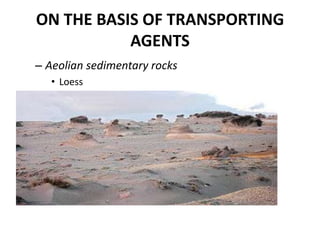
ON THE BASIS OF TRANSPORTING
AGENTS
– Aeolian sedimentary rocks
• Loess
Aeolian processes
• Aeolian processes, also spelled eolian, or
æolian, pertain to wind activity in the study of
geology and weather, and specifically to the
wind's ability to shape the surface of the Earth
(or other planets). Winds may
erode, transport, and deposit materials, and
are effective agents in regions with sparse
vegetation and a large supply of
unconsolidated sediments
A rock sculpted by wind erosion in the
Altiplano region of Bolivia
Sand blowing off a crest in the Kelso
Dunes of the Mojave Desert, California
ON THE BASIS OF TRANSPORTING
AGENTS
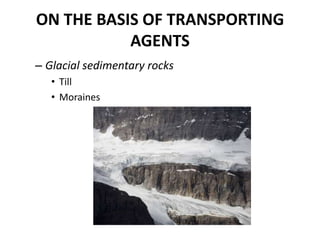
– Glacial sedimentary rocks
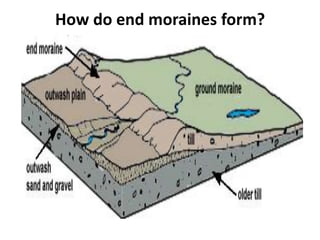
• Till
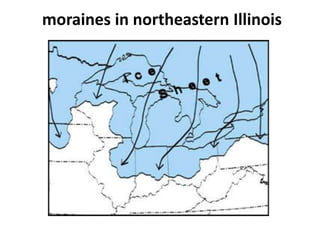
• Moraines
How do end moraines form?
moraines in northeastern Illinois
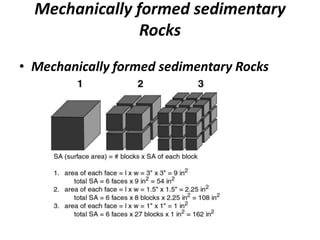
Mechanically formed sedimentary
Rocks
• Mechanically formed sedimentary Rocks
Mechanically formed sedimentary
Rocks
• Previously formed rocks are subjected to
mechanical or physical disintegration these
are called fragmental rock materials or Clastic
materials which become the source materials
for the formation of mechanical or clastic
sedimentary rocks.
Mechanically formed sedimentary
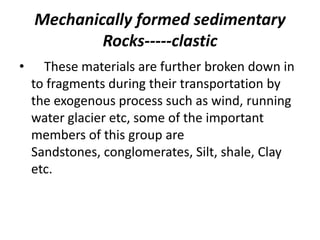
Rocks-----clastic
• These materials are further broken down in
to fragments during their transportation by
the exogenous process such as wind, running
water glacier etc, some of the important
members of this group are
Sandstones, conglomerates, Silt, shale, Clay
etc.
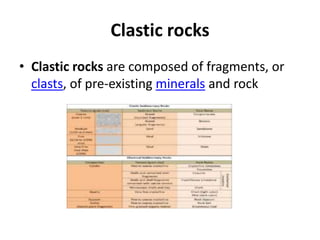
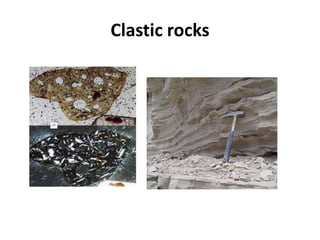
Clastic rocks
• Clastic rocks are composed of fragments, or
clasts, of pre-existing minerals and rock
Clastic rocks
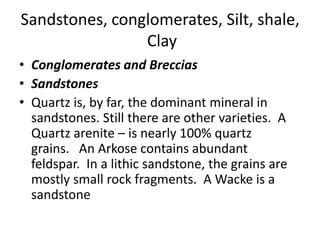
Sandstones, conglomerates, Silt, shale,
Clay
• Conglomerates and Breccias
• Sandstones
• Quartz is, by far, the dominant mineral in
sandstones. Still there are other varieties. A
Quartz arenite – is nearly 100% quartz
grains. An Arkose contains abundant
feldspar. In a lithic sandstone, the grains are
mostly small rock fragments. A Wacke is a
sandstone
Mechanically formed sedimentary
Rocks
• Sandstones
• Sandstones are formed mostly due to the
deposition, Cementation, compaction of Sand
grains. The Sand grains are divided into five
categories on the basis of their size
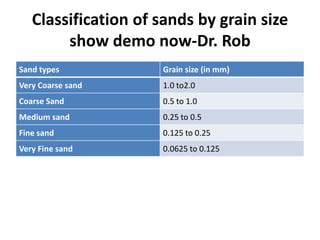
Classification of sands by grain size
show demo now-Dr. Rob
Sand types Grain size (in mm)
Very Coarse sand 1.0 to2.0
Coarse Sand 0.5 to 1.0
Medium sand 0.25 to 0.5
Fine sand 0.125 to 0.25
Very Fine sand 0.0625 to 0.125
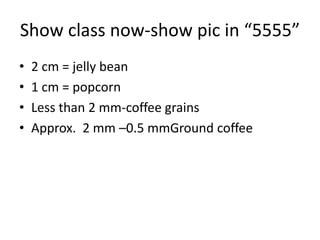
Show class now-show pic in “5555”
• 2 cm = jelly bean
• 1 cm = popcorn
• Less than 2 mm-coffee grains
• Approx. 2 mm –0.5 mmGround coffee
grains are deposited in the water
•
• These grains are deposited in the water
bodies, and are aggravated and consolidated
by Cementing elements such as Silica,
Calcium, iron oxide Clay etc. The Colour of the
sandstone Varies according to the nature of
the cementing elements.
Sandstones
• Sandstones become red and gray when
cemented by iron oxide and in to white when
the cementing element is replaced by calcium
Carbonate.
Sandstones
• . They become hard and resistant when
cemented by Silica. On an average the
sandstones are generally porous rocks.
Sandstones
• On the basis of mineralogical and textural
Characteristics sandstones are classified in to
the following types:
• Quartz Arenites (composed entirely of quartz
grains)
Quartz Arenites
• Quartz Arenites (composed entirely of quartz
grains)
Arkose Sandstones
• Arkose Sandstones (feldspar being the
dominant Mineral)
Lithic Arenites
• Lithic Arenites (composed of fine grained rock
fragments derived from Shales, schist, slates
and volcanic rocks).
Greywackle Sandstones
• Greywackle Sandstones (Composed of
feldspar, rock fragments, quartz).
Arsenite
• Note: The English word Arsenite is derived
from Latin word Arena-meaning thereby
Sand.
Stop here -3 am
• Conglomerates
• They are formed due to the consolidation
and cementing of pebbles of various Sizes
with Sands. Polished round fragments of size
with 4 mm of diameter are called Pebbles and
those with a diameter 256mm are called
boulders. Angular rock fragments are Called
breccia.
Clay rock and shale
• Clay rock and shale
• They are formed due to the deposition
and cementation of fine sediments.
Clay rock and shale
• Clay rock and shale
• . Sediment having grain size of 0.3mm to
O.4mm are called silts where as Clays are
formed When the grain size is between
0.4mm to O. 00012 mm are Cemented or
consolidated.
Clay rock and shale
• Clay rock and shale
• . Clay rocks are formed exclusive Kaolin
minerals and pure White in colour but they
Change to different colours because of being
mixed with impurities.
Chemically formed sedimentary Rocks
• When Running Water containing chemicals
come in touch with the rocks containing
Soluble materials are washed away and come
in contact with the Chemicals. The Chemical
materials are then settled down, compacted
and cemented to form Chemical sedimentary
rocks such as gypsum and salt rocks.
• Dissolution
• H2O + CO2 + CaCO3 --> Ca+2 + 2HCO3
-
water + carbon dioxide + calcite dissolve into
calcium ion and bicarbonate ion
• Oxidation (rust)
• 4Fe+2 +3O2 --> 2Fe2O3
ferrous iron + oxygen combine to form ferric
iron oxide (hematite)
• Will happen to all iron-bearing silicates to
varying degrees. Common reaction minerals
are hematite, limonite, and goethite.
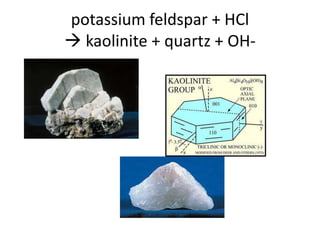
Hydrolysis ofpotassium feldspar
• Hydrolysis
• 2KAlSi3O8 + 3H20 --> Al2Si2O5(OH)4 + 4SiO2 +
2K(OH)
potassium feldspar in acidic water hydrolyses
to kaolinite + quartz + potassium hydroxide
potassium feldspar + HCl
 kaolinite + quartz + OH-
Organically formed sedimentary rocks
• The sediments derived from the
disintegration and decomposition of Plants
and animals deposit and consolidate to form
organic sedimentary rocks. The rocks are
divided in to three categories on the basis of
its carbon and lime content. They are
Organically formed sedimentary rocks
• Calcareous rocks
• Carbonaceous rocks
• Siliceous rocks
Organically formed sedimentary rocks
• Calcareous rocks are formed due to the
deposition and consolidation of sediments
derived from the remnants of animals and
plants which contain lime. Limestone is one of
the examples of the calcareous rocks.
Limestone is formed in the following Manner
Organically formed sedimentary rocks
• Calcium oxide (Cao) reacts with water to form
Calcium hydroxide Ca (0H) 2. This is given by
the following equation,
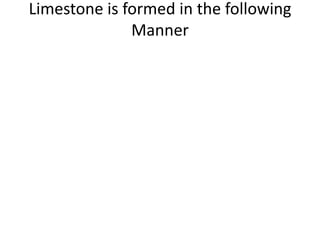
Limestone is formed in the following
Manner
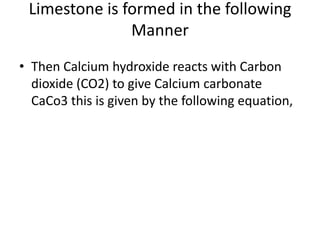
• Then Calcium hydroxide reacts with Carbon
dioxide (CO2) to give Calcium carbonate
CaCo3 this is given by the following equation,
Limestone is formed in the following
Manner
Limestone : calcareous rocks
•
• The calcareous rocks are collectively called
as carbonate rocks or carbonates. Calcium
carbonate (Caco3), Magnesium carbonate
(Mgco3), dolomite (CaMg (co3)2 are
important calcareous rocks. Limestone is both
thinly beaded and thickly bedded. The most
dominant minerals are calcite
(Hexagonal), Aragonite (orthorhombic).
Limestone : calcareous rocks
• Though Limestone are weak rocks in humid
regions they become more resistant when
exposed to dry climate, because of its uniform
or homogenous structure they are not easily
affected by differential expansion and
contraction due to temperature.
Limestone : calcareous rocks
• The Carbonate rocks after Chemical
weathering give birth too karst topography.
Chalks another form of Carbonate rocks are
formed due to the Precipitation of Carbonate
minerals desired from microorganisms like
foraminifera.
STOP HERE-5:35 AM
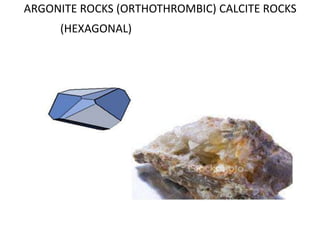
ARGONITE ROCKS (ORTHOTHROMBIC) CALCITE ROCKS
(HEXAGONAL)
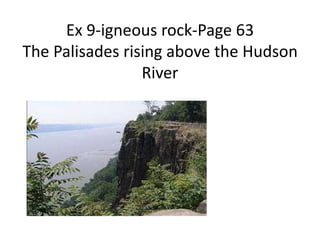
Ex 9-igneous rock-Page 63
The Palisades rising above the Hudson
River
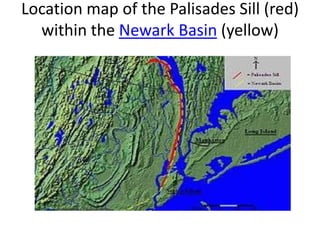
Location map of the Palisades Sill (red)
within the Newark Basin (yellow)
• The outcrop of the Palisades Sill is quite
recognizable for its prominent cliffs above the
Hudson River; it is easily seen from the
western portions of Manhattan
• The exposure is approximately 80 kilometers
(50 mi) long, most of it following the Hudson
River. It first emerges in Staten Island in New
York City.[1] The sill then crosses the state line
into New Jersey, where Hoboken, Jersey
City, Union City, Fort Lee, and Englewood Cliffs
all lie on it
• The sill eventually crosses back into New
York, following the Hudson River north until
reaching Haverstraw. It is at this point that the
sill makes a turn to the west, where it
disappears near Pomona. At this turn, the sill
cuts across local strata, making it a dike in that
area, not a sill.
• It has been proposed that the sill reemerges in
two locations in Pennsylvania (where the
outcrops are also discordant with local strata),
but this idea is not generally agreed upon, and
discussion of the Palisades Sill is usually
limited to the exposure in New York and New
Jersey.
Figure 11
• Separate host of granite from the mafic (Mg
and Fe)
• Suggest a origin of these zones:
• 1. partial melting-produces basalt
• 2. magnetic differentiation is best answer: it
separates early formed-denser material from
magma
Figure 11
• 3. also assimilation: since as magma rises-it
may add ions by melting
• As new material is incorporated –the magma
composition may change enough to enable
crystal to form –which might not ever been
otherwise able to be produced
Figure 11
• 4. lastly-magma mixing-evidence suggests
some intermediate rocks did not crystalize
• So they formed when-felsic and mafic were
mixed
Figure 12
• Tectonic settings for major igneous rock types
• Convergent boundaries
• Subduction zones
• Volcanic island arcs
• Andean –type mountains
Divergent boundaries
• Ocean hot-spot islands-basalt
• Ocean floors-basalt (MORB)
• Mid ocean ridges-basalt (MORB)
• Continental rift zones (Ryolite)
• Continents (granite, ryolite, basalt
Ex 10-page 65
• A. mid ocean ridges
• B. continental rifts
• C. oceanic and continental volcanic arcs
• D. hot spots

Answers part four do monday october 8

  • 2.
    UPLOAD TO SLIDESHARE ALL4 OPEN ALL OF THESE-3 AM • aaaaaaaaaaROCKEXAM aaaaaFELSIC PAGE 58 • Answers to tell class on Monday j5 ese 11 new • And • Characteristics of sedimentary rocks • And • Agends foe first payday open this Sunday and monday
  • 3.
    NEXT H.W-metamorphic rock •PAGE 106-EX 1 Page 109 –ex 2 Page 110-ex 3 and 4 Page 111-ex 5 Page 113-ex 6 Page 114-ex 7 Page 119-ex 8 Page 120-ex 9
  • 4.
    NEXT H.W-metamorphic rock •Page 122-ex 10 • Page 123-ex 11 • Page 124-ex 11-cont. • Page 125-ex metamorphic study sheet • Page 126-ex metamorphic study sheet • Page 127 -152-read ahead is best
  • 6.
  • 7.
    Granite is Phaneriticand • Composed of (page 72) • Granite is a hard, coarse-grained rock making up most of the earth. It consists chiefly of three minerals: quartz, alkali feldspar (which contain alumina and silica) and plagioclase feldspar (which contain sodium and calcium). It also contains small amounts of minerals such as hornblende and biotite mica.
  • 8.
    What ions • Composedof (page 72) • 1. Feldspars AlSi3Os (M : H, Li, Ag) synthesized by low-temperature ion exchange • only feldspars with essentially disordered Al-Si distributions 2. plagioclase feldspar (which contain sodium and calcium).
  • 9.
    Ca2(Mg, Fe, Al)5(Al, Si)8O22(OH)2, • Composed of (page 72) • HORNBLENDE • Chemistry: Ca2(Mg, Fe, Al)5 (Al, Si)8O22(OH)2, Calcium Magnesium Iron Aluminum Silicate Hydroxide. • Class: Silicates • Subclass: Inosilicates • Group: Amphibole
  • 10.
    compaction of thesediments. • Sedimentary rocks are formed due to the aggradations and compaction of the sediments. • The word sedimentary has been derived from the Latin word which means settling down..
  • 11.
    Stratified or layeredrocks • The sedimentary rocks are also Called as Stratified or layered rocks and hence Consists of different types of layers and strata of various sediments. Some sedimentary rocks do not consist of layers, ex: loess.
  • 12.
    Characteristics of Sedimentaryrocks • Sedimentary rocks are formed of sediments derived from older rocks, Plants and animal remains thus these rocks contains fossils of animals and plants
  • 13.
    Characteristics of Sedimentaryrocks • The sedimentary rocks are widespread about 75 % of the globe consists of sedimentary rocks and the remaining 25% by igneous and metamorphic rocks. Nevertheless the sedimentary constitute only 5 % of the composition of earth’s crust
  • 14.
    Characteristics of Sedimentaryrocks • The deposition of sediments takes place in a certain sequence. The size of the Sediments decreases from the littoral margins to the centre of the water bodies.
  • 15.
  • 16.
    Shoreline of alake with nearly unvegetated littoral zone
  • 17.
    Characteristics of Sedimentaryrocks • The sedimentary rocks are consolidated and compacted by cementing elements Such as Silica, iron compounds, Calcite, Clay Etc
  • 18.
    cement grain willnot have the same size Mineral Chemical formula Oxide composition Abbreviation Tricalcium silicate (alite) Ca3SiO5 3CaO.SiO2 C3S Dicalcium silicate (belite) Ca2SiO4 2CaO.SiO2 C2S Tricalcium aluminate Ca3Al2O4 3CaO.Al2O3 C3A Tetracalcium aluminoferrite Ca4AlnFe2-nO7 4CaO.AlnFe2-nO3 C4AF
  • 19.
    cement grain willnot have the same size
  • 20.
    calcium aluminoferrite • Thecalcium aluminoferrite (C4AF) forms a continuous phase around the other mineral crystallites, as the iron containing species act as a fluxing agent in the rotary kiln during cement production and are the last to solidify around the others. Figure 1 shows a typical cement grain.
  • 21.
    Characteristics of Sedimentaryrocks • of cementing materials and the rocks are Seldom found in their original manner because of the lateral compressive and tensile forces
  • 22.
    Characteristics of Sedimentaryrocks • Sedimentary rocks are seldom crystalline but are Characterized by Joints perpendicular to the bedding Planes
  • 23.
  • 24.
    Characteristics of Sedimentaryrocks • The connecting Plane between two consecutive beds or layers is called as bedding Plane.
  • 25.
    Types of formationin Sedimentary rocks • When two beds are uniform along the bedding Plane then this type of formation is called conformity.
  • 26.
    • Non-conformity (wheresedimentary rocks succeed igneous & metamorphic rocks) • Angular unconformity (where horizontal sedimentary beds are deposited over the previously folded strata) • Disconformity (where two conformable beds are separated by Changes in sediment type. • Paraconfirmity ( where two sets of conformable beds are Separated by same set of sediments)
  • 27.
    two beds • conformity. •When two beds are uniform along the bedding Plane then this type of formation is called conformity. • When two beds are not uniform then the structure is called as Unconformity
  • 28.
    Types of formationin Sedimentary rocks • Unconformity • When two beds are not uniform then the structure is called as Unconformity.
  • 29.
    Types of Unconformity •Non-conformity (where sedimentary rocks succeed igneous & metamorphic rocks)
  • 30.
    • Angular unconformity(where horizontal sedimentary beds are deposited over the previously folded strata)
  • 31.
    • Disconformity (wheretwo conformable beds are separated by Changes in sediment type.
  • 32.
    • Paraconfirmity (where two sets of conformable beds are Separated by same set of sediments)
  • 33.
    • A paraconformityis a type of unconformity in which strata are parallel; there is little apparent erosion and the unconformity surface resembles a simple bedding plane. It is also called nondepositional unconformity or pseudoconformity.
  • 34.
  • 35.
  • 36.
    • Sedimentation unitsin the rocks which are more than One centimeter is called BEDS
  • 37.
    • The upperand lower surface of the beds are called BEDDING PLANE or BOUNDING PLANES
  • 38.
    a bedding: BOUNDINGPLANES • In a quarry, a bedding is a term used for a structure occurring in granite and similar massive rocks that allows them to split in well- defined planes horizontally or parallel to the land surface.
  • 39.
    • Sometimes thelower surface of the bed is called SOLE. There are further sedimentary units within a bed. The units having more than one centimeter is called layer or Strata Where as the units below one centimeter are Called laminae
  • 40.
    strata and Layer> 1 cm laminae < 1 cm • 1 cm< • more than one centimeter is called layer or Strata Where as the units below one centimeter are Called laminae < 1 cm
  • 41.
    strata and laminae •Thus several strata and laminae make up a bed. When beds are deposited at an angle to the depositional surface they are called cross beds and the general phenomena of inclined layers are called cross lamination or cross bedding.
  • 42.
    MUD CRACKS • Softmud or alluvial deposits by rivers develop cracks when baked in sun and these cracks are generally of Polygonal Shape, such cracks are Called MUD CRACKS OR SUN CRACKS.
  • 43.
  • 44.
    Bedding plane viewof ancient mudcracks
  • 45.
    Cross-sectional view ofancient mudcrack
  • 46.
    Permeable and Porous •Most of the sedimentary rocks are Permeable and Porous but few of them are nonporous and Impermeable
  • 47.
    Permeability measures howeasily fluid passes through a rock
  • 48.
  • 49.
    a decent oilwell, • This means 92 percent is solid rock and 8 percent is open space containing oil, gas, or water. Eight percent is about the minimum porosity that is required to make a decent oil well,
  • 50.
  • 51.
  • 52.
    Classification of sedimentaryrocks • ON THE BASIS OF NATURE OF SEDIMENTS • Mechanically formed or clastic rocks • TEETH • Chemically formed sedimentary rocks • SALIVA • Organically formed sedimentary rocks • Angie-was happy to see you(
  • 53.
    Classification of sedimentaryrocks – ON THE BASIS OF NATURE OF SEDIMENTS – Mechanically formed or clastic rocks • Sandstones • Conglomerates • Clay rock • Shale • Loess
  • 54.
    Classification of sedimentaryrocks – ON THE BASIS OF NATURE OF SEDIMENTS – Chemically formed sedimentary rocks • Gypsum • Salt rock
  • 55.
    Classification of sedimentaryrocks – ON THE BASIS OF NATURE OF SEDIMENTS – Organically formed sedimentary rocks • Limestone • Dolomites • Coals • Peats
  • 56.
    ON THE BASISOF TRANSPORTING AGENTS – Argillaceous or aqueous rocks • Marine rocks • Lacustrine rocks • Riverine rocks
  • 57.
    ON THE BASISOF TRANSPORTING AGENTS – Aeolian sedimentary rocks • Loess
  • 58.
    Aeolian processes • Aeolianprocesses, also spelled eolian, or æolian, pertain to wind activity in the study of geology and weather, and specifically to the wind's ability to shape the surface of the Earth (or other planets). Winds may erode, transport, and deposit materials, and are effective agents in regions with sparse vegetation and a large supply of unconsolidated sediments
  • 59.
    A rock sculptedby wind erosion in the Altiplano region of Bolivia
  • 60.
    Sand blowing offa crest in the Kelso Dunes of the Mojave Desert, California
  • 61.
    ON THE BASISOF TRANSPORTING AGENTS – Glacial sedimentary rocks • Till • Moraines
  • 62.
    How do endmoraines form?
  • 63.
    How do endmoraines form?
  • 64.
  • 65.
    Mechanically formed sedimentary Rocks •Mechanically formed sedimentary Rocks
  • 66.
    Mechanically formed sedimentary Rocks •Previously formed rocks are subjected to mechanical or physical disintegration these are called fragmental rock materials or Clastic materials which become the source materials for the formation of mechanical or clastic sedimentary rocks.
  • 67.
    Mechanically formed sedimentary Rocks-----clastic •These materials are further broken down in to fragments during their transportation by the exogenous process such as wind, running water glacier etc, some of the important members of this group are Sandstones, conglomerates, Silt, shale, Clay etc.
  • 68.
    Clastic rocks • Clasticrocks are composed of fragments, or clasts, of pre-existing minerals and rock
  • 69.
  • 70.
    Sandstones, conglomerates, Silt,shale, Clay • Conglomerates and Breccias • Sandstones • Quartz is, by far, the dominant mineral in sandstones. Still there are other varieties. A Quartz arenite – is nearly 100% quartz grains. An Arkose contains abundant feldspar. In a lithic sandstone, the grains are mostly small rock fragments. A Wacke is a sandstone
  • 71.
    Mechanically formed sedimentary Rocks •Sandstones • Sandstones are formed mostly due to the deposition, Cementation, compaction of Sand grains. The Sand grains are divided into five categories on the basis of their size
  • 72.
    Classification of sandsby grain size show demo now-Dr. Rob Sand types Grain size (in mm) Very Coarse sand 1.0 to2.0 Coarse Sand 0.5 to 1.0 Medium sand 0.25 to 0.5 Fine sand 0.125 to 0.25 Very Fine sand 0.0625 to 0.125
  • 73.
    Show class now-showpic in “5555” • 2 cm = jelly bean • 1 cm = popcorn • Less than 2 mm-coffee grains • Approx. 2 mm –0.5 mmGround coffee
  • 74.
    grains are depositedin the water • • These grains are deposited in the water bodies, and are aggravated and consolidated by Cementing elements such as Silica, Calcium, iron oxide Clay etc. The Colour of the sandstone Varies according to the nature of the cementing elements.
  • 75.
    Sandstones • Sandstones becomered and gray when cemented by iron oxide and in to white when the cementing element is replaced by calcium Carbonate.
  • 76.
    Sandstones • . Theybecome hard and resistant when cemented by Silica. On an average the sandstones are generally porous rocks.
  • 77.
    Sandstones • On thebasis of mineralogical and textural Characteristics sandstones are classified in to the following types: • Quartz Arenites (composed entirely of quartz grains)
  • 78.
    Quartz Arenites • QuartzArenites (composed entirely of quartz grains)
  • 79.
    Arkose Sandstones • ArkoseSandstones (feldspar being the dominant Mineral)
  • 80.
    Lithic Arenites • LithicArenites (composed of fine grained rock fragments derived from Shales, schist, slates and volcanic rocks).
  • 81.
    Greywackle Sandstones • GreywackleSandstones (Composed of feldspar, rock fragments, quartz).
  • 82.
    Arsenite • Note: TheEnglish word Arsenite is derived from Latin word Arena-meaning thereby Sand.
  • 83.
    Stop here -3am • Conglomerates • They are formed due to the consolidation and cementing of pebbles of various Sizes with Sands. Polished round fragments of size with 4 mm of diameter are called Pebbles and those with a diameter 256mm are called boulders. Angular rock fragments are Called breccia.
  • 84.
    Clay rock andshale • Clay rock and shale • They are formed due to the deposition and cementation of fine sediments.
  • 85.
    Clay rock andshale • Clay rock and shale • . Sediment having grain size of 0.3mm to O.4mm are called silts where as Clays are formed When the grain size is between 0.4mm to O. 00012 mm are Cemented or consolidated.
  • 86.
    Clay rock andshale • Clay rock and shale • . Clay rocks are formed exclusive Kaolin minerals and pure White in colour but they Change to different colours because of being mixed with impurities.
  • 87.
    Chemically formed sedimentaryRocks • When Running Water containing chemicals come in touch with the rocks containing Soluble materials are washed away and come in contact with the Chemicals. The Chemical materials are then settled down, compacted and cemented to form Chemical sedimentary rocks such as gypsum and salt rocks.
  • 88.
    • Dissolution • H2O+ CO2 + CaCO3 --> Ca+2 + 2HCO3 - water + carbon dioxide + calcite dissolve into calcium ion and bicarbonate ion
  • 89.
    • Oxidation (rust) •4Fe+2 +3O2 --> 2Fe2O3 ferrous iron + oxygen combine to form ferric iron oxide (hematite) • Will happen to all iron-bearing silicates to varying degrees. Common reaction minerals are hematite, limonite, and goethite.
  • 90.
    Hydrolysis ofpotassium feldspar •Hydrolysis • 2KAlSi3O8 + 3H20 --> Al2Si2O5(OH)4 + 4SiO2 + 2K(OH) potassium feldspar in acidic water hydrolyses to kaolinite + quartz + potassium hydroxide
  • 91.
    potassium feldspar +HCl  kaolinite + quartz + OH-
  • 92.
    Organically formed sedimentaryrocks • The sediments derived from the disintegration and decomposition of Plants and animals deposit and consolidate to form organic sedimentary rocks. The rocks are divided in to three categories on the basis of its carbon and lime content. They are
  • 93.
    Organically formed sedimentaryrocks • Calcareous rocks • Carbonaceous rocks • Siliceous rocks
  • 94.
    Organically formed sedimentaryrocks • Calcareous rocks are formed due to the deposition and consolidation of sediments derived from the remnants of animals and plants which contain lime. Limestone is one of the examples of the calcareous rocks. Limestone is formed in the following Manner
  • 95.
    Organically formed sedimentaryrocks • Calcium oxide (Cao) reacts with water to form Calcium hydroxide Ca (0H) 2. This is given by the following equation,
  • 96.
    Limestone is formedin the following Manner • Then Calcium hydroxide reacts with Carbon dioxide (CO2) to give Calcium carbonate CaCo3 this is given by the following equation,
  • 97.
    Limestone is formedin the following Manner
  • 98.
    Limestone : calcareousrocks • • The calcareous rocks are collectively called as carbonate rocks or carbonates. Calcium carbonate (Caco3), Magnesium carbonate (Mgco3), dolomite (CaMg (co3)2 are important calcareous rocks. Limestone is both thinly beaded and thickly bedded. The most dominant minerals are calcite (Hexagonal), Aragonite (orthorhombic).
  • 99.
    Limestone : calcareousrocks • Though Limestone are weak rocks in humid regions they become more resistant when exposed to dry climate, because of its uniform or homogenous structure they are not easily affected by differential expansion and contraction due to temperature.
  • 100.
    Limestone : calcareousrocks • The Carbonate rocks after Chemical weathering give birth too karst topography. Chalks another form of Carbonate rocks are formed due to the Precipitation of Carbonate minerals desired from microorganisms like foraminifera.
  • 101.
  • 102.
    ARGONITE ROCKS (ORTHOTHROMBIC)CALCITE ROCKS (HEXAGONAL)
  • 103.
    Ex 9-igneous rock-Page63 The Palisades rising above the Hudson River
  • 104.
    Location map ofthe Palisades Sill (red) within the Newark Basin (yellow)
  • 105.
    • The outcropof the Palisades Sill is quite recognizable for its prominent cliffs above the Hudson River; it is easily seen from the western portions of Manhattan
  • 106.
    • The exposureis approximately 80 kilometers (50 mi) long, most of it following the Hudson River. It first emerges in Staten Island in New York City.[1] The sill then crosses the state line into New Jersey, where Hoboken, Jersey City, Union City, Fort Lee, and Englewood Cliffs all lie on it
  • 107.
    • The silleventually crosses back into New York, following the Hudson River north until reaching Haverstraw. It is at this point that the sill makes a turn to the west, where it disappears near Pomona. At this turn, the sill cuts across local strata, making it a dike in that area, not a sill.
  • 108.
    • It hasbeen proposed that the sill reemerges in two locations in Pennsylvania (where the outcrops are also discordant with local strata), but this idea is not generally agreed upon, and discussion of the Palisades Sill is usually limited to the exposure in New York and New Jersey.
  • 109.
    Figure 11 • Separatehost of granite from the mafic (Mg and Fe) • Suggest a origin of these zones: • 1. partial melting-produces basalt • 2. magnetic differentiation is best answer: it separates early formed-denser material from magma
  • 110.
    Figure 11 • 3.also assimilation: since as magma rises-it may add ions by melting • As new material is incorporated –the magma composition may change enough to enable crystal to form –which might not ever been otherwise able to be produced
  • 111.
    Figure 11 • 4.lastly-magma mixing-evidence suggests some intermediate rocks did not crystalize • So they formed when-felsic and mafic were mixed
  • 112.
    Figure 12 • Tectonicsettings for major igneous rock types
  • 113.
    • Convergent boundaries •Subduction zones • Volcanic island arcs • Andean –type mountains
  • 114.
    Divergent boundaries • Oceanhot-spot islands-basalt • Ocean floors-basalt (MORB) • Mid ocean ridges-basalt (MORB) • Continental rift zones (Ryolite) • Continents (granite, ryolite, basalt
  • 115.
    Ex 10-page 65 •A. mid ocean ridges • B. continental rifts • C. oceanic and continental volcanic arcs • D. hot spots