f r o m d e s k o f
1
SEDIMENTARY ROCKS
Sedimentary Rocks are those formed due to weathering (which is a
natural process of disintegration and decomposition) or erosion of the
preexisting rocks.
Also formed due to chemical precipitation or due to accumulation of
organic remains such as plants and animal hard parts.
Since, the sediments represent secondary , these rocks are also called as
“Secondary rocks”.
By volume, the secondary rocks constitute about 5% of the lithosphere
2
Sedimentary rocks are the lithified equivalents of sediments. They typically
are produced by cementing, compacting, and otherwise solidifying
preexisting unconsolidated sediments.
Some varieties of sedimentary rock, however, are precipitated directly into
their solid sedimentary form and exhibit no intervening existence as
sediment.
Organic reefs and bedded evaporites are examples of such rocks. Because
the processes of physical (mechanical) weathering and chemical weathering
are significantly different, they generate markedly distinct products.
Fundamentally different kinds of sediment and sedimentary rock:
•Clastic sedimentary rocks and
•Chemical sedimentary rocks.
3
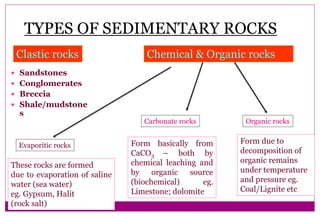
 Sandstones
 Conglomerates
 Breccia
 Shale/mudstone
s
TYPES OF SEDIMENTARY ROCKS
Clastic rocks Chemical & Organic rocks
Evaporitic rocks
These rocks are formed
due to evaporation of saline
water (sea water)
eg. Gypsum, Halit
(rock salt)
Carbonate rocks
Form basically from
CaCO3 – both by
chemical leaching and
by organic source
(biochemical) eg.
Limestone; dolomite
Organic rocks
Form due to
decomposition of
organic remains
under temperature
and pressure eg.
Coal/Lignite etc.
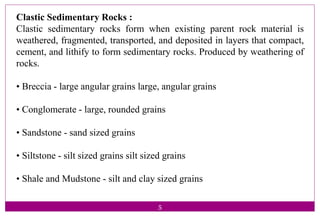
Clastic Sedimentary Rocks :
Clastic sedimentary rocks form when existing parent rock material is
weathered, fragmented, transported, and deposited in layers that compact,
cement, and lithify to form sedimentary rocks. Produced by weathering of
rocks.
• Breccia - large angular grains large, angular grains
• Conglomerate - large, rounded grains
• Sandstone - sand sized grains
• Siltstone - silt sized grains silt sized grains
• Shale and Mudstone - silt and clay sized grains
5
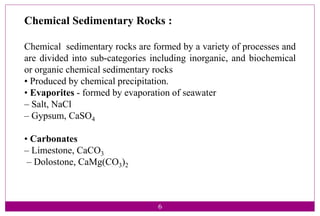
Chemical Sedimentary Rocks :
Chemical sedimentary rocks are formed by a variety of processes and
are divided into sub-categories including inorganic, and biochemical
or organic chemical sedimentary rocks
• Produced by chemical precipitation.
• Evaporites - formed by evaporation of seawater
– Salt, NaCl
– Gypsum, CaSO4
• Carbonates
– Limestone, CaCO3
– Dolostone, CaMg(CO3)2
6
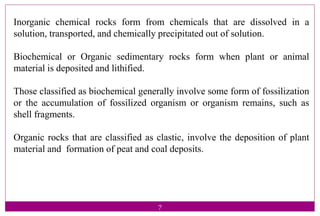
Inorganic chemical rocks form from chemicals that are dissolved in a
solution, transported, and chemically precipitated out of solution.
Biochemical or Organic sedimentary rocks form when plant or animal
material is deposited and lithified.
Those classified as biochemical generally involve some form of fossilization
or the accumulation of fossilized organism or organism remains, such as
shell fragments.
Organic rocks that are classified as clastic, involve the deposition of plant
material and formation of peat and coal deposits.
7
8
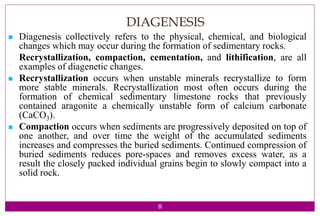
DIAGENESIS
 Diagenesis collectively refers to the physical, chemical, and biological
changes which may occur during the formation of sedimentary rocks.
Recrystallization, compaction, cementation, and lithification, are all
examples of diagenetic changes.
 Recrystallization occurs when unstable minerals recrystallize to form
more stable minerals. Recrystallization most often occurs during the
formation of chemical sedimentary limestone rocks that previously
contained aragonite a chemically unstable form of calcium carbonate
(CaCO3).
 Compaction occurs when sediments are progressively deposited on top of
one another, and over time the weight of the accumulated sediments
increases and compresses the buried sediments. Continued compression of
buried sediments reduces pore-spaces and removes excess water, as a
result the closely packed individual grains begin to slowly compact into a
solid rock.
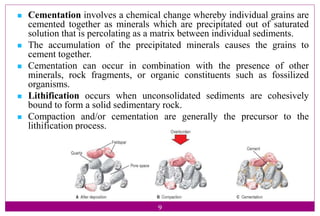
 Cementation involves a chemical change whereby individual grains are
cemented together as minerals which are precipitated out of saturated
solution that is percolating as a matrix between individual sediments.
 The accumulation of the precipitated minerals causes the grains to
cement together.
 Cementation can occur in combination with the presence of other
minerals, rock fragments, or organic constituents such as fossilized
organisms.
 Lithification occurs when unconsolidated sediments are cohesively
bound to form a solid sedimentary rock.
 Compaction and/or cementation are generally the precursor to the
lithification process.
9
10
Naming and Classifying Sedimentary Rocks
 Geologists name and classify sedimentary rocks based on their mineral
composition and texture
 Mineral composition refers to the specific minerals in the rock. For
example sandstone will contain predominantly quartz, while limestone
will contain mainly calcite (calcium carbonate).
 Texture includes the grain size and shape, sorting, and rounding of the
sediments that form the rock.
11
TEXTURE: GRAIN SIZE
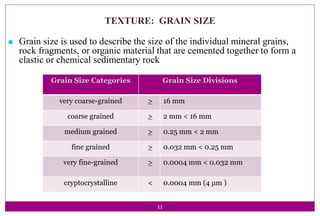
 Grain size is used to describe the size of the individual mineral grains,
rock fragments, or organic material that are cemented together to form a
clastic or chemical sedimentary rock
Grain Size Categories Grain Size Divisions
very coarse-grained > 16 mm
coarse grained > 2 mm < 16 mm
medium grained > 0.25 mm < 2 mm
fine grained > 0.032 mm < 0.25 mm
very fine-grained > 0.0004 mm < 0.032 mm
cryptocrystalline < 0.0004 mm (4 μm )
12
TEXTURE: SORTING
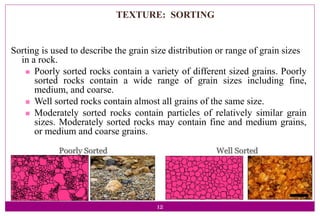
Sorting is used to describe the grain size distribution or range of grain sizes
in a rock.
 Poorly sorted rocks contain a variety of different sized grains. Poorly
sorted rocks contain a wide range of grain sizes including fine,
medium, and coarse.
 Well sorted rocks contain almost all grains of the same size.
 Moderately sorted rocks contain particles of relatively similar grain
sizes. Moderately sorted rocks may contain fine and medium grains,
or medium and coarse grains.
Poorly Sorted Well Sorted
13
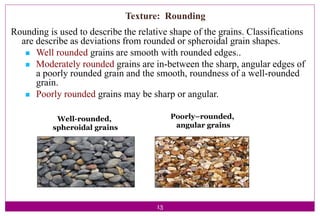
Texture: Rounding
Rounding is used to describe the relative shape of the grains. Classifications
are describe as deviations from rounded or spheroidal grain shapes.
 Well rounded grains are smooth with rounded edges..
 Moderately rounded grains are in-between the sharp, angular edges of
a poorly rounded grain and the smooth, roundness of a well-rounded
grain.
 Poorly rounded grains may be sharp or angular.
Well-rounded,
spheroidal grains
Poorly–rounded,
angular grains
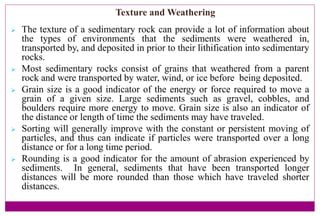
Texture and Weathering
 The texture of a sedimentary rock can provide a lot of information about
the types of environments that the sediments were weathered in,
transported by, and deposited in prior to their lithification into sedimentary
rocks.
 Most sedimentary rocks consist of grains that weathered from a parent
rock and were transported by water, wind, or ice before being deposited.
 Grain size is a good indicator of the energy or force required to move a
grain of a given size. Large sediments such as gravel, cobbles, and
boulders require more energy to move. Grain size is also an indicator of
the distance or length of time the sediments may have traveled.
 Sorting will generally improve with the constant or persistent moving of
particles, and thus can indicate if particles were transported over a long
distance or for a long time period.
 Rounding is a good indicator for the amount of abrasion experienced by
sediments. In general, sediments that have been transported longer
distances will be more rounded than those which have traveled shorter
distances.
15
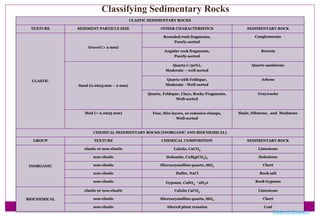
Classifying Sedimentary Rocks
CLASTIC SEDIMENTARY ROCKS
TEXTURE SEDIMENT PARTICLE SIZE OTHER CHARACTERISTICS SEDIMENTARY ROCK
CLASTIC
Gravel (> 2 mm)
Rounded rock fragments,
Poorly-sorted
Conglomerate
Angular rock fragments,
Poorly-sorted
Breccia
Sand (0.0625 mm – 2 mm)
Quartz (>50%),
Moderate – well sorted
Quartz sandstone
Quartz with Feldspar,
Moderate –Well sorted
Arkose
Quartz, Feldspar, Clays, Rocky Fragments,
Well-sorted
Graywacke
Mud (< 0.0625 mm) Fine, thin layers, or cohesive clumps,
Well-sorted
Shale, Siltstone, and Mudstone
CHEMICAL SEDIMENTARY ROCKS (INORGANIC AND BIOCHEMICAL)
GROUP TEXTURE CHEMICAL COMPOSITION SEDIMENTARY ROCK
INORGANIC
clastic or non-clastic Calcite, CaCO3 Limestone
non-clastic Dolomite, CaMg(CO3)2 Dolostone
non-clastic Microcrystalline quartz, SiO2 Chert
non-clastic Halite, NaCl Rock salt
non-clastic Gypsum, CaSO4 ۰2H20 Rock Gypsum
BIOCHEMICAL
clastic or non-clastic Calcite CaCO3 Limestone
non-clastic Microcrystalline quartz, SiO2 Chert
non-clastic Altered plant remains Coal
Table of Contents
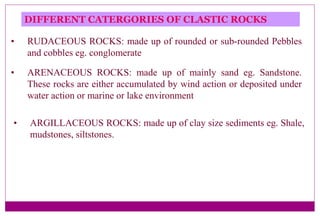
DIFFERENT CATERGORIES OF CLASTIC ROCKS
• RUDACEOUS ROCKS: made up of rounded or sub-rounded Pebbles
and cobbles eg. conglomerate
• ARENACEOUS ROCKS: made up of mainly sand eg. Sandstone.
These rocks are either accumulated by wind action or deposited under
water action or marine or lake environment
• ARGILLACEOUS ROCKS: made up of clay size sediments eg. Shale,
mudstones, siltstones.
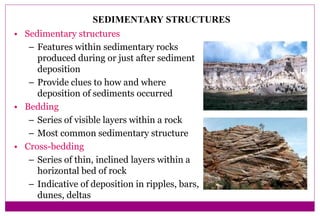
SEDIMENTARY STRUCTURES
• Sedimentary structures
– Features within sedimentary rocks
produced during or just after sediment
deposition
– Provide clues to how and where
deposition of sediments occurred
• Bedding
– Series of visible layers within a rock
– Most common sedimentary structure
• Cross-bedding
– Series of thin, inclined layers within a
horizontal bed of rock
– Indicative of deposition in ripples, bars,
dunes, deltas
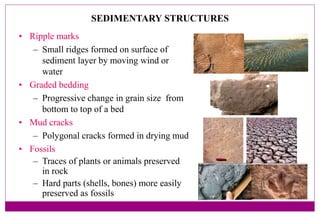
SEDIMENTARY STRUCTURES
• Ripple marks
– Small ridges formed on surface of
sediment layer by moving wind or
water
• Graded bedding
– Progressive change in grain size from
bottom to top of a bed
• Mud cracks
– Polygonal cracks formed in drying mud
• Fossils
– Traces of plants or animals preserved
in rock
– Hard parts (shells, bones) more easily
preserved as fossils
19
Several primary structures are evidenced in sedimentary rocks. These
structures offer significant evidences of depositional conditions.
These are:
•Stratification indicates the time period involved in their
deposition(Rocks which display layering or bedding) Eg; shales
•Cross-bedding indicates shallow water deposits.
Eg: sandstone ( A series of inclined bedding planes having some
relationship to the direction of current flow).
•Graded bedding indicates deeper water deposits.
Eg: Greywacks ( Coarser material at base and the finest material at the top
due to involvement of a river or stream flow is called as graded bedding).
•Ripple marks indicate the shallow water deposition.
20
SANDSTONE
 Sandstone rocks are composed almost entirely of sand-sized quartz grains
(0.063 – 2 mm) cemented together through lithification.
 Sandstone rocks are generally classified as quartz sandstone, arkose or
greywacke.
 Sandstones comprise about 20% of all sedimentary rocks and are formed
in a variety of different environments including fluvial (rivers), marine,
coastal (oceans and beaches), aeolian (wind blown), and glacial (ice).
 Sandstones are generally porous and permeable and considered one of the
best aquifers.
 By virtue of their porosity and permeability, they are not only capable of
holding a good quantity of groundwater but also yield the same when
tapped.
21
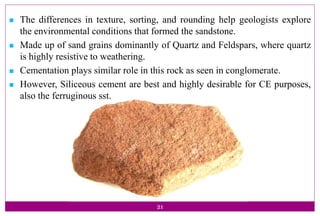
 The differences in texture, sorting, and rounding help geologists explore
the environmental conditions that formed the sandstone.
 Made up of sand grains dominantly of Quartz and Feldspars, where quartz
is highly resistive to weathering.
 Cementation plays similar role in this rock as seen in conglomerate.
 However, Siliceous cement are best and highly desirable for CE purposes,
also the ferruginous sst.
22
Varieties of Sandstone:
1. Arenite: A consolidated lithified sand with < 10% of matrix
2. Arkose: Formed by mechanical disintegration of granitic rocks and is
considerably rich in feldspars and sand grains and unsorted.
3. Flagstone: A thinly bedded sandstone.
4. Greywacke: A dark, tough, rich in clay & contains less of quartz and
unsorted
5. Grit: A sandstone composed of coarse angular grains.
Sandstone varieties based on cementing materials:
1. Siliceous sandstone: Cementing material is also silica ( porosity is less )
2. Ferruginous sandstone : Cementing material is a mixture of oxides &
hydroxides of Fe
3. Calcareous sandstone: Cementing material is calcium carbonate
4. Argillaceous sandstone: Cementing material s clay
23
CIVIL ENGINEERING POINT OF VIEW:
When sandstone is more porous, more permeable (not massive), so its
inherent load bearing capacity is LESS.
When sandstone is more porous and less permeable, so its inherent load
bearing capacity is INTERMEDIATE.
Siliceous sandstones are the best rock for all civil engineering purposes
such as site of foundation ; to be used as building stones; to be used for
railways and for tunneling etc….
Ferruginous sandstones come next in order of preference for civil
structures.
24
Calcareous sandstones initially be strong but may not be durable since
carbonates react with water and leaches out easily.
Argillaceous sandstones are not desirable for civil structures due to the
presence of clayey minerals.
USES :
Sandstone has been used for domestic construction and house wares since
prehistoric times, and continues to be used.
Sandstone was a popular building material from ancient times.
It is relatively soft, making it easy to carve.
It has been widely used around the world in constructing temples, homes,
and other buildings.
25
Some sandstones are resistant to weathering, yet are easy to work. This
makes sandstone a common building and paving material including in asphalt
concrete.
Because of the hardness of individual grains, uniformity of grain size
and friability of their structure, some types of sandstone are excellent
materials from which to make grindstones, for sharpening blades and other
implements.
Non-friable sandstone can be used to make grindstones for grinding grain,
e.g., gritstone.
A type of pure quartz sandstone, orthoquartzite, with more of 90–95
percent of quartz, has been proposed for nomination to the Global Heritage
Stone Resource.
26
SHALE
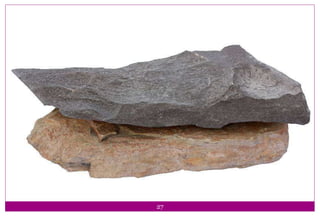
 Shale is a fine-grained, moderately to well-sorted rock formed by the
compaction of well rounded silt-and clay-sized grains.
 Shales often contain fine laminations which helps impart fissility to
the rock. Fissility is a term used to describe layered laminations
formed by compression forces exerted over long-time periods.
 Shale usually contains about 50% silt, 35% clay, and 15% chemical
materials, many shales may also contain organic plant materials and
fossils.
 Shale is characterized by thinly, laminated layers, representing
successive deposition of sediments.
 Shale accounts for about 50% of all sedimentary rocks deposited on
the Earth’s surface.
 The sediments that form shale are most likely deposited very
gradually in non-turbulent, environments such as a lakes, lagoons,
flood plains, and deep-ocean basins.
27
 Shales are clastic rocks, made up mainly fine silt/clay
 Mostly hydrous aluminum silicate in composition = from weathered
feldspars
 Deposition takes place under low fluvial regime or under weak water
current. Eg. Offshore or in Lagoon
 Shales are made of fine well sorted silt and clayey sediments, where
normally one can expect high porosity and permeability.
 But due to surface tension phenomenon of water and extremely fine
intergranular space shales are impermeable, hence does not yield water
when tapped
 When shales are saturated with water – under pressure they are likely to
produce slippery foundation for any structure- therefore not suitable for
CE structures
 eg. Lafayette dam of US constructed on argillaceous rocks sunk by 20
feet.
 Srisailam Dam in Andhra Pradesh (One of the 12th largest
Hydroelectric Projects in the India) faced similar problem, however,
precautions were take by grouting to stop the seepage along the weak
zones.
 Because of its impermeable and porous nature it acts as cap rocks in the
occurrence of Oil and Gas.
CE IMPORTANCE :
30
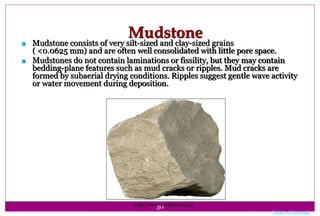
Mudstone
 Mudstone consists of very silt-sized and clay-sized grains
( <0.0625 mm) and are often well consolidated with little pore space.
 Mudstones do not contain laminations or fissility, but they may contain
bedding-plane features such as mud cracks or ripples. Mud cracks are
formed by subaerial drying conditions. Ripples suggest gentle wave activity
or water movement during deposition.
Table of Contents
http://www.auckland.ac.nz/
31
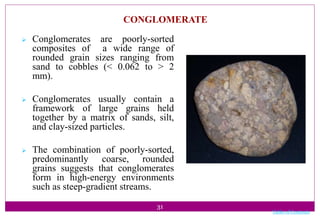
CONGLOMERATE
 Conglomerates are poorly-sorted
composites of a wide range of
rounded grain sizes ranging from
sand to cobbles (< 0.062 to > 2
mm).
 Conglomerates usually contain a
framework of large grains held
together by a matrix of sands, silt,
and clay-sized particles.
 The combination of poorly-sorted,
predominantly coarse, rounded
grains suggests that conglomerates
form in high-energy environments
such as steep-gradient streams.
Table of Contents
32
Mineralogically, pebbles are usually jasper, flint, quartz. The cementing
material may be siliceous, ferruginous, calcareous…
The rounded nature of pebbles indicates that the source of rocks from
which pebbles of the conglomerate have been derived far away from the
place of occurrence of the conglomerate.
Conglomerates form by the consolidation and lithification of gravel.
Conglomerates typically contain finer grained sediment, e.g.,
either sand, silt, clay or combination of them, called matrix by geologists,
filling their interstices and are often cemented by calcium carbonate, iron
oxide, silica, or hardened clay.
33
•Generally conglomerates are made up of fragments of other rocks, but at
times large quartz or feldspar crystals can also make up a significant
percentage of the conglomerate's components.
•These crystals are of course lacking in crystal faces and are just rounded
grains.
USES:
•Conglomerates with their interesting pebbled and fine matrix textures are
often used as ornamental rocks for buildings, monuments, grave stones,
tiles, and many other ornamental uses.
•However their irregular grain sizes contribute to less durability than that
of sandstone and therefore fewer uses in building construction.
34
Breccia
 Breccia is a poorly-sorted composite of a wide range of grain sizes
ranging from clays to gravels (< 0.062 to > 2 mm).
 Breccias usually contain a framework of gravel-sized grains held together
by a matrix of sands, silts, and clay.
 Breccia is similar to a conglomerate except that it consists of angular
grains, as opposed to rounded grains.
 The combination of poorly-sorted, predominantly coarse, angular grains
suggests that breccias form from rapid deposition in high energy
environments such as steep-gradient streams, glacial flood deposits,
landslides, talus, alluvial fans, or in association with faulting.
Table of Contents
35
LIMESTONE
 Limestone consists almost entirely of the mineral calcite (CaCO3) and
can form by either inorganic or biochemical processes.
 Limestones form under a variety of environmental conditions and for
this reason several types of limestone exist.
 Limestone accounts for about 10% of all sedimentary rocks, and of
those, limestones with marine biochemical origin are the most
common.
 The solubility of limestone in water and weak acid solutions leads
to karst landscapes, in which water erodes the limestone over
thousands to millions of years. Most cave systems are through
limestone bedrock.
Table of Contents
Copyright © Glen J. Kuban
36
Limestone often contains variable amounts of silica in the form
of chert (chalcedony, flint, jasper, etc.) or siliceous skeletal fragment
(sponge spicules, diatoms, radiolarians), and varying amounts
of clay, silt and sand (terrestrial detritus) carried in by rivers.
Some limestones do not consist of grains, and are formed by the
chemical precipitation of calcite or aragonite, i.e. travertine.
Secondary calcite may be deposited by supersaturated meteoric
waters (groundwater that precipitates the material in caves).
This produces speleothems, such as stalagmites and stalactites. Another
form taken by calcite is oolitic limestone, which can be recognized by its
granular (oolite) appearance.
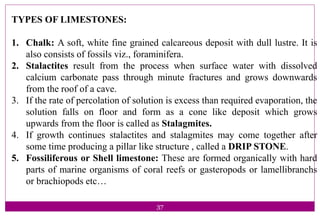
37
TYPES OF LIMESTONES:
1. Chalk: A soft, white fine grained calcareous deposit with dull lustre. It is
also consists of fossils viz., foraminifera.
2. Stalactites result from the process when surface water with dissolved
calcium carbonate pass through minute fractures and grows downwards
from the roof of a cave.
3. If the rate of percolation of solution is excess than required evaporation, the
solution falls on floor and form as a cone like deposit which grows
upwards from the floor is called as Stalagmites.
4. If growth continues stalactites and stalagmites may come together after
some time producing a pillar like structure , called a DRIP STONE.
5. Fossiliferous or Shell limestone: These are formed organically with hard
parts of marine organisms of coral reefs or gasteropods or lamellibranchs
or brachiopods etc…
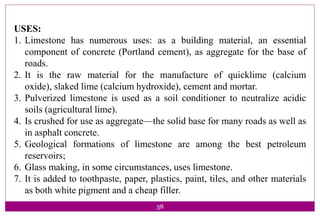
38
USES:
1. Limestone has numerous uses: as a building material, an essential
component of concrete (Portland cement), as aggregate for the base of
roads.
2. It is the raw material for the manufacture of quicklime (calcium
oxide), slaked lime (calcium hydroxide), cement and mortar.
3. Pulverized limestone is used as a soil conditioner to neutralize acidic
soils (agricultural lime).
4. Is crushed for use as aggregate—the solid base for many roads as well as
in asphalt concrete.
5. Geological formations of limestone are among the best petroleum
reservoirs;
6. Glass making, in some circumstances, uses limestone.
7. It is added to toothpaste, paper, plastics, paint, tiles, and other materials
as both white pigment and a cheap filler.
39
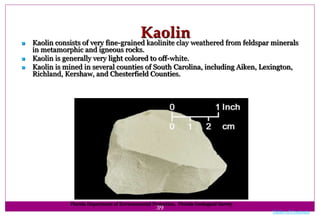
Kaolin Kaolin consists of very fine-grained kaolinite clay weathered from feldspar minerals
in metamorphic and igneous rocks.
 Kaolin is generally very light colored to off-white.
 Kaolin is mined in several counties of South Carolina, including Aiken, Lexington,
Richland, Kershaw, and Chesterfield Counties.
Florida Department of Environmental Protection, Florida Geological Survey
Table of Contents
40
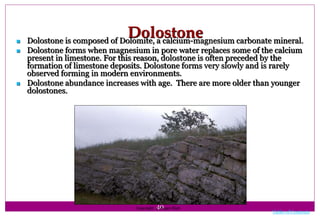
Dolostone Dolostone is composed of Dolomite, a calcium-magnesium carbonate mineral.
 Dolostone forms when magnesium in pore water replaces some of the calcium
present in limestone. For this reason, dolostone is often preceded by the
formation of limestone deposits. Dolostone forms very slowly and is rarely
observed forming in modern environments.
 Dolostone abundance increases with age. There are more older than younger
dolostones.
Copyright © Roger Slatt
Table of Contents

Sedimentary rocks

  • 1.
    f r om d e s k o f 1
  • 2.
    SEDIMENTARY ROCKS Sedimentary Rocksare those formed due to weathering (which is a natural process of disintegration and decomposition) or erosion of the preexisting rocks. Also formed due to chemical precipitation or due to accumulation of organic remains such as plants and animal hard parts. Since, the sediments represent secondary , these rocks are also called as “Secondary rocks”. By volume, the secondary rocks constitute about 5% of the lithosphere 2
  • 3.
    Sedimentary rocks arethe lithified equivalents of sediments. They typically are produced by cementing, compacting, and otherwise solidifying preexisting unconsolidated sediments. Some varieties of sedimentary rock, however, are precipitated directly into their solid sedimentary form and exhibit no intervening existence as sediment. Organic reefs and bedded evaporites are examples of such rocks. Because the processes of physical (mechanical) weathering and chemical weathering are significantly different, they generate markedly distinct products. Fundamentally different kinds of sediment and sedimentary rock: •Clastic sedimentary rocks and •Chemical sedimentary rocks. 3
  • 4.
     Sandstones  Conglomerates Breccia  Shale/mudstone s TYPES OF SEDIMENTARY ROCKS Clastic rocks Chemical & Organic rocks Evaporitic rocks These rocks are formed due to evaporation of saline water (sea water) eg. Gypsum, Halit (rock salt) Carbonate rocks Form basically from CaCO3 – both by chemical leaching and by organic source (biochemical) eg. Limestone; dolomite Organic rocks Form due to decomposition of organic remains under temperature and pressure eg. Coal/Lignite etc.
  • 5.
    Clastic Sedimentary Rocks: Clastic sedimentary rocks form when existing parent rock material is weathered, fragmented, transported, and deposited in layers that compact, cement, and lithify to form sedimentary rocks. Produced by weathering of rocks. • Breccia - large angular grains large, angular grains • Conglomerate - large, rounded grains • Sandstone - sand sized grains • Siltstone - silt sized grains silt sized grains • Shale and Mudstone - silt and clay sized grains 5
  • 6.
    Chemical Sedimentary Rocks: Chemical sedimentary rocks are formed by a variety of processes and are divided into sub-categories including inorganic, and biochemical or organic chemical sedimentary rocks • Produced by chemical precipitation. • Evaporites - formed by evaporation of seawater – Salt, NaCl – Gypsum, CaSO4 • Carbonates – Limestone, CaCO3 – Dolostone, CaMg(CO3)2 6
  • 7.
    Inorganic chemical rocksform from chemicals that are dissolved in a solution, transported, and chemically precipitated out of solution. Biochemical or Organic sedimentary rocks form when plant or animal material is deposited and lithified. Those classified as biochemical generally involve some form of fossilization or the accumulation of fossilized organism or organism remains, such as shell fragments. Organic rocks that are classified as clastic, involve the deposition of plant material and formation of peat and coal deposits. 7
  • 8.
    8 DIAGENESIS  Diagenesis collectivelyrefers to the physical, chemical, and biological changes which may occur during the formation of sedimentary rocks. Recrystallization, compaction, cementation, and lithification, are all examples of diagenetic changes.  Recrystallization occurs when unstable minerals recrystallize to form more stable minerals. Recrystallization most often occurs during the formation of chemical sedimentary limestone rocks that previously contained aragonite a chemically unstable form of calcium carbonate (CaCO3).  Compaction occurs when sediments are progressively deposited on top of one another, and over time the weight of the accumulated sediments increases and compresses the buried sediments. Continued compression of buried sediments reduces pore-spaces and removes excess water, as a result the closely packed individual grains begin to slowly compact into a solid rock.
  • 9.
     Cementation involvesa chemical change whereby individual grains are cemented together as minerals which are precipitated out of saturated solution that is percolating as a matrix between individual sediments.  The accumulation of the precipitated minerals causes the grains to cement together.  Cementation can occur in combination with the presence of other minerals, rock fragments, or organic constituents such as fossilized organisms.  Lithification occurs when unconsolidated sediments are cohesively bound to form a solid sedimentary rock.  Compaction and/or cementation are generally the precursor to the lithification process. 9
  • 10.
    10 Naming and ClassifyingSedimentary Rocks  Geologists name and classify sedimentary rocks based on their mineral composition and texture  Mineral composition refers to the specific minerals in the rock. For example sandstone will contain predominantly quartz, while limestone will contain mainly calcite (calcium carbonate).  Texture includes the grain size and shape, sorting, and rounding of the sediments that form the rock.
  • 11.
    11 TEXTURE: GRAIN SIZE Grain size is used to describe the size of the individual mineral grains, rock fragments, or organic material that are cemented together to form a clastic or chemical sedimentary rock Grain Size Categories Grain Size Divisions very coarse-grained > 16 mm coarse grained > 2 mm < 16 mm medium grained > 0.25 mm < 2 mm fine grained > 0.032 mm < 0.25 mm very fine-grained > 0.0004 mm < 0.032 mm cryptocrystalline < 0.0004 mm (4 μm )
  • 12.
    12 TEXTURE: SORTING Sorting isused to describe the grain size distribution or range of grain sizes in a rock.  Poorly sorted rocks contain a variety of different sized grains. Poorly sorted rocks contain a wide range of grain sizes including fine, medium, and coarse.  Well sorted rocks contain almost all grains of the same size.  Moderately sorted rocks contain particles of relatively similar grain sizes. Moderately sorted rocks may contain fine and medium grains, or medium and coarse grains. Poorly Sorted Well Sorted
  • 13.
    13 Texture: Rounding Rounding isused to describe the relative shape of the grains. Classifications are describe as deviations from rounded or spheroidal grain shapes.  Well rounded grains are smooth with rounded edges..  Moderately rounded grains are in-between the sharp, angular edges of a poorly rounded grain and the smooth, roundness of a well-rounded grain.  Poorly rounded grains may be sharp or angular. Well-rounded, spheroidal grains Poorly–rounded, angular grains
  • 14.
    Texture and Weathering The texture of a sedimentary rock can provide a lot of information about the types of environments that the sediments were weathered in, transported by, and deposited in prior to their lithification into sedimentary rocks.  Most sedimentary rocks consist of grains that weathered from a parent rock and were transported by water, wind, or ice before being deposited.  Grain size is a good indicator of the energy or force required to move a grain of a given size. Large sediments such as gravel, cobbles, and boulders require more energy to move. Grain size is also an indicator of the distance or length of time the sediments may have traveled.  Sorting will generally improve with the constant or persistent moving of particles, and thus can indicate if particles were transported over a long distance or for a long time period.  Rounding is a good indicator for the amount of abrasion experienced by sediments. In general, sediments that have been transported longer distances will be more rounded than those which have traveled shorter distances.
  • 15.
    15 Classifying Sedimentary Rocks CLASTICSEDIMENTARY ROCKS TEXTURE SEDIMENT PARTICLE SIZE OTHER CHARACTERISTICS SEDIMENTARY ROCK CLASTIC Gravel (> 2 mm) Rounded rock fragments, Poorly-sorted Conglomerate Angular rock fragments, Poorly-sorted Breccia Sand (0.0625 mm – 2 mm) Quartz (>50%), Moderate – well sorted Quartz sandstone Quartz with Feldspar, Moderate –Well sorted Arkose Quartz, Feldspar, Clays, Rocky Fragments, Well-sorted Graywacke Mud (< 0.0625 mm) Fine, thin layers, or cohesive clumps, Well-sorted Shale, Siltstone, and Mudstone CHEMICAL SEDIMENTARY ROCKS (INORGANIC AND BIOCHEMICAL) GROUP TEXTURE CHEMICAL COMPOSITION SEDIMENTARY ROCK INORGANIC clastic or non-clastic Calcite, CaCO3 Limestone non-clastic Dolomite, CaMg(CO3)2 Dolostone non-clastic Microcrystalline quartz, SiO2 Chert non-clastic Halite, NaCl Rock salt non-clastic Gypsum, CaSO4 ۰2H20 Rock Gypsum BIOCHEMICAL clastic or non-clastic Calcite CaCO3 Limestone non-clastic Microcrystalline quartz, SiO2 Chert non-clastic Altered plant remains Coal Table of Contents
  • 16.
    DIFFERENT CATERGORIES OFCLASTIC ROCKS • RUDACEOUS ROCKS: made up of rounded or sub-rounded Pebbles and cobbles eg. conglomerate • ARENACEOUS ROCKS: made up of mainly sand eg. Sandstone. These rocks are either accumulated by wind action or deposited under water action or marine or lake environment • ARGILLACEOUS ROCKS: made up of clay size sediments eg. Shale, mudstones, siltstones.
  • 17.
    SEDIMENTARY STRUCTURES • Sedimentarystructures – Features within sedimentary rocks produced during or just after sediment deposition – Provide clues to how and where deposition of sediments occurred • Bedding – Series of visible layers within a rock – Most common sedimentary structure • Cross-bedding – Series of thin, inclined layers within a horizontal bed of rock – Indicative of deposition in ripples, bars, dunes, deltas
  • 18.
    SEDIMENTARY STRUCTURES • Ripplemarks – Small ridges formed on surface of sediment layer by moving wind or water • Graded bedding – Progressive change in grain size from bottom to top of a bed • Mud cracks – Polygonal cracks formed in drying mud • Fossils – Traces of plants or animals preserved in rock – Hard parts (shells, bones) more easily preserved as fossils
  • 19.
    19 Several primary structuresare evidenced in sedimentary rocks. These structures offer significant evidences of depositional conditions. These are: •Stratification indicates the time period involved in their deposition(Rocks which display layering or bedding) Eg; shales •Cross-bedding indicates shallow water deposits. Eg: sandstone ( A series of inclined bedding planes having some relationship to the direction of current flow). •Graded bedding indicates deeper water deposits. Eg: Greywacks ( Coarser material at base and the finest material at the top due to involvement of a river or stream flow is called as graded bedding). •Ripple marks indicate the shallow water deposition.
  • 20.
    20 SANDSTONE  Sandstone rocksare composed almost entirely of sand-sized quartz grains (0.063 – 2 mm) cemented together through lithification.  Sandstone rocks are generally classified as quartz sandstone, arkose or greywacke.  Sandstones comprise about 20% of all sedimentary rocks and are formed in a variety of different environments including fluvial (rivers), marine, coastal (oceans and beaches), aeolian (wind blown), and glacial (ice).  Sandstones are generally porous and permeable and considered one of the best aquifers.  By virtue of their porosity and permeability, they are not only capable of holding a good quantity of groundwater but also yield the same when tapped.
  • 21.
    21  The differencesin texture, sorting, and rounding help geologists explore the environmental conditions that formed the sandstone.  Made up of sand grains dominantly of Quartz and Feldspars, where quartz is highly resistive to weathering.  Cementation plays similar role in this rock as seen in conglomerate.  However, Siliceous cement are best and highly desirable for CE purposes, also the ferruginous sst.
  • 22.
    22 Varieties of Sandstone: 1.Arenite: A consolidated lithified sand with < 10% of matrix 2. Arkose: Formed by mechanical disintegration of granitic rocks and is considerably rich in feldspars and sand grains and unsorted. 3. Flagstone: A thinly bedded sandstone. 4. Greywacke: A dark, tough, rich in clay & contains less of quartz and unsorted 5. Grit: A sandstone composed of coarse angular grains. Sandstone varieties based on cementing materials: 1. Siliceous sandstone: Cementing material is also silica ( porosity is less ) 2. Ferruginous sandstone : Cementing material is a mixture of oxides & hydroxides of Fe 3. Calcareous sandstone: Cementing material is calcium carbonate 4. Argillaceous sandstone: Cementing material s clay
  • 23.
    23 CIVIL ENGINEERING POINTOF VIEW: When sandstone is more porous, more permeable (not massive), so its inherent load bearing capacity is LESS. When sandstone is more porous and less permeable, so its inherent load bearing capacity is INTERMEDIATE. Siliceous sandstones are the best rock for all civil engineering purposes such as site of foundation ; to be used as building stones; to be used for railways and for tunneling etc…. Ferruginous sandstones come next in order of preference for civil structures.
  • 24.
    24 Calcareous sandstones initiallybe strong but may not be durable since carbonates react with water and leaches out easily. Argillaceous sandstones are not desirable for civil structures due to the presence of clayey minerals. USES : Sandstone has been used for domestic construction and house wares since prehistoric times, and continues to be used. Sandstone was a popular building material from ancient times. It is relatively soft, making it easy to carve. It has been widely used around the world in constructing temples, homes, and other buildings.
  • 25.
    25 Some sandstones areresistant to weathering, yet are easy to work. This makes sandstone a common building and paving material including in asphalt concrete. Because of the hardness of individual grains, uniformity of grain size and friability of their structure, some types of sandstone are excellent materials from which to make grindstones, for sharpening blades and other implements. Non-friable sandstone can be used to make grindstones for grinding grain, e.g., gritstone. A type of pure quartz sandstone, orthoquartzite, with more of 90–95 percent of quartz, has been proposed for nomination to the Global Heritage Stone Resource.
  • 26.
    26 SHALE  Shale isa fine-grained, moderately to well-sorted rock formed by the compaction of well rounded silt-and clay-sized grains.  Shales often contain fine laminations which helps impart fissility to the rock. Fissility is a term used to describe layered laminations formed by compression forces exerted over long-time periods.  Shale usually contains about 50% silt, 35% clay, and 15% chemical materials, many shales may also contain organic plant materials and fossils.  Shale is characterized by thinly, laminated layers, representing successive deposition of sediments.  Shale accounts for about 50% of all sedimentary rocks deposited on the Earth’s surface.  The sediments that form shale are most likely deposited very gradually in non-turbulent, environments such as a lakes, lagoons, flood plains, and deep-ocean basins.
  • 27.
  • 28.
     Shales areclastic rocks, made up mainly fine silt/clay  Mostly hydrous aluminum silicate in composition = from weathered feldspars  Deposition takes place under low fluvial regime or under weak water current. Eg. Offshore or in Lagoon  Shales are made of fine well sorted silt and clayey sediments, where normally one can expect high porosity and permeability.  But due to surface tension phenomenon of water and extremely fine intergranular space shales are impermeable, hence does not yield water when tapped
  • 29.
     When shalesare saturated with water – under pressure they are likely to produce slippery foundation for any structure- therefore not suitable for CE structures  eg. Lafayette dam of US constructed on argillaceous rocks sunk by 20 feet.  Srisailam Dam in Andhra Pradesh (One of the 12th largest Hydroelectric Projects in the India) faced similar problem, however, precautions were take by grouting to stop the seepage along the weak zones.  Because of its impermeable and porous nature it acts as cap rocks in the occurrence of Oil and Gas. CE IMPORTANCE :
  • 30.
    30 Mudstone  Mudstone consistsof very silt-sized and clay-sized grains ( <0.0625 mm) and are often well consolidated with little pore space.  Mudstones do not contain laminations or fissility, but they may contain bedding-plane features such as mud cracks or ripples. Mud cracks are formed by subaerial drying conditions. Ripples suggest gentle wave activity or water movement during deposition. Table of Contents http://www.auckland.ac.nz/
  • 31.
    31 CONGLOMERATE  Conglomerates arepoorly-sorted composites of a wide range of rounded grain sizes ranging from sand to cobbles (< 0.062 to > 2 mm).  Conglomerates usually contain a framework of large grains held together by a matrix of sands, silt, and clay-sized particles.  The combination of poorly-sorted, predominantly coarse, rounded grains suggests that conglomerates form in high-energy environments such as steep-gradient streams. Table of Contents
  • 32.
    32 Mineralogically, pebbles areusually jasper, flint, quartz. The cementing material may be siliceous, ferruginous, calcareous… The rounded nature of pebbles indicates that the source of rocks from which pebbles of the conglomerate have been derived far away from the place of occurrence of the conglomerate. Conglomerates form by the consolidation and lithification of gravel. Conglomerates typically contain finer grained sediment, e.g., either sand, silt, clay or combination of them, called matrix by geologists, filling their interstices and are often cemented by calcium carbonate, iron oxide, silica, or hardened clay.
  • 33.
    33 •Generally conglomerates aremade up of fragments of other rocks, but at times large quartz or feldspar crystals can also make up a significant percentage of the conglomerate's components. •These crystals are of course lacking in crystal faces and are just rounded grains. USES: •Conglomerates with their interesting pebbled and fine matrix textures are often used as ornamental rocks for buildings, monuments, grave stones, tiles, and many other ornamental uses. •However their irregular grain sizes contribute to less durability than that of sandstone and therefore fewer uses in building construction.
  • 34.
    34 Breccia  Breccia isa poorly-sorted composite of a wide range of grain sizes ranging from clays to gravels (< 0.062 to > 2 mm).  Breccias usually contain a framework of gravel-sized grains held together by a matrix of sands, silts, and clay.  Breccia is similar to a conglomerate except that it consists of angular grains, as opposed to rounded grains.  The combination of poorly-sorted, predominantly coarse, angular grains suggests that breccias form from rapid deposition in high energy environments such as steep-gradient streams, glacial flood deposits, landslides, talus, alluvial fans, or in association with faulting. Table of Contents
  • 35.
    35 LIMESTONE  Limestone consistsalmost entirely of the mineral calcite (CaCO3) and can form by either inorganic or biochemical processes.  Limestones form under a variety of environmental conditions and for this reason several types of limestone exist.  Limestone accounts for about 10% of all sedimentary rocks, and of those, limestones with marine biochemical origin are the most common.  The solubility of limestone in water and weak acid solutions leads to karst landscapes, in which water erodes the limestone over thousands to millions of years. Most cave systems are through limestone bedrock. Table of Contents Copyright © Glen J. Kuban
  • 36.
    36 Limestone often containsvariable amounts of silica in the form of chert (chalcedony, flint, jasper, etc.) or siliceous skeletal fragment (sponge spicules, diatoms, radiolarians), and varying amounts of clay, silt and sand (terrestrial detritus) carried in by rivers. Some limestones do not consist of grains, and are formed by the chemical precipitation of calcite or aragonite, i.e. travertine. Secondary calcite may be deposited by supersaturated meteoric waters (groundwater that precipitates the material in caves). This produces speleothems, such as stalagmites and stalactites. Another form taken by calcite is oolitic limestone, which can be recognized by its granular (oolite) appearance.
  • 37.
    37 TYPES OF LIMESTONES: 1.Chalk: A soft, white fine grained calcareous deposit with dull lustre. It is also consists of fossils viz., foraminifera. 2. Stalactites result from the process when surface water with dissolved calcium carbonate pass through minute fractures and grows downwards from the roof of a cave. 3. If the rate of percolation of solution is excess than required evaporation, the solution falls on floor and form as a cone like deposit which grows upwards from the floor is called as Stalagmites. 4. If growth continues stalactites and stalagmites may come together after some time producing a pillar like structure , called a DRIP STONE. 5. Fossiliferous or Shell limestone: These are formed organically with hard parts of marine organisms of coral reefs or gasteropods or lamellibranchs or brachiopods etc…
  • 38.
    38 USES: 1. Limestone hasnumerous uses: as a building material, an essential component of concrete (Portland cement), as aggregate for the base of roads. 2. It is the raw material for the manufacture of quicklime (calcium oxide), slaked lime (calcium hydroxide), cement and mortar. 3. Pulverized limestone is used as a soil conditioner to neutralize acidic soils (agricultural lime). 4. Is crushed for use as aggregate—the solid base for many roads as well as in asphalt concrete. 5. Geological formations of limestone are among the best petroleum reservoirs; 6. Glass making, in some circumstances, uses limestone. 7. It is added to toothpaste, paper, plastics, paint, tiles, and other materials as both white pigment and a cheap filler.
  • 39.
    39 Kaolin Kaolin consistsof very fine-grained kaolinite clay weathered from feldspar minerals in metamorphic and igneous rocks.  Kaolin is generally very light colored to off-white.  Kaolin is mined in several counties of South Carolina, including Aiken, Lexington, Richland, Kershaw, and Chesterfield Counties. Florida Department of Environmental Protection, Florida Geological Survey Table of Contents
  • 40.
    40 Dolostone Dolostone iscomposed of Dolomite, a calcium-magnesium carbonate mineral.  Dolostone forms when magnesium in pore water replaces some of the calcium present in limestone. For this reason, dolostone is often preceded by the formation of limestone deposits. Dolostone forms very slowly and is rarely observed forming in modern environments.  Dolostone abundance increases with age. There are more older than younger dolostones. Copyright © Roger Slatt Table of Contents