By teacher
Mr. Karwan Yousif
Presentation About
University of Zakho
College Of Engineering
Department Of Petroleum Engineering
Petroleum Geology
Supervisor
Mr. Nizar Botani
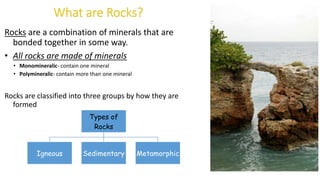
Rocks are a combination of minerals that are
bonded together in some way.
• All rocks are made of minerals
• Monomineralic- contain one mineral
• Polymineralic- contain more than one mineral
Rocks are classified into three groups by how they are
formed
Types of
Rocks
Igneous Sedimentary Metamorphic
3 types of Rocks
Types of
Rocks
Igneous Sedimentary Metamorphic
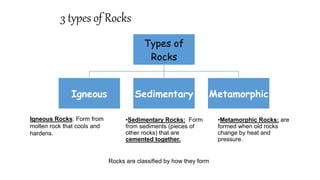
Igneous Rocks: Form from
molten rock that cools and
hardens.
•Sedimentary Rocks: Form
from sediments (pieces of
other rocks) that are
cemented together.
•Metamorphic Rocks: are
formed when old rocks
change by heat and
pressure.
Rocks are classified by how they form
Classification of igneous rocks-2 types
Intrusive
• Form from magma
• Cooled and solidified
(hardened) slowly deep
underground
• Large crystal size
Extrusive
• Form from lava
• Cooled and hardened
quickly at or near the
surface of the earth.
• Small or no crystals
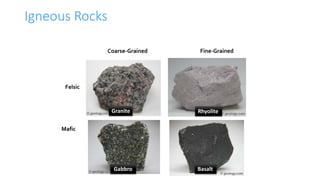
Igneous Rocks
Felsic
Mafic
Coarse-Grained Fine-Grained
Granite
Gabbro Basalt
Rhyolite
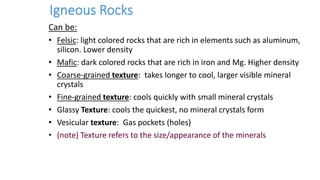
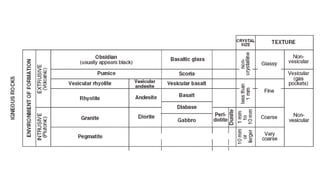
Can be:
• Felsic: light colored rocks that are rich in elements such as aluminum,
silicon. Lower density
• Mafic: dark colored rocks that are rich in iron and Mg. Higher density
• Coarse-grained texture: takes longer to cool, larger visible mineral
crystals
• Fine-grained texture: cools quickly with small mineral crystals
• Glassy Texture: cools the quickest, no mineral crystals form
• Vesicular texture: Gas pockets (holes)
• (note) Texture refers to the size/appearance of the minerals
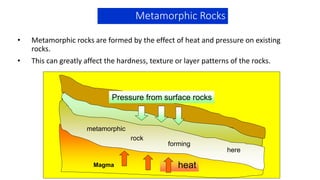
Metamorphic Rocks
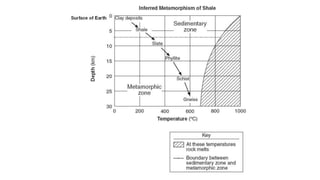
• Metamorphic rocks are formed by the effect of heat and pressure on existing
rocks.
• This can greatly affect the hardness, texture or layer patterns of the rocks.
Magma
metamorphic
rock
forming
here
heat
Pressure from surface rocks
Types of Metamorphic rock
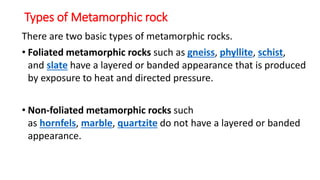
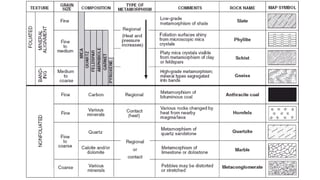
There are two basic types of metamorphic rocks.
• Foliated metamorphic rocks such as gneiss, phyllite, schist,
and slate have a layered or banded appearance that is produced
by exposure to heat and directed pressure.
• Non-foliated metamorphic rocks such
as hornfels, marble, quartzite do not have a layered or banded
appearance.
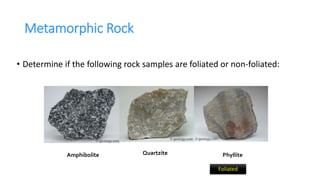
Metamorphic Rock
• Determine if the following rock samples are foliated or non-foliated:
Amphibolite Quartzite Phyllite
Foliated
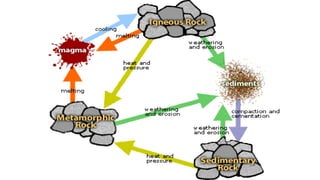
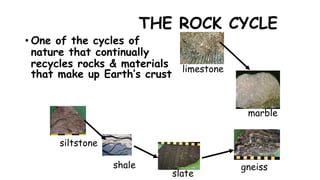
THE ROCK CYCLE
• One of the cycles of
nature that continually
recycles rocks & materials
that make up Earth’s crust
siltstone
slate
gneiss
limestone
marble
shale
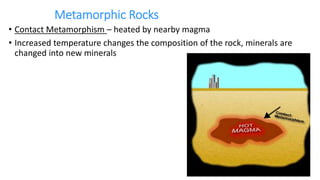
Metamorphic Rocks
• Contact Metamorphism – heated by nearby magma
• Increased temperature changes the composition of the rock, minerals are
changed into new minerals
Sedimentary Rock
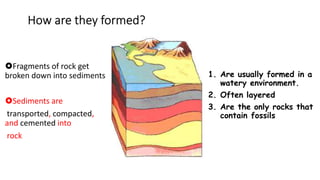
Fragments of rock get
broken down into sediments
Sediments are
transported, compacted,
and cemented into
rock
1. Are usually formed in a
watery environment.
2. Often layered
3. Are the only rocks that
contain fossils
Sedimentary Rocks
 Sedimentary rock is formed by erosion
 Sediments are moved from one place to another
 Sediments are deposited in layers, with the older ones
on the bottom
 The layers become compacted and cemented together
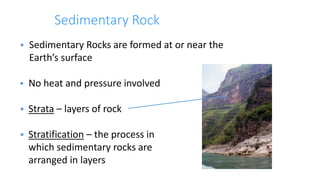
Sedimentary Rock
 Sedimentary Rocks are formed at or near the
Earth’s surface
 No heat and pressure involved
 Strata – layers of rock
 Stratification – the process in
which sedimentary rocks are
arranged in layers
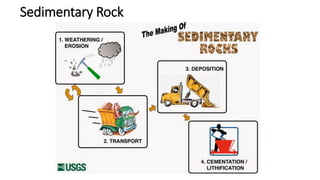
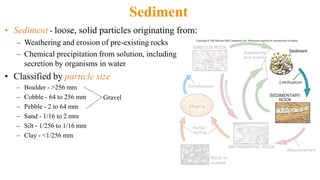
Sediment
• Sediment - loose, solid particles originating from:
– Weathering and erosion of pre-existing rocks
– Chemical precipitation from solution, including
secretion by organisms in water
• Classified by particle size
– Boulder - >256 mm
– Cobble - 64 to 256 mm
– Pebble - 2 to 64 mm
– Sand - 1/16 to 2 mm
– Silt - 1/256 to 1/16 mm
– Clay - <1/256 mm
Gravel
From Sediment to Sedimentary Rock
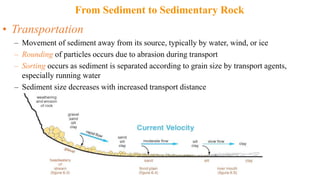
• Transportation
– Movement of sediment away from its source, typically by water, wind, or ice
– Rounding of particles occurs due to abrasion during transport
– Sorting occurs as sediment is separated according to grain size by transport agents,
especially running water
– Sediment size decreases with increased transport distance
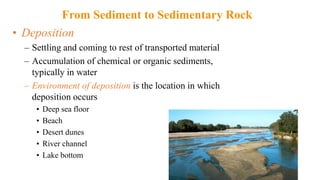
• Deposition
– Settling and coming to rest of transported material
– Accumulation of chemical or organic sediments,
typically in water
– Environment of deposition is the location in which
deposition occurs
• Deep sea floor
• Beach
• Desert dunes
• River channel
• Lake bottom
From Sediment to Sedimentary Rock
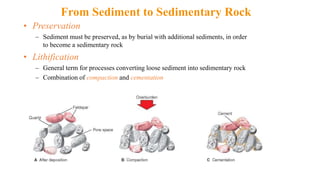
• Preservation
– Sediment must be preserved, as by burial with additional sediments, in order
to become a sedimentary rock
• Lithification
– General term for processes converting loose sediment into sedimentary rock
– Combination of compaction and cementation
From Sediment to Sedimentary Rock
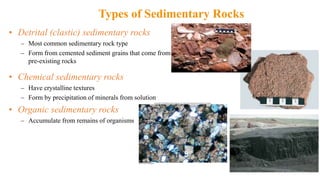
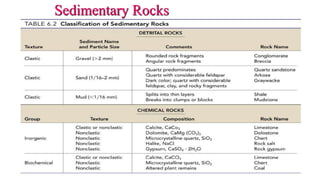
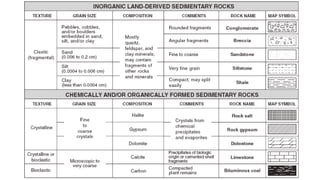
Types of Sedimentary Rocks
• Detrital (clastic) sedimentary rocks
– Most common sedimentary rock type
– Form from cemented sediment grains that come from
pre-existing rocks
• Chemical sedimentary rocks
– Have crystalline textures
– Form by precipitation of minerals from solution
• Organic sedimentary rocks
– Accumulate from remains of organisms
Sedimentary Rock
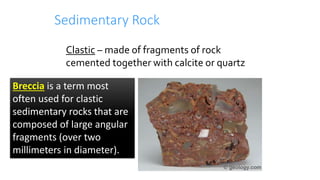
Clastic – made of fragments of rock
cemented together with calcite or quartz
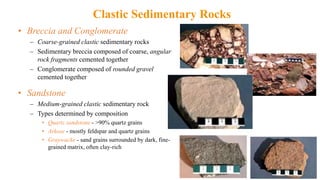
Breccia is a term most
often used for clastic
sedimentary rocks that are
composed of large angular
fragments (over two
millimeters in diameter).
Clastic Sedimentary Rocks
• Breccia and Conglomerate
– Coarse-grained clastic sedimentary rocks
– Sedimentary breccia composed of coarse, angular
rock fragments cemented together
– Conglomerate composed of rounded gravel
cemented together
• Sandstone
– Medium-grained clastic sedimentary rock
– Types determined by composition
• Quartz sandstone - >90% quartz grains
• Arkose - mostly feldspar and quartz grains
• Graywacke - sand grains surrounded by dark, fine-
grained matrix, often clay-rich
Clastic Sedimentary Rocks
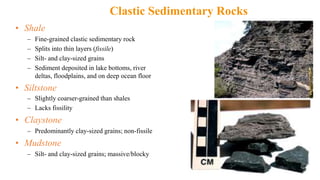
• Shale
– Fine-grained clastic sedimentary rock
– Splits into thin layers (fissile)
– Silt- and clay-sized grains
– Sediment deposited in lake bottoms, river
deltas, floodplains, and on deep ocean floor
• Siltstone
– Slightly coarser-grained than shales
– Lacks fissility
• Claystone
– Predominantly clay-sized grains; non-fissile
• Mudstone
– Silt- and clay-sized grains; massive/blocky
Chemical Sedimentary Rocks
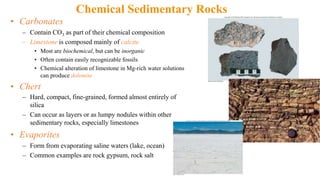
• Carbonates
– Contain CO3 as part of their chemical composition
– Limestone is composed mainly of calcite
• Most are biochemical, but can be inorganic
• Often contain easily recognizable fossils
• Chemical alteration of limestone in Mg-rich water solutions
can produce dolomite
• Chert
– Hard, compact, fine-grained, formed almost entirely of
silica
– Can occur as layers or as lumpy nodules within other
sedimentary rocks, especially limestones
• Evaporites
– Form from evaporating saline waters (lake, ocean)
– Common examples are rock gypsum, rock salt
Sedimentary Rock
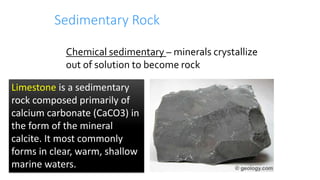
Chemical sedimentary – minerals crystallize
out of solution to become rock
Limestone is a sedimentary
rock composed primarily of
calcium carbonate (CaCO3) in
the form of the mineral
calcite. It most commonly
forms in clear, warm, shallow
marine waters.
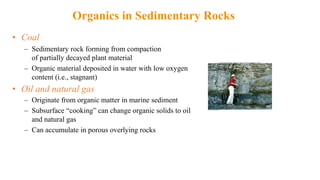
Organics in Sedimentary Rocks
• Coal
– Sedimentary rock forming from compaction
of partially decayed plant material
– Organic material deposited in water with low oxygen
content (i.e., stagnant)
• Oil and natural gas
– Originate from organic matter in marine sediment
– Subsurface “cooking” can change organic solids to oil
and natural gas
– Can accumulate in porous overlying rocks
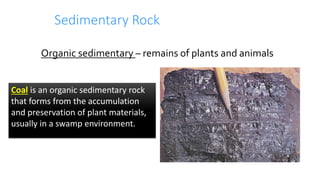
Sedimentary Rock
Organic sedimentary – remains of plants and animals
Coal is an organic sedimentary rock
that forms from the accumulation
and preservation of plant materials,
usually in a swamp environment.
Sedimentary Rocks
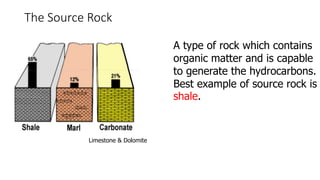
The Source Rock
A type of rock which contains
organic matter and is capable
to generate the hydrocarbons.
Best example of source rock is
shale.
Limestone & Dolomite
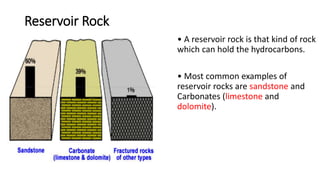
Reservoir Rock
• A reservoir rock is that kind of rock
which can hold the hydrocarbons.
• Most common examples of
reservoir rocks are sandstone and
Carbonates (limestone and
dolomite).
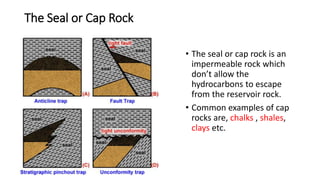
The Seal or Cap Rock
• The seal or cap rock is an
impermeable rock which
don’t allow the
hydrocarbons to escape
from the reservoir rock.
• Common examples of cap
rocks are, chalks , shales,
clays etc.

Petroleum geology lab 1

  • 2.
    By teacher Mr. KarwanYousif Presentation About University of Zakho College Of Engineering Department Of Petroleum Engineering Petroleum Geology Supervisor Mr. Nizar Botani
  • 4.
    Rocks are acombination of minerals that are bonded together in some way. • All rocks are made of minerals • Monomineralic- contain one mineral • Polymineralic- contain more than one mineral Rocks are classified into three groups by how they are formed Types of Rocks Igneous Sedimentary Metamorphic
  • 5.
    3 types ofRocks Types of Rocks Igneous Sedimentary Metamorphic Igneous Rocks: Form from molten rock that cools and hardens. •Sedimentary Rocks: Form from sediments (pieces of other rocks) that are cemented together. •Metamorphic Rocks: are formed when old rocks change by heat and pressure. Rocks are classified by how they form
  • 6.
    Classification of igneousrocks-2 types Intrusive • Form from magma • Cooled and solidified (hardened) slowly deep underground • Large crystal size Extrusive • Form from lava • Cooled and hardened quickly at or near the surface of the earth. • Small or no crystals
  • 7.
  • 8.
    Can be: • Felsic:light colored rocks that are rich in elements such as aluminum, silicon. Lower density • Mafic: dark colored rocks that are rich in iron and Mg. Higher density • Coarse-grained texture: takes longer to cool, larger visible mineral crystals • Fine-grained texture: cools quickly with small mineral crystals • Glassy Texture: cools the quickest, no mineral crystals form • Vesicular texture: Gas pockets (holes) • (note) Texture refers to the size/appearance of the minerals
  • 10.
    Metamorphic Rocks • Metamorphicrocks are formed by the effect of heat and pressure on existing rocks. • This can greatly affect the hardness, texture or layer patterns of the rocks. Magma metamorphic rock forming here heat Pressure from surface rocks
  • 11.
    Types of Metamorphicrock There are two basic types of metamorphic rocks. • Foliated metamorphic rocks such as gneiss, phyllite, schist, and slate have a layered or banded appearance that is produced by exposure to heat and directed pressure. • Non-foliated metamorphic rocks such as hornfels, marble, quartzite do not have a layered or banded appearance.
  • 12.
    Metamorphic Rock • Determineif the following rock samples are foliated or non-foliated: Amphibolite Quartzite Phyllite Foliated
  • 13.
    THE ROCK CYCLE •One of the cycles of nature that continually recycles rocks & materials that make up Earth’s crust siltstone slate gneiss limestone marble shale
  • 14.
    Metamorphic Rocks • ContactMetamorphism – heated by nearby magma • Increased temperature changes the composition of the rock, minerals are changed into new minerals
  • 17.
  • 18.
    Fragments of rockget broken down into sediments Sediments are transported, compacted, and cemented into rock 1. Are usually formed in a watery environment. 2. Often layered 3. Are the only rocks that contain fossils
  • 19.
    Sedimentary Rocks  Sedimentaryrock is formed by erosion  Sediments are moved from one place to another  Sediments are deposited in layers, with the older ones on the bottom  The layers become compacted and cemented together
  • 20.
    Sedimentary Rock  SedimentaryRocks are formed at or near the Earth’s surface  No heat and pressure involved  Strata – layers of rock  Stratification – the process in which sedimentary rocks are arranged in layers
  • 21.
    Sediment • Sediment -loose, solid particles originating from: – Weathering and erosion of pre-existing rocks – Chemical precipitation from solution, including secretion by organisms in water • Classified by particle size – Boulder - >256 mm – Cobble - 64 to 256 mm – Pebble - 2 to 64 mm – Sand - 1/16 to 2 mm – Silt - 1/256 to 1/16 mm – Clay - <1/256 mm Gravel
  • 22.
    From Sediment toSedimentary Rock • Transportation – Movement of sediment away from its source, typically by water, wind, or ice – Rounding of particles occurs due to abrasion during transport – Sorting occurs as sediment is separated according to grain size by transport agents, especially running water – Sediment size decreases with increased transport distance
  • 23.
    • Deposition – Settlingand coming to rest of transported material – Accumulation of chemical or organic sediments, typically in water – Environment of deposition is the location in which deposition occurs • Deep sea floor • Beach • Desert dunes • River channel • Lake bottom From Sediment to Sedimentary Rock
  • 24.
    • Preservation – Sedimentmust be preserved, as by burial with additional sediments, in order to become a sedimentary rock • Lithification – General term for processes converting loose sediment into sedimentary rock – Combination of compaction and cementation From Sediment to Sedimentary Rock
  • 25.
    Types of SedimentaryRocks • Detrital (clastic) sedimentary rocks – Most common sedimentary rock type – Form from cemented sediment grains that come from pre-existing rocks • Chemical sedimentary rocks – Have crystalline textures – Form by precipitation of minerals from solution • Organic sedimentary rocks – Accumulate from remains of organisms
  • 26.
    Sedimentary Rock Clastic –made of fragments of rock cemented together with calcite or quartz Breccia is a term most often used for clastic sedimentary rocks that are composed of large angular fragments (over two millimeters in diameter).
  • 27.
    Clastic Sedimentary Rocks •Breccia and Conglomerate – Coarse-grained clastic sedimentary rocks – Sedimentary breccia composed of coarse, angular rock fragments cemented together – Conglomerate composed of rounded gravel cemented together • Sandstone – Medium-grained clastic sedimentary rock – Types determined by composition • Quartz sandstone - >90% quartz grains • Arkose - mostly feldspar and quartz grains • Graywacke - sand grains surrounded by dark, fine- grained matrix, often clay-rich
  • 28.
    Clastic Sedimentary Rocks •Shale – Fine-grained clastic sedimentary rock – Splits into thin layers (fissile) – Silt- and clay-sized grains – Sediment deposited in lake bottoms, river deltas, floodplains, and on deep ocean floor • Siltstone – Slightly coarser-grained than shales – Lacks fissility • Claystone – Predominantly clay-sized grains; non-fissile • Mudstone – Silt- and clay-sized grains; massive/blocky
  • 29.
    Chemical Sedimentary Rocks •Carbonates – Contain CO3 as part of their chemical composition – Limestone is composed mainly of calcite • Most are biochemical, but can be inorganic • Often contain easily recognizable fossils • Chemical alteration of limestone in Mg-rich water solutions can produce dolomite • Chert – Hard, compact, fine-grained, formed almost entirely of silica – Can occur as layers or as lumpy nodules within other sedimentary rocks, especially limestones • Evaporites – Form from evaporating saline waters (lake, ocean) – Common examples are rock gypsum, rock salt
  • 30.
    Sedimentary Rock Chemical sedimentary– minerals crystallize out of solution to become rock Limestone is a sedimentary rock composed primarily of calcium carbonate (CaCO3) in the form of the mineral calcite. It most commonly forms in clear, warm, shallow marine waters.
  • 31.
    Organics in SedimentaryRocks • Coal – Sedimentary rock forming from compaction of partially decayed plant material – Organic material deposited in water with low oxygen content (i.e., stagnant) • Oil and natural gas – Originate from organic matter in marine sediment – Subsurface “cooking” can change organic solids to oil and natural gas – Can accumulate in porous overlying rocks
  • 32.
    Sedimentary Rock Organic sedimentary– remains of plants and animals Coal is an organic sedimentary rock that forms from the accumulation and preservation of plant materials, usually in a swamp environment.
  • 33.
  • 35.
    The Source Rock Atype of rock which contains organic matter and is capable to generate the hydrocarbons. Best example of source rock is shale. Limestone & Dolomite
  • 36.
    Reservoir Rock • Areservoir rock is that kind of rock which can hold the hydrocarbons. • Most common examples of reservoir rocks are sandstone and Carbonates (limestone and dolomite).
  • 37.
    The Seal orCap Rock • The seal or cap rock is an impermeable rock which don’t allow the hydrocarbons to escape from the reservoir rock. • Common examples of cap rocks are, chalks , shales, clays etc.