

Description and
Classification of Faults
Dr. P. Sarathbabu M.Sc. B.Ed. Ph.D.
Department of Geology
Acharya Nagarjuna University
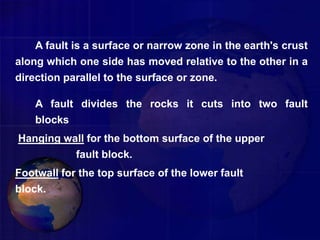
A fault is a surface or narrow zone in the earth's crust
along which one side has moved relative to the other in a
direction parallel to the surface or zone.
A fault divides the rocks it cuts into two fault
blocks
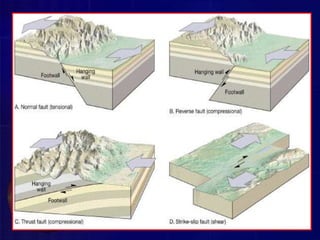
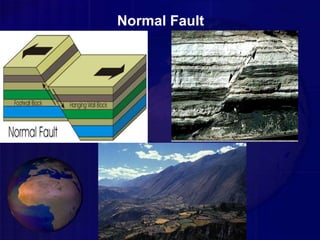
Hanging wall for the bottom surface of the upper
fault block.
Footwall for the top surface of the lower fault
block.
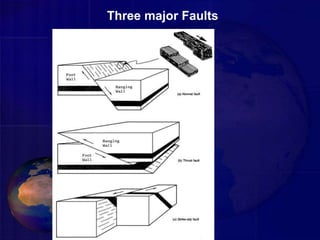
Three major Faults
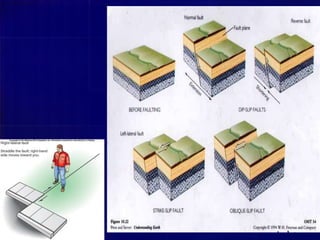
Normal Fault
• Based on the orientation of the relative displacement, or
slip i.e., the net distance and direction that the hanging
wall block has moved with respect to the footwall block
Dip-slip fault: slip is approx. parallel to the dip of
the fault surface
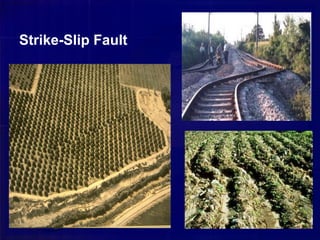
Strike-slip fault: slip is ~ horiz., parallel to the strike
of the fault surface
Oblique-slip fault: slip is inclined obliquely on the
fault surface
• Strike: It may be defined as the trend of the formed by intersection of fault
plane and horizontal plane
Strike-Slip Fault
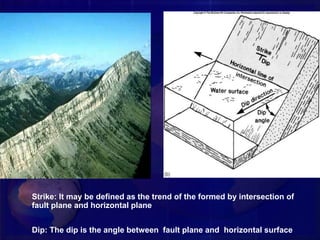
Strike: It may be defined as the trend of the formed by intersection of
fault plane and horizontal plane
Dip: The dip is the angle between fault plane and horizontal surface
Significance of Faults
• Along a fault zone, highly crushed and sheared rocks are
met with.
• These zones being weak, unstable and highly
permeable, pose expensive problems in civil engineering
constructions, such as dams, reservoirs, tunnels and
highways
FAULTS.ppt

FAULTS.ppt

  • 1.
    Description and Classification ofFaults Dr. P. Sarathbabu M.Sc. B.Ed. Ph.D. Department of Geology Acharya Nagarjuna University
  • 2.
    A fault isa surface or narrow zone in the earth's crust along which one side has moved relative to the other in a direction parallel to the surface or zone. A fault divides the rocks it cuts into two fault blocks Hanging wall for the bottom surface of the upper fault block. Footwall for the top surface of the lower fault block.
  • 4.
  • 5.
  • 6.
    • Based onthe orientation of the relative displacement, or slip i.e., the net distance and direction that the hanging wall block has moved with respect to the footwall block Dip-slip fault: slip is approx. parallel to the dip of the fault surface Strike-slip fault: slip is ~ horiz., parallel to the strike of the fault surface Oblique-slip fault: slip is inclined obliquely on the fault surface • Strike: It may be defined as the trend of the formed by intersection of fault plane and horizontal plane
  • 7.
  • 8.
    Strike: It maybe defined as the trend of the formed by intersection of fault plane and horizontal plane Dip: The dip is the angle between fault plane and horizontal surface
  • 10.
    Significance of Faults •Along a fault zone, highly crushed and sheared rocks are met with. • These zones being weak, unstable and highly permeable, pose expensive problems in civil engineering constructions, such as dams, reservoirs, tunnels and highways