How Self-Healing Nodes and Infrastructure
Management Impact Reliability
Oleg Chunikhin |CTO
Introductions
Oleg Chunikhin
CTO, Kublr
āœ” 20+ years in software architecture & development
āœ” Working w/ Kubernetes since its release in 2015
āœ” CTO at Kublr—an enterprise ready container
management platform
āœ” Twitter @olgch; @kublr
Like what you hear? Tweet at us!
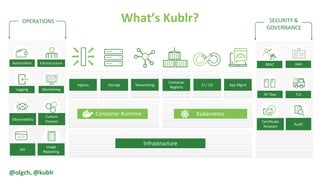
Automation
Ingress
Custom
Clusters
Infrastructure
Logging Monitoring
Observability
API
Usage
Reporting
RBAC IAM
Air Gap TLS
Certificate
Rotation
Audit
Storage Networking
Container
Registry
CI / CD App Mgmt
Infrastructure
Container Runtime Kubernetes
OPERATIONS SECURITY &
GOVERNANCE
What’s Kublr?
@olgch, @kublr
Building a Reliable System with Kubernetes
• Day 1: trivial, K8S will restart my pod!
• Day 30: this is not so simple...
• What Kubernetes does, can, and doesn’t do
• Full stack reliability: tools and approaches
@olgch, @kublr
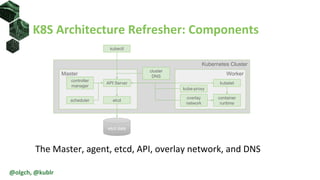
Kubernetes Cluster
K8S Architecture Refresher: Components
The Master, agent, etcd, API, overlay network, and DNS
Master
API Server
etcd data
controller
manager
scheduler etcd
kubectl
Worker
kubelet
container
runtime
overlay
network
cluster
DNS
kube-proxy
@olgch, @kublr
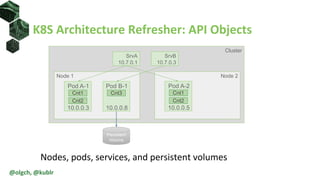
Cluster
K8S Architecture Refresher: API Objects
Nodes, pods, services, and persistent volumes
Node 1 Node 2
Pod A-1
10.0.0.3
Cnt1
Cnt2
Pod A-2
10.0.0.5
Cnt1
Cnt2
Pod B-1
10.0.0.8
Cnt3
SrvA
10.7.0.1
SrvB
10.7.0.3
Persistent
Volume
@olgch, @kublr
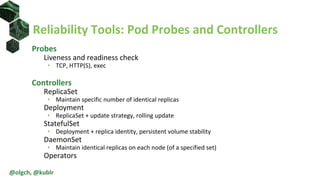
Reliability Tools: Pod Probes and Controllers
Probes
Liveness and readiness check
• TCP, HTTP(S), exec
Controllers
ReplicaSet
• Maintain specific number of identical replicas
Deployment
• ReplicaSet + update strategy, rolling update
StatefulSet
• Deployment + replica identity, persistent volume stability
DaemonSet
• Maintain identical replicas on each node (of a specified set)
Operators
@olgch, @kublr
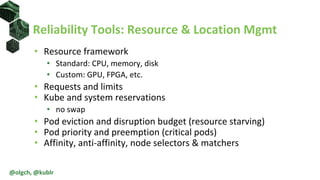
• Resource framework
• Standard: CPU, memory, disk
• Custom: GPU, FPGA, etc.
• Requests and limits
• Kube and system reservations
• no swap
• Pod eviction and disruption budget (resource starving)
• Pod priority and preemption (critical pods)
• Affinity, anti-affinity, node selectors & matchers
Reliability Tools: Resource & Location Mgmt
@olgch, @kublr
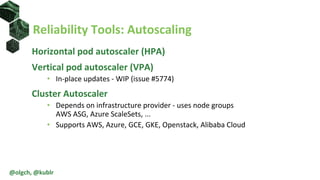
Reliability Tools: Autoscaling
Horizontal pod autoscaler (HPA)
Vertical pod autoscaler (VPA)
• In-place updates - WIP (issue #5774)
Cluster Autoscaler
• Depends on infrastructure provider - uses node groups
AWS ASG, Azure ScaleSets, ...
• Supports AWS, Azure, GCE, GKE, Openstack, Alibaba Cloud
@olgch, @kublr
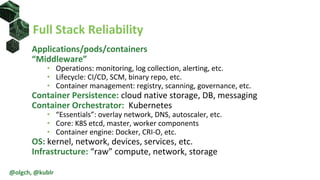
Applications/pods/containers
ā€œMiddlewareā€
• Operations: monitoring, log collection, alerting, etc.
• Lifecycle: CI/CD, SCM, binary repo, etc.
• Container management: registry, scanning, governance, etc.
Container Persistence: cloud native storage, DB, messaging
Container Orchestrator: Kubernetes
• ā€œEssentialsā€: overlay network, DNS, autoscaler, etc.
• Core: K8S etcd, master, worker components
• Container engine: Docker, CRI-O, etc.
OS: kernel, network, devices, services, etc.
Infrastructure: ā€œrawā€ compute, network, storage
Full Stack Reliability
@olgch, @kublr
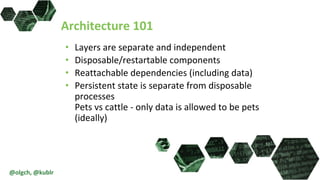
Architecture 101
• Layers are separate and independent
• Disposable/restartable components
• Reattachable dependencies (including data)
• Persistent state is separate from disposable
processes
Pets vs cattle - only data is allowed to be pets
(ideally)
@olgch, @kublr
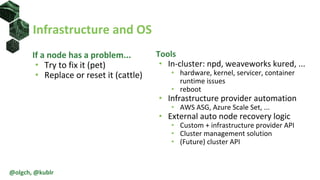
If a node has a problem...
• Try to fix it (pet)
• Replace or reset it (cattle)
Infrastructure and OS
Tools
• In-cluster: npd, weaveworks kured, ...
• hardware, kernel, servicer, container
runtime issues
• reboot
• Infrastructure provider automation
• AWS ASG, Azure Scale Set, ...
• External auto node recovery logic
• Custom + infrastructure provider API
• Cluster management solution
• (Future) cluster API
@olgch, @kublr
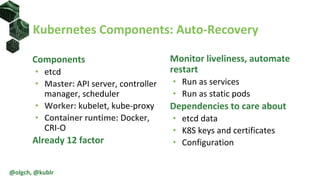
Components
• etcd
• Master: API server, controller
manager, scheduler
• Worker: kubelet, kube-proxy
• Container runtime: Docker,
CRI-O
Already 12 factor
Kubernetes Components: Auto-Recovery
Monitor liveliness, automate
restart
• Run as services
• Run as static pods
Dependencies to care about
• etcd data
• K8S keys and certificates
• Configuration
@olgch, @kublr
API Server
controller
manager
scheduler
API Server
controller
manager
scheduler
etcd data
etcd
etcd data
etcd
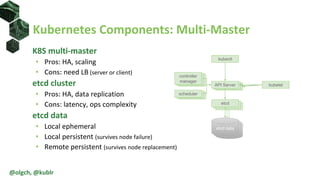
K8S multi-master
• Pros: HA, scaling
• Cons: need LB (server or client)
etcd cluster
• Pros: HA, data replication
• Cons: latency, ops complexity
etcd data
• Local ephemeral
• Local persistent (survives node failure)
• Remote persistent (survives node replacement)
Kubernetes Components: Multi-Master
API Server
etcd data
controller
manager
scheduler
etcd
kubectl
kubelet
@olgch, @kublr
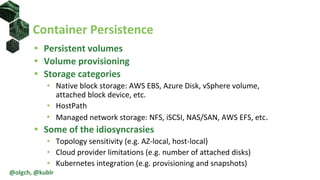
• Persistent volumes
• Volume provisioning
• Storage categories
• Native block storage: AWS EBS, Azure Disk, vSphere volume,
attached block device, etc.
• HostPath
• Managed network storage: NFS, iSCSI, NAS/SAN, AWS EFS, etc.
• Some of the idiosyncrasies
• Topology sensitivity (e.g. AZ-local, host-local)
• Cloud provider limitations (e.g. number of attached disks)
• Kubernetes integration (e.g. provisioning and snapshots)
Container Persistence
@olgch, @kublr
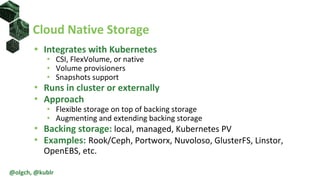
• Integrates with Kubernetes
• CSI, FlexVolume, or native
• Volume provisioners
• Snapshots support
• Runs in cluster or externally
• Approach
• Flexible storage on top of backing storage
• Augmenting and extending backing storage
• Backing storage: local, managed, Kubernetes PV
• Examples: Rook/Ceph, Portworx, Nuvoloso, GlusterFS, Linstor,
OpenEBS, etc.
Cloud Native Storage
@olgch, @kublr
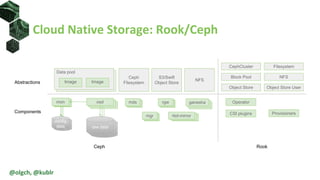
Data pool
mon
config
data
config
data
monmon
config
data
Cloud Native Storage: Rook/Ceph
raw data
osd
raw data
osd
raw data
mdsosd
Data pool
Image Image
Ceph
Filesystem
Components
Abstractions
Ceph
rgw
S3/Swift
Object Store
mgr
Rook
Operator
CSI plugins
osdosdganesha
NFS
CephCluster
Block Pool
Object Store
Filesystem
NFS
Object Store User
Provisioners
rbd-mirror
@olgch, @kublr
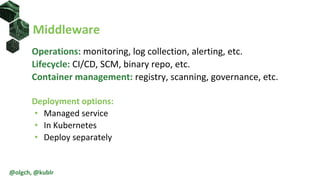
Operations: monitoring, log collection, alerting, etc.
Lifecycle: CI/CD, SCM, binary repo, etc.
Container management: registry, scanning, governance, etc.
Deployment options:
• Managed service
• In Kubernetes
• Deploy separately
Middleware
@olgch, @kublr
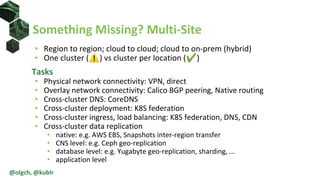
• Region to region; cloud to cloud; cloud to on-prem (hybrid)
• One cluster (⚠) vs cluster per location (āœ”)
Tasks
• Physical network connectivity: VPN, direct
• Overlay network connectivity: Calico BGP peering, Native routing
• Cross-cluster DNS: CoreDNS
• Cross-cluster deployment: K8S federation
• Cross-cluster ingress, load balancing: K8S federation, DNS, CDN
• Cross-cluster data replication
• native: e.g. AWS EBS, Snapshots inter-region transfer
• CNS level: e.g. Ceph geo-replication
• database level: e.g. Yugabyte geo-replication, sharding, ...
• application level
Something Missing? Multi-Site
@olgch, @kublr
To Recap...
• Kubernetes provides robust tools for application reliability
• Underlying infrastructure and Kubernetes components
recovery is responsibility of the cluster operator
• Kubernetes is just one of the layers
• Remember Architecture 101 and assess all layers accordingly
• Middleware, and even CNS, can run in Kubernetes and be
treated as regular applications to benefit from K8S capabilities
• Multi-site HA, balancing, failover is much easier with K8S and
the cloud native ecosystem. Still requires careful planning!
@olgch, @kublr
Q&A
@olgch, @kublr
Oleg Chunikhin
CTO | Kublr
oleg@kublr.com
Thank you!
Take Kublr for a test drive!
kublr.com/deploy
Free non-production license
@olgch, @kublr

Kubernetes stack reliability

  • 1.
    How Self-Healing Nodesand Infrastructure Management Impact Reliability Oleg Chunikhin |CTO
  • 2.
    Introductions Oleg Chunikhin CTO, Kublr āœ”20+ years in software architecture & development āœ” Working w/ Kubernetes since its release in 2015 āœ” CTO at Kublr—an enterprise ready container management platform āœ” Twitter @olgch; @kublr Like what you hear? Tweet at us!
  • 3.
    Automation Ingress Custom Clusters Infrastructure Logging Monitoring Observability API Usage Reporting RBAC IAM AirGap TLS Certificate Rotation Audit Storage Networking Container Registry CI / CD App Mgmt Infrastructure Container Runtime Kubernetes OPERATIONS SECURITY & GOVERNANCE What’s Kublr? @olgch, @kublr
  • 4.
    Building a ReliableSystem with Kubernetes • Day 1: trivial, K8S will restart my pod! • Day 30: this is not so simple... • What Kubernetes does, can, and doesn’t do • Full stack reliability: tools and approaches @olgch, @kublr
  • 5.
    Kubernetes Cluster K8S ArchitectureRefresher: Components The Master, agent, etcd, API, overlay network, and DNS Master API Server etcd data controller manager scheduler etcd kubectl Worker kubelet container runtime overlay network cluster DNS kube-proxy @olgch, @kublr
  • 6.
    Cluster K8S Architecture Refresher:API Objects Nodes, pods, services, and persistent volumes Node 1 Node 2 Pod A-1 10.0.0.3 Cnt1 Cnt2 Pod A-2 10.0.0.5 Cnt1 Cnt2 Pod B-1 10.0.0.8 Cnt3 SrvA 10.7.0.1 SrvB 10.7.0.3 Persistent Volume @olgch, @kublr
  • 7.
    Reliability Tools: PodProbes and Controllers Probes Liveness and readiness check • TCP, HTTP(S), exec Controllers ReplicaSet • Maintain specific number of identical replicas Deployment • ReplicaSet + update strategy, rolling update StatefulSet • Deployment + replica identity, persistent volume stability DaemonSet • Maintain identical replicas on each node (of a specified set) Operators @olgch, @kublr
  • 8.
    • Resource framework •Standard: CPU, memory, disk • Custom: GPU, FPGA, etc. • Requests and limits • Kube and system reservations • no swap • Pod eviction and disruption budget (resource starving) • Pod priority and preemption (critical pods) • Affinity, anti-affinity, node selectors & matchers Reliability Tools: Resource & Location Mgmt @olgch, @kublr
  • 9.
    Reliability Tools: Autoscaling Horizontalpod autoscaler (HPA) Vertical pod autoscaler (VPA) • In-place updates - WIP (issue #5774) Cluster Autoscaler • Depends on infrastructure provider - uses node groups AWS ASG, Azure ScaleSets, ... • Supports AWS, Azure, GCE, GKE, Openstack, Alibaba Cloud @olgch, @kublr
  • 10.
    Applications/pods/containers ā€œMiddlewareā€ • Operations: monitoring,log collection, alerting, etc. • Lifecycle: CI/CD, SCM, binary repo, etc. • Container management: registry, scanning, governance, etc. Container Persistence: cloud native storage, DB, messaging Container Orchestrator: Kubernetes • ā€œEssentialsā€: overlay network, DNS, autoscaler, etc. • Core: K8S etcd, master, worker components • Container engine: Docker, CRI-O, etc. OS: kernel, network, devices, services, etc. Infrastructure: ā€œrawā€ compute, network, storage Full Stack Reliability @olgch, @kublr
  • 11.
    Architecture 101 • Layersare separate and independent • Disposable/restartable components • Reattachable dependencies (including data) • Persistent state is separate from disposable processes Pets vs cattle - only data is allowed to be pets (ideally) @olgch, @kublr
  • 12.
    If a nodehas a problem... • Try to fix it (pet) • Replace or reset it (cattle) Infrastructure and OS Tools • In-cluster: npd, weaveworks kured, ... • hardware, kernel, servicer, container runtime issues • reboot • Infrastructure provider automation • AWS ASG, Azure Scale Set, ... • External auto node recovery logic • Custom + infrastructure provider API • Cluster management solution • (Future) cluster API @olgch, @kublr
  • 13.
    Components • etcd • Master:API server, controller manager, scheduler • Worker: kubelet, kube-proxy • Container runtime: Docker, CRI-O Already 12 factor Kubernetes Components: Auto-Recovery Monitor liveliness, automate restart • Run as services • Run as static pods Dependencies to care about • etcd data • K8S keys and certificates • Configuration @olgch, @kublr
  • 14.
    API Server controller manager scheduler API Server controller manager scheduler etcddata etcd etcd data etcd K8S multi-master • Pros: HA, scaling • Cons: need LB (server or client) etcd cluster • Pros: HA, data replication • Cons: latency, ops complexity etcd data • Local ephemeral • Local persistent (survives node failure) • Remote persistent (survives node replacement) Kubernetes Components: Multi-Master API Server etcd data controller manager scheduler etcd kubectl kubelet @olgch, @kublr
  • 15.
    • Persistent volumes •Volume provisioning • Storage categories • Native block storage: AWS EBS, Azure Disk, vSphere volume, attached block device, etc. • HostPath • Managed network storage: NFS, iSCSI, NAS/SAN, AWS EFS, etc. • Some of the idiosyncrasies • Topology sensitivity (e.g. AZ-local, host-local) • Cloud provider limitations (e.g. number of attached disks) • Kubernetes integration (e.g. provisioning and snapshots) Container Persistence @olgch, @kublr
  • 16.
    • Integrates withKubernetes • CSI, FlexVolume, or native • Volume provisioners • Snapshots support • Runs in cluster or externally • Approach • Flexible storage on top of backing storage • Augmenting and extending backing storage • Backing storage: local, managed, Kubernetes PV • Examples: Rook/Ceph, Portworx, Nuvoloso, GlusterFS, Linstor, OpenEBS, etc. Cloud Native Storage @olgch, @kublr
  • 17.
    Data pool mon config data config data monmon config data Cloud NativeStorage: Rook/Ceph raw data osd raw data osd raw data mdsosd Data pool Image Image Ceph Filesystem Components Abstractions Ceph rgw S3/Swift Object Store mgr Rook Operator CSI plugins osdosdganesha NFS CephCluster Block Pool Object Store Filesystem NFS Object Store User Provisioners rbd-mirror @olgch, @kublr
  • 18.
    Operations: monitoring, logcollection, alerting, etc. Lifecycle: CI/CD, SCM, binary repo, etc. Container management: registry, scanning, governance, etc. Deployment options: • Managed service • In Kubernetes • Deploy separately Middleware @olgch, @kublr
  • 19.
    • Region toregion; cloud to cloud; cloud to on-prem (hybrid) • One cluster (⚠) vs cluster per location (āœ”) Tasks • Physical network connectivity: VPN, direct • Overlay network connectivity: Calico BGP peering, Native routing • Cross-cluster DNS: CoreDNS • Cross-cluster deployment: K8S federation • Cross-cluster ingress, load balancing: K8S federation, DNS, CDN • Cross-cluster data replication • native: e.g. AWS EBS, Snapshots inter-region transfer • CNS level: e.g. Ceph geo-replication • database level: e.g. Yugabyte geo-replication, sharding, ... • application level Something Missing? Multi-Site @olgch, @kublr
  • 20.
    To Recap... • Kubernetesprovides robust tools for application reliability • Underlying infrastructure and Kubernetes components recovery is responsibility of the cluster operator • Kubernetes is just one of the layers • Remember Architecture 101 and assess all layers accordingly • Middleware, and even CNS, can run in Kubernetes and be treated as regular applications to benefit from K8S capabilities • Multi-site HA, balancing, failover is much easier with K8S and the cloud native ecosystem. Still requires careful planning! @olgch, @kublr
  • 21.
  • 22.
    Oleg Chunikhin CTO |Kublr oleg@kublr.com Thank you! Take Kublr for a test drive! kublr.com/deploy Free non-production license @olgch, @kublr