A2 Media Exam
Lesson Objectives: To develop your exam
technique.
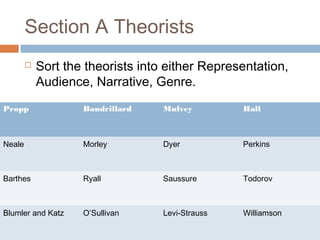
Section A Theorists


Sort the theorists into either Representation,
Audience, Narrative, Genre.

Propp

Baudrillard

Mulvey

Hall

Neale

Morley

Dyer

Perkins

Barthes

Ryall

Saussure

Todorov

Blumler and Katz

O’Sullivan

Levi-Strauss

Williamson
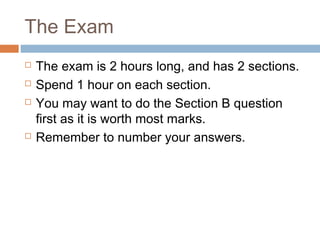
The Exam






The exam is 2 hours long, and has 2 sections.
Spend 1 hour on each section.
You may want to do the Section B question
first as it is worth most marks.
Remember to number your answers.
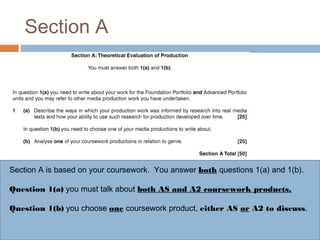
Section A

Section A is based on your coursework. You answer both questions 1(a) and 1(b).
Question 1(a) you must talk about both AS and A2 coursework products.
Question 1(b) you choose one coursework product, either AS or A2 to discuss.
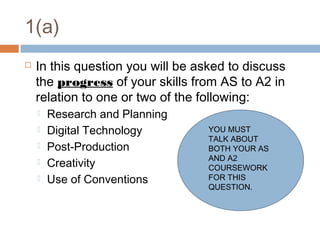
1(a)


In this question you will be asked to discuss
the progress of your skills from AS to A2 in
relation to one or two of the following:






Research and Planning
Digital Technology
Post-Production
Creativity
Use of Conventions

YOU MUST
TALK ABOUT
BOTH YOUR AS
AND A2
COURSEWORK
FOR THIS
QUESTION.
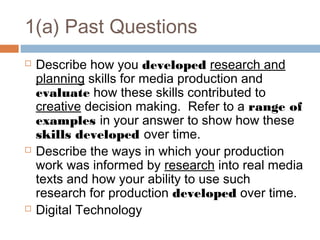
1(a) Past Questions






Describe how you developed research and
planning skills for media production and
evaluate how these skills contributed to
creative decision making. Refer to a range of
examples in your answer to show how these
skills developed over time.
Describe the ways in which your production
work was informed by research into real media
texts and how your ability to use such
research for production developed over time.
Digital Technology
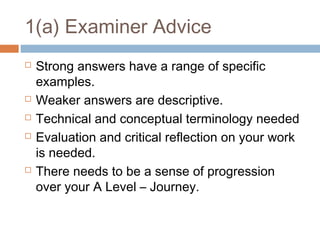
1(a) Examiner Advice








Strong answers have a range of specific
examples.
Weaker answers are descriptive.
Technical and conceptual terminology needed
Evaluation and critical reflection on your work
is needed.
There needs to be a sense of progression
over your A Level – Journey.
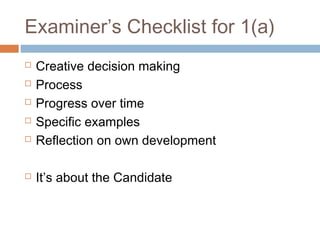
Examiner’s Checklist for 1(a)








Creative decision making
Process
Progress over time
Specific examples
Reflection on own development
It’s about the Candidate
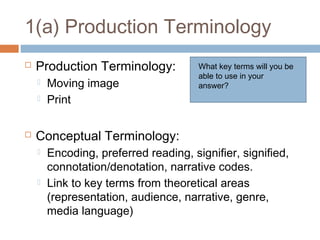
1(a) Production Terminology


Production Terminology:





Moving image
Print

What key terms will you be
able to use in your
answer?

Conceptual Terminology:




Encoding, preferred reading, signifier, signified,
connotation/denotation, narrative codes.
Link to key terms from theoretical areas
(representation, audience, narrative, genre,
media language)
1(a)









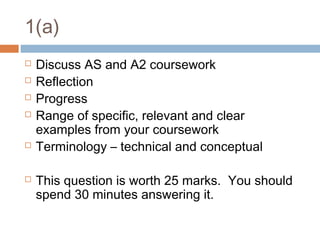
Discuss AS and A2 coursework
Reflection
Progress
Range of specific, relevant and clear
examples from your coursework
Terminology – technical and conceptual
This question is worth 25 marks. You should
spend 30 minutes answering it.
1(b)


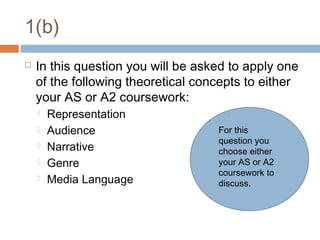
In this question you will be asked to apply one
of the following theoretical concepts to either
your AS or A2 coursework:






Representation
Audience
Narrative
Genre
Media Language

For this
question you
choose either
your AS or A2
coursework to
discuss.
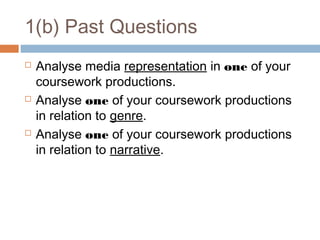
1(b) Past Questions






Analyse media representation in one of your
coursework productions.
Analyse one of your coursework productions
in relation to genre.
Analyse one of your coursework productions
in relation to narrative.
1(b) Examiner’s Advice


Stronger answers do 3 things well:








Outline the concept for discussion with reference
to relevant theorists
Apply these ideas to a range of specific elements
from your coursework
Discuss how well the concept/theories
relate to your product

Poor answers will lack reference to theory and
specific answers.
Choice of text is important.
1(b) Examiner’s Checklist







Showing understanding of the concept (ideally
with references/quotations)
Applying the concept
Textual analysis of the work (ONE
PRODUCTION) using the concept
It’s about the work.
1(b) Terminology


What key terms can you think of in relation to
each of the conceptual areas:






Representation
Audience
Narrative
Genre
Media Language
1(b) Terminology


Representation – visual pleasure,
object/subject of the gaze, objectification,
signs, signifier, signified,
connotation/denotation, hyperreality,
simulation, simulacra.
1(b) Terminology


Audience – encoding, decoding, dominant,
negotiated, oppositional, socio-cultural
context, reception, uses and gratifications,
surveillance, escapism, personal identity/
relationships, cultivation theory, hypodermic
model, passive audience/active audience
1(b) Terminology


Narrative – character types, hero, villain,
princess, etc., equilibrium, disequilibrium,
resolution, binary oppositions, narrative codes,
action, enigma, semic, symbolic, cultural.
1(b) Terminology


Genre – convention, iconography, codes,
product differentiation, capitalist, systems of
expectation and intelligibility, socio-cultural,
myths, genre supervises the relationship
between producer and audience
1(b) Media Language


Production Terminology - effect of technical
choices









Print Media
Moving Image

Use of genre conventions
Use of narrative structures/codes
Encoding of meaning- using varying
processes of signification including camera
movement, angles and framing of shots,
editing, mise en scene and sound.
-
1(b) Terminology


You may be able to link terminology from other
concepts into your discussion, e.g.:








Encoding of representations
Use of iconography to encode meaning, and
communicate narrative information
Use of character types in representation
Signifer, signified, dennotation, connotation,
creation of desired readings, mediation and
ideology etc.
Accurate use of production terms (think of your
AS exams).
1(b)









Understanding of concept
Relate concept to examples from your coursework
Range of specific, clear relevant examples
Use conceptual language throughout
Reference to theorists
Evaluation of usefulness of concept/theory to your
production
This question is worth 25 marks. You should
spend 30 minutes answering it.
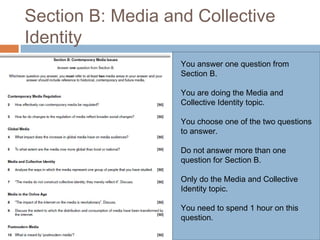
Section B: Media and Collective
Identity
You answer one question from
Section B.
You are doing the Media and
Collective Identity topic.
You choose one of the two questions
to answer.
Do not answer more than one
question for Section B.
Only do the Media and Collective
Identity topic.
You need to spend 1 hour on this
question.
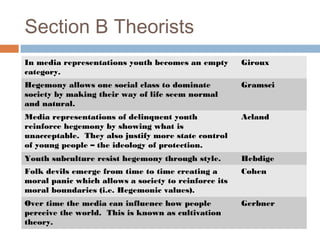
Section B Theorists
In media representations youth becomes an empty
category.
Hegemony allows one social class to dominate
society by making their way of life seem normal
and natural.
Media representations of delinquent youth
reinforce hegemony by showing what is
unacceptable. They also justify more state control
of young people – the ideology of protection.
Youth subculture resist hegemony through style.
Folk devils emerge from time to time creating a
moral panic which allows a society to reinforce its
moral boundaries (i.e. Hegemonic values).
Over time the media can influence how people
perceive the world. This is known as cultivation
theory.
Section B Theorists
In media representations youth becomes an empty
category.

Giroux

Hegemony allows one social class to dominate
society by making their way of life seem normal
and natural.

Gramsci

Media representations of delinquent youth
reinforce hegemony by showing what is
unacceptable. They also justify more state control
of young people – the ideology of protection.

Acland

Youth subculture resist hegemony through style.

Hebdige

Folk devils emerge from time to time creating a
moral panic which allows a society to reinforce its
moral boundaries (i.e. Hegemonic values).

Cohen

Over time the media can influence how people
perceive the world. This is known as cultivation
theory.

Gerbner
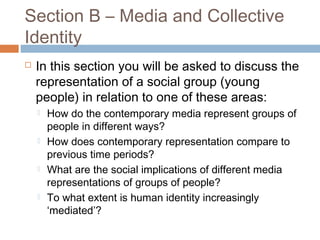
Section B – Media and Collective
Identity


In this section you will be asked to discuss the
representation of a social group (young
people) in relation to one of these areas:








How do the contemporary media represent groups of
people in different ways?
How does contemporary representation compare to
previous time periods?
What are the social implications of different media
representations of groups of people?
To what extent is human identity increasingly
‘mediated’?
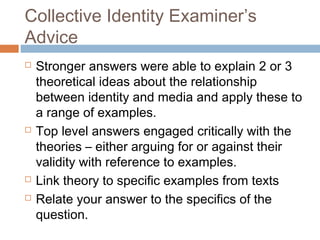
Collective Identity Examiner’s
Advice







Stronger answers were able to explain 2 or 3
theoretical ideas about the relationship
between identity and media and apply these to
a range of examples.
Top level answers engaged critically with the
theories – either arguing for or against their
validity with reference to examples.
Link theory to specific examples from texts
Relate your answer to the specifics of the
question.
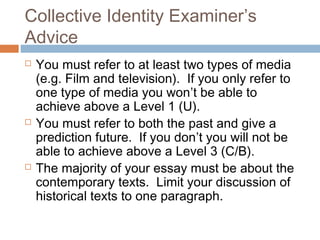
Collective Identity Examiner’s
Advice






You must refer to at least two types of media
(e.g. Film and television). If you only refer to
one type of media you won’t be able to
achieve above a Level 1 (U).
You must refer to both the past and give a
prediction future. If you don’t you will not be
able to achieve above a Level 3 (C/B).
The majority of your essay must be about the
contemporary texts. Limit your discussion of
historical texts to one paragraph.
Theory – Examiner’s Advice


When applying theory remember that the
theorists are usually not discussing the texts
you are talking about. You are applying their
ideas to your chosen texts.





Learning adapted to the focus of the question
Clear argument
Balance of theory, texts, personal engagement
Terminology
Terminology?


What key terms can you think of for this
section?
Section B Terminology


Hegemony, hegemonic values, dominant
ideology, subculture, style, ideology of
protection, folk devils, moral panic, ideological
state apparatus, cultivation theory, symbolic
violence.








Historical, contemporary, future
Most of the essay focused on contemporary
At least 2 types of media
Terminology
Links between theories and texts supported by
examples
Clear Argument
Time Management







You need to spend 1 hour on this question.
Most of your time should be spent writing
about the contemporary texts.
Introduction 5-10 minutes
Historical text 5-10 minutes
Contemporary Texts 30-40 minutes
Conclusion 10 minutes
Conclusion






In your conclusion you need to sum up what
you have demonstrated in relation to media
representations of young people.
You need to consider the issue of the
relationship between media representations
and identity – how does the media effect out
understanding of social groups (Gerbner,
Gauntlett).
You also need to consider how this will
develop in the future (e.g. Social networking
sites, more power though still limited, e.g.
Tuition fees protests).
Review











How long is your exam?
How many sections?
How many questions do you answer in
Section A?
What topic are you doing in Section B?
How many questions do you answer in
Section B?
What’s 1(a) about?
What’s 1(b) about?
What’s Section B about?

G325 Exam Overview

  • 1.
    A2 Media Exam LessonObjectives: To develop your exam technique.
  • 2.
    Section A Theorists  Sortthe theorists into either Representation, Audience, Narrative, Genre. Propp Baudrillard Mulvey Hall Neale Morley Dyer Perkins Barthes Ryall Saussure Todorov Blumler and Katz O’Sullivan Levi-Strauss Williamson
  • 3.
    The Exam     The examis 2 hours long, and has 2 sections. Spend 1 hour on each section. You may want to do the Section B question first as it is worth most marks. Remember to number your answers.
  • 4.
    Section A Section Ais based on your coursework. You answer both questions 1(a) and 1(b). Question 1(a) you must talk about both AS and A2 coursework products. Question 1(b) you choose one coursework product, either AS or A2 to discuss.
  • 5.
    1(a)  In this questionyou will be asked to discuss the progress of your skills from AS to A2 in relation to one or two of the following:      Research and Planning Digital Technology Post-Production Creativity Use of Conventions YOU MUST TALK ABOUT BOTH YOUR AS AND A2 COURSEWORK FOR THIS QUESTION.
  • 6.
    1(a) Past Questions    Describehow you developed research and planning skills for media production and evaluate how these skills contributed to creative decision making. Refer to a range of examples in your answer to show how these skills developed over time. Describe the ways in which your production work was informed by research into real media texts and how your ability to use such research for production developed over time. Digital Technology
  • 7.
    1(a) Examiner Advice      Stronganswers have a range of specific examples. Weaker answers are descriptive. Technical and conceptual terminology needed Evaluation and critical reflection on your work is needed. There needs to be a sense of progression over your A Level – Journey.
  • 8.
    Examiner’s Checklist for1(a)       Creative decision making Process Progress over time Specific examples Reflection on own development It’s about the Candidate
  • 9.
    1(a) Production Terminology  ProductionTerminology:    Moving image Print What key terms will you be able to use in your answer? Conceptual Terminology:   Encoding, preferred reading, signifier, signified, connotation/denotation, narrative codes. Link to key terms from theoretical areas (representation, audience, narrative, genre, media language)
  • 10.
    1(a)       Discuss AS andA2 coursework Reflection Progress Range of specific, relevant and clear examples from your coursework Terminology – technical and conceptual This question is worth 25 marks. You should spend 30 minutes answering it.
  • 11.
    1(b)  In this questionyou will be asked to apply one of the following theoretical concepts to either your AS or A2 coursework:      Representation Audience Narrative Genre Media Language For this question you choose either your AS or A2 coursework to discuss.
  • 12.
    1(b) Past Questions    Analysemedia representation in one of your coursework productions. Analyse one of your coursework productions in relation to genre. Analyse one of your coursework productions in relation to narrative.
  • 13.
    1(b) Examiner’s Advice  Strongeranswers do 3 things well:      Outline the concept for discussion with reference to relevant theorists Apply these ideas to a range of specific elements from your coursework Discuss how well the concept/theories relate to your product Poor answers will lack reference to theory and specific answers. Choice of text is important.
  • 14.
    1(b) Examiner’s Checklist     Showingunderstanding of the concept (ideally with references/quotations) Applying the concept Textual analysis of the work (ONE PRODUCTION) using the concept It’s about the work.
  • 15.
    1(b) Terminology  What keyterms can you think of in relation to each of the conceptual areas:      Representation Audience Narrative Genre Media Language
  • 16.
    1(b) Terminology  Representation –visual pleasure, object/subject of the gaze, objectification, signs, signifier, signified, connotation/denotation, hyperreality, simulation, simulacra.
  • 17.
    1(b) Terminology  Audience –encoding, decoding, dominant, negotiated, oppositional, socio-cultural context, reception, uses and gratifications, surveillance, escapism, personal identity/ relationships, cultivation theory, hypodermic model, passive audience/active audience
  • 18.
    1(b) Terminology  Narrative –character types, hero, villain, princess, etc., equilibrium, disequilibrium, resolution, binary oppositions, narrative codes, action, enigma, semic, symbolic, cultural.
  • 19.
    1(b) Terminology  Genre –convention, iconography, codes, product differentiation, capitalist, systems of expectation and intelligibility, socio-cultural, myths, genre supervises the relationship between producer and audience
  • 20.
    1(b) Media Language  ProductionTerminology - effect of technical choices       Print Media Moving Image Use of genre conventions Use of narrative structures/codes Encoding of meaning- using varying processes of signification including camera movement, angles and framing of shots, editing, mise en scene and sound. -
  • 21.
    1(b) Terminology  You maybe able to link terminology from other concepts into your discussion, e.g.:      Encoding of representations Use of iconography to encode meaning, and communicate narrative information Use of character types in representation Signifer, signified, dennotation, connotation, creation of desired readings, mediation and ideology etc. Accurate use of production terms (think of your AS exams).
  • 22.
    1(b)        Understanding of concept Relateconcept to examples from your coursework Range of specific, clear relevant examples Use conceptual language throughout Reference to theorists Evaluation of usefulness of concept/theory to your production This question is worth 25 marks. You should spend 30 minutes answering it.
  • 23.
    Section B: Mediaand Collective Identity You answer one question from Section B. You are doing the Media and Collective Identity topic. You choose one of the two questions to answer. Do not answer more than one question for Section B. Only do the Media and Collective Identity topic. You need to spend 1 hour on this question.
  • 24.
    Section B Theorists Inmedia representations youth becomes an empty category. Hegemony allows one social class to dominate society by making their way of life seem normal and natural. Media representations of delinquent youth reinforce hegemony by showing what is unacceptable. They also justify more state control of young people – the ideology of protection. Youth subculture resist hegemony through style. Folk devils emerge from time to time creating a moral panic which allows a society to reinforce its moral boundaries (i.e. Hegemonic values). Over time the media can influence how people perceive the world. This is known as cultivation theory.
  • 25.
    Section B Theorists Inmedia representations youth becomes an empty category. Giroux Hegemony allows one social class to dominate society by making their way of life seem normal and natural. Gramsci Media representations of delinquent youth reinforce hegemony by showing what is unacceptable. They also justify more state control of young people – the ideology of protection. Acland Youth subculture resist hegemony through style. Hebdige Folk devils emerge from time to time creating a moral panic which allows a society to reinforce its moral boundaries (i.e. Hegemonic values). Cohen Over time the media can influence how people perceive the world. This is known as cultivation theory. Gerbner
  • 26.
    Section B –Media and Collective Identity  In this section you will be asked to discuss the representation of a social group (young people) in relation to one of these areas:     How do the contemporary media represent groups of people in different ways? How does contemporary representation compare to previous time periods? What are the social implications of different media representations of groups of people? To what extent is human identity increasingly ‘mediated’?
  • 27.
    Collective Identity Examiner’s Advice     Strongeranswers were able to explain 2 or 3 theoretical ideas about the relationship between identity and media and apply these to a range of examples. Top level answers engaged critically with the theories – either arguing for or against their validity with reference to examples. Link theory to specific examples from texts Relate your answer to the specifics of the question.
  • 28.
    Collective Identity Examiner’s Advice    Youmust refer to at least two types of media (e.g. Film and television). If you only refer to one type of media you won’t be able to achieve above a Level 1 (U). You must refer to both the past and give a prediction future. If you don’t you will not be able to achieve above a Level 3 (C/B). The majority of your essay must be about the contemporary texts. Limit your discussion of historical texts to one paragraph.
  • 29.
    Theory – Examiner’sAdvice  When applying theory remember that the theorists are usually not discussing the texts you are talking about. You are applying their ideas to your chosen texts.
  • 30.
        Learning adapted tothe focus of the question Clear argument Balance of theory, texts, personal engagement Terminology
  • 31.
    Terminology?  What key termscan you think of for this section?
  • 32.
    Section B Terminology  Hegemony,hegemonic values, dominant ideology, subculture, style, ideology of protection, folk devils, moral panic, ideological state apparatus, cultivation theory, symbolic violence.
  • 33.
          Historical, contemporary, future Mostof the essay focused on contemporary At least 2 types of media Terminology Links between theories and texts supported by examples Clear Argument
  • 34.
    Time Management      You needto spend 1 hour on this question. Most of your time should be spent writing about the contemporary texts. Introduction 5-10 minutes Historical text 5-10 minutes Contemporary Texts 30-40 minutes Conclusion 10 minutes
  • 35.
    Conclusion    In your conclusionyou need to sum up what you have demonstrated in relation to media representations of young people. You need to consider the issue of the relationship between media representations and identity – how does the media effect out understanding of social groups (Gerbner, Gauntlett). You also need to consider how this will develop in the future (e.g. Social networking sites, more power though still limited, e.g. Tuition fees protests).
  • 36.
    Review         How long isyour exam? How many sections? How many questions do you answer in Section A? What topic are you doing in Section B? How many questions do you answer in Section B? What’s 1(a) about? What’s 1(b) about? What’s Section B about?