G235: Critical
Perspectives in
Media
LO: To have a basic understanding of how to analyse the
use and impact of media language in your productions.
Theoretical
Evaluation of
Production
1(b) Media Language
Importance of media language
• Every medium has its own ‘language’ – or
combination of languages – that it uses to
communicate meaning. Television, for example,
uses verbal and written language as well as the
languages of moving images and sound.
• We call these ‘languages’ because they use
familiar codes and conventions that are
generally understood.
LO: To have a basic understanding of how to analyse the
use and impact of media language in your productions.
Denotation, Connotation and
Myth
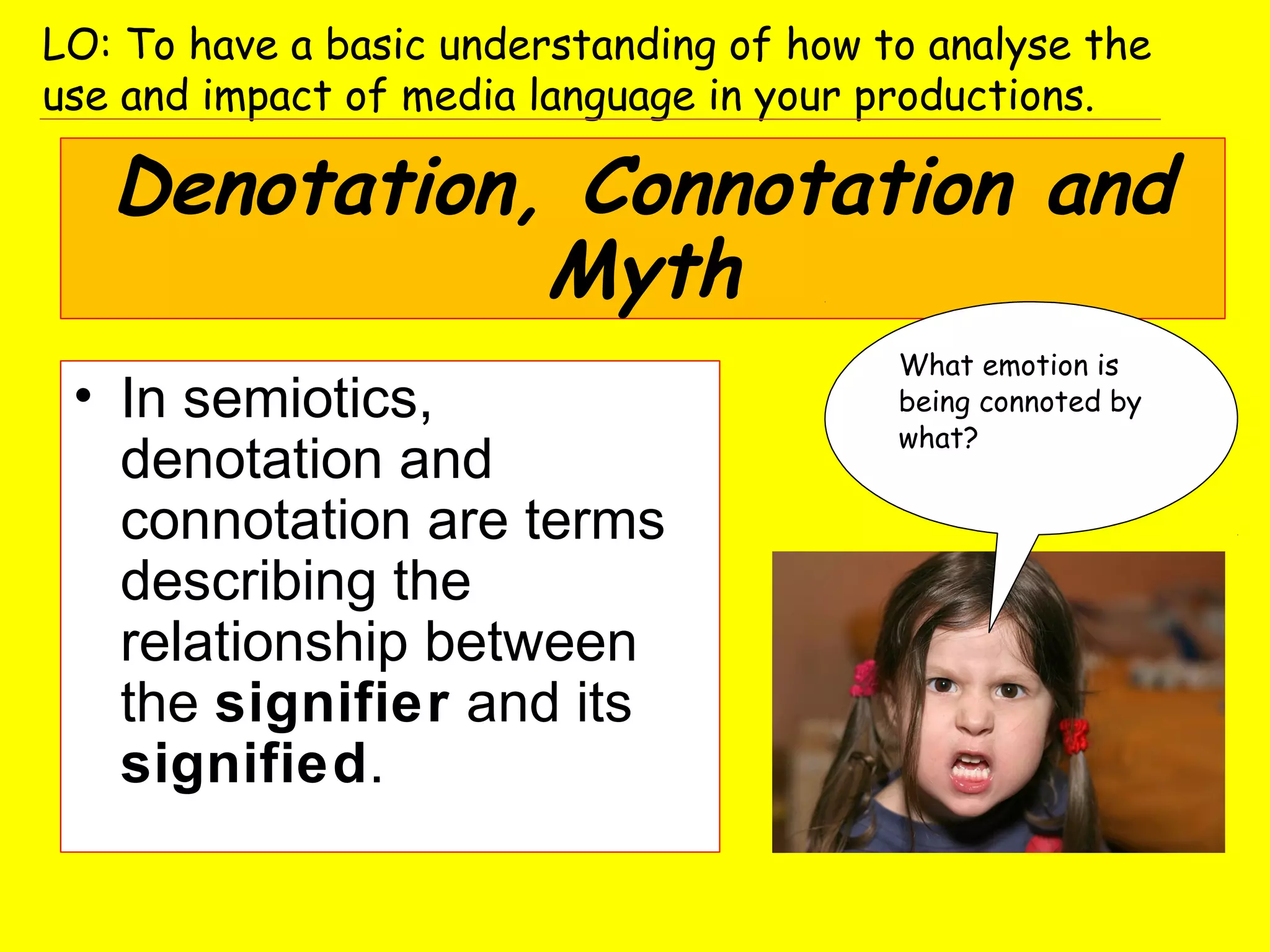
• In semiotics,
denotation and
connotation are terms
describing the
relationship between
the signifier and its
signified.
What emotion is
being connoted by
what?
LO: To have a basic understanding of how to analyse the
use and impact of media language in your productions.
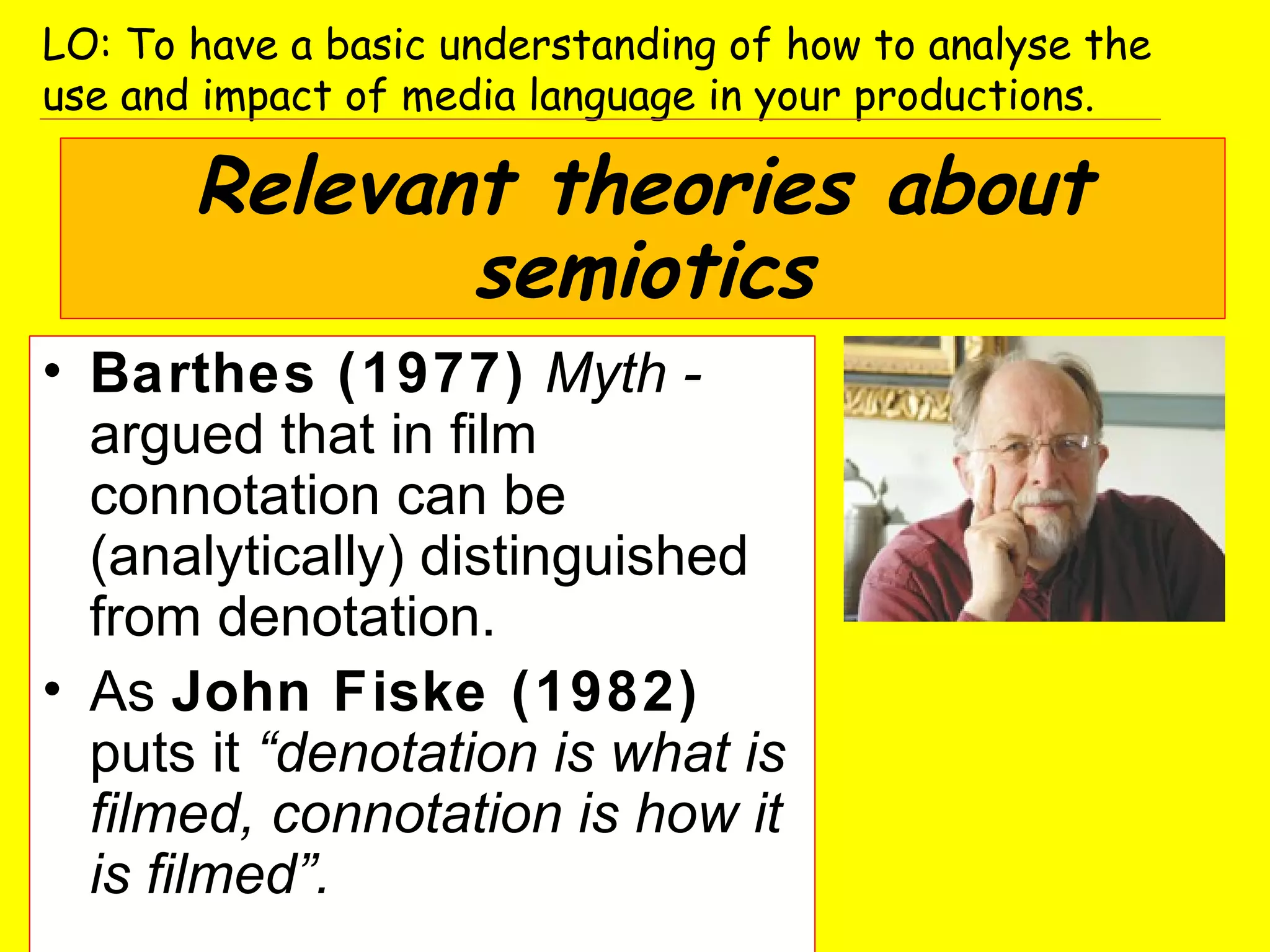
• Barthes (1977) Myth -
argued that in film
connotation can be
(analytically) distinguished
from denotation.
• As John Fiske (1982)
puts it “denotation is what is
filmed, connotation is how it
is filmed”.
LO: To have a basic understanding of how to analyse the
use and impact of media language in your productions.
Relevant theories about
semiotics
We must also remember to discuss the
preferred meaning (Hall, 1980) that
we wanted our audience to DECODE.
LO: To have a basic understanding of how to analyse the
use and impact of media language in your productions.
Evaluating media language is an
evaluation of all micro elements and
how they have created meaning to
inform us about genre, narrative,
representations/ ideology,
targeting of audiences.
This requires us to use semiotic
terminology to explain our encoding
of elements and codes and
conventions within our texts.
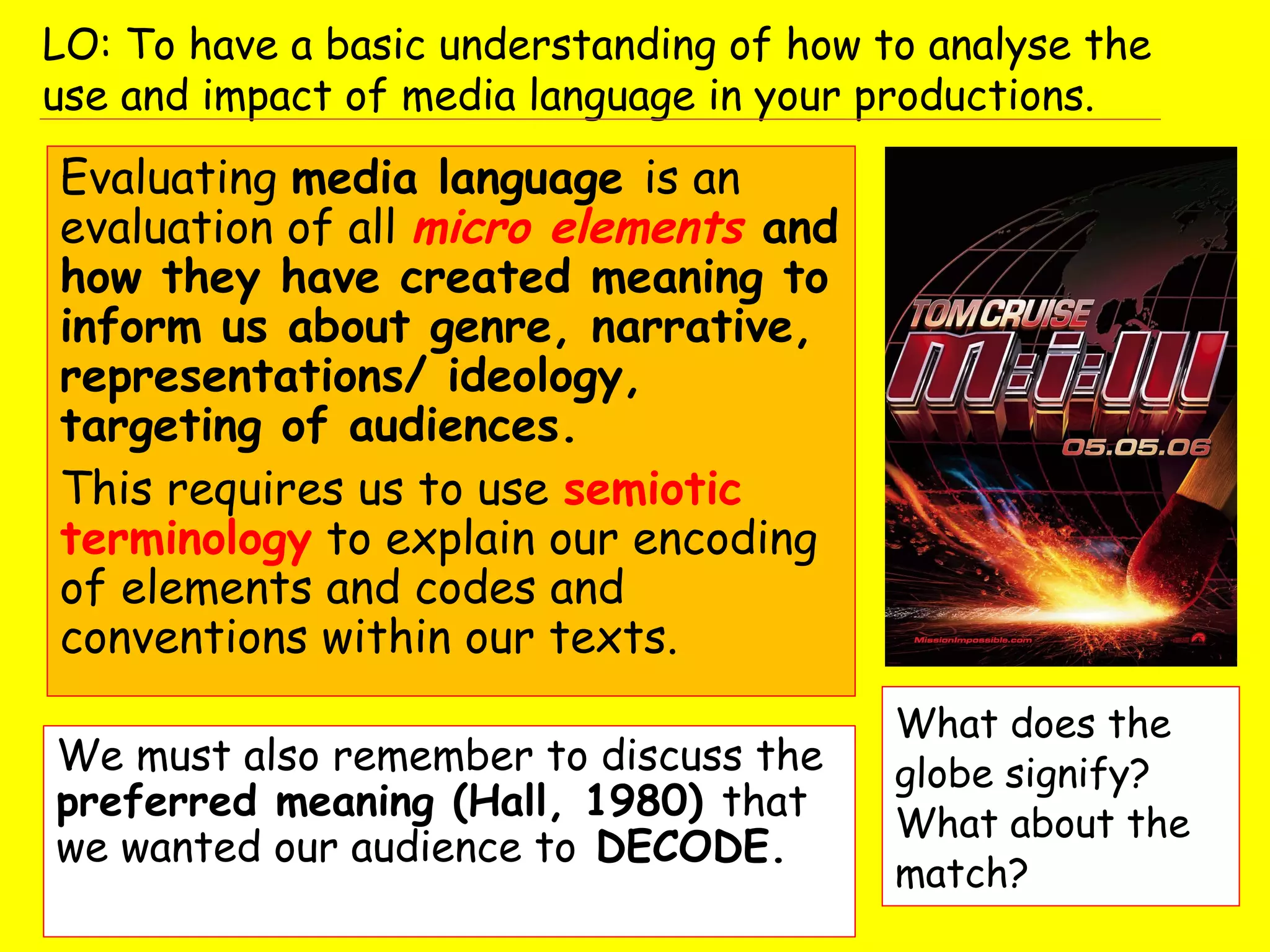
What does the
globe signify?
What about the
match?
What is the thematic preferred meaning
of your choice of text?
List the semiotic terminology that you
will use to explain your encoding of
elements and codes and conventions
within your texts.
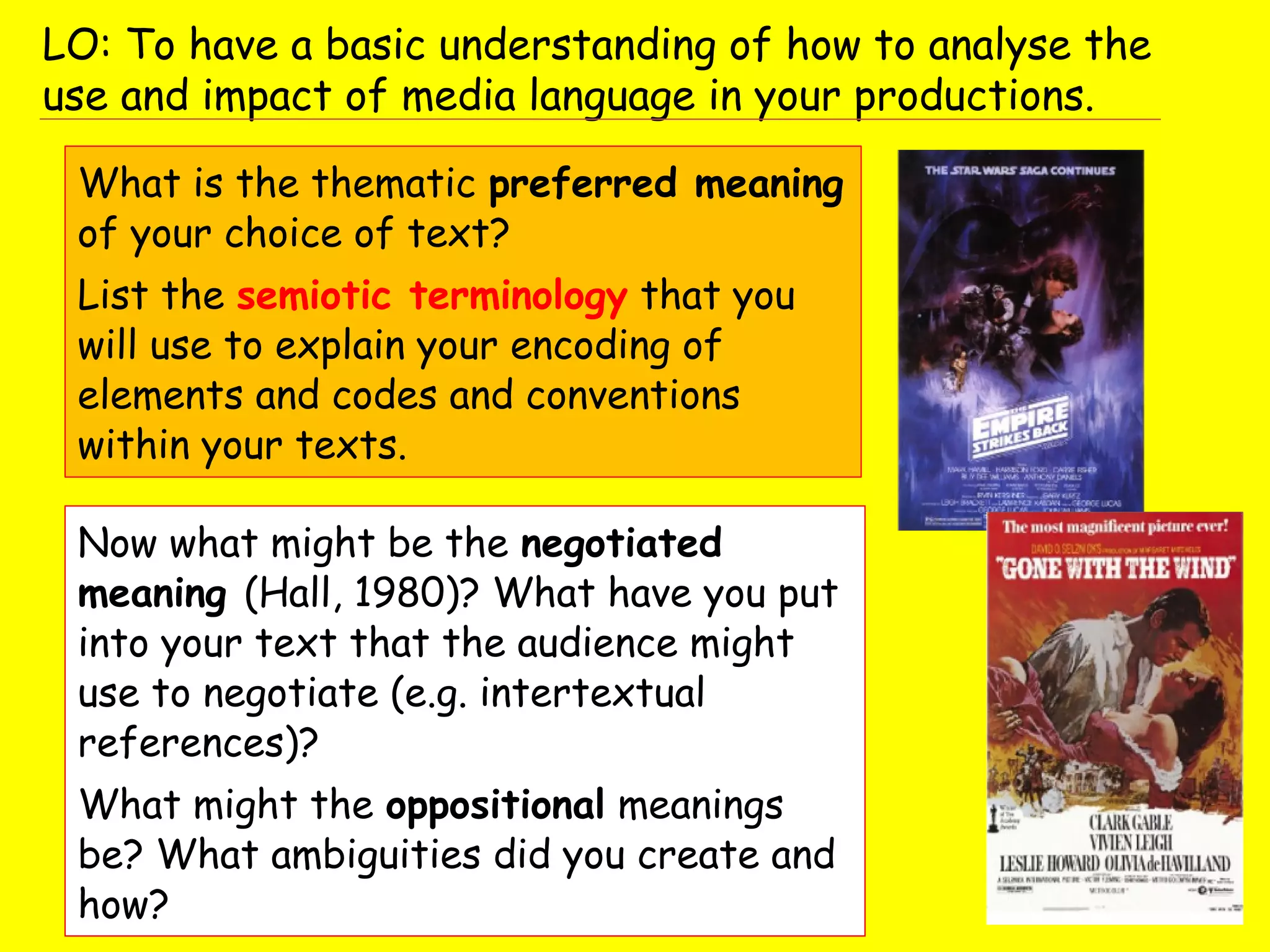
Now what might be the negotiated
meaning (Hall, 1980)? What have you put
into your text that the audience might
use to negotiate (e.g. intertextual
references)?
What might the oppositional meanings
be? What ambiguities did you create and
how?
LO: To have a basic understanding of how to analyse the
use and impact of media language in your productions.
Technical aspects:
cinematography
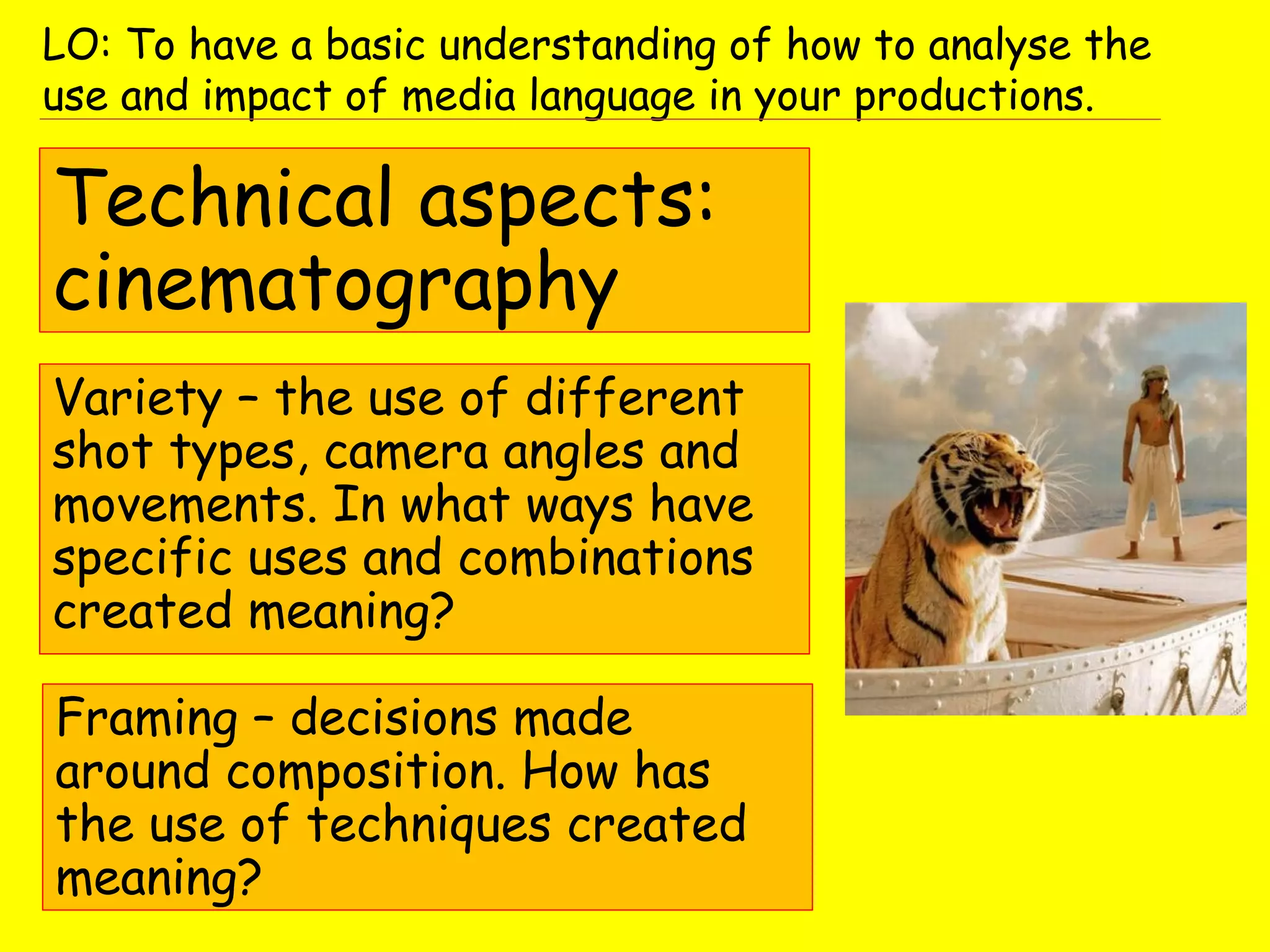
Framing – decisions made
around composition. How has
the use of techniques created
meaning?
Variety – the use of different
shot types, camera angles and
movements. In what ways have
specific uses and combinations
created meaning?
LO: To have a basic understanding of how to analyse the
use and impact of media language in your productions.
Editing - continuity
• Establishing/Re-establishing Shot
• Transitions.
• The 180°Line Rule.
• Action Match.
• Crosscutting.
• Cutaway.
• Insert Shots.
• Shot-Reverse Shot Structures.
• Eyeline Match.
Did you use any of these agreed norms?
Did you deliberately discard agreed norms? Was that
appropriate for the form? What was the effect?
LO: To have a basic understanding of how to analyse the
use and impact of media language in your productions.
Editing – non-continuity
1. Montage Sequence.
2. Flash Back/Forward.
3. Ellipsis.
4. Graphic Match.
5. Split or non-linear narrative.
Did you use any of these techniques?
Was this appropriate for the form? What was the effect?
LO: To have a basic understanding of how to analyse the
use and impact of media language in your productions.
“Media is communication”.
Discuss the ways that you have
used media language to create
meanings in one of your media
products.
Think of this question as the first part
of your practice response...
LO: To have a basic understanding of how to analyse the
use and impact of media language in your productions.

Media Language for G325 AS Media exam

  • 1.
    G235: Critical Perspectives in Media LO:To have a basic understanding of how to analyse the use and impact of media language in your productions. Theoretical Evaluation of Production 1(b) Media Language
  • 2.
    Importance of medialanguage • Every medium has its own ‘language’ – or combination of languages – that it uses to communicate meaning. Television, for example, uses verbal and written language as well as the languages of moving images and sound. • We call these ‘languages’ because they use familiar codes and conventions that are generally understood. LO: To have a basic understanding of how to analyse the use and impact of media language in your productions.
  • 3.
    Denotation, Connotation and Myth •In semiotics, denotation and connotation are terms describing the relationship between the signifier and its signified. What emotion is being connoted by what? LO: To have a basic understanding of how to analyse the use and impact of media language in your productions.
  • 4.
    • Barthes (1977)Myth - argued that in film connotation can be (analytically) distinguished from denotation. • As John Fiske (1982) puts it “denotation is what is filmed, connotation is how it is filmed”. LO: To have a basic understanding of how to analyse the use and impact of media language in your productions. Relevant theories about semiotics
  • 5.
    We must alsoremember to discuss the preferred meaning (Hall, 1980) that we wanted our audience to DECODE. LO: To have a basic understanding of how to analyse the use and impact of media language in your productions. Evaluating media language is an evaluation of all micro elements and how they have created meaning to inform us about genre, narrative, representations/ ideology, targeting of audiences. This requires us to use semiotic terminology to explain our encoding of elements and codes and conventions within our texts. What does the globe signify? What about the match?
  • 6.
    What is thethematic preferred meaning of your choice of text? List the semiotic terminology that you will use to explain your encoding of elements and codes and conventions within your texts. Now what might be the negotiated meaning (Hall, 1980)? What have you put into your text that the audience might use to negotiate (e.g. intertextual references)? What might the oppositional meanings be? What ambiguities did you create and how? LO: To have a basic understanding of how to analyse the use and impact of media language in your productions.
  • 7.
    Technical aspects: cinematography Framing –decisions made around composition. How has the use of techniques created meaning? Variety – the use of different shot types, camera angles and movements. In what ways have specific uses and combinations created meaning? LO: To have a basic understanding of how to analyse the use and impact of media language in your productions.
  • 8.
    Editing - continuity •Establishing/Re-establishing Shot • Transitions. • The 180°Line Rule. • Action Match. • Crosscutting. • Cutaway. • Insert Shots. • Shot-Reverse Shot Structures. • Eyeline Match. Did you use any of these agreed norms? Did you deliberately discard agreed norms? Was that appropriate for the form? What was the effect? LO: To have a basic understanding of how to analyse the use and impact of media language in your productions.
  • 9.
    Editing – non-continuity 1.Montage Sequence. 2. Flash Back/Forward. 3. Ellipsis. 4. Graphic Match. 5. Split or non-linear narrative. Did you use any of these techniques? Was this appropriate for the form? What was the effect? LO: To have a basic understanding of how to analyse the use and impact of media language in your productions.
  • 10.
    “Media is communication”. Discussthe ways that you have used media language to create meanings in one of your media products. Think of this question as the first part of your practice response... LO: To have a basic understanding of how to analyse the use and impact of media language in your productions.