What was the key quote relating to
genre by Steve Neale?
Discovery question
‘genre is a repetition with an
underlying pattern of variations’
Recap - Question 1b
• You must evaluate one production in relation
to the concept.
• You must apply theory and terminology in
relation to this concept.
Connect
Narrative
• What theory, theorists, terminology and ideas
can applied to the topic of NARRATIVE.
• Spend 5 minutes exploring your ideas
Discover
Narrative
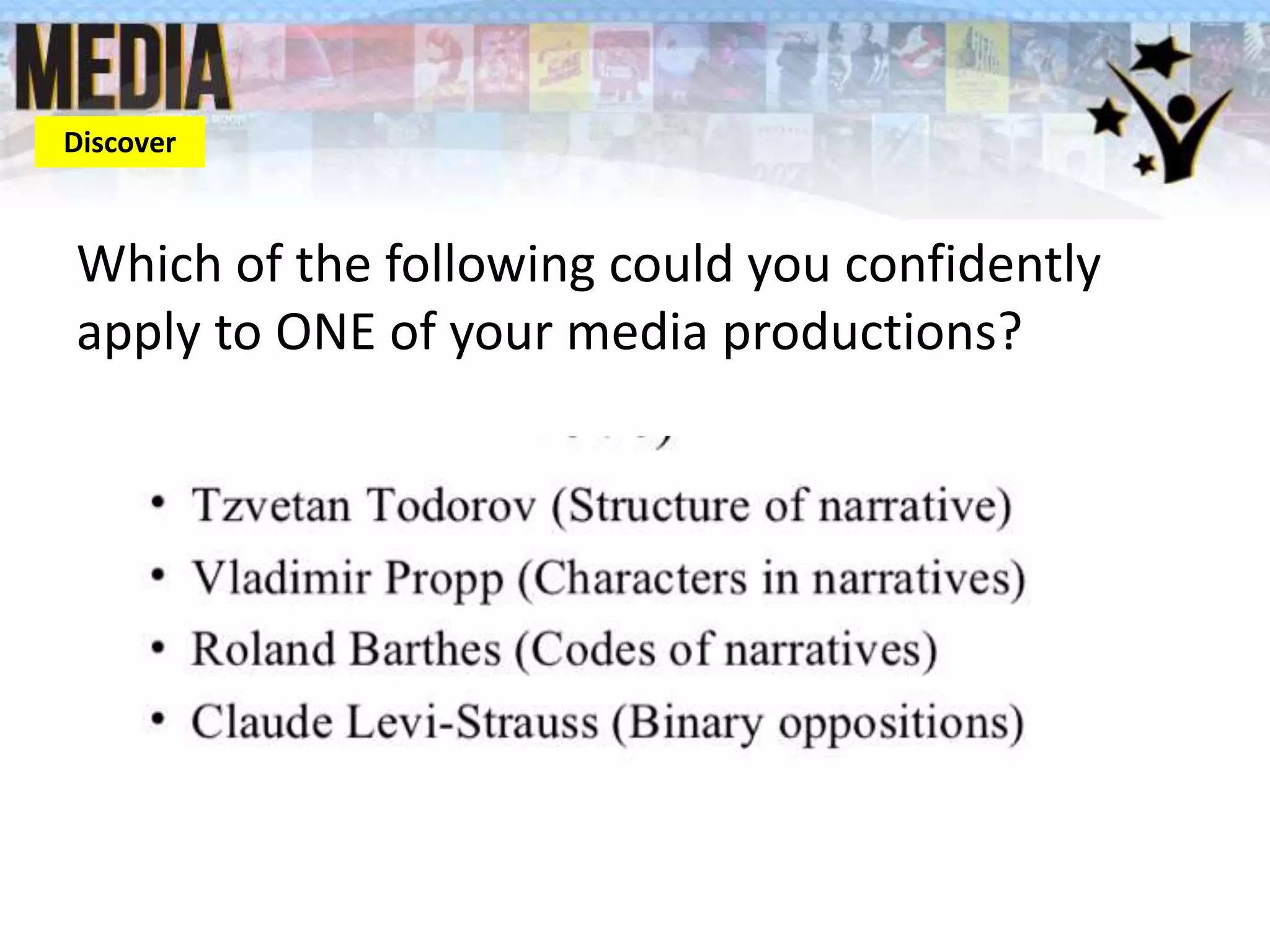
• Equilibrium theory – Tzvetan Todorov
-Equilibrium, disruption, recognition, attempt to repair,
new equilibrium.
• Binary Opposition – Claude Levi-Strauss
-Contrast or opposites
• Linear/non linear – chronological vs non
• Abstract, narrative, performance and hybrid – (music
video)
• Vladimir Propp – 7 characters
• Roland Barthes – enigma codes, semiotic, action,
cultural, symbolic
Which of the following could you confidently
apply to ONE of your media productions?
Discover
You will be given a theorist, theory or concept in
relation to narrative in your pair; some you may
be familiar with, some you may not.
For each one, consider how you might apply this
to your own work. You will be responsible for
explaining this to the rest of the class.
Discover
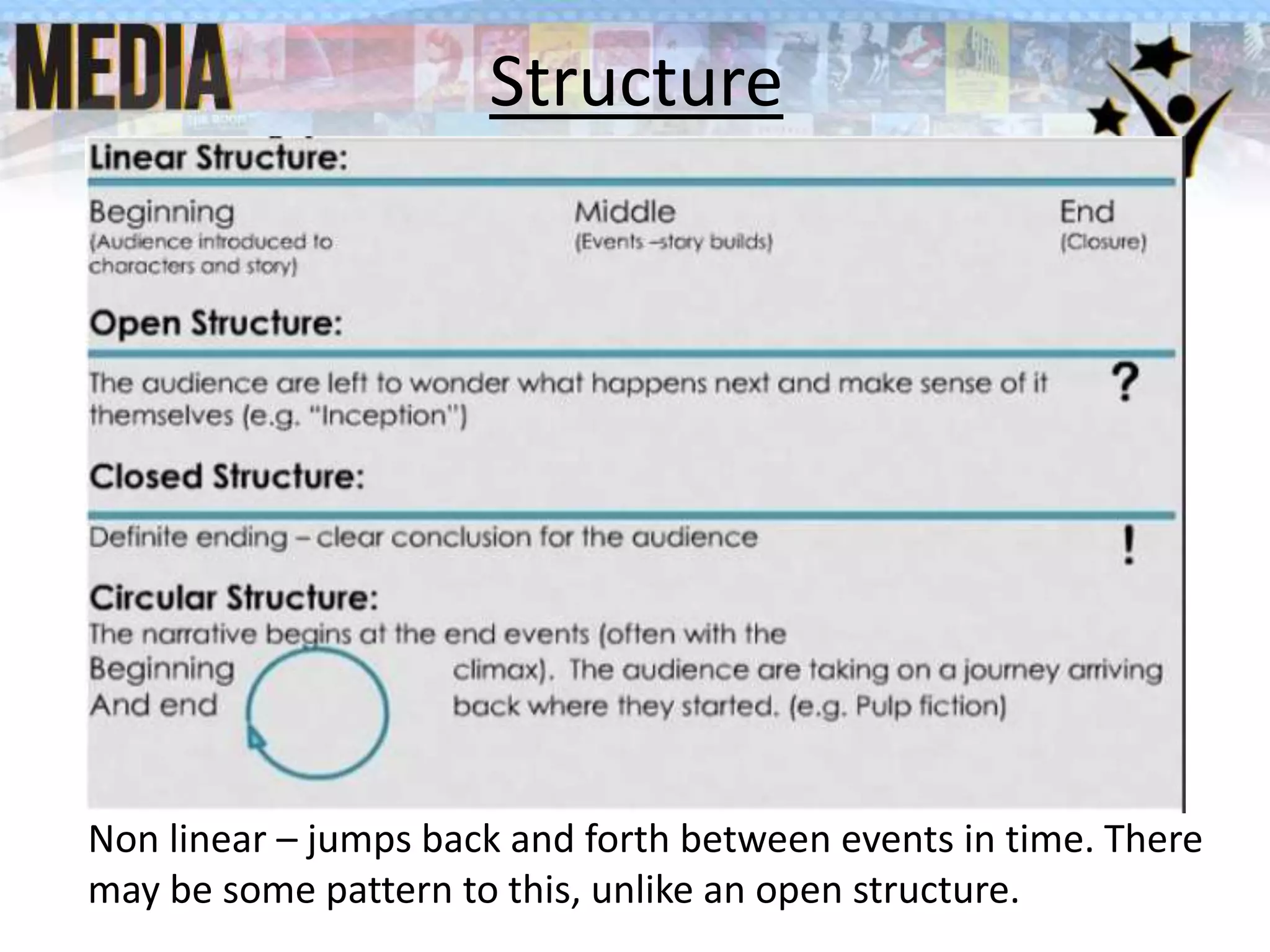
Structure
Non linear – jumps back and forth between events in time. There
may be some pattern to this, unlike an open structure.
• Structuralism: A belief that there is structure
in all things – that items within a certain
paradigm (a class of elements with
similarities) follow specific patterns.
Ferdinand de Saussure
5 codes - activate the reader to make sense of 'narrative'
or meaning within a text:
- action code - meaning of specific words, actions or
looks
- enigma code - puzzles set up to be solved by audience
- the semic code - the connotations of a
character/place/object
- the symbolic code - metaphor or figure of
representation
- cultural code - connections to the world outside the
text
Roland Barthes
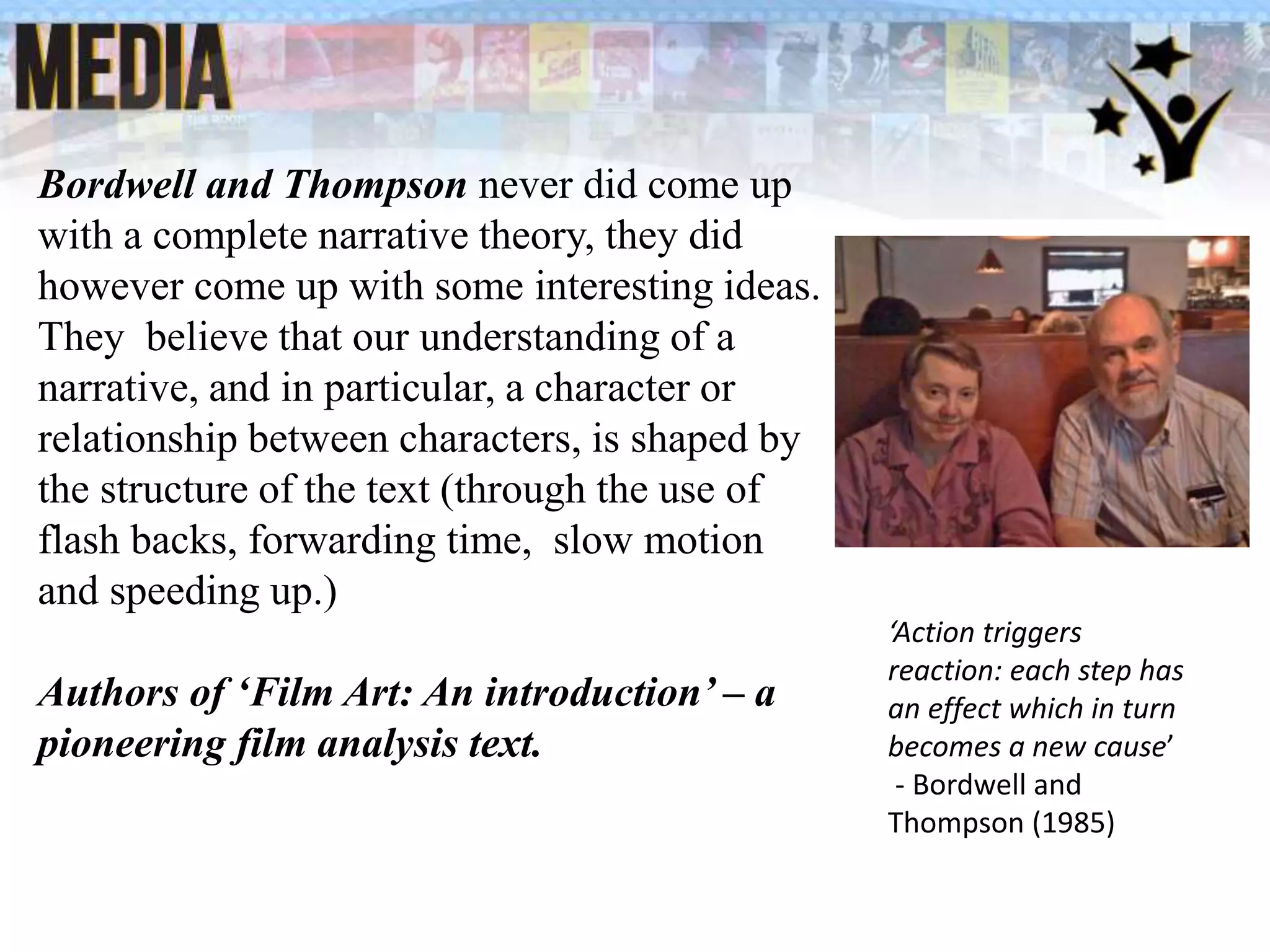
Bordwell and Thompson never did come up
with a complete narrative theory, they did
however come up with some interesting ideas.
They believe that our understanding of a
narrative, and in particular, a character or
relationship between characters, is shaped by
the structure of the text (through the use of
flash backs, forwarding time, slow motion
and speeding up.)
Authors of ‘Film Art: An introduction’ – a
pioneering film analysis text.
‘Action triggers
reaction: each step has
an effect which in turn
becomes a new cause’
- Bordwell and
Thompson (1985)
Binary opposition
focusing on the different sets of opposite values
which reveal the structure of the media texts.
Claude Levi-Strauss
Reflecting on your own work, which piece can
you confidently apply narrative theory to –
• Opening title sequence
• Music video
Spend 15 minutes reflecting on the chosen
piece. Use the following table to construct your
notes.
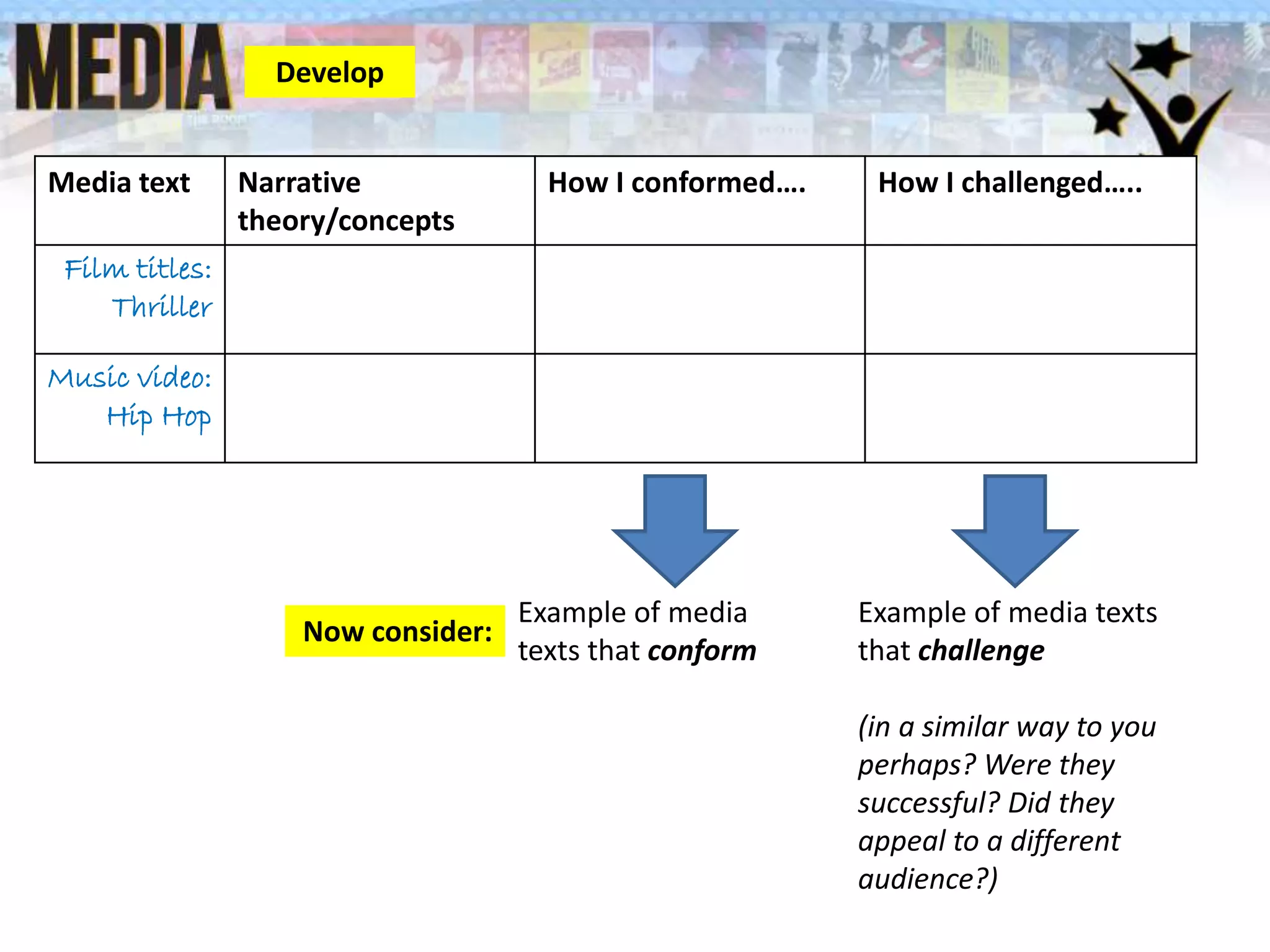
Media text Narrative
theory/concepts
How I conformed…. How I challenged…..
Film titles:
Thriller
Music video:
Hip Hop
Example of media
texts that conform
Example of media texts
that challenge
(in a similar way to you
perhaps? Were they
successful? Did they
appeal to a different
audience?)
Now consider:
Develop
How to structure your
answer…
Intro
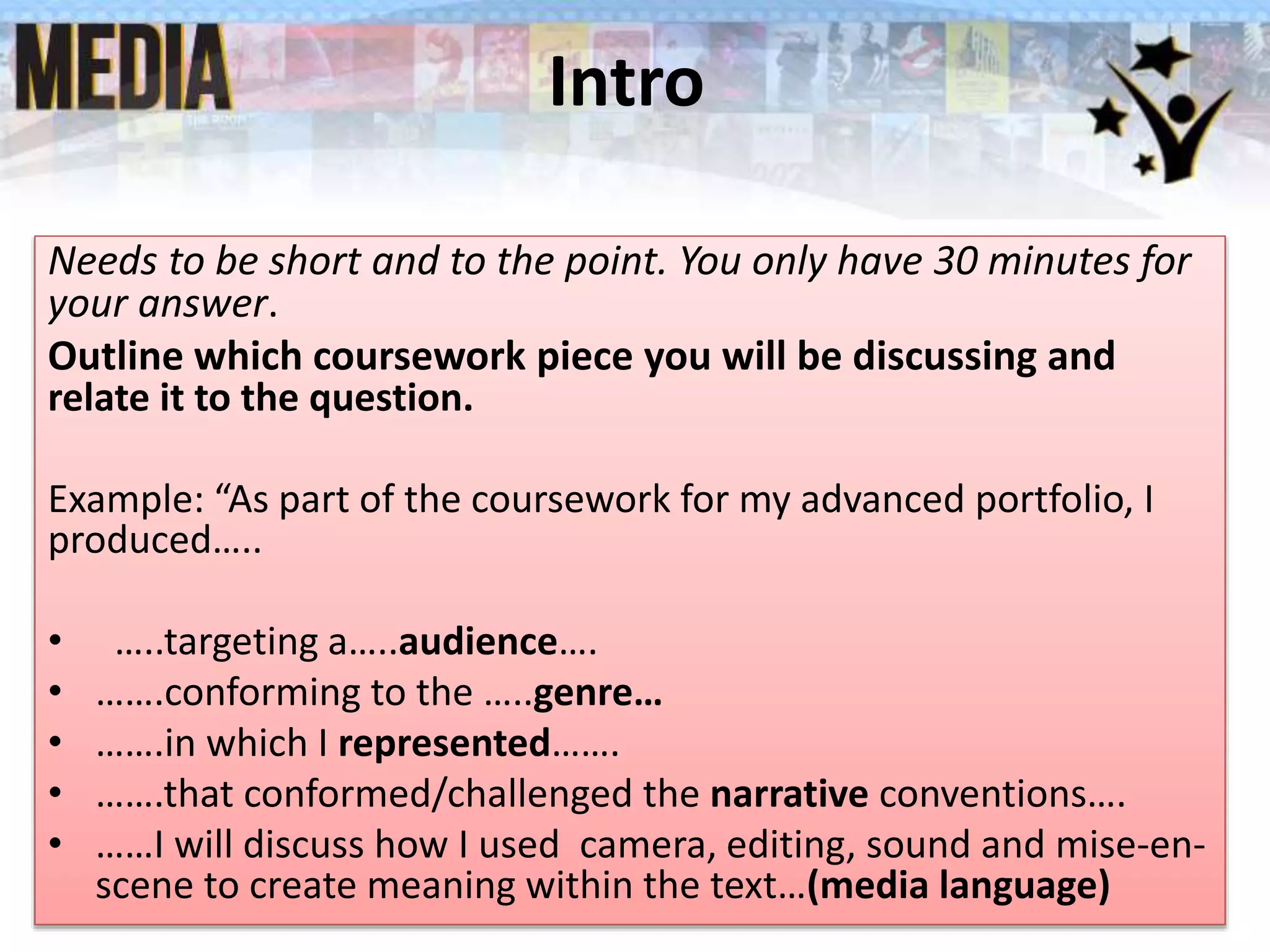
Needs to be short and to the point. You only have 30 minutes for
your answer.
Outline which coursework piece you will be discussing and
relate it to the question.
Example: “As part of the coursework for my advanced portfolio, I
produced…..
• …..targeting a…..audience….
• …….conforming to the …..genre…
• …….in which I represented…….
• …….that conformed/challenged the narrative conventions….
• ……I will discuss how I used camera, editing, sound and mise-en-
scene to create meaning within the text…(media language)
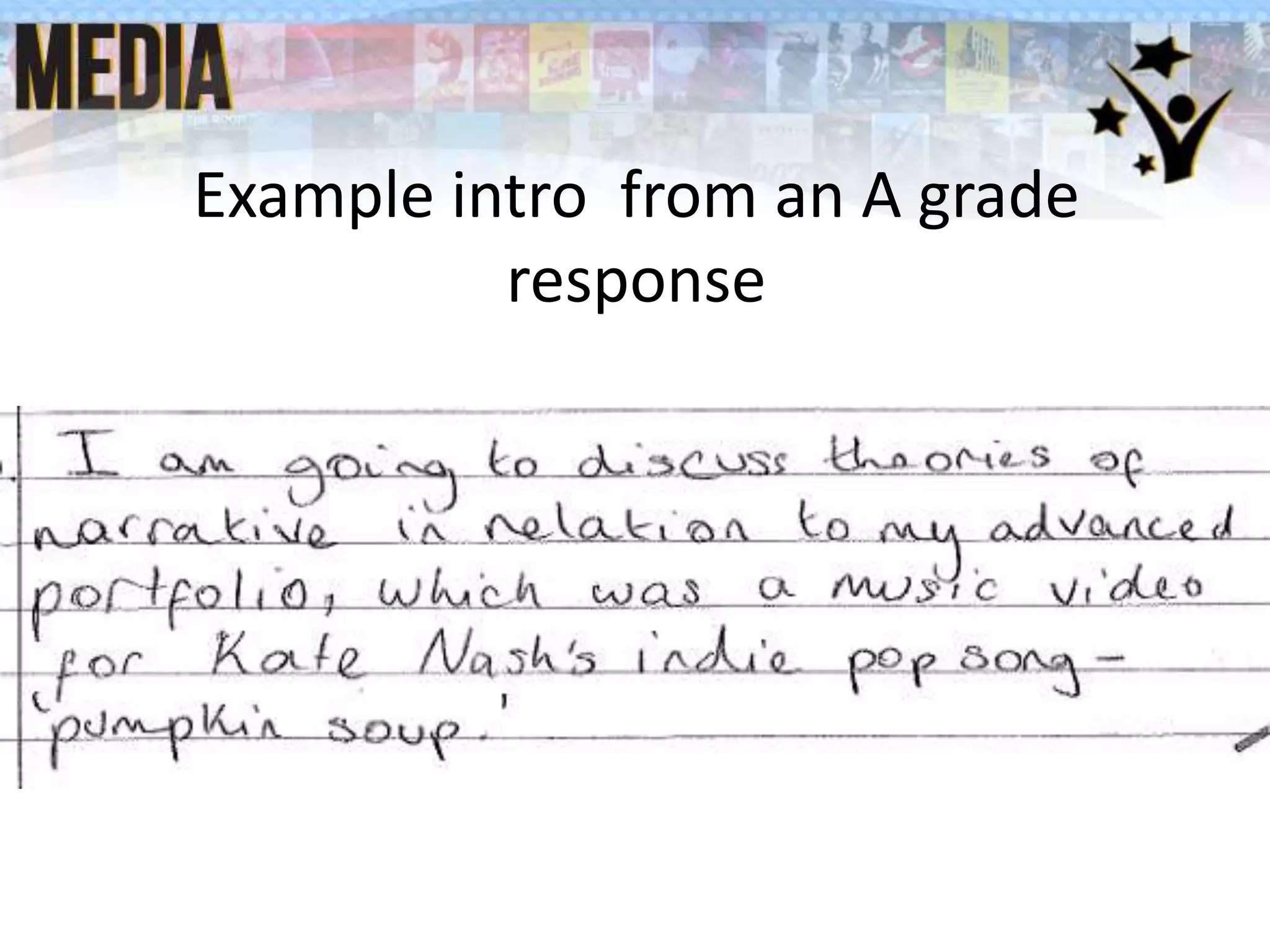
Example intro from an A grade
response
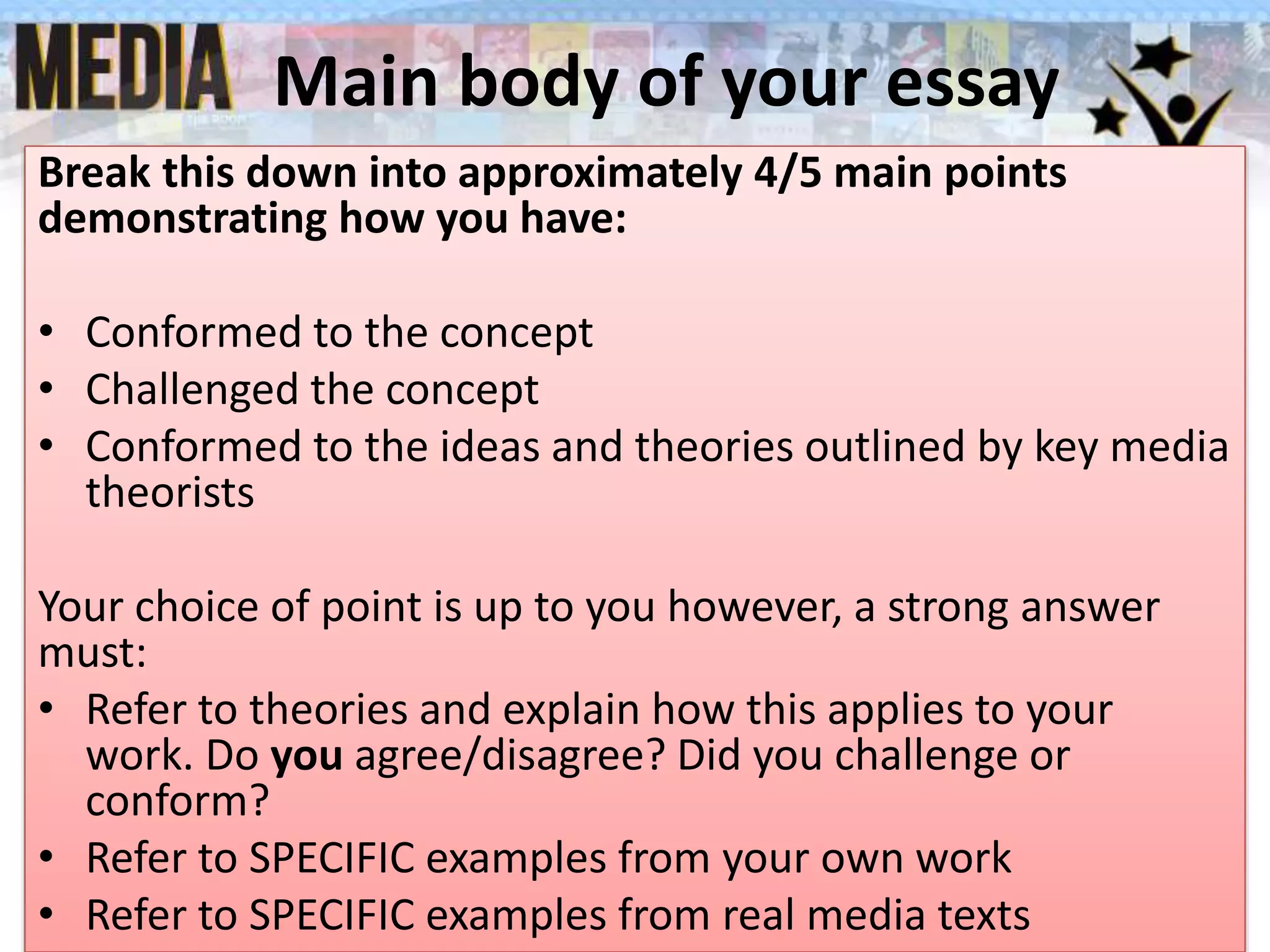
Main body of your essay
Break this down into approximately 4/5 main points
demonstrating how you have:
• Conformed to the concept
• Challenged the concept
• Conformed to the ideas and theories outlined by key media
theorists
Your choice of point is up to you however, a strong answer
must:
• Refer to theories and explain how this applies to your
work. Do you agree/disagree? Did you challenge or
conform?
• Refer to SPECIFIC examples from your own work
• Refer to SPECIFIC examples from real media texts
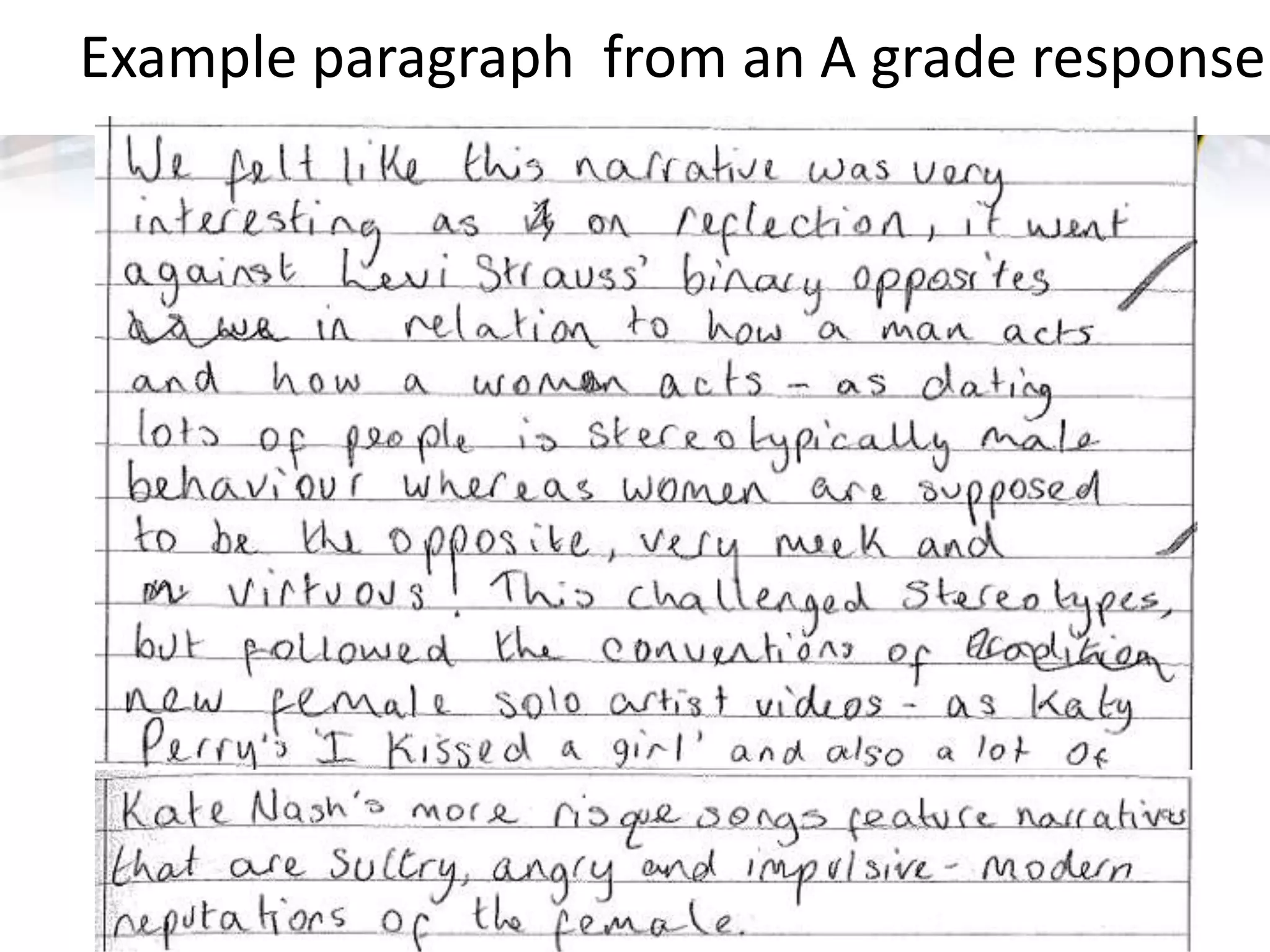
Example paragraph from an A grade response
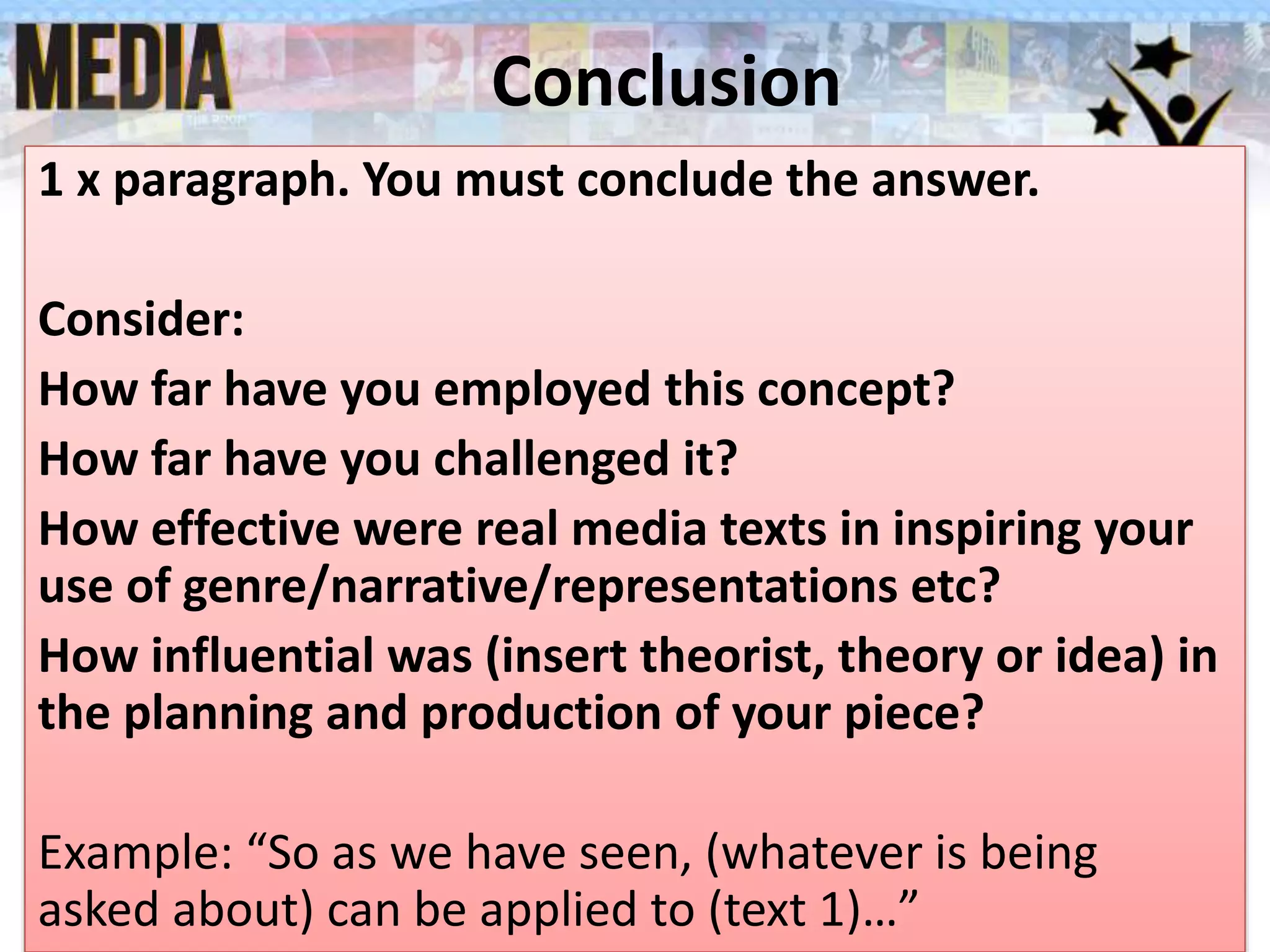
Conclusion
1 x paragraph. You must conclude the answer.
Consider:
How far have you employed this concept?
How far have you challenged it?
How effective were real media texts in inspiring your
use of genre/narrative/representations etc?
How influential was (insert theorist, theory or idea) in
the planning and production of your piece?
Example: “So as we have seen, (whatever is being
asked about) can be applied to (text 1)…”
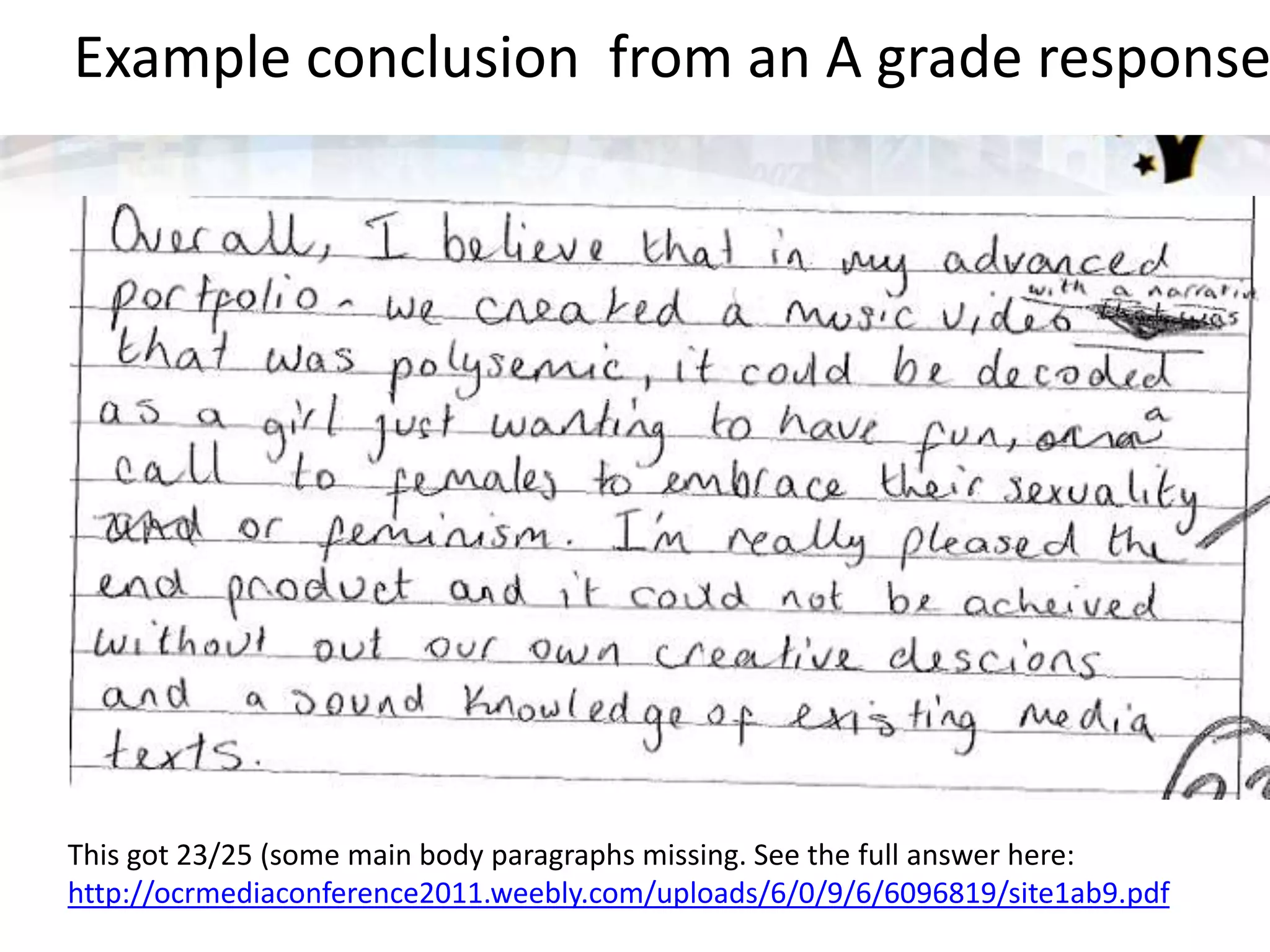
Example conclusion from an A grade response
This got 23/25 (some main body paragraphs missing. See the full answer here:
http://ocrmediaconference2011.weebly.com/uploads/6/0/9/6/6096819/site1ab9.pdf
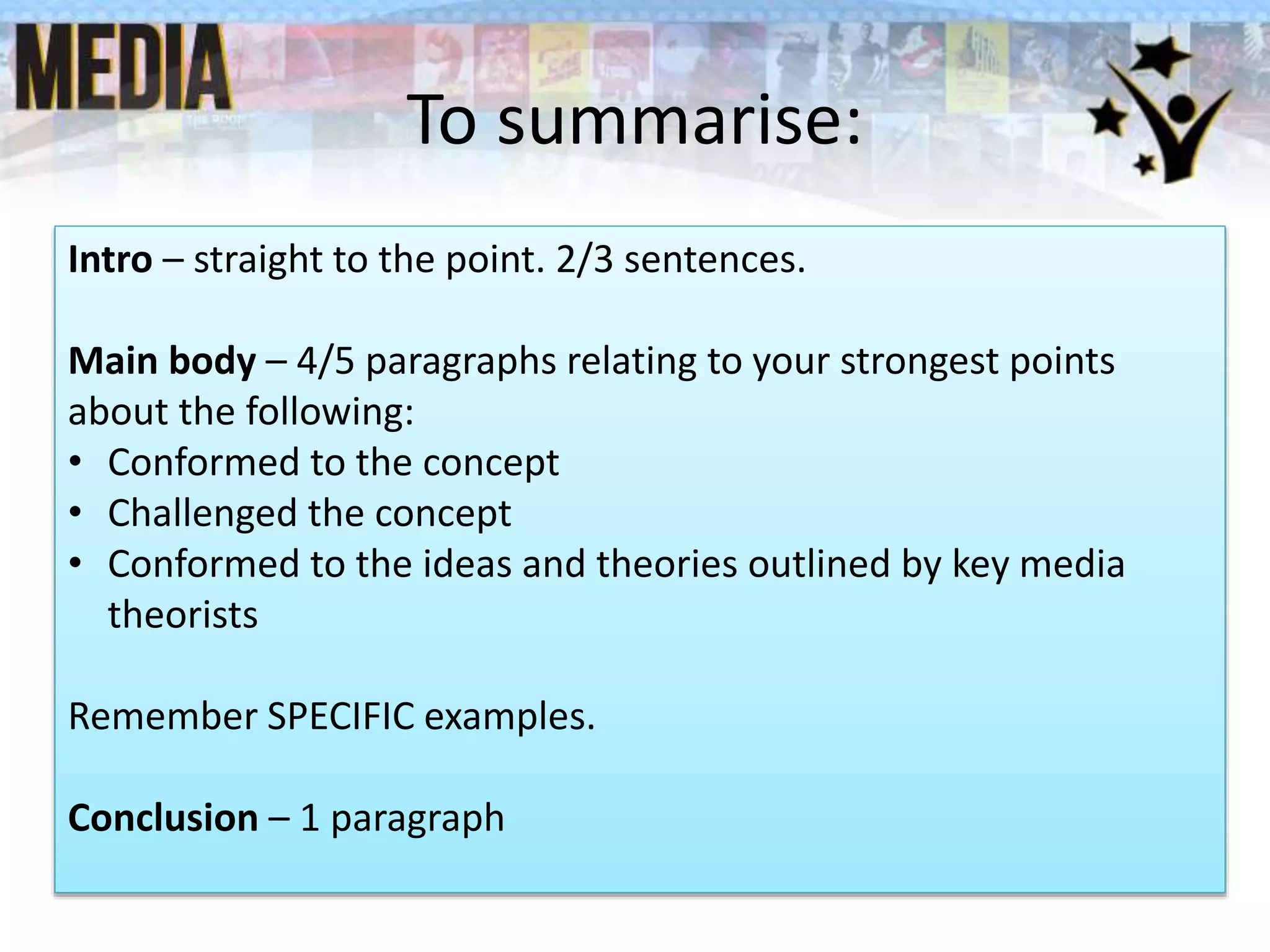
To summarise:
Intro – straight to the point. 2/3 sentences.
Main body – 4/5 paragraphs relating to your strongest points
about the following:
• Conformed to the concept
• Challenged the concept
• Conformed to the ideas and theories outlined by key media
theorists
Remember SPECIFIC examples.
Conclusion – 1 paragraph
Section 1b
“Analyse one of your coursework
productions in relation to
narrative”.
30 minutes
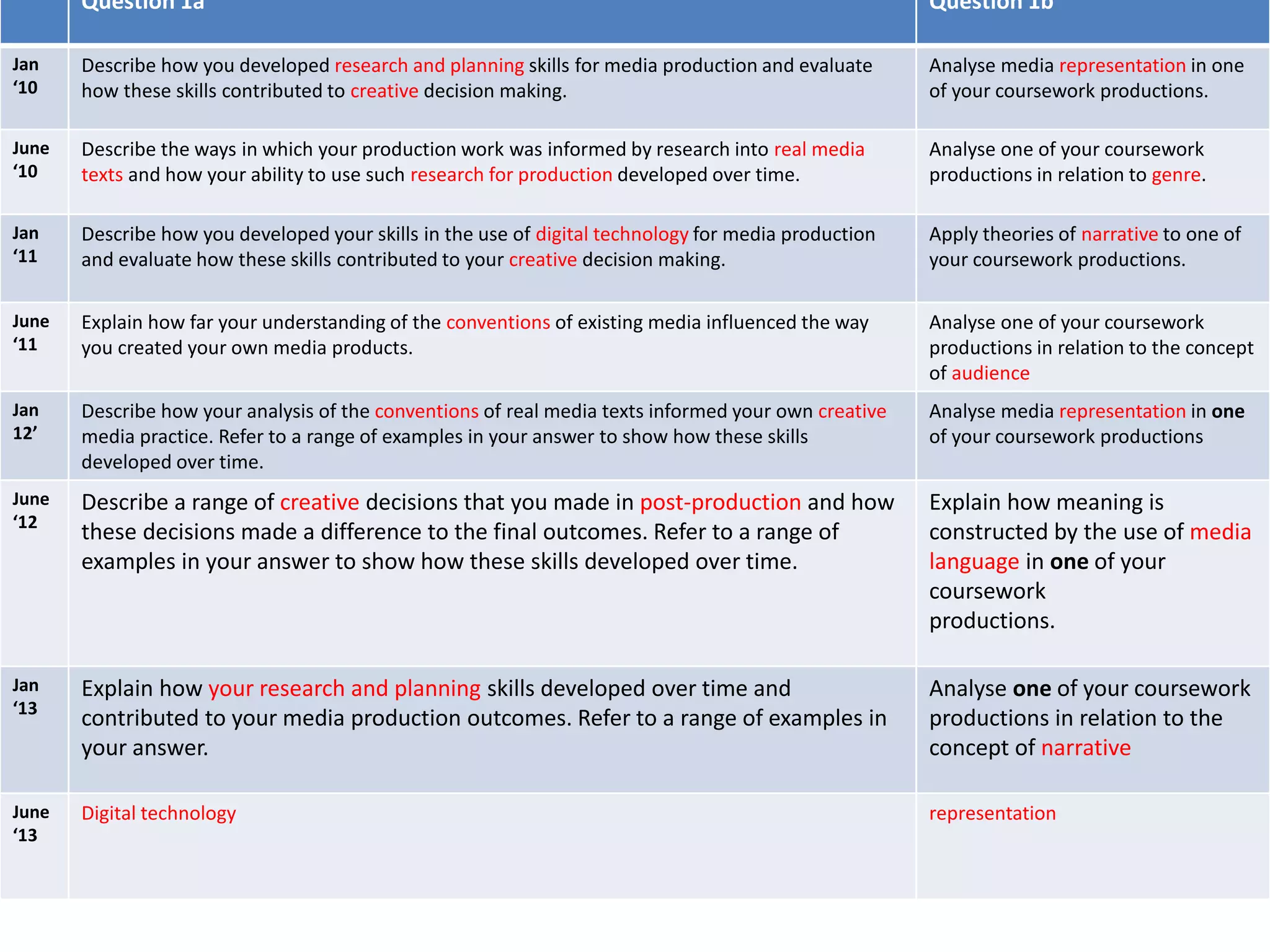
Question 1a Question 1b
Jan
‘10
Describe how you developed research and planning skills for media production and evaluate
how these skills contributed to creative decision making.
Analyse media representation in one
of your coursework productions.
June
‘10
Describe the ways in which your production work was informed by research into real media
texts and how your ability to use such research for production developed over time.
Analyse one of your coursework
productions in relation to genre.
Jan
‘11
Describe how you developed your skills in the use of digital technology for media production
and evaluate how these skills contributed to your creative decision making.
Apply theories of narrative to one of
your coursework productions.
June
‘11
Explain how far your understanding of the conventions of existing media influenced the way
you created your own media products.
Analyse one of your coursework
productions in relation to the concept
of audience
Jan
12’
Describe how your analysis of the conventions of real media texts informed your own creative
media practice. Refer to a range of examples in your answer to show how these skills
developed over time.
Analyse media representation in one
of your coursework productions
June
‘12
Describe a range of creative decisions that you made in post-production and how
these decisions made a difference to the final outcomes. Refer to a range of
examples in your answer to show how these skills developed over time.
Explain how meaning is
constructed by the use of media
language in one of your
coursework
productions.
Jan
‘13
Explain how your research and planning skills developed over time and
contributed to your media production outcomes. Refer to a range of examples in
your answer.
Analyse one of your coursework
productions in relation to the
concept of narrative
June
‘13
Digital technology representation

Narrative and essay planning for section 1b

  • 1.
    What was thekey quote relating to genre by Steve Neale? Discovery question ‘genre is a repetition with an underlying pattern of variations’
  • 2.
    Recap - Question1b • You must evaluate one production in relation to the concept. • You must apply theory and terminology in relation to this concept. Connect
  • 3.
    Narrative • What theory,theorists, terminology and ideas can applied to the topic of NARRATIVE. • Spend 5 minutes exploring your ideas Discover
  • 4.
    Narrative • Equilibrium theory– Tzvetan Todorov -Equilibrium, disruption, recognition, attempt to repair, new equilibrium. • Binary Opposition – Claude Levi-Strauss -Contrast or opposites • Linear/non linear – chronological vs non • Abstract, narrative, performance and hybrid – (music video) • Vladimir Propp – 7 characters • Roland Barthes – enigma codes, semiotic, action, cultural, symbolic
  • 5.
    Which of thefollowing could you confidently apply to ONE of your media productions? Discover
  • 6.
    You will begiven a theorist, theory or concept in relation to narrative in your pair; some you may be familiar with, some you may not. For each one, consider how you might apply this to your own work. You will be responsible for explaining this to the rest of the class. Discover
  • 7.
    Structure Non linear –jumps back and forth between events in time. There may be some pattern to this, unlike an open structure.
  • 8.
    • Structuralism: Abelief that there is structure in all things – that items within a certain paradigm (a class of elements with similarities) follow specific patterns. Ferdinand de Saussure
  • 9.
    5 codes -activate the reader to make sense of 'narrative' or meaning within a text: - action code - meaning of specific words, actions or looks - enigma code - puzzles set up to be solved by audience - the semic code - the connotations of a character/place/object - the symbolic code - metaphor or figure of representation - cultural code - connections to the world outside the text Roland Barthes
  • 10.
    Bordwell and Thompsonnever did come up with a complete narrative theory, they did however come up with some interesting ideas. They believe that our understanding of a narrative, and in particular, a character or relationship between characters, is shaped by the structure of the text (through the use of flash backs, forwarding time, slow motion and speeding up.) Authors of ‘Film Art: An introduction’ – a pioneering film analysis text. ‘Action triggers reaction: each step has an effect which in turn becomes a new cause’ - Bordwell and Thompson (1985)
  • 11.
    Binary opposition focusing onthe different sets of opposite values which reveal the structure of the media texts. Claude Levi-Strauss
  • 12.
    Reflecting on yourown work, which piece can you confidently apply narrative theory to – • Opening title sequence • Music video Spend 15 minutes reflecting on the chosen piece. Use the following table to construct your notes.
  • 13.
    Media text Narrative theory/concepts HowI conformed…. How I challenged….. Film titles: Thriller Music video: Hip Hop Example of media texts that conform Example of media texts that challenge (in a similar way to you perhaps? Were they successful? Did they appeal to a different audience?) Now consider: Develop
  • 14.
    How to structureyour answer…
  • 15.
    Intro Needs to beshort and to the point. You only have 30 minutes for your answer. Outline which coursework piece you will be discussing and relate it to the question. Example: “As part of the coursework for my advanced portfolio, I produced….. • …..targeting a…..audience…. • …….conforming to the …..genre… • …….in which I represented……. • …….that conformed/challenged the narrative conventions…. • ……I will discuss how I used camera, editing, sound and mise-en- scene to create meaning within the text…(media language)
  • 16.
    Example intro froman A grade response
  • 17.
    Main body ofyour essay Break this down into approximately 4/5 main points demonstrating how you have: • Conformed to the concept • Challenged the concept • Conformed to the ideas and theories outlined by key media theorists Your choice of point is up to you however, a strong answer must: • Refer to theories and explain how this applies to your work. Do you agree/disagree? Did you challenge or conform? • Refer to SPECIFIC examples from your own work • Refer to SPECIFIC examples from real media texts
  • 18.
    Example paragraph froman A grade response
  • 19.
    Conclusion 1 x paragraph.You must conclude the answer. Consider: How far have you employed this concept? How far have you challenged it? How effective were real media texts in inspiring your use of genre/narrative/representations etc? How influential was (insert theorist, theory or idea) in the planning and production of your piece? Example: “So as we have seen, (whatever is being asked about) can be applied to (text 1)…”
  • 20.
    Example conclusion froman A grade response This got 23/25 (some main body paragraphs missing. See the full answer here: http://ocrmediaconference2011.weebly.com/uploads/6/0/9/6/6096819/site1ab9.pdf
  • 21.
    To summarise: Intro –straight to the point. 2/3 sentences. Main body – 4/5 paragraphs relating to your strongest points about the following: • Conformed to the concept • Challenged the concept • Conformed to the ideas and theories outlined by key media theorists Remember SPECIFIC examples. Conclusion – 1 paragraph
  • 22.
    Section 1b “Analyse oneof your coursework productions in relation to narrative”. 30 minutes
  • 23.
    Question 1a Question1b Jan ‘10 Describe how you developed research and planning skills for media production and evaluate how these skills contributed to creative decision making. Analyse media representation in one of your coursework productions. June ‘10 Describe the ways in which your production work was informed by research into real media texts and how your ability to use such research for production developed over time. Analyse one of your coursework productions in relation to genre. Jan ‘11 Describe how you developed your skills in the use of digital technology for media production and evaluate how these skills contributed to your creative decision making. Apply theories of narrative to one of your coursework productions. June ‘11 Explain how far your understanding of the conventions of existing media influenced the way you created your own media products. Analyse one of your coursework productions in relation to the concept of audience Jan 12’ Describe how your analysis of the conventions of real media texts informed your own creative media practice. Refer to a range of examples in your answer to show how these skills developed over time. Analyse media representation in one of your coursework productions June ‘12 Describe a range of creative decisions that you made in post-production and how these decisions made a difference to the final outcomes. Refer to a range of examples in your answer to show how these skills developed over time. Explain how meaning is constructed by the use of media language in one of your coursework productions. Jan ‘13 Explain how your research and planning skills developed over time and contributed to your media production outcomes. Refer to a range of examples in your answer. Analyse one of your coursework productions in relation to the concept of narrative June ‘13 Digital technology representation