Media Language
Organisation
Representation
Genre
Audience
Narrative
1
REVISION: MEDIA LANGUAGE
© ZigZag Education 2015
Quickfire
• What do you remember about the following…
04/09/2014 Term 1, Lesson 1 2
Denotation &
Connotation
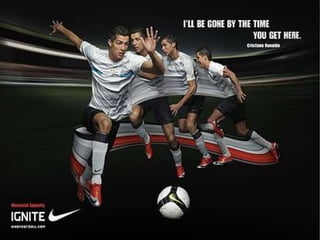
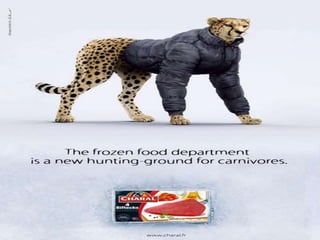
Image
Denotation
•What do you see?
Connotation
• What is the meaning behind the
image?
3 © ZigZag Education 2015
04/09/2014 Term 1, Lesson 1 4
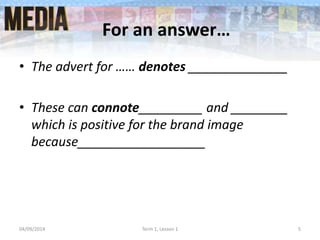
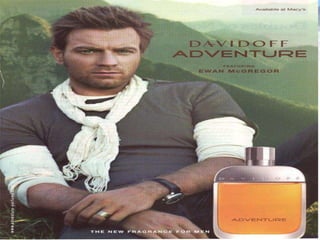
For an answer…
• The advert for …… denotes ______________
• These can connote_________ and ________
which is positive for the brand image
because__________________
04/09/2014 Term 1, Lesson 1 5
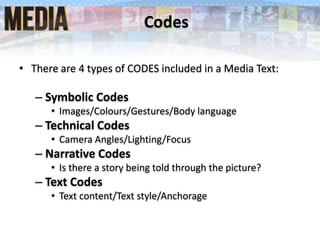
• There are 4 types of CODES included in a Media Text:
– Symbolic Codes
• Images/Colours/Gestures/Body language
– Technical Codes
• Camera Angles/Lighting/Focus
– Narrative Codes
• Is there a story being told through the picture?
– Text Codes
• Text content/Text style/Anchorage
Codes
04/09/2014 Term 1, Lesson 1 7
Camera Shots and
Angles
Camera Shots Camera Angles
04/09/2014 Term 1, Lesson 1 8
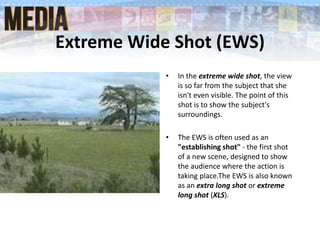
Extreme Wide Shot (EWS)
• In the extreme wide shot, the view
is so far from the subject that she
isn't even visible. The point of this
shot is to show the subject's
surroundings.
• The EWS is often used as an
"establishing shot" - the first shot
of a new scene, designed to show
the audience where the action is
taking place.The EWS is also known
as an extra long shot or extreme
long shot (XLS).
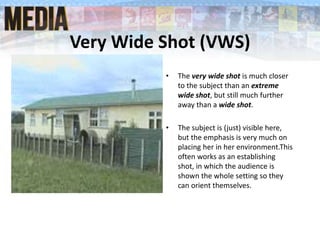
Very Wide Shot (VWS)
• The very wide shot is much closer
to the subject than an extreme
wide shot, but still much further
away than a wide shot.
• The subject is (just) visible here,
but the emphasis is very much on
placing her in her environment.This
often works as an establishing
shot, in which the audience is
shown the whole setting so they
can orient themselves.
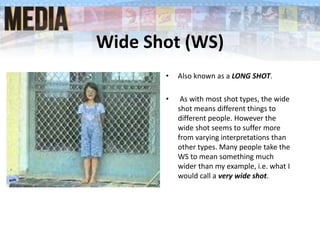
Wide Shot (WS)
• Also known as a LONG SHOT.
• As with most shot types, the wide
shot means different things to
different people. However the
wide shot seems to suffer more
from varying interpretations than
other types. Many people take the
WS to mean something much
wider than my example, i.e. what I
would call a very wide shot.
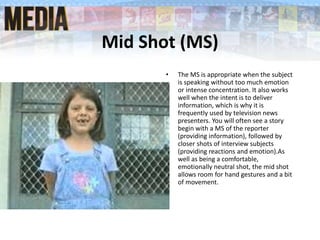
Mid Shot (MS)
• The MS is appropriate when the subject
is speaking without too much emotion
or intense concentration. It also works
well when the intent is to deliver
information, which is why it is
frequently used by television news
presenters. You will often see a story
begin with a MS of the reporter
(providing information), followed by
closer shots of interview subjects
(providing reactions and emotion).As
well as being a comfortable,
emotionally neutral shot, the mid shot
allows room for hand gestures and a bit
of movement.
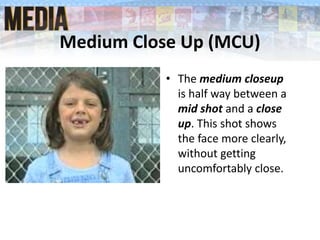
Medium Close Up (MCU)
• The medium closeup
is half way between a
mid shot and a close
up. This shot shows
the face more clearly,
without getting
uncomfortably close.
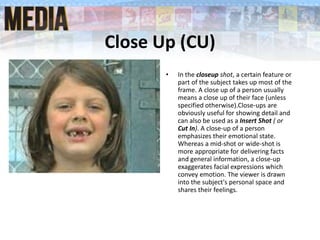
Close Up (CU)
• In the closeup shot, a certain feature or
part of the subject takes up most of the
frame. A close up of a person usually
means a close up of their face (unless
specified otherwise).Close-ups are
obviously useful for showing detail and
can also be used as a Insert Shot ( or
Cut In). A close-up of a person
emphasizes their emotional state.
Whereas a mid-shot or wide-shot is
more appropriate for delivering facts
and general information, a close-up
exaggerates facial expressions which
convey emotion. The viewer is drawn
into the subject's personal space and
shares their feelings.
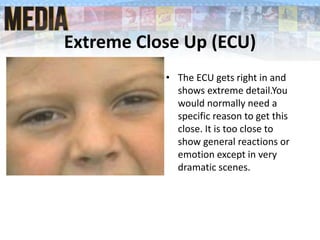
Extreme Close Up (ECU)
• The ECU gets right in and
shows extreme detail.You
would normally need a
specific reason to get this
close. It is too close to
show general reactions or
emotion except in very
dramatic scenes.
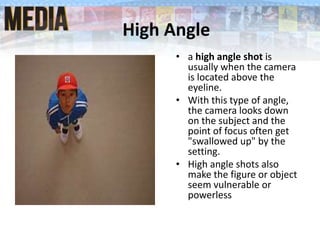
High Angle
• a high angle shot is
usually when the camera
is located above the
eyeline.
• With this type of angle,
the camera looks down
on the subject and the
point of focus often get
"swallowed up" by the
setting.
• High angle shots also
make the figure or object
seem vulnerable or
powerless
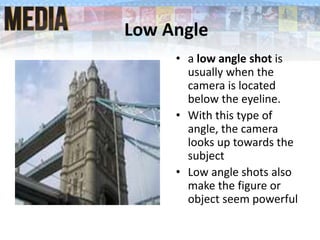
Low Angle
• a low angle shot is
usually when the
camera is located
below the eyeline.
• With this type of
angle, the camera
looks up towards the
subject
• Low angle shots also
make the figure or
object seem powerful
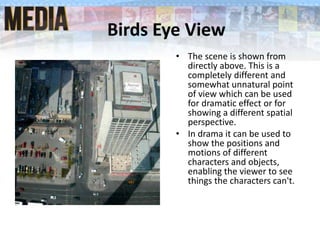
Birds Eye View
• The scene is shown from
directly above. This is a
completely different and
somewhat unnatural point
of view which can be used
for dramatic effect or for
showing a different spatial
perspective.
• In drama it can be used to
show the positions and
motions of different
characters and objects,
enabling the viewer to see
things the characters can't.
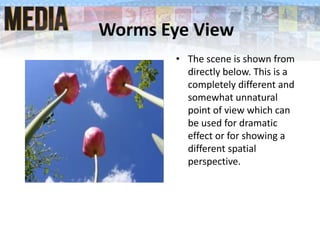
Worms Eye View
• The scene is shown from
directly below. This is a
completely different and
somewhat unnatural
point of view which can
be used for dramatic
effect or for showing a
different spatial
perspective.
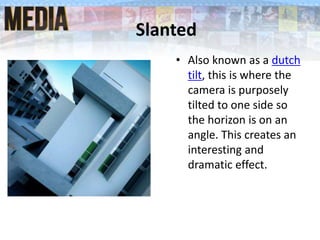
Slanted
• Also known as a dutch
tilt, this is where the
camera is purposely
tilted to one side so
the horizon is on an
angle. This creates an
interesting and
dramatic effect.
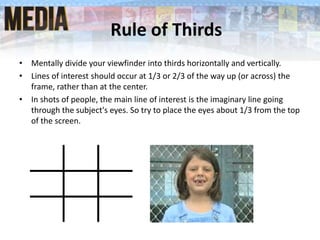
Rule of Thirds
• Mentally divide your viewfinder into thirds horizontally and vertically.
• Lines of interest should occur at 1/3 or 2/3 of the way up (or across) the
frame, rather than at the center.
• In shots of people, the main line of interest is the imaginary line going
through the subject's eyes. So try to place the eyes about 1/3 from the top
of the screen.
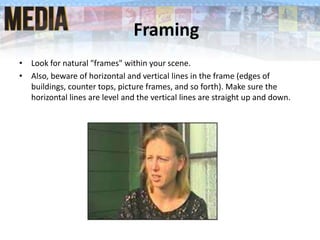
Framing
• Look for natural "frames" within your scene.
• Also, beware of horizontal and vertical lines in the frame (edges of
buildings, counter tops, picture frames, and so forth). Make sure the
horizontal lines are level and the vertical lines are straight up and down.
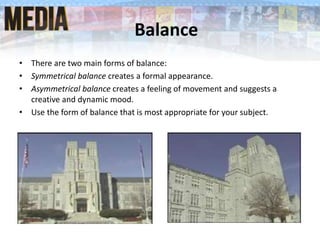
Balance
• There are two main forms of balance:
• Symmetrical balance creates a formal appearance.
• Asymmetrical balance creates a feeling of movement and suggests a
creative and dynamic mood.
• Use the form of balance that is most appropriate for your subject.
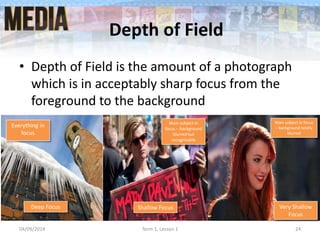
Depth of Field
• Depth of Field is the amount of a photograph
which is in acceptably sharp focus from the
foreground to the background
04/09/2014 Term 1, Lesson 1 24
Everything in
focus
Main subject in
focus – background
blurred but
recognisable
Main subject in focus
– background totally
blurred
Deep Focus Shallow Focus Very Shallow
Focus
04/09/2014 Term 1, Lesson 1 25
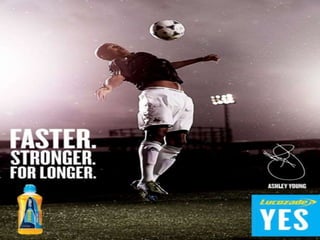
For an answer…
• The advert for …… uses a ______________ camera
shot and a _________ angle
The Focus is _________________
The Layout uses the rule of thirds by______________
• These technical codes can connote_________ and
________ which is positive for the brand image
because__________________
04/09/2014 Term 1, Lesson 1 26
27
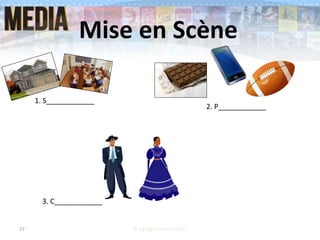
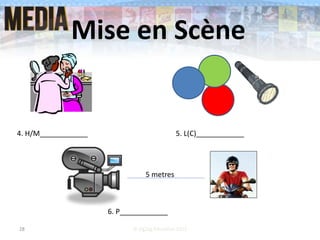
Mise en Scène
1. S____________
2. P____________
3. C____________
© ZigZag Education 2015
28
Mise en Scène
4. H/M____________
6. P____________
5. L(C)____________
5 metres
© ZigZag Education 2015
29
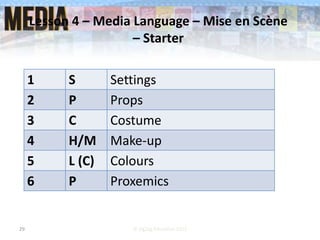
Lesson 4 – Media Language – Mise en Scène
– Starter
1 S Settings
2 P Props
3 C Costume
4 H/M Make-up
5 L (C) Colours
6 P Proxemics
© ZigZag Education 2015
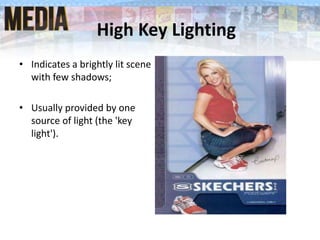
High Key Lighting
• Indicates a brightly lit scene
with few shadows;
• Usually provided by one
source of light (the 'key
light').
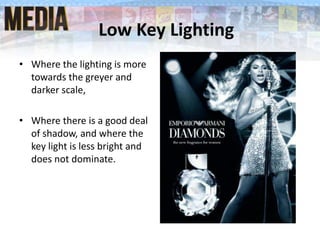
Low Key Lighting
• Where the lighting is more
towards the greyer and
darker scale,
• Where there is a good deal
of shadow, and where the
key light is less bright and
does not dominate.
08/05/2015 GCSE MEDIA MOCK REVISION GUIDE 32
For an answer…
• The advert for …… denotes __________ and
____________
• These symbolic codes can connote_________
and ________ which is positive for the brand
image because__________________
04/09/2014 Term 1, Lesson 1 33
Language
• Words can play a powerful part in Adverts
• Text in adverts is known as COPY
• A brand might also use a SLOGAN
• By selecting the correct words, font and colours,
words can play a huge part in advertising!
04/09/2014 Term 1, Lesson 1 34
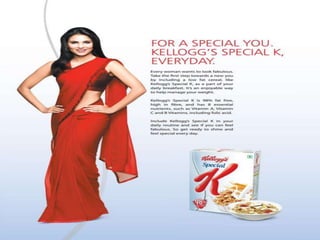
08/05/2015 GCSE MEDIA MOCK REVISION GUIDE 35
For an answer…
• The language techniques in the advert for ……
are ______________ and _____________
• This can connote_________ and ________
which is positive for the brand image
because__________________
04/09/2014 Term 1, Lesson 1 36

Revision 1 media language

  • 1.
  • 2.
    Quickfire • What doyou remember about the following… 04/09/2014 Term 1, Lesson 1 2
  • 3.
    Denotation & Connotation Image Denotation •What doyou see? Connotation • What is the meaning behind the image? 3 © ZigZag Education 2015
  • 4.
  • 5.
    For an answer… •The advert for …… denotes ______________ • These can connote_________ and ________ which is positive for the brand image because__________________ 04/09/2014 Term 1, Lesson 1 5
  • 6.
    • There are4 types of CODES included in a Media Text: – Symbolic Codes • Images/Colours/Gestures/Body language – Technical Codes • Camera Angles/Lighting/Focus – Narrative Codes • Is there a story being told through the picture? – Text Codes • Text content/Text style/Anchorage Codes
  • 7.
  • 8.
    Camera Shots and Angles CameraShots Camera Angles 04/09/2014 Term 1, Lesson 1 8
  • 9.
    Extreme Wide Shot(EWS) • In the extreme wide shot, the view is so far from the subject that she isn't even visible. The point of this shot is to show the subject's surroundings. • The EWS is often used as an "establishing shot" - the first shot of a new scene, designed to show the audience where the action is taking place.The EWS is also known as an extra long shot or extreme long shot (XLS).
  • 10.
    Very Wide Shot(VWS) • The very wide shot is much closer to the subject than an extreme wide shot, but still much further away than a wide shot. • The subject is (just) visible here, but the emphasis is very much on placing her in her environment.This often works as an establishing shot, in which the audience is shown the whole setting so they can orient themselves.
  • 11.
    Wide Shot (WS) •Also known as a LONG SHOT. • As with most shot types, the wide shot means different things to different people. However the wide shot seems to suffer more from varying interpretations than other types. Many people take the WS to mean something much wider than my example, i.e. what I would call a very wide shot.
  • 12.
    Mid Shot (MS) •The MS is appropriate when the subject is speaking without too much emotion or intense concentration. It also works well when the intent is to deliver information, which is why it is frequently used by television news presenters. You will often see a story begin with a MS of the reporter (providing information), followed by closer shots of interview subjects (providing reactions and emotion).As well as being a comfortable, emotionally neutral shot, the mid shot allows room for hand gestures and a bit of movement.
  • 13.
    Medium Close Up(MCU) • The medium closeup is half way between a mid shot and a close up. This shot shows the face more clearly, without getting uncomfortably close.
  • 14.
    Close Up (CU) •In the closeup shot, a certain feature or part of the subject takes up most of the frame. A close up of a person usually means a close up of their face (unless specified otherwise).Close-ups are obviously useful for showing detail and can also be used as a Insert Shot ( or Cut In). A close-up of a person emphasizes their emotional state. Whereas a mid-shot or wide-shot is more appropriate for delivering facts and general information, a close-up exaggerates facial expressions which convey emotion. The viewer is drawn into the subject's personal space and shares their feelings.
  • 15.
    Extreme Close Up(ECU) • The ECU gets right in and shows extreme detail.You would normally need a specific reason to get this close. It is too close to show general reactions or emotion except in very dramatic scenes.
  • 16.
    High Angle • ahigh angle shot is usually when the camera is located above the eyeline. • With this type of angle, the camera looks down on the subject and the point of focus often get "swallowed up" by the setting. • High angle shots also make the figure or object seem vulnerable or powerless
  • 17.
    Low Angle • alow angle shot is usually when the camera is located below the eyeline. • With this type of angle, the camera looks up towards the subject • Low angle shots also make the figure or object seem powerful
  • 18.
    Birds Eye View •The scene is shown from directly above. This is a completely different and somewhat unnatural point of view which can be used for dramatic effect or for showing a different spatial perspective. • In drama it can be used to show the positions and motions of different characters and objects, enabling the viewer to see things the characters can't.
  • 19.
    Worms Eye View •The scene is shown from directly below. This is a completely different and somewhat unnatural point of view which can be used for dramatic effect or for showing a different spatial perspective.
  • 20.
    Slanted • Also knownas a dutch tilt, this is where the camera is purposely tilted to one side so the horizon is on an angle. This creates an interesting and dramatic effect.
  • 21.
    Rule of Thirds •Mentally divide your viewfinder into thirds horizontally and vertically. • Lines of interest should occur at 1/3 or 2/3 of the way up (or across) the frame, rather than at the center. • In shots of people, the main line of interest is the imaginary line going through the subject's eyes. So try to place the eyes about 1/3 from the top of the screen.
  • 22.
    Framing • Look fornatural "frames" within your scene. • Also, beware of horizontal and vertical lines in the frame (edges of buildings, counter tops, picture frames, and so forth). Make sure the horizontal lines are level and the vertical lines are straight up and down.
  • 23.
    Balance • There aretwo main forms of balance: • Symmetrical balance creates a formal appearance. • Asymmetrical balance creates a feeling of movement and suggests a creative and dynamic mood. • Use the form of balance that is most appropriate for your subject.
  • 24.
    Depth of Field •Depth of Field is the amount of a photograph which is in acceptably sharp focus from the foreground to the background 04/09/2014 Term 1, Lesson 1 24 Everything in focus Main subject in focus – background blurred but recognisable Main subject in focus – background totally blurred Deep Focus Shallow Focus Very Shallow Focus
  • 25.
    04/09/2014 Term 1,Lesson 1 25
  • 26.
    For an answer… •The advert for …… uses a ______________ camera shot and a _________ angle The Focus is _________________ The Layout uses the rule of thirds by______________ • These technical codes can connote_________ and ________ which is positive for the brand image because__________________ 04/09/2014 Term 1, Lesson 1 26
  • 27.
    27 Mise en Scène 1.S____________ 2. P____________ 3. C____________ © ZigZag Education 2015
  • 28.
    28 Mise en Scène 4.H/M____________ 6. P____________ 5. L(C)____________ 5 metres © ZigZag Education 2015
  • 29.
    29 Lesson 4 –Media Language – Mise en Scène – Starter 1 S Settings 2 P Props 3 C Costume 4 H/M Make-up 5 L (C) Colours 6 P Proxemics © ZigZag Education 2015
  • 30.
    High Key Lighting •Indicates a brightly lit scene with few shadows; • Usually provided by one source of light (the 'key light').
  • 31.
    Low Key Lighting •Where the lighting is more towards the greyer and darker scale, • Where there is a good deal of shadow, and where the key light is less bright and does not dominate.
  • 32.
    08/05/2015 GCSE MEDIAMOCK REVISION GUIDE 32
  • 33.
    For an answer… •The advert for …… denotes __________ and ____________ • These symbolic codes can connote_________ and ________ which is positive for the brand image because__________________ 04/09/2014 Term 1, Lesson 1 33
  • 34.
    Language • Words canplay a powerful part in Adverts • Text in adverts is known as COPY • A brand might also use a SLOGAN • By selecting the correct words, font and colours, words can play a huge part in advertising! 04/09/2014 Term 1, Lesson 1 34
  • 35.
    08/05/2015 GCSE MEDIAMOCK REVISION GUIDE 35
  • 36.
    For an answer… •The language techniques in the advert for …… are ______________ and _____________ • This can connote_________ and ________ which is positive for the brand image because__________________ 04/09/2014 Term 1, Lesson 1 36