MCHS AS MEDIA STUDIES                 MS1 REPRESENTATIONS AND
                                                    RESPONSES


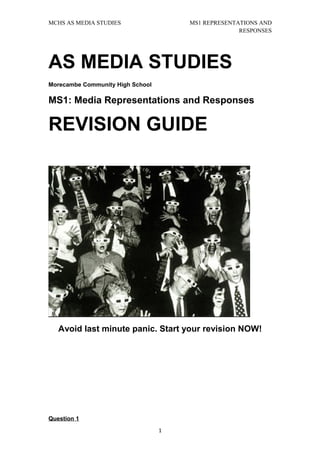
AS MEDIA STUDIES
Morecambe Community High School

MS1: Media Representations and Responses

REVISION GUIDE


   Avoid last minute panic. Start your revision NOW!


Question 1
                                  1
MCHS AS MEDIA STUDIES                                   MS1 REPRESENTATIONS AND
                                                                      RESPONSES


This will focus on textual analysis and will test your ability to analyse a media text
in detail using appropriate media language. You must be able to not just
recognise the techniques used but also able to analyse and say why they have been
used. You need to be aware of the generic conventions of a range of forms and
formats – for example the codes and conventions for certain types of TV
programmes (e.g. Situation Comedies) or film genres (this could be a sequence or
trailer).

The textual analysis question this year will be audio/visual (It could be a film trailer,
extract from a film or TV programme, music video, or TV advert) During the viewing
time make sure you organise your notes. Use sub headings similar to the ones
we use in class. Remember to discuss technical codes and narrative & generic
codes.

Technical Codes include:
   • Mise-en-scene (Costumes, props, location, make-up, lighting)

   •   Sound: Soundtrack, theme tune, incidental music, sound effects, ambient
       sound, dialogue, voiceover

   •   Editing: Cuts, manipulation of time, transitions, slow motion, etc.

   •   Camera Techniques: Types of shot, camera movement and angles.
       Establishing shot,, close-up, long shot, two shot, high angle, low angle, aerial
       shot, point of view , pan, tilt, track, dolly, (remember the dance…)
       zoom/reverse zoom, framing, composition, hand-held, steadicam.

Narrative Codes include:
   • Linear Narrative – plot moves forward in a straight line.

   •   Parallel Action (Non-Linear)– a narrative device in which two scenes are
       observed as happening at the same time by cutting between them.

   •   Flash back narrative (Non-Linear)

Generic Codes & Conventions
Genre is the classification of texts into types. E.G. westerns, horror, comedy,
romance, etc.

   •   Codes & Conventions are the elements that the audience will recognise.
       These include: characters, settings, plots and iconography.

   •   Iconography – signs associated with a genre. e.g. gangster – guns, violence,
       urban settings, Italians.


                                           2
MCHS AS MEDIA STUDIES                                      MS1 REPRESENTATIONS AND
                                                                         RESPONSES


Glossary of terms

Audience Consumption – how the audience use the media.

Audience Profiling – building a detailed picture of the audience.

Demographic Profiling – age, gender, social class.

Psychographic Profiling – beliefs, aspirations, lifestyles of the demographic

Signifier/Denotation – what is literally in the picture.

Signified/Connotations – different meanings and associations with images.

Preferred Meaning – texts are constructed to encourage the audience towards a
particular interpretation.

Cropping – cutting a picture to focus on a particular part. This can change the
meaning,

Anchorage – a caption or a heading to fix the meaning of an image.

Mise-en-scene is a French word and it means 'what is the scene or frame'. What is
put in or left out can make a big difference to the signals we, the audience, receive
about what sort of film we are watching. The elements in Mise-en-scene to consider
are: Setting and Props, Costume, Hair and Make-up, Facial Expressions and
Body Language, Lighting and Colour, Positioning of Characters and Objects.

High key lighting appears normal and realistic to the eye.

Low key lighting produces sharp contrasts between light and dark areas on the
screen. Deep shadows are formed.

Diegetic sound is sound within the frame – dialogue, traffic, birds etc.

Non-diegetic sound is sound that is not part of the frame – e.g. music used to
create mood.

Intertextuality is when texts refer to other media texts that producers assume
audiences will recognise. This means that a text will mimic or otherwise copy certain
stylistic features of another text. Advertising and music videos rely heavily on the
use of intertextuality to achieve a particular effect.


                                            3
MCHS AS MEDIA STUDIES                                 MS1 REPRESENTATIONS AND
                                                                    RESPONSES


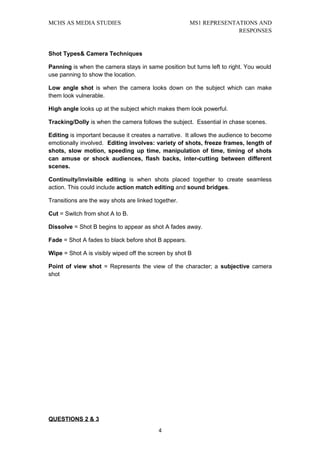
Shot Types& Camera Techniques

Panning is when the camera stays in same position but turns left to right. You would
use panning to show the location.

Low angle shot is when the camera looks down on the subject which can make
them look vulnerable.

High angle looks up at the subject which makes them look powerful.

Tracking/Dolly is when the camera follows the subject. Essential in chase scenes.

Editing is important because it creates a narrative. It allows the audience to become
emotionally involved. Editing involves: variety of shots, freeze frames, length of
shots, slow motion, speeding up time, manipulation of time, timing of shots
can amuse or shock audiences, flash backs, inter-cutting between different
scenes.

Continuity/invisible editing is when shots placed together to create seamless
action. This could include action match editing and sound bridges.

Transitions are the way shots are linked together.

Cut = Switch from shot A to B.

Dissolve = Shot B begins to appear as shot A fades away.

Fade = Shot A fades to black before shot B appears.

Wipe = Shot A is visibly wiped off the screen by shot B

Point of view shot = Represents the view of the character; a subjective camera
shot


QUESTIONS 2 & 3
                                          4
MCHS AS MEDIA STUDIES                                MS1 REPRESENTATIONS AND
                                                                   RESPONSES


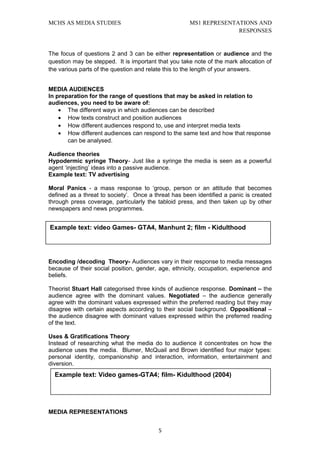
The focus of questions 2 and 3 can be either representation or audience and the
question may be stepped. It is important that you take note of the mark allocation of
the various parts of the question and relate this to the length of your answers.


MEDIA AUDIENCES
In preparation for the range of questions that may be asked in relation to
audiences, you need to be aware of:
    • The different ways in which audiences can be described
    • How texts construct and position audiences
    • How different audiences respond to, use and interpret media texts
    • How different audiences can respond to the same text and how that response
       can be analysed.

Audience theories
Hypodermic syringe Theory- Just like a syringe the media is seen as a powerful
agent ‘injecting’ ideas into a passive audience.
Example text: TV advertising

Moral Panics - a mass response to ‘group, person or an attitude that becomes
defined as a threat to society’. Once a threat has been identified a panic is created
through press coverage, particularly the tabloid press, and then taken up by other
newspapers and news programmes.


Example text: video Games- GTA4, Manhunt 2; film - Kidulthood


Encoding /decoding Theory- Audiences vary in their response to media messages
because of their social position, gender, age, ethnicity, occupation, experience and
beliefs.

Theorist Stuart Hall categorised three kinds of audience response. Dominant – the
audience agree with the dominant values. Negotiated – the audience generally
agree with the dominant values expressed within the preferred reading but they may
disagree with certain aspects according to their social background. Oppositional –
the audience disagree with dominant values expressed within the preferred reading
of the text.

Uses & Gratifications Theory
Instead of researching what the media do to audience it concentrates on how the
audience uses the media. Blumer, McQuail and Brown identified four major types:
personal identity, companionship and interaction, information, entertainment and
diversion.
  Example text: Video games-GTA4; film- Kidulthood (2004)


MEDIA REPRESENTATIONS


                                         5
MCHS AS MEDIA STUDIES                               MS1 REPRESENTATIONS AND
                                                                  RESPONSES


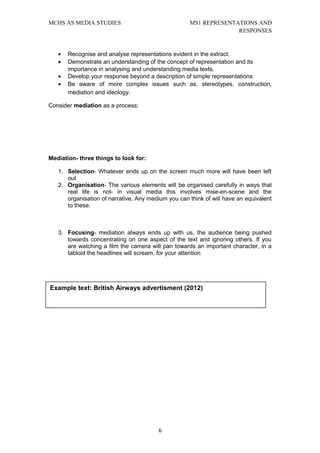
   •   Recognise and analyse representations evident in the extract.
   •   Demonstrate an understanding of the concept of representation and its
       importance in analysing and understanding media texts.
   •   Develop your response beyond a description of simple representations
   •   Be aware of more complex issues such as; stereotypes, construction,
       mediation and ideology.

Consider mediation as a process:


Mediation- three things to look for:

   1. Selection- Whatever ends up on the screen much more will have been left
      out
   2. Organisation- The various elements will be organised carefully in ways that
      real life is not- in visual media this involves mise-en-scene and the
      organisation of narrative, Any medium you can think of will have an equivalent
      to these.


   3. Focusing- mediation always ends up with us, the audience being pushed
      towards concentrating on one aspect of the text and ignoring others. If you
      are watching a film the camera will pan towards an important character, in a
      tabloid the headlines will scream, for your attention


Example text: British Airways advertisment (2012)


                                         6
MCHS AS MEDIA STUDIES                                MS1 REPRESENTATIONS AND
                                                                   RESPONSES


Ultimately, you should aim to discuss more than one medium in your answer s (i.e.
film, TV, video games). Provide detailed textual evidence from our studies. And
remember, even though its 2 ½ hours long, keep focused and keep writing! Good
Luck!

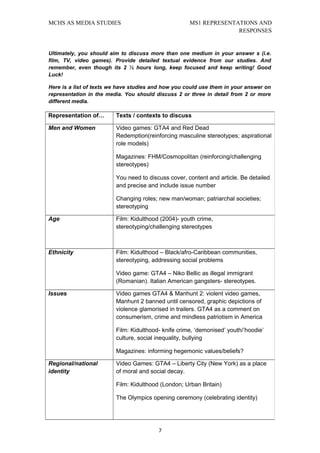
Here is a list of texts we have studies and how you could use them in your answer on
representation in the media. You should discuss 2 or three in detail from 2 or more
different media.

Representation of…       Texts / contexts to discuss

Men and Women            Video games: GTA4 and Red Dead
                         Redemption(reinforcing masculine stereotypes; aspirational
                         role models)

                         Magazines: FHM/Cosmopolitan (reinforcing/challenging
                         stereotypes)

                         You need to discuss cover, content and article. Be detailed
                         and precise and include issue number

                         Changing roles; new man/woman; patriarchal societies;
                         stereotyping

Age                      Film: Kidulthood (2004)- youth crime,
                         stereotyping/challenging stereotypes


Ethnicity                Film: Kidulthood – Black/afro-Caribbean communities,
                         stereotyping, addressing social problems

                         Video game: GTA4 – Niko Bellic as illegal immigrant
                         (Romanian). Italian American gangsters- stereotypes.

Issues                   Video games GTA4 & Manhunt 2: violent video games,
                         Manhunt 2 banned until censored, graphic depictions of
                         violence glamorised in trailers. GTA4 as a comment on
                         consumerism, crime and mindless patriotism in America

                         Film: Kidulthood- knife crime, ‘demonised’ youth/’hoodie’
                         culture, social inequality, bullying

                         Magazines: informing hegemonic values/beliefs?

Regional/national        Video Games: GTA4 – Liberty City (New York) as a place
identity                 of moral and social decay.

                         Film: Kidulthood (London; Urban Britain)

                         The Olympics opening ceremony (celebrating identity)


                                         7
MCHS AS MEDIA STUDIES                                  MS1 REPRESENTATIONS AND
                                                                     RESPONSES


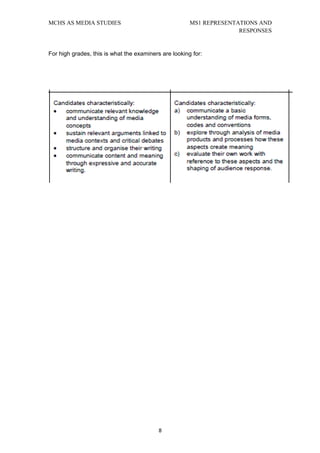
For high grades, this is what the examiners are looking for:


                                           8

Ms1 revision guide revised2

  • 1.
    MCHS AS MEDIASTUDIES MS1 REPRESENTATIONS AND RESPONSES AS MEDIA STUDIES Morecambe Community High School MS1: Media Representations and Responses REVISION GUIDE Avoid last minute panic. Start your revision NOW! Question 1 1
  • 2.
    MCHS AS MEDIASTUDIES MS1 REPRESENTATIONS AND RESPONSES This will focus on textual analysis and will test your ability to analyse a media text in detail using appropriate media language. You must be able to not just recognise the techniques used but also able to analyse and say why they have been used. You need to be aware of the generic conventions of a range of forms and formats – for example the codes and conventions for certain types of TV programmes (e.g. Situation Comedies) or film genres (this could be a sequence or trailer). The textual analysis question this year will be audio/visual (It could be a film trailer, extract from a film or TV programme, music video, or TV advert) During the viewing time make sure you organise your notes. Use sub headings similar to the ones we use in class. Remember to discuss technical codes and narrative & generic codes. Technical Codes include: • Mise-en-scene (Costumes, props, location, make-up, lighting) • Sound: Soundtrack, theme tune, incidental music, sound effects, ambient sound, dialogue, voiceover • Editing: Cuts, manipulation of time, transitions, slow motion, etc. • Camera Techniques: Types of shot, camera movement and angles. Establishing shot,, close-up, long shot, two shot, high angle, low angle, aerial shot, point of view , pan, tilt, track, dolly, (remember the dance…) zoom/reverse zoom, framing, composition, hand-held, steadicam. Narrative Codes include: • Linear Narrative – plot moves forward in a straight line. • Parallel Action (Non-Linear)– a narrative device in which two scenes are observed as happening at the same time by cutting between them. • Flash back narrative (Non-Linear) Generic Codes & Conventions Genre is the classification of texts into types. E.G. westerns, horror, comedy, romance, etc. • Codes & Conventions are the elements that the audience will recognise. These include: characters, settings, plots and iconography. • Iconography – signs associated with a genre. e.g. gangster – guns, violence, urban settings, Italians. 2
  • 3.
    MCHS AS MEDIASTUDIES MS1 REPRESENTATIONS AND RESPONSES Glossary of terms Audience Consumption – how the audience use the media. Audience Profiling – building a detailed picture of the audience. Demographic Profiling – age, gender, social class. Psychographic Profiling – beliefs, aspirations, lifestyles of the demographic Signifier/Denotation – what is literally in the picture. Signified/Connotations – different meanings and associations with images. Preferred Meaning – texts are constructed to encourage the audience towards a particular interpretation. Cropping – cutting a picture to focus on a particular part. This can change the meaning, Anchorage – a caption or a heading to fix the meaning of an image. Mise-en-scene is a French word and it means 'what is the scene or frame'. What is put in or left out can make a big difference to the signals we, the audience, receive about what sort of film we are watching. The elements in Mise-en-scene to consider are: Setting and Props, Costume, Hair and Make-up, Facial Expressions and Body Language, Lighting and Colour, Positioning of Characters and Objects. High key lighting appears normal and realistic to the eye. Low key lighting produces sharp contrasts between light and dark areas on the screen. Deep shadows are formed. Diegetic sound is sound within the frame – dialogue, traffic, birds etc. Non-diegetic sound is sound that is not part of the frame – e.g. music used to create mood. Intertextuality is when texts refer to other media texts that producers assume audiences will recognise. This means that a text will mimic or otherwise copy certain stylistic features of another text. Advertising and music videos rely heavily on the use of intertextuality to achieve a particular effect. 3
  • 4.
    MCHS AS MEDIASTUDIES MS1 REPRESENTATIONS AND RESPONSES Shot Types& Camera Techniques Panning is when the camera stays in same position but turns left to right. You would use panning to show the location. Low angle shot is when the camera looks down on the subject which can make them look vulnerable. High angle looks up at the subject which makes them look powerful. Tracking/Dolly is when the camera follows the subject. Essential in chase scenes. Editing is important because it creates a narrative. It allows the audience to become emotionally involved. Editing involves: variety of shots, freeze frames, length of shots, slow motion, speeding up time, manipulation of time, timing of shots can amuse or shock audiences, flash backs, inter-cutting between different scenes. Continuity/invisible editing is when shots placed together to create seamless action. This could include action match editing and sound bridges. Transitions are the way shots are linked together. Cut = Switch from shot A to B. Dissolve = Shot B begins to appear as shot A fades away. Fade = Shot A fades to black before shot B appears. Wipe = Shot A is visibly wiped off the screen by shot B Point of view shot = Represents the view of the character; a subjective camera shot QUESTIONS 2 & 3 4
  • 5.
    MCHS AS MEDIASTUDIES MS1 REPRESENTATIONS AND RESPONSES The focus of questions 2 and 3 can be either representation or audience and the question may be stepped. It is important that you take note of the mark allocation of the various parts of the question and relate this to the length of your answers. MEDIA AUDIENCES In preparation for the range of questions that may be asked in relation to audiences, you need to be aware of: • The different ways in which audiences can be described • How texts construct and position audiences • How different audiences respond to, use and interpret media texts • How different audiences can respond to the same text and how that response can be analysed. Audience theories Hypodermic syringe Theory- Just like a syringe the media is seen as a powerful agent ‘injecting’ ideas into a passive audience. Example text: TV advertising Moral Panics - a mass response to ‘group, person or an attitude that becomes defined as a threat to society’. Once a threat has been identified a panic is created through press coverage, particularly the tabloid press, and then taken up by other newspapers and news programmes. Example text: video Games- GTA4, Manhunt 2; film - Kidulthood Encoding /decoding Theory- Audiences vary in their response to media messages because of their social position, gender, age, ethnicity, occupation, experience and beliefs. Theorist Stuart Hall categorised three kinds of audience response. Dominant – the audience agree with the dominant values. Negotiated – the audience generally agree with the dominant values expressed within the preferred reading but they may disagree with certain aspects according to their social background. Oppositional – the audience disagree with dominant values expressed within the preferred reading of the text. Uses & Gratifications Theory Instead of researching what the media do to audience it concentrates on how the audience uses the media. Blumer, McQuail and Brown identified four major types: personal identity, companionship and interaction, information, entertainment and diversion. Example text: Video games-GTA4; film- Kidulthood (2004) MEDIA REPRESENTATIONS 5
  • 6.
    MCHS AS MEDIASTUDIES MS1 REPRESENTATIONS AND RESPONSES • Recognise and analyse representations evident in the extract. • Demonstrate an understanding of the concept of representation and its importance in analysing and understanding media texts. • Develop your response beyond a description of simple representations • Be aware of more complex issues such as; stereotypes, construction, mediation and ideology. Consider mediation as a process: Mediation- three things to look for: 1. Selection- Whatever ends up on the screen much more will have been left out 2. Organisation- The various elements will be organised carefully in ways that real life is not- in visual media this involves mise-en-scene and the organisation of narrative, Any medium you can think of will have an equivalent to these. 3. Focusing- mediation always ends up with us, the audience being pushed towards concentrating on one aspect of the text and ignoring others. If you are watching a film the camera will pan towards an important character, in a tabloid the headlines will scream, for your attention Example text: British Airways advertisment (2012) 6
  • 7.
    MCHS AS MEDIASTUDIES MS1 REPRESENTATIONS AND RESPONSES Ultimately, you should aim to discuss more than one medium in your answer s (i.e. film, TV, video games). Provide detailed textual evidence from our studies. And remember, even though its 2 ½ hours long, keep focused and keep writing! Good Luck! Here is a list of texts we have studies and how you could use them in your answer on representation in the media. You should discuss 2 or three in detail from 2 or more different media. Representation of… Texts / contexts to discuss Men and Women Video games: GTA4 and Red Dead Redemption(reinforcing masculine stereotypes; aspirational role models) Magazines: FHM/Cosmopolitan (reinforcing/challenging stereotypes) You need to discuss cover, content and article. Be detailed and precise and include issue number Changing roles; new man/woman; patriarchal societies; stereotyping Age Film: Kidulthood (2004)- youth crime, stereotyping/challenging stereotypes Ethnicity Film: Kidulthood – Black/afro-Caribbean communities, stereotyping, addressing social problems Video game: GTA4 – Niko Bellic as illegal immigrant (Romanian). Italian American gangsters- stereotypes. Issues Video games GTA4 & Manhunt 2: violent video games, Manhunt 2 banned until censored, graphic depictions of violence glamorised in trailers. GTA4 as a comment on consumerism, crime and mindless patriotism in America Film: Kidulthood- knife crime, ‘demonised’ youth/’hoodie’ culture, social inequality, bullying Magazines: informing hegemonic values/beliefs? Regional/national Video Games: GTA4 – Liberty City (New York) as a place identity of moral and social decay. Film: Kidulthood (London; Urban Britain) The Olympics opening ceremony (celebrating identity) 7
  • 8.
    MCHS AS MEDIASTUDIES MS1 REPRESENTATIONS AND RESPONSES For high grades, this is what the examiners are looking for: 8