CS 221: Artificial Intelligence Lecture 4: Probabilistic Inference Sebastian Thrun and Peter Norvig Slide credit: Dan Klein
Announcements Homework Assignment 2 Due Sunday stanford.ai-class.com Programming Assignment 2 Due Today cs221.stanford.edu TA Review Session Next Tuesday
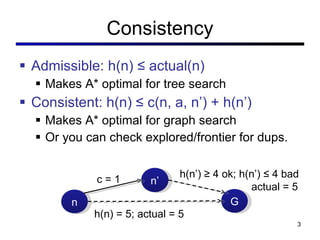
Consistency Admissible: h(n) ≤ actual(n) Makes A* optimal for tree search Consistent: h(n) ≤ c(n, a, n’) + h(n’) Makes A* optimal for graph search Or you can check explored/frontier for dups. n n’ G c = 1 h(n) = 5; actual = 5 h(n’) ≥ 4 ok; h(n’) ≤ 4 bad   actual = 5
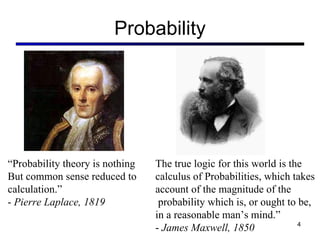
Probability “ Probability theory is nothing  But common sense reduced to  calculation.” -  Pierre Laplace, 1819 The true logic for this world is the  calculus of Probabilities, which takes  account of the magnitude of the probability which is, or ought to be,  in a reasonable man’s mind.” -  James Maxwell, 1850
Probabilistic Inference Joel Spolsky: A very senior developer who moved to Google told me that Google works and thinks at a higher level of abstraction...   "Google uses Bayesian filtering the way [previous employer] uses the if statement,"   he said.
Google Whiteboard
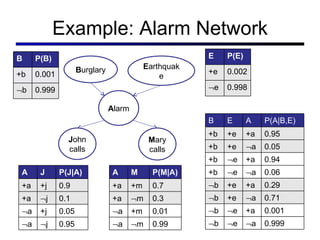
Example: Alarm Network B urglary E arthquake A larm J ohn calls M ary calls B P(B) +b 0.001  b 0.999 E P(E) +e 0.002  e 0.998 B E A P(A|B,E) +b +e +a 0.95 +b +e  a 0.05 +b  e +a 0.94 +b  e  a 0.06  b +e +a 0.29  b +e  a 0.71  b  e +a 0.001  b  e  a 0.999 A J P(J|A) +a +j 0.9 +a  j 0.1  a +j 0.05  a  j 0.95 A M P(M|A) +a +m 0.7 +a  m 0.3  a +m 0.01  a  m 0.99
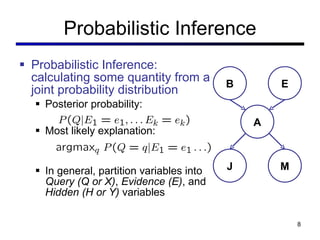
Probabilistic Inference Probabilistic Inference: calculating some quantity from a joint probability distribution Posterior probability: Most likely explanation: In general, partition variables into Query (Q or X) ,  Evidence (E) , and  Hidden (H or Y)  variables B E A J M
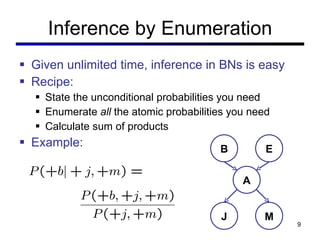
Inference by Enumeration Given unlimited time, inference in BNs is easy Recipe: State the unconditional probabilities you need Enumerate  all  the atomic probabilities you need Calculate sum of products Example: B E A J M
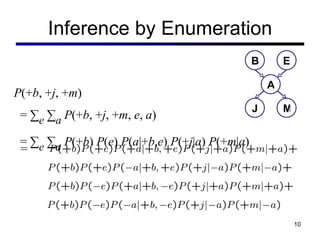
Inference by Enumeration P (+ b , + j , + m )    = ∑ e   ∑ a  P (+ b , + j , + m ,  e ,  a ) = ∑ e   ∑ a  P (+ b )  P ( e )  P ( a |+ b , e )  P (+ j | a )  P (+ m | a )  =   B E A J M
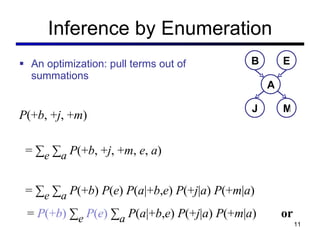
Inference by Enumeration An optimization: pull terms out of summations =  P (+ b )  ∑ e   P ( e )  ∑ a  P ( a |+ b , e )  P (+ j | a )  P (+ m | a )  or   =  P (+ b )  ∑ a  P (+ j | a )  P (+ m | a )  ∑ e   P ( e )  P ( a |+ b , e ) P (+ b , + j , + m )    = ∑ e   ∑ a  P (+ b , + j , + m ,  e ,  a ) = ∑ e   ∑ a  P (+ b )  P ( e )  P ( a |+ b , e )  P (+ j | a )  P (+ m | a ) B E A J M
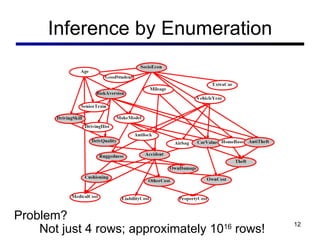
Inference by Enumeration Not just 4 rows; approximately 10 16  rows! Problem?
How can we make inference tractible?
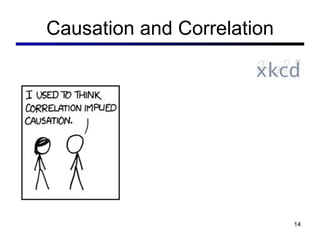
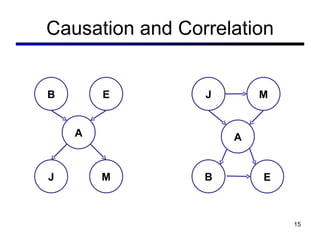
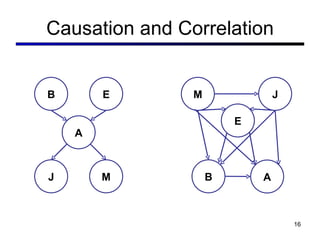
Causation and Correlation
Causation and Correlation J M A B E B E A J M
Causation and Correlation M J E B A B E A J M
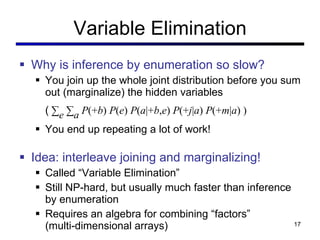
Variable Elimination Why is inference by enumeration so slow? You join up the whole joint distribution before you sum out (marginalize) the hidden variables (  ∑ e   ∑ a  P (+ b )  P ( e )  P ( a |+ b , e )  P (+ j | a )  P (+ m | a ) ) You end up repeating a lot of work! Idea: interleave joining and marginalizing! Called  “Variable Elimination” Still NP-hard, but usually much faster than inference by enumeration Requires an algebra for combining  “factors” (multi-dimensional arrays)
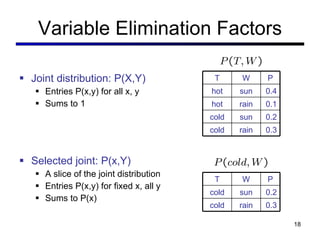
Variable Elimination Factors Joint distribution: P(X,Y) Entries P(x,y) for all x, y Sums to 1 Selected joint: P(x,Y) A slice of the joint distribution Entries P(x,y) for fixed x, all y Sums to P(x) T W P hot sun 0.4 hot rain 0.1 cold sun 0.2 cold rain 0.3 T W P cold sun 0.2 cold rain 0.3
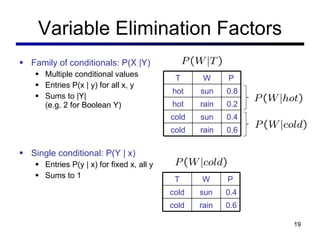
Variable Elimination Factors Family of conditionals: P(X |Y) Multiple conditional values Entries P(x | y) for all x, y Sums to |Y| (e.g. 2 for Boolean Y) Single conditional: P(Y | x) Entries P(y | x) for fixed x, all y Sums to 1 T W P hot sun 0.8 hot rain 0.2 cold sun 0.4 cold rain 0.6 T W P cold sun 0.4 cold rain 0.6
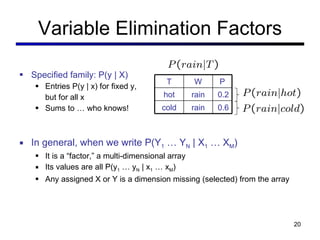
Variable Elimination Factors Specified family: P(y | X) Entries P(y | x) for fixed y, but for all x Sums to … who knows! In general, when we write P(Y 1  … Y N  | X 1  … X M ) It is a  “factor,” a multi-dimensional array Its values are all P(y 1  … y N  | x 1  … x M ) Any assigned X or Y is a dimension missing (selected) from the array T W P hot rain 0.2 cold rain 0.6
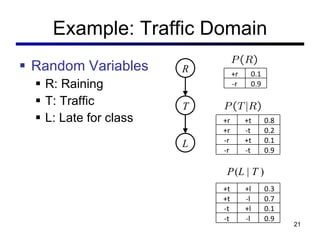
Example: Traffic Domain Random Variables R: Raining T: Traffic L: Late for class T L R P   ( L  |  T  ) +r 0.1 -r 0.9 +r +t 0.8 +r -t 0.2 -r +t 0.1 -r -t 0.9 +t +l 0.3 +t -l 0.7 -t +l 0.1 -t -l 0.9
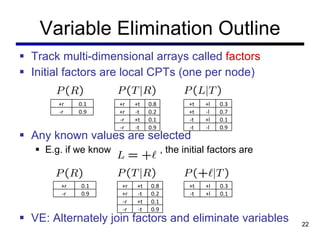
Track multi-dimensional arrays called  factors Initial factors are local CPTs (one per node) Any known values are selected E.g. if we know  , the initial factors are VE: Alternately join factors and eliminate variables Variable Elimination Outline +r 0.1 -r 0.9 +r +t 0.8 +r -t 0.2 -r +t 0.1 -r -t 0.9 +t +l 0.3 +t -l 0.7 -t +l 0.1 -t -l 0.9 +t +l 0.3 -t +l 0.1 +r 0.1 -r 0.9 +r +t 0.8 +r -t 0.2 -r +t 0.1 -r -t 0.9
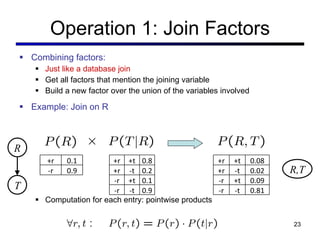
Combining factors: Just like a database join Get all factors that mention the joining variable Build a new factor over the union of the variables involved Example: Join on R Computation for each entry: pointwise products Operation 1: Join Factors T R R,T +r 0.1 -r 0.9 +r +t 0.8 +r -t 0.2 -r +t 0.1 -r -t 0.9 +r +t 0.08 +r -t 0.02 -r +t 0.09 -r -t 0.81
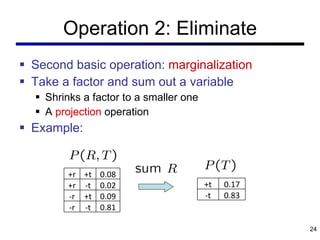
Operation 2: Eliminate Second basic operation:  marginalization Take a factor and sum out a variable Shrinks a factor to a smaller one A  projection  operation Example: +r +t 0.08 +r -t 0.02 -r +t 0.09 -r -t 0.81 +t 0.17 -t 0.83
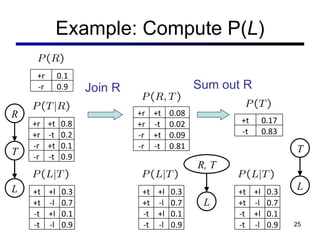
Example: Compute P( L ) Sum out R T L T R L Join R R,   T L +r +t 0.08 +r -t 0.02 -r +t 0.09 -r -t 0.81 +t +l 0.3 +t -l 0.7 -t +l 0.1 -t -l 0.9 +t 0.17 -t 0.83 +t +l 0.3 +t -l 0.7 -t +l 0.1 -t -l 0.9 +r 0.1 -r 0.9 +r +t 0.8 +r -t 0.2 -r +t 0.1 -r -t 0.9 +t +l 0.3 +t -l 0.7 -t +l 0.1 -t -l 0.9
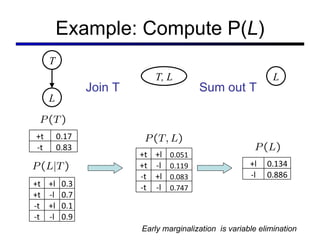
Example: Compute P( L ) Join T Sum out T T, L L Early marginalization  is variable elimination T L +t 0.17 -t 0.83 +t +l 0.3 +t -l 0.7 -t +l 0.1 -t -l 0.9 +t +l 0.051 +t -l 0.119 -t +l 0.083 -t -l 0.747 +l 0.134 -l 0.886
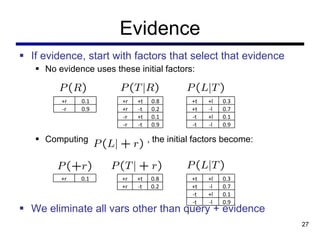
If evidence, start with factors that select that evidence No evidence uses these initial factors: Computing  , the initial factors become: We eliminate all vars other than query + evidence Evidence +r 0.1 -r 0.9 +r +t 0.8 +r -t 0.2 -r +t 0.1 -r -t 0.9 +t +l 0.3 +t -l 0.7 -t +l 0.1 -t -l 0.9 +r 0.1 +r +t 0.8 +r -t 0.2 +t +l 0.3 +t -l 0.7 -t +l 0.1 -t -l 0.9
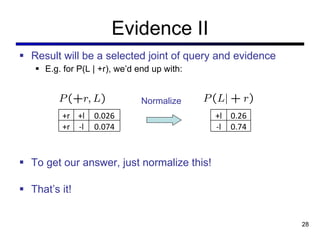
Result will be a selected joint of query and evidence E.g. for P(L | +r), we ’d end up with: To get our answer, just normalize this! That ’s it! Evidence II Normalize +l 0.26 -l 0.74 +r +l 0.026 +r -l 0.074
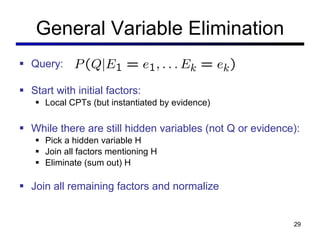
General Variable Elimination Query: Start with initial factors: Local CPTs (but instantiated by evidence) While there are still hidden variables (not Q or evidence): Pick a hidden variable H Join all factors mentioning H Eliminate (sum out) H Join all remaining factors and normalize
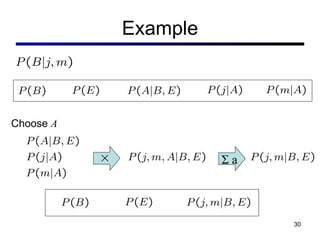
Example Choose  A Σ a
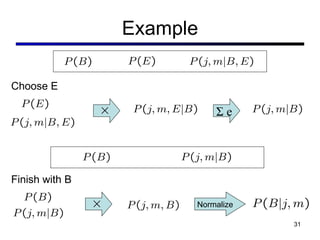
Example Choose E Finish with B Normalize Σ e
Pause for Questions
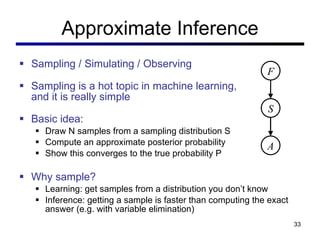
Approximate Inference Sampling / Simulating / Observing Sampling is a hot topic in machine learning, and it is really simple Basic idea: Draw N samples from a sampling distribution S Compute an approximate posterior probability Show this converges to the true probability P Why sample? Learning: get samples from a distribution you don ’t know Inference: getting a sample is faster than computing the exact answer (e.g. with variable elimination) S A F
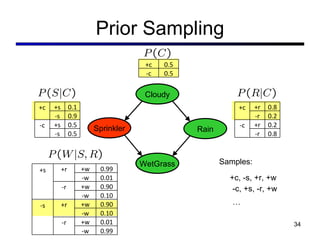
Prior Sampling Cloudy Sprinkler Rain WetGrass Cloudy Sprinkler Rain WetGrass Samples: +c, -s, +r, +w -c, +s, -r, +w … +c 0.5 -c 0.5 +c +s 0.1 -s 0.9 -c +s 0.5 -s 0.5 +c +r 0.8 -r 0.2 -c +r 0.2 -r 0.8 +s +r +w 0.99 -w 0.01 -r +w 0.90 -w 0.10 -s +r +w 0.90 -w 0.10 -r +w 0.01 -w 0.99
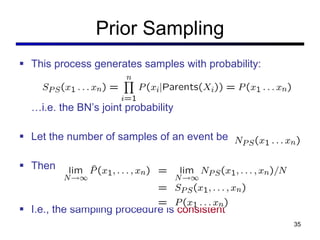
Prior Sampling This process generates samples with probability: … i.e. the BN ’s joint probability Let the number of samples of an event be Then I.e., the sampling procedure is  consistent
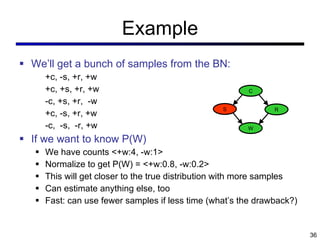
Example We ’ll get a bunch of samples from the BN: +c, -s, +r, +w +c, +s, +r, +w -c, +s, +r,  -w +c, -s, +r, +w -c,  -s,  -r, +w If we want to know P(W) We have counts <+w:4, -w:1> Normalize to get P(W) = <+w:0.8, -w:0.2> This will get closer to the true distribution with more samples Can estimate anything else, too Fast: can use fewer samples if less time (what ’s the drawback?) Cloudy Sprinkler Rain WetGrass C S R W
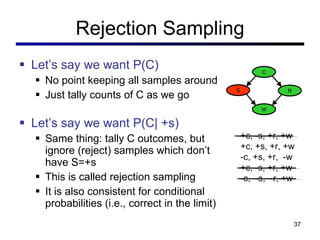
Rejection Sampling Let ’s say we want P(C) No point keeping all samples around Just tally counts of C as we go Let ’s say we want P(C| +s) Same thing: tally C outcomes, but ignore (reject) samples which don ’t have S=+s This is called rejection sampling It is also consistent for conditional probabilities (i.e., correct in the limit) +c, -s, +r, +w +c, +s, +r, +w -c, +s, +r,  -w +c, -s, +r, +w -c,  -s,  -r, +w Cloudy Sprinkler Rain WetGrass C S R W
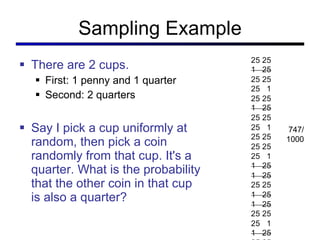
Sampling Example There are 2 cups.  First: 1 penny and 1 quarter Second: 2 quarters Say I pick a cup uniformly at random, then pick a coin randomly from that cup. It's a quarter. What is the probability that the other coin in that cup is also a quarter? 747/ 1000
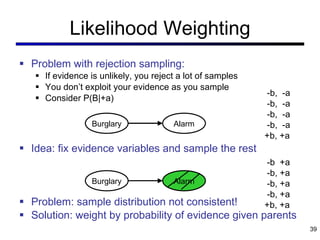
Likelihood Weighting Problem with rejection sampling: If evidence is unlikely, you reject a lot of samples You don ’t exploit your evidence as you sample Consider P(B|+a) Idea: fix evidence variables and sample the rest Problem: sample distribution not consistent! Solution: weight by probability of evidence given parents Burglary Alarm Burglary Alarm -b,  -a -b,  -a -b,  -a -b,  -a +b, +a -b  +a -b, +a -b, +a -b, +a +b, +a
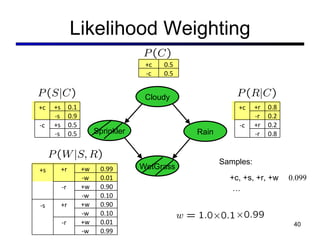
Likelihood Weighting Samples: +c, +s, +r, +w … Cloudy Sprinkler Rain WetGrass Cloudy Sprinkler Rain WetGrass 0.099 +c 0.5 -c 0.5 +c +s 0.1 -s 0.9 -c +s 0.5 -s 0.5 +c +r 0.8 -r 0.2 -c +r 0.2 -r 0.8 +s +r +w 0.99 -w 0.01 -r +w 0.90 -w 0.10 -s +r +w 0.90 -w 0.10 -r +w 0.01 -w 0.99
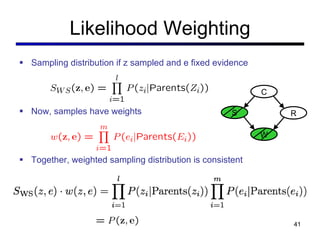
Likelihood Weighting Sampling distribution if z sampled and e fixed evidence Now, samples have weights Together, weighted sampling distribution is consistent Cloudy R C S W
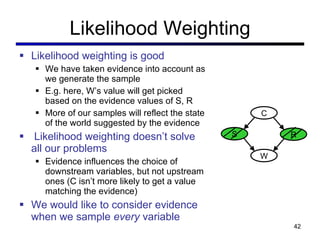
Likelihood Weighting Likelihood weighting is good We have taken evidence into account as we generate the sample E.g. here, W ’s value will get picked based on the evidence values of S, R More of our samples will reflect the state of the world suggested by the evidence Likelihood weighting doesn ’t solve all our problems Evidence influences the choice of downstream variables, but not upstream ones (C isn ’t more likely to get a value matching the evidence) We would like to consider evidence when we sample  every  variable Cloudy Rain C S R W
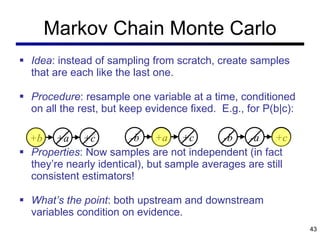
Markov Chain Monte Carlo Idea : instead of sampling from scratch, create samples that are each like the last one. Procedure : resample one variable at a time, conditioned on all the rest, but keep evidence fixed.  E.g., for P(b|c): Properties : Now samples are not independent (in fact they ’re nearly identical), but sample averages are still consistent estimators! What ’s the point : both upstream and downstream variables condition on evidence. +a +c +b +a +c -b -a +c -b
World’s most famous probability problem?
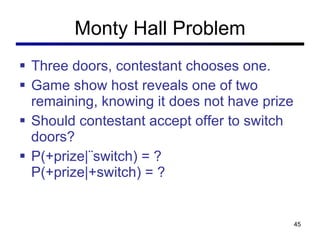
Monty Hall Problem Three doors, contestant chooses one. Game show host reveals one of two remaining, knowing it does not have prize Should contestant accept offer to switch doors? P(+prize|¬switch) = ? P(+prize|+switch) = ?
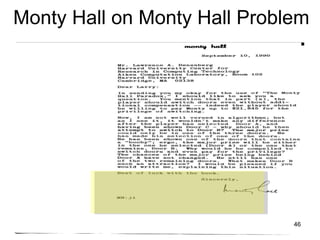
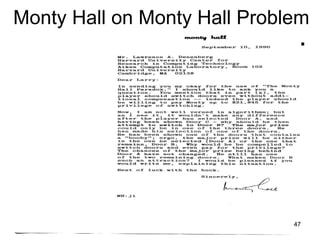
Monty Hall on Monty Hall Problem

Cs221 lecture4-fall11

  • 1.
    CS 221: ArtificialIntelligence Lecture 4: Probabilistic Inference Sebastian Thrun and Peter Norvig Slide credit: Dan Klein
  • 2.
    Announcements Homework Assignment2 Due Sunday stanford.ai-class.com Programming Assignment 2 Due Today cs221.stanford.edu TA Review Session Next Tuesday
  • 3.
    Consistency Admissible: h(n)≤ actual(n) Makes A* optimal for tree search Consistent: h(n) ≤ c(n, a, n’) + h(n’) Makes A* optimal for graph search Or you can check explored/frontier for dups. n n’ G c = 1 h(n) = 5; actual = 5 h(n’) ≥ 4 ok; h(n’) ≤ 4 bad actual = 5
  • 4.
    Probability “ Probabilitytheory is nothing But common sense reduced to calculation.” - Pierre Laplace, 1819 The true logic for this world is the calculus of Probabilities, which takes account of the magnitude of the probability which is, or ought to be, in a reasonable man’s mind.” - James Maxwell, 1850
  • 5.
    Probabilistic Inference JoelSpolsky: A very senior developer who moved to Google told me that Google works and thinks at a higher level of abstraction... &quot;Google uses Bayesian filtering the way [previous employer] uses the if statement,&quot; he said.
  • 6.
  • 7.
    Example: Alarm NetworkB urglary E arthquake A larm J ohn calls M ary calls B P(B) +b 0.001  b 0.999 E P(E) +e 0.002  e 0.998 B E A P(A|B,E) +b +e +a 0.95 +b +e  a 0.05 +b  e +a 0.94 +b  e  a 0.06  b +e +a 0.29  b +e  a 0.71  b  e +a 0.001  b  e  a 0.999 A J P(J|A) +a +j 0.9 +a  j 0.1  a +j 0.05  a  j 0.95 A M P(M|A) +a +m 0.7 +a  m 0.3  a +m 0.01  a  m 0.99
  • 8.
    Probabilistic Inference ProbabilisticInference: calculating some quantity from a joint probability distribution Posterior probability: Most likely explanation: In general, partition variables into Query (Q or X) , Evidence (E) , and Hidden (H or Y) variables B E A J M
  • 9.
    Inference by EnumerationGiven unlimited time, inference in BNs is easy Recipe: State the unconditional probabilities you need Enumerate all the atomic probabilities you need Calculate sum of products Example: B E A J M
  • 10.
    Inference by EnumerationP (+ b , + j , + m ) = ∑ e ∑ a P (+ b , + j , + m , e , a ) = ∑ e ∑ a P (+ b ) P ( e ) P ( a |+ b , e ) P (+ j | a ) P (+ m | a ) = B E A J M
  • 11.
    Inference by EnumerationAn optimization: pull terms out of summations = P (+ b ) ∑ e P ( e ) ∑ a P ( a |+ b , e ) P (+ j | a ) P (+ m | a ) or = P (+ b ) ∑ a P (+ j | a ) P (+ m | a ) ∑ e P ( e ) P ( a |+ b , e ) P (+ b , + j , + m ) = ∑ e ∑ a P (+ b , + j , + m , e , a ) = ∑ e ∑ a P (+ b ) P ( e ) P ( a |+ b , e ) P (+ j | a ) P (+ m | a ) B E A J M
  • 12.
    Inference by EnumerationNot just 4 rows; approximately 10 16 rows! Problem?
  • 13.
    How can wemake inference tractible?
  • 14.
  • 15.
    Causation and CorrelationJ M A B E B E A J M
  • 16.
    Causation and CorrelationM J E B A B E A J M
  • 17.
    Variable Elimination Whyis inference by enumeration so slow? You join up the whole joint distribution before you sum out (marginalize) the hidden variables ( ∑ e ∑ a P (+ b ) P ( e ) P ( a |+ b , e ) P (+ j | a ) P (+ m | a ) ) You end up repeating a lot of work! Idea: interleave joining and marginalizing! Called “Variable Elimination” Still NP-hard, but usually much faster than inference by enumeration Requires an algebra for combining “factors” (multi-dimensional arrays)
  • 18.
    Variable Elimination FactorsJoint distribution: P(X,Y) Entries P(x,y) for all x, y Sums to 1 Selected joint: P(x,Y) A slice of the joint distribution Entries P(x,y) for fixed x, all y Sums to P(x) T W P hot sun 0.4 hot rain 0.1 cold sun 0.2 cold rain 0.3 T W P cold sun 0.2 cold rain 0.3
  • 19.
    Variable Elimination FactorsFamily of conditionals: P(X |Y) Multiple conditional values Entries P(x | y) for all x, y Sums to |Y| (e.g. 2 for Boolean Y) Single conditional: P(Y | x) Entries P(y | x) for fixed x, all y Sums to 1 T W P hot sun 0.8 hot rain 0.2 cold sun 0.4 cold rain 0.6 T W P cold sun 0.4 cold rain 0.6
  • 20.
    Variable Elimination FactorsSpecified family: P(y | X) Entries P(y | x) for fixed y, but for all x Sums to … who knows! In general, when we write P(Y 1 … Y N | X 1 … X M ) It is a “factor,” a multi-dimensional array Its values are all P(y 1 … y N | x 1 … x M ) Any assigned X or Y is a dimension missing (selected) from the array T W P hot rain 0.2 cold rain 0.6
  • 21.
    Example: Traffic DomainRandom Variables R: Raining T: Traffic L: Late for class T L R P ( L | T ) +r 0.1 -r 0.9 +r +t 0.8 +r -t 0.2 -r +t 0.1 -r -t 0.9 +t +l 0.3 +t -l 0.7 -t +l 0.1 -t -l 0.9
  • 22.
    Track multi-dimensional arrayscalled factors Initial factors are local CPTs (one per node) Any known values are selected E.g. if we know , the initial factors are VE: Alternately join factors and eliminate variables Variable Elimination Outline +r 0.1 -r 0.9 +r +t 0.8 +r -t 0.2 -r +t 0.1 -r -t 0.9 +t +l 0.3 +t -l 0.7 -t +l 0.1 -t -l 0.9 +t +l 0.3 -t +l 0.1 +r 0.1 -r 0.9 +r +t 0.8 +r -t 0.2 -r +t 0.1 -r -t 0.9
  • 23.
    Combining factors: Justlike a database join Get all factors that mention the joining variable Build a new factor over the union of the variables involved Example: Join on R Computation for each entry: pointwise products Operation 1: Join Factors T R R,T +r 0.1 -r 0.9 +r +t 0.8 +r -t 0.2 -r +t 0.1 -r -t 0.9 +r +t 0.08 +r -t 0.02 -r +t 0.09 -r -t 0.81
  • 24.
    Operation 2: EliminateSecond basic operation: marginalization Take a factor and sum out a variable Shrinks a factor to a smaller one A projection operation Example: +r +t 0.08 +r -t 0.02 -r +t 0.09 -r -t 0.81 +t 0.17 -t 0.83
  • 25.
    Example: Compute P(L ) Sum out R T L T R L Join R R, T L +r +t 0.08 +r -t 0.02 -r +t 0.09 -r -t 0.81 +t +l 0.3 +t -l 0.7 -t +l 0.1 -t -l 0.9 +t 0.17 -t 0.83 +t +l 0.3 +t -l 0.7 -t +l 0.1 -t -l 0.9 +r 0.1 -r 0.9 +r +t 0.8 +r -t 0.2 -r +t 0.1 -r -t 0.9 +t +l 0.3 +t -l 0.7 -t +l 0.1 -t -l 0.9
  • 26.
    Example: Compute P(L ) Join T Sum out T T, L L Early marginalization is variable elimination T L +t 0.17 -t 0.83 +t +l 0.3 +t -l 0.7 -t +l 0.1 -t -l 0.9 +t +l 0.051 +t -l 0.119 -t +l 0.083 -t -l 0.747 +l 0.134 -l 0.886
  • 27.
    If evidence, startwith factors that select that evidence No evidence uses these initial factors: Computing , the initial factors become: We eliminate all vars other than query + evidence Evidence +r 0.1 -r 0.9 +r +t 0.8 +r -t 0.2 -r +t 0.1 -r -t 0.9 +t +l 0.3 +t -l 0.7 -t +l 0.1 -t -l 0.9 +r 0.1 +r +t 0.8 +r -t 0.2 +t +l 0.3 +t -l 0.7 -t +l 0.1 -t -l 0.9
  • 28.
    Result will bea selected joint of query and evidence E.g. for P(L | +r), we ’d end up with: To get our answer, just normalize this! That ’s it! Evidence II Normalize +l 0.26 -l 0.74 +r +l 0.026 +r -l 0.074
  • 29.
    General Variable EliminationQuery: Start with initial factors: Local CPTs (but instantiated by evidence) While there are still hidden variables (not Q or evidence): Pick a hidden variable H Join all factors mentioning H Eliminate (sum out) H Join all remaining factors and normalize
  • 30.
  • 31.
    Example Choose EFinish with B Normalize Σ e
  • 32.
  • 33.
    Approximate Inference Sampling/ Simulating / Observing Sampling is a hot topic in machine learning, and it is really simple Basic idea: Draw N samples from a sampling distribution S Compute an approximate posterior probability Show this converges to the true probability P Why sample? Learning: get samples from a distribution you don ’t know Inference: getting a sample is faster than computing the exact answer (e.g. with variable elimination) S A F
  • 34.
    Prior Sampling CloudySprinkler Rain WetGrass Cloudy Sprinkler Rain WetGrass Samples: +c, -s, +r, +w -c, +s, -r, +w … +c 0.5 -c 0.5 +c +s 0.1 -s 0.9 -c +s 0.5 -s 0.5 +c +r 0.8 -r 0.2 -c +r 0.2 -r 0.8 +s +r +w 0.99 -w 0.01 -r +w 0.90 -w 0.10 -s +r +w 0.90 -w 0.10 -r +w 0.01 -w 0.99
  • 35.
    Prior Sampling Thisprocess generates samples with probability: … i.e. the BN ’s joint probability Let the number of samples of an event be Then I.e., the sampling procedure is consistent
  • 36.
    Example We ’llget a bunch of samples from the BN: +c, -s, +r, +w +c, +s, +r, +w -c, +s, +r, -w +c, -s, +r, +w -c, -s, -r, +w If we want to know P(W) We have counts <+w:4, -w:1> Normalize to get P(W) = <+w:0.8, -w:0.2> This will get closer to the true distribution with more samples Can estimate anything else, too Fast: can use fewer samples if less time (what ’s the drawback?) Cloudy Sprinkler Rain WetGrass C S R W
  • 37.
    Rejection Sampling Let’s say we want P(C) No point keeping all samples around Just tally counts of C as we go Let ’s say we want P(C| +s) Same thing: tally C outcomes, but ignore (reject) samples which don ’t have S=+s This is called rejection sampling It is also consistent for conditional probabilities (i.e., correct in the limit) +c, -s, +r, +w +c, +s, +r, +w -c, +s, +r, -w +c, -s, +r, +w -c, -s, -r, +w Cloudy Sprinkler Rain WetGrass C S R W
  • 38.
    Sampling Example Thereare 2 cups. First: 1 penny and 1 quarter Second: 2 quarters Say I pick a cup uniformly at random, then pick a coin randomly from that cup. It's a quarter. What is the probability that the other coin in that cup is also a quarter? 747/ 1000
  • 39.
    Likelihood Weighting Problemwith rejection sampling: If evidence is unlikely, you reject a lot of samples You don ’t exploit your evidence as you sample Consider P(B|+a) Idea: fix evidence variables and sample the rest Problem: sample distribution not consistent! Solution: weight by probability of evidence given parents Burglary Alarm Burglary Alarm -b, -a -b, -a -b, -a -b, -a +b, +a -b +a -b, +a -b, +a -b, +a +b, +a
  • 40.
    Likelihood Weighting Samples:+c, +s, +r, +w … Cloudy Sprinkler Rain WetGrass Cloudy Sprinkler Rain WetGrass 0.099 +c 0.5 -c 0.5 +c +s 0.1 -s 0.9 -c +s 0.5 -s 0.5 +c +r 0.8 -r 0.2 -c +r 0.2 -r 0.8 +s +r +w 0.99 -w 0.01 -r +w 0.90 -w 0.10 -s +r +w 0.90 -w 0.10 -r +w 0.01 -w 0.99
  • 41.
    Likelihood Weighting Samplingdistribution if z sampled and e fixed evidence Now, samples have weights Together, weighted sampling distribution is consistent Cloudy R C S W
  • 42.
    Likelihood Weighting Likelihoodweighting is good We have taken evidence into account as we generate the sample E.g. here, W ’s value will get picked based on the evidence values of S, R More of our samples will reflect the state of the world suggested by the evidence Likelihood weighting doesn ’t solve all our problems Evidence influences the choice of downstream variables, but not upstream ones (C isn ’t more likely to get a value matching the evidence) We would like to consider evidence when we sample every variable Cloudy Rain C S R W
  • 43.
    Markov Chain MonteCarlo Idea : instead of sampling from scratch, create samples that are each like the last one. Procedure : resample one variable at a time, conditioned on all the rest, but keep evidence fixed. E.g., for P(b|c): Properties : Now samples are not independent (in fact they ’re nearly identical), but sample averages are still consistent estimators! What ’s the point : both upstream and downstream variables condition on evidence. +a +c +b +a +c -b -a +c -b
  • 44.
    World’s most famousprobability problem?
  • 45.
    Monty Hall ProblemThree doors, contestant chooses one. Game show host reveals one of two remaining, knowing it does not have prize Should contestant accept offer to switch doors? P(+prize|¬switch) = ? P(+prize|+switch) = ?
  • 46.
    Monty Hall onMonty Hall Problem
  • 47.
    Monty Hall onMonty Hall Problem