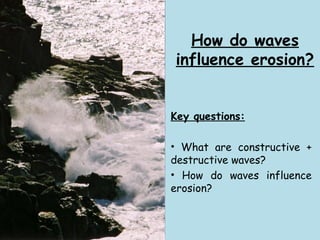
How do waves
influence erosion?
Key questions:
• What are constructive +
destructive waves?
• How do waves influence
erosion?
How do waves work?
What causes waves?
How do waves work?
• Waves are created by wind
• The friction of the wind makes the sea
swell and rise up
• The energy of the wind causes water
particles inside the sea to rotate and
this movement pushes the wave forward
• The waves get bigger until they reach
the coast where they break
Waves
Coastal processes
• Bitesize coastal processes
Geog.GCSE
• P88
• Make a large, neat copy of the diagram
on p88.
• Add short labels
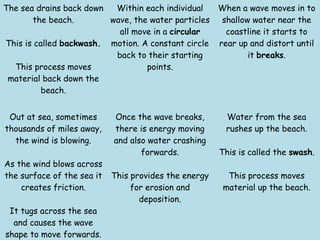
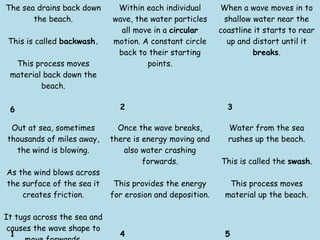
The sea drains back down
the beach.
This is called backwash.
This process moves
material back down the
beach.
Within each individual
wave, the water particles
all move in a circular
motion. A constant circle
back to their starting
points.
When a wave moves in to
shallow water near the
coastline it starts to
rear up and distort until
it breaks.
Out at sea, sometimes
thousands of miles away,
the wind is blowing.
As the wind blows across
the surface of the sea it
creates friction.
It tugs across the sea
and causes the wave
shape to move forwards.
Once the wave breaks,
there is energy moving
and also water crashing
forwards.
This provides the energy
for erosion and
deposition.
Water from the sea
rushes up the beach.
This is called the swash.
This process moves
material up the beach.
The sea drains back down
the beach.
This is called backwash.
This process moves
material back down the
beach.
Within each individual
wave, the water particles
all move in a circular
motion. A constant circle
back to their starting
points.
When a wave moves in to
shallow water near the
coastline it starts to rear
up and distort until it
breaks.
Out at sea, sometimes
thousands of miles away,
the wind is blowing.
As the wind blows across
the surface of the sea it
creates friction.
It tugs across the sea and
causes the wave shape to
Once the wave breaks,
there is energy moving and
also water crashing
forwards.
This provides the energy
for erosion and deposition.
Water from the sea
rushes up the beach.
This is called the swash.
This process moves
material up the beach.
6
1
2 3
4 5
Waves keywords
• Swash = the wave washing up the beach.
• Backwash = the wave pulling back down the
beach by gravity.
• The crest = is the top of the curling wave,
the wave at its highest point.
• The fetch = is the distance a wave travels
before it crashes on to the coastline.
• A constructive wave = helps to build a beach.
• A destructive wave = erodes a beach.
Why are some waves stronger
than others?
Geog.gcse p88. Complete these Qs in sentences.
1. The height and strength of waves depend on
i)................ii)................iii)...................
2. What is the ‘fetch’?
3. What winds affect our south coast in Britain?
4. South-westerly winds produce ....................... waves
because ...........................
5. South-easterly winds produce ..............................
waves because ...........................
6. What is more important, fetch or wind speed?
Fetch
Brazil
Atlantic
Ocean
France
English
channel
Why do waves break?
• Why do you think waves break when
they reach a beach?
Characteristics of Waves
crest
Fetch
Waves
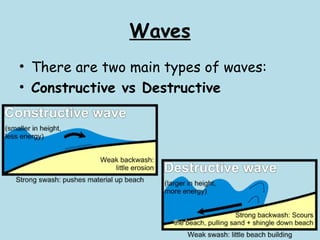
• There are two main types of waves:
• Constructive vs Destructive
Constructive vs Destructive
• Geog.gcse p89 or Tomorrow’s Geog p5
• Copy the diagrams of the two types.
• You must include the information too
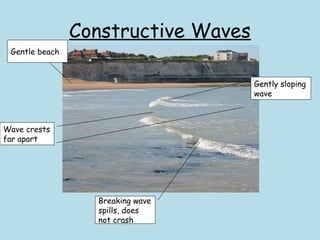
Constructive Waves
Gently sloping
wave
Wave crests
far apart
Breaking wave
spills, does
not crash
Gentle beach
Destructive Waves Steeply
sloping wave
Breaking wave
plunges + crashes
Waves close
together
Quick test
• Which waves builds up the beach?
• Which wave has a stronger backwash?
• Which wave has low wave height?
• Constructive waves usually happen on
gentle or steep slope beaches? Why?
• Destructive waves are ‘spilling’ or
‘breaking’?
Waves + the coast
• Not only do waves erode the coast, they
also transport and deposit the material
that they erode to different places
• Southsea beach may have been eroded
and transported there from France
• How do waves transport material?
Long-shore drift (LSD)
Exam Q
1) Describe and explain how constructive
and destructive waves work. Use
keywords or examples where possible.
[4marks]
2) Apart from the strength of waves,
what other factors can effect how
quickly a coastline erodes? [3marks]

L2 waves

  • 1.
    How do waves influenceerosion? Key questions: • What are constructive + destructive waves? • How do waves influence erosion?
  • 2.
    How do waveswork? What causes waves?
  • 3.
    How do waveswork? • Waves are created by wind • The friction of the wind makes the sea swell and rise up • The energy of the wind causes water particles inside the sea to rotate and this movement pushes the wave forward • The waves get bigger until they reach the coast where they break
  • 4.
  • 5.
  • 6.
    Geog.GCSE • P88 • Makea large, neat copy of the diagram on p88. • Add short labels
  • 7.
    The sea drainsback down the beach. This is called backwash. This process moves material back down the beach. Within each individual wave, the water particles all move in a circular motion. A constant circle back to their starting points. When a wave moves in to shallow water near the coastline it starts to rear up and distort until it breaks. Out at sea, sometimes thousands of miles away, the wind is blowing. As the wind blows across the surface of the sea it creates friction. It tugs across the sea and causes the wave shape to move forwards. Once the wave breaks, there is energy moving and also water crashing forwards. This provides the energy for erosion and deposition. Water from the sea rushes up the beach. This is called the swash. This process moves material up the beach.
  • 8.
    The sea drainsback down the beach. This is called backwash. This process moves material back down the beach. Within each individual wave, the water particles all move in a circular motion. A constant circle back to their starting points. When a wave moves in to shallow water near the coastline it starts to rear up and distort until it breaks. Out at sea, sometimes thousands of miles away, the wind is blowing. As the wind blows across the surface of the sea it creates friction. It tugs across the sea and causes the wave shape to Once the wave breaks, there is energy moving and also water crashing forwards. This provides the energy for erosion and deposition. Water from the sea rushes up the beach. This is called the swash. This process moves material up the beach. 6 1 2 3 4 5
  • 9.
    Waves keywords • Swash= the wave washing up the beach. • Backwash = the wave pulling back down the beach by gravity. • The crest = is the top of the curling wave, the wave at its highest point. • The fetch = is the distance a wave travels before it crashes on to the coastline. • A constructive wave = helps to build a beach. • A destructive wave = erodes a beach.
  • 10.
    Why are somewaves stronger than others? Geog.gcse p88. Complete these Qs in sentences. 1. The height and strength of waves depend on i)................ii)................iii)................... 2. What is the ‘fetch’? 3. What winds affect our south coast in Britain? 4. South-westerly winds produce ....................... waves because ........................... 5. South-easterly winds produce .............................. waves because ........................... 6. What is more important, fetch or wind speed?
  • 11.
  • 12.
    Why do wavesbreak? • Why do you think waves break when they reach a beach?
  • 13.
  • 14.
    Waves • There aretwo main types of waves: • Constructive vs Destructive
  • 15.
    Constructive vs Destructive •Geog.gcse p89 or Tomorrow’s Geog p5 • Copy the diagrams of the two types. • You must include the information too
  • 16.
    Constructive Waves Gently sloping wave Wavecrests far apart Breaking wave spills, does not crash Gentle beach
  • 17.
    Destructive Waves Steeply slopingwave Breaking wave plunges + crashes Waves close together
  • 18.
    Quick test • Whichwaves builds up the beach? • Which wave has a stronger backwash? • Which wave has low wave height? • Constructive waves usually happen on gentle or steep slope beaches? Why? • Destructive waves are ‘spilling’ or ‘breaking’?
  • 19.
    Waves + thecoast • Not only do waves erode the coast, they also transport and deposit the material that they erode to different places • Southsea beach may have been eroded and transported there from France • How do waves transport material?
  • 20.
  • 22.
    Exam Q 1) Describeand explain how constructive and destructive waves work. Use keywords or examples where possible. [4marks] 2) Apart from the strength of waves, what other factors can effect how quickly a coastline erodes? [3marks]