
UNIT 3:TROPICAL RAINFOREST
• Did you know?

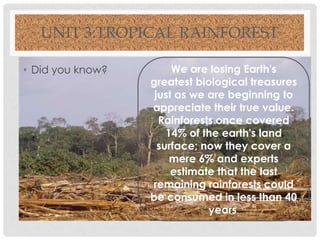
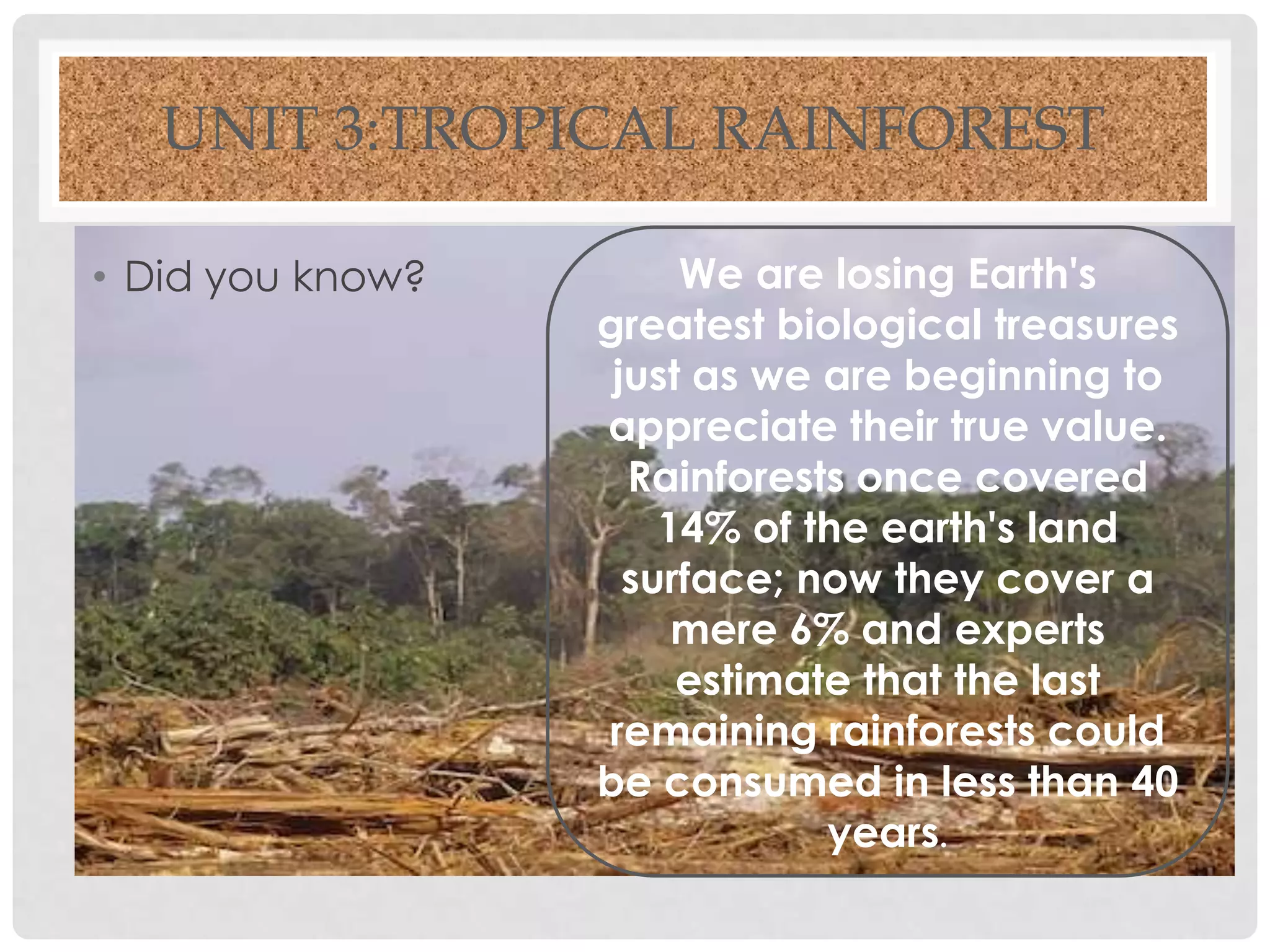
We are losing Earth's
greatest biological treasures
just as we are beginning to
appreciate their true value.
Rainforests once covered
14% of the earth's land
surface; now they cover a
mere 6% and experts
estimate that the last
remaining rainforests could
be consumed in less than 40
years.
WHAT ARE WE INVESTIGATING?
TROPICAL RAINFOREST

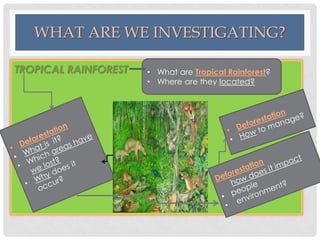
• What are Tropical Rainforest?
• Where are they located?
YOU WILL LEARN TO
• use photographs and sketches to describe
the characteristics of Tropical rainforest
• describe how Tropical rainforest adapt to
the tropical climate
• describe the uses and importance of
Tropical rainforest respect different people’s
perspectives about rainforest
CHARACTERISTICS OF TROPICAL
RAINFOREST

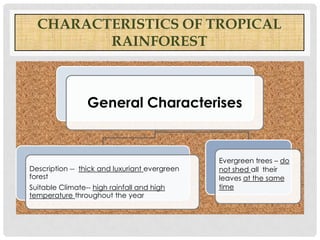
General Characterises

Description -- thick and luxuriant evergreen
forest
Suitable Climate-- high rainfall and high
temperature throughout the year

Evergreen trees – do
not shed all their
leaves at the same
time
CHARACTERISTICS OF TROPICAL
RAINFOREST

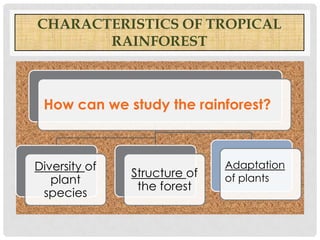
How can we study the rainforest?

Diversity of
plant
species

Structure of
the forest

Adaptation
of plants
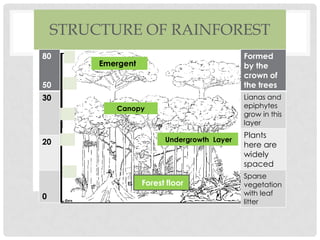
STRUCTURE OF RAINFOREST
80

Formed
by the
crown of
the trees

Emergent

50
30

Lianas and
epiphytes
grow in this
layer

Canopy

20

Undergrowth Layer

Forest floor
0

Plants
here are
widely
spaced
Sparse
vegetation
with leaf
litter
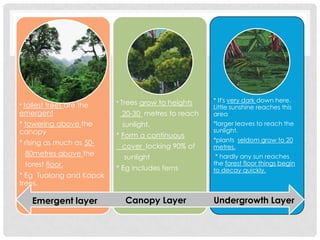
* tallest

trees are the
emergent
* towering above the
canopy
* rising as much as 5080metres above the
forest floor.
* Eg Tualang and Kapok
trees.

Emergent layer

* Trees

grow to heights

20-30 metres to reach
sunlight.
* Form a continuous
cover locking 90% of
sunlight

* Eg includes ferns

Canopy Layer

* It's very dark down here.
Little sunshine reaches this
area
*larger leaves to reach the
sunlight.
*plants seldom grow to 20
metres.
* hardly any sun reaches
the forest floor things begin
to decay quickly.

Undergrowth Layer
HOMEWORK
• Read Pages 75 to 76 from textbook
• Do exercise 3.1 and 3.2 (pages 37-40)
from your workbook.
• (you may refer to slide 6 of your notes and pg. 79 of your
textbook to help you draw the sketch of the rainforest)
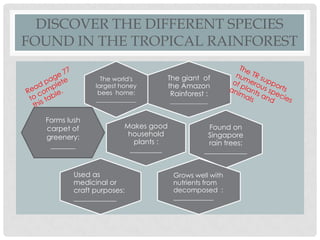
DISCOVER THE DIFFERENT SPECIES
FOUND IN THE TROPICAL RAINFOREST
The world's
largest honey
bees home:
_____________

Forms lush
carpet of
greenery:
_______

Makes good
household
plants :
_________

Used as
medicinal or
craft purposes:
____________

The giant of
the Amazon
Rainforest :
____________

Found on
Singapore
rain trees:
____________
Grows well with
nutrients from
decomposed :
____________
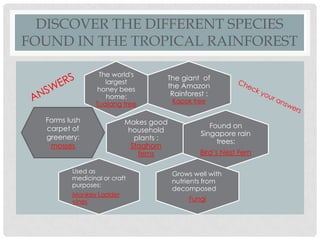
DISCOVER THE DIFFERENT SPECIES
FOUND IN THE TROPICAL RAINFOREST
The world's
largest
honey bees
home:
Tualang tree

Forms lush
carpet of
greenery:
mosses

Makes good
household
plants :
Staghorn
ferns

Used as
medicinal or craft
purposes:
Monkey Ladder
vines

The giant of
the Amazon
Rainforest :
Kapok tree

Found on
Singapore rain
trees:
Bird’s Nest Fern
Grows well with
nutrients from
decomposed
Fungi
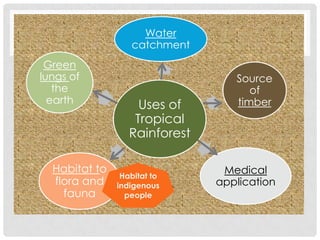
Water
catchment
Green
lungs of
the
earth

Habitat to
flora and
fauna

Uses of
Tropical
Rainforest
Habitat to
indigenous
people

Source
of
timber

Medical
application
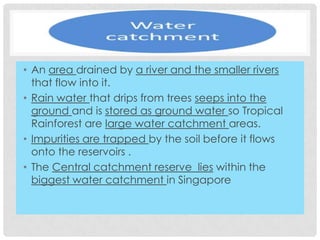
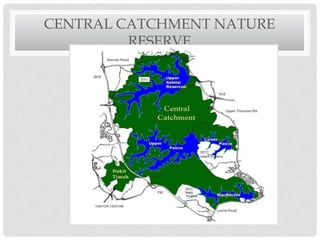
• An area drained by a river and the smaller rivers
that flow into it.
• Rain water that drips from trees seeps into the
ground and is stored as ground water so Tropical
Rainforest are large water catchment areas.
• Impurities are trapped by the soil before it flows
onto the reservoirs .
• The Central catchment reserve lies within the
biggest water catchment in Singapore
CENTRAL CATCHMENT NATURE
RESERVE
GREEN LUNG OF THE EARTH
• Forest absorb carbon dioxide from the atmosphere
and release oxygen through photosynthesis.
• Forest helps the earth to “breath” so its called
“green lungs of the earth.”
• 20% of earth oxygen is generated by the Amazon
rainforest.
• Forest acts as the earth’s natural purifier and the
dense vegetation keeps it cool.
• Rainforest is home to 2 million of the world’s
plants, animals, insects and a variety of fungi.
• Ample sunlight allows plants to thrive which in
becomes food to animals.
• The canopy allows other plants and animals to
survive.
• Indigenous people obtain food through hunting or
as shifting cultivators and depend on the rainforest
for basic necessities too.
• Forest provide wood for fuel for cooking.
• Tropical rainforest supply one-fifth of the world's
industrial timber .
• Teak, ebony, mahogany and meranti are valued
for their strength, durability, texture and beauty.
• Products made include
doors, window frames and furniture
• Tropical Rainforest is the world’s largest pharmacy
source of medicine
• Brazil nuts have cancer-fighting prosperities
• Cinchona tree – treats Malaria
• Madagascar periwinkle plant– treats childhood
leukaemia
• Clavillia plants treats eczema & itchiness
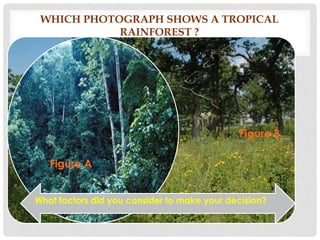
WHICH PHOTOGRAPH SHOWS A TROPICAL
RAINFOREST ?

Figure B

Figure A
What factors did you consider to make your decision?
GEOGRAPHICAL INVESTIGATION
SKILLS
A SCHOOL-BASED ACTIVITY- SKETCHING

• Observe how the trees in the school field adapt to
our climate.
• Take a photo of the tree that shows a characteristics
of the adaptation.
• Using the skills studied in Unit 2 and with reference
to Pg. 79 of the textbook, sketch the feature you
see.
• Paste your sketch and the photo on a A4 paper and
submit to your teacher

Sec 1 g_-_unit_3.1_-3.2_answers[1]

  • 1.
    UNIT 3:TROPICAL RAINFOREST •Did you know? We are losing Earth's greatest biological treasures just as we are beginning to appreciate their true value. Rainforests once covered 14% of the earth's land surface; now they cover a mere 6% and experts estimate that the last remaining rainforests could be consumed in less than 40 years.
  • 2.
    WHAT ARE WEINVESTIGATING? TROPICAL RAINFOREST • What are Tropical Rainforest? • Where are they located?
  • 3.
    YOU WILL LEARNTO • use photographs and sketches to describe the characteristics of Tropical rainforest • describe how Tropical rainforest adapt to the tropical climate • describe the uses and importance of Tropical rainforest respect different people’s perspectives about rainforest
  • 4.
    CHARACTERISTICS OF TROPICAL RAINFOREST GeneralCharacterises Description -- thick and luxuriant evergreen forest Suitable Climate-- high rainfall and high temperature throughout the year Evergreen trees – do not shed all their leaves at the same time
  • 5.
    CHARACTERISTICS OF TROPICAL RAINFOREST Howcan we study the rainforest? Diversity of plant species Structure of the forest Adaptation of plants
  • 6.
    STRUCTURE OF RAINFOREST 80 Formed bythe crown of the trees Emergent 50 30 Lianas and epiphytes grow in this layer Canopy 20 Undergrowth Layer Forest floor 0 Plants here are widely spaced Sparse vegetation with leaf litter
  • 7.
    * tallest trees arethe emergent * towering above the canopy * rising as much as 5080metres above the forest floor. * Eg Tualang and Kapok trees. Emergent layer * Trees grow to heights 20-30 metres to reach sunlight. * Form a continuous cover locking 90% of sunlight * Eg includes ferns Canopy Layer * It's very dark down here. Little sunshine reaches this area *larger leaves to reach the sunlight. *plants seldom grow to 20 metres. * hardly any sun reaches the forest floor things begin to decay quickly. Undergrowth Layer
  • 8.
    HOMEWORK • Read Pages75 to 76 from textbook • Do exercise 3.1 and 3.2 (pages 37-40) from your workbook. • (you may refer to slide 6 of your notes and pg. 79 of your textbook to help you draw the sketch of the rainforest)
  • 9.
    DISCOVER THE DIFFERENTSPECIES FOUND IN THE TROPICAL RAINFOREST The world's largest honey bees home: _____________ Forms lush carpet of greenery: _______ Makes good household plants : _________ Used as medicinal or craft purposes: ____________ The giant of the Amazon Rainforest : ____________ Found on Singapore rain trees: ____________ Grows well with nutrients from decomposed : ____________
  • 10.
    DISCOVER THE DIFFERENTSPECIES FOUND IN THE TROPICAL RAINFOREST The world's largest honey bees home: Tualang tree Forms lush carpet of greenery: mosses Makes good household plants : Staghorn ferns Used as medicinal or craft purposes: Monkey Ladder vines The giant of the Amazon Rainforest : Kapok tree Found on Singapore rain trees: Bird’s Nest Fern Grows well with nutrients from decomposed Fungi
  • 11.
    Water catchment Green lungs of the earth Habitat to floraand fauna Uses of Tropical Rainforest Habitat to indigenous people Source of timber Medical application
  • 12.
    • An areadrained by a river and the smaller rivers that flow into it. • Rain water that drips from trees seeps into the ground and is stored as ground water so Tropical Rainforest are large water catchment areas. • Impurities are trapped by the soil before it flows onto the reservoirs . • The Central catchment reserve lies within the biggest water catchment in Singapore
  • 13.
  • 14.
    GREEN LUNG OFTHE EARTH • Forest absorb carbon dioxide from the atmosphere and release oxygen through photosynthesis. • Forest helps the earth to “breath” so its called “green lungs of the earth.” • 20% of earth oxygen is generated by the Amazon rainforest. • Forest acts as the earth’s natural purifier and the dense vegetation keeps it cool.
  • 15.
    • Rainforest ishome to 2 million of the world’s plants, animals, insects and a variety of fungi. • Ample sunlight allows plants to thrive which in becomes food to animals. • The canopy allows other plants and animals to survive. • Indigenous people obtain food through hunting or as shifting cultivators and depend on the rainforest for basic necessities too.
  • 16.
    • Forest providewood for fuel for cooking. • Tropical rainforest supply one-fifth of the world's industrial timber . • Teak, ebony, mahogany and meranti are valued for their strength, durability, texture and beauty. • Products made include doors, window frames and furniture
  • 17.
    • Tropical Rainforestis the world’s largest pharmacy source of medicine • Brazil nuts have cancer-fighting prosperities • Cinchona tree – treats Malaria • Madagascar periwinkle plant– treats childhood leukaemia • Clavillia plants treats eczema & itchiness
  • 18.
    WHICH PHOTOGRAPH SHOWSA TROPICAL RAINFOREST ? Figure B Figure A What factors did you consider to make your decision?
  • 19.
    GEOGRAPHICAL INVESTIGATION SKILLS A SCHOOL-BASEDACTIVITY- SKETCHING • Observe how the trees in the school field adapt to our climate. • Take a photo of the tree that shows a characteristics of the adaptation. • Using the skills studied in Unit 2 and with reference to Pg. 79 of the textbook, sketch the feature you see. • Paste your sketch and the photo on a A4 paper and submit to your teacher