The goal ofSoftware Engineering is to provide
models and processes that lead to the
production of well-documented maintainable
software in a manner that is predictable.
Software Life Cycle Models
3.
“The period oftime that starts when a software product is conceived
and ends when the product is no longer available for use. The
software life cycle typically includes a requirement phase, design
phase, implementation phase, test phase, installation and check out
phase, operation and maintenance phase, and sometimes retirement
phase”.
Software Life Cycle Models
4.
Build & FixModel
❖ Product is constructed without
specifications or any attempt at
design
❖ Adhoc approach and not well
defined
❖ Simple two phase model Fix
Build
Code
5.
❖ Suitable forsmall programming exercises of 100 or 200 lines
❖ Unsatisfactory for software for any reasonable size
❖ Code soon becomes unfixable & unenhanceable
❖ No room for structured design
❖ Maintenance is practically not possible
Build & Fix Model
6.
Design
Implementation
and unit testing
Integrationand
systemtesting
Operationand
maintenance
Requirement
Analysis & Specification
Waterfall Model
This model is named “waterfall
model” because its diagrammatic
representation resembles a cascade of
waterfalls.
7.
This model iseasy to understand and reinforces
the notion of “define before design” and “design
before code”.
The model
requirements
unrealistic
expects complete & accurate
early in the process, which is
Waterfall Model
8.
Problems of waterfallmodel
i. It is difficult to define all requirements at the beginning of a
project
ii. This model is not suitable for accommodating any change
iii. A working version of the system is not seen until late in
the project’s life
iv. It does not scale up well to large projects.
v. Real projects are rarely sequential.
Waterfall Model
9.
Incremental Process Models
Theyare effective in the situations where requirements are
defined precisely and there is no confusion about the
functionality of the final product.
After every cycle a useable product is given to the customer.
Popular particularly when we have to quickly deliver a limited
functionality system.
10.
Iterative Enhancement Model
Thismodel has the same phases as the waterfall model, but with
fewer restrictions. Generally the phases occur in the same order as
in the waterfall model, but they may be conducted in several cycles.
Useable product is released at the end of the each cycle, with each
release providing additional functionality.
✓ Customers and developers specify as many requirements as
possible and prepare a SRS document.
✓ Developers and customers then prioritize these requirements
✓ Developers implement the specified requirements in one or
more cycles of design, implementation and test based on the
defined priorities.
The Rapid ApplicationDevelopment (RAD)Model
o Developed by IBM in 1980
o User participation is essential
The requirements
specification was
defined like this
The developers
understood it in
that way
This is how the
problem was
solved before.
This is how the
problem is
solved now
That is the program after
debugging
This is how the program is
described by marketing
department
This, in fact, is what the
customer wanted …
13.
o Build arapid prototype
o Give it to user for evaluation & obtain feedback
o Prototype is refined
With active participation of users
Requirements
Planning
User
Description
Construction Cut over
The Rapid Application Development (RAD)Model
14.
Not an appropriatemodel in the absence of user
participation.
Reusable components are required to reduce development
time.
Highly specialized & skilled developers are required and
such developers are not easily available.
The Rapid Application Development (RAD)Model
15.
Evolutionary Process Models
Evolutionaryprocess model resembles iterative enhancement
model. The same phases as defined for the waterfall model occur
here in a cyclical fashion. This model differs from iterative
enhancement model in the sense that this does not require a
useable product at the end of each cycle. In evolutionary
development, requirements are implemented by category rather
than by priority.
This model is useful for projects using new technology that is not
well understood. This is also used for complex projects where all
functionality must be delivered at one time, but the requirements
are unstable or not well understood at the beginning.
Prototyping Model
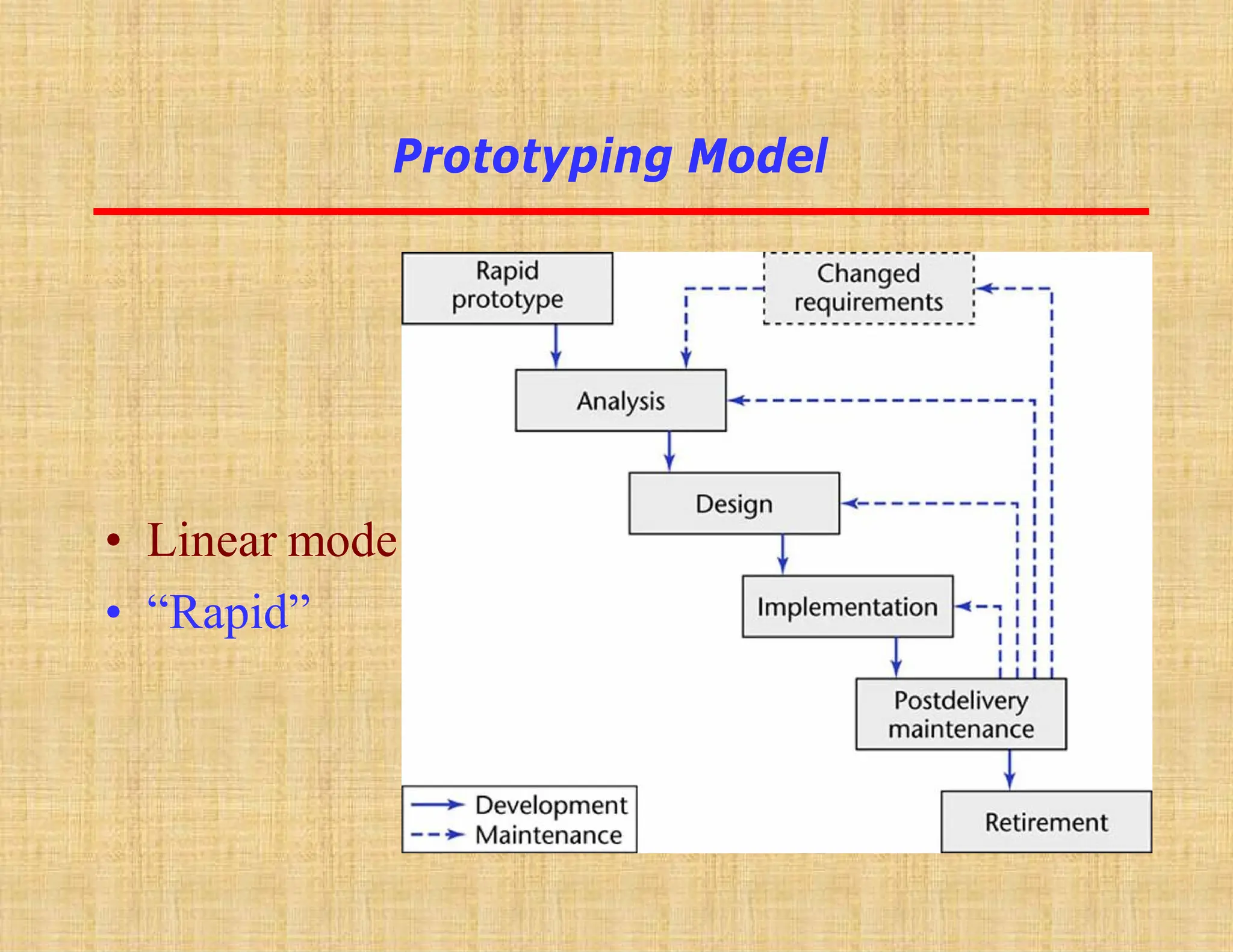
➢ Theprototype may be a usable program but is not suitable as
the final software product.
➢ The code for the prototype is thrown away. However
experience gathered helps in developing the actual system.
➢ The development of a prototype might involve extra cost, but
overall cost might turnout to be lower than that of an
equivalent system developed using the waterfall model.
Spiral Model
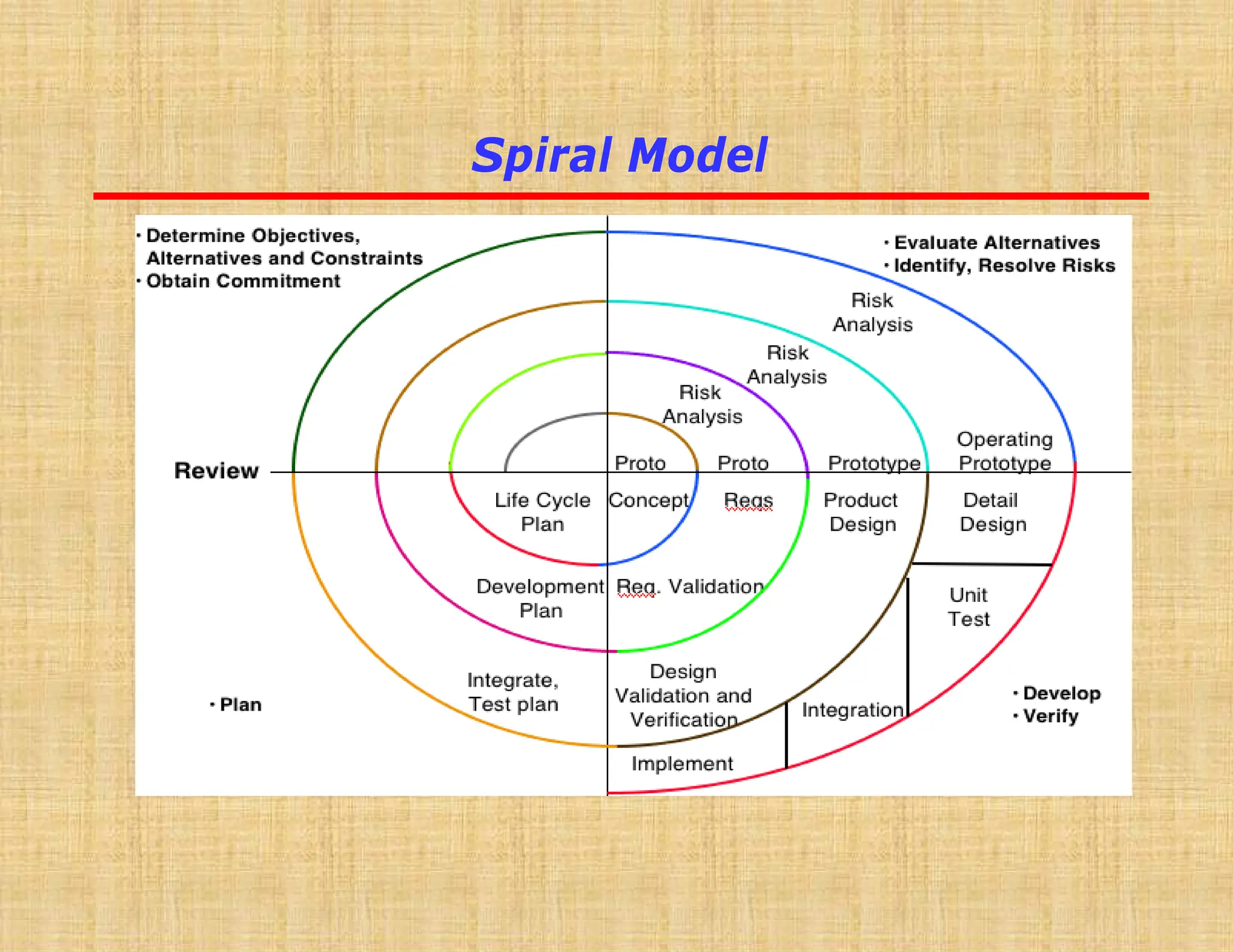
Models donot deal with uncertainly which is inherent to software
projects.
Important software projects have failed because project risks were
neglected & nobody was prepared when something unforeseen
happened.
Barry Boehm recognized this and tired to incorporate the “project
risk” factor into a life cycle model.
The result is the spiral model, which was presented in 1986.
The radial dimensionof the model represents the cumulative costs.
Each path around the spiral is indicative of increased costs. The
angular dimension represents the progress made in completing each
cycle. Each loop of the spiral from X-axis clockwise through 360o
represents one phase. One phase is split roughly into four sectors of
major activities.
▪ Planning: Determination of objectives, alternatives &
constraints.
▪ Risk Analysis: Analyze alternatives and attempts to identify
and resolve the risks involved.
▪ Development: Product development and testing product.
▪ Assessment: Customer evaluation
Spiral Model
22.
▪ An importantfeature of the spiral model is that each phase is
completed with a review by the people concerned with the
project (designers and programmers)
▪ The advantage of this model is the wide range of options to
accommodate the good features of other life cycle models.
▪ It becomes equivalent to another life cycle model in
appropriate situations.
The spiral model has some difficulties that need to be resolved
before it can be a universally applied life cycle model. These
difficulties include lack of explicit process guidance in determining
objectives, constraints, alternatives; relying on risk assessment
expertise; and provides more flexibility than required for many
applications.
Spiral Model
23.
The Unified Process
•Developed by I.Jacobson, G.Booch and J.Rumbaugh.
• Software engineering process with the goal of producing good
quality maintainable software within specified time and budget.
• Developed through a series of fixed length mini projects called
iterations.
• Maintained and enhanced by Rational Software Corporation and
thus referred to as Rational Unified Process (RUP).
24.
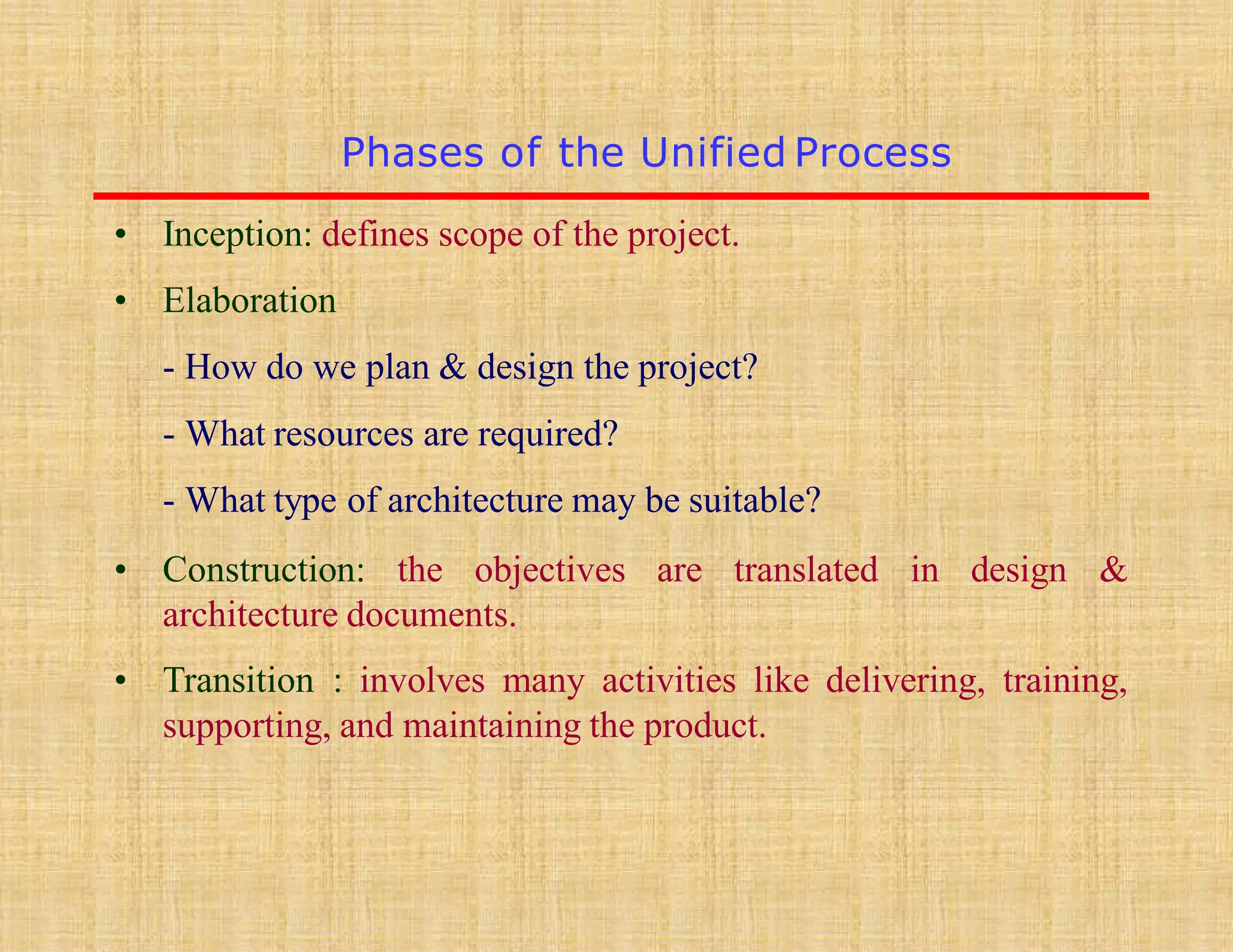
Phases of theUnified Process
Definition of
objectives
of the project
Planning &
architecture
for the project
Initial
operational
capability
Inception
Inception Elaboration
Elaboration Construction
Construction Transition
Transition
Release of
the Software
product
Time
25.
• Inception: definesscope of the project.
• Elaboration
- How do we plan & design the project?
- What resources are required?
- What type of architecture may be suitable?
• Construction: the objectives are translated in design &
architecture documents.
• Transition : involves many activities like delivering, training,
supporting, and maintaining the product.
Phases of the Unified Process
26.
Initial development &Evolution Cycles
Initial development Cycle
Evolution Cycle
Continue till the product is retired
V1=version1, V2 =version2, V3=version3
Inception
Inception Elaboration
Elaboration Construction
Construction Transition
Transition
V1
Inception
Inception Elaboration
Elaboration Construction
Construction Transition
Transition
V2
Inception
Inception Elaboration
Elaboration Construction
Construction Transition
Transition
V3
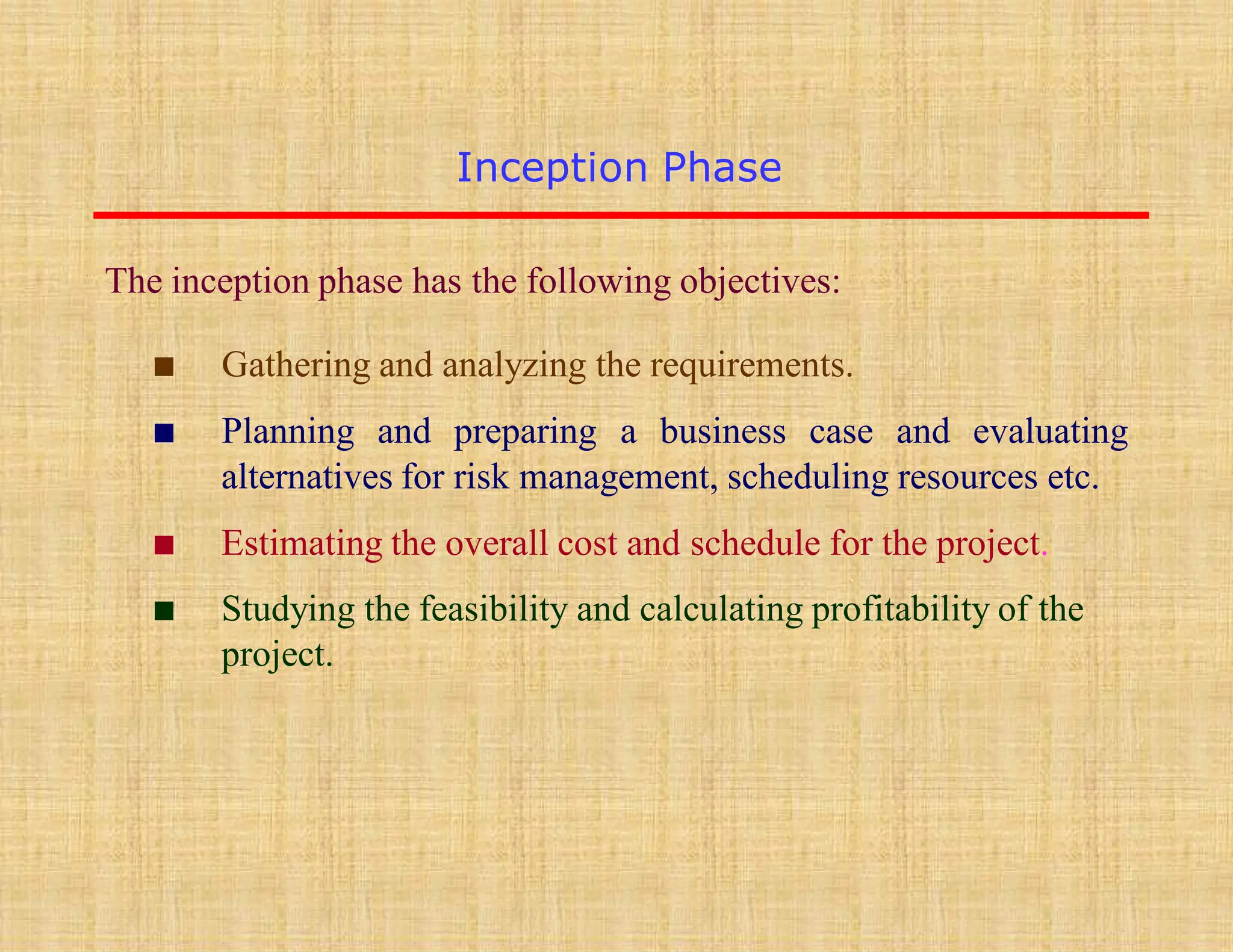
Inception Phase
▪ Gatheringand analyzing the requirements.
▪ Planning and preparing a business case and evaluating
alternatives for risk management, scheduling resources etc.
▪ Estimating the overall cost and schedule for the project.
▪ Studying the feasibility and calculating profitability of the
project.
The inception phase has the following objectives:
29.
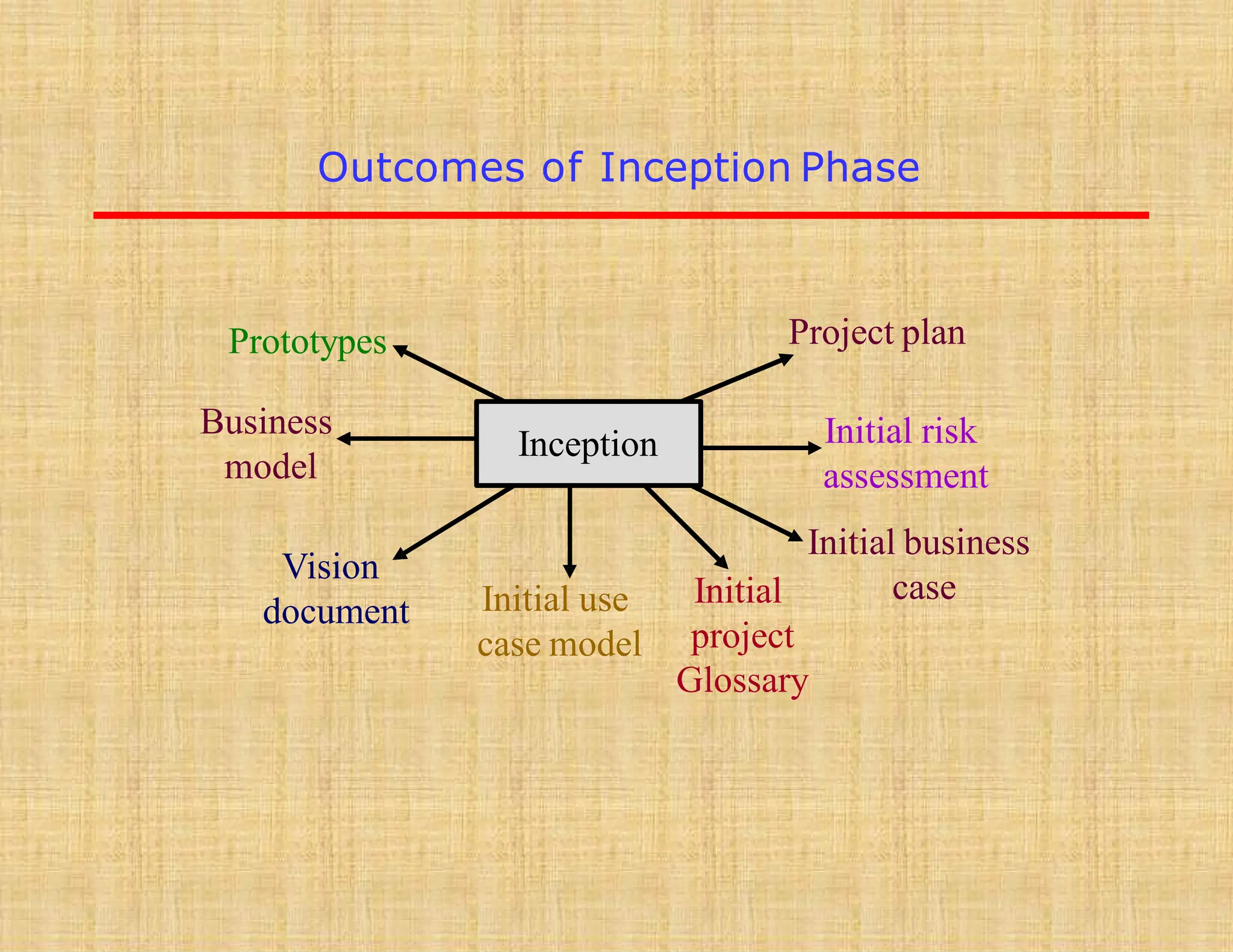
Outcomes of InceptionPhase
Inception
Project plan
Initial risk
assessment
Initial business
case
Vision
document Initial use
case model
Initial
project
Glossary
Business
model
Prototypes
30.
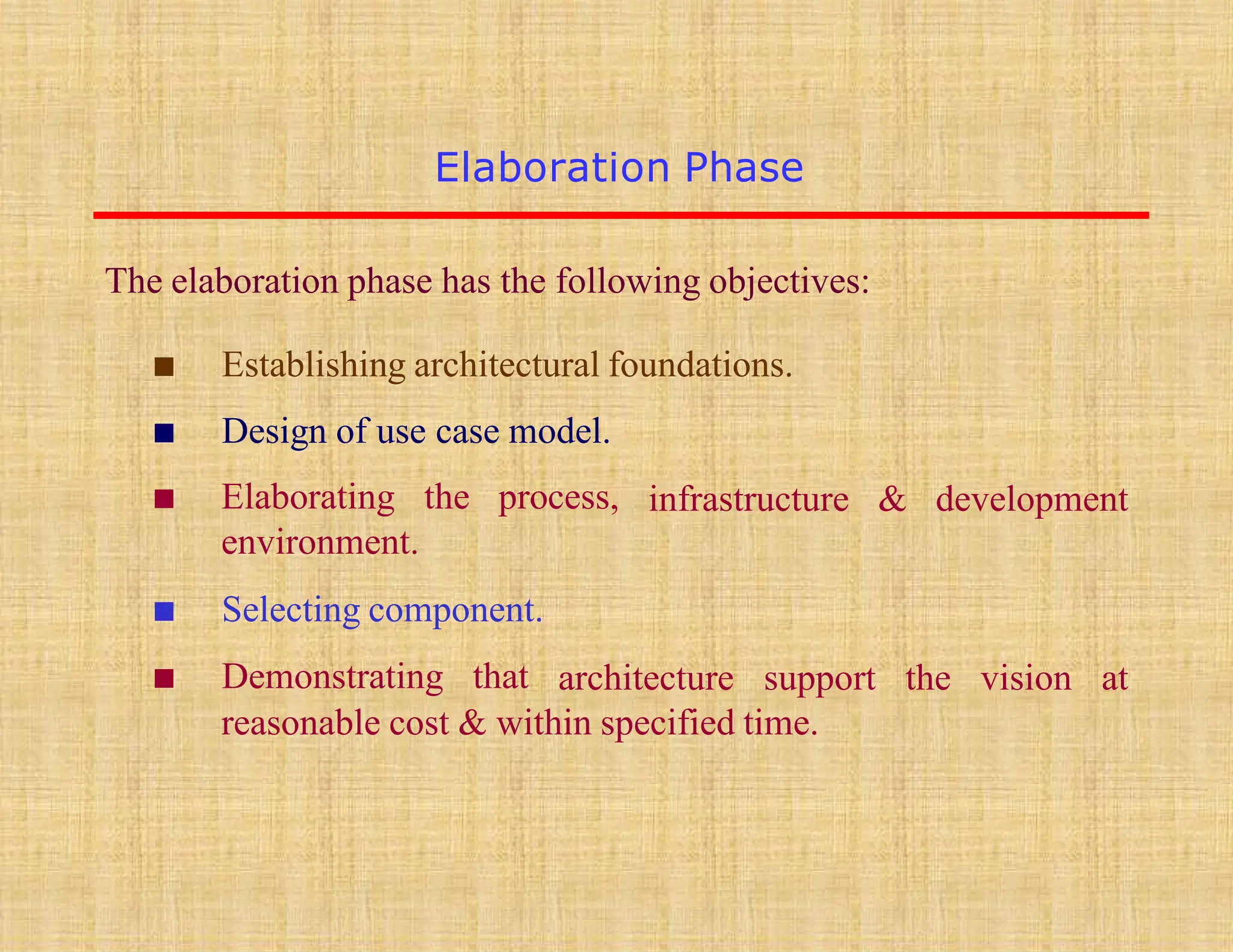
Elaboration Phase
infrastructure &development
▪ Establishing architectural foundations.
▪ Design of use case model.
▪ Elaborating the process,
environment.
▪ Selecting component.
▪ Demonstrating that architecture support the vision at
reasonable cost & within specified time.
The elaboration phase has the following objectives:
31.
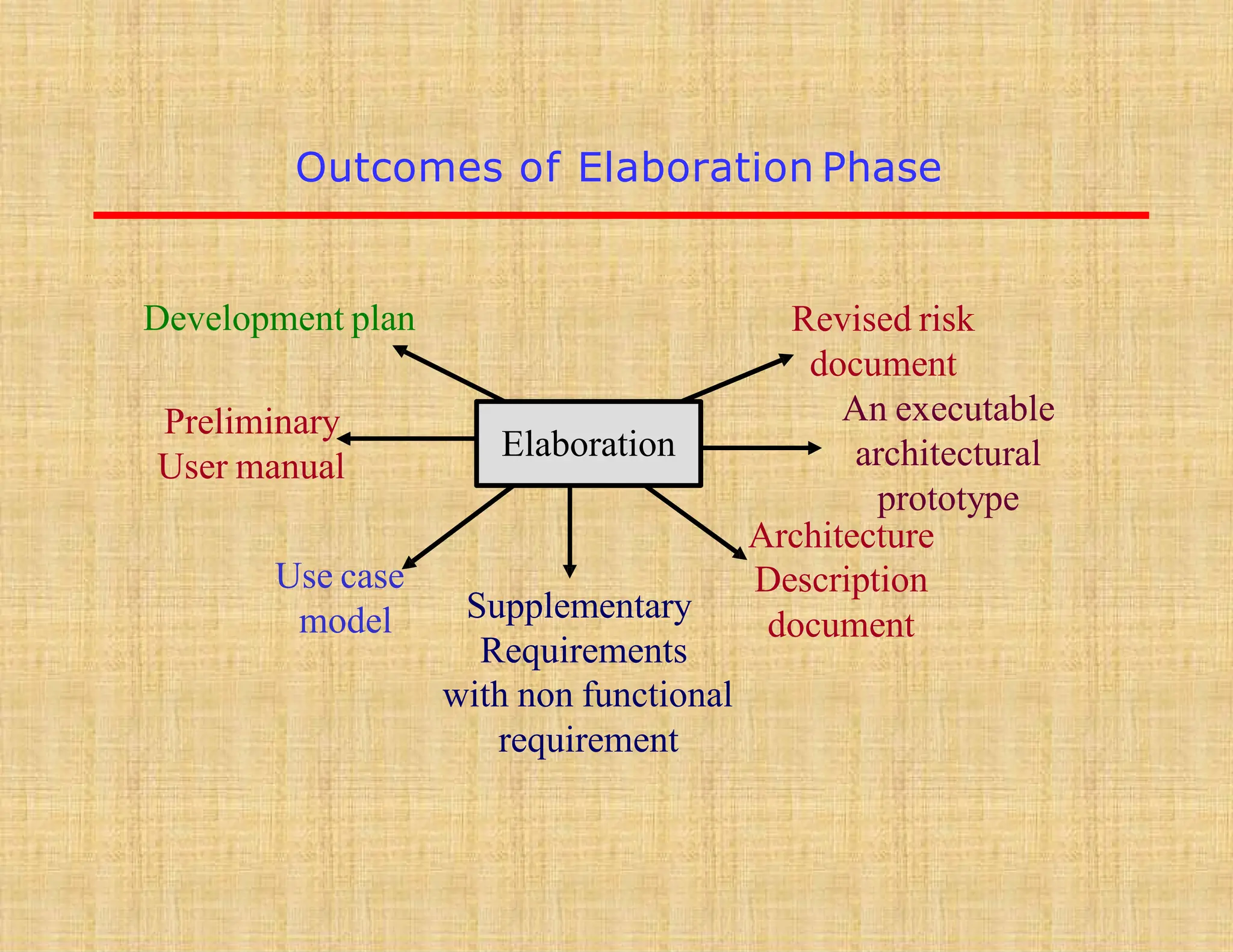
Outcomes of ElaborationPhase
Elaboration
Use case
model
Revised risk
document
An executable
architectural
prototype
Architecture
Description
document
Supplementary
Requirements
with non functional
requirement
Preliminary
User manual
Development plan
32.
Construction Phase
The constructionphase has the following objectives:
▪ Implementing the project.
▪ Minimizing development cost.
▪ Management and optimizing resources.
▪ Testing the product
▪ Assessing the product releases against acceptance criteria
33.
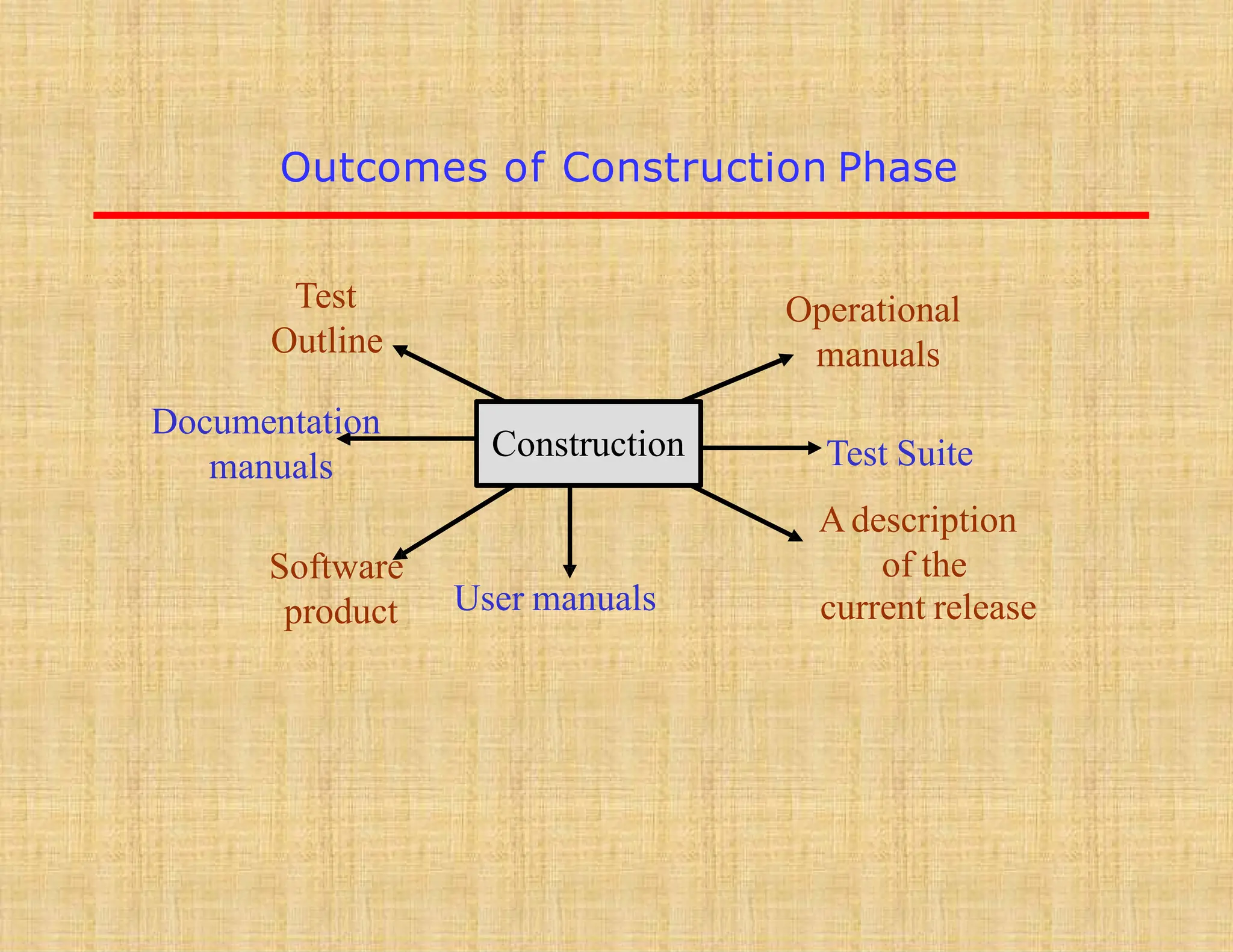
Outcomes of ConstructionPhase
Construction
Operational
manuals
Test Suite
Adescription
of the
current release
Software
product User manuals
Documentation
manuals
Test
Outline
34.
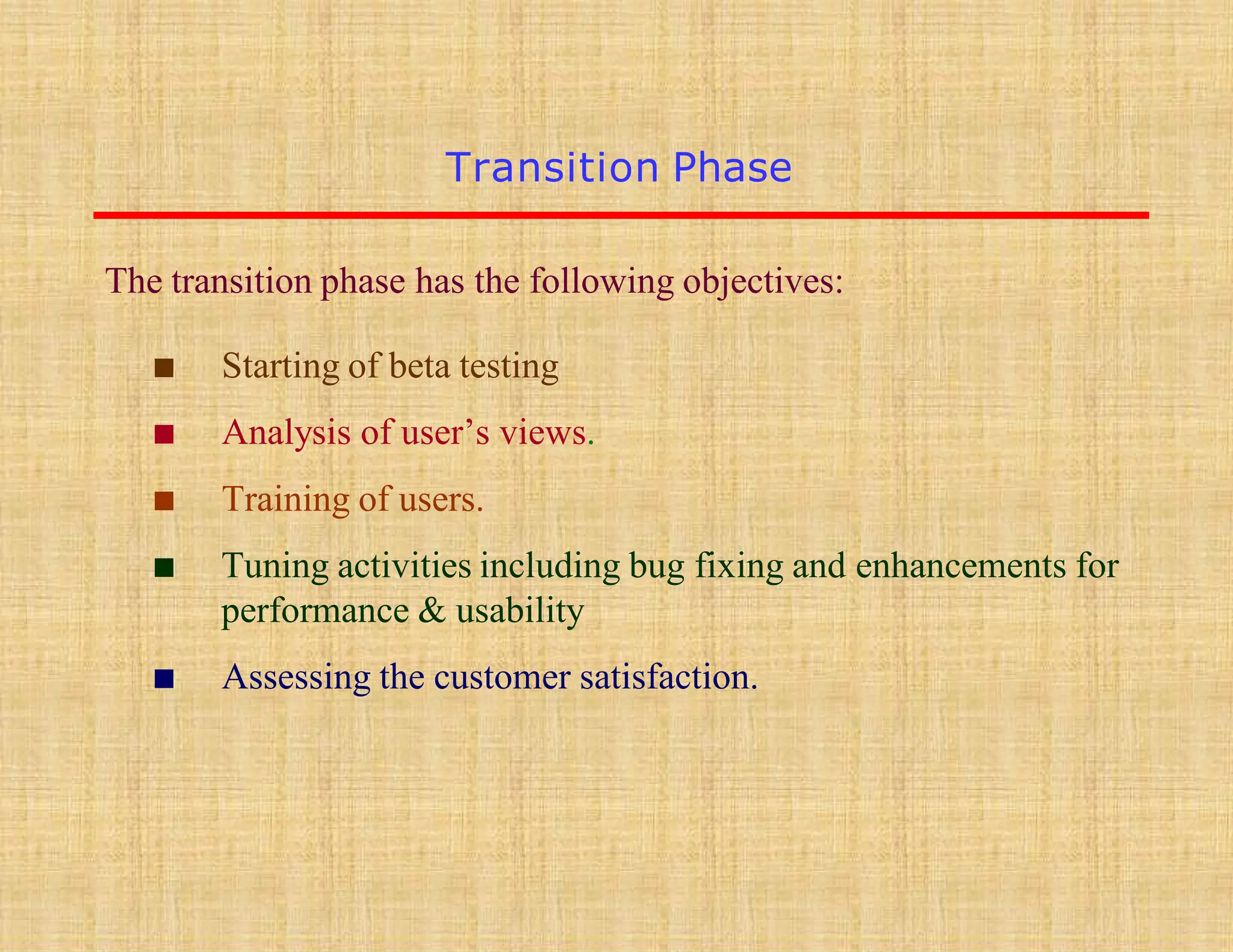
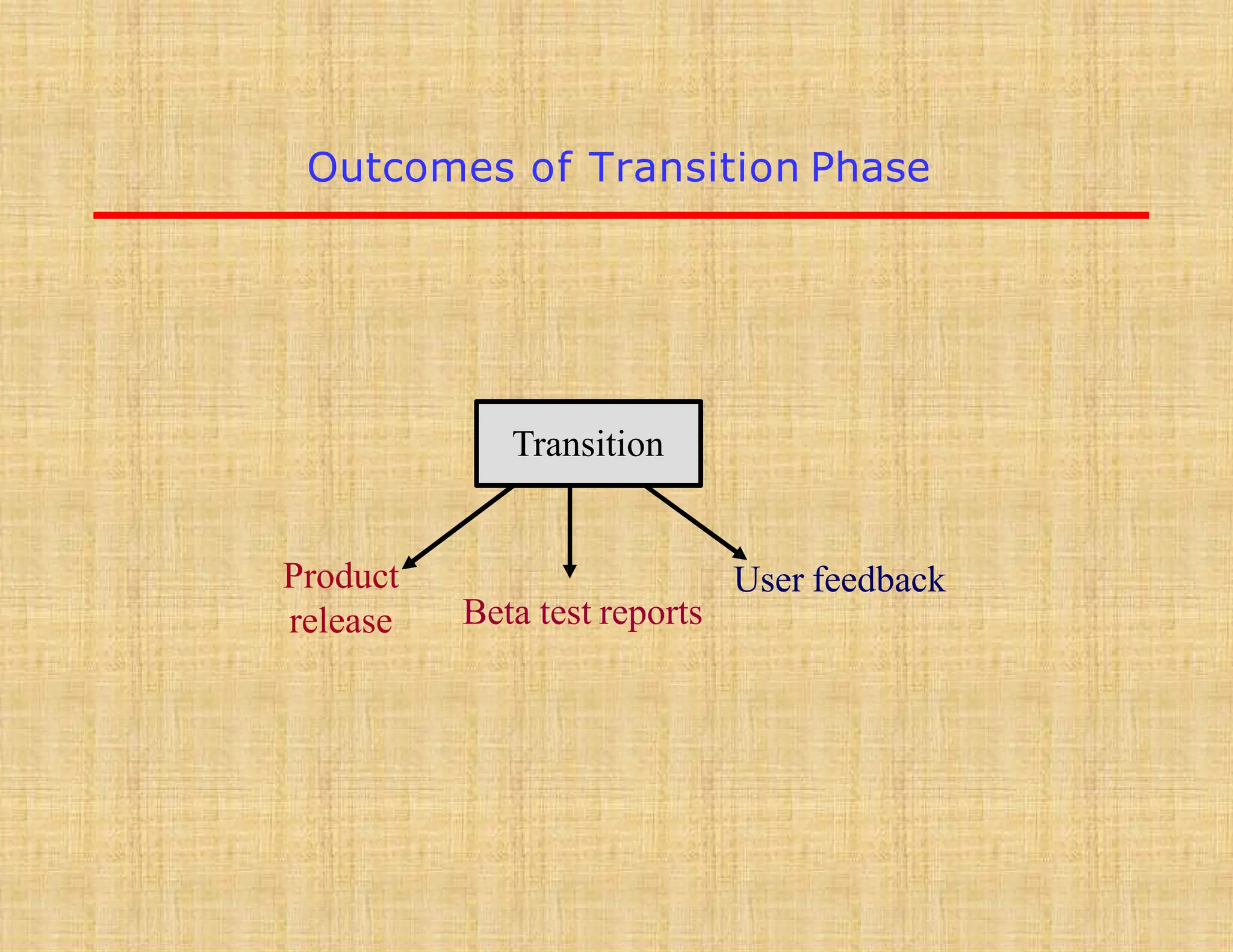
Transition Phase
The transitionphase has the following objectives:
▪ Starting of beta testing
▪ Analysis of user’s views.
▪ Training of users.
▪ Tuning activities including bug fixing and enhancements for
performance & usability
▪ Assessing the customer satisfaction.
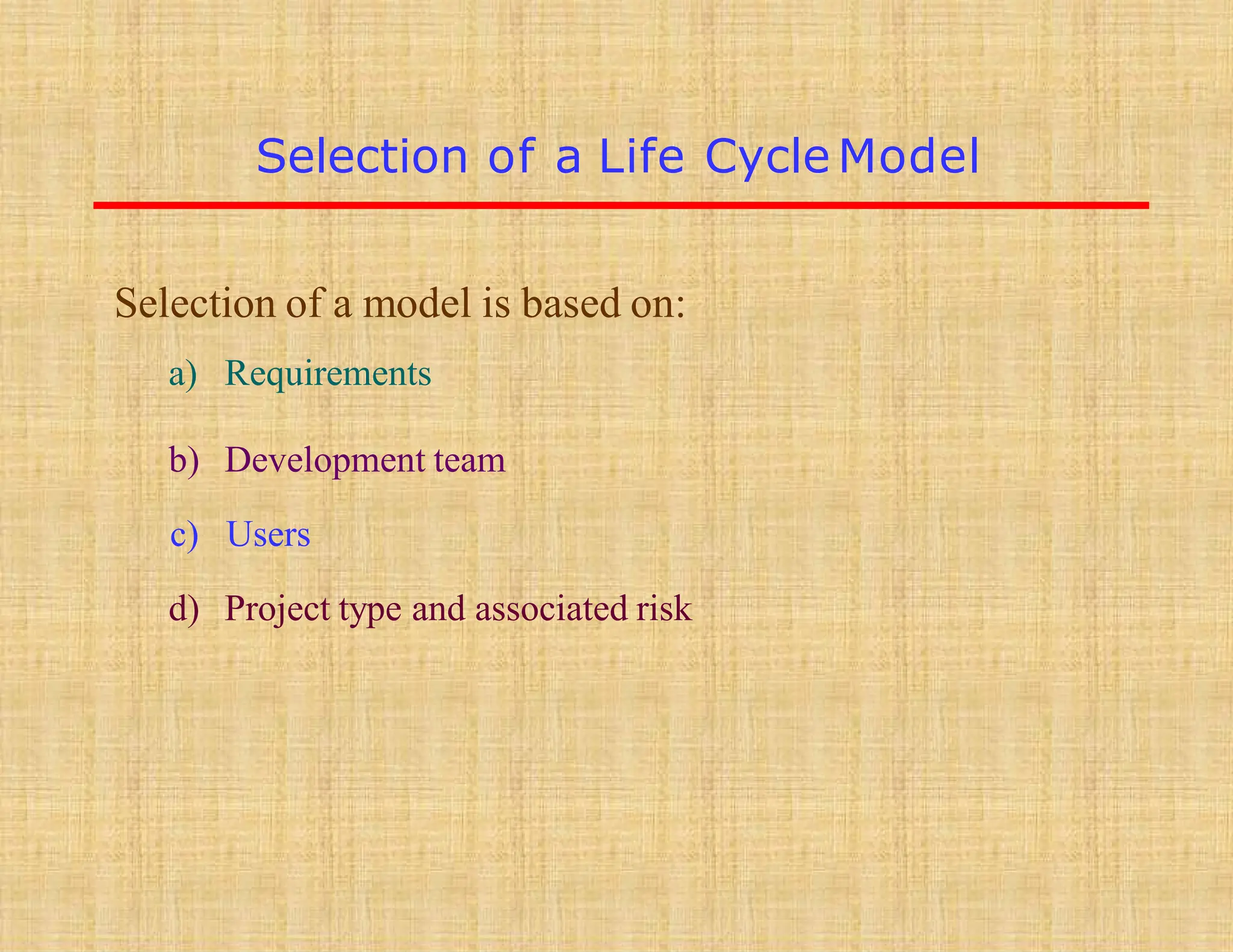
Selection of aLife Cycle Model
Selection of a model is based on:
a) Requirements
b) Development team
c) Users
d) Project type and associated risk
37.
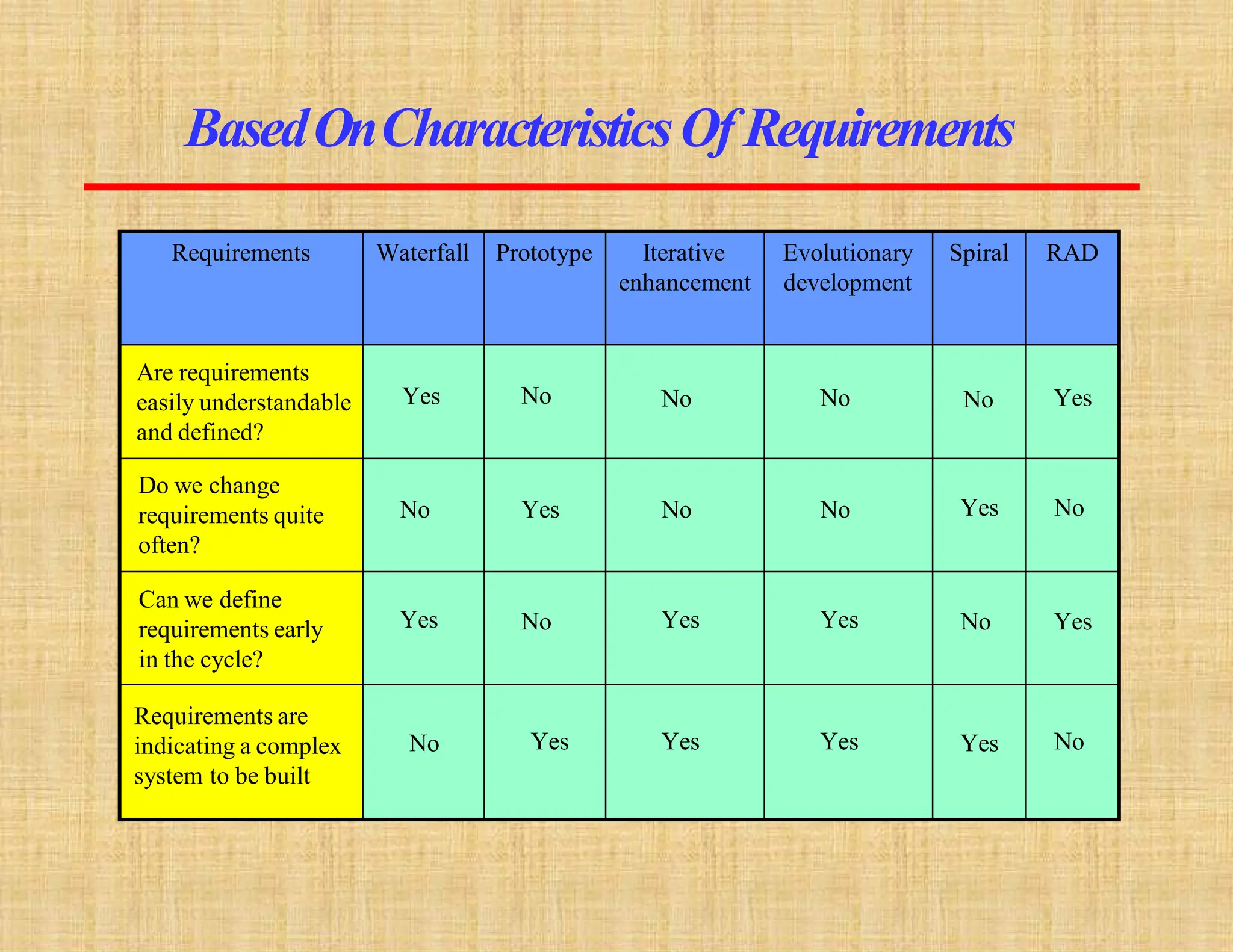
BasedOnCharacteristicsOf Requirements
Requirements WaterfallPrototype Iterative
enhancement
Evolutionary
development
Spiral RAD
Are requirements
easily understandable
and defined?
Yes No No No No Yes
Do we change
requirements quite
often?
No Yes No No Yes No
Can we define
requirements early
in the cycle?
Yes No Yes Yes No Yes
Requirements are
indicating a complex
system to be built
No Yes Yes Yes Yes No
38.
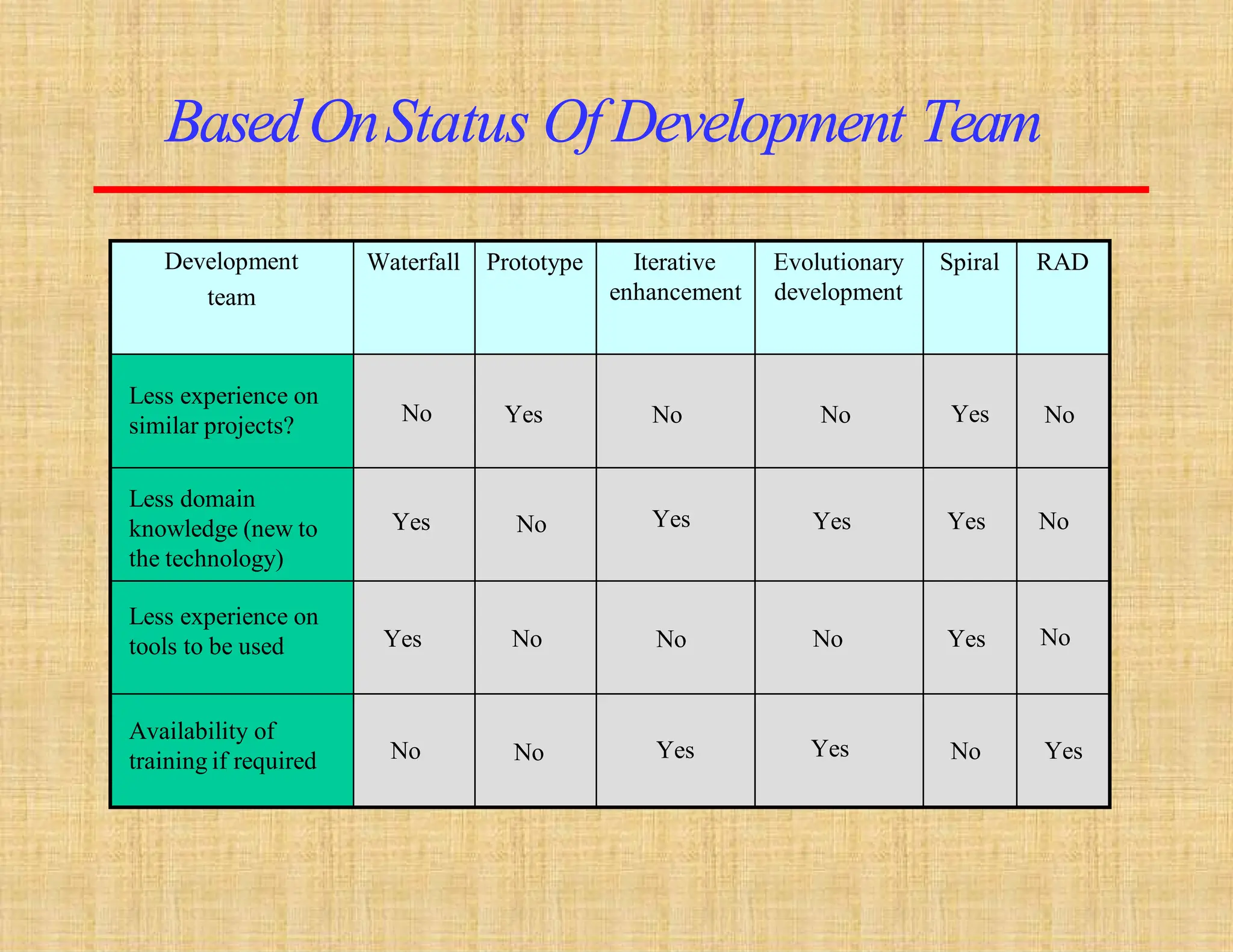
Development
team
Waterfall Prototype Iterative
enhancement
Evolutionary
development
SpiralRAD
Less experience on
similar projects? No Yes No No Yes No
Less domain
knowledge (new to
the technology)
Yes No Yes Yes Yes No
Less experience on
tools to be used Yes No No No Yes No
Availability of
training if required No No Yes Yes No Yes
BasedOnStatus Of Development Team
39.
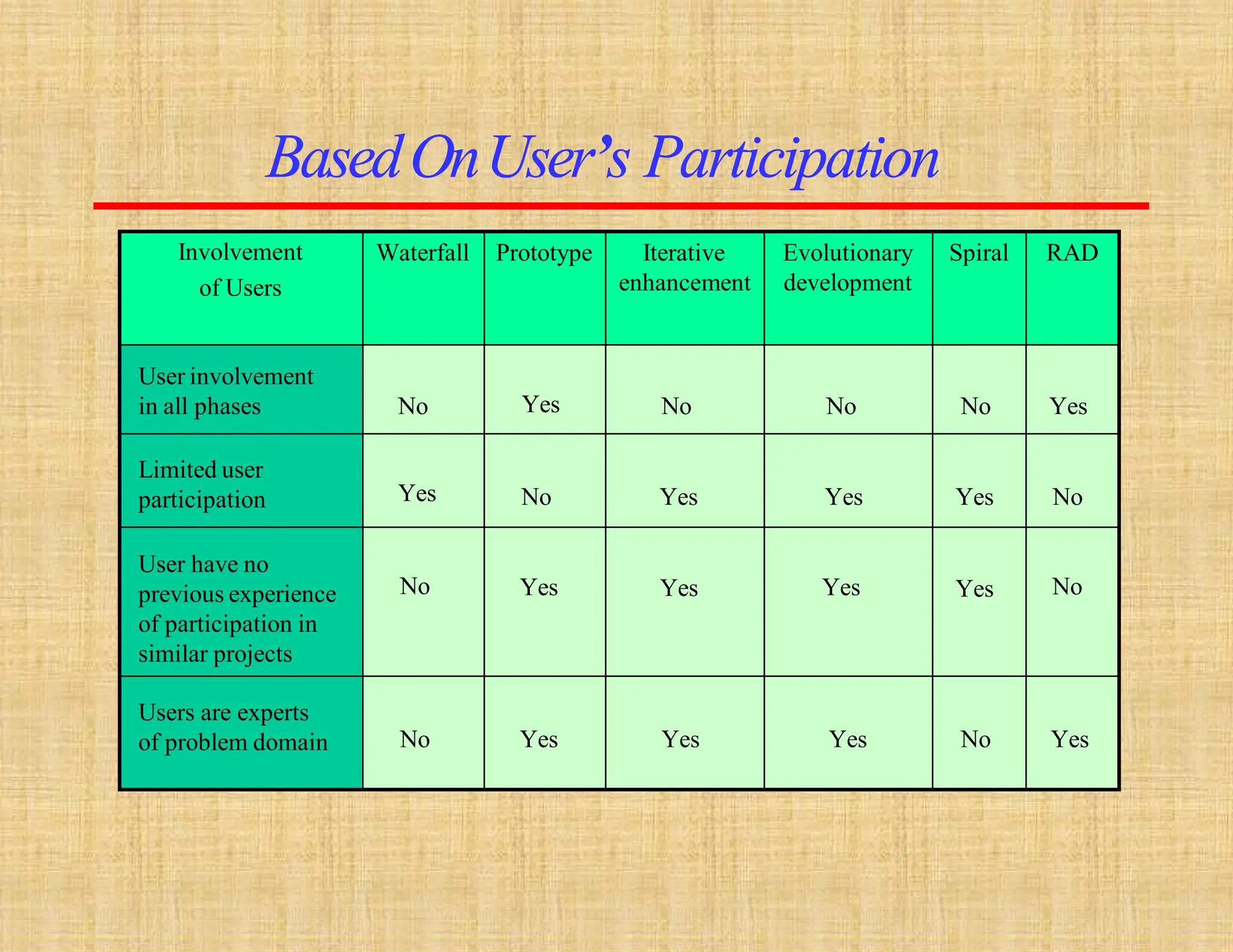
BasedOnUser’s Participation
Involvement
of Users
WaterfallPrototype Iterative
enhancement
Evolutionary
development
Spiral RAD
User involvement
in all phases No Yes No No No Yes
Limited user
participation Yes No Yes Yes Yes No
User have no
previous experience
of participation in
similar projects
No Yes Yes Yes Yes No
Users are experts
of problem domain No Yes Yes Yes No Yes
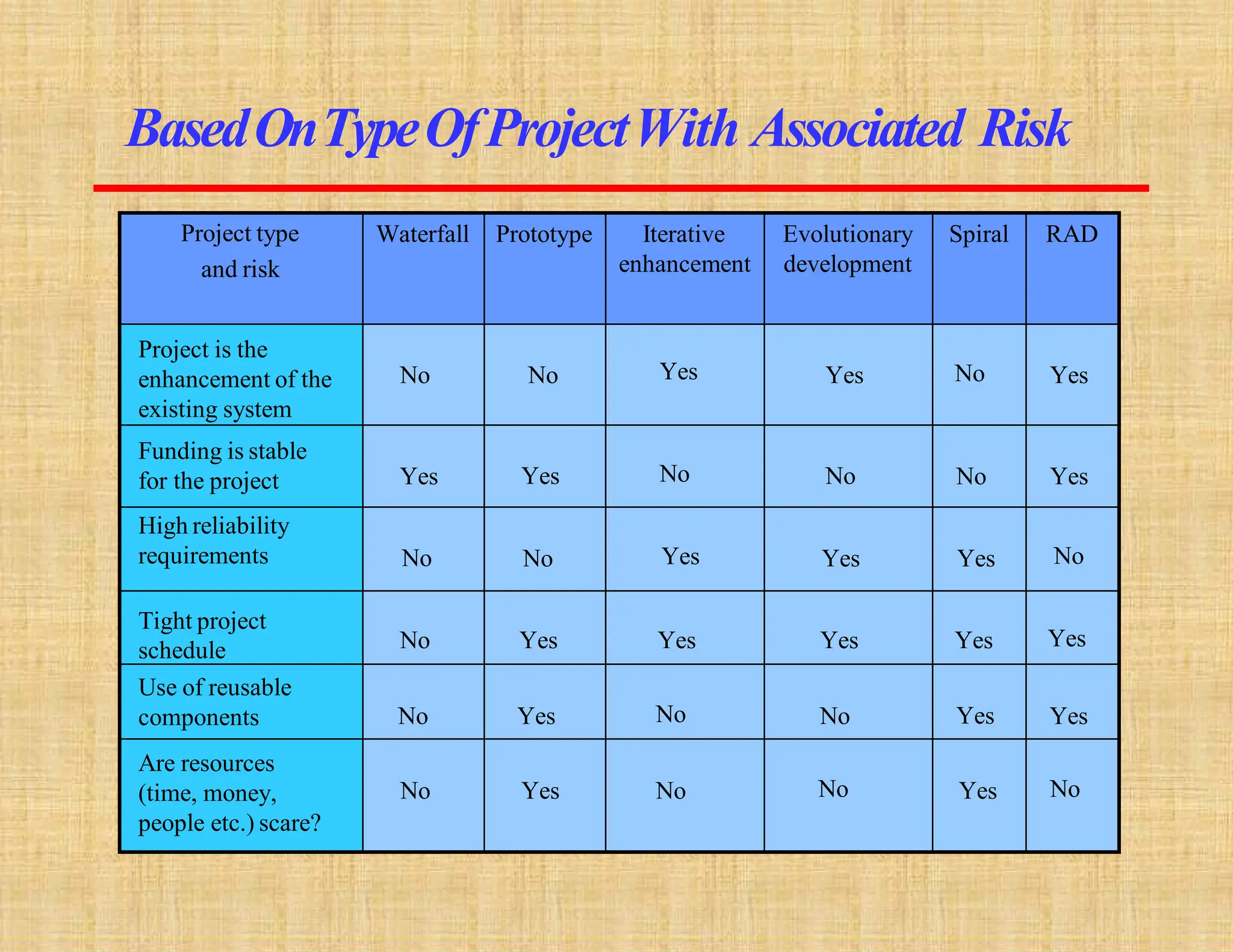
40.
Project type
and risk
WaterfallPrototype Iterative
enhancement
Evolutionary
development
Spiral RAD
Project is the
enhancement of the
existing system
No No Yes Yes No Yes
Funding is stable
for the project Yes Yes No No No Yes
High reliability
requirements No No Yes Yes Yes No
Tight project
schedule No Yes Yes Yes Yes Yes
Use of reusable
components No Yes No No Yes Yes
Are resources
(time, money,
people etc.) scare?
No Yes No No Yes No
BasedOnTypeOfProjectWith Associated Risk













![Process Models [Autosaved] [Autosaved].pptx](https://cdn.slidesharecdn.com/ss_thumbnails/processmodelsautosavedautosaved-250818180444-1b8b2341-thumbnail.jpg?width=640&height=640&fit=bounds)


