Group 2…
Aguirre, Roniel Rodrigo
Cabezas, Neil Menard
David, Carl John
Pilapil, Jordan
Viray, Roberto II
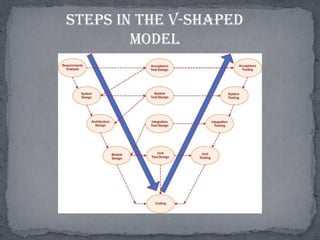
 V- model means Verification and Validation
model. Just like the waterfall model, the V-
Shaped life cycle is a sequential path of
execution of processes. Each phase must be
completed before the next phase
begins. Testing of the product is planned in
parallel with a corresponding phase of
development.
Steps in the V-Shaped
Model
 Simple and easy to use.
 Testing activities like planning, test designing
happens well before coding. This saves a lot
of time. Hence higher chance of success over
the waterfall model.
 Proactive defect tracking – that is defects are
found at early stage.
 Avoids the downward flow of the defects.
 Works well for small projects where
requirements are easily understood.
 Very rigid and least flexible.
 Software is developed during the
implementation phase, so no early prototypes
of the software are produced.
 If any changes happen in midway, then the
test documents along with requirement
documents has to be updated.
 The V-shaped model should be used for small to
medium sized projects where requirements are
clearly defined and fixed.
 The V-Shaped model should be chosen when
ample technical resources are available with
needed technical expertise.
High confidence of customer is required for
choosing the V-Shaped model approach. Since, no
prototypes are produced, there is a very high risk
involved in meeting customer expectations.
Vmodel
Vmodel
Vmodel

Vmodel

  • 1.
    Group 2… Aguirre, RonielRodrigo Cabezas, Neil Menard David, Carl John Pilapil, Jordan Viray, Roberto II
  • 2.
     V- modelmeans Verification and Validation model. Just like the waterfall model, the V- Shaped life cycle is a sequential path of execution of processes. Each phase must be completed before the next phase begins. Testing of the product is planned in parallel with a corresponding phase of development.
  • 3.
    Steps in theV-Shaped Model
  • 4.
     Simple andeasy to use.  Testing activities like planning, test designing happens well before coding. This saves a lot of time. Hence higher chance of success over the waterfall model.  Proactive defect tracking – that is defects are found at early stage.  Avoids the downward flow of the defects.  Works well for small projects where requirements are easily understood.
  • 5.
     Very rigidand least flexible.  Software is developed during the implementation phase, so no early prototypes of the software are produced.  If any changes happen in midway, then the test documents along with requirement documents has to be updated.
  • 6.
     The V-shapedmodel should be used for small to medium sized projects where requirements are clearly defined and fixed.  The V-Shaped model should be chosen when ample technical resources are available with needed technical expertise. High confidence of customer is required for choosing the V-Shaped model approach. Since, no prototypes are produced, there is a very high risk involved in meeting customer expectations.