SDH Basics
Frame Structure
Objective
 Standards
 Frame Structure
 Multiplexing
 Regenerator Section Overhead
 Multiplex Section Overhead
 Path Overhead
 Advantages
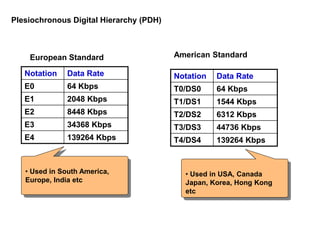
Plesiochronous Digital Hierarchy (PDH)
Notation Data Rate
E0 64 Kbps
E1 2048 Kbps
E2 8448 Kbps
E3 34368 Kbps
E4 139264 Kbps
Notation Data Rate
T0/DS0 64 Kbps
T1/DS1 1544 Kbps
T2/DS2 6312 Kbps
T3/DS3 44736 Kbps
T4/DS4 139264 Kbps
European Standard American Standard
• Used in South America,
Europe, India etc
• Used in USA, Canada
Japan, Korea, Hong Kong
etc
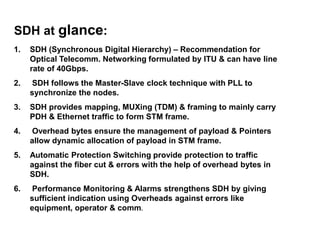
1. SDH (Synchronous Digital Hierarchy) – Recommendation for
Optical Telecomm. Networking formulated by ITU & can have line
rate of 40Gbps.
2. SDH follows the Master-Slave clock technique with PLL to
synchronize the nodes.
3. SDH provides mapping, MUXing (TDM) & framing to mainly carry
PDH & Ethernet traffic to form STM frame.
4. Overhead bytes ensure the management of payload & Pointers
allow dynamic allocation of payload in STM frame.
5. Automatic Protection Switching provide protection to traffic
against the fiber cut & errors with the help of overhead bytes in
SDH.
6. Performance Monitoring & Alarms strengthens SDH by giving
sufficient indication using Overheads against errors like
equipment, operator & comm.
SDH at glance:
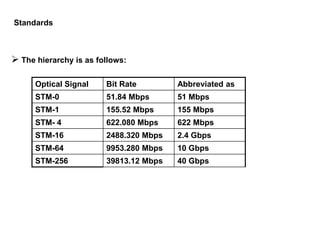
 The hierarchy is as follows:
Optical Signal Bit Rate Abbreviated as
STM-0 51.84 Mbps 51 Mbps
STM-1 155.52 Mbps 155 Mbps
STM- 4 622.080 Mbps 622 Mbps
STM-16 2488.320 Mbps 2.4 Gbps
STM-64 9953.280 Mbps 10 Gbps
STM-256 39813.12 Mbps 40 Gbps
Standards
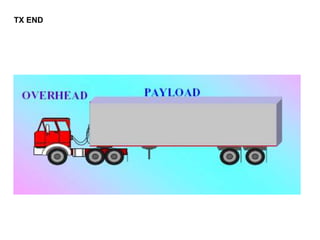
TX END
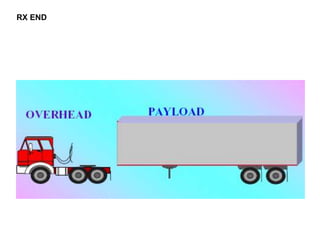
RX END
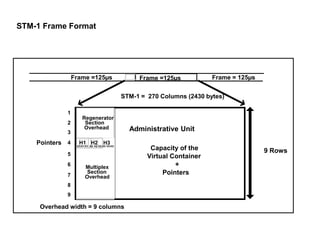
STM-1 Frame Format
9 Rows
Administrative Unit
Capacity of the
Virtual Container
+
Pointers
1
2
3
4
5
6
7
8
9
Regenerator
Section
Overhead
Multiplex
Section
Overhead
H3
H1 H2
Pointers
STM-1 = 270 Columns (2430 bytes)
H1H1 H1 H2 H2 H2 H3 H3H3
Frame =125µs Frame = 125µs
Frame =125µs
Overhead width = 9 columns
STM-N Frame Format
Frame = 125µs
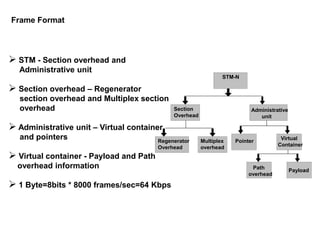
Frame Format
 STM - Section overhead and
Administrative unit
 Section overhead – Regenerator
section overhead and Multiplex section
overhead
 Administrative unit – Virtual container
and pointers
 Virtual container - Payload and Path
overhead information
 1 Byte=8bits * 8000 frames/sec=64 Kbps
Payload
STM-N
Administrative
unit
Pointer
Virtual
Container
Path
overhead
Section
Overhead
Regenerator
Overhead
Multiplex
overhead
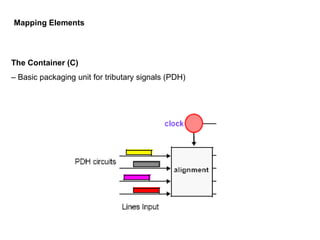
The Container (C)
– Basic packaging unit for tributary signals (PDH)
Mapping Elements
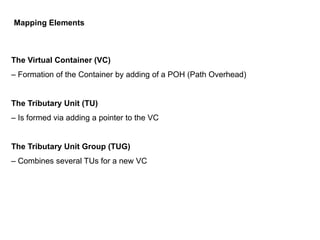
The Virtual Container (VC)
– Formation of the Container by adding of a POH (Path Overhead)
The Tributary Unit (TU)
– Is formed via adding a pointer to the VC
The Tributary Unit Group (TUG)
– Combines several TUs for a new VC
Mapping Elements
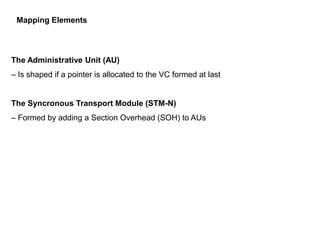
The Administrative Unit (AU)
– Is shaped if a pointer is allocated to the VC formed at last
The Syncronous Transport Module (STM-N)
– Formed by adding a Section Overhead (SOH) to AUs
Mapping Elements
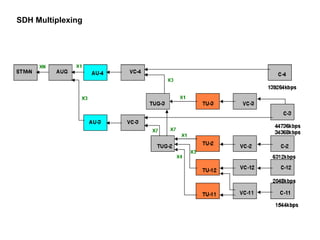
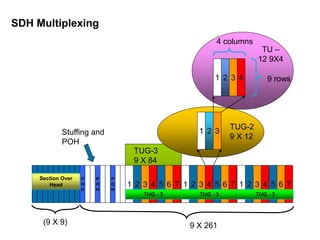
SDH Multiplexing
SDH Multiplexing
9 X 261
7
4
3 6
5
2
1 7
4
3 6
5
2
1 7
4
3 6
5
2
1
3
2
1
4
3
2
1 9 rows
4 columns
TUG-2
9 X 12
TU –
12 9X4
TUG-3
9 X 84
P
O
H
P
O
H
P
O
H
Stuffing and
POH
TUG - 3
TUG - 3
TUG - 3
Section Over
Head
(9 X 9)
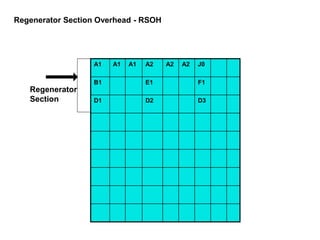
A1 A1 A1 A2 A2 A2 J0
B1 E1 F1
D1 D2 D3
Regenerator
Section
Regenerator Section Overhead - RSOH
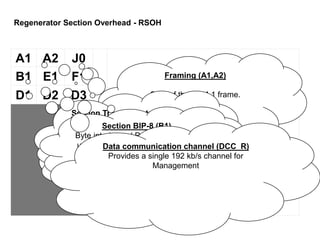
A1 A2 J0
B1 E1 F1
D1 D2 D3
Framing (A1,A2)
Start of the STM-1 frame.
Section Trace or Future Growth
(J0)
J0 carries section trace message.
Local Orderwire (E1)
Channel for voice communications
between any two NEs.
Section User Channel (F1)
A 64kb/s user channel.
Section BIP-8 (B1)
Byte interleaved Parity-8 (BIP-8) is
used for regenerator section error
monitoring.
Data communication channel (DCC_R)
Provides a single 192 kb/s channel for
Management
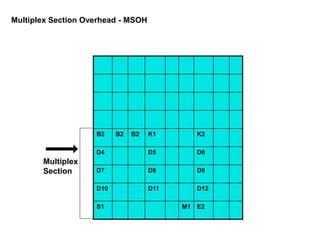
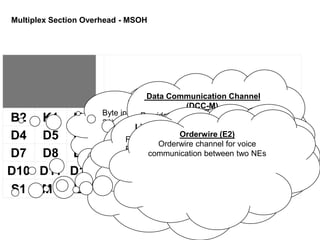
B2 B2 B2 K1 K2
D4 D5 D6
D7 D8 D9
D10 D11 D12
S1 M1 E2
Multiplex
Section
Multiplex Section Overhead - MSOH
B2 K1 K2
D4 D5 D6
D7 D8 D9
D10 D11 D12
S1 M1 E2
Line BIP-24 (B2)
Byte interleaved Parity-24 (BIP-
24) is used for multiplex section
error monitoring.
Multiplex Section Overhead - MSOH
Data Communication Channel
(DCC-M)
Provides a single 576 kb/s channel
for Management
Automatic Protection Switch
(APS) (K1,K2)
Used for APS signaling
Synchronization status or Future
growth (S1)
5-8 bits of the byte defines
Synchronous status message
Line Remote Error Indicator (M1)
Remote error indication. Conveys the
BIP-24 error count back to the source
Orderwire (E2)
Orderwire channel for voice
communication between two NEs
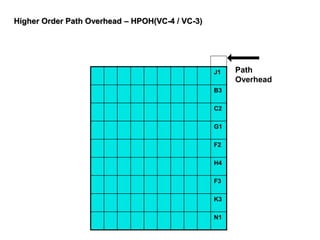
J1
B3
C2
G1
F2
H4
F3
K3
N1
Higher Order Path Overhead – HPOH(VC-4 / VC-3)
Path
Overhead
J1
B3
C2
G1
F2
H4
F3
K3
N1
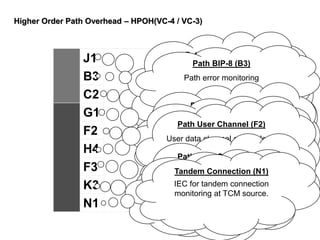
Path Signal Label (C2)
Indicates the type of payload in
AU
Path Trace (J1)
J1 byte carries the trace
information at path level
Path BIP-8 (B3)
Path error monitoring
Path Status (G1)
Provides status and
performance information back
to the remote end
Indicator byte (H4)
Carries multiframe information
Path User Channel (F2)
User data channel at path level
Path User Channel (F3)
User data channel at path level
Bits 1-4 are allocated for APS.
Bits 5-8 are for future use.
Tandem Connection (N1)
IEC for tandem connection
monitoring at TCM source.
Higher Order Path Overhead – HPOH(VC-4 / VC-3)
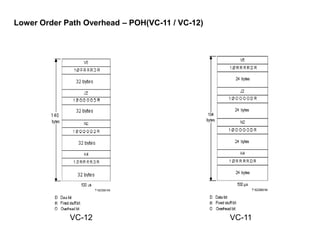
Lower Order Path Overhead – POH(VC-11 / VC-12)
VC-12 VC-11
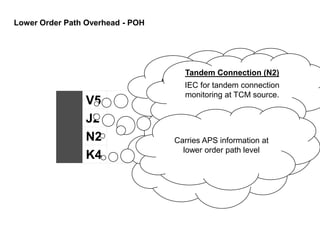
Lower Order Path Overhead - POH
V5
J2
N2
K4
Signal Label and parity check
Path Trace (J2)
J2 byte carries the trace
information at lower order path
level
Tandem Connection (N2)
IEC for tandem connection
monitoring at TCM source.
Carries APS information at
lower order path level

Advantages
 High speed standards
 Efficient Multiplexing / Demultiplexing
 Enhanced Operation, administration, Provisioning, Maintenance
capabilities (OAM&P)
Thank You…

SDH_Frame_Structure.ppt

  • 1.
  • 2.
    Objective  Standards  FrameStructure  Multiplexing  Regenerator Section Overhead  Multiplex Section Overhead  Path Overhead  Advantages
  • 3.
    Plesiochronous Digital Hierarchy(PDH) Notation Data Rate E0 64 Kbps E1 2048 Kbps E2 8448 Kbps E3 34368 Kbps E4 139264 Kbps Notation Data Rate T0/DS0 64 Kbps T1/DS1 1544 Kbps T2/DS2 6312 Kbps T3/DS3 44736 Kbps T4/DS4 139264 Kbps European Standard American Standard • Used in South America, Europe, India etc • Used in USA, Canada Japan, Korea, Hong Kong etc
  • 4.
    1. SDH (SynchronousDigital Hierarchy) – Recommendation for Optical Telecomm. Networking formulated by ITU & can have line rate of 40Gbps. 2. SDH follows the Master-Slave clock technique with PLL to synchronize the nodes. 3. SDH provides mapping, MUXing (TDM) & framing to mainly carry PDH & Ethernet traffic to form STM frame. 4. Overhead bytes ensure the management of payload & Pointers allow dynamic allocation of payload in STM frame. 5. Automatic Protection Switching provide protection to traffic against the fiber cut & errors with the help of overhead bytes in SDH. 6. Performance Monitoring & Alarms strengthens SDH by giving sufficient indication using Overheads against errors like equipment, operator & comm. SDH at glance:
  • 5.
     The hierarchyis as follows: Optical Signal Bit Rate Abbreviated as STM-0 51.84 Mbps 51 Mbps STM-1 155.52 Mbps 155 Mbps STM- 4 622.080 Mbps 622 Mbps STM-16 2488.320 Mbps 2.4 Gbps STM-64 9953.280 Mbps 10 Gbps STM-256 39813.12 Mbps 40 Gbps Standards
  • 6.
  • 7.
  • 8.
    STM-1 Frame Format 9Rows Administrative Unit Capacity of the Virtual Container + Pointers 1 2 3 4 5 6 7 8 9 Regenerator Section Overhead Multiplex Section Overhead H3 H1 H2 Pointers STM-1 = 270 Columns (2430 bytes) H1H1 H1 H2 H2 H2 H3 H3H3 Frame =125µs Frame = 125µs Frame =125µs Overhead width = 9 columns
  • 9.
  • 10.
    Frame Format  STM- Section overhead and Administrative unit  Section overhead – Regenerator section overhead and Multiplex section overhead  Administrative unit – Virtual container and pointers  Virtual container - Payload and Path overhead information  1 Byte=8bits * 8000 frames/sec=64 Kbps Payload STM-N Administrative unit Pointer Virtual Container Path overhead Section Overhead Regenerator Overhead Multiplex overhead
  • 11.
    The Container (C) –Basic packaging unit for tributary signals (PDH) Mapping Elements
  • 12.
    The Virtual Container(VC) – Formation of the Container by adding of a POH (Path Overhead) The Tributary Unit (TU) – Is formed via adding a pointer to the VC The Tributary Unit Group (TUG) – Combines several TUs for a new VC Mapping Elements
  • 13.
    The Administrative Unit(AU) – Is shaped if a pointer is allocated to the VC formed at last The Syncronous Transport Module (STM-N) – Formed by adding a Section Overhead (SOH) to AUs Mapping Elements
  • 14.
  • 15.
    SDH Multiplexing 9 X261 7 4 3 6 5 2 1 7 4 3 6 5 2 1 7 4 3 6 5 2 1 3 2 1 4 3 2 1 9 rows 4 columns TUG-2 9 X 12 TU – 12 9X4 TUG-3 9 X 84 P O H P O H P O H Stuffing and POH TUG - 3 TUG - 3 TUG - 3 Section Over Head (9 X 9)
  • 16.
    A1 A1 A1A2 A2 A2 J0 B1 E1 F1 D1 D2 D3 Regenerator Section Regenerator Section Overhead - RSOH
  • 17.
    Regenerator Section Overhead- RSOH A1 A2 J0 B1 E1 F1 D1 D2 D3 Framing (A1,A2) Start of the STM-1 frame. Section Trace or Future Growth (J0) J0 carries section trace message. Local Orderwire (E1) Channel for voice communications between any two NEs. Section User Channel (F1) A 64kb/s user channel. Section BIP-8 (B1) Byte interleaved Parity-8 (BIP-8) is used for regenerator section error monitoring. Data communication channel (DCC_R) Provides a single 192 kb/s channel for Management
  • 18.
    B2 B2 B2K1 K2 D4 D5 D6 D7 D8 D9 D10 D11 D12 S1 M1 E2 Multiplex Section Multiplex Section Overhead - MSOH
  • 19.
    B2 K1 K2 D4D5 D6 D7 D8 D9 D10 D11 D12 S1 M1 E2 Line BIP-24 (B2) Byte interleaved Parity-24 (BIP- 24) is used for multiplex section error monitoring. Multiplex Section Overhead - MSOH Data Communication Channel (DCC-M) Provides a single 576 kb/s channel for Management Automatic Protection Switch (APS) (K1,K2) Used for APS signaling Synchronization status or Future growth (S1) 5-8 bits of the byte defines Synchronous status message Line Remote Error Indicator (M1) Remote error indication. Conveys the BIP-24 error count back to the source Orderwire (E2) Orderwire channel for voice communication between two NEs
  • 20.
    J1 B3 C2 G1 F2 H4 F3 K3 N1 Higher Order PathOverhead – HPOH(VC-4 / VC-3) Path Overhead
  • 21.
    J1 B3 C2 G1 F2 H4 F3 K3 N1 Path Signal Label(C2) Indicates the type of payload in AU Path Trace (J1) J1 byte carries the trace information at path level Path BIP-8 (B3) Path error monitoring Path Status (G1) Provides status and performance information back to the remote end Indicator byte (H4) Carries multiframe information Path User Channel (F2) User data channel at path level Path User Channel (F3) User data channel at path level Bits 1-4 are allocated for APS. Bits 5-8 are for future use. Tandem Connection (N1) IEC for tandem connection monitoring at TCM source. Higher Order Path Overhead – HPOH(VC-4 / VC-3)
  • 22.
    Lower Order PathOverhead – POH(VC-11 / VC-12) VC-12 VC-11
  • 23.
    Lower Order PathOverhead - POH V5 J2 N2 K4 Signal Label and parity check Path Trace (J2) J2 byte carries the trace information at lower order path level Tandem Connection (N2) IEC for tandem connection monitoring at TCM source. Carries APS information at lower order path level

  • 24.
    Advantages  High speedstandards  Efficient Multiplexing / Demultiplexing  Enhanced Operation, administration, Provisioning, Maintenance capabilities (OAM&P)
  • 25.