CRCC NSPI 14
ED 307
PURPOSE AND POLICIES
OF HIGHER EDUCATION
Dr. AURORA M. IBRAHIM
PROFESSOR
MR. JORGE SAVANT
TECHNICAL ASSISTANT
DEXTER LLOYD C CATIAG
Teacher, Midsalip National High School
Zamboanga del Sur Division
dexterlloyd.catiag@deped.gov.ph
MANAGING
EDUCATIONAL
“”
Every few hundred years in Western history
there occurs a sharp transformation. Within a
few short decades, society—its worldview, its
basic values, its social and political structures,
its arts, its key institutions—rearranges itself.
And the people born then cannot even
imagine a world in which their grandparents
lived and into which their own parents were
born. We are living through such a
transformation.”
—Peter Drucker, Post Capitalist Society
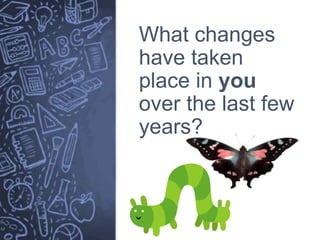
What changes
have taken
place in you
over the last few
years?
•Over the course of
your professional
career WHO has
influenced you most?
Who has changed
you? How?
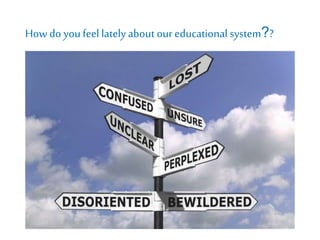
How do youfeel lately about our educational system??
CRCC NSPI 14
The present COVID-19 pandemic has brought
extraordinary challenges and has affected the
educational sectors, and no one knows when it will
end.
“There will be no face-to-
face classes and sessions
until we are assured of the
safety of our children and
teachers,” Education
secretary Leonor Briones
said on May 28.
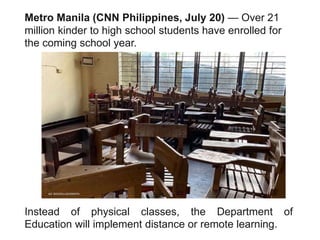
Metro Manila (CNN Philippines, July 20) — Over 21
million kinder to high school students have enrolled for
the coming school year.
Instead of physical classes, the Department of
Education will implement distance or remote learning.
SINCE the beginning of the current academic year,
which began on October 5 after being delayed due to
the coronavirus pandemic, there have been a
multitude of complaints.
For some parents,
distance learning
seems impractical as it
could mean spending
more time and money
on their children’s
education.
They worry about online
requirements, and
having to pay for
internet regularly.
LearningTarget
• Understand concepts
and significance of
‘change’ in education
• Evaluate styles in
managing educational
changes
• Draw personal
perspectives with some
educational changes
Educational meaning of change
14
Educational organizations are
among the aspects that are
experiencing a lot of change in the
whole world and hence information
concerning how this change should
be led and managed is of great
importance. There are different ways
that are used in bringing about
change in educational systems.
Many researchers and scholars
have stated that bring about change
is one thing and leading and
managing that change is another
aspect.
15
Traditional educational
settings need to be
changed in order to
incorporate the aspect
of advanced technology
in education (Harris,
2007, pp.316)
16
In the current world, leading
and managing change in
educational institution
setting requires a lot of
innovations and
inventions. This is
because the current world
is changing at very high
rate and without
innovations and inventions
educational institutions will
lag behind.
Make a Change practically useful
17
For instance, many schools in the
world especially in the developed
world have moved from the
aspect of copying notes in a book
to typing notes during classes
while using laptops. This is a
technological change and which
should be taught to students over
time (Baldridge & Deal, 1975,
pp.76). The best way of managing
change in educational
organization settings is to train
parties involved (teachers,
students, and seniors) on the
uses of that change.
18
On the other hand, managers plan
and budget for changes, organizing
people to be prepared for change, do
the staffing, control the workforce,
and help in solving problems that may
be brought about by this change. It
should be noted that in educational
organizations setting change,
managers analyze the situation,
motivate the parties involved in
change implementations towards
acceptance of this change, and set up
public relations with the people
(Students, teachers, communities,
and administrators) who are affected
by the change (Easterby-Smith et al,
2003, pp.63)
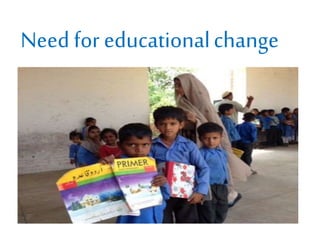
Need for educationalchange
The current world is
changing at very high
rate and without
innovations and
inventions educational
institutions will lag
behind.
Need
Changing society
Weaknesses within the Current
System
Inert Knowledge
Erroneous Assumptions
We Need to Look at Other ways
The introduction of new digital
technologies in educations
introduced changes to the
social, cultural and
technological world.
With the increase of the
technology because of the
globalization, many sectors of
the society are being
influenced by it. Enhance the
importance of change in
educational field.
In educational settings,
technology has caused a lot
of changes which have
brought about improvement
in performance of both
students and teachers
(Paton & McCalman, 2000)
23
24
The concept of change does not only
occur in the leadership and management
of educational organizations but also to
the performance of students and teachers.
In this respect, the quality of education is
changing more students because of
improved and advanced technologies.
Organizational change, as stated by
Fullan (2001, pp.43), is the process of
moving from the present or current
operational phase into the next and
advanced functional phase.
25
In educational organizational settings,
there are some barriers that hinder
change from taking place. These
barriers include;
•inefficient leadership and
leadership strategies
ineffective communication
with parties involved in
change implementation,
• unclear processes and procedures
concerning specific and general
goals,
•lack of involvement of all parties
that are concerned or involved in
change management, resistance
from employees, and improper or
ineffective management of
resources (Easterby-Smith et al,
2003, pp.23).
Roleof Manager in educational institutio
26
When a certain educational program
or course is introduced in a
campus in any country, it is the role
of the managers to make sure that
the project is adequately funded,
the sources of funds, the personnel
who will be involved in that project
like who will be the head of
department, which teachers will be
teaching this new course and so
on, and the responsibilities of each
and every member of staff who will
be required to take part in that
project
The Role of School
Manager (Hallinger,2005))
27
• Focused on creating a
shared vision. This aligns
with much of the general
research.
• Developed a climate of high
expectation
• Guided the continuous
improvements of the school
The Role of School
Manager (Hallinger,2005))
28
• Monitored the curriculum
and students learning
outcomes
• Created and
communicated the
school vision Arranged
Staff development
• Became a visible presence in the
school by modeling the share
values of the school’s culture
Competencies of head:
29
A professional
A builder of relationships
A good communicator
A good listener
A positive person
A motivator
Excellent leader
30
•Teaching as a career in which
teachers are properly inducted
into the profession and are
provided new responsibilities,
appropriate support, increased
recognition, and significantly
increased salary at each
career stage
•A vision of practice that values
and honors respect and dignity
as well as shared power and
decision making
Teacher Education Strategy
Avision for teachers – a vision for change
1.
• Commitment to their students and to educating all
of their
31
students.
2.
3.
4.
5.
• Possess general knowledge, subject knowledge,
use a variety of teaching methods that respect
students and make them active learners, to
improve and develop life-skills including
problem-solving and critical thinking.
• Responsible for monitoring and guiding
their students’ learning.
• Think systematically about their practices, learn
from their experiences and continue to develop
professionally.
• Work with their colleagues as members of a
community of learners.
• Teachers are the main
change agents for school
learning environment
therefore, their professional
development is necessary
for bringing change in
teaching learning process
• Hall and Hord (1987) also
indicate the importance of
teachers’ concern and say,
“Change can be more successful if
the concerns of teacher are
considered”
32
Need forFacilities in Schools .
33
Facilities are materials designed to serve
specific
purposes. In the school system, there are
multiplicity of facilities, which facilitate
teaching and learning. They are used;
(1) To illustrate concepts
(2) Provide opportunity for firsthand
experience
(3) For experimentation and demonstration
(4) For scientific investigation and discovery
(5) To provide diversity of thoughts
(6) For observation and inquiry
(7) For development of scientific attitudes and
skills
(8) To protect the individual and also provide
comfort
34
• Improvement in Learning
Environment
(Better infrastructure through School
Management Councils)
• Technical / Vocational
Education
(It is important to provide demand
related skills).
• Instructional Methods
(Emphasis must be given on
development of analytical faculties
of the students).
• Teachers’ Training and Knowledge
(To improve teachers’ knowledge of the
subject and equip them with a wide
repertoire of teaching skills).
35
Change is a concept that occurs over a
period of time and from time to time.
Not all people in an organization are
ready for this change and hence it can
be resisted by some people. It is
therefore the role of change manager
to make sure that all people are
incorporated in the process of
adapting change. The managers of
change in educational institutions
should ensure that there are enough
resources for the implementation of a
new change. It is very essential for
leaders to understand the views of all
people in order to avoid much
resistance to change.
Lessons of
Change
1. integrity, trust and authenticity
• Knowing others is intelligence; knowing yourself is true
wisdom. Mastering others is strength; mastering
yourself is true power. If you realize that you have
enough, you are truly rich.”
― Laozi Tao Te Ching
2. Change isthrough people,not systems
• Change one heart at a time…Emotional Intelligence
3.Understand the Culture
•It is much easier to “act your
way into new thinking
patterns” than to “think your
way into new behaviour.”
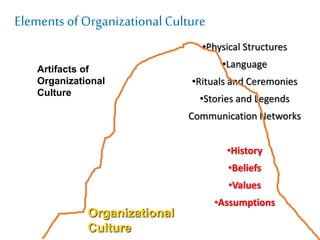
Elements of Organizational Culture
•Physical Structures
•Language
•Rituals and Ceremonies
•Stories and Legends
Communication Networks
•History
•Beliefs
•Values
•Assumptions
Artifacts of
Organizational
Culture
Organizational
Culture
My School culture
Write 5 adjectives
to describe your
school culture….
4.Plan , Delegate & Build Capacity
• Planning is critical to achieving
successful change. Realistic
objectives. Short term goals which
can be achieved and celebrated.
• Plans do not have to be elaborate or
complex but structure is important
• Delegate to others the responsibility
to carry out the actions. Give others
the opportunity to lead and be part of
a team
• Offer opportunities for feedback and
dialogue
What is your SMART
plan of action?
Write down your
SMART plan of
action
•Specific
•Measurable
•Achievable
•Relevant
•Time framed
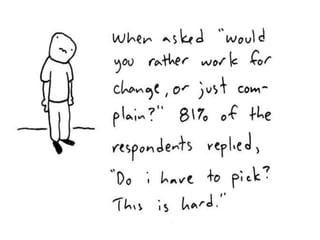
5. Expect Resistance
6.ReflectivePractice-
/ActionResearch
“What do I want to
change?”
“What are the values that
underpin that change?”
Self evaluation-self
reflection
“The starting point for improvement
is not system change, not change in
others around us , but change in
ourselves” ( Fullan, 1991 New
Meaning of Ed Change )
7.ShowLeadership
• Role model the change you want to
see
• Look to Transformational Leadership
for style that can bring about change
• Power of story telling to connect,
inspire and move us to change…tell
the story of the possibilities!
• Change management principles are
only as effective as the person who is
implementing them!
• Sphere of influence re change- be
realistic
• Create learning communities where the
predominant voice is one of
professional dialogue-we need others
with us on this journey.
•Reflect on the reasons why
you became an educator?
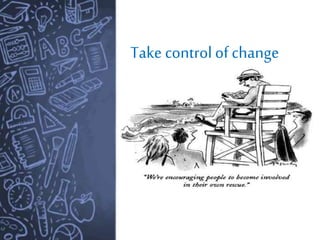
Take control of change
We are….
• Conductor of Transformation
• Potter who shapes the Culture
• Poet who uses language to describe
the change
• Actor who role models the values
and behaviours
• Helper who offers the safe places in
the school
• Artists who paints the ‘vision’ of how
it can be
• The leader who believes in and
creates a better future
• Sometimes you are all a child has to
have a chance!
CRCC NSPI 14
References
52
• Anderson, D. (2009). Organization Development: The Process
of Leading Organizational Change. New Jersey: Wiley
Baldridge, J. and Deal, T. (1975). Managing Change in
Educational Organizations. London: Prentice Hall Bartunek,
• J. (2003). Organizational and Educational Change. New
York: Blackwell Bascia, N. and Hargreaves, A. (2000). The
Sharp Edge of Educational
• https://www.cnn.ph/news/2020/6/11/COVID-19-2020-
school-classes.html
• https://www.google.com/search?q=briones&hl=en&source=
lnms&tbm=isch&sa=X&ved=2ahUKEwjV3La-
leHuAhW5xosBHaYKA4IQ_AUoAXoECAgQAw&biw=1600
&bih=667#imgrc=XqqC1j3dlBR0tM
DEXTER LLOYD C CATIAG
Teacher, Midsalip National High School
Zamboanga del Sur Division
dexterlloyd.catiag@deped.gov.ph

MANAGING EDUCATIONAL CHANGE

  • 1.
  • 2.
    ED 307 PURPOSE ANDPOLICIES OF HIGHER EDUCATION Dr. AURORA M. IBRAHIM PROFESSOR MR. JORGE SAVANT TECHNICAL ASSISTANT
  • 3.
    DEXTER LLOYD CCATIAG Teacher, Midsalip National High School Zamboanga del Sur Division dexterlloyd.catiag@deped.gov.ph MANAGING EDUCATIONAL
  • 4.
    “” Every few hundredyears in Western history there occurs a sharp transformation. Within a few short decades, society—its worldview, its basic values, its social and political structures, its arts, its key institutions—rearranges itself. And the people born then cannot even imagine a world in which their grandparents lived and into which their own parents were born. We are living through such a transformation.” —Peter Drucker, Post Capitalist Society
  • 5.
    What changes have taken placein you over the last few years?
  • 6.
    •Over the courseof your professional career WHO has influenced you most? Who has changed you? How?
  • 7.
    How do youfeellately about our educational system??
  • 8.
  • 9.
    The present COVID-19pandemic has brought extraordinary challenges and has affected the educational sectors, and no one knows when it will end. “There will be no face-to- face classes and sessions until we are assured of the safety of our children and teachers,” Education secretary Leonor Briones said on May 28.
  • 10.
    Metro Manila (CNNPhilippines, July 20) — Over 21 million kinder to high school students have enrolled for the coming school year. Instead of physical classes, the Department of Education will implement distance or remote learning.
  • 11.
    SINCE the beginningof the current academic year, which began on October 5 after being delayed due to the coronavirus pandemic, there have been a multitude of complaints. For some parents, distance learning seems impractical as it could mean spending more time and money on their children’s education. They worry about online requirements, and having to pay for internet regularly.
  • 13.
    LearningTarget • Understand concepts andsignificance of ‘change’ in education • Evaluate styles in managing educational changes • Draw personal perspectives with some educational changes
  • 14.
    Educational meaning ofchange 14 Educational organizations are among the aspects that are experiencing a lot of change in the whole world and hence information concerning how this change should be led and managed is of great importance. There are different ways that are used in bringing about change in educational systems. Many researchers and scholars have stated that bring about change is one thing and leading and managing that change is another aspect.
  • 15.
    15 Traditional educational settings needto be changed in order to incorporate the aspect of advanced technology in education (Harris, 2007, pp.316)
  • 16.
    16 In the currentworld, leading and managing change in educational institution setting requires a lot of innovations and inventions. This is because the current world is changing at very high rate and without innovations and inventions educational institutions will lag behind.
  • 17.
    Make a Changepractically useful 17 For instance, many schools in the world especially in the developed world have moved from the aspect of copying notes in a book to typing notes during classes while using laptops. This is a technological change and which should be taught to students over time (Baldridge & Deal, 1975, pp.76). The best way of managing change in educational organization settings is to train parties involved (teachers, students, and seniors) on the uses of that change.
  • 18.
    18 On the otherhand, managers plan and budget for changes, organizing people to be prepared for change, do the staffing, control the workforce, and help in solving problems that may be brought about by this change. It should be noted that in educational organizations setting change, managers analyze the situation, motivate the parties involved in change implementations towards acceptance of this change, and set up public relations with the people (Students, teachers, communities, and administrators) who are affected by the change (Easterby-Smith et al, 2003, pp.63)
  • 19.
  • 20.
    The current worldis changing at very high rate and without innovations and inventions educational institutions will lag behind.
  • 21.
    Need Changing society Weaknesses withinthe Current System Inert Knowledge Erroneous Assumptions We Need to Look at Other ways
  • 22.
    The introduction ofnew digital technologies in educations introduced changes to the social, cultural and technological world. With the increase of the technology because of the globalization, many sectors of the society are being influenced by it. Enhance the importance of change in educational field.
  • 23.
    In educational settings, technologyhas caused a lot of changes which have brought about improvement in performance of both students and teachers (Paton & McCalman, 2000) 23
  • 24.
    24 The concept ofchange does not only occur in the leadership and management of educational organizations but also to the performance of students and teachers. In this respect, the quality of education is changing more students because of improved and advanced technologies. Organizational change, as stated by Fullan (2001, pp.43), is the process of moving from the present or current operational phase into the next and advanced functional phase.
  • 25.
    25 In educational organizationalsettings, there are some barriers that hinder change from taking place. These barriers include; •inefficient leadership and leadership strategies ineffective communication with parties involved in change implementation, • unclear processes and procedures concerning specific and general goals, •lack of involvement of all parties that are concerned or involved in change management, resistance from employees, and improper or ineffective management of resources (Easterby-Smith et al, 2003, pp.23).
  • 26.
    Roleof Manager ineducational institutio 26 When a certain educational program or course is introduced in a campus in any country, it is the role of the managers to make sure that the project is adequately funded, the sources of funds, the personnel who will be involved in that project like who will be the head of department, which teachers will be teaching this new course and so on, and the responsibilities of each and every member of staff who will be required to take part in that project
  • 27.
    The Role ofSchool Manager (Hallinger,2005)) 27 • Focused on creating a shared vision. This aligns with much of the general research. • Developed a climate of high expectation • Guided the continuous improvements of the school
  • 28.
    The Role ofSchool Manager (Hallinger,2005)) 28 • Monitored the curriculum and students learning outcomes • Created and communicated the school vision Arranged Staff development • Became a visible presence in the school by modeling the share values of the school’s culture
  • 29.
    Competencies of head: 29 Aprofessional A builder of relationships A good communicator A good listener A positive person A motivator Excellent leader
  • 30.
    30 •Teaching as acareer in which teachers are properly inducted into the profession and are provided new responsibilities, appropriate support, increased recognition, and significantly increased salary at each career stage •A vision of practice that values and honors respect and dignity as well as shared power and decision making
  • 31.
    Teacher Education Strategy Avisionfor teachers – a vision for change 1. • Commitment to their students and to educating all of their 31 students. 2. 3. 4. 5. • Possess general knowledge, subject knowledge, use a variety of teaching methods that respect students and make them active learners, to improve and develop life-skills including problem-solving and critical thinking. • Responsible for monitoring and guiding their students’ learning. • Think systematically about their practices, learn from their experiences and continue to develop professionally. • Work with their colleagues as members of a community of learners.
  • 32.
    • Teachers arethe main change agents for school learning environment therefore, their professional development is necessary for bringing change in teaching learning process • Hall and Hord (1987) also indicate the importance of teachers’ concern and say, “Change can be more successful if the concerns of teacher are considered” 32
  • 33.
    Need forFacilities inSchools . 33 Facilities are materials designed to serve specific purposes. In the school system, there are multiplicity of facilities, which facilitate teaching and learning. They are used; (1) To illustrate concepts (2) Provide opportunity for firsthand experience (3) For experimentation and demonstration (4) For scientific investigation and discovery (5) To provide diversity of thoughts (6) For observation and inquiry (7) For development of scientific attitudes and skills (8) To protect the individual and also provide comfort
  • 34.
    34 • Improvement inLearning Environment (Better infrastructure through School Management Councils) • Technical / Vocational Education (It is important to provide demand related skills). • Instructional Methods (Emphasis must be given on development of analytical faculties of the students). • Teachers’ Training and Knowledge (To improve teachers’ knowledge of the subject and equip them with a wide repertoire of teaching skills).
  • 35.
    35 Change is aconcept that occurs over a period of time and from time to time. Not all people in an organization are ready for this change and hence it can be resisted by some people. It is therefore the role of change manager to make sure that all people are incorporated in the process of adapting change. The managers of change in educational institutions should ensure that there are enough resources for the implementation of a new change. It is very essential for leaders to understand the views of all people in order to avoid much resistance to change.
  • 36.
  • 37.
    1. integrity, trustand authenticity • Knowing others is intelligence; knowing yourself is true wisdom. Mastering others is strength; mastering yourself is true power. If you realize that you have enough, you are truly rich.” ― Laozi Tao Te Ching 2. Change isthrough people,not systems • Change one heart at a time…Emotional Intelligence
  • 38.
    3.Understand the Culture •Itis much easier to “act your way into new thinking patterns” than to “think your way into new behaviour.”
  • 39.
    Elements of OrganizationalCulture •Physical Structures •Language •Rituals and Ceremonies •Stories and Legends Communication Networks •History •Beliefs •Values •Assumptions Artifacts of Organizational Culture Organizational Culture
  • 40.
    My School culture Write5 adjectives to describe your school culture….
  • 41.
    4.Plan , Delegate& Build Capacity • Planning is critical to achieving successful change. Realistic objectives. Short term goals which can be achieved and celebrated. • Plans do not have to be elaborate or complex but structure is important • Delegate to others the responsibility to carry out the actions. Give others the opportunity to lead and be part of a team • Offer opportunities for feedback and dialogue
  • 42.
    What is yourSMART plan of action? Write down your SMART plan of action •Specific •Measurable •Achievable •Relevant •Time framed
  • 43.
  • 45.
    6.ReflectivePractice- /ActionResearch “What do Iwant to change?” “What are the values that underpin that change?” Self evaluation-self reflection “The starting point for improvement is not system change, not change in others around us , but change in ourselves” ( Fullan, 1991 New Meaning of Ed Change )
  • 46.
    7.ShowLeadership • Role modelthe change you want to see • Look to Transformational Leadership for style that can bring about change • Power of story telling to connect, inspire and move us to change…tell the story of the possibilities! • Change management principles are only as effective as the person who is implementing them! • Sphere of influence re change- be realistic • Create learning communities where the predominant voice is one of professional dialogue-we need others with us on this journey.
  • 47.
    •Reflect on thereasons why you became an educator?
  • 48.
  • 50.
    We are…. • Conductorof Transformation • Potter who shapes the Culture • Poet who uses language to describe the change • Actor who role models the values and behaviours • Helper who offers the safe places in the school • Artists who paints the ‘vision’ of how it can be • The leader who believes in and creates a better future • Sometimes you are all a child has to have a chance!
  • 51.
  • 52.
    References 52 • Anderson, D.(2009). Organization Development: The Process of Leading Organizational Change. New Jersey: Wiley Baldridge, J. and Deal, T. (1975). Managing Change in Educational Organizations. London: Prentice Hall Bartunek, • J. (2003). Organizational and Educational Change. New York: Blackwell Bascia, N. and Hargreaves, A. (2000). The Sharp Edge of Educational • https://www.cnn.ph/news/2020/6/11/COVID-19-2020- school-classes.html • https://www.google.com/search?q=briones&hl=en&source= lnms&tbm=isch&sa=X&ved=2ahUKEwjV3La- leHuAhW5xosBHaYKA4IQ_AUoAXoECAgQAw&biw=1600 &bih=667#imgrc=XqqC1j3dlBR0tM
  • 53.
    DEXTER LLOYD CCATIAG Teacher, Midsalip National High School Zamboanga del Sur Division dexterlloyd.catiag@deped.gov.ph