Sample Matatag WAP For Teachers
Educational Foundations (University of the Philippines Visayas)
Scan to open on Studocu
Studocu is not sponsored or endorsed by any college or university
Sample Matatag WAP For Teachers
Educational Foundations (University of the Philippines Visayas)
Scan to open on Studocu
Studocu is not sponsored or endorsed by any college or university
Downloaded by JULIA ESPEJO (julia.espejo01@deped.gov.ph)
lOMoARcPSD|37109213
(Enclosure No. 6 to DepEd Memorandum No. 44, s. 2023)
Republic of the Philippines
Department of Education
National Educators Academy of the Philippines
MATATAG WAP Template: For Teachers I-III (Proficient Teachers)
I. Profile
Name ARIEL P. LAGUITAO School and Position Tinoc National High School
Title of PD Programs Training of Teachers (SBTT) on MATATAG
Curriculum
Date of Delivery Indicate when the training was conducted
PD Program
Provider
National Educators Academy of the
Philippines in collaboration with Curriculum
and Teaching Strand (BCD and BLD)
Name of Immediate
Supervisor
OLIVER D. TOBIAGON School and Position Principal II
II. Background and Rationale of WAP:
The Department of Education has pursued its education reform, the MATATAG: Bansang Makabata, Batang Makabansa Agenda, which
sets the new direction of the agency and stakeholders in resolving basic education challenges. In pursuing such reform in the basic
education curriculum, it is imperative to understand the current context and setting. Doing so will allow the Department to recognize the
existing and expected realities and, consequently, adopt appropriate measures to realize its vision, hence making the MATATAG
Curriculum, which is responsive and attuned to the dynamic changes that come into play in the society (General Shaping Paper,
Downloaded by JULIA ESPEJO (julia.espejo01@deped.gov.ph)
lOMoARcPSD|37109213
MATATAG Curriculum 2023).
The MATATAG Curriculum focuses on foundational skills and embedding peace competencies, building more resilient schools and
classrooms, strengthening inclusive education programs, advocating for teachers’ additional benefits, and providing professional
development programs, among others. The aim is to create a more effective and impactful educational experience for Filipino learners.

The Training on MATATAG curriculum is rooted in the fundamental importance of ensuring that teachers are fully equipped with the
knowledge, understanding, and skills necessary to effectively implement the curriculum. Teacher quality is vital in raising learner
achievement. However, teachers alone cannot bring about substantive changes without effective leadership.
In addition, DepEd Order No. 24, s. 2022 or the Adoption of the Basic Education Development Plan 2030 (BEDP 2030) outlines the
priorities of the Department in addressing the immediate and long-term concerns confronting basic education: access, equity, quality,
and resiliency. Quality is designed to address the quality of education through various strategic means such as but not limited to
upskilling and reskilling of teachers.
To articulate the general shape of the MATATAG Curriculum and to ensure its full implementation, all teachers shall develop a Work
Application Plan (WAP) underscoring the intensification of Learning Action Cells (LACs) through Collaborative Expertise (CE).
The School-based Training of Teachers (SBTT) on MATATAG Curriculum provides the teachers with an opportunity to:
 address the appropriate indicators domains, strands, and indicators in the Philippine Professional Standards for Teachers (PPST) in
the effective and efÏcient delivery of the MATATAG Curriculum through the intensification of School LACs through the
Collaborative Expertise (CE).
The following professional standards/competencies are being addressed in the Training of Teachers on MATATAG Curriculum:
Professional Standards PD Program Goals Indicators (Subtask) Application Objective
2
Downloaded by JULIA ESPEJO (julia.espejo01@deped.gov.ph)
lOMoARcPSD|37109213
Philippine Professional Standards for Teachers (PPST)
DepEd Order No. 42, s. 2017
Domain 1. Content
Knowledge and
Pedagogy; Strand 1.1
Content Knowledge and
its application within
and across curriculum
areas;
1.1.2. Apply knowledge of
content within and across
curriculum teaching area.
Identify the overall structure
and salient features of the
general shaping paper and
learning area curriculum guide
Accomplishing reflection journal
on the salient features and
aspirations for MATATAG
Curriculum
Implement Workplace
Application Plan (WAP)
articulating their required
competencies to be developed
and/or enhanced using school
LACs through Collaborative
Expertise (CE) aligned with the
PPST.
Domain 1, Content
Knowledge, and
Pedagogy; Strand 1.5.
Strategies for
developing critical and
creative thinking, as
well as other higher-
order thinking skills;
1.5.2 Apply a range of
teaching strategies to
develop critical and
creative thinking, as well
as other higher-order
thinking skills.
Integrate 21st century skills,
inclusion principles and brain-
based learning theories in
teaching and learning
processes
Identifying 21st
century skills
targeted by the learning
competencies in the curriculum
Domain 3. Diversity of
Learners. 3.1 Learners’
gender, needs
strengths, interests,
and experiences;
3.1.2 Use differentiated
developmentally
appropriate learning
experiences to address
learners’ gender, needs,
strengths, interests, and
experiences.
Domain 4. Curriculum
and Planning; Strand
4.1. Planning and
managemoent of
teaching and learning
process;
4.1.2 Plan, manage and
implement
developmentally
sequenced teaching and
learning process to meet
curriculum requirements
and varied teaching
contexts.
Develop a lesson plan that
shows understanding of the
connections among
instructional elements
(standards, instruction,
assessment, and evaluation
and feedback) of the MATATAG
curriculum
Developing lesson plan integrating
the MATATAG instructional design
framework, pedagogies, and
assessment strategies
Conducting classroom observation
and post conference simulation
Domain 4. Curriculum
and Planning; Strand
4.2. Learning outcomes
4.2.2 Set achievable and
appropriate learning
outcomes that are
Demonstrate knowledge and
skills on
unpacking/merging/clustering
Unpacking and/or merging of Q1
and Q2 learning competencies
3
Downloaded by JULIA ESPEJO (julia.espejo01@deped.gov.ph)
lOMoARcPSD|37109213
aligned with learning
competencies;
aligned with learning
competencies.
competencies per grade level
and learning area.
Domain 5. Assessment
and Reporting is
composed of five
strands: Strand 5.1.
Design, selection,
organization, and
utilization of
assessment strategies;
5.1.2 Design, select,
organize, and use
diagnostic, formative and
summative assessment
strategies consistent with
curriculum requirements.
Design a classroom-based
assessment tool for an
identified learning competency
within the MATATAG
Curriculum, ensuring alignment
with instructional objectives
and diverse assessment
methods
Identifying assessment strategies
consistent with curriculum
requirements and which will
integrate 21st
century skills
Domain 5: Assessment
and Reporting; 5.2.
Monitoring and
evaluation of learner
progress and
achievement;
5.2.2. Monitor and
evaluate learner progress
and achievement using
learner attainment data.
Domain 5. Assessment
and Reporting; Strand
5.5. Use of assessment
data to enhance
teaching and learning
practices and programs;
5.5.2 Utilize assessment
data to inform the
modification of teaching
and learning practices
and programs.
Domain 7. Personal
Growth and Professional
Development; Strand
7.3 Professional links
with colleagues;
7.3.2 Participate in
professional networks to
share knowledge and to
enhance practice.
Simulate collaborative learning
expertise;
Facilitate and give feedback to
a teaching-learning session
using the co-developed lesson
plan;
Exhibit positive /inclusive
attitude towards the
implementation of the
MATATAG curriculum
Conducting collaborative expertise
focused on MATATAG curriculum
implementation and becoming
visible teachers
Domain 7. Personal
Growth and Professional
Development; Strand
7.5 Professional
development goals;
7.5.2 Set professional
development goals based
on the Philippine
Professional Standards
for Teachers.
IV. Implementation Plan [the WAP must be implemented within 6-9 months after the training]
4
Downloaded by JULIA ESPEJO (julia.espejo01@deped.gov.ph)
lOMoARcPSD|37109213
Application Objective [it must be aligned with the PD Program Goals]
 implement Workplace Application Plan (WAP) articulating their required competencies to be developed and/or enhanced using
school LACs through Collaborative Expertise (CE) aligned with the PPST.
Specific Task
[minimum of two (2)]
(Aligned with the application
objective, what are the
specific tasks of a teacher to
enhance teaching
competencies
More tasks may be added to
ensure mastery or progress
of application of learning.
Activities
(Specify activities on the
identified task)
Timeline
(Start-end of each activity)
Expected Outcomes/
MOVs
(It represents what is
predicted or intended to
happen as a result of
implementing a specific
task or initiative)
Learning Facilitator
(Immediate Supervisor or
peer assigned to guide the
teacher)
 Engage in or conduct
collaborative
expertise session
with colleagues
focusing on planning
and preparation of
instruction leading to
implementing the
MATATAG Curriculum
Collaborative Expertise
Session (Planning and
Preparation)
Identify agreed timeline.
This must be done per
quarter or as needed.
 LAC/Collaborative
Expertise Session
Report
 Developed Lesson
Plans/DLLs/Les
 Instructional
Materials
Facilitator may be a co-
proficient teacher, a highly
proficient teacher or
master teacher, a head
teacher, and/or the school
head.
 Apply the developed
lesson plan through
classroom teaching
Classroom Observations
Identify agreed timeline.
This must be done per
 Lesson Plan
 Classroom
Observation Tool
Facilitator may be a highly
proficient teacher or
5
Downloaded by JULIA ESPEJO (julia.espejo01@deped.gov.ph)
lOMoARcPSD|37109213
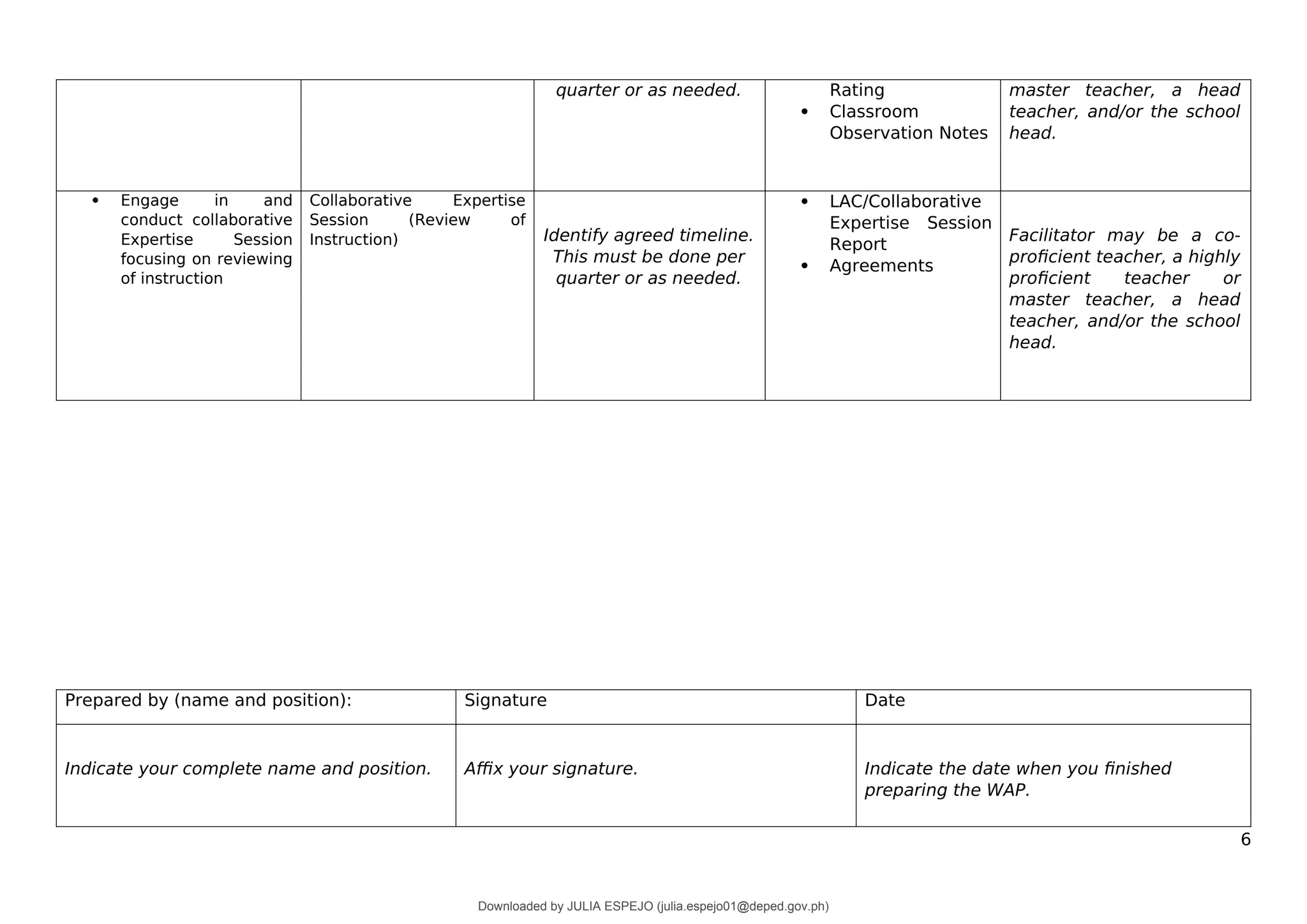
quarter or as needed. Rating
 Classroom
Observation Notes
master teacher, a head
teacher, and/or the school
head.
 Engage in and
conduct collaborative
Expertise Session
focusing on reviewing
of instruction
Collaborative Expertise
Session (Review of
Instruction) Identify agreed timeline.
This must be done per
quarter or as needed.
 LAC/Collaborative
Expertise Session
Report
 Agreements
Facilitator may be a co-
proficient teacher, a highly
proficient teacher or
master teacher, a head
teacher, and/or the school
head.
Prepared by (name and position): Signature Date
Indicate your complete name and position. AfÏx your signature. Indicate the date when you finished
preparing the WAP.
6
Downloaded by JULIA ESPEJO (julia.espejo01@deped.gov.ph)
lOMoARcPSD|37109213
*Reviewed by (name and position): Signature Date
Indicate your reviewer’s name and position. Let the reviewer afÏx his or her signature. Indicate the date when the WAP was
reviewed.
**Approved by (name and position): Signature Date
Indicate immediate supervisor’s name and
position.
Let the immediate supervisor afÏx his or her
signature.
Indicate the date when the WAP was
approved.
*for proficient teacher: reviewed by the master teacher or immediate supervisor and **approved by the school head/head teacher/OIC for schools
without school head
7
Downloaded by JULIA ESPEJO (julia.espejo01@deped.gov.ph)
lOMoARcPSD|37109213

sample matatag workplace application plan for-teachers.pdf

  • 1.
    Sample Matatag WAPFor Teachers Educational Foundations (University of the Philippines Visayas) Scan to open on Studocu Studocu is not sponsored or endorsed by any college or university Sample Matatag WAP For Teachers Educational Foundations (University of the Philippines Visayas) Scan to open on Studocu Studocu is not sponsored or endorsed by any college or university Downloaded by JULIA ESPEJO (julia.espejo01@deped.gov.ph) lOMoARcPSD|37109213
  • 2.
    (Enclosure No. 6to DepEd Memorandum No. 44, s. 2023) Republic of the Philippines Department of Education National Educators Academy of the Philippines MATATAG WAP Template: For Teachers I-III (Proficient Teachers) I. Profile Name ARIEL P. LAGUITAO School and Position Tinoc National High School Title of PD Programs Training of Teachers (SBTT) on MATATAG Curriculum Date of Delivery Indicate when the training was conducted PD Program Provider National Educators Academy of the Philippines in collaboration with Curriculum and Teaching Strand (BCD and BLD) Name of Immediate Supervisor OLIVER D. TOBIAGON School and Position Principal II II. Background and Rationale of WAP: The Department of Education has pursued its education reform, the MATATAG: Bansang Makabata, Batang Makabansa Agenda, which sets the new direction of the agency and stakeholders in resolving basic education challenges. In pursuing such reform in the basic education curriculum, it is imperative to understand the current context and setting. Doing so will allow the Department to recognize the existing and expected realities and, consequently, adopt appropriate measures to realize its vision, hence making the MATATAG Curriculum, which is responsive and attuned to the dynamic changes that come into play in the society (General Shaping Paper, Downloaded by JULIA ESPEJO (julia.espejo01@deped.gov.ph) lOMoARcPSD|37109213
  • 3.
    MATATAG Curriculum 2023). TheMATATAG Curriculum focuses on foundational skills and embedding peace competencies, building more resilient schools and classrooms, strengthening inclusive education programs, advocating for teachers’ additional benefits, and providing professional development programs, among others. The aim is to create a more effective and impactful educational experience for Filipino learners. The Training on MATATAG curriculum is rooted in the fundamental importance of ensuring that teachers are fully equipped with the knowledge, understanding, and skills necessary to effectively implement the curriculum. Teacher quality is vital in raising learner achievement. However, teachers alone cannot bring about substantive changes without effective leadership. In addition, DepEd Order No. 24, s. 2022 or the Adoption of the Basic Education Development Plan 2030 (BEDP 2030) outlines the priorities of the Department in addressing the immediate and long-term concerns confronting basic education: access, equity, quality, and resiliency. Quality is designed to address the quality of education through various strategic means such as but not limited to upskilling and reskilling of teachers. To articulate the general shape of the MATATAG Curriculum and to ensure its full implementation, all teachers shall develop a Work Application Plan (WAP) underscoring the intensification of Learning Action Cells (LACs) through Collaborative Expertise (CE). The School-based Training of Teachers (SBTT) on MATATAG Curriculum provides the teachers with an opportunity to:  address the appropriate indicators domains, strands, and indicators in the Philippine Professional Standards for Teachers (PPST) in the effective and efÏcient delivery of the MATATAG Curriculum through the intensification of School LACs through the Collaborative Expertise (CE). The following professional standards/competencies are being addressed in the Training of Teachers on MATATAG Curriculum: Professional Standards PD Program Goals Indicators (Subtask) Application Objective 2 Downloaded by JULIA ESPEJO (julia.espejo01@deped.gov.ph) lOMoARcPSD|37109213

  • 4.
    Philippine Professional Standardsfor Teachers (PPST) DepEd Order No. 42, s. 2017 Domain 1. Content Knowledge and Pedagogy; Strand 1.1 Content Knowledge and its application within and across curriculum areas; 1.1.2. Apply knowledge of content within and across curriculum teaching area. Identify the overall structure and salient features of the general shaping paper and learning area curriculum guide Accomplishing reflection journal on the salient features and aspirations for MATATAG Curriculum Implement Workplace Application Plan (WAP) articulating their required competencies to be developed and/or enhanced using school LACs through Collaborative Expertise (CE) aligned with the PPST. Domain 1, Content Knowledge, and Pedagogy; Strand 1.5. Strategies for developing critical and creative thinking, as well as other higher- order thinking skills; 1.5.2 Apply a range of teaching strategies to develop critical and creative thinking, as well as other higher-order thinking skills. Integrate 21st century skills, inclusion principles and brain- based learning theories in teaching and learning processes Identifying 21st century skills targeted by the learning competencies in the curriculum Domain 3. Diversity of Learners. 3.1 Learners’ gender, needs strengths, interests, and experiences; 3.1.2 Use differentiated developmentally appropriate learning experiences to address learners’ gender, needs, strengths, interests, and experiences. Domain 4. Curriculum and Planning; Strand 4.1. Planning and managemoent of teaching and learning process; 4.1.2 Plan, manage and implement developmentally sequenced teaching and learning process to meet curriculum requirements and varied teaching contexts. Develop a lesson plan that shows understanding of the connections among instructional elements (standards, instruction, assessment, and evaluation and feedback) of the MATATAG curriculum Developing lesson plan integrating the MATATAG instructional design framework, pedagogies, and assessment strategies Conducting classroom observation and post conference simulation Domain 4. Curriculum and Planning; Strand 4.2. Learning outcomes 4.2.2 Set achievable and appropriate learning outcomes that are Demonstrate knowledge and skills on unpacking/merging/clustering Unpacking and/or merging of Q1 and Q2 learning competencies 3 Downloaded by JULIA ESPEJO (julia.espejo01@deped.gov.ph) lOMoARcPSD|37109213
  • 5.
    aligned with learning competencies; alignedwith learning competencies. competencies per grade level and learning area. Domain 5. Assessment and Reporting is composed of five strands: Strand 5.1. Design, selection, organization, and utilization of assessment strategies; 5.1.2 Design, select, organize, and use diagnostic, formative and summative assessment strategies consistent with curriculum requirements. Design a classroom-based assessment tool for an identified learning competency within the MATATAG Curriculum, ensuring alignment with instructional objectives and diverse assessment methods Identifying assessment strategies consistent with curriculum requirements and which will integrate 21st century skills Domain 5: Assessment and Reporting; 5.2. Monitoring and evaluation of learner progress and achievement; 5.2.2. Monitor and evaluate learner progress and achievement using learner attainment data. Domain 5. Assessment and Reporting; Strand 5.5. Use of assessment data to enhance teaching and learning practices and programs; 5.5.2 Utilize assessment data to inform the modification of teaching and learning practices and programs. Domain 7. Personal Growth and Professional Development; Strand 7.3 Professional links with colleagues; 7.3.2 Participate in professional networks to share knowledge and to enhance practice. Simulate collaborative learning expertise; Facilitate and give feedback to a teaching-learning session using the co-developed lesson plan; Exhibit positive /inclusive attitude towards the implementation of the MATATAG curriculum Conducting collaborative expertise focused on MATATAG curriculum implementation and becoming visible teachers Domain 7. Personal Growth and Professional Development; Strand 7.5 Professional development goals; 7.5.2 Set professional development goals based on the Philippine Professional Standards for Teachers. IV. Implementation Plan [the WAP must be implemented within 6-9 months after the training] 4 Downloaded by JULIA ESPEJO (julia.espejo01@deped.gov.ph) lOMoARcPSD|37109213
  • 6.
    Application Objective [itmust be aligned with the PD Program Goals]  implement Workplace Application Plan (WAP) articulating their required competencies to be developed and/or enhanced using school LACs through Collaborative Expertise (CE) aligned with the PPST. Specific Task [minimum of two (2)] (Aligned with the application objective, what are the specific tasks of a teacher to enhance teaching competencies More tasks may be added to ensure mastery or progress of application of learning. Activities (Specify activities on the identified task) Timeline (Start-end of each activity) Expected Outcomes/ MOVs (It represents what is predicted or intended to happen as a result of implementing a specific task or initiative) Learning Facilitator (Immediate Supervisor or peer assigned to guide the teacher)  Engage in or conduct collaborative expertise session with colleagues focusing on planning and preparation of instruction leading to implementing the MATATAG Curriculum Collaborative Expertise Session (Planning and Preparation) Identify agreed timeline. This must be done per quarter or as needed.  LAC/Collaborative Expertise Session Report  Developed Lesson Plans/DLLs/Les  Instructional Materials Facilitator may be a co- proficient teacher, a highly proficient teacher or master teacher, a head teacher, and/or the school head.  Apply the developed lesson plan through classroom teaching Classroom Observations Identify agreed timeline. This must be done per  Lesson Plan  Classroom Observation Tool Facilitator may be a highly proficient teacher or 5 Downloaded by JULIA ESPEJO (julia.espejo01@deped.gov.ph) lOMoARcPSD|37109213
  • 7.
    quarter or asneeded. Rating  Classroom Observation Notes master teacher, a head teacher, and/or the school head.  Engage in and conduct collaborative Expertise Session focusing on reviewing of instruction Collaborative Expertise Session (Review of Instruction) Identify agreed timeline. This must be done per quarter or as needed.  LAC/Collaborative Expertise Session Report  Agreements Facilitator may be a co- proficient teacher, a highly proficient teacher or master teacher, a head teacher, and/or the school head. Prepared by (name and position): Signature Date Indicate your complete name and position. AfÏx your signature. Indicate the date when you finished preparing the WAP. 6 Downloaded by JULIA ESPEJO (julia.espejo01@deped.gov.ph) lOMoARcPSD|37109213
  • 8.
    *Reviewed by (nameand position): Signature Date Indicate your reviewer’s name and position. Let the reviewer afÏx his or her signature. Indicate the date when the WAP was reviewed. **Approved by (name and position): Signature Date Indicate immediate supervisor’s name and position. Let the immediate supervisor afÏx his or her signature. Indicate the date when the WAP was approved. *for proficient teacher: reviewed by the master teacher or immediate supervisor and **approved by the school head/head teacher/OIC for schools without school head 7 Downloaded by JULIA ESPEJO (julia.espejo01@deped.gov.ph) lOMoARcPSD|37109213