MATATAG Curriculum Training| 2024
Professional Standards
Supervisors (Chief EPS, EPS, PSDS)
Domain 4: Developing Self and Others
4.1 Learning and Development
4.1.1 Demonstrate knowledge and understanding of different learning and
development interventions
4.1.2. Ensure the delivery of different learning and development
interventions to support divisions/districts/schools and/or learning centers.
4
5.
MATATAG Curriculum Training| 2024
School Heads (TICs, HTs, Department Heads,
Principal 1, Principal 2, Principal 3, Principal 4)
Domain 4. Developing Self and Others
4.5 Professional Development of School Personnel
4.5.1. Demonstrate knowledge and understanding of professional
development in enhancing strengths and in addressing performance gaps
among school personnel.
5
6.
MATATAG Curriculum Training| 2024
4.5.2. Implement professional development initiatives to enhance strengths
and address performance gaps among school personnel.
4.5.3 Monitor and evaluation implementation of professional development
initiatives in enhancing and in addressing performance gaps among school
personnel.
6
Cont..
7.
MATATAG Curriculum Training| 2024
Grades 2, 3,5 and 8 Master Teachers I-IV (Highly
Proficient)
Domain 7. Personal Growth and Professional Development
7.3. Professional links with colleagues
7.3.3. Contribute actively to professional networks within and between
schools to improve knowledge and to enhance practice.
7
8.
MATATAG Curriculum Training| 2024
Grades 2,3,5 and 8 Teachers I-III (Proficient)
Domain 7. Personal Growth and Professional Development
7.3. Professional links with colleagues
7.3.2. Participate in professional networks to share knowledge and to
enhance practice.
8
9.
MATATAG Curriculum Training| 2024
Session Objectives
9
● Analyze situations illustrating collaborative
expertise.
● Acknowledge the value of diversity in teaching
styles and perspectives within a team.
● Practice collaborative expertise through review and
improvement of a lesson exemplar.
10.
MATATAG Curriculum Training| 2024
Session Flow
DepEd Issuances (DepEd Order 35, s. 2016
and DepEd Order 14, s. 2023)
Collaborative Expertise
10
MATATAG Curriculum Training| 2024
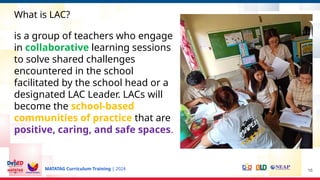
What is LAC?
is a group of teachers who engage
in collaborative learning sessions
to solve shared challenges
encountered in the school
facilitated by the school head or a
designated LAC Leader. LACs will
become the school-based
communities of practice that are
positive, caring, and safe spaces.
16
MATATAG Curriculum Training| 2024 18
44. Two days every week shall be dedicated to fostering
collaborative expertise through LAC and other
activities. The LAC sessions shall focus on strategies,
preparing teaching materials, and discussing other
teaching-related concerns. The goal is to enhance the
teaching and learning process and promote continuous
professional development among educators.
MATATAG Curriculum Training| 2024 20
LAC or not?
1. Mr. Sison, a school head of an integrated school,
observed the poor test scores in Reading and Literacy. He
convened the concerned teachers and conducted a focus
group discussion to discover the challenges encountered
that led to a collaborative solution that focused on
development of contextualized supplementary learning
resources.
MATATAG Curriculum Training| 2024 22
LAC or not?
2. Ms. Lon, with permission from the school head
convened several teachers to share updates on products
and benefits that can be availed from a local bank. Free
financial consultations were also provided to the teachers
during the session.
23.
MATATAG Curriculum Training| 2024
IMPORTANT! Limitation/Prohibitions
23
The holding of LAC sessions for purposes other than
those provided herein is prohibited. Prohibited purposes
may include but shall not be limited to the following:
sale of goods and other merchandise; lending
transactions; political and religious meetings and
other purposes which are not included in this policy.
– DO 35, s. 2016.
24.
MATATAG Curriculum Training| 2024 24
LAC or not?
3. Mrs. Bartolome, a master teacher in a rural farm
school, convened all grade 7 TLE teachers for them to
discuss a particular learning competency in ICT. They
planned as a group on how to properly tackle the content
and come up with strategies and assessments aligned
with their available resources.
MATATAG Curriculum Training| 2024
● CE involves raising the
effectiveness of all teachers to
the level of the best teachers.
We teachers in schools to be
like teams working together in
sport.
27
● CE is a concept that recognizes
varying expertise within
schools and aims to reduce
variability in teacher
effectiveness.
28.
MATATAG Curriculum Training| 2024
●School leaders lay a
crucial role in
harnessing expertise
within schools.
28
●Teachers should
aspire to become
part of a community
of highly effective
and expert
educators.
29.
MATATAG Curriculum Training| 2024
●The education system should support
collaborative expertise through
resources and time.
29
MATATAG Curriculum Training| 2024
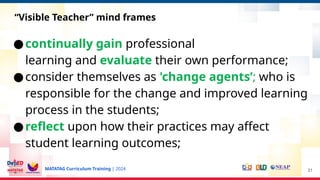
●continually gain professional
learning and evaluate their own performance;
●consider themselves as 'change agents’; who is
responsible for the change and improved learning
process in the students;
●reflect upon how their practices may affect
student learning outcomes;
31
“Visible Teacher” mind frames
32.
MATATAG Curriculum Training| 2024
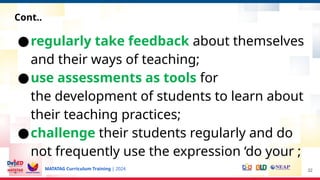
●regularly take feedback about themselves
and their ways of teaching;
●use assessments as tools for
the development of students to learn about
their teaching practices;
●challenge their students regularly and do
not frequently use the expression ‘do your ;
32
Cont..
33.
MATATAG Curriculum Training| 2024
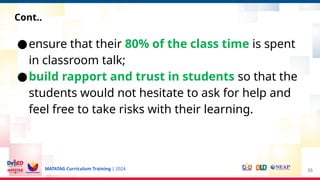
●ensure that their 80% of the class time is spent
in classroom talk;
●build rapport and trust in students so that the
students would not hesitate to ask for help and
feel free to take risks with their learning.
33
Cont..
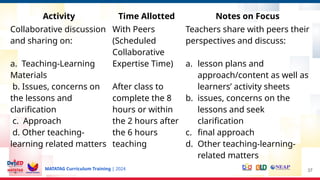
MATATAG Curriculum Training| 2024 37
Activity Time Allotted Notes on Focus
Collaborative discussion
and sharing on:
a. Teaching-Learning
Materials
b. Issues, concerns on
the lessons and
clarification
c. Approach
d. Other teaching-
learning related matters
With Peers
(Scheduled
Collaborative
Expertise Time)
After class to
complete the 8
hours or within
the 2 hours after
the 6 hours
teaching
Teachers share with peers their
perspectives and discuss:
a. lesson plans and
approach/content as well as
learners’ activity sheets
b. issues, concerns on the
lessons and seek
clarification
c. final approach
d. Other teaching-learning-
related matters
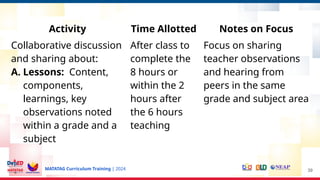
MATATAG Curriculum Training| 2024 39
Activity Time Allotted Notes on Focus
Collaborative discussion
and sharing about:
A. Lessons: Content,
components,
learnings, key
observations noted
within a grade and a
subject
After class to
complete the
8 hours or
within the 2
hours after
the 6 hours
teaching
Focus on sharing
teacher observations
and hearing from
peers in the same
grade and subject area
40.
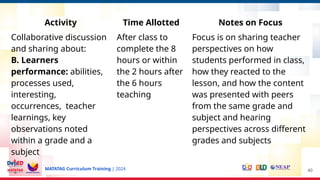
MATATAG Curriculum Training| 2024 40
Activity Time Allotted Notes on Focus
Collaborative discussion
and sharing about:
B. Learners
performance: abilities,
processes used,
interesting,
occurrences, teacher
learnings, key
observations noted
within a grade and a
subject
After class to
complete the 8
hours or within
the 2 hours after
the 6 hours
teaching
Focus is on sharing teacher
perspectives on how
students performed in class,
how they reacted to the
lesson, and how the content
was presented with peers
from the same grade and
subject and hearing
perspectives across different
grades and subjects
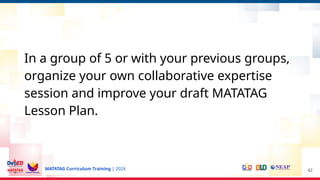
MATATAG Curriculum Training| 2024
In a group of 5 or with your previous groups,
organize your own collaborative expertise
session and improve your draft MATATAG
Lesson Plan.
42
43.
MATATAG Curriculum Training| 2024
1. Assign the following roles: facilitator,
researcher, checker, recorder, timekeeper.
43
44.
MATATAG Curriculum Training| 2024
2. In 20 minutes, discuss your MATATAG Learning Area
Walkthrough of Learning Resources Output
(Critique of Lesson Exemplar). Revisit the lesson
exemplar, curriculum guide, instructional design
framework, suggested pedagogies and assessment
strategies.
44
45.
MATATAG Curriculum Training| 2024
3. In 40 minutes, strategize and prepare a one-day
lesson plan using the MATATAG template. Assign
a demo teacher who will deliver the lesson. While
some members are busy with the LP, other
members may prepare the learning resources to
be used (e.g., visual aids, setting up online
resources, assessment, etc.).
45
46.
MATATAG Curriculum Training| 2024
4. In 10 minutes, finalize and check the lesson
plan and learning resources. Take a clear
photo of your output and send it to your
MATATAG learning area group GC.
46
MATATAG Curriculum Training| 2024
Session Objectives
51
● Analyze situations illustrating collaborative
expertise.
● Acknowledge the value of diversity in teaching
styles and perspectives within a team.
● Practice collaborative expertise through review and
improvement of a lesson exemplar.
52.
MATATAG Curriculum Training| 2024
Reference
DepEd Order No. 35, s. 2016, The Learning Action Cell As A K To 12
Basic Education Program School-based Continuing Professional
Development Strategy For The Improvement Of Teaching And
Learning
DepEd Order No. 14, s. 2023, Policy Guidelines on the
Implementation of the National Learning Camp
Visible Learning,
https://www.structural-learning.com/post/visible-learning-a-teachers
-guide
52
MATATAG Curriculum Training| 2024 54
Program Management Team
Curriculum and Teaching Strand
Bureau of Curriculum Development
Bureau of Learning Delivery
Bureau of Education Assessment
Bureau of Alternative Education
Bureau of Learning Resources
Human Resources and Organizational
Development Strand
National Educators Academy of the Philippines
(NEAP)
Professional Development Division
Quality Assurance Division
Session Guide and Presentation
Deck Developer/s
NEAP
Dustin Troy Joson
MATATAG CURRICULUM TRAINING RESOURCE PACKAGE
#1 Introduction:
Welcome the participants and set the tone for the training.
Say:
Good morning/afternoon, dear fellow school leaders/teachers!
#2 Show:
COLLABORATIVE EXPERTISE
Do:
Ask the participants if they are familiar with the concept of collaborative expertise? Where do we commonly use this concept? Affirm their responses and mention that this concept is done aligned with the Learning Action Cells (LAC)
#3 Say: As introduced I am <name of resource person> and I will be your facilitator for this session.
#11 Say:
Before we go deep into our discussion, I just want to confirm something about Learning Action Cells. The activity is called How’s you LAC? I’ll be flashing some questions on screen and I’ll be calling some participants to answer.
#12 Do:
Flash and read the question. Pause for at least 5 seconds and call from the group to share their answer.
15.1 Learner Diversity and Student Inclusion
15.2 Content and Pedagogy of the K to 12 Basic Education Program
15.3 Assessment and Reporting in the K to 12 Basic Education Program
15.4 21st Century Skills and ICT Integration in Instruction and Assessment
15.5 Curriculum Contextualization, Localization, and Indigenization
#13 Do:
Flash and read the question. Pause for at least 5 seconds and call from the group to share their answer.
self-assessment tools,
classroom observation results,
critical reflections,
surveys,
research-based teacher development needs,
students’ assessment results, and other forms.
#14 Do:
Thank the participants for their participation. Affirm their responses and reactions and connect it to the review of DO no. 35, s. 2016
#15 Show: (Slides # )
Present DepEd Order 35, s. 2016
#16 Say:
LAC is a group of teachers who engage in collaborative learning sessions to solve shared challenges encountered in the school facilitated by the school head or a designated LAC Leader. LACs will become the school-based communities of practice that are positive, caring, and safe spaces.
Do:
Put emphasis when saying the words in bold text. These words will be repeated throughout the session. Observe the participants reaction and acknowledge while passing through the text.
#17 Say:
Similarly, this is the concept of how LAC is used for the CE which is evident in the implementation of the National Learning Camp.
#18 Do:
Ask one of the participants to read the text. Thank the participant.
Say:
The CE through LAC shall focus on strategies, preparing teaching materials, and discussing other teaching-related concerns. Also take note, per the policy the CE is done two days every week. Ideally, every Monday for the planning and preparation and Friday for the review of practice.
#19 Say:
For this activity, I will be randomly calling one participant. Once called, kindly stand and shout your name, region, grade level and learning area.
We will be having scenarios; the lucky participants will be asked to read what is flashed on screen. The question is, is it LAC or not considering the provisions of DepEd Order No. 35, s. 2016.
So, let’s start!
#20 Do: Read the scenario or ask a participant to read the scenario then call a random participant from the registration list. Enrich the processing by allowing the group to pitch in ideas.
#21 Do: Reveal the answer for each situation. Validate the answer with the participants and process accordingly.
#22 Do: Call a random participant from the registration list. Enrich the processing by allowing the group to pitch in ideas.
#23 Do: Reveal the answer for each situation. Validate the answer with the participants and process accordingly.
#24 Do: Call a random participant from the registration list. Enrich the processing by allowing the group to pitch in ideas.
#25 Do: Reveal the answer for each situation. Validate the answer with the participants and process accordingly.
#26 Say:
After that quick review of policies and issuances. Now lets fully immerse ourselves with the highlight of the session which is collaborative expertise.
#29 Do:
Read the slide content.
Say:
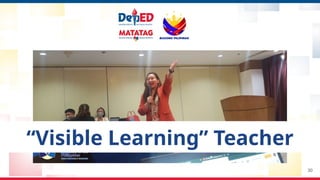
CE is a deliberate activity that teachers must organize. To better facilitate such activity, here are characteristics of a “Visible Teacher” of John Hattie.
#30 Show:
The “Visible Learning” Teacher
Say:
To become the best teacher to our learners, becoming a “visible teacher” is as simple as being active, transparent, engaging and passionate in one’s own learning and teaching the students. John Hattie believes that the visible teachers possess the following eight important mind frames.
#31 Do:
Read the text.
Say:
As teachers, we need to continuously improve ourselves, the “how’s” of teaching. We are the greatest change agents! Remember that dear teachers. All professions will not exist if not for us. That’s how important we are and by that we should take pride in what we do.
#32 Do:
Read the text.
Say:
Just like how important feedback is to the learners, the same goes for us teachers. That’s why do not be afraid of it. When you have your CO, take pride in it and look forward to the feedback and comments because it will help you improve. And knowing CE, even without a formal CO you may organize such observations. The thing is you need to be willing and open to it. No hard feelings. Reflect on your pre-and post test, your performance task, why? Because it can help you evaluate your own performance. There are even times that at the end of activities, we can also ask our learners on how we can improve the activity. Be open to that. Do you assignment, do your individual work, do your project.. Let us deviate from such expressions and be more creative in engaging our students like what we are doing now through collaboration.
#33 Do:
Read the text.
Say:
Let me just clarify, 80% of class time is in classroom talk means meaningful conversations. Group dynamics. Analysis of text, video, sounds, etc.. Engage the learners to be critical thinkers and welcome dialogue with them. But just note, be ahead of them. You need to be well versed in your specialization and must also be able to form links and connections with other learning areas or relevant social content. I think this is the most important of it all. Be someone they can trust and have confidence in. You have to be approachable and willing to extend yourself to them.
#34 Say:
The question is? Are you a Visible Learning Teacher? Do you possess the 8 mind frames?
Do:
Ask for show of hands
Say:
If you are, that’s amazing! Let’s keep on the passion for teaching alive. If you’re not, don’t worry! That’s why we have each other. That’s the reason for revisiting LAC and reforming our practice through CE. Not only for us, well it is for us and primarily for our kids, the learners.
#35 Say:
For a better structure of CE, I will now share with you a timetable that you can use to organize your CE. Please take note that this has been applied during the NLC and can be adopted.
Notes to RP:
This schedule is only suggested as applied in the NLC. There might be future issuances that will secure a legal basis of conducting CE through LAC.
#36 Do: Show the slide
Say: Ideally this CE is done every first day of the week or Monday.
Do: Ask the participants, the critiquing of the lesson exemplar in the previous session is considered as?, is it planning and preparation or review of instruction?
Practice collaborative expertise through review and improvement of a lesson exemplar.
#37 Do:
Ask one participant to read the activity column, another for time allotted column, and another for notes on focus.
Say:
Following the personal preparation is the collaboration. This can be scheduled 2 hours before or after the 8 teaching hours. Take note on the area of focus.
#38 Do: Show the slide
Say: Ideal this CE is done every last day of the week or Friday.
#39 Do:
Read the text. Remind the teachers to be open to the observations and feedback of the group.
#40 Do:
Read ask participants to read individually each column. After reading, remind the participants to be open to the observations and feedback of the group.
#41 Show:
Let’s Collaborate
Do:
Capture the participants attention and ask them to focus and listen.
Say:
Now lets have a practice.
#42 Do:
Read the instruction and provide the templates
#43 Do:
Read the instruction and provide the templates
#44 Do:
Read the instruction and provide the templates
#45 Do:
Read the instruction and provide the templates
#46 Do:
Read the instruction and provide the templates
#47 Say:
Alright, time is up. I hope everyone is ready with their lesson plans. Remember this will be used in the next session for demonstration teaching.
Do:
Ask the participants to settle down.
Say:
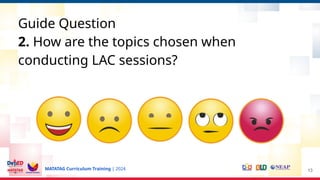
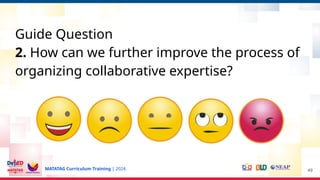
To formally close this session, let’s have a quick reflection with the help of emojis.
#48 Do: Read the question and call one or two participants to share their insight.
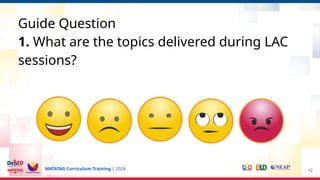
Smile
Sad
Neutral
Rolled Eyes
Angry
Ask them why they chose that emoji. Respectfully cut the conversation if it is too long.
#49 Do: Read the question and call one or two participants to share their insight.
Smile
Sad
Neutral
Rolled Eyes
Angry
Ask them why they chose that emoji. Respectfully cut the conversation if it is too long.
#50 Conclusion
Say:
Do you have any thoughts or insight you would like to share to the group? Any clarifications or concerns you want to discuss?
Do:
Provide 5 points to end the session.
Say:
1. Collaborative Expertise is a concept introduced by prominent educational researcher John Hattie in his book "Visible Learning". 2. CE is conducted through LAC. 3. School Leaders must lead and support the conduct of CE. 4. The CE is a safe space that allows teachers to discuss freely the challenges and issues in the delivery of lessons and to work as a group in coming up with the desired solution. 5. CE is a cycle of planning and preparation and review of instruction.
#51 Show:
Present the session objectives and confirm with the participants if all objectives were achieved.
#52 Say:
Here are the references we used. If you come across a question or concern, feel free to reach out to me or to any members of our team and we will respond accordingly.
#53 Do:
Thank the participants and close the session by reading the quote presented on the slide.





























![Matatag Curriculum Plenary_Opening Program [Day 1].pptx](https://cdn.slidesharecdn.com/ss_thumbnails/plenaryopeningprogramday1-240729085529-f4dff39b-thumbnail.jpg?width=640&height=640&fit=bounds)


