

What is CIP?
CIP stands for Classroom Improvement
Plan
It is a plan to bring improvement in
a classroom and its environment

Principal
Section Head
Coordinators
Teachers
Students
Members of CIP

 Vision
 Mission Statement
 SWOT/C Analysis
 Prioritization
 Planning
 Implementation
 Evaluation
Elements of CIP

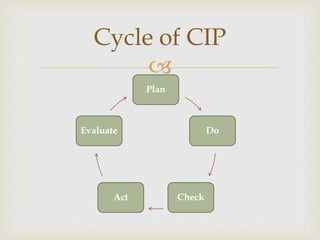
Plan
Do
CheckAct
Evaluate
Cycle of CIP

 A vision statement is an institution's road map,
indicating both what the company wants to become
and guiding transformational initiatives by setting a
defined direction for the company's growth.
 Think about a Vision Statement for your
Classroom with the help of your friend and draft it.
 Share your Vision Statement with the whole
Training Hall.
Vision Statement

Example:
A classroom where disciplinary manners and quality
level teaching - learning process and maximum
students learning outcomes are obtained.
Vision Statement

 A formal summary of the aims and values of an
institution, organization, or individual.
 A written declaration of an institution's core purpose
and focus that normally remains unchanged over
time.
 A mission statement defines what an institution is,
why it exists, its reason for being.
Mission Statement

Think about a Mission Statement for your Classroom.
Write it on your draft pad and exchange with your
friend.
Do necessary changes in it, if any.
Share with the whole hall.
Think, Pair & Share…

Example:
To promote quality teaching - learning
environment according to the APSAC system.
Mission Statement

To develop CIP, we should set objectives, keeping our
set target in view.
Objectives must be SMART.
Specific, Measurable, Achievable, Realistic, Time bound
Setting Objectives

 Develop objectives for your CIP
 Share it with your partner
 Edit them according to the need
 Share your objectives with the hall
Try it…

 To teach the students per APSAC system.
 To ensure Print Rich environment in the classroom
maximizing Learning Outcomes.
 To promote English languages environment among the
students in the class.
 To develop a participatory Teaching-Learning techniques
in the classroom.
Objectives for CIP

Strengths
Weaknesses
Opportunities
Threats / Challenges
SWOT/C ?
Strengths Weaknesses
Opportunities Threats/Challenges
SWOT/C Table ?

Strength Weaknesses
i. Wide area ie. Lawns for out of class
learning activities.
ii. Qualified and experienced
Teachers.
iii. Standard Curriculum of APSAC
system.
iv. Well organized class rooms.
v. Urdu languages speaking culture in
the class.
i. Struggling students in the
class.
ii. Lack of English Speaking
culture among the students.
Opportunities Threats/Challenges
i. Training sessions for teachers
according to the APSAC system.
ii. Support and guidelines from APSC
Swat Management.
iii. CPD for Teachers.
iv. Mentorship for teachers from SHs
and Principal.
i. To maintain APSAC’s classroom
standards.
ii. To bring struggling students up to
APSC’s standards with the new
students.
SWOT/C Table

Once we have SWOT/C analysis, we can identify our
needs.
Needs are many but we choose the important ones.
Needs are in jumbled form but we list them on realistic
approach and prioritize.
Identification of Needs

We prioritize our needs on such away that first to fulfill
the most important one and so on.
Identify the needs for your Classroom and Prioritize
them in a list form.
1. Soft boards preparation
2. Identification of struggling Learners
3. Remedial activities with the struggling Learners
4. etc…
Prioritization of Needs

 CIP is planned so that we must know WHEN and
HOW to improve our Classroom.
Plans and generally of TWO Types.
1. Macro Planning.
2. Micro Planning.
Usually, first we do Macro Planning and then Micro
Planning in CIP.
Planning CIP

 Implementation indicates us HOW the plan will be
implemented and WHO is responsible for.
 The process of implementation is monitored by high
authorities regularly for support and on time
improvement.
Implementation

Annex - III
ARMY PUBLIC SCHOOL & COLLEGE SWAT
Detail Implentation Plan Mar, 2018 - Feb, 2019
Activity No Activities Mar Apr May Jun Jul Aug Sep Oct Nov Dec Jan Feb Remarks
I Soft boards preparation
II Identification of Struggling Learners
III Remedial Activities for Struggling Learners

 The process of evaluation is done to know our level
of work in view of defined Standards.
 Evaluation helps us to plan the next CIP more
suitable and errorless so that maximum outcomes
are obtained.
Note:- Evaluation is done at the end of the term or academic year
while monitoring is on going process for on spot improvement.
E.g. Monitoring is Formative while Evaluation is Summative.
Evaluation

 Every Teacher is responsible to make his/her own CIP.
 Approve and Sign by concern Section Head.
 Section Heads will Counter Sign it from the Principal.
 The Final CIPs will be submitted the Regional Director.
Who will make CIP?


Classroom Improvement Plan

  • 2.
     What is CIP? CIPstands for Classroom Improvement Plan It is a plan to bring improvement in a classroom and its environment
  • 3.
  • 4.
      Vision  MissionStatement  SWOT/C Analysis  Prioritization  Planning  Implementation  Evaluation Elements of CIP
  • 5.
  • 6.
      A visionstatement is an institution's road map, indicating both what the company wants to become and guiding transformational initiatives by setting a defined direction for the company's growth.  Think about a Vision Statement for your Classroom with the help of your friend and draft it.  Share your Vision Statement with the whole Training Hall. Vision Statement
  • 7.
     Example: A classroom wheredisciplinary manners and quality level teaching - learning process and maximum students learning outcomes are obtained. Vision Statement
  • 8.
      A formalsummary of the aims and values of an institution, organization, or individual.  A written declaration of an institution's core purpose and focus that normally remains unchanged over time.  A mission statement defines what an institution is, why it exists, its reason for being. Mission Statement
  • 9.
     Think about aMission Statement for your Classroom. Write it on your draft pad and exchange with your friend. Do necessary changes in it, if any. Share with the whole hall. Think, Pair & Share…
  • 10.
     Example: To promote qualityteaching - learning environment according to the APSAC system. Mission Statement
  • 11.
     To develop CIP,we should set objectives, keeping our set target in view. Objectives must be SMART. Specific, Measurable, Achievable, Realistic, Time bound Setting Objectives
  • 12.
      Develop objectivesfor your CIP  Share it with your partner  Edit them according to the need  Share your objectives with the hall Try it…
  • 13.
      To teachthe students per APSAC system.  To ensure Print Rich environment in the classroom maximizing Learning Outcomes.  To promote English languages environment among the students in the class.  To develop a participatory Teaching-Learning techniques in the classroom. Objectives for CIP
  • 14.
  • 15.
  • 16.
     Strength Weaknesses i. Widearea ie. Lawns for out of class learning activities. ii. Qualified and experienced Teachers. iii. Standard Curriculum of APSAC system. iv. Well organized class rooms. v. Urdu languages speaking culture in the class. i. Struggling students in the class. ii. Lack of English Speaking culture among the students. Opportunities Threats/Challenges i. Training sessions for teachers according to the APSAC system. ii. Support and guidelines from APSC Swat Management. iii. CPD for Teachers. iv. Mentorship for teachers from SHs and Principal. i. To maintain APSAC’s classroom standards. ii. To bring struggling students up to APSC’s standards with the new students. SWOT/C Table
  • 17.
     Once we haveSWOT/C analysis, we can identify our needs. Needs are many but we choose the important ones. Needs are in jumbled form but we list them on realistic approach and prioritize. Identification of Needs
  • 18.
     We prioritize ourneeds on such away that first to fulfill the most important one and so on. Identify the needs for your Classroom and Prioritize them in a list form. 1. Soft boards preparation 2. Identification of struggling Learners 3. Remedial activities with the struggling Learners 4. etc… Prioritization of Needs
  • 19.
      CIP isplanned so that we must know WHEN and HOW to improve our Classroom. Plans and generally of TWO Types. 1. Macro Planning. 2. Micro Planning. Usually, first we do Macro Planning and then Micro Planning in CIP. Planning CIP
  • 20.
      Implementation indicatesus HOW the plan will be implemented and WHO is responsible for.  The process of implementation is monitored by high authorities regularly for support and on time improvement. Implementation
  • 21.
     Annex - III ARMYPUBLIC SCHOOL & COLLEGE SWAT Detail Implentation Plan Mar, 2018 - Feb, 2019 Activity No Activities Mar Apr May Jun Jul Aug Sep Oct Nov Dec Jan Feb Remarks I Soft boards preparation II Identification of Struggling Learners III Remedial Activities for Struggling Learners
  • 22.
      The processof evaluation is done to know our level of work in view of defined Standards.  Evaluation helps us to plan the next CIP more suitable and errorless so that maximum outcomes are obtained. Note:- Evaluation is done at the end of the term or academic year while monitoring is on going process for on spot improvement. E.g. Monitoring is Formative while Evaluation is Summative. Evaluation
  • 23.
      Every Teacheris responsible to make his/her own CIP.  Approve and Sign by concern Section Head.  Section Heads will Counter Sign it from the Principal.  The Final CIPs will be submitted the Regional Director. Who will make CIP?
  • 24.