Presented By
Miss. Kshama P. Mundokar
M. Pharm Sem II (Pharmacology)
Guided By
Prof. Vinod Jadhav
Associate Professor
M. Pharm (Pharmacology)
Dr. Rajendra Gode, Institute Of Pharmacy, Amravati
D
E
P
ARTMENT
O
F
P
H
A
RMACOLO
G
Y
“Pharmacological and Toxicological
Screening Methods - II”
(MPL 202T)
Pharmacy Council of India, New Delhi
Skin sensitization
CONTENTS
• Introduction
• Guinea pig maximization test : Preparation of Animal
Procedure
Rechallenge
• Buehler Test Method : Procedure
• Local Lymph Node Assays : Procedure
November 2023 2
DRGIOP
INTRODUCTION
• Skin sensitization is defined as an allergic response to a substance after skin
contact
• Substances are classified as skin sensitizers if there is evidence in humans
that the substance can lead to sensitization be skin contact or if there are
positive results from an appropriate animal test
• Sensitization test estimate the potential for contact sensitization to medical
devices or materials
• Symptom of sensitization are often seen in skin
November 2023 DRGIOP 3
• Sensitization is a immune response to chemicals
• The sensitization tests are used to determine the allergic or sensitizing
capacity to the repeated or prolonged exposure of a test material
• Sensitization is characterized by the fact that reactions are delayed, not
localized, and independent of dose
• Skin sensitization is a delayed type humoral immune response mediated by
the T-cell
November 2023 DRGIOP 4
Continue…
• Sensitized T cells migrate to the site and,
on contracting the allergen, liberate
cytokines
• These cytokines attract leukocytes to the
site and appear to raise the temperature of
the area
November 2023 DRGIOP 5
Continue…
• A variety of methods are available for the prospective identification of skin
sensitizing chemicals
• The methods that have been used are as:
(a) Traditional Guinea Pig models for skin sensitization
1. Guinea pig maximization test (GPMT)
2. Buehler test
(b) New alternative: Local lymph node assay (LLNA)
November 2023 DRGIOP 6
Continue…
GUINEA PIG MAXIMIZATION TEST
• Animal : Guinea Pig
• Sex : Male (Females, should be nulliparous & non-pregnant)
• Body Weight : 250-500 g
• Acclimatization : at least 5 days prior to the test
• Dose : An average, a guinea pig requires 10-30 mg/kg daily
November 2023 DRGIOP 7
PREPARATION OF THE ANIMALS
• Before the test, animals are
randomised & assigned to the treatment
groups
• Removal of hair is by clipping,
shaving or possibly by chemical
depilation, depending on the test method
used
• Care should be taken to avoid abrading
the skin
• The animals are weighed before the
test and at the end of the test
November 2023 DRGIOP 8
Continue…
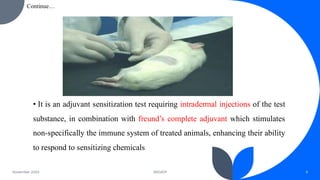
• It is an adjuvant sensitization test requiring intradermal injections of the test
substance, in combination with freund’s complete adjuvant which stimulates
non-specifically the immune system of treated animals, enhancing their ability
to respond to sensitizing chemicals
November 2023 DRGIOP 9
Continue…
PROCEDURE
A minimum of 10 animals used in the treatment group and at least 5 animals
in the control group are used (or 20 test and 10 control animals
Induction is done initially on skin of shoulder region with three intradermal
injection on day 0; 1/1 mixture of Freud’s complete adjuvant (FCA)/water or
saline
November 2023 DRGIOP 10
Continue…
Test substance (appropriate concentrations may be determined from a pilot
study using two or three animals)
Test substance in a 1/1 mixture of FCA/water or saline
Control animals also receive three intradermal injections, but only vehicle is
used instead of the test substance
November 2023 DRGIOP 11
Continue…
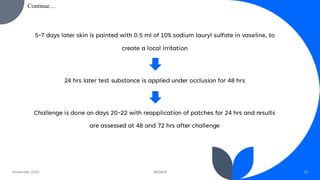
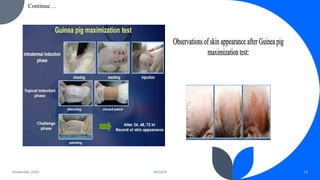
5-7 days later skin is painted with 0.5 ml of 10% sodium lauryl sulfate in vaseline, to
create a local irritation
24 hrs later test substance is applied under occlusion for 48 hrs
Challenge is done on days 20-22 with reapplication of patches for 24 hrs and results
are assessed at 48 and 72 hrs after challenge
November 2023 DRGIOP 12
Continue…
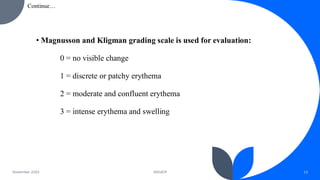
• Magnusson and Kligman grading scale is used for evaluation:
0 = no visible change
1 = discrete or patchy erythema
2 = moderate and confluent erythema
3 = intense erythema and swelling
November 2023 DRGIOP 13
Continue…
RECHALLENGE
• If it is necessary to clarify the results
obtained in the first challenge
• A second challenge with a new control
group/ original control group should be
considered approximately one week after
the first one
November 2023 DRGIOP 14
Continue…
November 2023 DRGIOP 15
Continue…
BUEHLER TEST METHOD
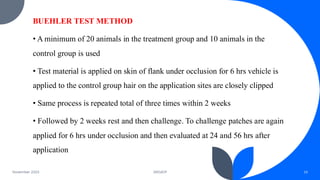
• A minimum of 20 animals in the treatment group and 10 animals in the
control group is used
• Test material is applied on skin of flank under occlusion for 6 hrs vehicle is
applied to the control group hair on the application sites are closely clipped
• Same process is repeated total of three times within 2 weeks
• Followed by 2 weeks rest and then challenge. To challenge patches are again
applied for 6 hrs under occlusion and then evaluated at 24 and 56 hrs after
application
November 2023 DRGIOP 16
• If necessary rechallenge is done by repeating the same procedure 1 week
later
• Due to multiple limitations of these assays including subjective assessment
of the frequency of responses, it is not possible to assess sensitizing potencies
of a chemical using this assay
November 2023 DRGIOP 17
Continue…
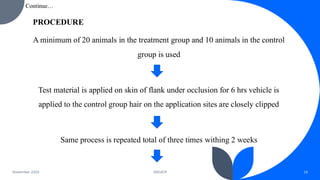
PROCEDURE
A minimum of 20 animals in the treatment group and 10 animals in the control
group is used
Test material is applied on skin of flank under occlusion for 6 hrs vehicle is
applied to the control group hair on the application sites are closely clipped
Same process is repeated total of three times withing 2 weeks
November 2023 DRGIOP 18
Continue…
Followed by 2 weeks rest and then challenge
To challenge patches are again applied for 6 hrs under occlusion and then
evaluated at 24 and 56 hrs after application
If necessary rechallenge is done by repeating the same procedure 1 week later
November 2023 DRGIOP 19
Continue…
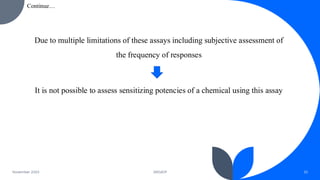
Due to multiple limitations of these assays including subjective assessment of
the frequency of responses
It is not possible to assess sensitizing potencies of a chemical using this assay
November 2023 DRGIOP 20
Continue…
LOCAL LYMPH NODE ASSAY
• The assay is based on the fact that sensitizers induce a primary proliferation of
lymphocytes in the lymph nodes draining the site of application
• This proliferation is proportional to the dose applied and provides objective data on
of sensitizing potential
• Radioactive labeling with (3H) thymidine is done to measure cell proliferation
November 2023 DRGIOP 21
PROCEDURE
A minimum of four animals is used per dose group with a minimum of 3
concentrations of the test substance, plus a concurrent negative control group
treated only with the vehicle for the test substance, and a positive control
Animals are treated topically on the dorsum of both ears with 25 uL of test
material, or with an equal volume of the vehicle once a day for 3 days
November 2023 DRGIOP 22
Continue…
Five days after the initial exposure, all mice will be injected with 20 uCi of
tritiated (3H) – methyl thymidine via the tail vein
5 hrs later, all animals are humanely killed; draining auricular lymph nodes
are excised and processed
Cellular proliferation is determined by measuring incorporated radioactivity
November 2023 DRGIOP 23
Continue…
LLNA: DA; Cellular proliferation is determined by measurement of the
adenosine triphosphate (ATP) content by bioluminescence as an indicator of
this proliferation
Results are calculated based on stimulation index (SI), result is regarded
positive when SI >/equal to 3
DRC are plotted in order to provide information on the relative potencies of
skin sensitizers
November 2023 DRGIOP 24
Continue…
November 2023 DRGIOP 25
Continue…
THANK YOU !!!

Screening Methods for Skin Sensitization

  • 1.
    Presented By Miss. KshamaP. Mundokar M. Pharm Sem II (Pharmacology) Guided By Prof. Vinod Jadhav Associate Professor M. Pharm (Pharmacology) Dr. Rajendra Gode, Institute Of Pharmacy, Amravati D E P ARTMENT O F P H A RMACOLO G Y “Pharmacological and Toxicological Screening Methods - II” (MPL 202T) Pharmacy Council of India, New Delhi Skin sensitization
  • 2.
    CONTENTS • Introduction • Guineapig maximization test : Preparation of Animal Procedure Rechallenge • Buehler Test Method : Procedure • Local Lymph Node Assays : Procedure November 2023 2 DRGIOP
  • 3.
    INTRODUCTION • Skin sensitizationis defined as an allergic response to a substance after skin contact • Substances are classified as skin sensitizers if there is evidence in humans that the substance can lead to sensitization be skin contact or if there are positive results from an appropriate animal test • Sensitization test estimate the potential for contact sensitization to medical devices or materials • Symptom of sensitization are often seen in skin November 2023 DRGIOP 3
  • 4.
    • Sensitization isa immune response to chemicals • The sensitization tests are used to determine the allergic or sensitizing capacity to the repeated or prolonged exposure of a test material • Sensitization is characterized by the fact that reactions are delayed, not localized, and independent of dose • Skin sensitization is a delayed type humoral immune response mediated by the T-cell November 2023 DRGIOP 4 Continue…
  • 5.
    • Sensitized Tcells migrate to the site and, on contracting the allergen, liberate cytokines • These cytokines attract leukocytes to the site and appear to raise the temperature of the area November 2023 DRGIOP 5 Continue…
  • 6.
    • A varietyof methods are available for the prospective identification of skin sensitizing chemicals • The methods that have been used are as: (a) Traditional Guinea Pig models for skin sensitization 1. Guinea pig maximization test (GPMT) 2. Buehler test (b) New alternative: Local lymph node assay (LLNA) November 2023 DRGIOP 6 Continue…
  • 7.
    GUINEA PIG MAXIMIZATIONTEST • Animal : Guinea Pig • Sex : Male (Females, should be nulliparous & non-pregnant) • Body Weight : 250-500 g • Acclimatization : at least 5 days prior to the test • Dose : An average, a guinea pig requires 10-30 mg/kg daily November 2023 DRGIOP 7
  • 8.
    PREPARATION OF THEANIMALS • Before the test, animals are randomised & assigned to the treatment groups • Removal of hair is by clipping, shaving or possibly by chemical depilation, depending on the test method used • Care should be taken to avoid abrading the skin • The animals are weighed before the test and at the end of the test November 2023 DRGIOP 8 Continue…
  • 9.
    • It isan adjuvant sensitization test requiring intradermal injections of the test substance, in combination with freund’s complete adjuvant which stimulates non-specifically the immune system of treated animals, enhancing their ability to respond to sensitizing chemicals November 2023 DRGIOP 9 Continue…
  • 10.
    PROCEDURE A minimum of10 animals used in the treatment group and at least 5 animals in the control group are used (or 20 test and 10 control animals Induction is done initially on skin of shoulder region with three intradermal injection on day 0; 1/1 mixture of Freud’s complete adjuvant (FCA)/water or saline November 2023 DRGIOP 10 Continue…
  • 11.
    Test substance (appropriateconcentrations may be determined from a pilot study using two or three animals) Test substance in a 1/1 mixture of FCA/water or saline Control animals also receive three intradermal injections, but only vehicle is used instead of the test substance November 2023 DRGIOP 11 Continue…
  • 12.
    5-7 days laterskin is painted with 0.5 ml of 10% sodium lauryl sulfate in vaseline, to create a local irritation 24 hrs later test substance is applied under occlusion for 48 hrs Challenge is done on days 20-22 with reapplication of patches for 24 hrs and results are assessed at 48 and 72 hrs after challenge November 2023 DRGIOP 12 Continue…
  • 13.
    • Magnusson andKligman grading scale is used for evaluation: 0 = no visible change 1 = discrete or patchy erythema 2 = moderate and confluent erythema 3 = intense erythema and swelling November 2023 DRGIOP 13 Continue…
  • 14.
    RECHALLENGE • If itis necessary to clarify the results obtained in the first challenge • A second challenge with a new control group/ original control group should be considered approximately one week after the first one November 2023 DRGIOP 14 Continue…
  • 15.
    November 2023 DRGIOP15 Continue…
  • 16.
    BUEHLER TEST METHOD •A minimum of 20 animals in the treatment group and 10 animals in the control group is used • Test material is applied on skin of flank under occlusion for 6 hrs vehicle is applied to the control group hair on the application sites are closely clipped • Same process is repeated total of three times within 2 weeks • Followed by 2 weeks rest and then challenge. To challenge patches are again applied for 6 hrs under occlusion and then evaluated at 24 and 56 hrs after application November 2023 DRGIOP 16
  • 17.
    • If necessaryrechallenge is done by repeating the same procedure 1 week later • Due to multiple limitations of these assays including subjective assessment of the frequency of responses, it is not possible to assess sensitizing potencies of a chemical using this assay November 2023 DRGIOP 17 Continue…
  • 18.
    PROCEDURE A minimum of20 animals in the treatment group and 10 animals in the control group is used Test material is applied on skin of flank under occlusion for 6 hrs vehicle is applied to the control group hair on the application sites are closely clipped Same process is repeated total of three times withing 2 weeks November 2023 DRGIOP 18 Continue…
  • 19.
    Followed by 2weeks rest and then challenge To challenge patches are again applied for 6 hrs under occlusion and then evaluated at 24 and 56 hrs after application If necessary rechallenge is done by repeating the same procedure 1 week later November 2023 DRGIOP 19 Continue…
  • 20.
    Due to multiplelimitations of these assays including subjective assessment of the frequency of responses It is not possible to assess sensitizing potencies of a chemical using this assay November 2023 DRGIOP 20 Continue…
  • 21.
    LOCAL LYMPH NODEASSAY • The assay is based on the fact that sensitizers induce a primary proliferation of lymphocytes in the lymph nodes draining the site of application • This proliferation is proportional to the dose applied and provides objective data on of sensitizing potential • Radioactive labeling with (3H) thymidine is done to measure cell proliferation November 2023 DRGIOP 21
  • 22.
    PROCEDURE A minimum offour animals is used per dose group with a minimum of 3 concentrations of the test substance, plus a concurrent negative control group treated only with the vehicle for the test substance, and a positive control Animals are treated topically on the dorsum of both ears with 25 uL of test material, or with an equal volume of the vehicle once a day for 3 days November 2023 DRGIOP 22 Continue…
  • 23.
    Five days afterthe initial exposure, all mice will be injected with 20 uCi of tritiated (3H) – methyl thymidine via the tail vein 5 hrs later, all animals are humanely killed; draining auricular lymph nodes are excised and processed Cellular proliferation is determined by measuring incorporated radioactivity November 2023 DRGIOP 23 Continue…
  • 24.
    LLNA: DA; Cellularproliferation is determined by measurement of the adenosine triphosphate (ATP) content by bioluminescence as an indicator of this proliferation Results are calculated based on stimulation index (SI), result is regarded positive when SI >/equal to 3 DRC are plotted in order to provide information on the relative potencies of skin sensitizers November 2023 DRGIOP 24 Continue…
  • 25.
    November 2023 DRGIOP25 Continue…
  • 26.